Email Opening Sentences: 30 Openers That Get Replies in 2026
Your first line decides whether the rest of the email gets read. Here are 30 tested email opening sentences, the four patterns behind them, and the openers to delete from your templates today.
TL;DR
- The opening sentence is the second thing a prospect reads, not the first — the subject line and preview text are doing the work before it, and your first line is usually visible in the inbox preview whether you like it or not.
- Openers fail for three reasons: they're about you, they're generic enough to send to 10,000 people, or they burn the reader's attention on throat-clearing ("I hope this email finds you well").
- The four openers that consistently earn replies are the observed trigger, the specific compliment with a reason, the mutual-context bridge, and the blunt reason-for-writing.
- Personalization only scales when the research is structured — a field you can fill for every row in your list, not a one-off insight you found by reading someone's blog for 20 minutes.
- A great opening line on a bounced or wrong address is worth zero. Verify contacts before you spend time writing first lines for them.
What is an email opening sentence, and where does it actually appear?#
An email opening sentence is the first line of body copy after the greeting. It has one job: buy the next three seconds.
Think of it like the first ten seconds of a phone call with a stranger. You are not closing anything. You are proving you are not a robot and not a waste of time — and you have about one breath to do it.
Here's the part most people miss: in Gmail, Outlook, and Apple Mail, your opening sentence is often rendered as preview text right in the inbox list, next to the subject line. So the first line is doing double duty — it's both the hook inside the email and part of the decision to open it at all. If your first line is "I hope this email finds you well," you have spent your preview text on nothing.
That's why fixing openers has an outsized effect relative to how little work it is. You're not rewriting the whole sequence. You're rewriting nine words that appear in two places.
Why do most email opening sentences fail?#
Three failure modes, in order of how often they show up in real sequences.
1. The opener is about you. "My name is X and I'm the founder of Y." Nobody asked. The reader is scanning for something relevant to their week, and you've handed them your resume. Every "I" in the first sentence is a small tax on attention.
2. The opener is interchangeable. If you can paste your first line into an email to a completely different company and it still makes sense, it's not personalization — it's padding. "I came across your company and was impressed by your growth" is the canonical example. It reads as a mail merge with the merge field missing.
3. The opener stalls. Pleasantries, weather, apologies for interrupting, long windups about how you know they're busy. Telling a busy person you know they're busy is a strange use of their time.
There's a fourth, subtler one: the opener is a lie. "I've been following your work for years" from a rep who found the company on a list 40 minutes ago. People can smell it, and once they smell one false note, they read the rest of the email as a script.
What makes an email opening sentence work?#
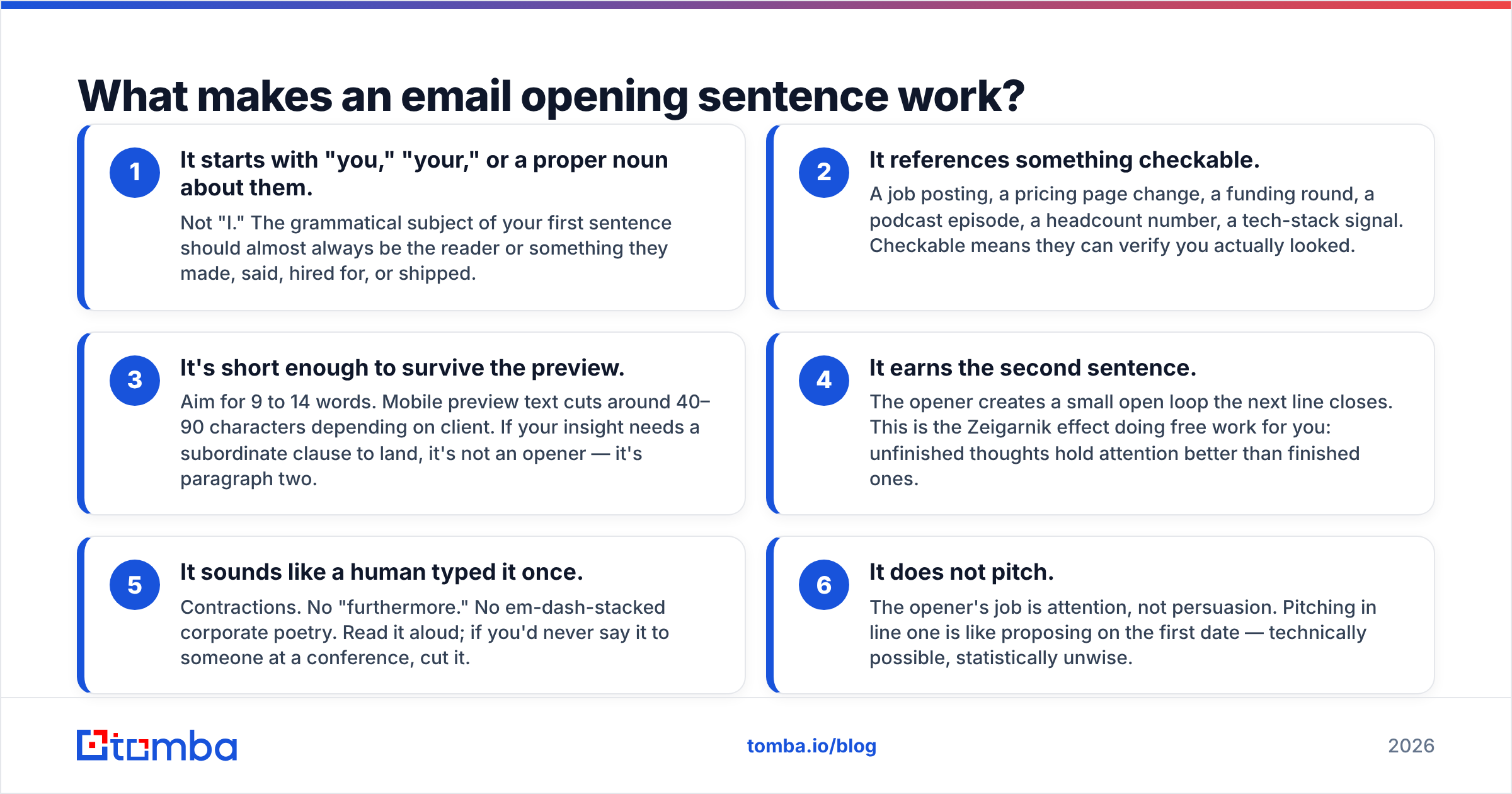
Strong openers share a structure, not a vibe. Here's what to check before a line ships:
- It starts with "you," "your," or a proper noun about them. Not "I." The grammatical subject of your first sentence should almost always be the reader or something they made, said, hired for, or shipped.
- It references something checkable. A job posting, a pricing page change, a funding round, a podcast episode, a headcount number, a tech-stack signal. Checkable means they can verify you actually looked.
- It's short enough to survive the preview. Aim for 9 to 14 words. Mobile preview text cuts around 40–90 characters depending on client. If your insight needs a subordinate clause to land, it's not an opener — it's paragraph two.
- It earns the second sentence. The opener creates a small open loop the next line closes. This is the Zeigarnik effect doing free work for you: unfinished thoughts hold attention better than finished ones.
- It sounds like a human typed it once. Contractions. No "furthermore." No em-dash-stacked corporate poetry. Read it aloud; if you'd never say it to someone at a conference, cut it.
- It does not pitch. The opener's job is attention, not persuasion. Pitching in line one is like proposing on the first date — technically possible, statistically unwise.
Which types of email opening sentences perform best?#
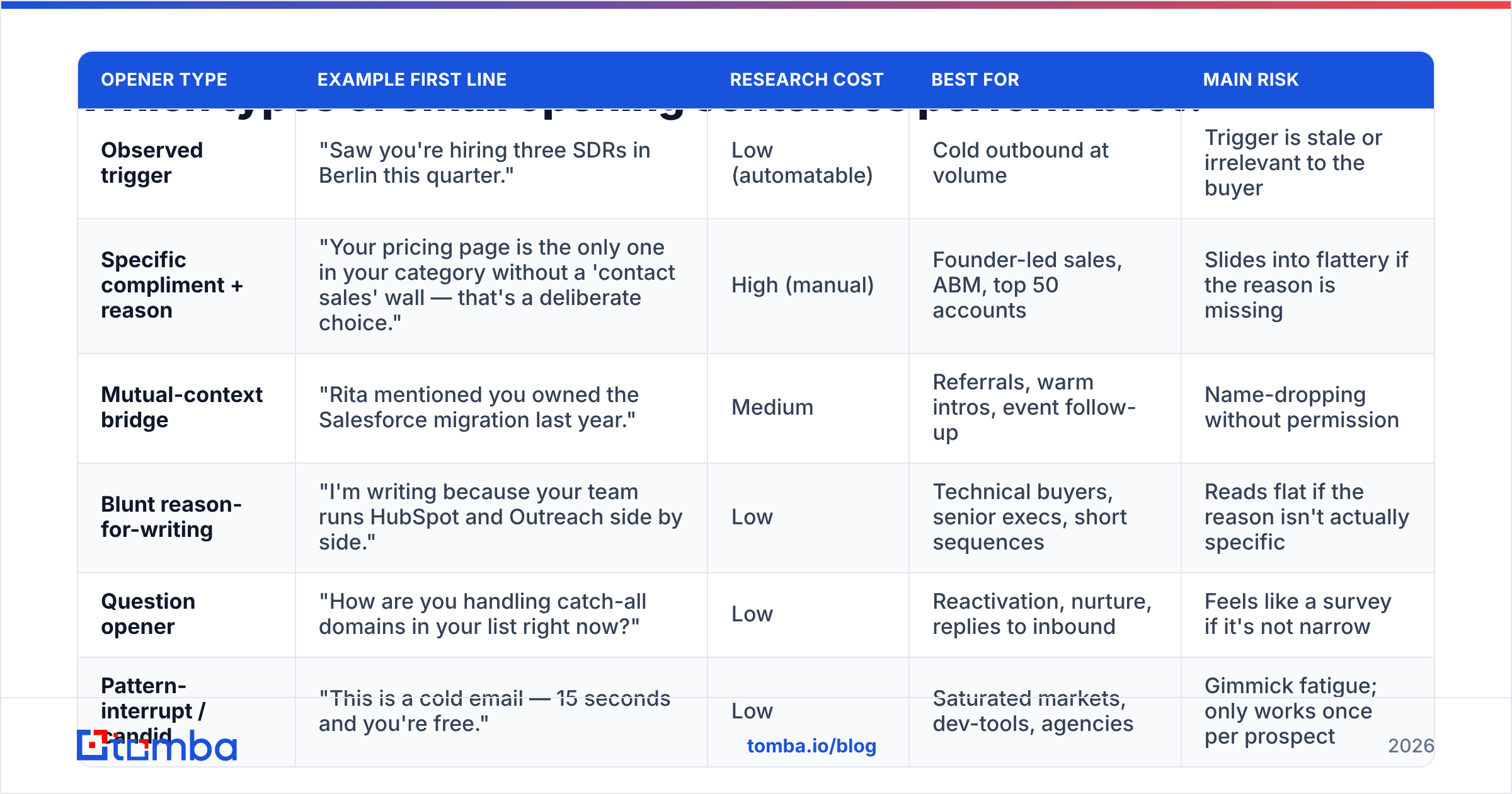
The four patterns below cover roughly every good cold or warm opener. The trade-off is always the same: the more specific the line, the better it performs and the more research it costs per prospect.
| Opener type | Example first line | Research cost | Best for | Main risk |
|---|---|---|---|---|
| Observed trigger | "Saw you're hiring three SDRs in Berlin this quarter." | Low (automatable) | Cold outbound at volume | Trigger is stale or irrelevant to the buyer |
| Specific compliment + reason | "Your pricing page is the only one in your category without a 'contact sales' wall — that's a deliberate choice." | High (manual) | Founder-led sales, ABM, top 50 accounts | Slides into flattery if the reason is missing |
| Mutual-context bridge | "Rita mentioned you owned the Salesforce migration last year." | Medium | Referrals, warm intros, event follow-up | Name-dropping without permission |
| Blunt reason-for-writing | "I'm writing because your team runs HubSpot and Outreach side by side." | Low | Technical buyers, senior execs, short sequences | Reads flat if the reason isn't actually specific |
| Question opener | "How are you handling catch-all domains in your list right now?" | Low | Reactivation, nurture, replies to inbound | Feels like a survey if it's not narrow |
| Pattern-interrupt / candid | "This is a cold email — 15 seconds and you're free." | Low | Saturated markets, dev-tools, agencies | Gimmick fatigue; only works once per prospect |
If you only take one thing from that table: observed trigger is the highest ROI pattern for teams sending more than 200 emails a month, because it's the only high-performing type that a data pipeline can populate for you.
What are 30 email opening sentences you can adapt today?#
Copy the structure, not the words. Every bracket is a field you should be able to fill from your CRM or a data provider.
Trigger-based (cold outbound)
- Saw the [Series B] news — congrats. Assuming headcount is about to be your biggest line item.
- You've had [3] open [RevOps] roles since [March], which usually means one of two things.
- Noticed [Company] switched from [Tool A] to [Tool B] on the site last month.
- Your careers page went from [4] to [11] listings this quarter.
- [Competitor] just launched [feature] — curious whether that's changed your roadmap.
- Read that you're expanding into [DACH] in [Q3].
- Your [G2] reviews mention [onboarding speed] in six of the last ten.
- Spotted [Company] in the [Product Hunt] top 5 on Tuesday.
Compliment with a reason (ABM, top accounts)
- Your [changelog] is the only one I read for fun — the "why we killed it" entries especially.
- You publish pricing publicly in a category where nobody does. That took a decision.
- Your onboarding email at day 3 is the best I've received this year, and I get a lot of them.
- The [podcast episode] where you argued against [common belief] — I've quoted it twice since.
- Your docs answer the question before I ask it, which is rarer than it should be.
- [Name] on your team gave the clearest answer I've had about [topic] on LinkedIn last week.
Mutual context and referral
- [Rita] said you're the person who owns [the data stack] — she may have oversold my usefulness.
- We both spoke at [Event] last year; you had the slot after mine, which was unfair to me.
- You and I are both in [Community], though I mostly lurk.
- [Name] at [Company] mentioned you two solved [problem] together in 2024.
- Following up on the [booth conversation] at [Event] — you asked about [X].
Blunt reason-for-writing
- I'm writing because you run [Tool] and we fix the part of it people complain about.
- Cold email, but a specific one: this is about [your bounce rate on outbound].
- One reason for this email: [your team of 12 SDRs] is exactly who breaks our product in useful ways.
- Straight to it — you're the [VP Sales], we do [thing], here's the 20-second version.
- No pitch in this email. Just a question about how you handle [problem].
Question openers (reactivation, nurture, inbound replies)
- What's your current process for [verifying emails before a send]?
- Did [the migration] actually finish, or is it still "mostly done"?
- Is [outbound] still owned by your team, or did that move under marketing?
- Quick one: are you still using [Tool] for [job]?
- What changed after [event] — did [problem] go away or just get quieter?
- Are you the right person for [topic], or should I be talking to someone else?
That last one is underrated. "Am I talking to the wrong person?" gets replies from people who would otherwise ignore you, because answering costs them one word and makes them feel helpful.
Which email opening sentences should you delete?#
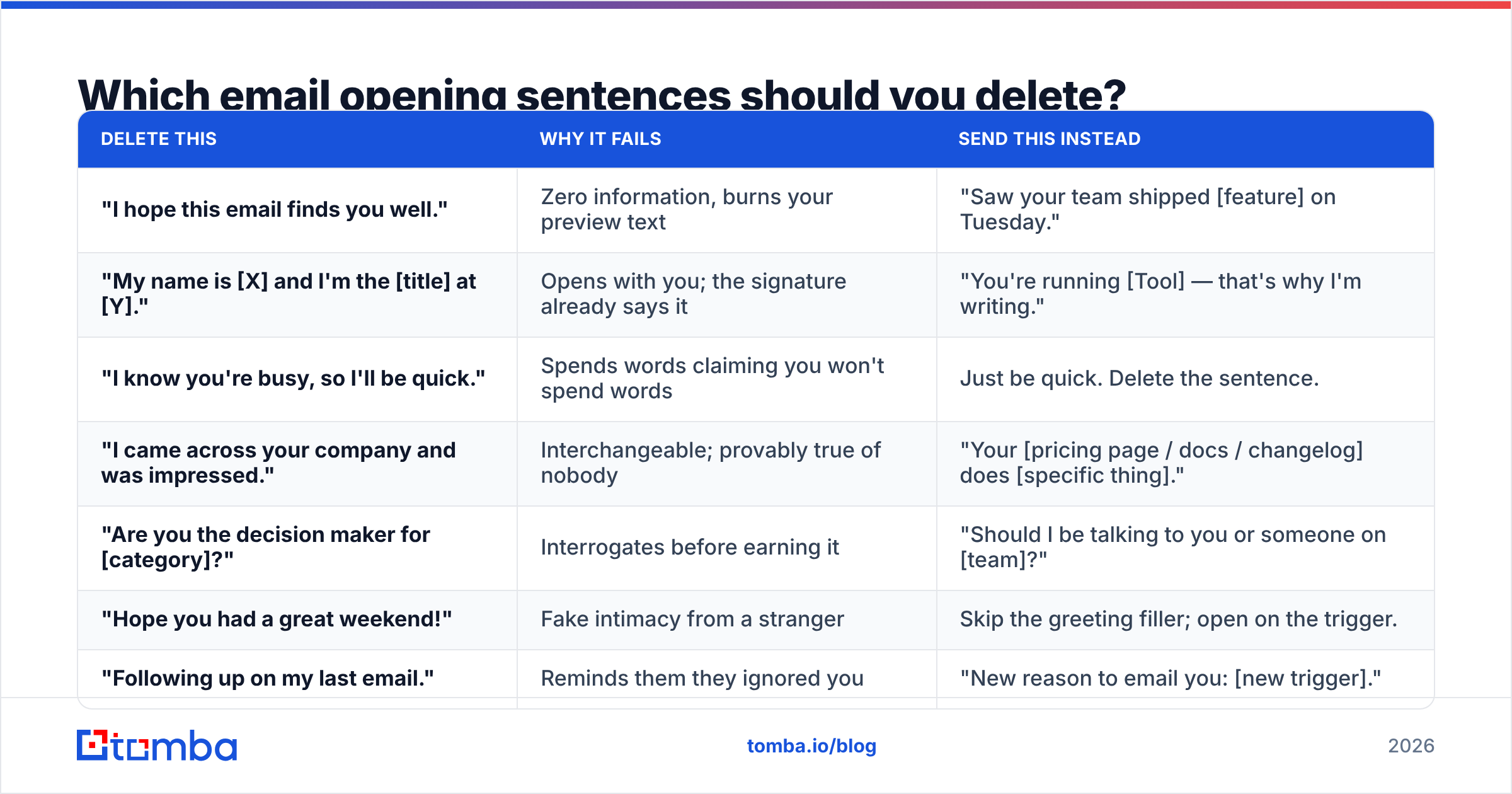
Some lines actively cost you replies. Here's the swap table.
| Delete this | Why it fails | Send this instead |
|---|---|---|
| "I hope this email finds you well." | Zero information, burns your preview text | "Saw your team shipped [feature] on Tuesday." |
| "My name is [X] and I'm the [title] at [Y]." | Opens with you; the signature already says it | "You're running [Tool] — that's why I'm writing." |
| "I know you're busy, so I'll be quick." | Spends words claiming you won't spend words | Just be quick. Delete the sentence. |
| "I came across your company and was impressed." | Interchangeable; provably true of nobody | "Your [pricing page / docs / changelog] does [specific thing]." |
| "Are you the decision maker for [category]?" | Interrogates before earning it | "Should I be talking to you or someone on [team]?" |
| "Hope you had a great weekend!" | Fake intimacy from a stranger | Skip the greeting filler; open on the trigger. |
| "Following up on my last email." | Reminds them they ignored you | "New reason to email you: [new trigger]." |
The follow-up one deserves emphasis. "Just bumping this to the top of your inbox" is the most common second-touch opener in B2B and one of the weakest, because it contains no new information. Each follow-up should open with a genuinely new angle — a different pain, a customer story, a stat, a question you haven't asked. If you can't find a new angle, the sequence is done.
How do you personalize opening sentences at scale?#
The honest answer: you don't personalize every line by hand, and you shouldn't pretend to. You build a small number of research fields you can fill for every contact, then template around them.
A workable stack looks like this:
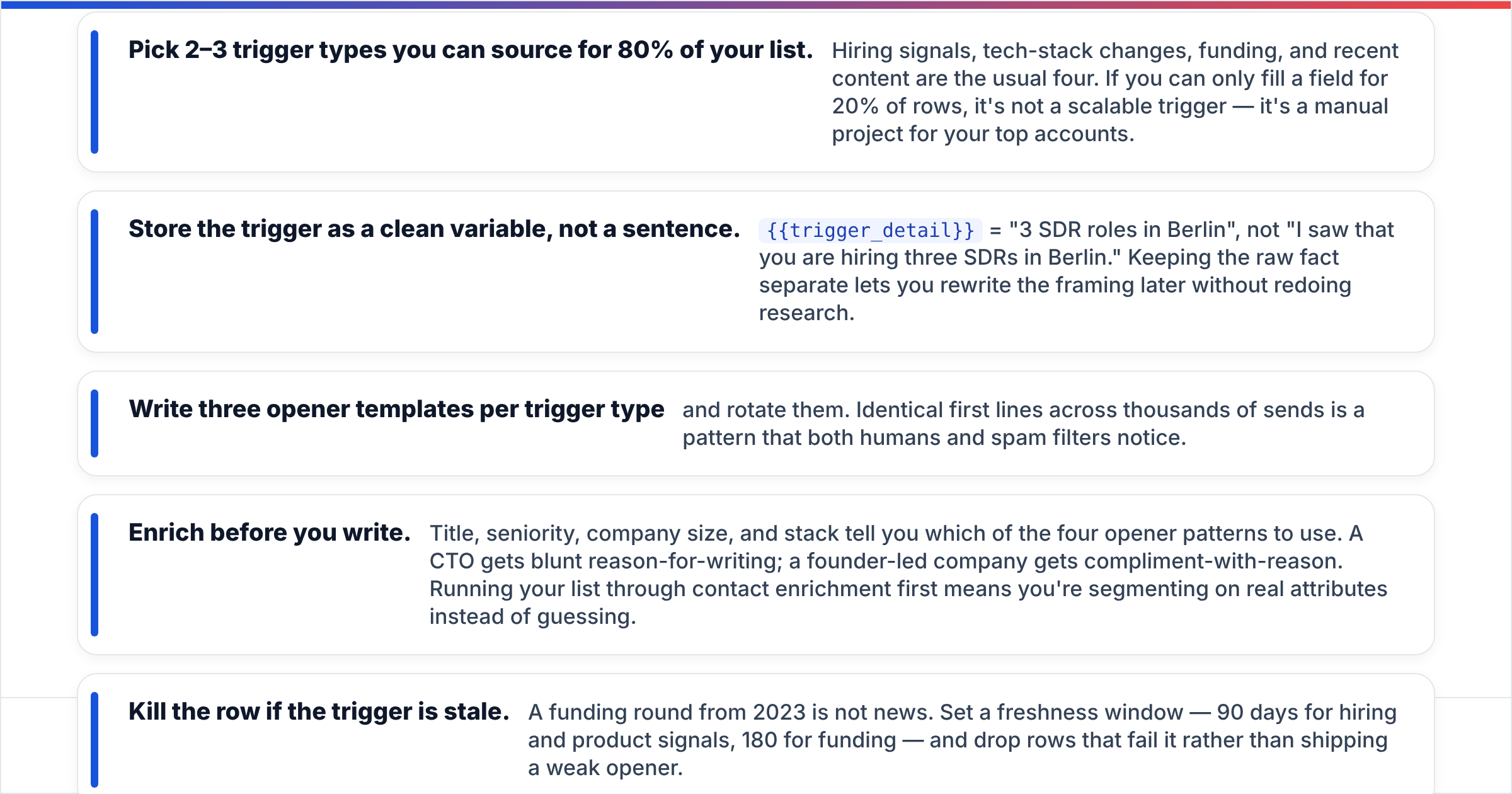
- Pick 2–3 trigger types you can source for 80% of your list. Hiring signals, tech-stack changes, funding, and recent content are the usual four. If you can only fill a field for 20% of rows, it's not a scalable trigger — it's a manual project for your top accounts.
- Store the trigger as a clean variable, not a sentence.
{{trigger_detail}}= "3 SDR roles in Berlin", not "I saw that you are hiring three SDRs in Berlin." Keeping the raw fact separate lets you rewrite the framing later without redoing research. - Write three opener templates per trigger type and rotate them. Identical first lines across thousands of sends is a pattern that both humans and spam filters notice.
- Enrich before you write. Title, seniority, company size, and stack tell you which of the four opener patterns to use. A CTO gets blunt reason-for-writing; a founder-led company gets compliment-with-reason. Running your list through contact enrichment first means you're segmenting on real attributes instead of guessing.
- Kill the row if the trigger is stale. A funding round from 2023 is not news. Set a freshness window — 90 days for hiring and product signals, 180 for funding — and drop rows that fail it rather than shipping a weak opener.
Sales teams that measure this well tend to find the same thing Gong and HubSpot's sales research keep reporting: specificity beats volume of personalization. One concrete, checkable detail outperforms three vague flattering ones.
Does the opening sentence matter if your list is bad?#
No. And this is the part that quietly ruins otherwise good campaigns.
An opening line only earns a reply if a real person reads it. If 18% of your list bounces, you've burned research time writing first lines for mailboxes that don't exist — and you've damaged the sender reputation that determines whether the good addresses ever see your email at all. Copy quality and deliverability are not separate problems; a hard-bounce spike will suppress a perfectly written sequence.
The order of operations that actually works:
- Build or source the list.
- Run it through an email verifier and drop invalids and risky rows.
- Enrich the survivors with the fields your opener templates need.
- Then write the openers.
Doing step 4 first is how teams end up with a beautiful sequence and a 3% response rate.
How should you test your opening sentences?#
Test the opener as its own variable, not bundled with a new subject line and a new CTA. Otherwise you learn nothing.
- Split on the first line only. Same subject, same body, same CTA, two openers. 300+ sends per arm before you call it.
- Measure reply rate, not open rate. Open rate has been unreliable since privacy-protection features started prefetching images. Replies and positive-reply rate are the metrics that survive.
- Watch the "wrong person" replies. A rising share of "you want my colleague" replies means your opener works and your targeting doesn't. That's a data problem, not a copy problem.
- Retire winners on a schedule. A pattern-interrupt opener that crushes for six weeks becomes the thing everyone in your niche is sending by month four.
- Keep a swipe file of replies you got, not lines you liked. Your own reply data beats any blog list, including this one.
If you're also testing what sits above the opener, run your subject lines through a subject line tester so you're not attributing a subject-line win to a first-line change. And when you need a starting skeleton rather than a blank page, the cold email templates library gives you full structures you can strip down to your own voice.
Start with contacts worth writing to#
The best opening sentence in the world is worth nothing on an address that bounces. Before you spend an afternoon crafting first lines, get a list that deserves them: Tomba's Email Finder pulls verified professional addresses by name, domain, or company, with sources you can inspect, so the research you do on line one lands in an inbox instead of a bounce log. The free tier gives you 25 searches a month to test it against your own target accounts, and paid plans start at $49/mo — see Tomba pricing for the full breakdown. Write fewer emails, to better addresses, with first lines you'd actually reply to.
Related guides#
Ready to find emails that actually work?
Join 150,000+ professionals who stopped guessing and started sending. Free credits on signup — no credit card required.
Get the Tomba newsletter
Practical outbound tactics and product updates — once every two weeks.
About the author