Email Outreach to Executives: The 2026 Playbook That Gets Replies
Executives read email in 4-second bursts between meetings. Here's what separates the 3% of cold emails that get a C-suite reply from the 97% archived unread — with benchmarks, templates, and the data work behind them.
TL;DR
- Executives don't read email — they triage it. Your message gets 3 to 4 seconds of attention on a phone screen, usually between meetings, and the decision is binary: archive or open a reply box.
- The single biggest lever is not copy. It's relevance plus deliverability: a verified address, a clean sending domain, and a first line that proves you know something specific about their quarter.
- Executive-appropriate emails run 50–125 words. Anything past 150 words on mobile reads as a wall and gets swiped away.
- Reply rates to VP+ titles are structurally lower than to managers (typically 2–6% vs 8–15%), but the deals are 3–5x larger and cycles are shorter when the exec responds.
- Bad data kills executive outreach faster than bad copy. A bounce to a CRO's inbox burns the domain reputation you need for the next 400 sends.
Why is email outreach to executives different from normal cold email?#
Because the constraint isn't attention span — it's opportunity cost.
A sales manager reading a cold email is deciding whether your idea is interesting. A CFO reading the same email is deciding whether reading paragraph two is a better use of the next 20 seconds than the board deck open in the other tab. That's a much higher bar, and it changes everything downstream: length, subject line, ask, and follow-up cadence.
Three structural differences matter most:
- The inbox volume is 5–10x higher. A VP of Sales at a 500-person company gets 60–150 unsolicited emails a week. A frontline manager gets 10–20. Your email isn't competing with silence; it's competing with 40 other vendors saying the same thing.
- The buying committee has grown. Gartner's B2B buying research puts the typical enterprise buying group at 6–10 stakeholders. The executive you email is rarely the person who evaluates — they're the person who authorizes an evaluation. Your ask should reflect that.
- Assistants and rules filter first. Roughly a third of C-suite inboxes at companies above 1,000 employees have some kind of human or rule-based pre-filter. Your subject line has to survive a reader who isn't the buyer.
Treat executive outreach as a separate motion with its own list, its own copy standard, and its own success metric — not as your standard sequence with the title filter changed.
Who actually opens executive email, and when?#
Before you write anything, understand the reading context. Executive email is read:
- On a phone, 60–75% of the time. Preview panes show roughly 35–45 characters of subject line and the first 40–90 characters of body text on iOS. Everything else is invisible at decision time.
- In bursts, not sessions. Early morning (6:00–8:00 local), between meetings, and late evening. Mid-morning sends land in the busiest block and get buried by 11am.
- With the sender name read before the subject. If your From name looks like a system address or a lead-gen alias, you lose before the subject is parsed.
- Under a delete-by-default policy. Most executives report archiving unread anything that looks templated. "Looks templated" means: two paragraphs of equal length, a bolded value prop, and a Calendly link.
The practical consequence: your first 90 characters of body text carry more weight than the rest of the email combined. Write them last, and write them like a text message from a peer.
What does a good executive email look like versus a standard cold email?#
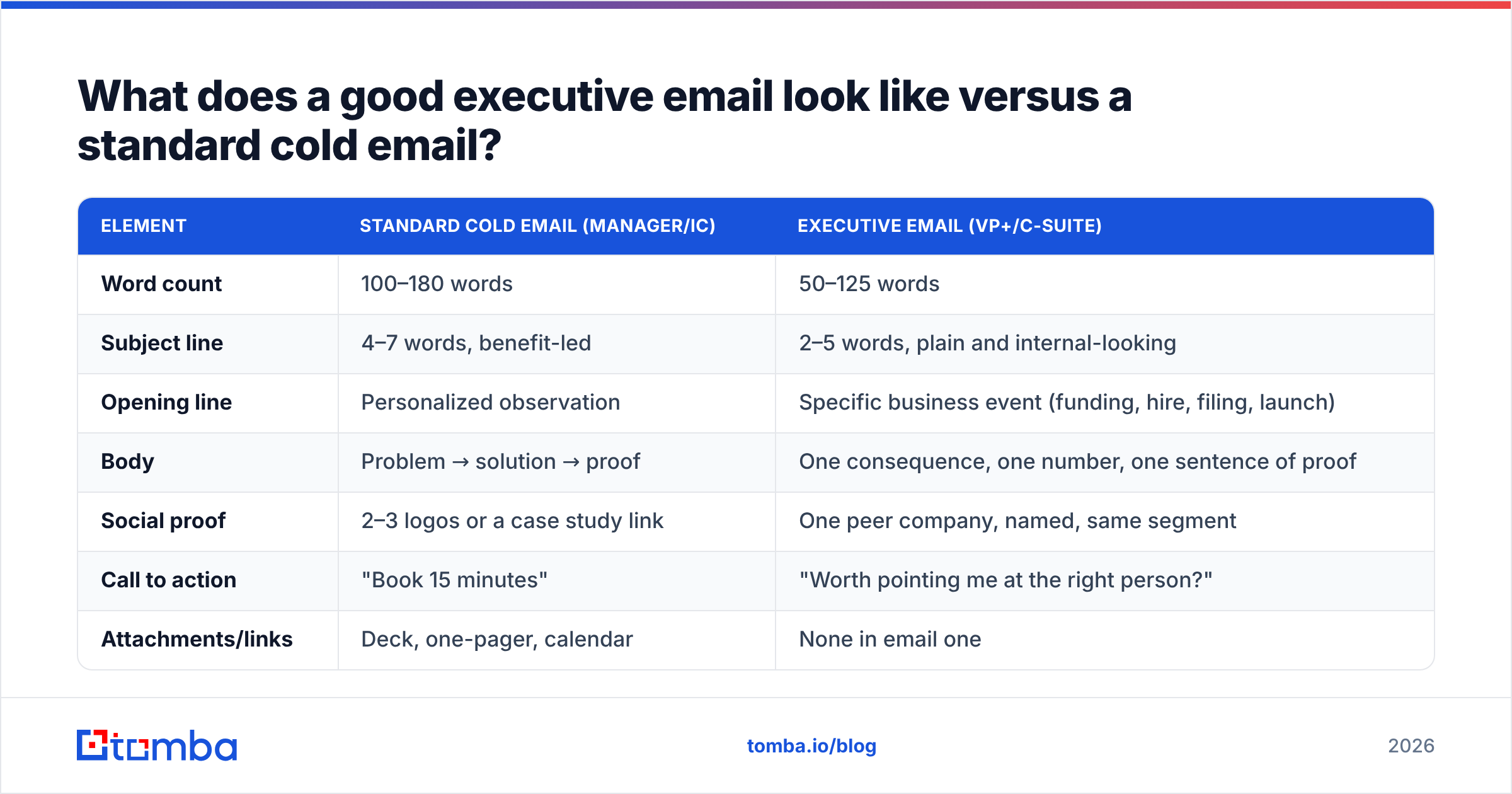
Here's the structural difference, side by side.
| Element | Standard cold email (manager/IC) | Executive email (VP+/C-suite) |
|---|---|---|
| Word count | 100–180 words | 50–125 words |
| Subject line | 4–7 words, benefit-led | 2–5 words, plain and internal-looking |
| Opening line | Personalized observation | Specific business event (funding, hire, filing, launch) |
| Body | Problem → solution → proof | One consequence, one number, one sentence of proof |
| Social proof | 2–3 logos or a case study link | One peer company, named, same segment |
| Call to action | "Book 15 minutes" | "Worth pointing me at the right person?" |
| Attachments/links | Deck, one-pager, calendar | None in email one |
| Follow-up count | 5–7 touches | 3–4 touches, wider spacing |
| Realistic reply rate | 8–15% | 2–6% |
The row that trips up most teams is the CTA. Asking a Chief Revenue Officer for 30 minutes assumes your topic outranks their calendar. Asking them for a redirect — "is Dana the right person for this, or should I go through RevOps?" — costs them eight seconds and converts far better. A referral from the exec down into the org lands with authority a cold email never has.
How short should the email actually be?#
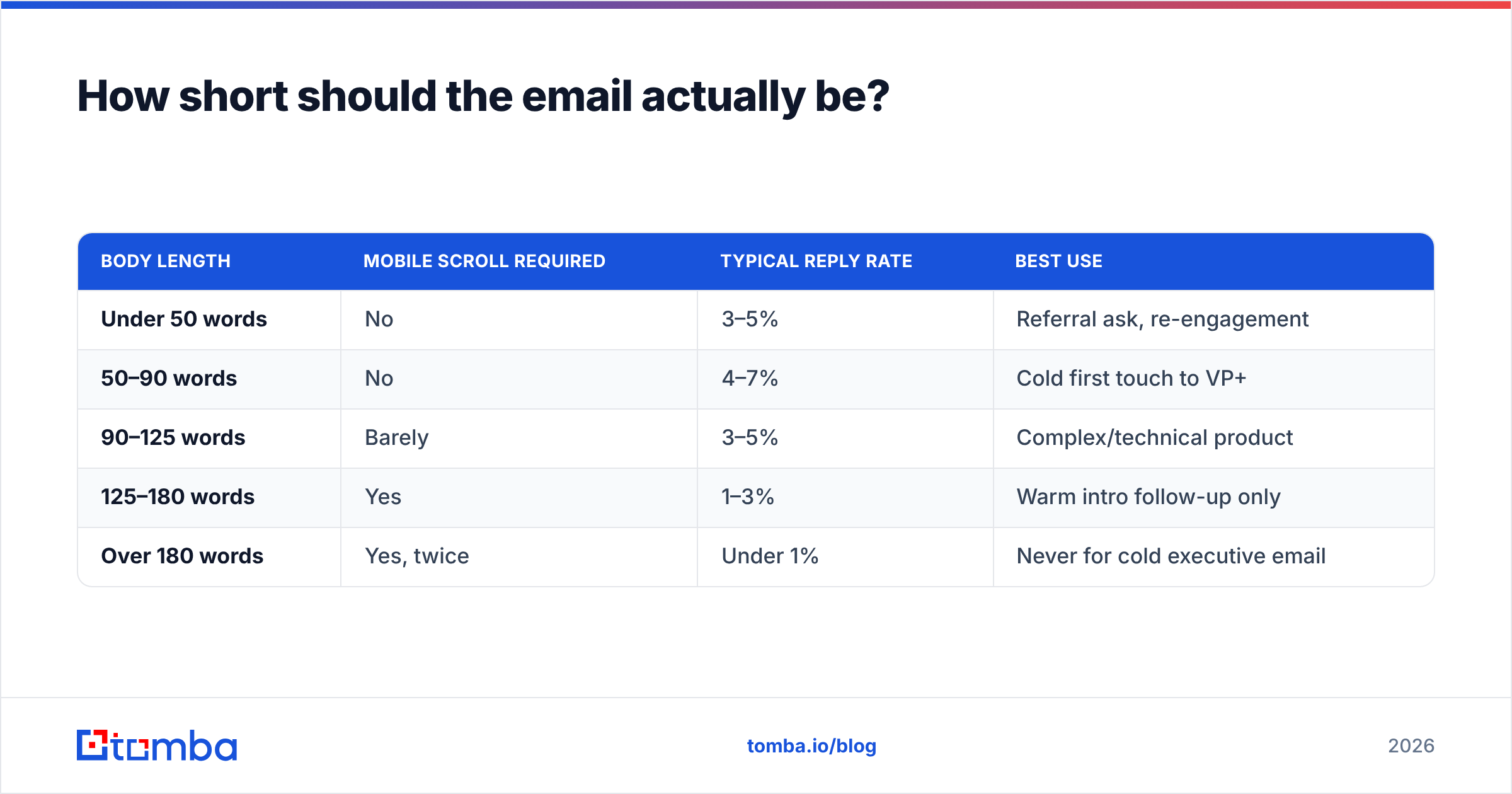
Short enough to read without scrolling. Here's the length-to-outcome pattern most teams see once they instrument it:
| Body length | Mobile scroll required | Typical reply rate | Best use |
|---|---|---|---|
| Under 50 words | No | 3–5% | Referral ask, re-engagement |
| 50–90 words | No | 4–7% | Cold first touch to VP+ |
| 90–125 words | Barely | 3–5% | Complex/technical product |
| 125–180 words | Yes | 1–3% | Warm intro follow-up only |
| Over 180 words | Yes, twice | Under 1% | Never for cold executive email |
Word count is a proxy for something else: how many ideas you're asking them to hold. One email, one idea. If you need to explain the category, the product, and the ROI model, you don't have an email — you have a deck, and the email's only job is to earn the meeting where the deck gets shown.
Which subject lines survive executive triage?#
The counterintuitive rule: executive subject lines should be boring. Marketing-flavored subject lines announce "this is a vendor email" before it's opened.
What works, ranked by observed open rate in VP+ segments:
- The internal-memo style — "Q3 pipeline coverage" or "renewal risk, EMEA". Reads like something a colleague sent. Highest opens, highest expectation to deliver on the promise immediately.
- The named-company reference — "Datadog's approach to X". Anchors on a peer they respect. Works when the reference is genuinely relevant and true.
- The question — "who owns lead routing?". Low friction, pairs naturally with the referral CTA.
- The one-word — "timing" or "intro". Curiosity-driven, gets opened, but burns goodwill fast if the body doesn't justify it. Use sparingly.
- The event trigger — "congrats on the Series C". Effective for two weeks after the event, dead after that.
Avoid anything with a number-plus-percentage ("Increase pipeline 47%"), anything with "quick" ("quick question"), and anything with an emoji. Those three patterns are the strongest templated-email signals in the executive inbox. If you want to sanity-check variants before sending, run them through a subject line tester and cut anything that scores as promotional.
Where do you get accurate executive email addresses?#
This is where most executive campaigns quietly fail. Executive contact data is the hardest tier to source accurately, for three reasons:
- Executives change roles more often than the data refreshes. VP+ average tenure at growth-stage companies is under 24 months. A database snapshot from nine months ago is materially wrong at the top of the org chart.
- Their addresses are less exposed. ICs and managers leave email trails in docs, GitHub, support tickets, and conference lists. C-suite addresses appear far less often in scrapable sources, so pattern-guessing tools return more false positives.
- Executive domains are more likely to be catch-all. Enterprise mail servers frequently accept everything, so a naive verifier reports "valid" on an address that routes to nowhere.
The fix is a two-step process: find, then verify with catch-all handling. Use an email finder that resolves against multiple sources rather than one pattern-guess, then push every result through an email verifier before it enters the sequence. For enterprise domains that accept all mail, a dedicated catch-all verifier is the difference between a 2% bounce rate and a 14% one.
If you're building the list from the company side rather than the person side, domain search returns the org's known addresses plus the dominant email pattern, which lets you validate a guessed executive address against how that company actually formats mail.
One bounce to a CEO address is not one lost lead. Mailbox providers weight bounces heavily, and a 5% bounce rate on a domain that normally runs under 1% will visibly depress inbox placement for every campaign on that domain for weeks. Executive lists are small and expensive to build — protecting the sending domain that reaches them is not optional. Track sender reputation the same way you track pipeline.
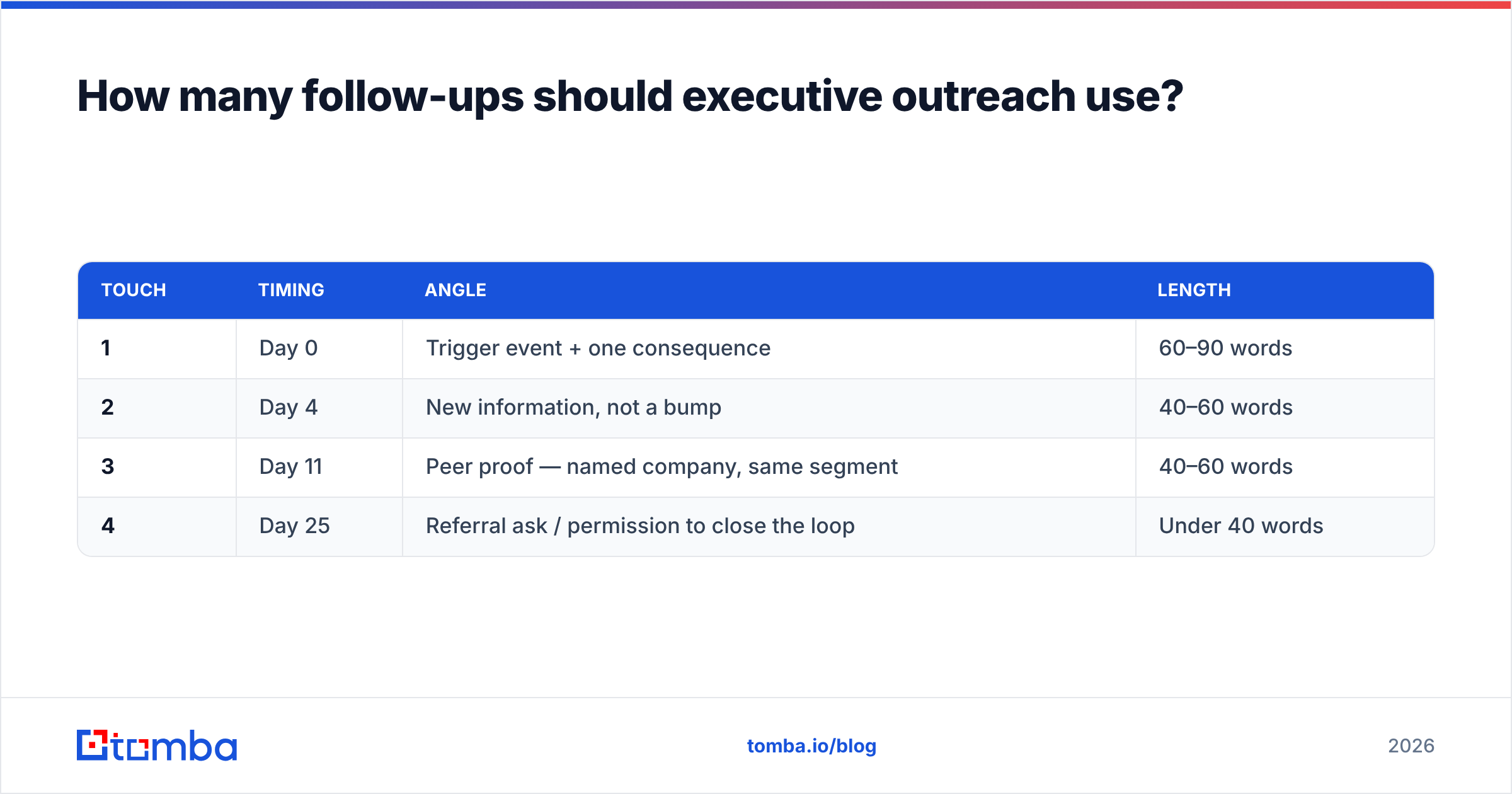
How many follow-ups should executive outreach use?#
Fewer than you think, spaced wider than you think.
| Touch | Timing | Angle | Length |
|---|---|---|---|
| 1 | Day 0 | Trigger event + one consequence | 60–90 words |
| 2 | Day 4 | New information, not a bump | 40–60 words |
| 3 | Day 11 | Peer proof — named company, same segment | 40–60 words |
| 4 | Day 25 | Referral ask / permission to close the loop | Under 40 words |
The rules that matter more than the schedule:
- Never send "just bumping this to the top of your inbox." It communicates that your previous email wasn't worth their time and this one isn't either.
- Every follow-up must carry new information. A benchmark, a customer result, a relevant news item. If you have nothing new, you don't have a follow-up.
- Break the thread on touch three. Fresh subject line, fresh context. Threads with three unanswered messages get archived as a unit.
- Close the loop explicitly on the last touch. "I'll stop here — if this becomes relevant in Q4, reply and I'll pick it up." This single line generates a meaningful share of total replies in most executive sequences, because it removes the pressure to respond.
Nine-touch sequences work for SMB manager-level outreach. Run them at a CFO and you get a spam complaint, which does more damage than the entire campaign was worth. HubSpot's sales research is consistent on this: persistence pays until it flips into annoyance, and the flip point is far earlier for senior titles.
What are the most common executive outreach mistakes?#
- Pitching the product instead of the consequence. Executives buy outcomes at the P&L level. "Cuts SDR research time by 40%" is an operations pitch. "Adds 11 selling hours per rep per month" is closer, but "recovers roughly $340K of annualized rep capacity across your 22-person team" is the executive version.
- Sending at 10am Tuesday. That's when everyone sends. Test 6:40am and 7:15pm in their local timezone.
- Using the company's marketing voice. Executive email should read like it was typed by one person who was in a hurry. No formatting, no bold, no bullets in email one.
- Personalizing the wrong thing. Referencing their podcast appearance is fine. Referencing their kid's school in their LinkedIn banner is not. The line is: would this be normal to mention at a conference?
- Skipping enrichment. Without firmographic context — headcount trend, funding stage, tech stack — your "specific" opener is generic. Contact enrichment turns a name and a domain into something you can actually write a first line about.
- Measuring open rate. Apple Mail Privacy Protection made open rate unreliable years ago. Measure response rate, positive reply rate, and meetings-per-100-sends.
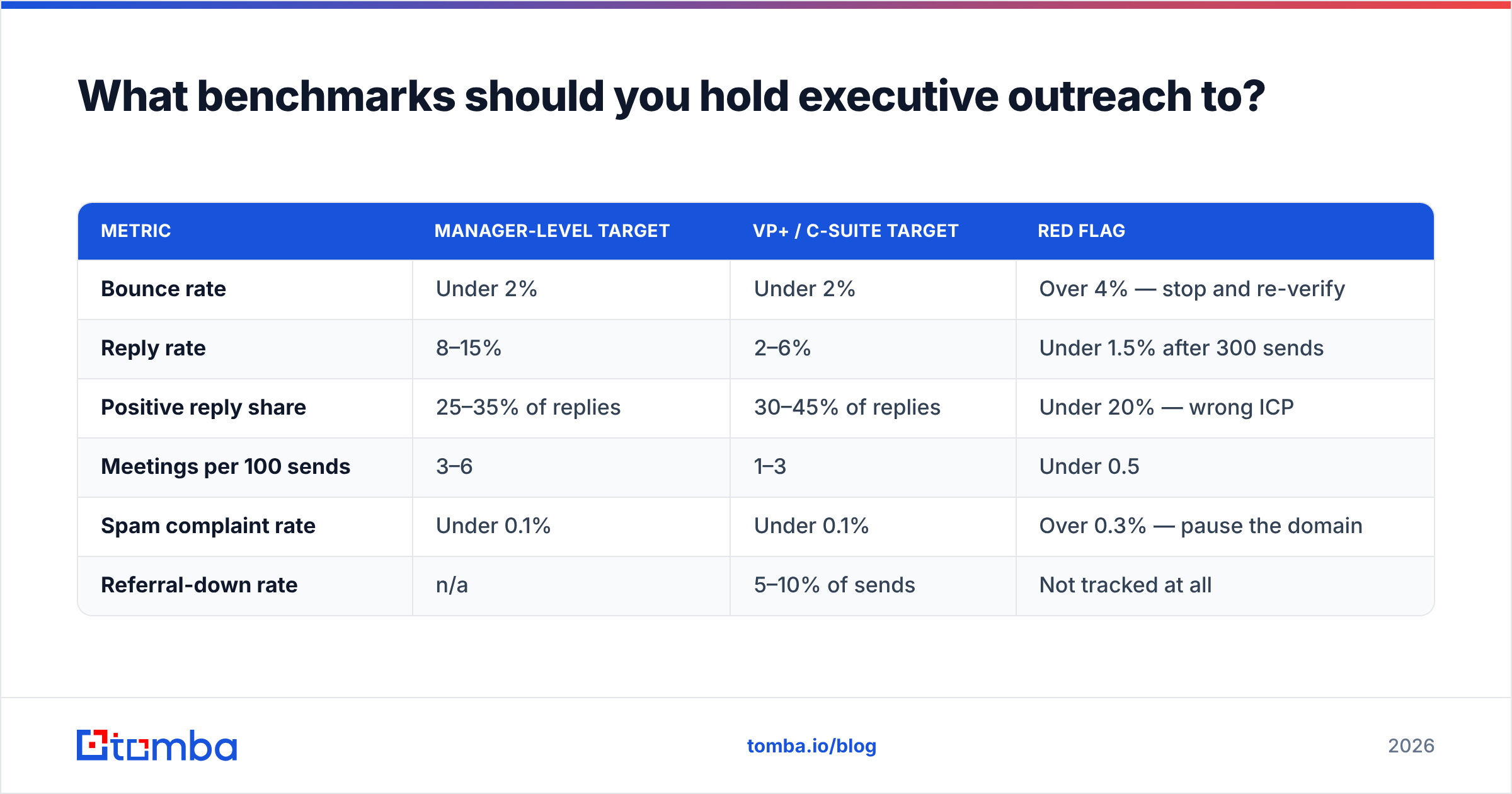
What benchmarks should you hold executive outreach to?#
Set expectations before the campaign launches, not after.
| Metric | Manager-level target | VP+ / C-suite target | Red flag |
|---|---|---|---|
| Bounce rate | Under 2% | Under 2% | Over 4% — stop and re-verify |
| Reply rate | 8–15% | 2–6% | Under 1.5% after 300 sends |
| Positive reply share | 25–35% of replies | 30–45% of replies | Under 20% — wrong ICP |
| Meetings per 100 sends | 3–6 | 1–3 | Under 0.5 |
| Spam complaint rate | Under 0.1% | Under 0.1% | Over 0.3% — pause the domain |
| Referral-down rate | n/a | 5–10% of sends | Not tracked at all |
That last row is the one most teams never instrument. When a CRO forwards your email to a director with "can you take a look at this," that's a win with a higher close rate than a direct reply — but it shows up nowhere in your sequencing tool. Tag it manually. It will change how you write CTAs within a month.
Is executive outreach worth the lower reply rate?#
Usually yes, for one reason: executive-sourced deals close faster.
When a director sources a deal, it goes through evaluation, procurement, and then executive sign-off — and roughly a third die at the last step for reasons no one below the C-suite could have predicted. When the executive sources it, that risk is retired on day one. Teams that track both motions typically see 20–40% shorter cycles and materially higher win rates on executive-sourced opportunities, even though the top of the funnel is thinner.
The correct model is not "executive outreach instead of manager outreach." It's a barbell: a high-volume, well-personalized motion at the practitioner level to build the champion base, and a low-volume, extremely high-quality motion at the executive level to create air cover. Run them from different sending domains so a mistake in the volume motion never touches the deliverability of the precision one.
Where should you start?#
Pick 50 target accounts. Build a real executive list for them — the actual VP or C-level owner of the problem you solve, not whoever the database returns first. Verify every address before the first send. Write 60-word emails anchored on one consequence and one named peer. Follow up four times over 25 days, and close the loop out loud.
Then measure meetings per 100 sends and referral-down rate, and iterate on the first 90 characters of body text before touching anything else.
The data layer is where this either works or quietly falls apart. If your executive addresses are guessed patterns dressed up as verified contacts, no amount of copywriting saves the campaign. Start with the Tomba Email Finder to source VP+ and C-suite addresses against multiple sources, run them through verification including catch-all domains, and send into a list you can actually trust. The free tier gives you 25 searches a month to test the workflow on a pilot account list; paid plans start at $49/mo, with full Tomba pricing available if you need bulk volume or API access for an automated enrichment pipeline.
Related guides#
// get started
Find, verify and enrich your first contacts today
Start on the free plan with 25 searches a month, then scale when your team is ready.
Free plan · No credit card required · GDPR & CCPA
// about the author