Email Pitch Subject Line Examples That Get Opened in 2026
Forty real email pitch subject line examples for cold sales, PR, podcast, partnership and investor outreach — plus the formulas behind them and the phrases that quietly kill your open rate.
TL;DR
- The best email pitch subject line examples are short (3–7 words), specific to the recipient, and make a promise the body actually keeps.
- Six formulas cover almost every pitch: Observation, Mutual Connection, Number/Result, Direct Ask, Curiosity Gap, and Re-Frame. Everything else is a variation.
- Personalization beats cleverness. A subject line naming a real detail ("your Q3 pricing page") outperforms a witty one that could have been sent to 10,000 people.
- Fake-reply tricks ("Re: our chat"), all-caps urgency, and emoji-stuffed lines still get opened — and still tank reply rates and sender reputation.
- Subject lines cannot fix bad data. A 60% open rate on a list where 30% of addresses bounce is a vanity number.
What counts as an email pitch subject line?#
A pitch subject line is the first line of a message where you are asking a stranger — or near-stranger — for time, attention, coverage, budget, or a partnership. That is a different job from a newsletter subject line or a transactional one.
Newsletter subject lines sell a click to someone who already opted in. Pitch subject lines have to survive a colder test: the recipient does not know you, did not ask for this, and is scanning a preview pane deciding whether you are worth eight seconds.
Five contexts use the same mechanics with different stakes:
- Cold sales pitch — you want a discovery call. Highest volume, lowest tolerance for fluff.
- PR / media pitch — you want a journalist to cover something. Journalists get 50–200 pitches a day and open by relevance to their beat.
- Podcast or guest-post pitch — you want a slot. The host is protecting their audience, not their calendar.
- Partnership / BD pitch — you want a co-marketing or integration conversation. The reader is asking "does this make my number bigger?"
- Investor pitch — you want a meeting. Signal density matters more than charm; traction numbers in the subject line work here and almost nowhere else.
The subject line's only job is to earn the open. It is not a summary, not a headline, and definitely not the pitch itself.
Why do most pitch subject lines fail?#
Three reasons, in order of frequency.
They are about you, not the reader. "Introducing Acme's new AI workflow platform" tells the recipient what you want to talk about. It gives them no reason to care. Rewrite it as the outcome the reader owns: "cutting your onboarding queue by half."
They over-promise and under-deliver. Curiosity-gap lines ("You're going to want to see this") get opened once. When the body is a generic demo request, the sender is mentally filed under "ignore" and every future email suffers. HubSpot's sales research has consistently shown that reply rate, not open rate, is the metric that correlates with pipeline.
They are indistinguishable from the last 40 pitches. "Quick question," "touching base," "following up," and "circling back" are so common that recipients pattern-match them before reading. They are not offensive — they are invisible.
There is a fourth, quieter failure: the email never lands in the inbox at all. If your domain has weak authentication or your list is full of dead addresses, the subject line is irrelevant. Google's bulk sender requirements made list hygiene a hard gate rather than a nice-to-have.

What do the best email pitch subject line examples look like?#
Here are 40 examples organized by pitch type. Treat the bracketed parts as required, not optional — a template with unfilled variables is worse than no template.
Cold sales pitch subject lines#
[Company]'s checkout flowquestion about your Series B hiring3 reps, 40 hours of manual researchsaw your job post for an SDRre: your API docsidea for [Company]'s EMEA launchworth 10 minutes?[Competitor] switched last quarteryour G2 reviews mention onboardingcutting [Company]'s bounce rate
The pattern: a concrete noun from the prospect's own world. "Your API docs" proves you looked. "Worth 10 minutes?" works only when paired with a body that is genuinely 10 minutes of value — it is the weakest of the ten and should be reserved for warm-ish leads.
PR and media pitch subject lines#
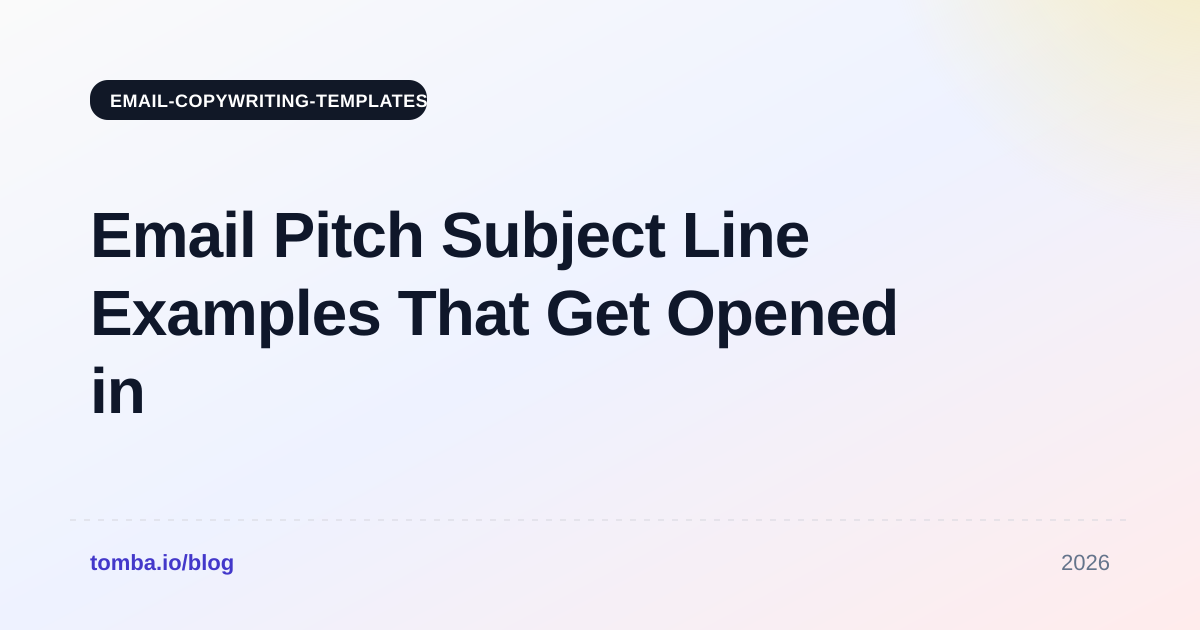
data: 41% of SDR emails never reach an inboxexclusive for [Publication]: our 2026 outbound benchmarksource for your piece on AI hiringfollow-up data for your Jan 12 storyembargoed until Tues 9am ET: [News][Beat] story idea — 200 companies surveyedcorrection/context on the [Topic] numbersfounder available today for [Trending Story]
Journalists open by beat relevance and deadline pressure. Lead with the data point or the exclusivity, never with your company name.
Podcast and guest-pitch subject lines#
episode idea: why outbound broke in 2025guest pitch — [Your Name], [Credential]heard ep. 112 — one thing you missedtopic your listeners keep asking about[Host name], a counterargument to ep. 8840-minute story: scaling to $4M with 3 reps
Referencing a specific episode number is the single highest-leverage move here. It is unfakeable at scale.
Partnership and BD subject lines#
[Your Company] + [Their Company] integrationyour customers keep asking us for [X]co-marketing idea for Q3we send [N] signups/month to tools like yourspartnership — 2 lines, no deckshared customer: [Account Name]
Investor pitch subject lines#
[Company] — $40k MRR, 14% MoM, raising seedintro from [Mutual Contact] — [Company] seed[Category] infrastructure, 3x net revenue retentionpre-seed: [one-line thesis]deck attached — [Company], [Traction number]
Follow-up subject lines#
one more thing on [Topic]closing the loop on [Company]'s [Problem]should I stop emailing?2-line version of my last email[Mutual Contact] suggested I try again
Never send a follow-up with a blank or recycled subject line hoping the thread does the work. Change the angle, not just the timestamp.
Which subject line formula should you use?#
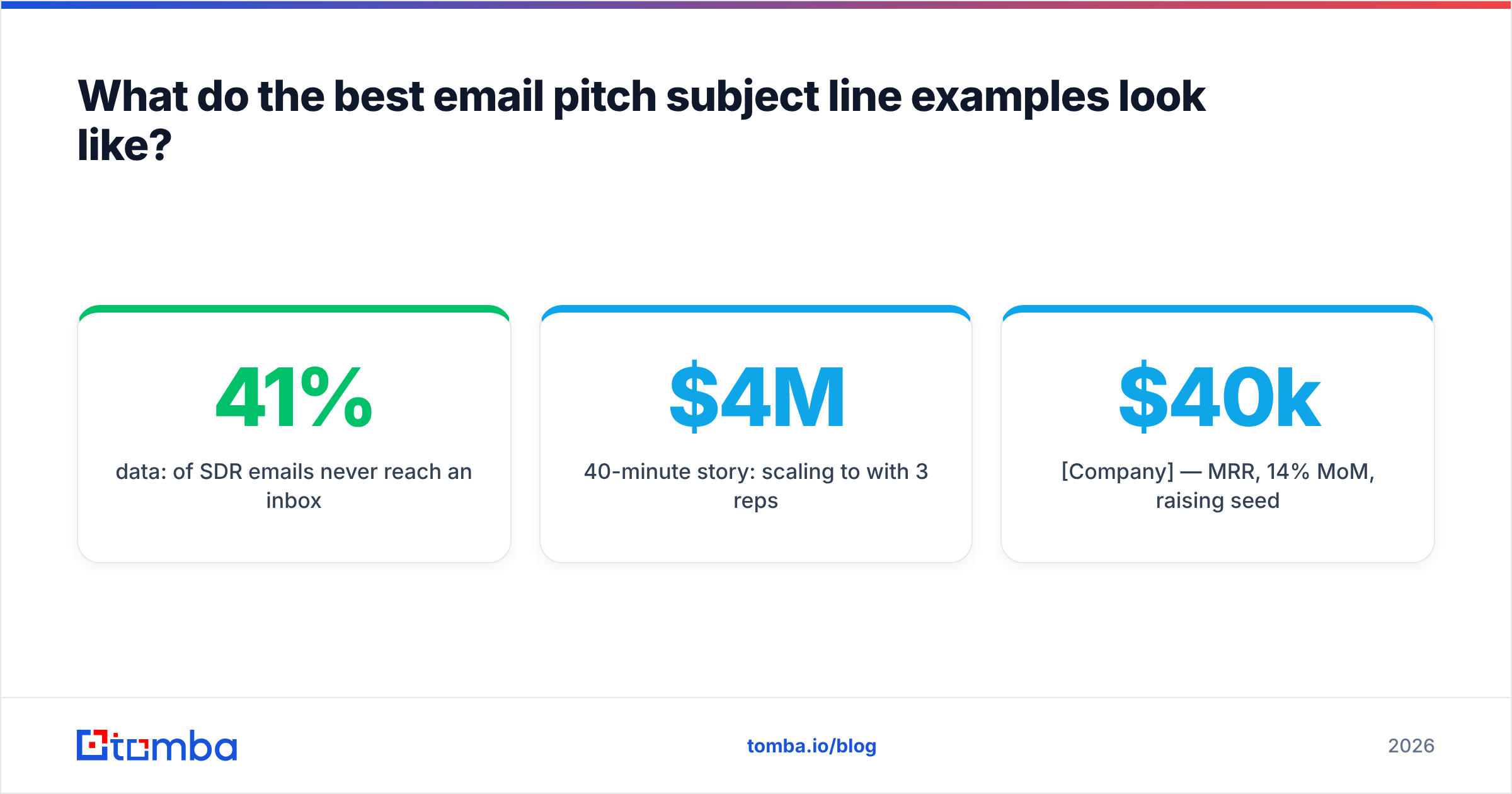
Six formulas cover the 40 examples above. This table maps each one to the context where it actually performs.
| Formula | Example | Best pitch type | Typical open range | Main risk |
|---|---|---|---|---|
| Observation | saw your job post for an SDR |
Cold sales | 45–60% | Feels creepy if the detail is too personal |
| Mutual connection | intro from Sara — [Company] seed |
Investor, BD | 55–75% | Useless without a real connection |
| Number / result | 3 reps, 40 hours of manual research |
Cold sales, PR | 40–55% | Reads like an ad if the number is generic |
| Direct ask | partnership — 2 lines, no deck |
BD, podcast | 35–50% | Low ceiling, but high reply quality |
| Curiosity gap | one thing you missed in ep. 112 |
Podcast, media | 50–65% | Burns trust if the body under-delivers |
| Re-frame | should I stop emailing? |
Follow-up | 40–60% | Only works once per thread |
If you only remember one row: mutual connection wins whenever it is honest, and observation wins when it is not.
Does length, personalization, or curiosity matter more?#
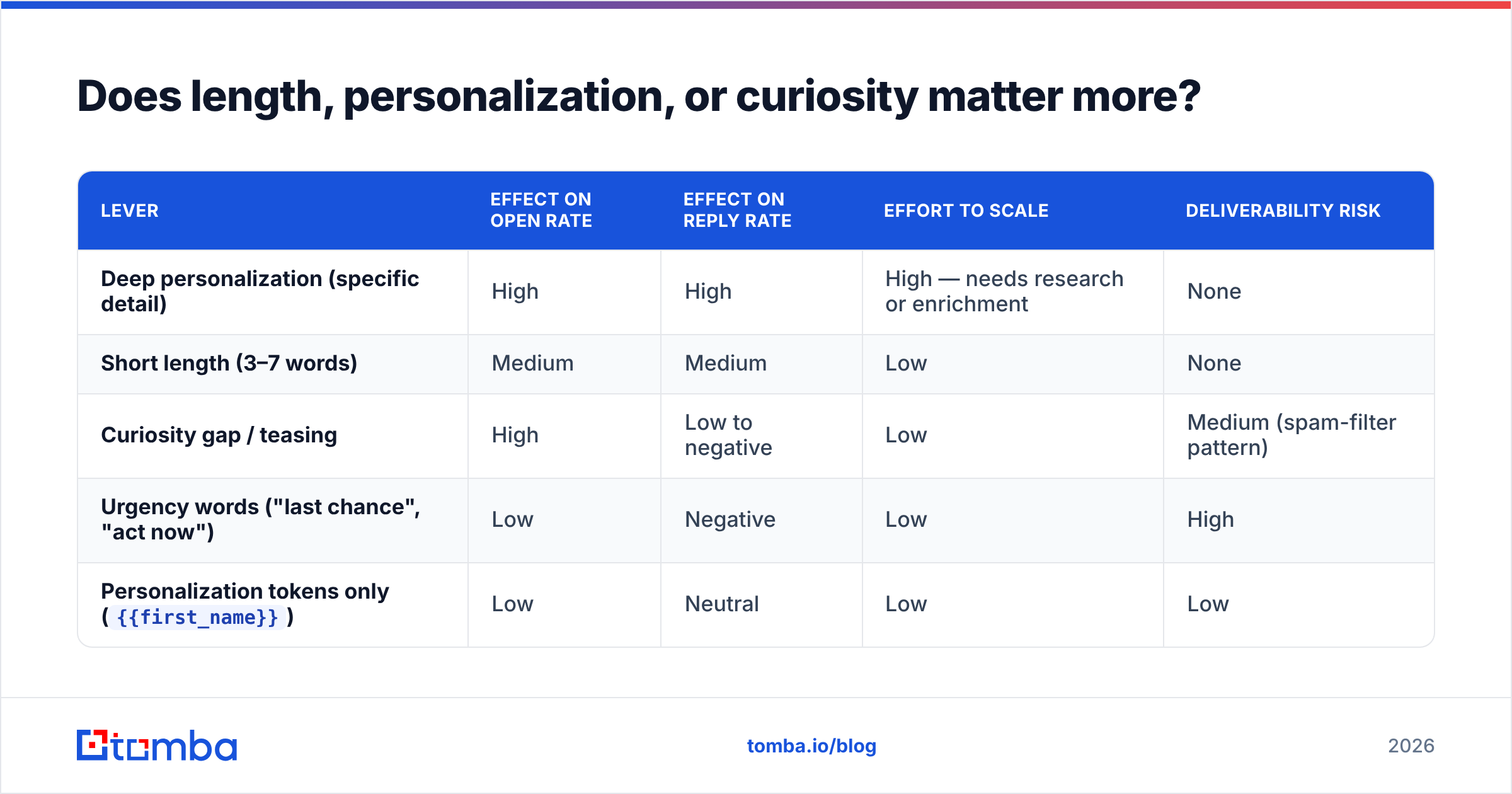
Personalization, then length, then curiosity — in that order.
Here is how the three levers compare on the dimensions that actually decide whether a pitch converts:
| Lever | Effect on open rate | Effect on reply rate | Effort to scale | Deliverability risk |
|---|---|---|---|---|
| Deep personalization (specific detail) | High | High | High — needs research or enrichment | None |
| Short length (3–7 words) | Medium | Medium | Low | None |
| Curiosity gap / teasing | High | Low to negative | Low | Medium (spam-filter pattern) |
| Urgency words ("last chance", "act now") | Low | Negative | Low | High |
Personalization tokens only ({{first_name}}) |
Low | Neutral | Low | Low |
Two notes on that table. First, a merge tag is not personalization — recipients have been trained to spot Hi {{first_name}} since 2012. Second, urgency language is the fastest way to trip content filters; run anything urgency-flavored through a spam checker before it goes near a real list.
On length: aim for under 40 characters so nothing truncates on mobile. Roughly 60% of B2B email is first previewed on a phone, and the cut point on most mobile clients is around 35–38 characters. Lowercase subject lines — no title case, no period — consistently read as person-to-person rather than campaign-to-list.
What subject lines should you never send?#
Six patterns to cut from your library today:
- Fake replies and forwards —
Re: our conversation,Fwd: as discussed. It works exactly once, and it is the single fastest way to get marked as spam by a recipient who feels tricked. - All caps or excessive punctuation —
URGENT!!!triggers filters and reads as a scam. - Bare "quick question" — the most-used pitch subject line in B2B, which means it is the most-ignored.
- Your own company name alone —
Acme Softwaretells the reader nothing except that this is a vendor email. - Emoji-led lines in B2B pitches — fine for e-commerce, corrosive in enterprise sales. Reviews on G2 for outbound tools are full of buyers describing exactly this as a disqualifier.
- Anything with "free" in the first three words — content filters weight early-position trigger words more heavily than late ones.
If you want a starting library instead of a blank page, the subject line generator produces variations by pitch type, and the subject line tester scores length, spam risk, and mobile truncation before you send.
How do you test subject lines without wrecking deliverability?#
Split-testing subject lines is easy to do badly. Three rules keep the test honest.
Test one variable at a time. If variant A is short and personalized while variant B is long and generic, you have learned nothing about either lever.
Use a large enough sample. Below roughly 300 sends per variant, the difference you are seeing is noise. If your daily send volume is 50 emails, run the test over two weeks instead of two days.
Measure replies, not opens. Open tracking has been unreliable since Apple Mail Privacy Protection started pre-fetching images in 2021; a meaningful share of "opens" are machine opens. Reply rate and meetings booked are the metrics that survive.
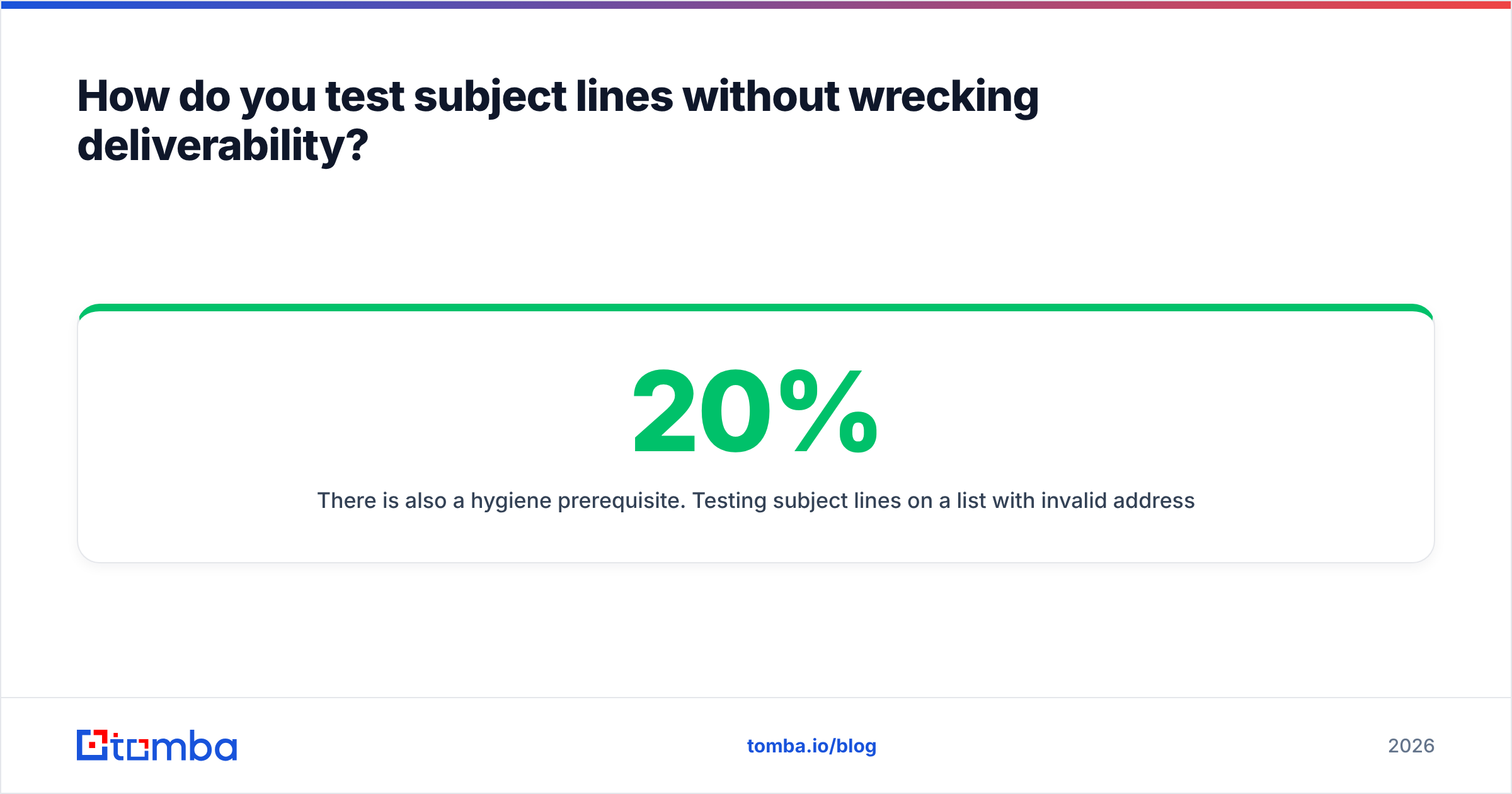
There is also a hygiene prerequisite. Testing subject lines on a list with 20% invalid addresses produces garbage data and damages your sender reputation at the same time. Clean the list first with an email verifier, confirm SPF/DKIM/DMARC are passing, and only then start optimizing copy. Fixing the subject line is the last 10% of the problem; the first 90% is whether the message can reach a human at all. The mechanics of email deliverability — authentication, volume ramp, complaint rate — sit upstream of every word you write.
How do you match the subject line to the rest of the pitch?#
The subject line writes a check. The first sentence has to cash it within about five words.
If the subject is saw your job post for an SDR, the opening line cannot be "Hope this email finds you well." It has to be "You're hiring two SDRs — most teams that scale from 3 to 5 reps hit a data bottleneck first." Continuity is what converts an open into a reply.
A working sequence looks like this:
- Subject: a specific, observed detail (3–7 words, lowercase)
- Line 1: why that detail made you write — no pleasantries
- Line 2: the relevant proof point, ideally a number from a comparable company
- Line 3: one low-friction ask — a question, not a calendar link
- Signature: name, company, nothing else
Everything else — the case study, the deck, the pricing — belongs in the reply, not in email one. A three-line pitch with a precise subject line beats a beautifully designed template every time, and it is far cheaper to iterate on.
One last honest caveat: subject lines are the most-optimized and least-leveraged part of outbound. Doubling your open rate on a badly targeted list changes nothing. Halving your list and doubling the research quality changes everything.
Where should you start?#
Pick three formulas from the table — Observation, Mutual Connection, and Number/Result cover most B2B cases — and write ten variations of each against real accounts you already know something about. Score them for length and spam risk, send at least 300 per variant, and judge on replies.
Then fix the layer underneath. Accurate contact data is what makes the observation-based subject lines possible in the first place: you cannot reference someone's job post, their API docs, or their new market if you cannot reliably reach the right person. Tomba's Email Finder returns verified, source-attributed business emails by name and domain, with a free tier of 25 searches a month and paid plans starting at $49/mo — see Tomba pricing for the full breakdown. Get the contact right, then let the subject line do the small job it was designed for.
Related guides#
Ready to find emails that actually work?
Join 150,000+ professionals who stopped guessing and started sending. Free credits on signup — no credit card required.
Get the Tomba newsletter
Practical outbound tactics and product updates — once every two weeks.
About the author