Email Sales Funnel: How to Build One That Converts in 2026
Most email funnels leak revenue in two places: the data at the top and the follow-up in the middle. Here is the stage-by-stage build, with benchmark rates, tool costs, and the fixes that actually move pipeline.
TL;DR
- An email sales funnel is a staged sequence — contact → delivered → engaged → replied → meeting → closed — where each stage has its own conversion rate and its own failure mode.
- The two stages that leak the most revenue are the first (bad contact data) and the third (no structured follow-up). Copy is rarely the primary problem.
- Realistic 2026 benchmarks for cold B2B email: 95%+ delivery on verified data, 25-45% open, 3-8% reply, 20-35% reply-to-meeting. Anything above that is a niche or a small, hyper-targeted list.
- A working stack costs roughly $150-$400/month for one sender team: data + verification + sending + CRM. You do not need a $1,500/month platform to start.
- Track stage-to-stage conversion, not vanity totals. "We sent 10,000 emails" is not a funnel metric. "Contact → meeting = 1.4%" is.
What is an email sales funnel?#
An email sales funnel is the sequence of states a prospect passes through when email is your primary outbound channel — from raw contact record to closed revenue — with a measurable drop-off between each state.
Think of it like a water pipe with joints. Water pressure at the tap depends less on how hard you pump and more on which joint is leaking. Most teams respond to weak results by pumping harder (more volume, more sequences, more SDR hours) when one specific joint is losing 40% of the flow.
Technically, the funnel is a set of conditional states tracked per contact: added → validated → sent → delivered → opened → replied → positive reply → meeting booked → opportunity → closed. Each transition is a ratio. Your job is to find the worst ratio relative to benchmark and fix that one thing.
The distinction matters because "email marketing funnel" (nurture, newsletters, lifecycle) and "email sales funnel" (outbound, 1:1 or 1:few, human reply expected) behave differently. A nurture funnel optimises for click-through and time-to-purchase. A sales funnel optimises for a human reply that converts into a calendar event. Same channel, different physics.
How is an email sales funnel different from just having a list?#
A list is inventory. A funnel is a process with exit criteria.
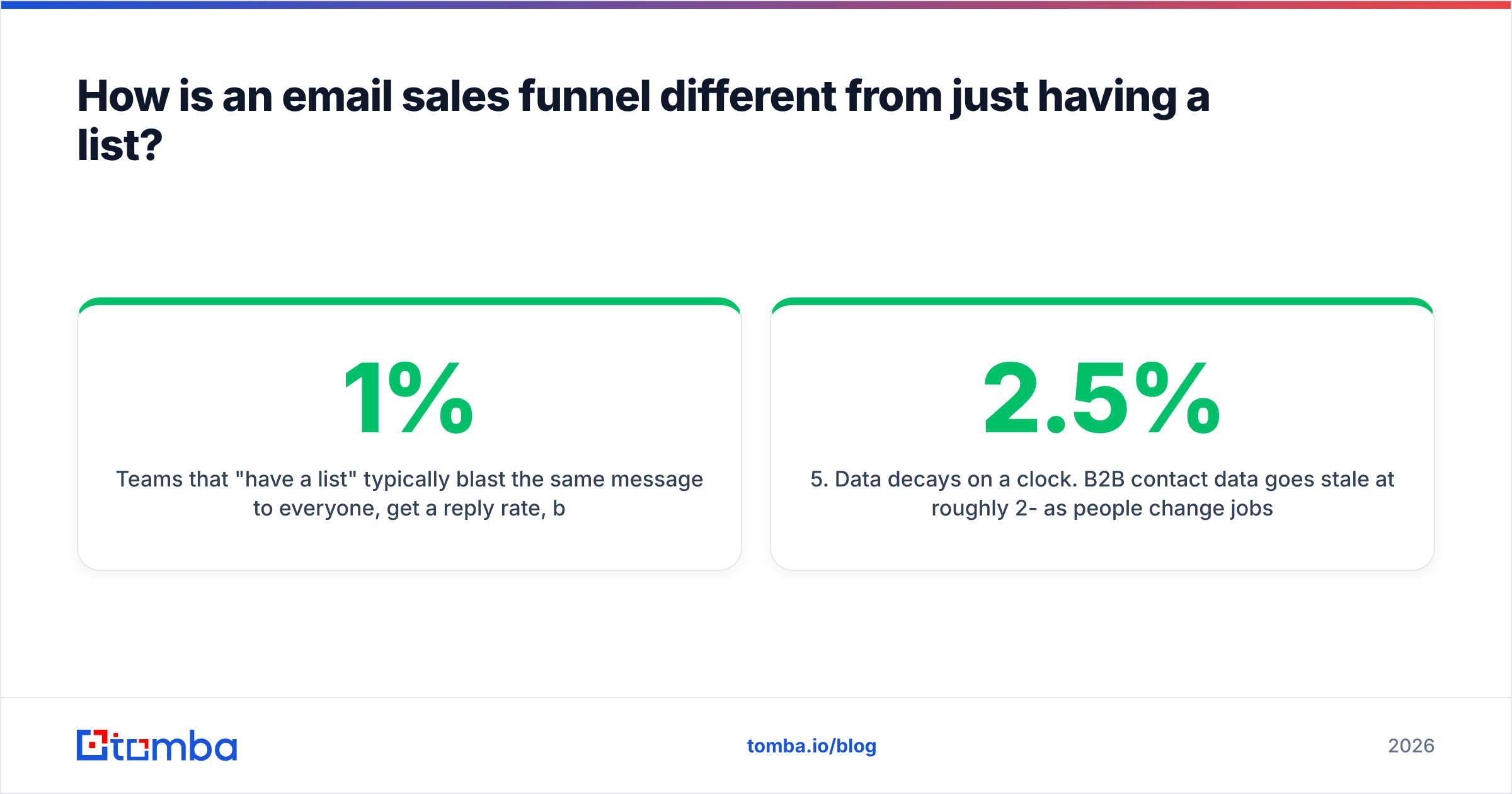
Teams that "have a list" typically blast the same message to everyone, get a 1% reply rate, blame the copy, and rewrite the subject line. Teams that run a funnel know that of 5,000 contacts, 700 were never valid, 1,100 never got delivered to the inbox, and 40% of positive replies never got a second touch. Those are three different problems with three different fixes.
Here's the practical difference in how work gets scheduled:
- Entry criteria are explicit. A contact enters the funnel only when it has a verified email, a confirmed role, and a documented trigger (funding, hiring, tech change, content signal). No trigger, no entry.
- Every stage has an owner and an SLA. Positive replies get answered within four business hours. Not "when the SDR checks Monday."
- Exits are defined. Contacts leave the funnel on close, on hard no, or after a fixed number of touches — then re-enter a nurture track 90 days later.
- Stage rates are reviewed weekly. Not open rate in aggregate. Stage-to-stage, by segment, by sender.
- Data decays on a clock. B2B contact data goes stale at roughly 2-2.5% per month as people change jobs. A list built in January is meaningfully worse by June if nothing re-validates it.
What are the stages of an email sales funnel?#
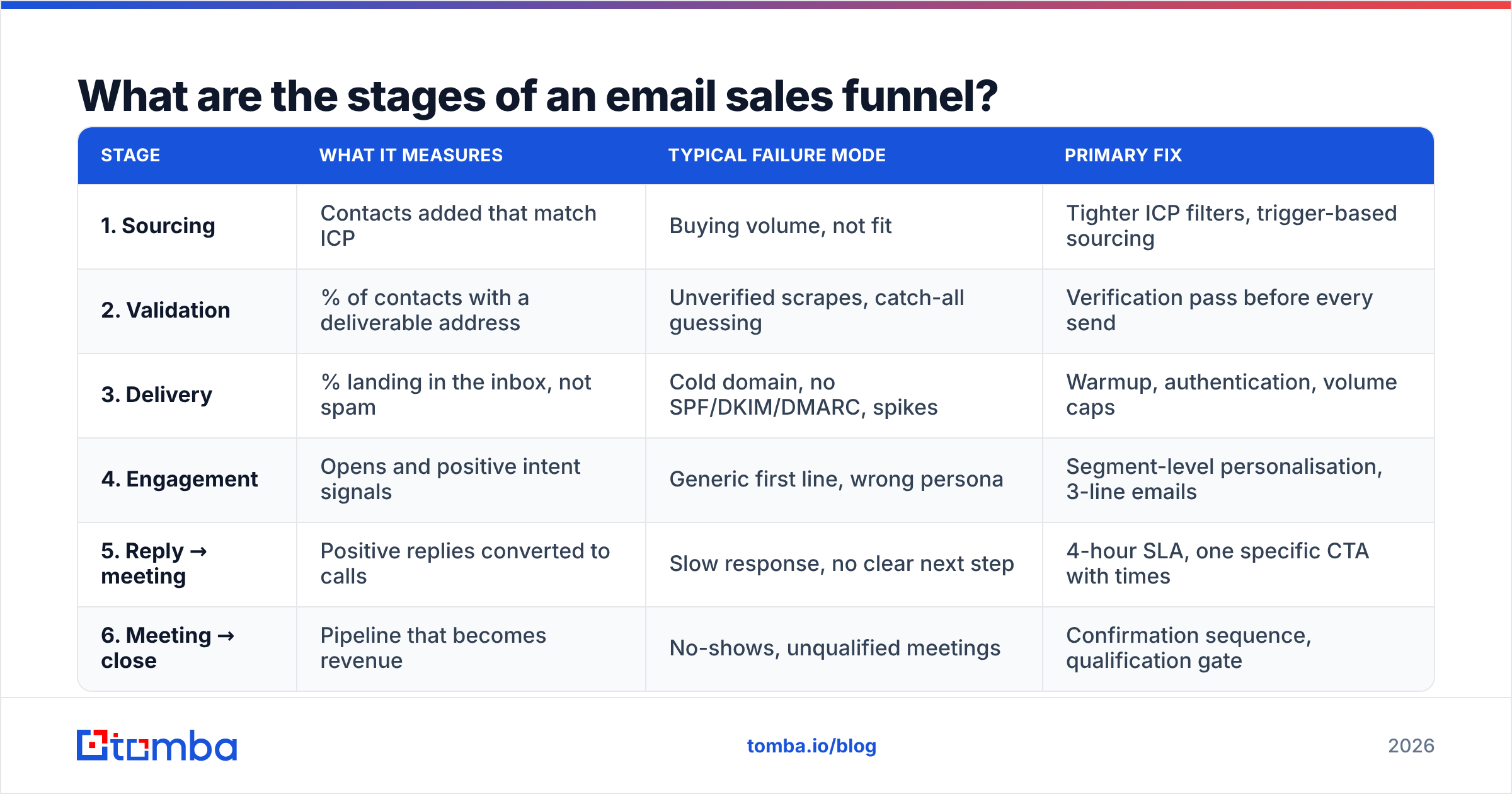
Six stages, each with a distinct failure mode and a distinct fix. This is the map you should be able to draw from memory.
| Stage | What it measures | Typical failure mode | Primary fix |
|---|---|---|---|
| 1. Sourcing | Contacts added that match ICP | Buying volume, not fit | Tighter ICP filters, trigger-based sourcing |
| 2. Validation | % of contacts with a deliverable address | Unverified scrapes, catch-all guessing | Verification pass before every send |
| 3. Delivery | % landing in the inbox, not spam | Cold domain, no SPF/DKIM/DMARC, spikes | Warmup, authentication, volume caps |
| 4. Engagement | Opens and positive intent signals | Generic first line, wrong persona | Segment-level personalisation, 3-line emails |
| 5. Reply → meeting | Positive replies converted to calls | Slow response, no clear next step | 4-hour SLA, one specific CTA with times |
| 6. Meeting → close | Pipeline that becomes revenue | No-shows, unqualified meetings | Confirmation sequence, qualification gate |
Notice that four of the six failure modes are operational, not creative. That's the uncomfortable finding when you actually instrument a funnel: copy matters at stage 4 and almost nowhere else.
Stage 1-2: sourcing and validation#
This is where the largest single loss happens and where it's least visible, because a bounced email doesn't feel like a lost deal — it feels like nothing at all.
If you're pulling contacts from a scraped export or an old CRM segment, expect 15-35% of addresses to be undeliverable. Send to that and you're not just wasting sends; you're damaging the domain reputation that determines whether the good addresses reach the inbox. One bad send degrades the next ten good ones.
The fix is boring and non-negotiable: source from a provider that verifies at lookup time, then re-verify anything older than 60 days. Running your list through an email verifier before every campaign takes minutes and typically pulls hard-bounce rates under 2%. If a large chunk of your target accounts sit on catch-all domains — common in enterprise and European mid-market — a dedicated catch-all verifier will tell you which of those are actually safe to send to instead of forcing a binary guess.
For building the list itself, domain search is the highest-leverage move: give it a company domain, get back the people, roles, and the company's email pattern. Pattern knowledge is what lets you fill gaps for the accounts that matter without guessing blindly.
Stage 3: delivery#
Delivery is a technical stage that sales teams keep treating as a marketing problem. Three things account for most inbox placement:
- Authentication. SPF, DKIM, and DMARC configured on the sending domain. Google and Yahoo's bulk-sender requirements made this table stakes, and enforcement has only tightened since. Google publishes the current requirements in its Email sender guidelines.
- Domain age and warmup. New domains send 10-20/day for the first two weeks, ramping to 40-50/day per mailbox. Buy secondary domains for outbound; never burn the primary.
- Volume shape. Steady daily volume beats bursts. A flat 200/day across five mailboxes outperforms 1,000 on Monday and zero after.
Spam-complaint rate is the metric filters weight hardest. Keep it under 0.1%. One-click unsubscribe on every cold email is not optional in 2026, and it costs you almost nothing — people who would have marked you as spam now just leave quietly.
Stage 4-5: engagement and reply handling#
Once mail reaches the inbox, the funnel becomes a human problem. Two rules do most of the work.
First: the email should be readable on a phone without scrolling. Three to five lines. One specific observation about their business, one sentence of relevance, one question. Long emails signal broadcast, and broadcast gets archived.
Second: reply speed dominates everything else at stage 5. Response rates decay sharply with time — the research HubSpot has published on lead response has been consistent for years on this point. A positive reply answered in one hour and a positive reply answered in two days are not the same asset. Set a four-hour SLA and staff for it.
What conversion rates should an email sales funnel actually hit?#
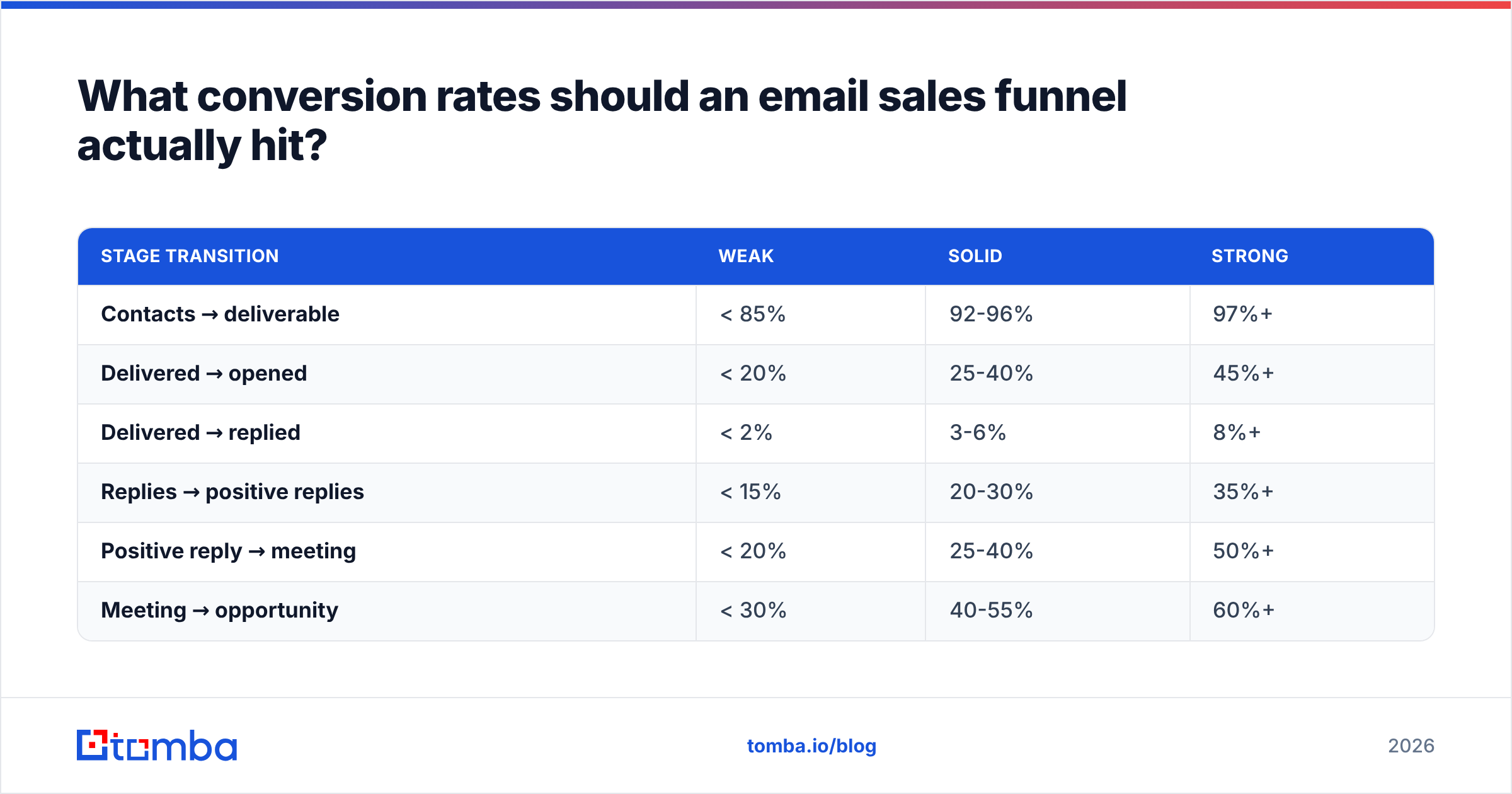
Benchmarks vary enormously by market, seniority, and list quality, so treat these as sanity checks rather than targets. These reflect cold B2B outbound to a well-defined ICP, not opt-in nurture.
| Stage transition | Weak | Solid | Strong |
|---|---|---|---|
| Contacts → deliverable | < 85% | 92-96% | 97%+ |
| Delivered → opened | < 20% | 25-40% | 45%+ |
| Delivered → replied | < 2% | 3-6% | 8%+ |
| Replies → positive replies | < 15% | 20-30% | 35%+ |
| Positive reply → meeting | < 20% | 25-40% | 50%+ |
| Meeting → opportunity | < 30% | 40-55% | 60%+ |
Run the math end to end and the picture gets honest fast. 1,000 verified contacts × 95% deliverable × 5% reply = 47 replies. × 25% positive = 12 positive replies. × 35% to meeting = 4 meetings. That's a 0.4% contact-to-meeting rate on a decent funnel.
Which means the fastest way to double meetings is rarely a better subject line. It's either doubling clean, well-targeted volume, or lifting one weak stage rate from "weak" to "solid." Improving contact-to-deliverable from 82% to 96% adds 17% more meetings without writing a single new word.
Note that open rate has become an unreliable metric since Apple Mail Privacy Protection began pre-fetching images. Treat it as directional only. Reply rate is the first metric in the funnel you can actually trust.
Which tools does an email sales funnel need?#
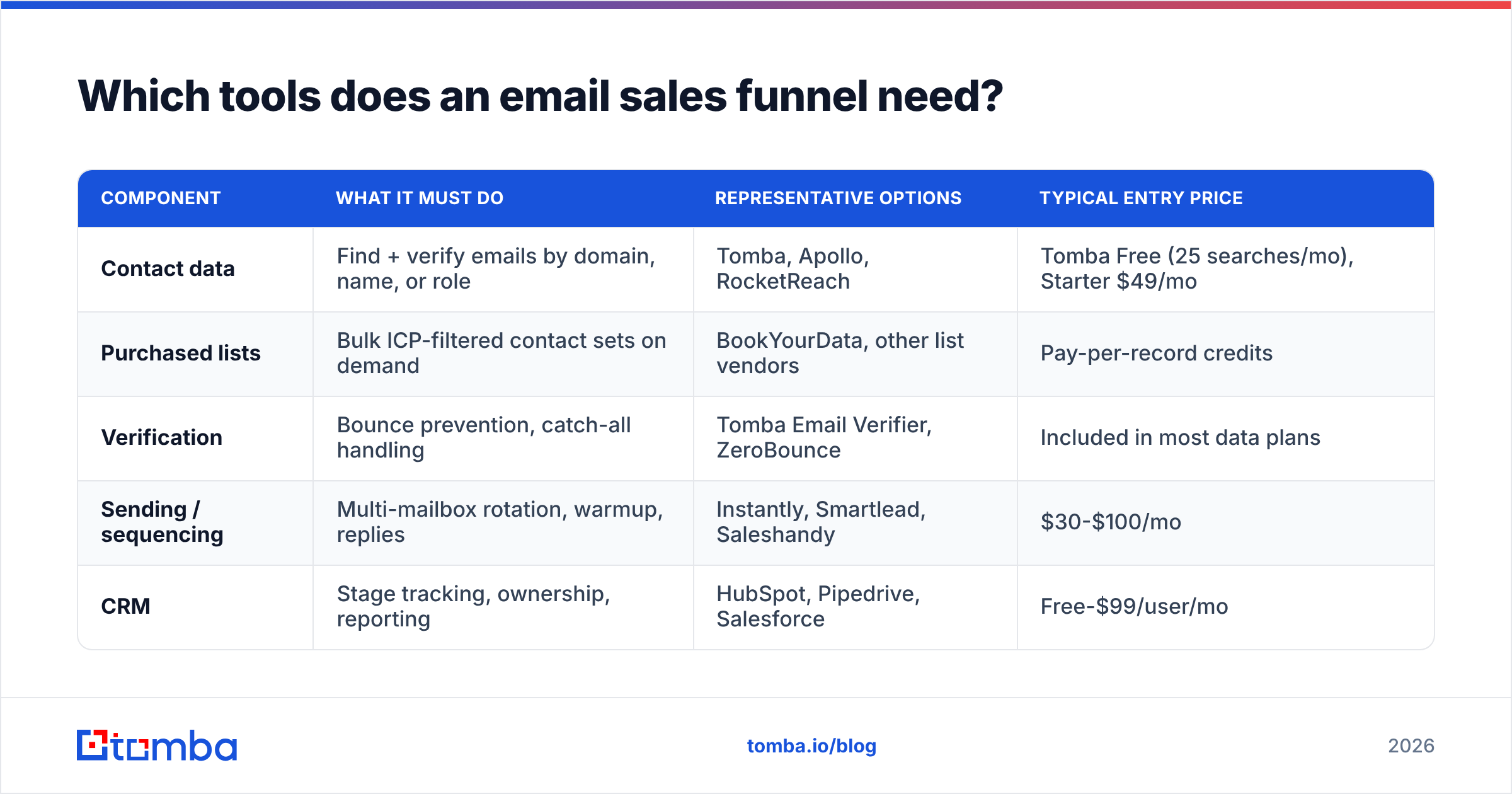
Four jobs: find contacts, verify them, send and sequence, track in CRM. Some platforms bundle several; bundling is convenient but usually means one component is mediocre.
| Component | What it must do | Representative options | Typical entry price |
|---|---|---|---|
| Contact data | Find + verify emails by domain, name, or role | Tomba, Apollo, RocketReach | Tomba Free (25 searches/mo), Starter $49/mo |
| Purchased lists | Bulk ICP-filtered contact sets on demand | BookYourData, other list vendors | Pay-per-record credits |
| Verification | Bounce prevention, catch-all handling | Tomba Email Verifier, ZeroBounce | Included in most data plans |
| Sending / sequencing | Multi-mailbox rotation, warmup, replies | Instantly, Smartlead, Saleshandy | $30-$100/mo |
| CRM | Stage tracking, ownership, reporting | HubSpot, Pipedrive, Salesforce | Free-$99/user/mo |
A few notes on choosing:
- Bundled all-in-ones (data + sending in one login) are fastest to launch and hardest to fix when one part underperforms — you can't swap the weak component without replatforming.
- Purchased list vendors like BookYourData work well when you need a defined, filterable set of records quickly — geography, title, company size — and want to pay per record rather than per seat. Pair them with an independent verification pass so you know exactly what you're sending to.
- API-first data tools matter more than they look. If your funnel is going to be automated at all, you want an email finder API that enriches records inside your own workflow rather than a UI you have to babysit. Same reasoning applies to bulk email finder runs when you're refreshing thousands of records at once.
- Cost discipline. For a two-person outbound team, $150-$400/month total is realistic. Tomba's own pricing runs Free (25 searches/mo), Starter $49/mo, Growth $99/mo, and Pro $249/mo, which covers the data-and-verification slice for most teams under 10 reps.
What breaks most email sales funnels?#
Five recurring failures, ranked by how much revenue they quietly destroy.
- Unverified data at the top. A 12% bounce rate doesn't just cost you 12% of sends — it drags inbox placement down for the remaining 88%. This is the single highest-ROI fix in outbound and the most frequently skipped.
- No follow-up structure. Most positive outcomes arrive on touch two through four. Teams that send once and move on are leaving the majority of their reachable pipeline untouched. Three to five touches over 14-21 days, each adding something new, is the working default.
- Persona drift. Sourcing "anyone at the company" instead of the specific role that owns the problem. Your reply rate to a VP of Ops and a VP of Engineering for the same product can differ by 4x.
- Slow reply handling. Interest is perishable. A four-hour SLA on positive replies is the cheapest conversion lift available to a sales team.
- No decay management. Contacts that entered in Q1 and were never re-validated are actively hurting Q3 sends. Schedule a quarterly re-verification pass on any contact you intend to touch again.
There's a sixth that's harder to fix: measuring the funnel in aggregate rather than by segment. A blended 4% reply rate can hide a 9% segment and a 0.5% segment. Split every report by ICP segment and sender before you draw conclusions from it.
How do you actually instrument and review it?#
Weekly, review five numbers per segment: deliverable rate, reply rate, positive-reply rate, meeting rate, and spam-complaint rate. Everything else is diagnostic detail you pull only when one of those five moves.
Then apply a simple rule: fix the stage whose gap to benchmark is largest, not the stage that's easiest to work on. Rewriting copy feels productive. Re-verifying a list feels like admin. The list usually wins.
Set a monthly cadence for hygiene: re-verify anything older than 60-90 days, prune contacts with three no-response sequences, and refresh your ICP filters against the accounts that actually closed last quarter. Funnels degrade silently — the numbers only tell you after the damage is done, so treat maintenance as scheduled work, not as a response to bad results.
Finally, connect the funnel to the CRM properly. If reply and meeting stages live in a sending tool while opportunities live in a CRM, nobody can compute meeting-to-close and the bottom half of your funnel is invisible. Push stage events into the CRM through your integrations so a single record carries the contact from sourcing through close.
Where should you start this week?#
Start at stage 2, because it's the fastest measurable win. Take your current list, run a verification pass, and see what percentage comes back undeliverable. That number tells you immediately whether your problem is data or messaging — and it takes about fifteen minutes to find out.
If it's data, rebuild the top of the funnel from verified sources rather than patching the old list. The Tomba Email Finder finds professional email addresses by domain, name, or company and verifies at lookup, so contacts enter your funnel deliverable instead of becoming a bounce report three days later. The free tier gives you 25 searches a month to test the accuracy against accounts you already know — start there, measure the deliverable rate, then decide whether the rest of the funnel needs work at all.
Related guides#
Ready to find emails that actually work?
Join 150,000+ professionals who stopped guessing and started sending. Free credits on signup — no credit card required.
Get the Tomba newsletter
Practical outbound tactics and product updates — once every two weeks.
About the author