Email Scraper Software in 2026: What Actually Works Now
Most email scraper software still ships 2019-era assumptions: grab everything, verify nothing, hope the bounce rate holds. Here's what breaks, what's legal, and which approach actually feeds a working pipeline in 2026.
Email scraper software is easy to buy and easy to get wrong. This guide covers what each kind does, how it breaks, and what to use instead. The short version: most teams buy a scraper when what they need is a finder.
TL;DR
- Email scraper software is three tools sharing one name. Page scrapers grab
mailto:text. Browser add-ons lift contacts off LinkedIn. Finders work out an address, then test it. Each one fails in its own way. - Raw scraping gives you the worst lists money can buy. Public emails skew to
info@,support@, and shared inboxes that feed ticket queues. - Count how many emails land, not how many you found. A tool that returns 50,000 emails at 62% valid is worth less than one that returns 6,000 at 96%.
- GDPR, CCPA, and a wave of court cases make blind bulk scraping a real risk in 2026.
- The stack that works: source by domain and role, test each email, then add data after they reply.
What is email scraper software, exactly?#
Email scraper software is any tool that pulls emails from a source you do not own. That source might be a web page, a search page, a social profile, a PDF, or a scanned list. The tool hands you the results as a list.
Think of it as fishing with a net instead of sonar. The net drags in all it can reach. You get good emails, dead ones, spam traps, noreply@, and a photographer's contact form from 2014. Sonar tells you where the one fish sits before you cast. Both put fish in the boat. One puts far less junk in it.
The category splits into four types:
- Crawlers. They spider a site and match email patterns in the HTML, including
mailto:links and masked forms likename [at] company [dot] com. Cheap, fast, and the least precise. - Browser add-ons. They run inside a LinkedIn or Sales Navigator tab and read what your logged in view can see. More useful, but bound by rate limits and the site's terms.
- Search harvesters. They fire queries like
site:company.com "@company.com"and parse the results page. Google and Bing both fight this, so it breaks often. - Finders that test. These do not scrape in the crude sense. They learn the email format a company uses, apply it to a named person, then test the mailbox before they hand it back. That is what an email finder does.
Most buyers who search for email scraper software want the fourth type and do not know its name yet. They want people they can reach, not text they can match.

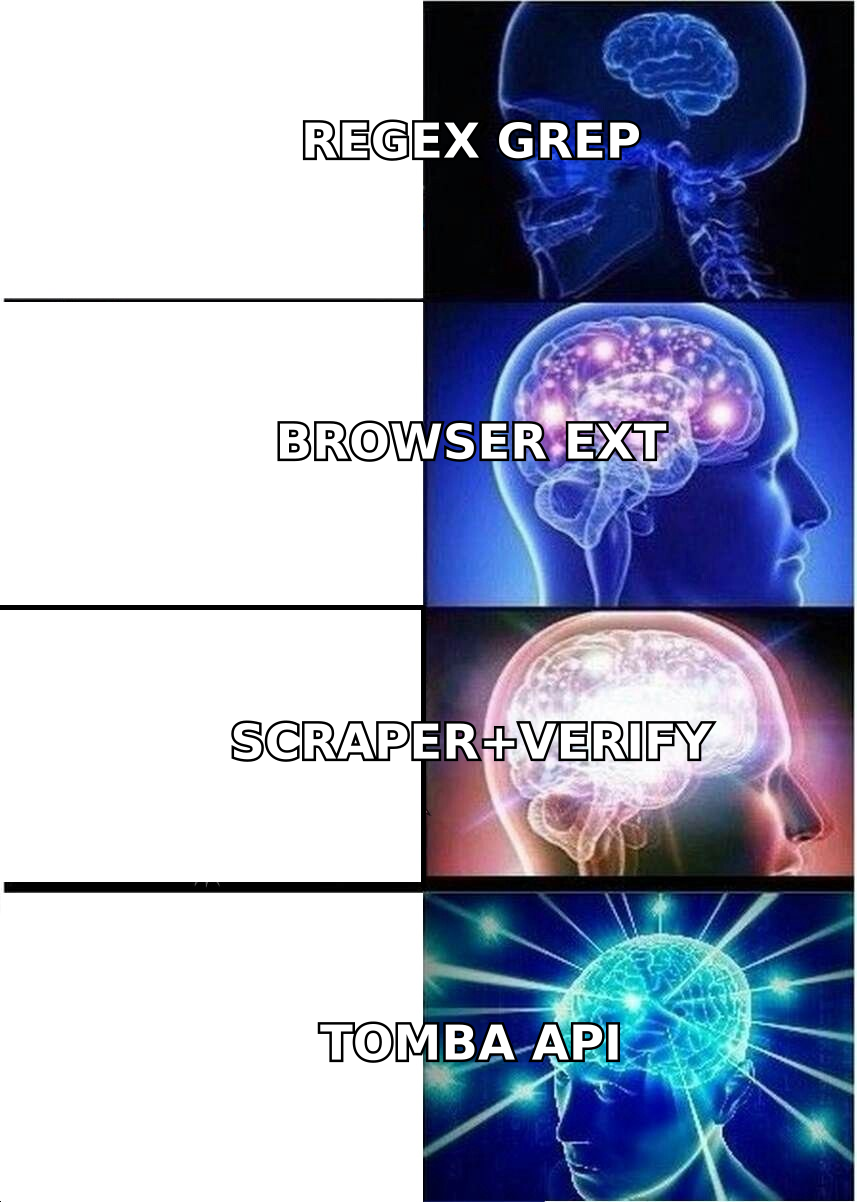
(placeholder above: https://blog-cdn.tomba.io/content/images/2026/08/memes/2026-08-06/email-scraper-software-meme-1.png)

Why do scraped lists bounce so hard?#
Because public emails are a skewed sample, and email scraper software grabs that skew along with the data. The skew then grows at every stage of your funnel.
Here is what sits in the HTML of a normal B2B site:
- Shared inboxes like
info@,hello@,sales@, andcareers@. They face heavy filters and almost no one replies in person. Many email tools also read a high share of them as a spam signal. - Stale emails. A team page from three years ago lists four people who have since left. The text still parses. The mailbox is gone.
- Spam traps. These are dead emails that inbox providers switch back on to catch list buyers. A few hits can sink your sender reputation.
- Broken text. Poorly parsed strings like
name(at)domain(dot)comturn into emails that cannot exist. - The wrong people. A scraper cannot tell the CFO from a summer intern.
Run 10,000 raw scraped emails through a decent email verifier and 30–45% fail on the spot. Of the rest, a large share are shared inboxes. Your real reach is often under 20% of what the tool claimed.
That gap is the whole argument. The number a scraper reports is not a count of leads. It is a count of text strings.

Vendors also measure in ways you cannot compare. Some report match rate, which asks whether they returned anything at all. Others report valid rate, which asks whether the mailbox took the mail. Ask which one a number means before you trust it.
Is scraping emails legal in 2026?#
Short answer: pulling public data is not illegal by itself. What you then do with it is ruled tightly, and that is where firms get hit.
Here is the split most teams miss.
- Collecting. US case law, notably hiQ v. LinkedIn, cut back how far the Computer Fraud and Abuse Act reaches over public pages. But terms of service are contracts. LinkedIn and Meta have both won on that ground. An add-on that scrapes inside a logged in tab is far more exposed than a crawler on a public page.
- Processing. Under GDPR, a work email tied to a named person is personal data, so you need a lawful basis. For B2B outreach that is normally legitimate interest. It calls for a written balance test, a clear privacy notice, and an opt out that works.
- Sending. CAN-SPAM in the US wants true headers and a live opt out. It does not ask for consent up front. EU rules are stricter, and several states there want opt in even for B2B. Canada's CASL is stricter still.
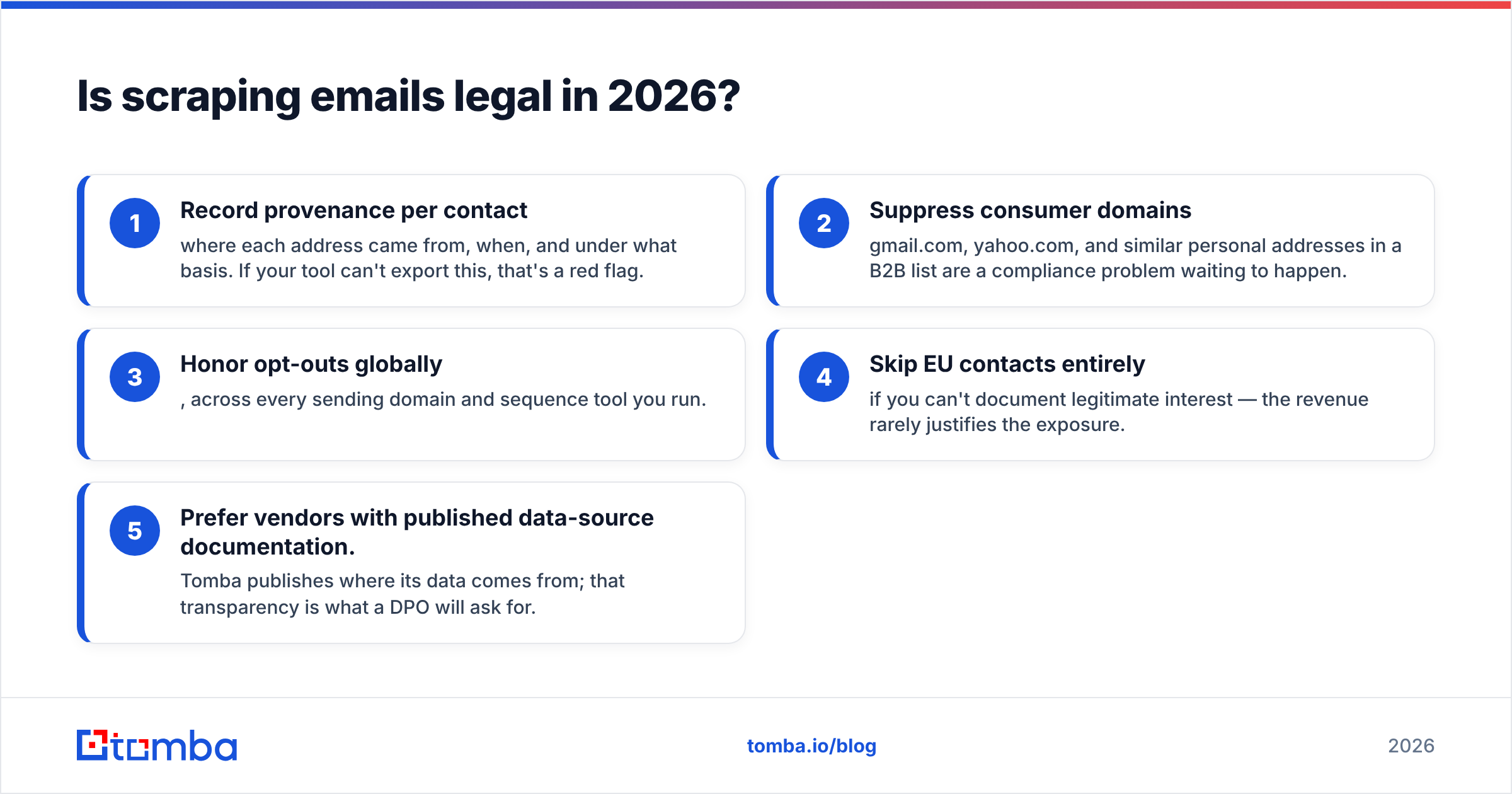
Five guardrails keep you on safe ground.
- Log where each email came from, when, and on what basis. If your tool cannot export that, treat it as a red flag.
- Drop consumer domains such as gmail.com and yahoo.com from a B2B list.
- Honor every opt out across all of your sending domains and tools.
- Skip EU contacts if you cannot show legitimate interest. The revenue rarely covers the risk.
- Pick vendors who publish their sources. Tomba shows where its data comes from, which is the first thing a data officer will ask for.
None of this is legal advice, and the rules shift by country. But "the tool did it on its own" has never worked as a defense.
How does email scraper software compare with a finder?#
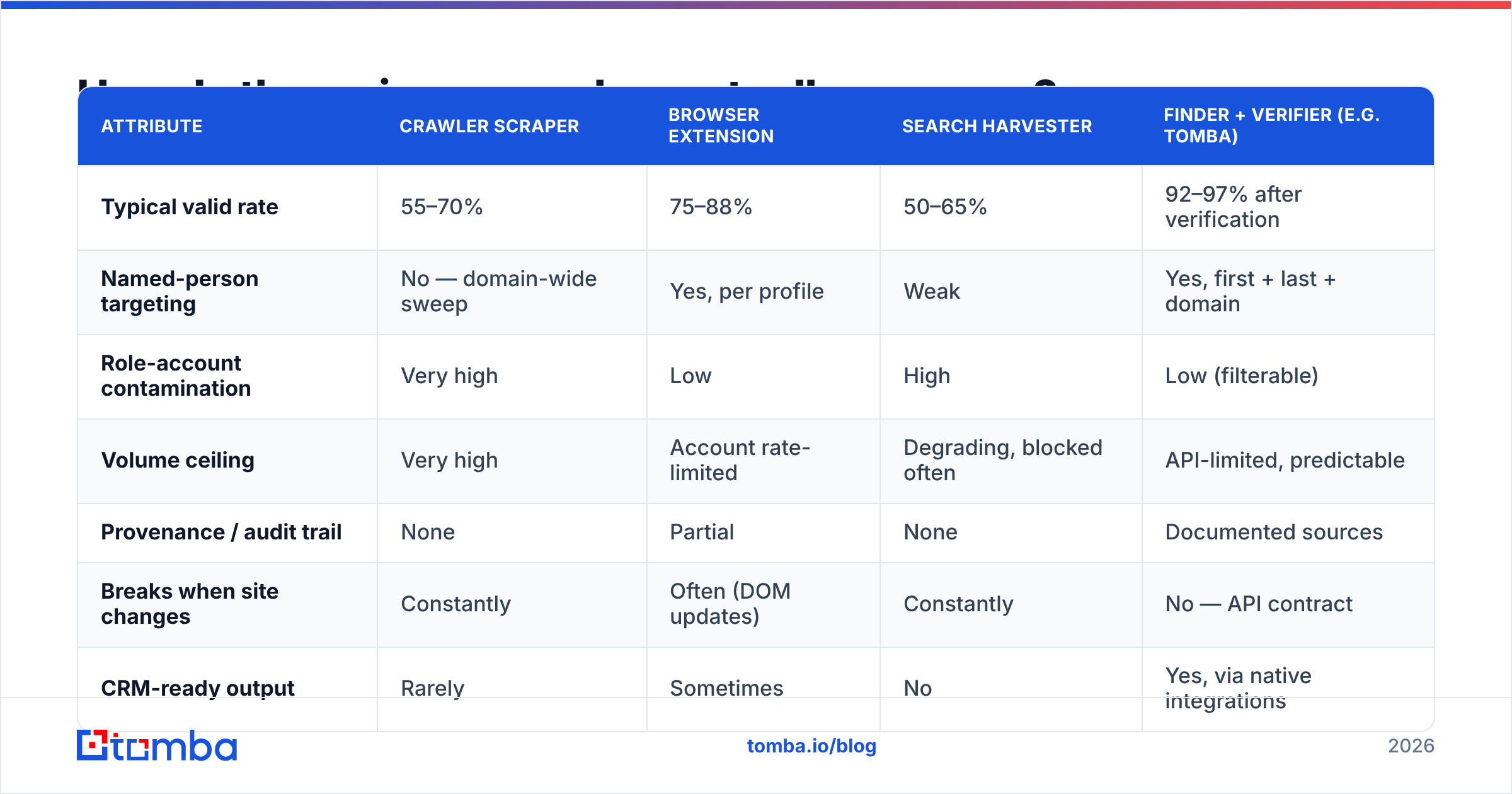
| Attribute | Crawler | Browser add-on | Search harvester | Finder plus tests |
|---|---|---|---|---|
| Typical valid rate | 55–70% | 75–88% | 50–65% | 92–97% |
| Targets a named person | No | Yes | Weak | Yes |
| Shared inbox noise | Very high | Low | High | Low |
| Volume ceiling | Very high | Rate limited | Often blocked | Steady |
| Source records | None | Partial | None | Full |
| Breaks when a site changes | Often | Often | Often | No |
| Ready for your CRM | Rarely | Sometimes | No | Yes |
| Cost per usable contact | High | Medium | High | Low |
| Best for | Bulk domain sweeps | Small target lists | Little in 2026 | Steady outreach |
That last row decides most deals, and most vendor pages skip it. Say a $29 tool returns 20,000 strings. At 60% valid, with 55% of those shared inboxes, you get about 5,400 named people. And you have not paid to test them yet. Price the output, not the input.
What should a 2026 email sourcing stack look like?#
Build it in four layers. Each one narrows the funnel and lifts quality. Email scraper software, at best, feeds the first layer.
1. Find companies. Start with accounts, not people. Filter by size, funding, or tech in use with the website tech stack checker. You can also spot firms who visit you through visitor reveal. The output is a list of domains.
2. Find people. For each domain, pull the roles you sell to. Domain search returns known emails at a firm with roles and a score. It is the honest swap for crawling the site yourself. If you already have a name from LinkedIn or an event, the email finder turns first name, last name, and domain into a tested email.
3. Test. Never send to an email you have not tested. Never trust a test older than 90 days. Roughly 2–3% of any B2B list rots each month as people move jobs. Catch-all domains need care of their own, so a catch-all verifier tells you if a domain takes all mail or if the mailbox is real.
4. Add data and route. Job title, seniority, headcount, and phone should flow into your CRM so routing and scoring work. Contact enrichment and the HubSpot integration do this with no CSV round trip.
Run it as a pipeline, not a one off dump. Teams with healthy email deliverability treat list building as upkeep. They re-test each quarter, block hard bounces for good, and hold back volume on new domains until trust is built.
Which tool fits which job?#
There is no single winner, because the jobs differ.
- You want every email on 500 named domains, shared inboxes included, for partner or PR work. A crawler earns its place here. Test the list before you send.
- You are running ABM against 80 accounts. A browser add-on plus human review beats bulk. Volume does not matter. Precision does.
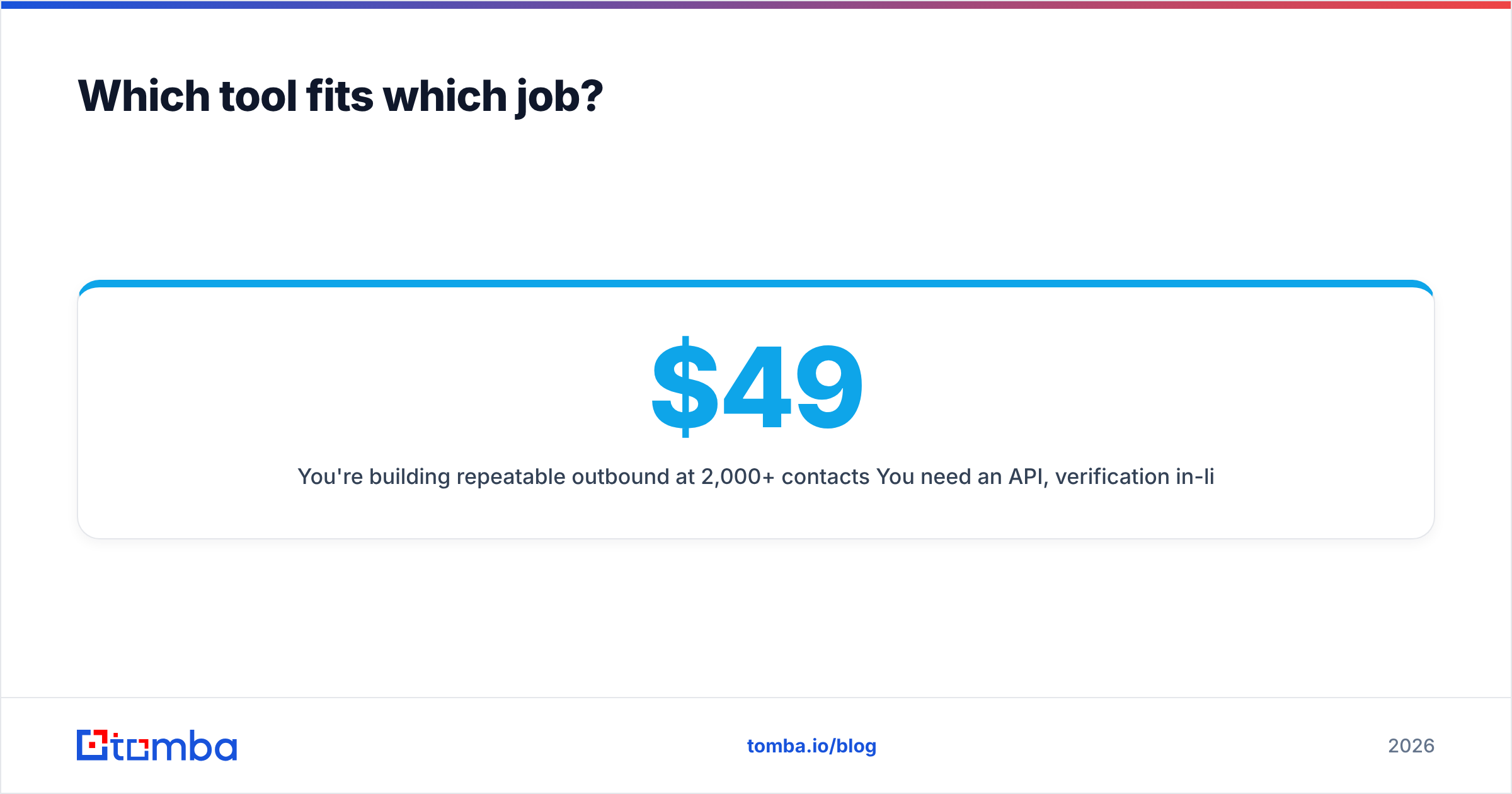
- You send 2,000 or more emails a month. You need an API, tests in line, and source records.
On that third case, Tomba pricing is worth a direct look. Free covers 25 searches a month to test the water. Starter is $49, Growth is $99, and Pro is $249. Enterprise is custom. Compare the cost per usable contact, not the sticker.
Two more cases sit outside those three.
- You buy by the list, not by the lookup. Vendors like BookYourData sell filtered B2B data as you go. That is a different buy from a per lookup finder, and a fair fit when you want a set list handed over.
- You want this in code. The Tomba API and MCP server drop into a script or an agent. The bulk email finder handles CSV scale jobs with no crawler to write.
Read the reviews before you commit. G2's lead intelligence category and Capterra both surface real gripes about accuracy and billing. Read the two star reviews first. They name the failure modes.
What metrics should you track?#
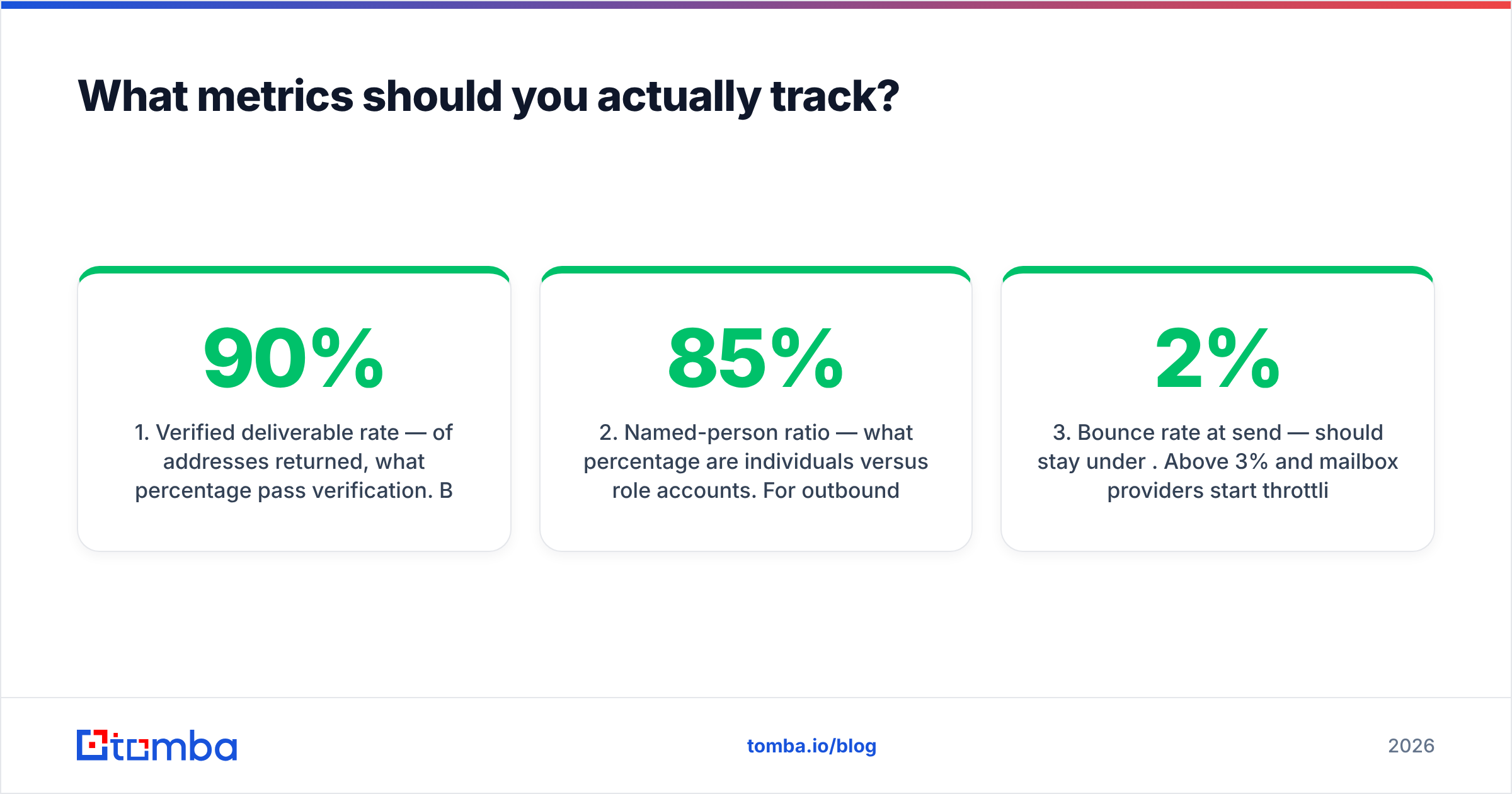
Most email scraper software sells you on one number: emails found. Drop it and track these four instead.
- Valid rate. Of the emails returned, how many pass a test. Under 90% for a paid finder is weak.
- Named person share. How many are people, not shared inboxes. For outreach, aim above 85%.
- Bounce rate at send. Keep it under 2%. Above 3% and inbox providers throttle you. Above 5% and you harm your domain.
- Cost per reply. The only number your CFO wants. Divide data spend by talks started, not by contacts bought.
Track them each month, by source. Most teams learn within two cycles that their cheapest source is the priciest one once bounces, inbox harm, and rep hours are counted.
Test before you scale. Pull 100 contacts from a new source, test them, send to 50, and read the bounce and reply rates before you spend. A free email checker makes the first half of that test free.
Where does email scraper software still win?#
Three cases, and they are narrower than the ads suggest.
- Directories and marketplaces where the emails are published so people will write in. Think trade groups, event exhibitor lists, and supplier books.
- Market research where you want the shape of a market, not a send list.
- Seeding a domain list that you then work through properly. Scrape to find firms. Source to find people.
Everything else has a better tool. If email scraper software is your whole prospecting plan, you pay for the same lead three times: once in credits, once in inbox harm, and once in rep hours spent on dead mailboxes.
Ready to stop scraping and start sourcing?#
If this sounds like your week — big lists, ugly bounce rates, reps who hit nobody — the fix is not a better scraper. Swap the grab step for a resolve and test step.
Start with the Tomba Email Finder. The free tier gives you 25 searches a month. Run it head to head against the email scraper software you use now. Same 25 people, same day. Compare valid rate and named person share. If Tomba loses, you are out one afternoon. If it wins, you have a number to take to your budget talk instead of a hunch.
Related guides#
Ready to find emails that actually work?
Join 150,000+ professionals who stopped guessing and started sending. Free credits on signup — no credit card required.
Get the Tomba newsletter
Practical outbound tactics and product updates — once every two weeks.
About the author