Email Sentiment Tracking: The 2026 Guide for Sales Teams
Sentiment tracking promises to tell you which replies are actually warm. Here's how the scoring really works, how accurate it is on cold outbound, what the major tools charge, and when it earns its seat in your stack.
TL;DR
- Email sentiment tracking classifies inbound replies as positive, neutral, or negative so reps can triage a shared inbox by intent instead of by timestamp.
- On clean, well-targeted outbound, modern LLM-based classifiers land around 85–92% agreement with human labeling. On messy cold outbound stuffed with auto-replies, bounces, and one-word answers, real-world accuracy drops closer to 70%.
- The biggest ROI is not "measuring team morale." It is routing: surfacing the 3–5% of replies that are genuinely buying signals within minutes instead of hours.
- Sentiment data is downstream of list quality. Garbage sends produce garbage replies, and no classifier fixes that — verification and targeting do.
- Budget $0 (native in HubSpot/Outreach tiers you already pay for) to roughly $300+/mo standalone. Only buy standalone if you handle 2,000+ replies a month.
What is email sentiment tracking?#
Email sentiment tracking is the practice of automatically scoring the emotional tone and intent of inbound replies, then using that score to route, prioritize, or report on conversations.
Think of it like a hotel front desk. A hundred guests walk in every hour. Some want to check in, some want to complain, some are just asking where the elevator is. A good front desk clerk sorts them in under two seconds by tone and body language. Sentiment tracking is software trying to do that same triage on your reply inbox — but with text only, and without eye contact.
Technically, most systems output two things per reply:
- A polarity label — positive, neutral, or negative, usually with a confidence score between 0 and 1.
- An intent label — "interested," "not now," "wrong person," "unsubscribe," "out of office," "referral."
The second one is what actually moves revenue. Polarity alone is nearly useless in B2B: "Sure, send me pricing" and "Sure, but we just signed with a competitor" both read as positive to a naive model. Intent classification is what separates a tool worth paying for from a sentiment gauge that looks nice on a dashboard.
Worth noting: sentiment tracking is not the same as reply-rate reporting. Your response rate tells you how many people wrote back. Sentiment tracking tells you whether you'd want them to.
How does email sentiment tracking actually work?#
Under the hood, almost every tool on the market runs some version of this five-step chain:
- Ingestion — The tool connects to your mailbox via Gmail API, Microsoft Graph, or IMAP, and pulls new inbound messages tied to a known sequence or contact record.
- Cleaning — Quoted history, signatures, disclaimers, and legal footers get stripped. This step matters more than people expect; a 300-word legal footer will drag a two-word reply's classification in unpredictable directions.
- Classification — The cleaned body goes to a model. In 2024 this was usually a fine-tuned BERT-family classifier. In 2026 it is almost always an LLM call with a structured output schema, sometimes with a cheap classifier in front to filter obvious auto-replies.
- Enrichment — The label is joined to CRM context: deal stage, ICP fit, account tier, prior touches. A "positive" from a target enterprise account is a different event than a "positive" from a student inquiry.
- Action — Routing rules fire. Positive replies to a rep's queue or Slack channel, negatives to auto-suppression, out-of-office to a re-queue with a date offset.
Steps 2 and 4 are where vendors differentiate. Step 3 is largely commoditized — most tools call the same underlying foundation models, so "our AI is more accurate" claims deserve skepticism unless the vendor publishes a labeled benchmark.
How accurate is email sentiment tracking in practice?#
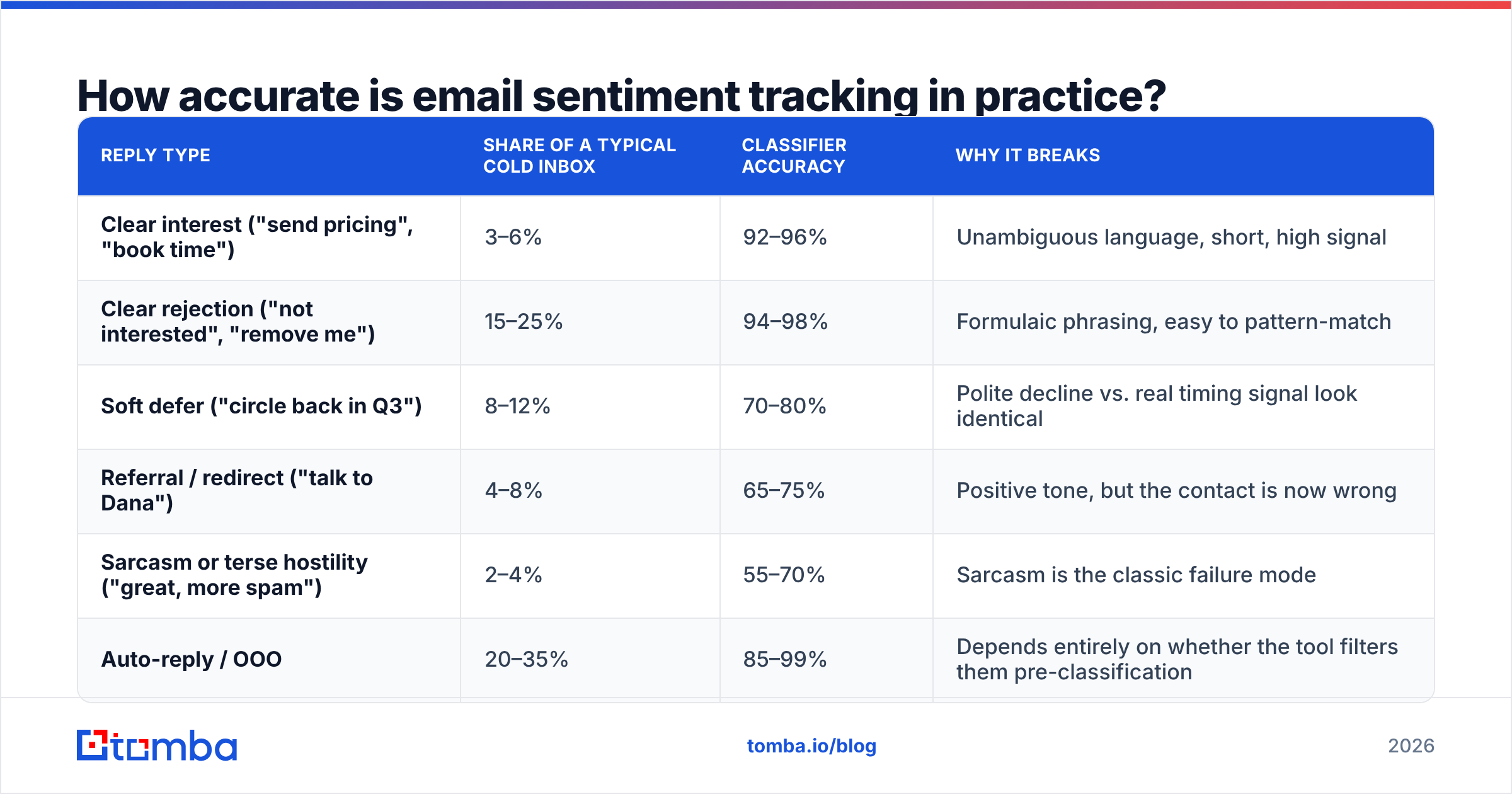
Accuracy depends almost entirely on the input, not the model. Here is the honest breakdown by reply type:
| Reply type | Share of a typical cold inbox | Classifier accuracy | Why it breaks |
|---|---|---|---|
| Clear interest ("send pricing", "book time") | 3–6% | 92–96% | Unambiguous language, short, high signal |
| Clear rejection ("not interested", "remove me") | 15–25% | 94–98% | Formulaic phrasing, easy to pattern-match |
| Soft defer ("circle back in Q3") | 8–12% | 70–80% | Polite decline vs. real timing signal look identical |
| Referral / redirect ("talk to Dana") | 4–8% | 65–75% | Positive tone, but the contact is now wrong |
| Sarcasm or terse hostility ("great, more spam") | 2–4% | 55–70% | Sarcasm is the classic failure mode |
| Auto-reply / OOO | 20–35% | 85–99% | Depends entirely on whether the tool filters them pre-classification |
Two takeaways. First, the categories that are easiest to classify are the ones you care least about — you don't need AI to spot "unsubscribe." Second, the highest-value ambiguous cases (soft defers and referrals) are exactly where models are weakest. Any vendor quoting a single blended "94% accurate" number is averaging over the easy cases.
Sarcasm remains the honest limitation. It has been the documented weak point of automated sentiment analysis since the field started, and the general research consensus on sentiment analysis hasn't changed on that front just because the models got bigger.
Which tools offer email sentiment tracking in 2026?#
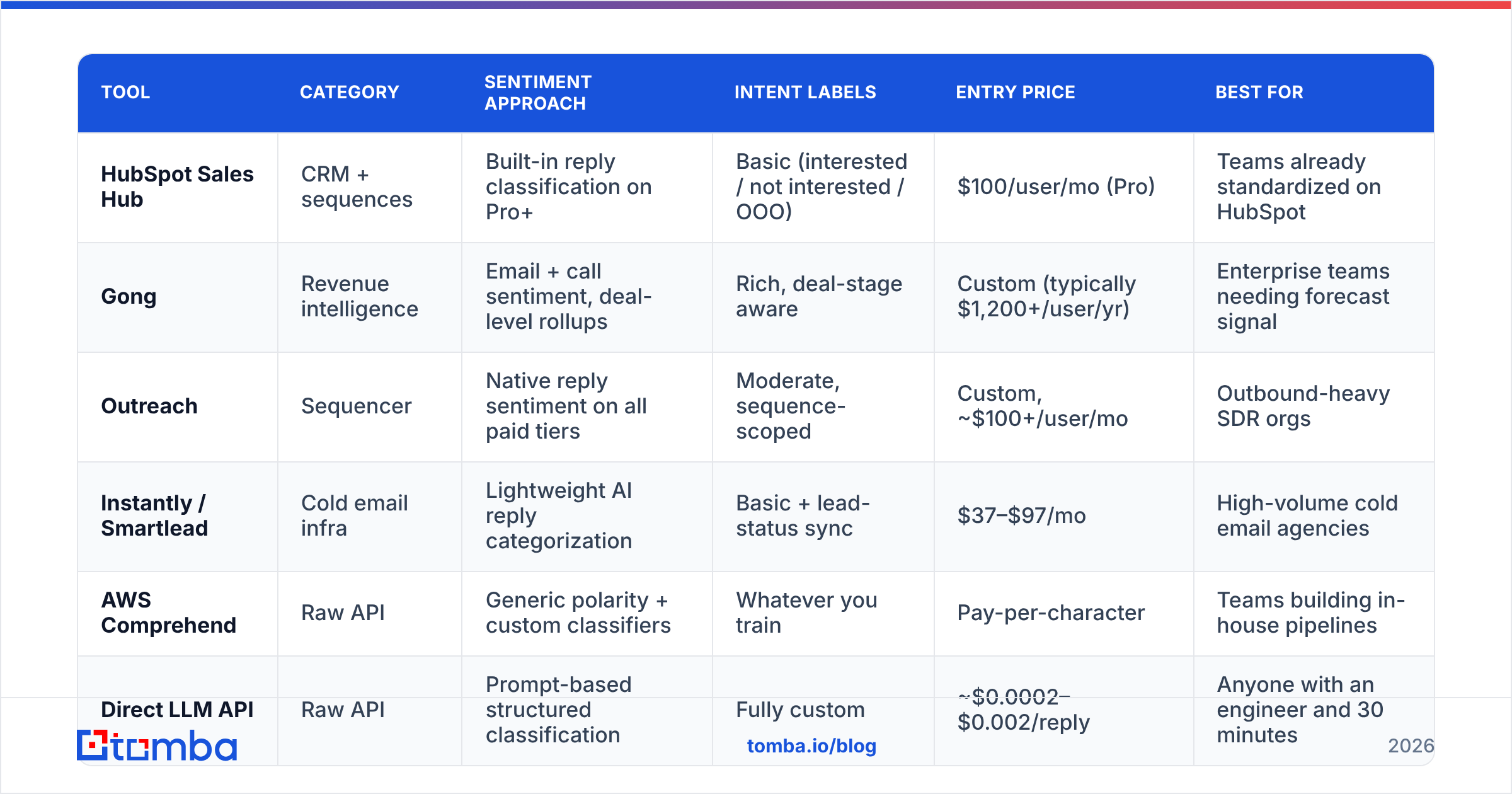
The market splits into three groups: sequencers that bundle it, revenue-intelligence platforms that do it as part of broader conversation analysis, and standalone API-first classifiers.
| Tool | Category | Sentiment approach | Intent labels | Entry price | Best for |
|---|---|---|---|---|---|
| HubSpot Sales Hub | CRM + sequences | Built-in reply classification on Pro+ | Basic (interested / not interested / OOO) | $100/user/mo (Pro) | Teams already standardized on HubSpot |
| Gong | Revenue intelligence | Email + call sentiment, deal-level rollups | Rich, deal-stage aware | Custom (typically $1,200+/user/yr) | Enterprise teams needing forecast signal |
| Outreach | Sequencer | Native reply sentiment on all paid tiers | Moderate, sequence-scoped | Custom, ~$100+/user/mo | Outbound-heavy SDR orgs |
| Instantly / Smartlead | Cold email infra | Lightweight AI reply categorization | Basic + lead-status sync | $37–$97/mo | High-volume cold email agencies |
| AWS Comprehend | Raw API | Generic polarity + custom classifiers | Whatever you train | Pay-per-character | Teams building in-house pipelines |
| Direct LLM API | Raw API | Prompt-based structured classification | Fully custom | ~$0.0002–$0.002/reply | Anyone with an engineer and 30 minutes |
The uncomfortable finding when you lay it out: for most teams, the marginal value of a standalone sentiment product over the classification already bundled in their sequencer is small. If you send from Outreach or Instantly, you already have reply categorization. The question is whether it's good enough, not whether you're missing the capability entirely.
If you're evaluating vendors, cross-check the marketing claims against verified user reviews on G2 — sentiment accuracy complaints show up in review text long before they show up in a vendor's changelog.
Is email sentiment tracking worth the cost?#
Run the arithmetic before you sign anything. The value is measured in rep-minutes saved and speed-to-lead gained, not in dashboard aesthetics.
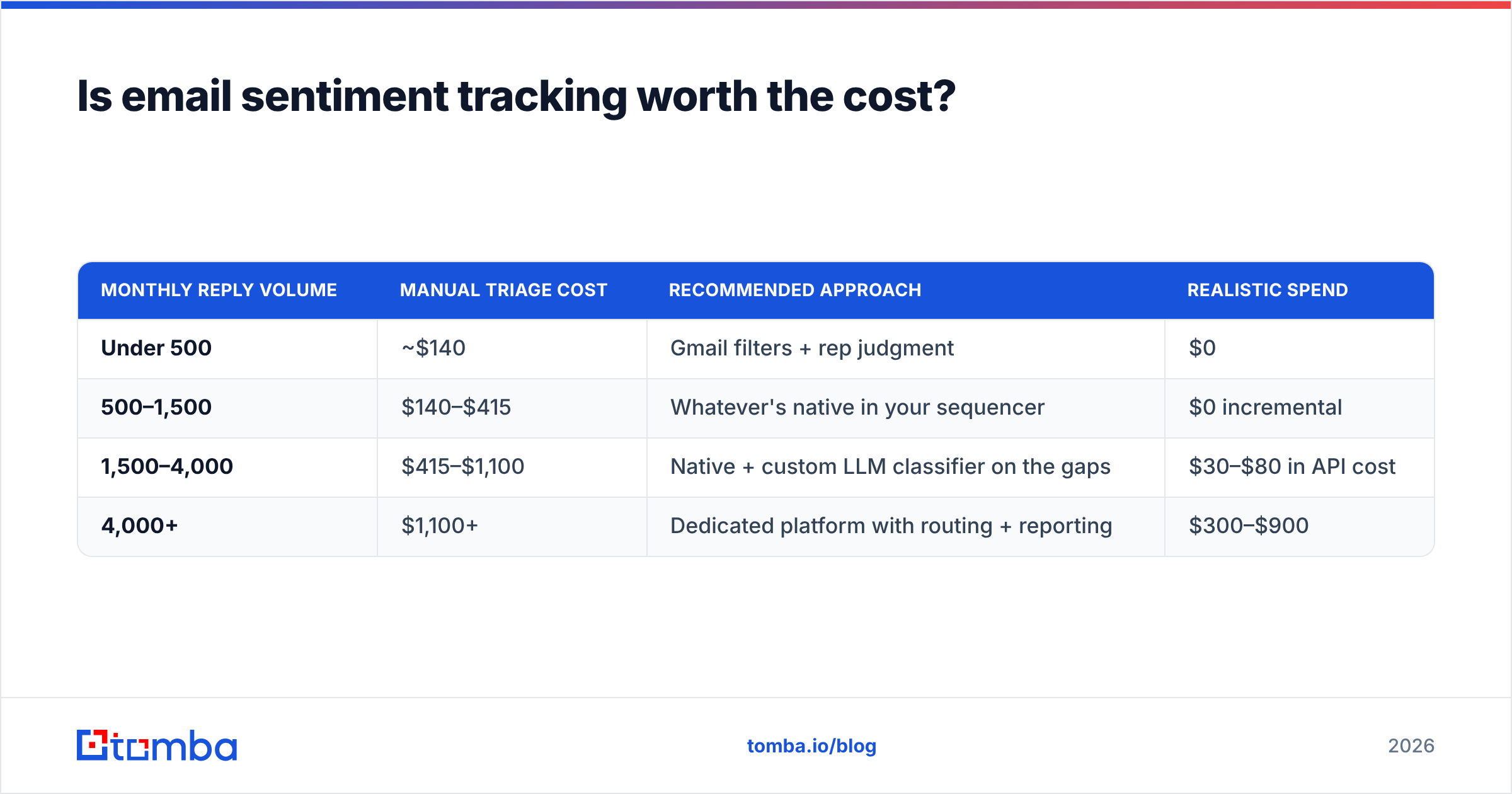
Suppose a 5-rep team receives 1,500 replies a month. Manual triage takes roughly 20 seconds per reply, so that's about 8.3 hours of collective sorting monthly. At a loaded rep cost of $50/hour, manual triage burns roughly $415/mo. A classifier that handles 85% of replies correctly cuts that to about $110/mo in review time — call it $300/mo in recovered capacity.
That means a $300/mo standalone tool breaks even on labor alone at 1,500 replies. Below roughly 800 replies a month, standalone tooling loses to a spreadsheet and a filter rule. Above 3,000, it wins comfortably — and the speed-to-lead gain on that top 3–5% of hot replies stops being a rounding error.
| Monthly reply volume | Manual triage cost | Recommended approach | Realistic spend |
|---|---|---|---|
| Under 500 | ~$140 | Gmail filters + rep judgment | $0 |
| 500–1,500 | $140–$415 | Whatever's native in your sequencer | $0 incremental |
| 1,500–4,000 | $415–$1,100 | Native + custom LLM classifier on the gaps | $30–$80 in API cost |
| 4,000+ | $1,100+ | Dedicated platform with routing + reporting | $300–$900 |
The row people skip is the third one. A direct LLM API call with a well-written schema costs roughly two-tenths of a cent per reply and beats most bundled classifiers, because you control the prompt and the label taxonomy. If you have any engineering capacity, build before you buy.
What does sentiment tracking not fix?#
This is the section vendors leave out. Sentiment tracking is a measurement layer. It reports on the quality of conversations you already started — it does not improve them.
Three failure patterns show up repeatedly:
- The "everything is neutral" inbox. If 80% of your replies classify as neutral, the problem is not the model. It's that your emails aren't asking anything worth reacting to. Fix the ask, not the classifier.
- The negative-sentiment spiral that's actually a deliverability problem. A sudden spike in hostile replies almost always correlates with a targeting or list-hygiene failure — you're reaching people who never should have been in the segment. Sentiment shows the symptom; email deliverability and list quality are the disease.
- Sentiment as a rep performance metric. Once "positive reply rate" becomes a scoreboard, reps optimize for it. They send softer, lower-commitment asks that generate polite non-answers. You get better sentiment scores and fewer meetings. Track it as a diagnostic, never as a quota.
The upstream fix is boring and effective: send fewer, better-targeted emails to addresses that actually exist. Running your list through an email verifier before launch removes the bounce noise that pollutes every downstream metric, sentiment included. Layering contact enrichment on top means your classifier is scoring replies from people who plausibly have the budget and the pain — which is when sentiment data starts predicting pipeline instead of just describing an inbox.

How do you implement email sentiment tracking without wasting a quarter?#
A pragmatic 30-day rollout:
- Label 200 replies by hand first. Before you evaluate any tool, build your own ground-truth set. Pull 200 recent replies, have two people label each one, and keep only the ones they agree on. This is your benchmark. Without it, you cannot evaluate a vendor's accuracy claim.
- Define your taxonomy in business terms. Not positive/negative. Use labels that trigger a different action:
book-meeting,send-info,wrong-person,timing-later,hard-no,auto-reply. Six labels is plenty. Twelve is unmanageable. - Test the native option first. Run your sequencer's built-in classifier against your 200-reply set. Score it. If it clears 85% on the labels you care about, stop shopping.
- Wire routing before reporting. The value is in the action.
book-meetingshould hit a Slack channel within 60 seconds.hard-noshould auto-suppress across every sequence. Dashboards can wait a month. - Re-audit at 90 days. Model behavior drifts, your messaging changes, and your ICP shifts. Re-run the benchmark quarterly with 100 fresh replies.
- Feed corrections back. Every manual reclassification a rep makes is training data. If your tool has no correction loop, that's a real strike against it.
Step 1 is the one teams skip and the one that determines whether the whole project produces anything. Buying a classifier without a benchmark is buying a scale without a reference weight.
Is sentiment tracking different for cold outbound vs. existing customers?#
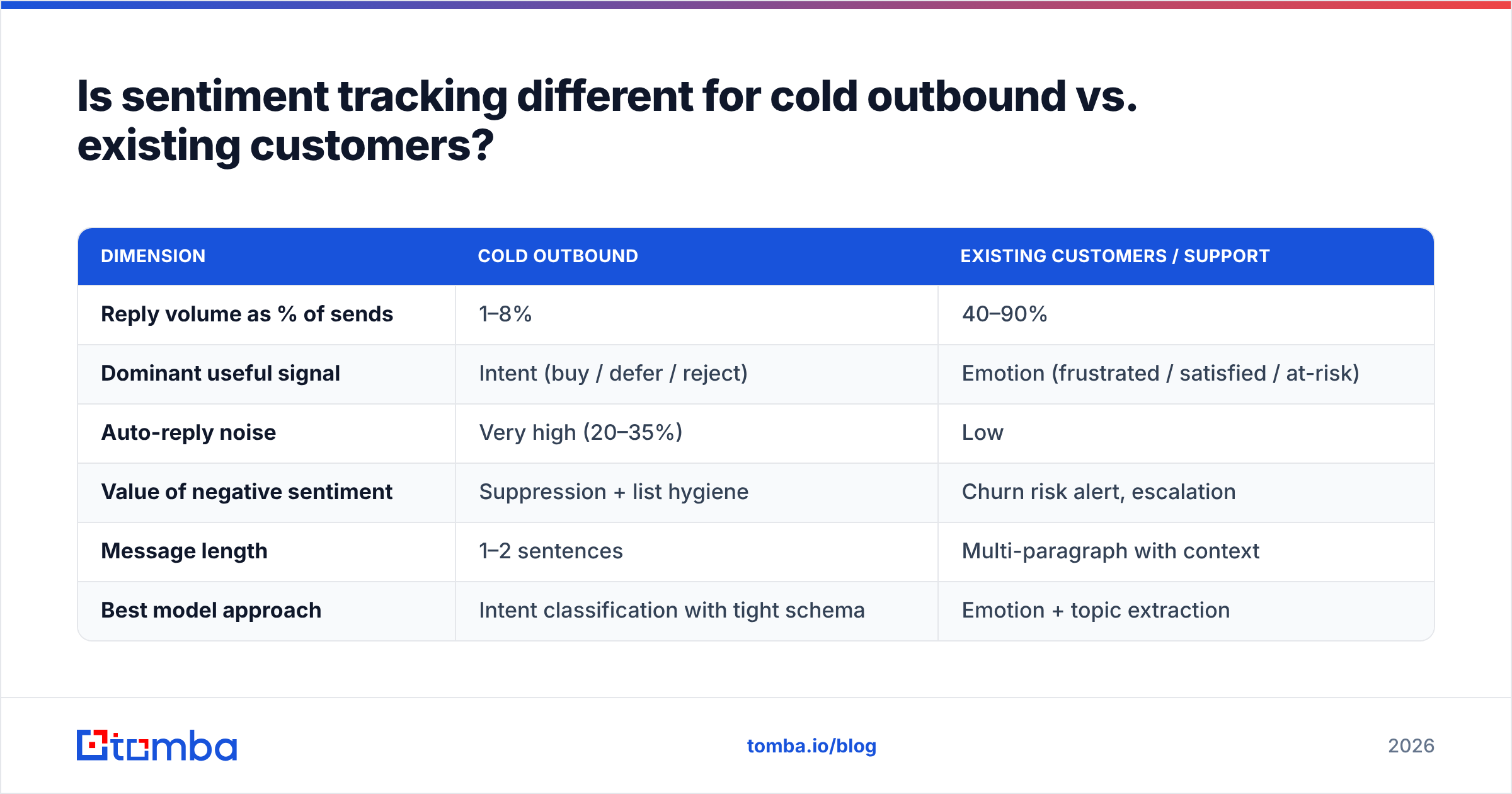
Substantially. Two different problems wearing the same name.
| Dimension | Cold outbound | Existing customers / support |
|---|---|---|
| Reply volume as % of sends | 1–8% | 40–90% |
| Dominant useful signal | Intent (buy / defer / reject) | Emotion (frustrated / satisfied / at-risk) |
| Auto-reply noise | Very high (20–35%) | Low |
| Value of negative sentiment | Suppression + list hygiene | Churn risk alert, escalation |
| Message length | 1–2 sentences | Multi-paragraph with context |
| Best model approach | Intent classification with tight schema | Emotion + topic extraction |
Vendors that built for customer support and then repositioned for sales tend to over-index on emotion and under-deliver on intent. If you're doing cold outbound, ask any vendor specifically how they handle out-of-office filtering and one-word replies — those two cases are most of your volume, and how a tool answers tells you whether it was actually built for outbound.
Frequently asked questions#
Does sentiment tracking hurt deliverability? No. It reads inbound mail; it doesn't change how you send. But acting on negative sentiment — suppressing hostile recipients fast — helps deliverability meaningfully by reducing future complaints.
Can I do this with ChatGPT and a spreadsheet? Yes, for under a few hundred replies a month. Export replies, batch them, classify with a structured-output prompt, paste back. It's unglamorous and it works. Automate once the manual loop annoys you twice in a week.
How many labels should I use? Five to seven. Beyond that, inter-rater agreement among your own humans collapses, which means you have no reliable benchmark to measure the model against.
Is 85% accuracy good enough? For routing, yes — a wrong label costs a rep 15 seconds of re-reading. For reporting to a board, no. Never present sentiment-derived pipeline forecasts without disclosing the error rate.
Where should you start?#
Start upstream. Sentiment tracking is a lens on the conversations your outbound creates, and the lens can only be as sharp as the list behind it. Teams that get real value from reply classification are almost always the ones whose contact data was accurate before they ever turned the feature on — verified addresses, correct roles, right companies.
If your reply data is currently a mix of bounces, catch-all guesses, and gatekeepers, fix that first. Tomba Email Finder gives you verified, source-attributed business emails so the replies you do get come from people worth classifying — starting free with 25 searches a month, with paid plans from $49/mo on the Starter tier. Check Tomba pricing to size it against your send volume. Clean inputs first, sentiment second — that order is the whole game.
Related guides#
Ready to find emails that actually work?
Join 150,000+ professionals who stopped guessing and started sending. Free credits on signup — no credit card required.
Get the Tomba newsletter
Practical outbound tactics and product updates — once every two weeks.
About the author