Email Sequence for Sales Funnels: The 2026 Playbook
Most funnel sequences die at email two. Here's the stage-by-stage structure, timing, and copy rules that keep a sales funnel email sequence producing replies in 2026 — plus the tooling that actually matters.
TL;DR
- An email sequence for sales funnels is not one campaign — it's three or four different sequences, each mapped to a funnel stage with its own goal, cadence, and success metric.
- Most sequences fail before the copy is even read: bad data, unverified addresses, and a domain that never warmed up properly.
- The highest-performing structure in 2026 is 5–7 emails over 18–24 days, with each email carrying exactly one job and one ask.
- Reply rate — not open rate — is the only top-line metric worth optimising after Apple and Google broke open tracking.
- Build the list with a verified email finder, then let the sequence do the qualifying.
What is an email sequence for sales funnels?#
An email sequence for sales funnels is a pre-planned series of messages that moves a specific contact from one funnel stage to the next — cold to aware, aware to engaged, engaged to booked, booked to closed.
The word "sequence" trips people up. Marketers hear "nurture drip." Sales reps hear "cold outreach cadence." They are different animals with different job descriptions, and running one where the other belongs is the single most common reason funnel email underperforms.
Think of it like a restaurant service. The host seats you, the server takes the order, the runner brings the food, the manager checks in. Each person has one job and hands off cleanly. A funnel sequence works the same way: each email has one job, one ask, and one handoff. When a single email tries to introduce you, explain the product, share three case studies, and book a call, it does all four badly.
Here's how the jobs break down by stage:
- Top of funnel (cold, no relationship) — earn a reply, not a meeting. The ask is a question, not a calendar link. Success metric: reply rate above 6%.
- Middle of funnel (engaged, hasn't bought) — prove relevance with proof. Case studies, benchmarks, teardown of their current setup. Success metric: click-through to a specific asset.
- Bottom of funnel (in an active deal) — remove friction. Pricing clarity, security docs, references, procurement help. Success metric: stage advance within 14 days.
- Post-loss / recycled — re-open on a trigger. New funding, new hire in the buying role, competitor churn. Success metric: reactivation rate per quarter.
- Expansion / referral — ask for the next unit of value from someone who already trusts you. Success metric: intro rate.
If you can't say which of those five a given email belongs to, it doesn't belong in the sequence.
Why do most funnel sequences stall at the second email?#
Because email two is where the sender runs out of things to say that aren't about themselves.
Email one usually has a hook — a trigger event, a mutual connection, an observation about their site. Email two, in a bad sequence, is "just bumping this to the top of your inbox." That message carries zero new information, which trains the recipient to ignore the thread. By email three the reply rate is effectively zero and every subsequent send is drilling a hole in your sender reputation.
The fix is boring: write all emails in the sequence before you send email one, and require every message after the first to introduce one new piece of information. A benchmark. A named customer in their vertical. A specific screenshot. A question you didn't ask yet. If you can't source new information for email five, the sequence is four emails long. That's fine.
The second stall cause is mechanical rather than editorial. If 12% of your list bounces, the mailbox provider downgrades your domain, and emails three through seven land in Promotions or Spam no matter how good the copy is. That's why email verification belongs in the build step, not the cleanup step.
What does a full funnel email sequence look like?#
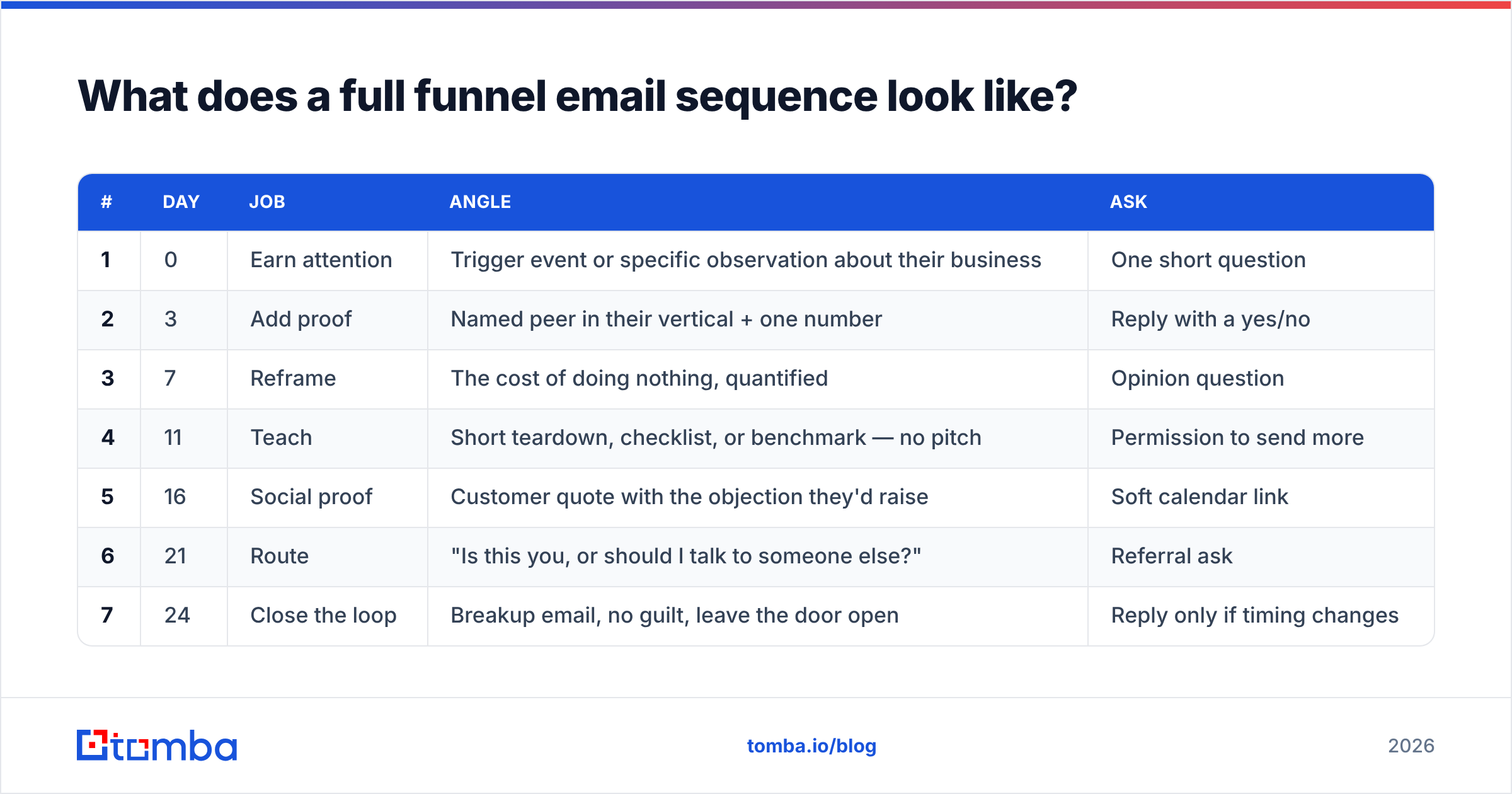
Here's a working 7-email structure for a mid-market B2B funnel. Adapt the angles; keep the spacing and the one-job-per-email rule.
| # | Day | Job | Angle | Ask |
|---|---|---|---|---|
| 1 | 0 | Earn attention | Trigger event or specific observation about their business | One short question |
| 2 | 3 | Add proof | Named peer in their vertical + one number | Reply with a yes/no |
| 3 | 7 | Reframe | The cost of doing nothing, quantified | Opinion question |
| 4 | 11 | Teach | Short teardown, checklist, or benchmark — no pitch | Permission to send more |
| 5 | 16 | Social proof | Customer quote with the objection they'd raise | Soft calendar link |
| 6 | 21 | Route | "Is this you, or should I talk to someone else?" | Referral ask |
| 7 | 24 | Close the loop | Breakup email, no guilt, leave the door open | Reply only if timing changes |
Two things about this table matter more than the specific angles.
First, the gaps widen as the sequence progresses: 3, 4, 4, 5, 5, 3 days. Front-loading is fine when the trigger is fresh; hammering someone every 48 hours on day 20 is not. The final short gap before the breakup email is deliberate — breakups perform best when they arrive close behind a real value email.
Second, only two of the seven emails contain a calendar link. Sequences that put a booking link in every message consistently underperform ones that ask questions, because a booking link is a large ask from someone who doesn't yet believe you're worth 30 minutes.
Which sequence type fits your funnel stage?#
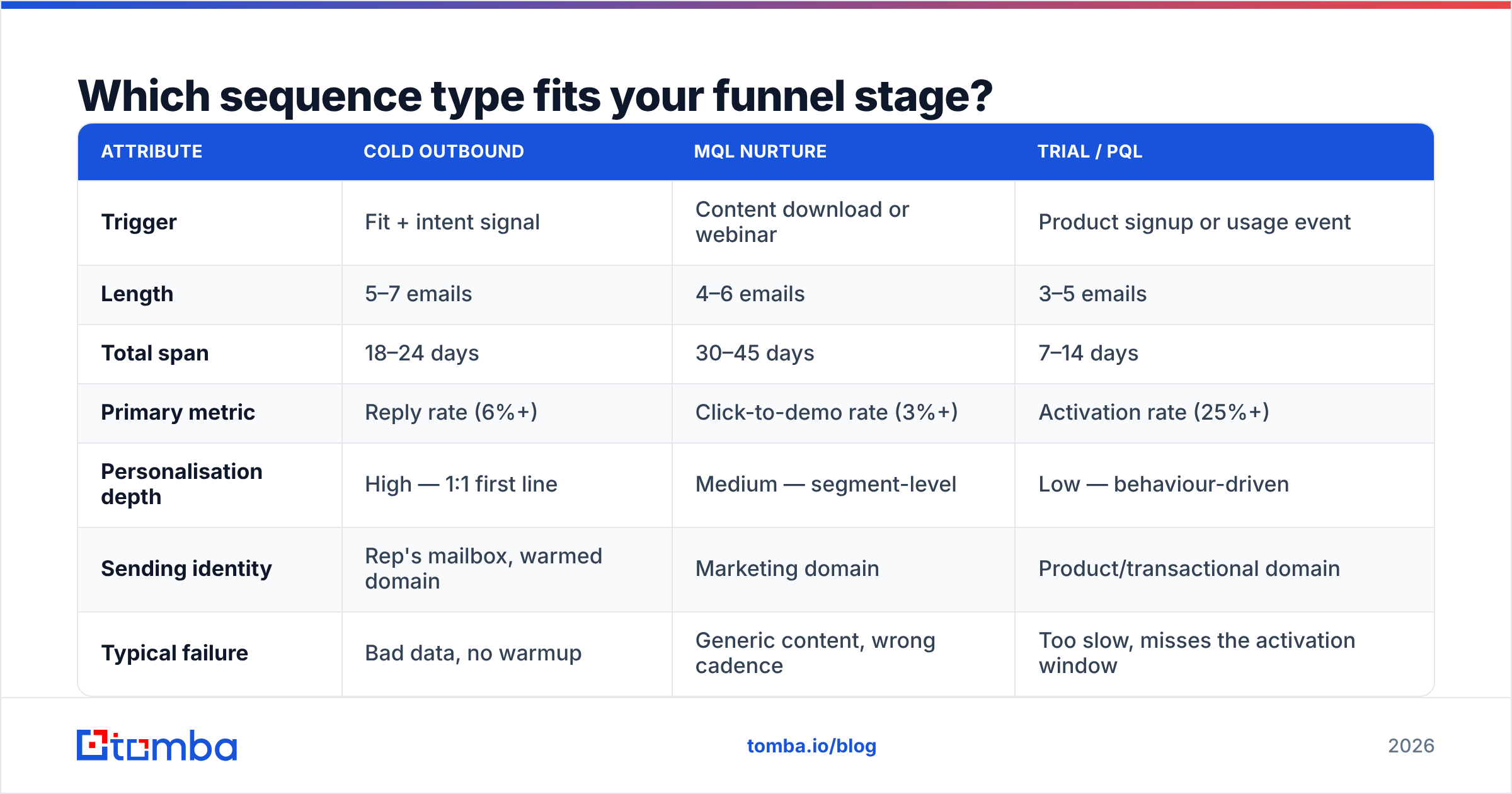
The same seven-email skeleton behaves very differently depending on which funnel stage you attach it to. Choosing wrong is expensive.
| Attribute | Cold outbound | MQL nurture | Trial / PQL |
|---|---|---|---|
| Trigger | Fit + intent signal | Content download or webinar | Product signup or usage event |
| Length | 5–7 emails | 4–6 emails | 3–5 emails |
| Total span | 18–24 days | 30–45 days | 7–14 days |
| Primary metric | Reply rate (6%+) | Click-to-demo rate (3%+) | Activation rate (25%+) |
| Personalisation depth | High — 1:1 first line | Medium — segment-level | Low — behaviour-driven |
| Sending identity | Rep's mailbox, warmed domain | Marketing domain | Product/transactional domain |
| Typical failure | Bad data, no warmup | Generic content, wrong cadence | Too slow, misses the activation window |
| Verification need | Critical | Moderate | Minimal (self-reported) |
The row that catches most teams out is sending identity. Running cold outbound from the same domain as your marketing newsletter is a fast way to torch both. Use a separate sending domain for cold, keep the main domain for opt-in traffic, and check the setup with an SPF checker before you send anything at volume.
The other row worth staring at is total span. Trial sequences that stretch past 14 days are usually arriving after the user has already decided. Cold sequences compressed into 10 days are usually arriving before the recipient has had a chance to notice you exist.
How do you write emails that don't sound like a sequence?#
Three rules cover 80% of it.
Rule one: one idea per email, under 120 words. Long emails get archived. The test is whether the whole message fits on a phone screen without scrolling. If it doesn't, cut the paragraph you're most proud of — that's usually the one about you.
Rule two: subject lines describe, they don't sell. "Question about your onboarding flow" beats "Transform your onboarding today." Descriptive subjects survive spam filters better and set an honest expectation, which is what actually drives replies further down the sequence. Run candidates through a subject line tester before you commit 2,000 sends to one.
Rule three: never reference your own previous emails as the reason to reply. "Following up on my last note" is a status update about your workflow. "Saw you just opened a second office in Austin — does that change the timeline we discussed?" is information. One earns attention, the other spends it.
For the copy itself, HubSpot's sales blog publishes decent teardowns of real sequences with reply data attached, which beats guessing. But treat any published template as a skeleton, not a script — templates that circulate widely stop working because recipients pattern-match them within weeks.
What data and tooling does the sequence actually need?#
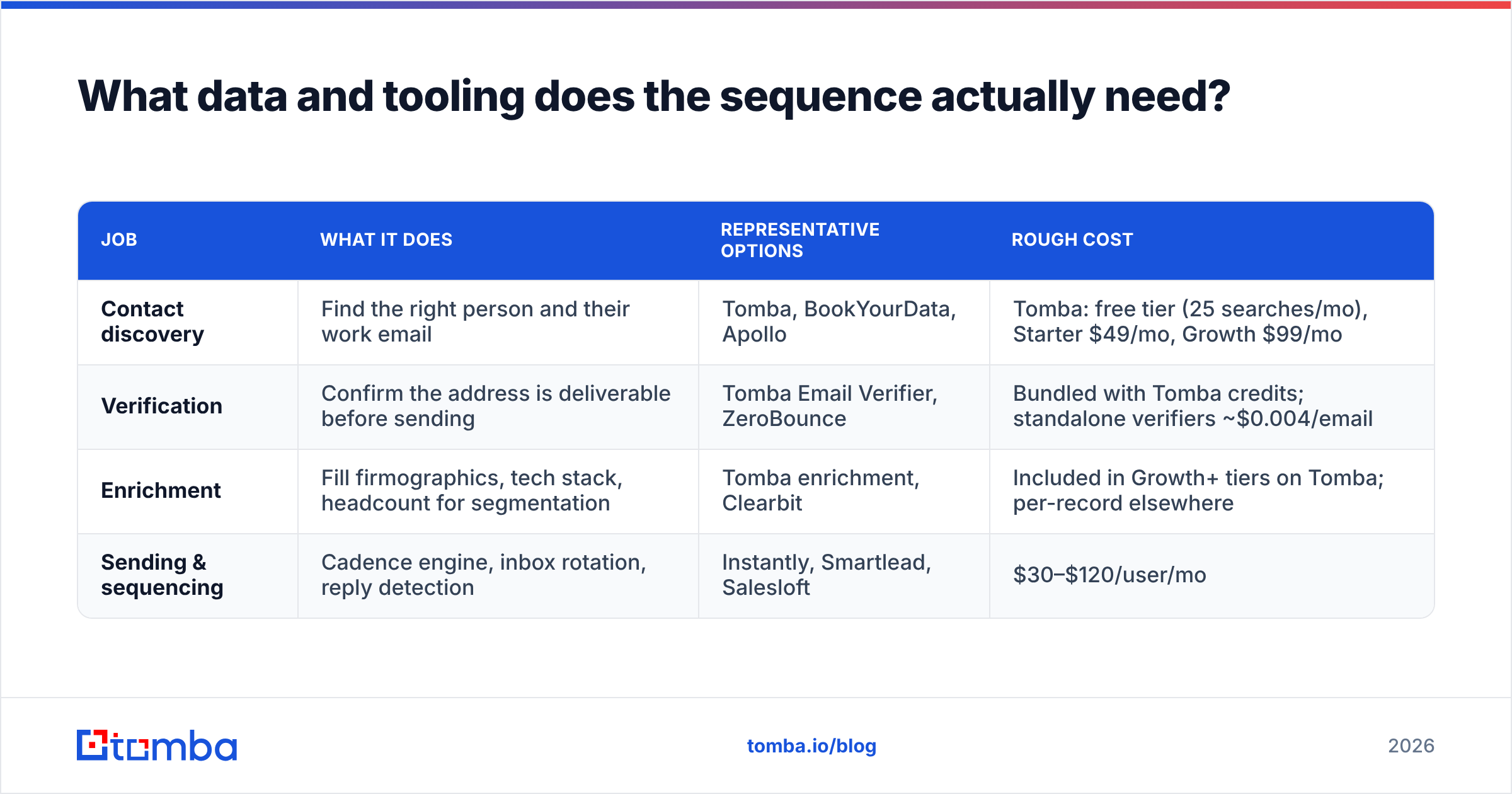
A funnel sequence is only as good as the contact records feeding it. The stack breaks into four jobs, and you can usually consolidate two or three of them.
| Job | What it does | Representative options | Rough cost |
|---|---|---|---|
| Contact discovery | Find the right person and their work email | Tomba, BookYourData, Apollo | Tomba: free tier (25 searches/mo), Starter $49/mo, Growth $99/mo |
| Verification | Confirm the address is deliverable before sending | Tomba Email Verifier, ZeroBounce | Bundled with Tomba credits; standalone verifiers ~$0.004/email |
| Enrichment | Fill firmographics, tech stack, headcount for segmentation | Tomba enrichment, Clearbit | Included in Growth+ tiers on Tomba; per-record elsewhere |
| Sending & sequencing | Cadence engine, inbox rotation, reply detection | Instantly, Smartlead, Salesloft | $30–$120/user/mo |
A note on the middle two rows: enrichment is what makes the second and third emails writable. If all you have is a name and an address, email two is going to be a bump. If you have headcount, funding stage, and tech stack, email two writes itself — "you're on HubSpot and just hired a RevOps lead, so this probably lands differently now."
For list building at the top, domain search is usually more efficient than person-by-person lookup: pull every relevant contact at a target account in one pass, then filter by role. BookYourData is a solid option when you'd rather buy a pre-built, filtered list than assemble one, particularly for verticals where you already know the ICP cold. Between the two approaches, the deciding factor is usually whether your ICP is defined by firmographics (buy a list) or by behaviour and triggers (build it yourself).
On the sending side, G2's sales engagement category is the least biased place to compare cadence tools, since the reviews are volume-weighted and you can filter by company size.
How do you measure whether the sequence works?#
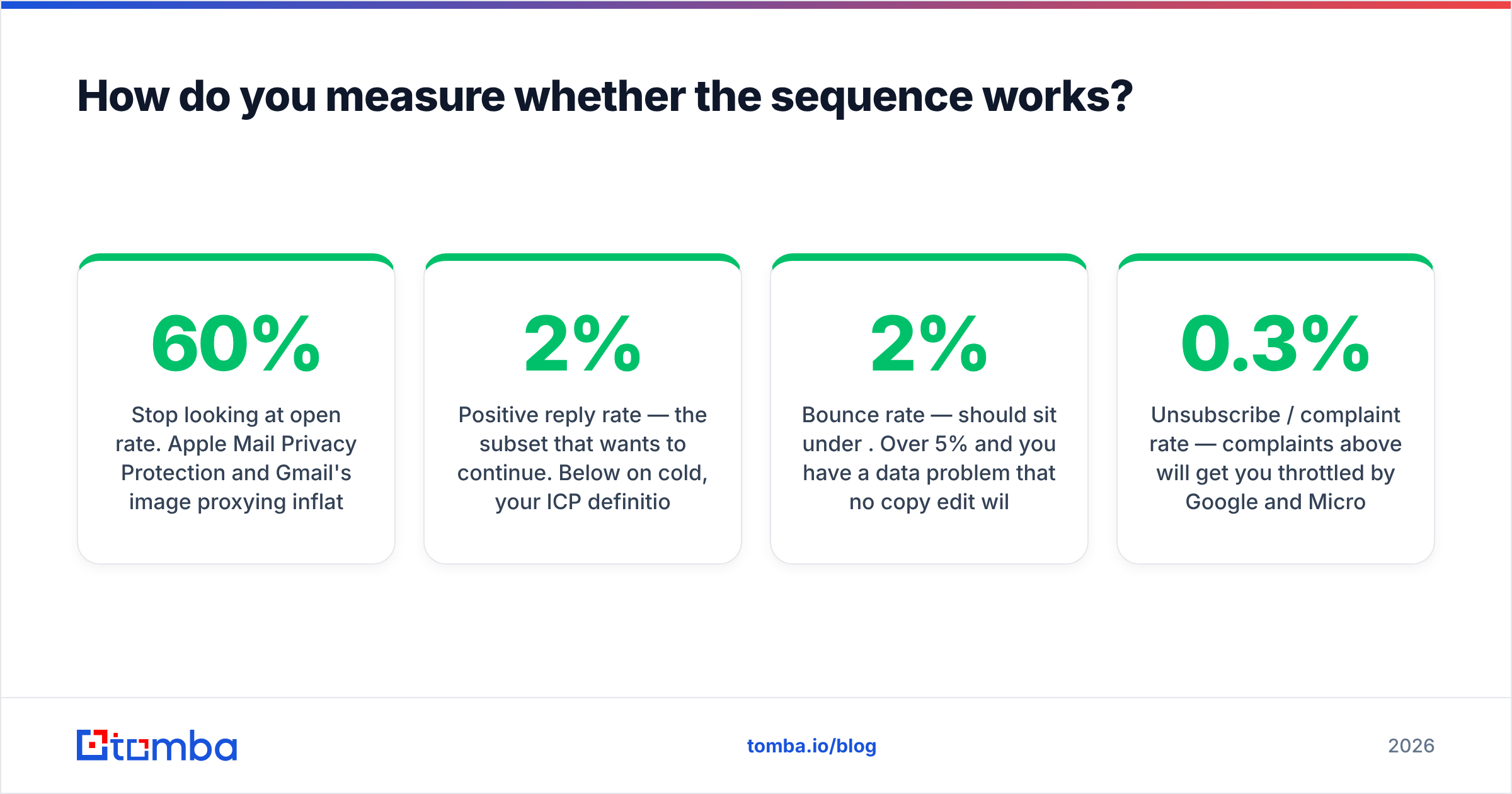
Stop looking at open rate. Apple Mail Privacy Protection and Gmail's image proxying inflate opens to the point where a 60% "open rate" tells you nothing about whether a human read anything.
Track these instead, per email position in the sequence:
- Reply rate — total replies divided by delivered, including negatives. Negative replies are data; they tell you the targeting is off, not the copy.
- Positive reply rate — the subset that wants to continue. Below 2% on cold, your ICP definition is wrong, not your copy.
- Bounce rate — should sit under 2%. Over 5% and you have a data problem that no copy edit will fix.
- Stage-advance rate — of contacts who entered the sequence, what percentage moved to the next funnel stage within 30 days. This is the metric your CRO actually cares about.
- Unsubscribe / complaint rate — complaints above 0.3% will get you throttled by Google and Microsoft regardless of everything else.
Then do the per-email breakdown. If email four generates 40% of your replies, the first three are too slow — move four's angle up. If email seven generates 30%, your breakup email is doing the work your value emails should have done, which usually means your value emails are pitching instead of teaching.
Salesforce's sales resources are worth a read on attaching sequence metrics to pipeline rather than to activity, which is where most sequence reporting falls apart.
What are the mistakes that quietly kill funnel sequences?#
Sending to unverified lists. The damage isn't the bounced email — it's the 30 days of degraded inbox placement afterwards that makes every good address perform worse. Verify before the first send, and re-verify any list older than 90 days.
Ignoring catch-all domains. A large share of enterprise domains accept everything at the SMTP layer, so a standard verifier returns "unknown." Sending blind to those is a coin flip; skipping them all means throwing away enterprise accounts. A dedicated catch-all verifier resolves most of that grey zone.
Reusing one sequence across every segment. A 200-person SaaS company and a 12,000-person manufacturer do not respond to the same cadence, the same proof, or the same ask. Two sequences with real segment fit beat one "universal" sequence every time.
No exit conditions. If a contact replies, books, or unsubscribes, they must exit immediately. Nothing kills trust faster than a "just following up" email arriving three days after someone booked a call with you.
Treating the breakup email as a threat. "I'll close your file" reads as manipulation to anyone who's received it twice. A neutral "sounds like this isn't a priority right now — I'll stop here, reply anytime if that changes" converts better and leaves the account re-openable next quarter.
Where should you start?#
Start with the list, not the copy. A mediocre sequence sent to 300 precisely-targeted, verified contacts will outperform a brilliant sequence sent to 3,000 scraped ones, and it will do it without damaging the domain you'll need for the next twelve months.
Pull your target accounts, find the right decision-makers, and verify every address before a single email goes out. The Tomba Email Finder does discovery and verification in one pass — start on the free tier at 25 searches a month to test your ICP hypothesis, then move to Starter at $49/mo once you know which segment replies. Full Tomba pricing scales from there as your funnel volume does.
Build the list right, and the sequence has a chance. Build it wrong, and no amount of copywriting saves it.
Related guides#
Ready to find emails that actually work?
Join 150,000+ professionals who stopped guessing and started sending. Free credits on signup — no credit card required.
Get the Tomba newsletter
Practical outbound tactics and product updates — once every two weeks.
About the author