Email Subject For Reaching Out: 47 Lines That Get Replies
Most cold subject lines fail before the body is ever read. Here are the formats, word counts, and 47 tested examples that actually earn opens and replies in 2026 — plus the ones to retire.
TL;DR
- The best email subject for reaching out is 3–7 words, lowercase-ish, and reads like a note from a colleague — not a campaign.
- Curiosity beats cleverness. Specificity beats curiosity. A subject that names a real detail about the recipient's world outperforms every "quick question" variant.
- Personalization tokens are worth roughly nothing if the rest of the line is generic.
{{FirstName}}in a template subject is a tell, not a trick. - Open rate is a vanity metric now that Apple Mail Privacy Protection inflates it. Optimize subject lines against reply rate, not opens.
- None of this matters if the address bounces. Verify before you send — a 6% bounce rate will bury even a perfect subject line.
What makes an email subject for reaching out actually work?#
Short answer: it survives the two-second scan in a crowded inbox because it looks like it came from a person who already knows something about the recipient.
Think of the inbox like a hotel lobby. Everyone in a matching branded polo shirt gets ignored. The one person who walks up and says "you're the one who runs the Berlin warehouse, right?" gets three seconds of attention. That's the whole job of a subject line for a cold or semi-cold outreach email — buy three seconds.
Four mechanics do the heavy lifting:
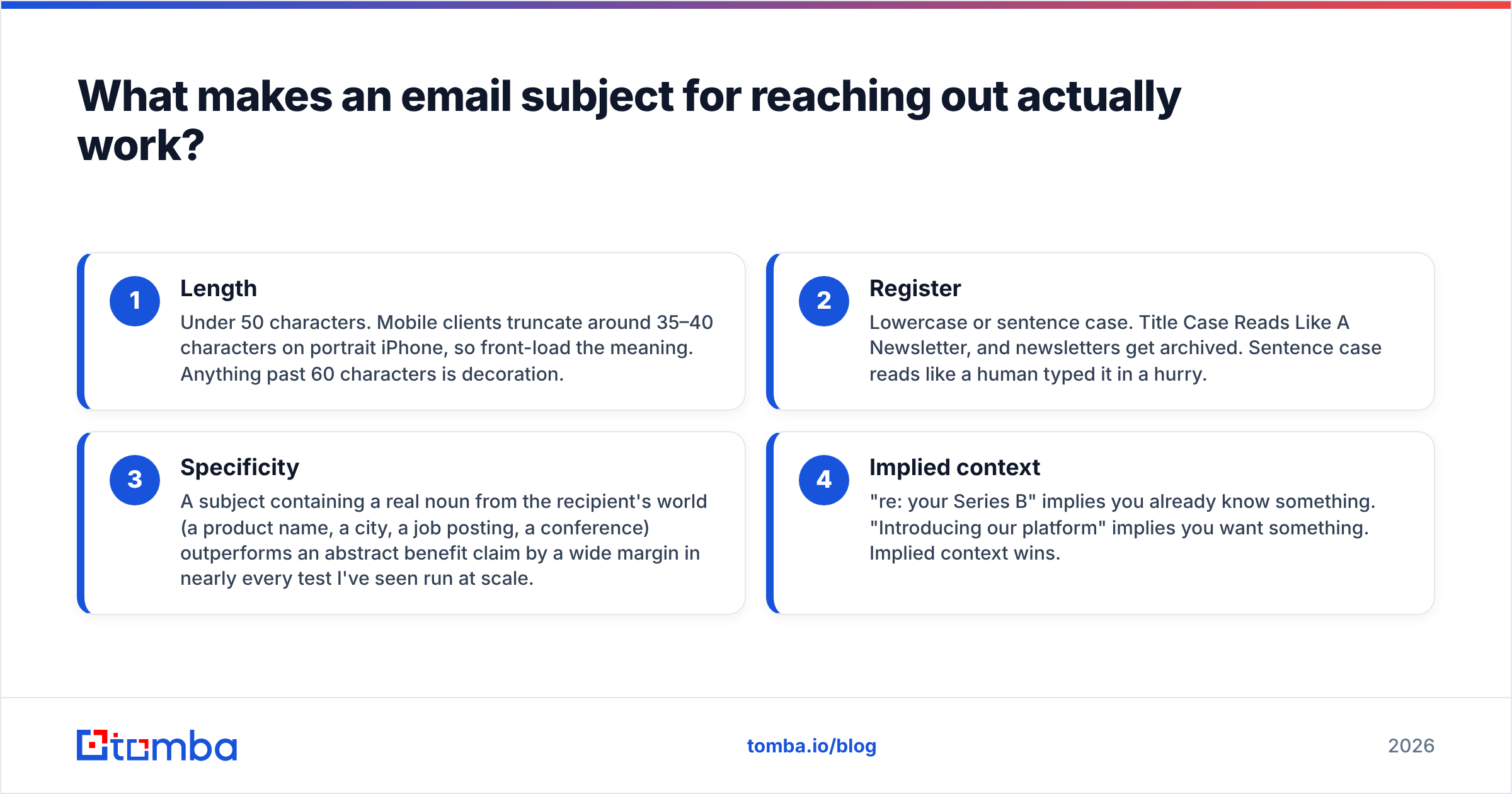
- Length — Under 50 characters. Mobile clients truncate around 35–40 characters on portrait iPhone, so front-load the meaning. Anything past 60 characters is decoration.
- Register — Lowercase or sentence case. Title Case Reads Like A Newsletter, and newsletters get archived. Sentence case reads like a human typed it in a hurry.
- Specificity — A subject containing a real noun from the recipient's world (a product name, a city, a job posting, a conference) outperforms an abstract benefit claim by a wide margin in nearly every test I've seen run at scale.
- Implied context — "re: your Series B" implies you already know something. "Introducing our platform" implies you want something. Implied context wins.
What does not work: emoji, ALL CAPS, exclamation points, the word "FREE," fake Re: and Fwd: prefixes on a first-touch email, and anything that reads like it was generated from a template you found on page one of Google.
What are the best subject line formats for reaching out?#
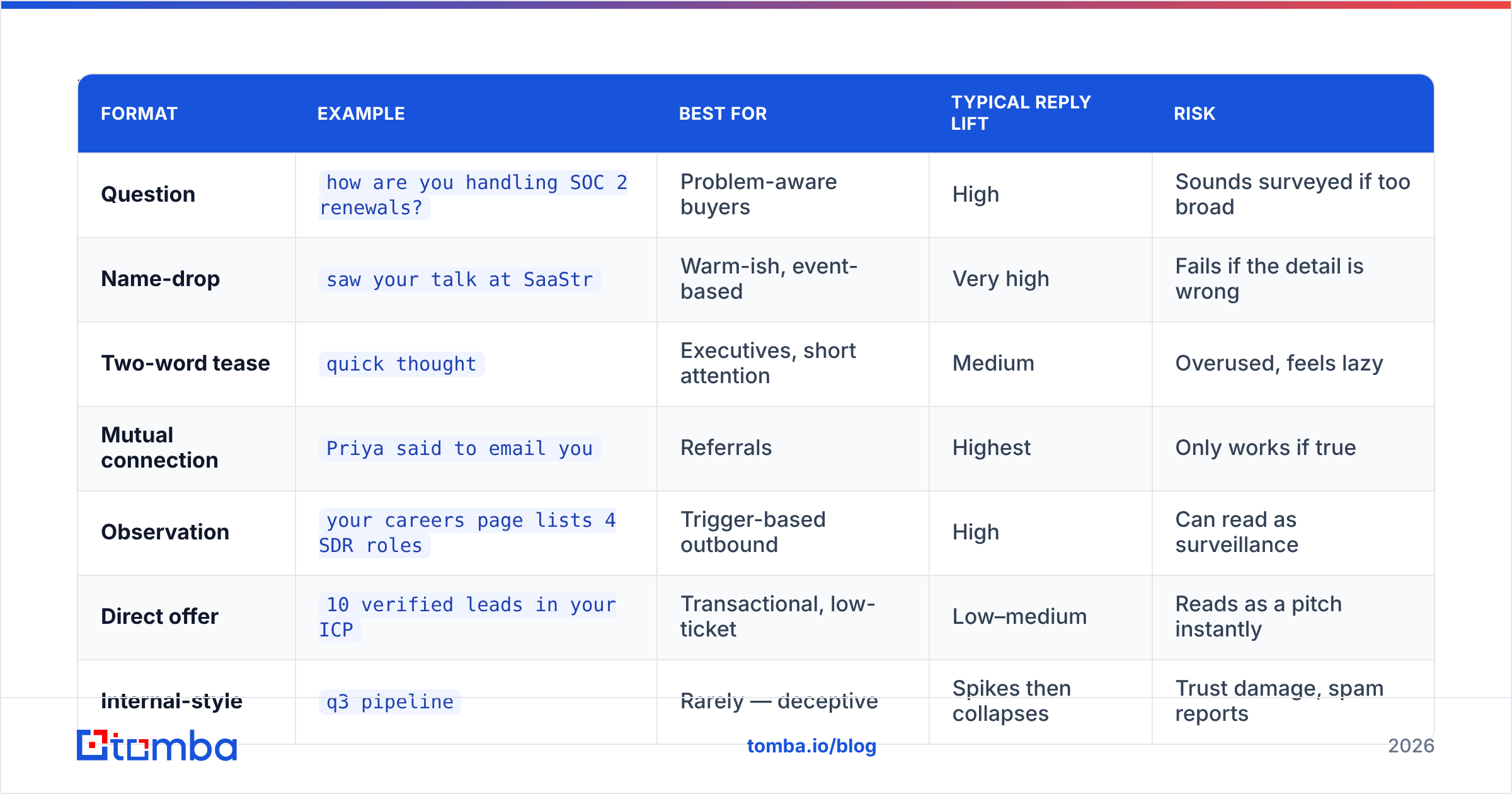
Here's the format taxonomy, with when each one earns its place. Use this as a decision table rather than a list of lines to copy.
| Format | Example | Best for | Typical reply lift | Risk |
|---|---|---|---|---|
| Question | how are you handling SOC 2 renewals? |
Problem-aware buyers | High | Sounds surveyed if too broad |
| Name-drop | saw your talk at SaaStr |
Warm-ish, event-based | Very high | Fails if the detail is wrong |
| Two-word tease | quick thought |
Executives, short attention | Medium | Overused, feels lazy |
| Mutual connection | Priya said to email you |
Referrals | Highest | Only works if true |
| Observation | your careers page lists 4 SDR roles |
Trigger-based outbound | High | Can read as surveillance |
| Direct offer | 10 verified leads in your ICP |
Transactional, low-ticket | Low–medium | Reads as a pitch instantly |
| Internal-style | q3 pipeline |
Rarely — deceptive | Spikes then collapses | Trust damage, spam reports |
The pattern to notice: everything above the midpoint of that table requires research, and everything below it requires none. That's not a coincidence. The formats that work are the ones a bulk sender can't produce at volume, which is exactly why they still work.
Wait — that placeholder renders as an image below.
How long should a subject line for reaching out be?#
Aim for 3–7 words and under 45 characters. Here's why each threshold exists:
- Under 35 characters — Fully visible on an iPhone in portrait mode with a two-line preview. This is the safest zone and where most high-reply lines land.
- 35–50 characters — Visible on desktop Gmail and most Outlook layouts. Fine if the first three words carry the meaning.
- 50–60 characters — Truncation risk on mobile. Only acceptable if the line still parses when cut in half.
- Over 60 characters — You're writing a sentence, not a subject. Move it into the first line of the body, where it will actually be read.
- One word — Works occasionally (
pricing,intro,timing) but only when the sender name carries authority or the recipient has some prior context. - Zero words — Empty subject lines get opened at surprisingly high rates and reported as spam at surprisingly high rates too. Not worth it.
A useful test: read the subject out loud. If it sounds like something you'd say to a coworker walking past your desk, it's fine. If it sounds like something a brand would say, rewrite it.
What are 47 subject lines worth stealing?#
Grouped by scenario. Swap the bracketed parts for real details — a template with the brackets left in is worse than no email at all.
Cold outbound, problem-first (1–10)
how are you handling [problem]?[Company]'s [process] questionis [pain point] still a thing at [Company]?two ways [peer company] fixed thisyour [tool] setupworth 10 minutes?[metric] questionafter the [recent change]about your [department] headcountis this on your roadmap?
Trigger-based (11–19)
11. saw the [funding round] news
12. congrats on [milestone]
13. your [job title] opening
14. noticed you're hiring SDRs
15. re: the [product] launch
16. [New exec name] joining — timing?
17. you moved off [old tool]?
18. your [conference] session
19. new office in [city]?
Referral and mutual connection (20–26)
20. [Name] suggested I reach out
21. [Name] said you'd know
22. intro from [Name]
23. we both know [Name]
24. passing this along from [Name]
25. [Name] mentioned [topic]
26. following up on [Name]'s intro
Content and value-first (27–34)
27. benchmark data for [industry]
28. the [industry] report you asked about
29. [number] things [competitor] does differently
30. stole this idea for you
31. a teardown of your [asset]
32. [X] vs [Y] — the honest version
33. checklist for [process]
34. one line to fix in your [asset]
Follow-up (35–42)
35. closing the loop
36. should I stop?
37. bad timing?
38. one more idea
39. bumping this up
40. wrong person?
41. last one from me
42. still worth a look?
Reconnecting with a dormant contact (43–47)
43. long time — quick update
44. still at [Company]?
45. been a while
46. thought of you when I saw this
47. picking this back up
Notice how few of them contain your company name. That's deliberate. The subject line's job is to get opened; the body's job is to explain who you are.
If you want a fast way to generate variants and pressure-test them against length and spam-trigger rules, run them through a subject line generator and then score the finalists with a subject line tester before they hit a real list.
Which subject lines should you retire in 2026?#
These still show up in templates everywhere, and they've been fully burned:
- "Quick question" — Not quick, rarely a question. Recipients have learned the pattern.
- "Following up" — Says nothing about why. Use
should I stop?orbad timing?instead. - "[Company] x [Their Company]" — Agency-speak. Signals a partnership pitch nobody asked for.
- "Idea for [Company]" — Fine in 2019, now a spam-filter smell in high-volume mailboxes.
- "Are you the right person?" — Puts the labor on the recipient before you've earned anything.
- Fake
Re:prefixes — Short-term open lift, long-term spam complaints. Google's sender guidelines treat complaint rate as a primary signal, and complaints follow deception faster than anything else. - Emoji in B2B — Works in ecommerce newsletters, reads as unserious in enterprise sales.
HubSpot's ongoing subject line research lands in the same place: the lines that survive are short, concrete, and free of hype adjectives.
Does personalization still beat curiosity?#
Yes — but only real personalization, which is a different thing from merge tags.
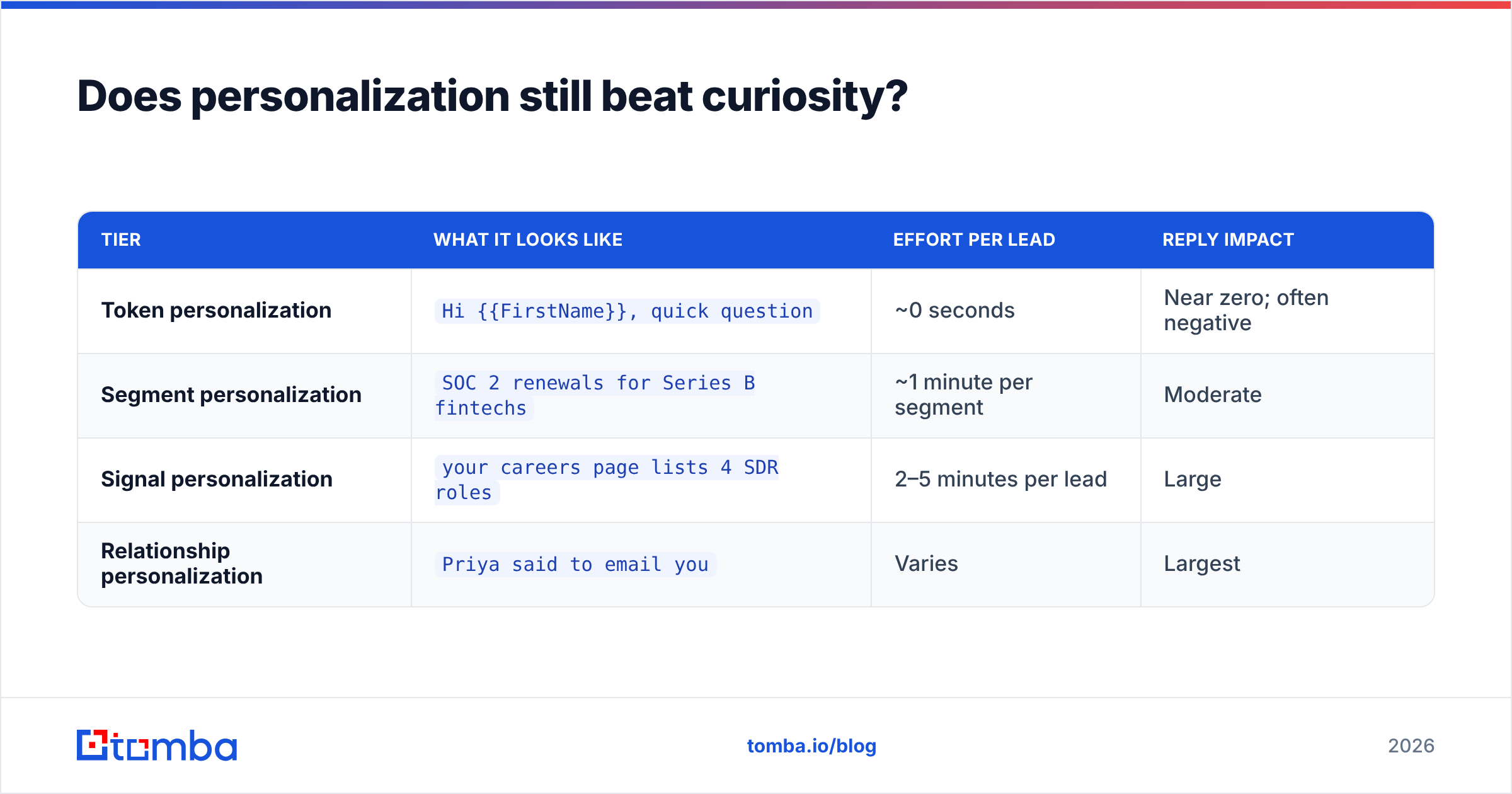
There are three tiers, and the gap between them is enormous:
| Tier | What it looks like | Effort per lead | Reply impact |
|---|---|---|---|
| Token personalization | Hi {{FirstName}}, quick question |
~0 seconds | Near zero; often negative |
| Segment personalization | SOC 2 renewals for Series B fintechs |
~1 minute per segment | Moderate |
| Signal personalization | your careers page lists 4 SDR roles |
2–5 minutes per lead | Large |
| Relationship personalization | Priya said to email you |
Varies | Largest |
The practical move for most teams is tier three at a manageable volume rather than tier one at scale. Fifty signal-personalized emails a day will beat a thousand token-personalized ones on booked meetings, and they won't torch your domain in the process.
A word on curiosity: it works, but it's a loan. A vague subject like worth 10 minutes? gets the open, then the body has to immediately pay it back with a concrete reason. If the body is also vague, you've trained that recipient to ignore your next three emails.
How do you test subject lines without burning your domain?#
Test in small, honest batches, and measure the right thing.
Set up the test properly:
- Split by lead, not by send. Randomize at the contact level so both variants hit comparable segments.
- Minimum 200 sends per variant. Below that you're reading noise. Most "our subject line doubled opens" claims come from 40-send samples.
- Change one thing. Format or length or personalization token — not all three.
- Run for a full week. Tuesday morning behavior differs from Friday afternoon behavior.
- Measure reply rate as primary, meeting rate as secondary. Open rate is polluted by Apple Mail Privacy Protection pre-fetching images, which marks messages as opened whether or not a human looked. Treat opens as directional only.
Protect the domain while you test:
- Keep bounce rate under 2%. Above 5% and mailbox providers start throttling regardless of content quality.
- Cap daily volume per mailbox during ramp-up; use multiple sending domains rather than one overloaded one.
- Watch complaint rate weekly. A subject line that wins on opens but loses on complaints is a net loss.
This is where the unglamorous part matters more than the copy. A brilliant subject line sent to first.last@ when the company actually uses flast@ produces a hard bounce, and enough hard bounces will drop your entire domain's deliverability into the void. Run the list through an email verifier before any subject-line test, or you'll be A/B testing your own bounce rate.
What does the full stack look like in practice?#
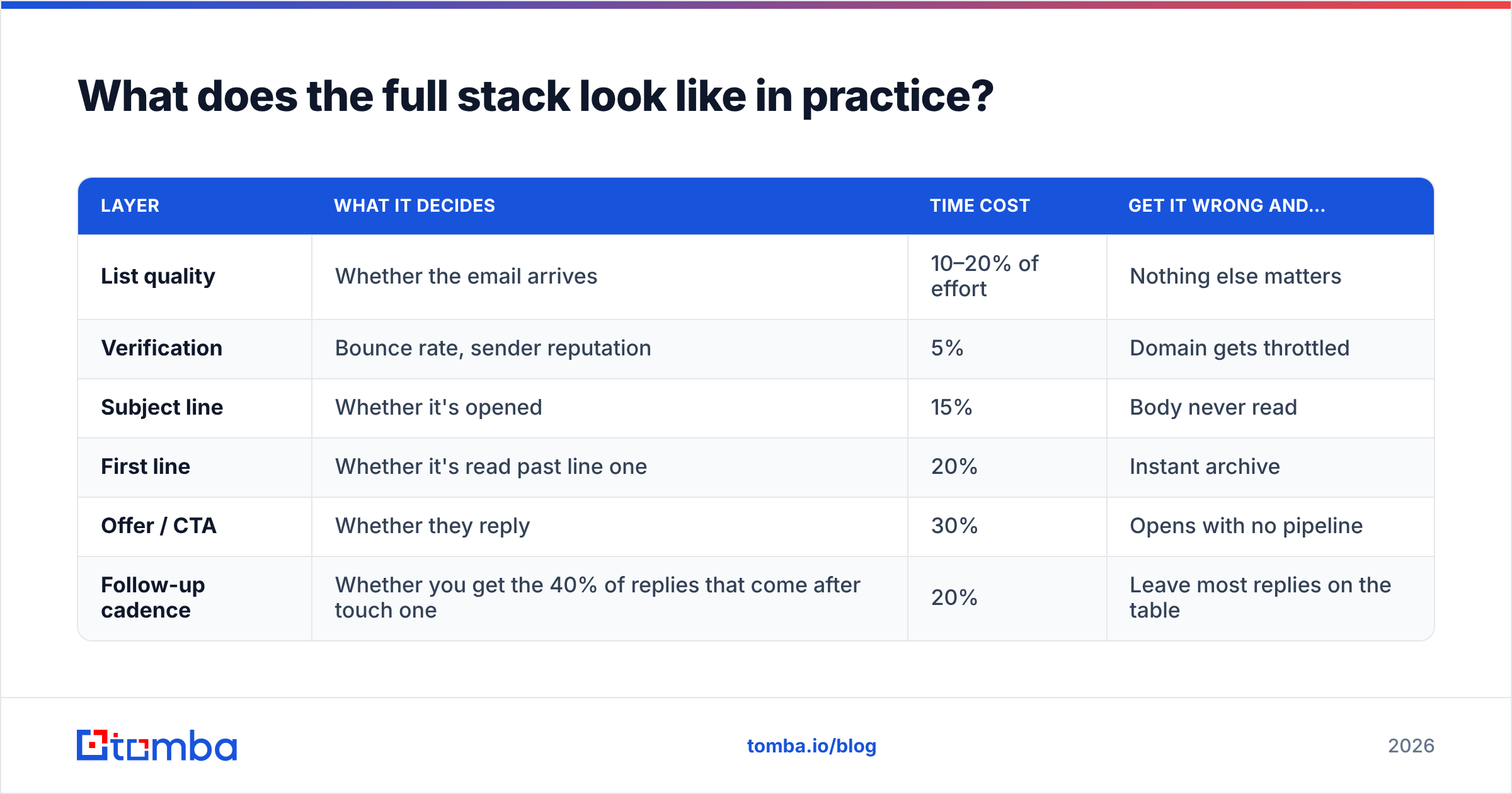
Here's how the pieces fit for a typical outbound motion, and roughly what each layer costs in time:
| Layer | What it decides | Time cost | Get it wrong and… |
|---|---|---|---|
| List quality | Whether the email arrives | 10–20% of effort | Nothing else matters |
| Verification | Bounce rate, sender reputation | 5% | Domain gets throttled |
| Subject line | Whether it's opened | 15% | Body never read |
| First line | Whether it's read past line one | 20% | Instant archive |
| Offer / CTA | Whether they reply | 30% | Opens with no pipeline |
| Follow-up cadence | Whether you get the 40% of replies that come after touch one | 20% | Leave most replies on the table |
Two takeaways. First, the subject line is roughly 15% of the outcome — important, but not the lever most teams think it is. Second, the two cheapest layers to fix (list quality and verification) sit upstream of everything else, which means fixing them multiplies the return on every subject line you write afterward.
If your response rate is stuck below 3%, check the layers in order from the top of that table. It's almost never the subject line.
FAQ#
Should I use the recipient's first name in the subject?
Only when it doesn't look automated. Sarah — quick one about your careers page works. Hi Sarah alone reads like a merge field.
Is it okay to use "Re:" on a first email? No. It lifts opens and destroys trust. The reply you get will often be a complaint.
What about lowercase subject lines? Lowercase reads as informal and personal, which usually helps in B2B outbound. Avoid it if you're emailing legal, finance, or government contacts, where formality signals credibility.
How many follow-ups before I stop?
Three to five touches over two to three weeks is standard. should I stop? as a final subject line reliably surfaces replies from people who meant to respond and forgot.
Do subject lines affect spam placement? Indirectly. Filters weigh sender reputation, authentication, and engagement far more heavily than wording — but hype words and deceptive prefixes drive the complaints that wreck reputation. See the CAN-SPAM Act for the legal floor on deceptive subject lines in the US.
Where should you start?#
Pick five subject lines from the trigger-based group above, find a real signal for each of your next twenty prospects, and send. That's it — no sequence builder required for the first test.
The bottleneck won't be the copy. It'll be getting accurate, verified addresses for the people you actually want to reach. That's what the Tomba Email Finder is built for: search by domain, name, or company, get the verified address with a confidence score, and skip the guess-and-bounce cycle entirely. The free tier gives you 25 searches a month to sanity-check the workflow, and paid plans start at $49/mo — see Tomba pricing for the full breakdown.
Write a better subject line second. Get the address right first.
Related guides#
Ready to find emails that actually work?
Join 150,000+ professionals who stopped guessing and started sending. Free credits on signup — no credit card required.
Get the Tomba newsletter
Practical outbound tactics and product updates — once every two weeks.
About the author