Email Subject Line Formulas That Actually Get Opens in 2026
Fourteen tested email subject line formulas, the open-rate patterns behind them, and the exact situations where each one wins or flops. Includes a side-by-side comparison table and a testing framework.
TL;DR
- Subject lines do not sell. They buy you the first two seconds of attention, and nothing more — the body has to carry the rest.
- Formulas beat improvisation because they force a specific job: create a knowledge gap, name a shared context, or state a concrete outcome.
- The highest-performing patterns in 2026 are short (3–6 words), lowercase-friendly, and reference something only the recipient's company would recognize.
- Personalization tokens are table stakes now, and recipients spot a merge field instantly. Relevance, not
{{first_name}}, is what lifts opens. - Formulas fail when your list is dirty. A 40% open rate on a bounced-out list is a vanity number — verify before you test.
What Are Email Subject Line Formulas, and Why Do They Work?#
An email subject line formula is a reusable sentence structure with variable slots, built around one psychological trigger. Think of it like a recipe card: the method stays fixed, the ingredients swap per recipient.
The reason formulas outperform freeform writing has nothing to do with magic words. It is that a formula forces you to answer a question before you type: what job is this subject line doing? There are only four real jobs.
- Open the curiosity gap. Present incomplete information the reader wants closed. "Your competitor's hiring page" works because it names something specific but withholds the point.
- Establish shared context. Reference a mutual connection, an event, a piece of content they published, or a trigger event. "Re: your SOC 2 post" is context, not curiosity.
- State a concrete outcome. Name a number or a result. "Cut onboarding from 14 days to 3" is a promise the body must then keep.
- Reduce perceived effort. Signal that the email is short and the ask is small. "2-min question about your API docs" sets the price up front.
Every formula below is a variation on one of those four. If a subject line does not clearly do one of them, it is decoration.
The mechanics also changed. Most inboxes now show 35–45 characters on mobile before truncation, and Apple Mail Privacy Protection has been pre-fetching images since 2021, which inflates open rates across the board. Treat opens as a directional signal and reply rate as the real scoreboard.
Which Email Subject Line Formulas Perform Best in 2026?#
Here is the working set. Each includes the pattern, a filled example, and the situation where it earns its keep.
Curiosity-gap formulas#
1. The withheld noun — [Their company]'s [specific asset]
Acme's careers page
Works because it is unmistakably about them and gives away nothing. Fails on cold lists where the recipient has no reason to trust you.
2. The unfinished observation — noticed something about [thing]
noticed something about your checkout flow
High open, high risk. If the body does not deliver a real observation, you have burned the relationship. Never use this if you have not actually looked.
3. The odd number — [Odd number] [things] for [role]
3 pricing pages your CFO should see
Odd numbers read as researched rather than rounded. Keep it under five items.
Context formulas#
4. The mutual reference — [Name] suggested I reach out
Priya suggested I reach out
Still the highest-open formula in B2B, and the fastest to destroy your credibility if the referral is invented. Only use with a real, verifiable connection.
5. The trigger event — congrats on [event]
congrats on the Series B
Time-sensitive. Send within 10 days or it reads as automated scraping.
6. The content hook — your [post/talk/podcast] on [topic]
your talk on RevOps hiring
Pairs well with an author finder workflow — you find the piece, find the writer, and reference something they actually wrote. If you publish content research at scale, an author finder removes the manual step of tracking down who wrote what.
7. The shared-stack line — [Tool] + [their company]
Snowflake + Acme
Works when you have verified technographic data. Guessing their stack is worse than saying nothing.
Outcome formulas#
8. The metric delta — [Metric] from [before] to [after]
reply rate from 1.2% to 4.8%
The strongest formula for warm and re-engagement sends. Requires a real case study.
9. The competitor benchmark — how [peer company] handles [problem]
how Ramp handles vendor onboarding
Peer proof beats vendor proof. Use a company they actually consider a peer, not a logo they will never resemble.
10. The cost frame — the [$ or hours] cost of [status quo]
the 11 hours/week cost of manual list building
Good for problem-aware buyers. Useless if they do not yet perceive the problem.
Low-effort formulas#
11. The time price — [N]-min question about [specific thing]
2-min question about your API rate limits
Sets the cost explicitly. The specific thing matters more than the number.
12. The one-word line — [Single relevant noun]
forecasting
Reads like internal mail. Overuse tanks it. Deploy sparingly, in follow-ups rather than first touches.
13. The yes/no ask — worth a look?
worth a look?
Best as a third or fourth follow-up. It is a closing device, not an opener.
14. The breakup — closing your file
closing your file
Reliably generates replies, but many of them are "no." That is still useful — a fast no clears your pipeline.
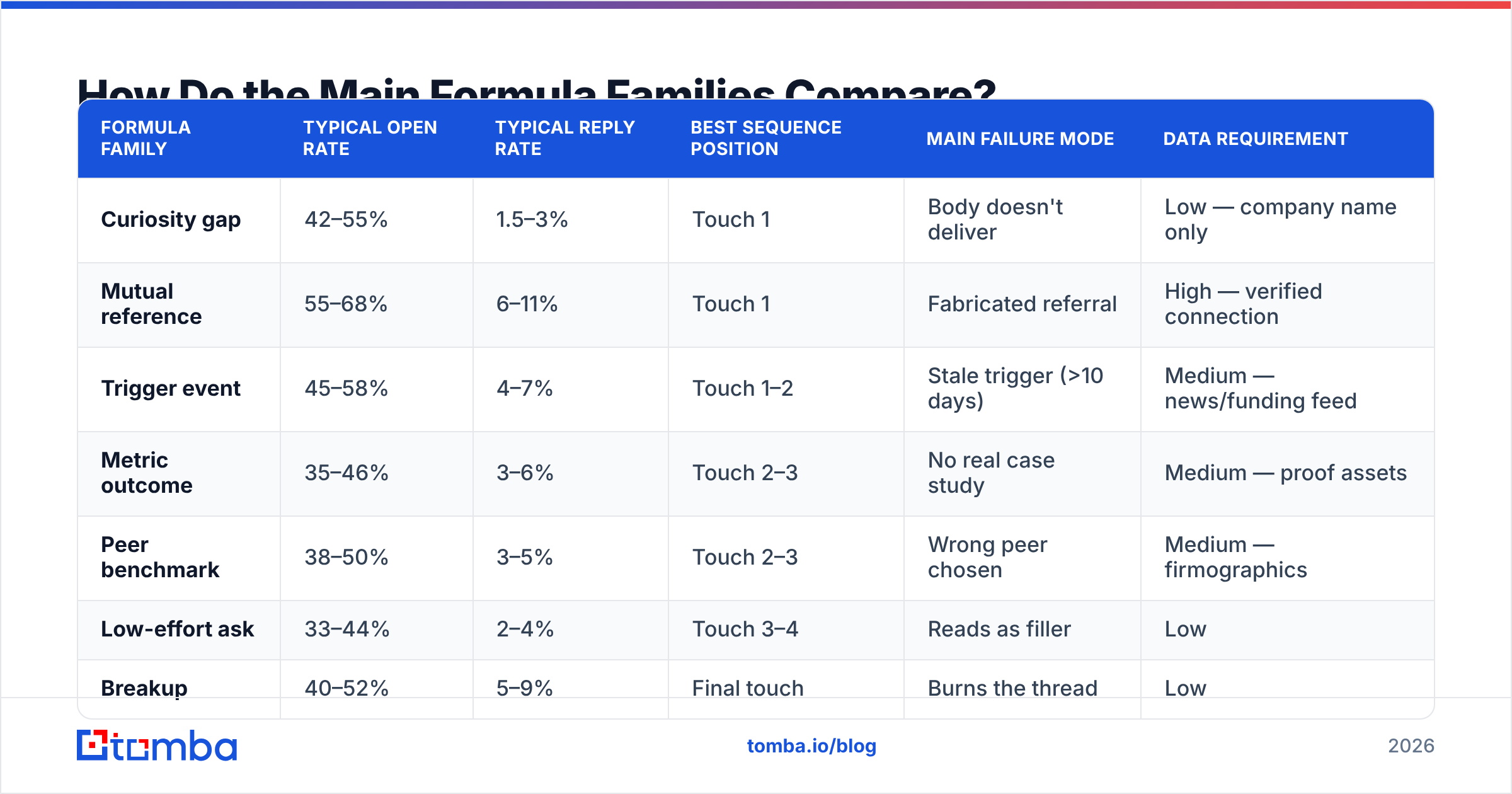
How Do the Main Formula Families Compare?#
| Formula family | Typical open rate | Typical reply rate | Best sequence position | Main failure mode | Data requirement |
|---|---|---|---|---|---|
| Curiosity gap | 42–55% | 1.5–3% | Touch 1 | Body doesn't deliver | Low — company name only |
| Mutual reference | 55–68% | 6–11% | Touch 1 | Fabricated referral | High — verified connection |
| Trigger event | 45–58% | 4–7% | Touch 1–2 | Stale trigger (>10 days) | Medium — news/funding feed |
| Metric outcome | 35–46% | 3–6% | Touch 2–3 | No real case study | Medium — proof assets |
| Peer benchmark | 38–50% | 3–5% | Touch 2–3 | Wrong peer chosen | Medium — firmographics |
| Low-effort ask | 33–44% | 2–4% | Touch 3–4 | Reads as filler | Low |
| Breakup | 40–52% | 5–9% | Final touch | Burns the thread | Low |
Read those ranges as relative, not absolute. Open rates are inflated by privacy pre-fetching, and reply rates swing hard by industry, seniority, and list quality. The useful signal is the ordering: reference-based lines out-reply curiosity-based lines by a wide margin, every time, in every dataset I have seen. Curiosity gets the open; context gets the answer.
Why Do Good Formulas Still Produce Bad Results?#
Because the subject line is the last variable that matters, not the first.
Run this diagnostic before blaming your copy:
- Deliverability. If you land in Promotions or spam, your formula never gets evaluated. Check your authentication with an SPF checker and confirm your domain is not listed anywhere with a blacklist scan. Google and Yahoo's bulk-sender requirements — documented in Google's sender guidelines — made SPF, DKIM, and DMARC non-negotiable for anyone sending at volume.
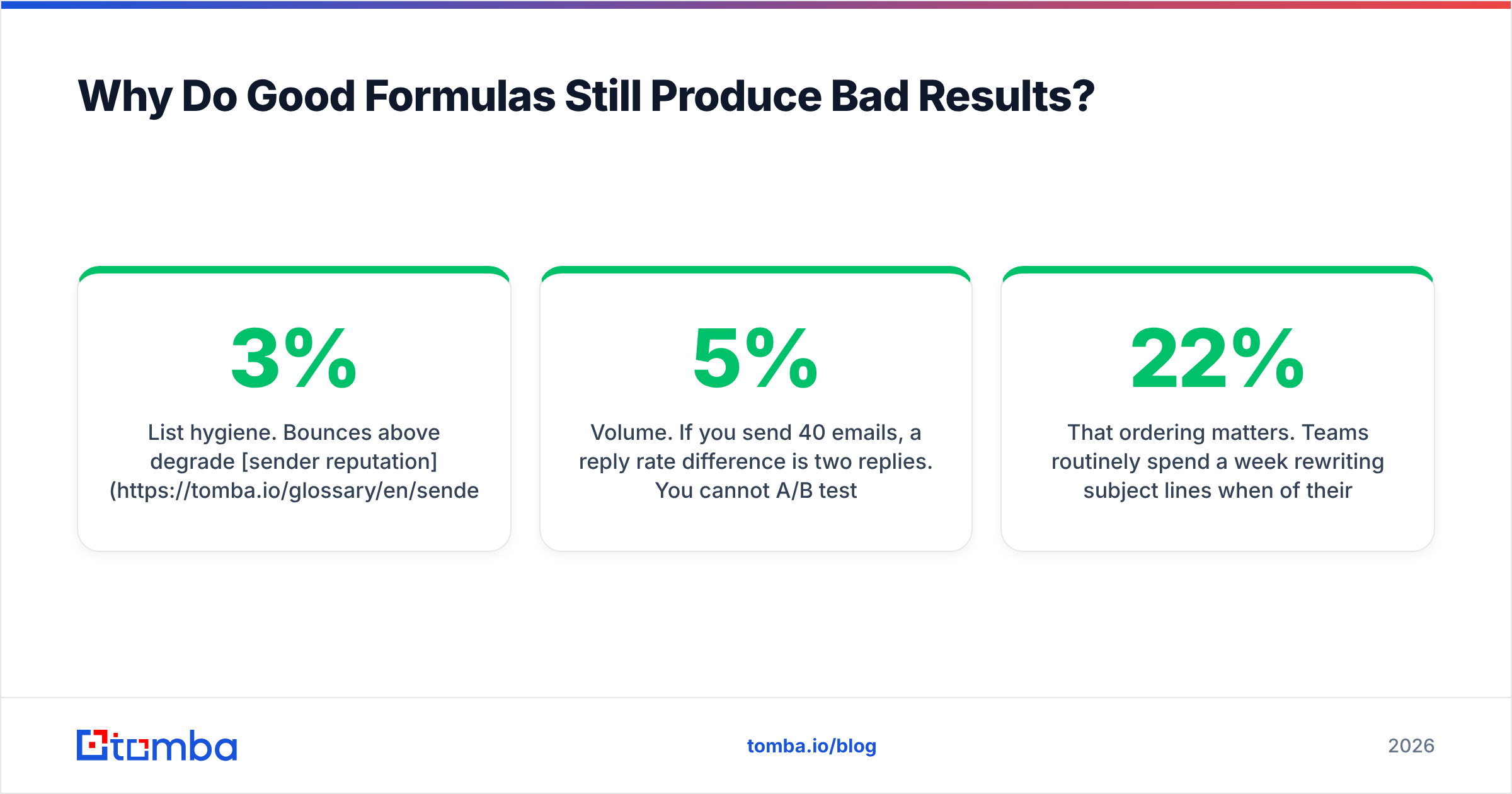
- List hygiene. Bounces above 3% degrade sender reputation fast, and a degraded reputation suppresses every subsequent send. Verified addresses are the floor, not an optimization.
- Targeting. The best subject line written to the wrong persona underperforms a mediocre one written to the right persona. This is not close.
- Volume. If you send 40 emails, a 5% reply rate difference is two replies. You cannot A/B test your way to significance at that scale — you need several hundred sends per variant.
- Send timing. Tuesday–Thursday mornings are still the modal recommendation, but the effect size is smaller than any of the four items above.
That ordering matters. Teams routinely spend a week rewriting subject lines when 22% of their list is invalid. Fix the plumbing first.
How Should You Test Subject Line Formulas?#
Test families, not words. Comparing "Quick question" to "Quick question?" is noise. Comparing a curiosity-gap family against a context family is a real experiment.
A workable protocol:
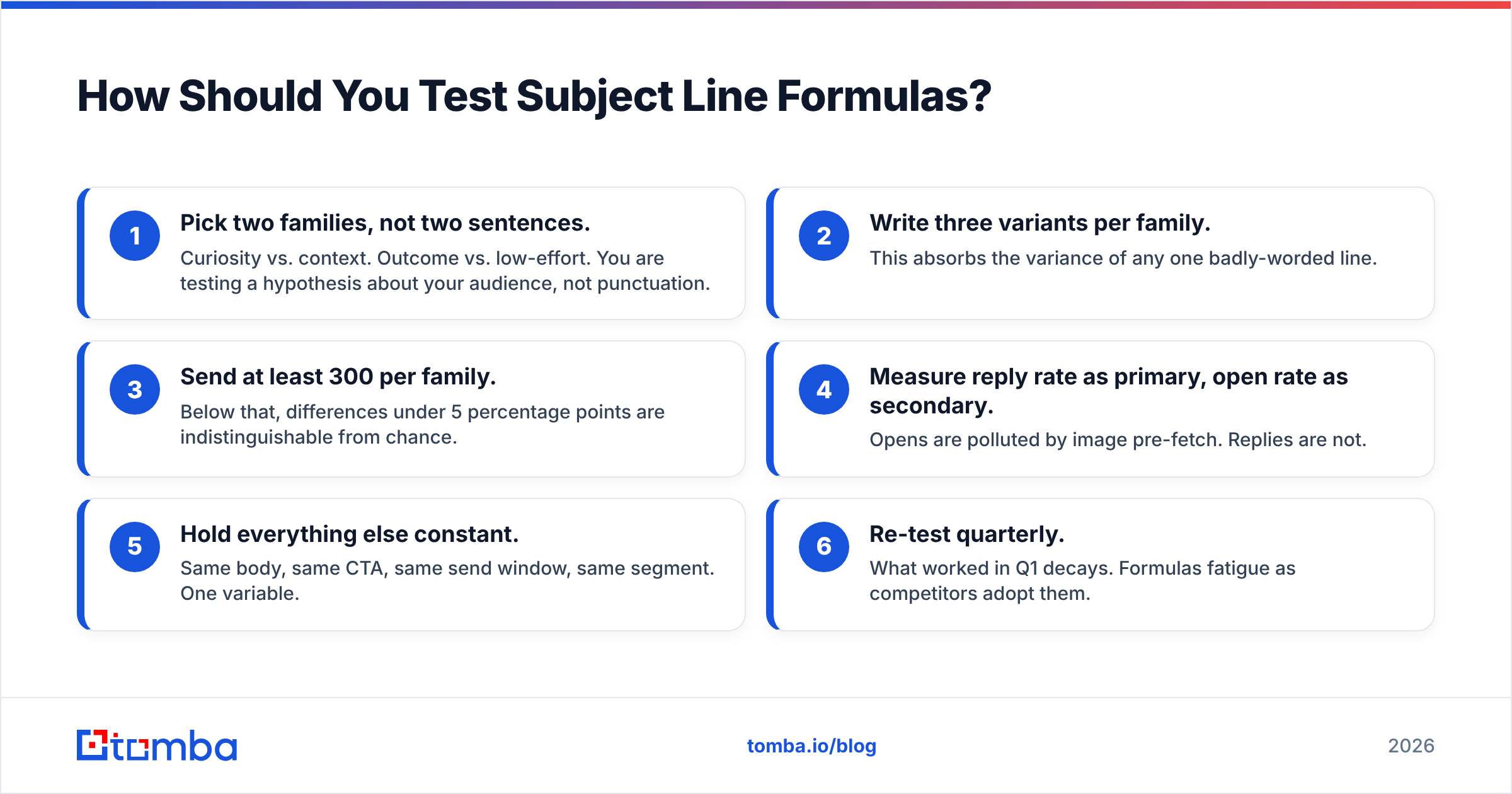
- Pick two families, not two sentences. Curiosity vs. context. Outcome vs. low-effort. You are testing a hypothesis about your audience, not punctuation.
- Write three variants per family. This absorbs the variance of any one badly-worded line.
- Send at least 300 per family. Below that, differences under 5 percentage points are indistinguishable from chance.
- Measure reply rate as primary, open rate as secondary. Opens are polluted by image pre-fetch. Replies are not.
- Hold everything else constant. Same body, same CTA, same send window, same segment. One variable.
- Re-test quarterly. What worked in Q1 decays. Formulas fatigue as competitors adopt them.
Before you write a single variant, run your list through an email verifier so that bounce noise does not contaminate the comparison. A test run on a 78%-deliverable list tells you nothing about copy.
If you want a fast starting point rather than a blank page, a subject line generator will produce family-appropriate variants you can then edit down to something specific.
What Should You Never Put in a Subject Line?#
A short list of things that cost you more than they earn:
RE:orFW:on a first touch. It is a lie, recipients recognize it instantly, and several ESPs now flag it.- ALL CAPS or excessive punctuation. "!!!" is a spam-filter signal and a credibility signal, both negative.
- Unfilled or broken merge tokens.
Hi {{first_name|there}}is the fastest way to advertise a mass send. Test your merge fields on a seed list first. - Vague urgency. "Last chance" with no stated deadline trains readers to ignore you.
- Your product name on a cold first touch. They have not heard of it. It reads as an ad, because it is one.
- Emoji on B2B cold outreach. Consumer marketing data supports emoji; B2B cold data generally does not. HubSpot's research on subject lines and vendor A/B data both point the same direction for professional audiences.
One nuance worth flagging: capitalization. Sentence case and lowercase now outperform Title Case in cold B2B, because Title Case reads as marketing and lowercase reads as a person typing quickly. This is a real, repeatable effect, and it is free to implement.
How Do Subject Lines Fit the Rest of Your Outbound?#
A subject line is one link in a chain, and the chain is only as strong as its weakest link:
- Data — Do you have the right contact, at the right company, with a verified address?
- Trigger — Is there a reason to email this week rather than any week?
- Subject line — Does it do one of the four jobs, in under 45 characters?
- First line — Does it prove the subject line was not automated?
- Ask — Is it small, specific, and answerable in one sentence?
The subject line inherits its power from the two links above it. This is why teams with strong data infrastructure get better results from identical copy: their "congrats on the Series B" is actually about a Series B that happened last Tuesday, sent to the operations lead who now has budget.
Sourcing that layer is a tooling question. Pulling verified contacts by company through domain search, or resolving a list of target accounts in bulk before a campaign, is what makes context-based formulas usable at more than 20 emails a week. Vendors in this space differ widely on accuracy and coverage — cross-check independent reviews on G2 before committing to an annual contract, and note that peers like BookYourData take a database-first approach that suits teams wanting pre-built lists rather than on-demand lookups.
Which Formula Should You Start With?#
If you are starting from zero, run this sequence and stop optimizing until you have 500 sends behind it:
- Touch 1: Trigger event or content hook. Highest context, highest reply rate.
- Touch 2: Peer benchmark. Introduces proof without repeating yourself.
- Touch 3: Low-effort ask. Reduces the perceived cost of replying.
- Touch 4: Breakup. Harvests the no's and clears your pipeline.
Four touches, four different jobs, no repeated formula. That structure alone outperforms most teams' fifth iteration of a single clever line.
Then measure, and be honest about what the numbers say. If your context-based lines are not out-replying your curiosity-based lines, the problem is almost certainly that your "context" is not actually specific — you are referencing an industry, not a company.
Start With the Data Layer#
The single highest-leverage change most teams can make is not a better formula. It is sending to real people at real addresses with a real reason to hear from you.
Tomba Email Finder finds professional email addresses by domain, name, or company, so the context formulas above have something true to sit on top of. The free tier covers 25 searches a month for testing the workflow; paid plans start at $49/month for Starter and $99/month for Growth, with full Tomba pricing published up front. Build the list, verify it, then spend your energy on the subject line — in that order.
Related guides#
Ready to find emails that actually work?
Join 150,000+ professionals who stopped guessing and started sending. Free credits on signup — no credit card required.
Get the Tomba newsletter
Practical outbound tactics and product updates — once every two weeks.
About the author