Email Subject Line Testing: A 2026 Framework That Works
Most subject line tests are statistically meaningless. Here's how to run email subject line tests that actually reach significance, what to test first, and when open rate is lying to you.
TL;DR
- Most B2B subject line tests never reach statistical significance. With a 200-person list and a 2-point difference, you'd need roughly 15,000 recipients per variant to be confident the winner is real.
- Apple Mail Privacy Protection and Gmail image proxying inflate opens by 15-40% depending on your audience mix. Optimize for reply rate, not open rate.
- Test in this order: audience segment → offer → subject line format → wording. Wording is the smallest lever and most people start there.
- Deliverability contaminates every test. If variant A lands in Primary and variant B lands in Promotions, you measured inbox placement, not copy.
- Structured, sequential testing on small lists beats classic A/B splits. Run one variable across four weeks instead of splitting 200 contacts into two useless buckets.
What is email subject line testing, really?#
Email subject line testing is the practice of sending two or more subject line variants to comparable segments of your list, then measuring which one produces more of the outcome you care about. That's the textbook definition, and it's where most teams stop thinking.
The version that matters in B2B outbound is narrower: subject line testing is an attempt to isolate one variable in a system with a dozen confounding variables. Send time, sender reputation, list freshness, inbox provider mix, the preview text, whether the recipient has heard of you — all of these move open rate more than the words in your subject line. If you don't control for them, you're not running a test. You're collecting anecdotes with decimal points attached.
Here's the analogy: testing subject lines without controlling for deliverability is like taste-testing two recipes when one was served hot and the other was served cold three hours later. You'll get a clear winner. The winner will tell you nothing about the recipes.
The four things that actually change your open rate#
- Inbox placement — Primary vs Promotions vs spam is worth 20-50 percentage points of open rate. Nothing you write in a subject line comes close.
- Sender recognition — Whether the recipient recognizes your name or domain. This is why warm intros and second-touch emails outperform cold first-touches on identical copy.
- Data quality — Bounced and invalid addresses suppress deliverability for the entire send, dragging down the variants that would otherwise have won.
- Timing and volume — Tuesday 9am into a full inbox behaves differently from Thursday 2pm into a quiet one.
- Subject line copy — Real, but the smallest of the five for cold audiences. Roughly a 2-8% relative lift in most honest B2B tests.
- Preview text — Frequently ignored, often worth as much as the subject line itself because it doubles your visible character count.
Notice where copy ranks. That ordering is why "we tested 40 subject lines and nothing moved" is such a common complaint — the team was optimizing the fifth variable while the first one was broken.
Why do most subject line tests produce garbage data?#
Because of sample size, and nobody wants to do the math.
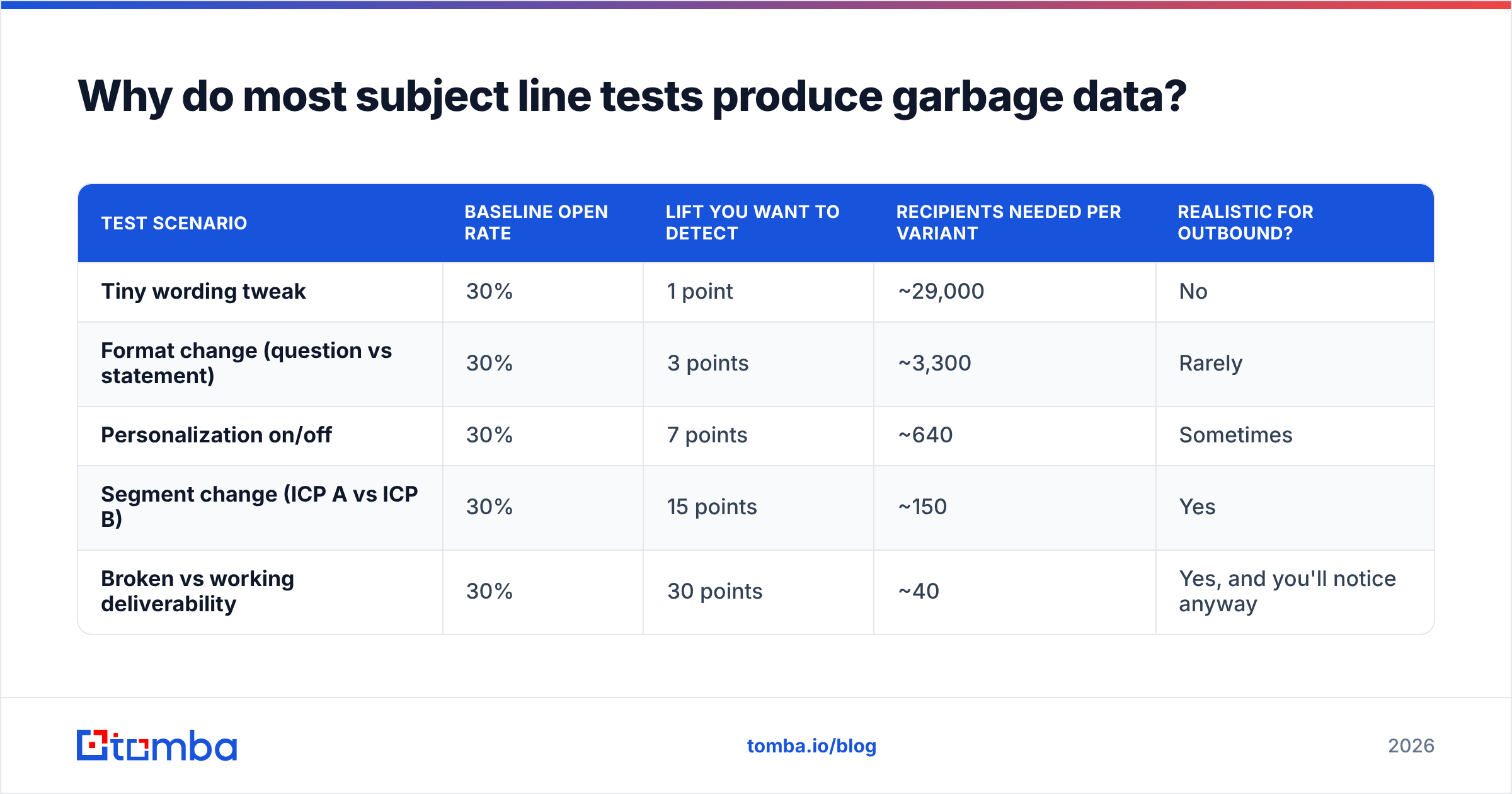
Statistical significance in an A/B test depends on three inputs: your baseline conversion rate, the minimum lift you want to detect, and your confidence threshold. For a baseline 30% open rate, detecting a 2-percentage-point absolute lift at 95% confidence with 80% power requires approximately 7,400 recipients per variant. Detecting a 5-point lift needs roughly 1,300 per variant. Detecting a 10-point lift needs about 350 per variant.
Most B2B outbound sequences run 50-500 contacts per campaign. At that volume you can only reliably detect enormous differences — the kind that come from a broken variant, not a clever one.
| Test scenario | Baseline open rate | Lift you want to detect | Recipients needed per variant | Realistic for outbound? |
|---|---|---|---|---|
| Tiny wording tweak | 30% | 1 point | ~29,000 | No |
| Format change (question vs statement) | 30% | 3 points | ~3,300 | Rarely |
| Personalization on/off | 30% | 7 points | ~640 | Sometimes |
| Segment change (ICP A vs ICP B) | 30% | 15 points | ~150 | Yes |
| Broken vs working deliverability | 30% | 30 points | ~40 | Yes, and you'll notice anyway |
Read that table twice. The tests you can actually run at outbound volume are structural: which audience, which offer, which format. Not "does 'quick question' beat 'quick q'."
This is the single most useful thing to internalize about email subject line testing. Small lists demand big hypotheses.
Should you test open rate at all in 2026?#
Mostly no — treat it as a diagnostic, not a goal.
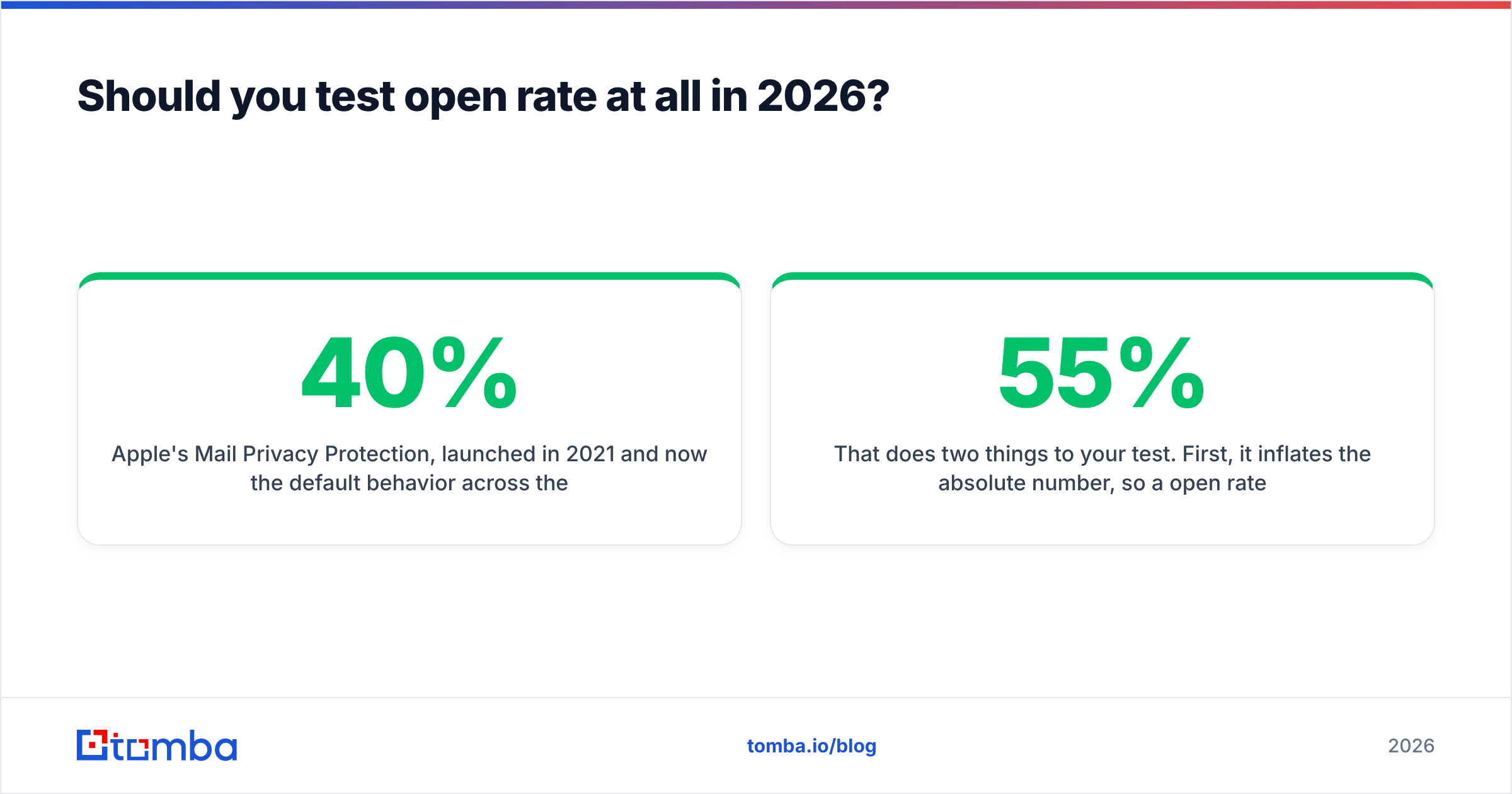
Apple's Mail Privacy Protection, launched in 2021 and now the default behavior across the majority of Apple Mail users, pre-fetches tracking pixels regardless of whether the human opened the message. Gmail proxies images through its own servers. Depending on your audience's device and client mix, 15-40% of your recorded "opens" in a B2B list are machine opens.
That does two things to your test. First, it inflates the absolute number, so a 55% open rate might really be 35%. Second and worse, it compresses the difference between variants — machine opens are distributed roughly evenly across variants, so a genuine 6-point difference in human opens can show up as a 4-point difference in recorded opens. You lose signal precisely where you need it.
What to measure instead, in priority order:
- Reply rate — the only metric that ties directly to pipeline. Noisy on small lists, but honest.
- Positive reply rate — replies excluding "unsubscribe," "wrong person," and "not interested." This is your real signal.
- Click rate, if your email contains a link. Less pixel-contaminated than opens, though bot link-scanners from security gateways create their own noise.
- Meeting booked rate — the ground truth, and hopeless as a test metric below several thousand sends.
Use open rate for one job only: detecting deliverability collapse. If a variant's opens fall off a cliff, you have a placement problem, not a copy problem. Check your SPF record and sender authentication before you rewrite anything. Google's own bulk sender guidelines spell out the authentication requirements that now gate Primary-tab placement.
What should you test first, and in what order?#
Test in descending order of impact. Here's the sequence that produces learnings instead of noise:
1. Audience segment. Same subject line, two ICP segments. If "Cutting onboarding time at Series B fintechs" gets 9% replies from fintech ops leads and 1% from generic "Head of Operations" titles, you learned something worth thousands of dollars. Segment fit dwarfs copy.
2. Offer and angle. Problem-led vs outcome-led vs curiosity-led. "Your Q3 hiring plan" is a different bet than "How Ramp cut onboarding to 4 days." This is the biggest copy-level lever and the one most teams skip.
3. Format and length. Question vs statement. Lowercase vs title case. 3 words vs 8 words. Personalization token vs none. Formats produce measurable differences more often than word swaps do because they change how the line renders on mobile — where roughly 40-50 characters are visible before truncation.
4. Specific wording. Synonym-level changes. Almost never worth testing on lists under 5,000. Pick the version a competent human would write and move on.
5. Preview text. Underrated. On most clients you get another 35-90 characters of visible real estate. Testing preview text is functionally testing a second subject line, and almost nobody does it.

How do you run a valid test on a small list?#
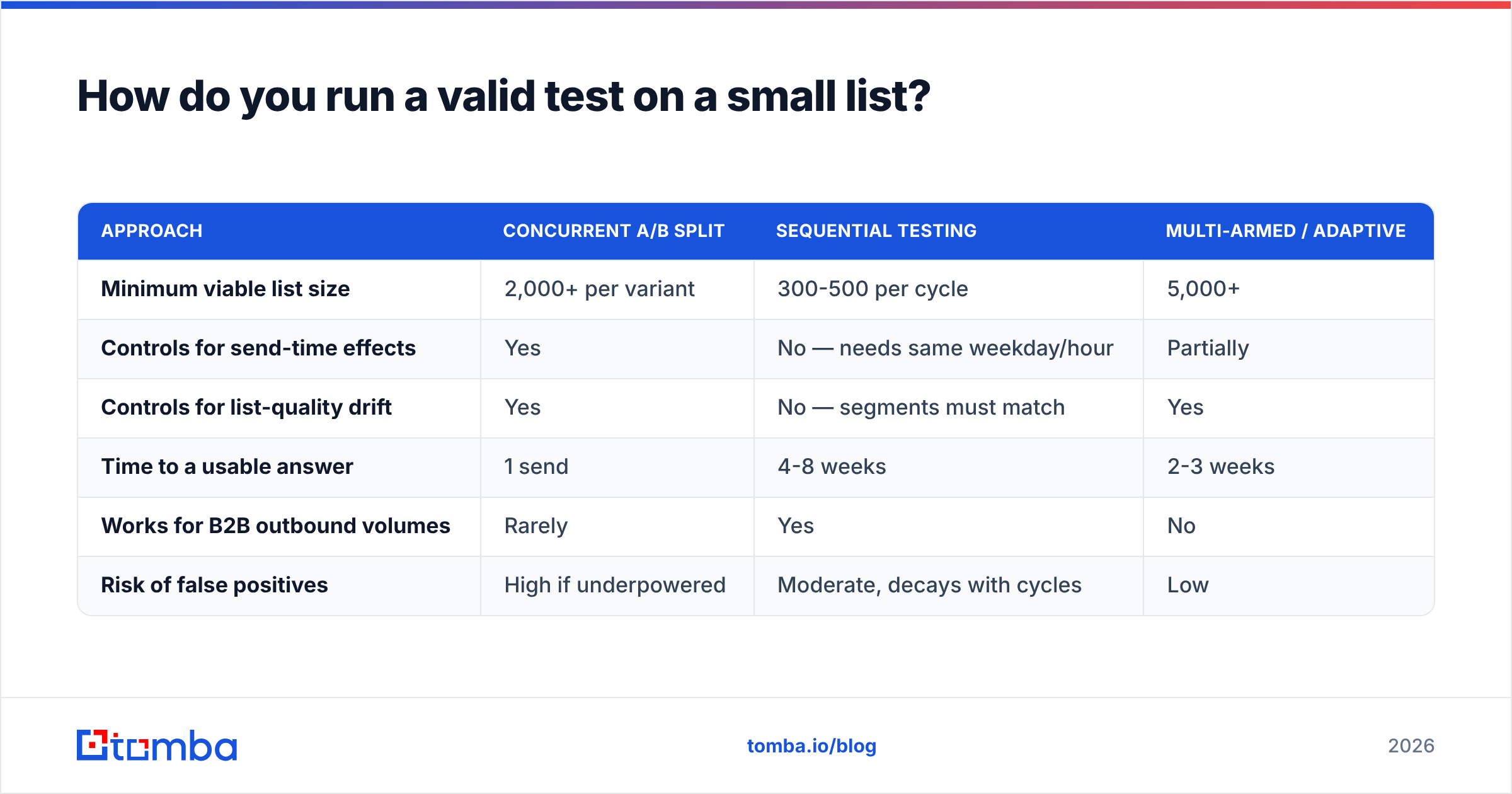
Use sequential testing instead of concurrent splits.
The classic A/B split — divide 400 contacts into two 200-person buckets, send simultaneously — gives you two underpowered samples and one useless result. Sequential testing runs one variant to the full list this week, the other variant to a comparable list next week, and accumulates data across cycles until it's meaningful.
| Approach | Concurrent A/B split | Sequential testing | Multi-armed / adaptive |
|---|---|---|---|
| Minimum viable list size | 2,000+ per variant | 300-500 per cycle | 5,000+ |
| Controls for send-time effects | Yes | No — needs same weekday/hour | Partially |
| Controls for list-quality drift | Yes | No — segments must match | Yes |
| Time to a usable answer | 1 send | 4-8 weeks | 2-3 weeks |
| Works for B2B outbound volumes | Rarely | Yes | No |
| Risk of false positives | High if underpowered | Moderate, decays with cycles | Low |
Sequential testing has a real weakness: it can't separate your variable from calendar effects. Mitigate it by holding constant everything you can — same weekday, same hour, same segment definition, same sender, same sequence position — and by running at least four cycles before you believe anything.
The pre-test checklist#
Before any subject line test, confirm these or your results are noise:
- List is verified. Bounces above 2% will tank placement mid-send and corrupt whichever variant went out second. Run the list through an email verifier first and drop catch-all addresses you can't confirm.
- Sending domain is authenticated. SPF, DKIM, and DMARC all passing. Non-negotiable since the 2024 Google and Yahoo bulk-sender requirements.
- Segments are genuinely comparable. Same seniority band, same company size range, same industry. Randomize within the segment, don't split alphabetically — alphabetical splits correlate with company name, which correlates with industry.
- Sample is large enough for the effect you're testing. Consult the table above. If it isn't, test a bigger variable.
- One variable changes. If you change the subject line and the first sentence, you learned nothing about either.
- Success metric is defined before the send. Deciding afterward which metric "won" is how teams talk themselves into bad copy.
What do the numbers say about specific subject line patterns?#
Aggregate benchmarks are directional at best — your list, offer, and reputation swamp any published average. That said, patterns that hold up reasonably well across B2B outbound datasets:
- Short beats long on mobile. 3-6 words survives truncation. Anything past 50 characters is a gamble on client width.
- Lowercase reads as human, not always as better. It lifts opens for founder-led outbound and can hurt in regulated industries where recipients expect formality.
- Personalization tokens work when they're non-obvious. {{first_name}} in a subject line is now pattern-matched as automation by most buyers. A specific detail — a job posting, a recent funding round, a tech stack signal — still lands.
- Questions raise opens and can lower replies. They create curiosity, then disappoint if the body doesn't deliver. Watch positive reply rate, not opens.
- Emoji are mostly a Promotions-tab signal in B2B. Test them if you like, but expect placement noise to dominate the result.
- RE: and FW: prefixes on cold email are deceptive and increasingly penalized. They also destroy trust when the recipient realizes. Not worth it.
For a broader view of what's happening across email programs, HubSpot's state of marketing research and Litmus's email client market share data are both worth reading before you assume your audience's client mix matches the averages.
If you want a starting point rather than a blank page, generate candidates with a subject line generator, then run them through a subject line tester to catch spam triggers and truncation problems before they ever hit a real inbox. That's not a substitute for testing — it's a filter that keeps obviously broken variants out of your limited test budget.
How does data quality change what your test is measuring?#
More than the copy does.
Consider two identical campaigns. Campaign A goes to a list where 8% of addresses are invalid and 12% are unverified catch-alls. Campaign B goes to a fully verified list. Campaign A's bounce rate triggers throttling at the receiving provider partway through the send. The subject line variant that happened to go out in the second half now shows a 14-point lower open rate.
You will conclude that variant lost. It didn't. Your list did.
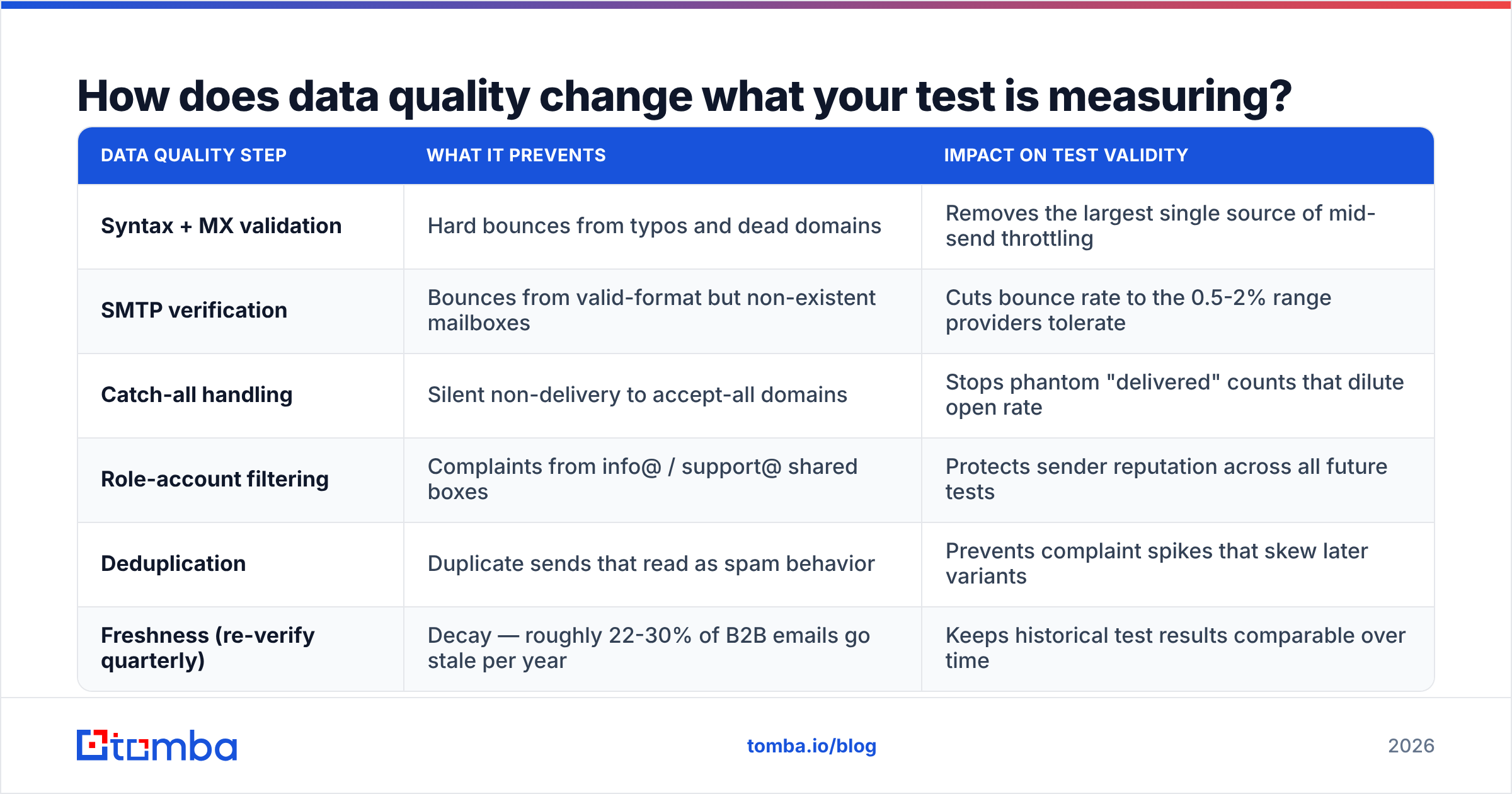
This is why every serious testing program starts upstream of the copy. Before you argue about word choice:
| Data quality step | What it prevents | Impact on test validity |
|---|---|---|
| Syntax + MX validation | Hard bounces from typos and dead domains | Removes the largest single source of mid-send throttling |
| SMTP verification | Bounces from valid-format but non-existent mailboxes | Cuts bounce rate to the 0.5-2% range providers tolerate |
| Catch-all handling | Silent non-delivery to accept-all domains | Stops phantom "delivered" counts that dilute open rate |
| Role-account filtering | Complaints from info@ / support@ shared boxes | Protects sender reputation across all future tests |
| Deduplication | Duplicate sends that read as spam behavior | Prevents complaint spikes that skew later variants |
| Freshness (re-verify quarterly) | Decay — roughly 22-30% of B2B emails go stale per year | Keeps historical test results comparable over time |
Building the list correctly in the first place matters as much as cleaning it. Sourcing contacts through a domain search with confidence scores attached means you know which addresses are pattern-guessed and which are verified from a real source — and you can exclude the low-confidence tier from tests entirely. Tomba publishes its data sources if you want to evaluate that before committing.
What does a working test program look like month to month?#
Concrete, four-week cadence for a team sending 400-800 emails a week:
Week 1 — Baseline. Send your control subject line to segment A. Record reply rate, positive reply rate, bounce rate, and open rate. Don't change anything else all month.
Week 2 — Variant. Same segment definition, fresh contacts, same weekday and hour. Send variant B, which differs from control in exactly one structural way (format, angle, or personalization presence).
Week 3 — Repeat control. Yes, again. This tells you your week-to-week variance, which is the number that determines whether your week 1 vs week 2 difference means anything. If control-to-control varies by 4 points, then a 3-point variant "win" is noise.
Week 4 — Repeat variant. Now you have two observations of each, and a variance estimate.
Then: keep the winner only if the gap between variants exceeds your control-to-control variance by a clear margin. Otherwise declare a tie, keep the simpler line, and go test something bigger — a new segment, a new offer, a different sequence position.
Log every test in one place with the segment definition, the exact copy, the send window, and all four metrics. Teams that skip the log re-test the same hypothesis every quarter and never build institutional knowledge. A shared sheet is fine; Tomba's Google Sheets add-on keeps the contact side of that workflow in the same place as the results.
What should you stop testing?#
Kill these to free up test budget:
- Emoji vs no emoji on cold B2B. Placement noise swamps the effect.
- Single-word synonym swaps. Underpowered by definition at your volume.
- Send-time micro-optimization (9:00 vs 9:15). Real effects exist at the day and half-day level; minute-level testing is superstition.
- Anything you can't act on. If you'd send the same email either way, don't spend the sample.
Spend the freed budget on segment tests and offer tests, where the effect sizes are large enough for your list to actually detect them.
Where to start#
Fix the inputs before you optimize the words. Verified contacts, authenticated domain, comparable segments, one variable at a time, reply rate as the scoreboard — that's the whole method. Everything else is decoration.
The upstream half of that is a data problem. Tomba's Email Finder sources professional addresses by domain, name, or company with confidence scoring attached, so you know which contacts belong in a test and which should be excluded before they distort your numbers. The free tier gives you 25 searches a month to check quality against your own known-good list, and paid plans start at $49/mo — see Tomba pricing for the full breakdown. Get the list right first, then argue about subject lines.
Related guides#
Ready to find emails that actually work?
Join 150,000+ professionals who stopped guessing and started sending. Free credits on signup — no credit card required.
Get the Tomba newsletter
Practical outbound tactics and product updates — once every two weeks.
About the author