Email Subject Line to Introduce Yourself: 27 Examples That Get Opened
Introduction emails live or die in the inbox preview. Here are 27 subject lines for introducing yourself, the length rules that actually matter, and the four formats that consistently beat "Introduction".
TL;DR
- The best email subject line to introduce yourself names a shared reference point — a mutual contact, an event, a piece of their work, or a specific trigger — instead of announcing that an introduction is happening.
- Keep it to 3–7 words / roughly 30–45 characters. Mobile clients cut most previews around 35–40 characters, so the payload has to sit at the front.
- The word "Introduction" as a subject line is the weakest option available to you. It describes the email's genre, not its value.
- Four formats do the heavy lifting: mutual connection, shared context, specific observation, and direct question. Everything else is a variation.
- None of it matters if the address bounces. Verify before you send — a 6% bounce rate will torch your domain faster than a bad subject line ever could.
What Is an Email Subject Line to Introduce Yourself?#
It's the 40-character pitch you make before your pitch. When you email someone who has no idea who you are, the subject line does three jobs at once: it signals you're a human and not a sequence, it gives a reason this email is relevant to them specifically, and it sets an expectation the body can actually meet.
Think of it like knocking on a stranger's door. "Hello, I'd like to introduce myself" gets the door closed. "Hi — I'm your new neighbor at number 14, your package got delivered to me" gets the door opened. Same person, same intent, radically different framing. One describes the interaction; the other gives the recipient a reason to participate in it.
That's the whole game. Most introduction subject lines fail because they describe the email instead of giving the reader something.
Why Do Most Introduction Subject Lines Fail?#
Five failure modes account for the majority of ignored intro emails:
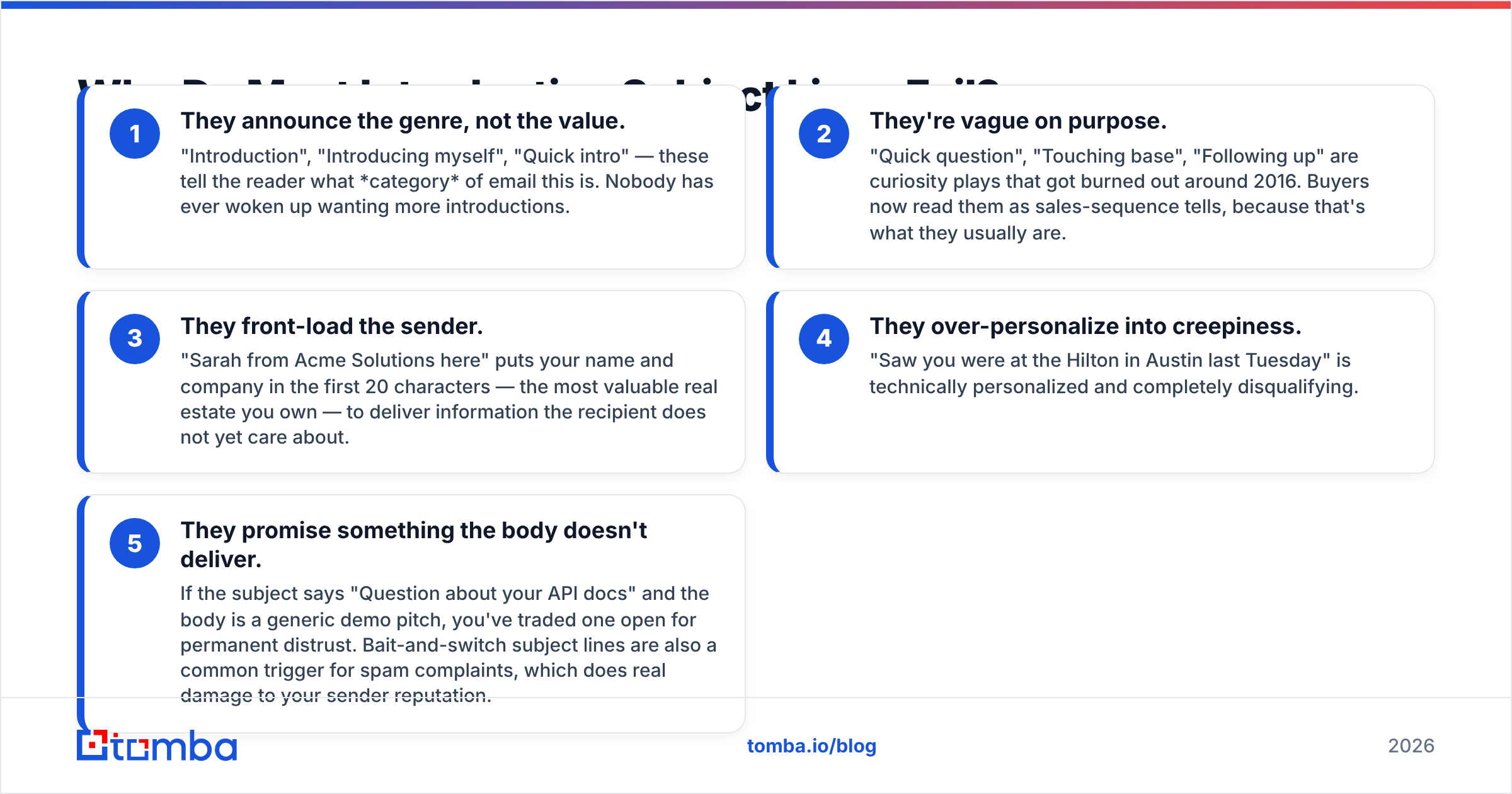
- They announce the genre, not the value. "Introduction", "Introducing myself", "Quick intro" — these tell the reader what category of email this is. Nobody has ever woken up wanting more introductions.
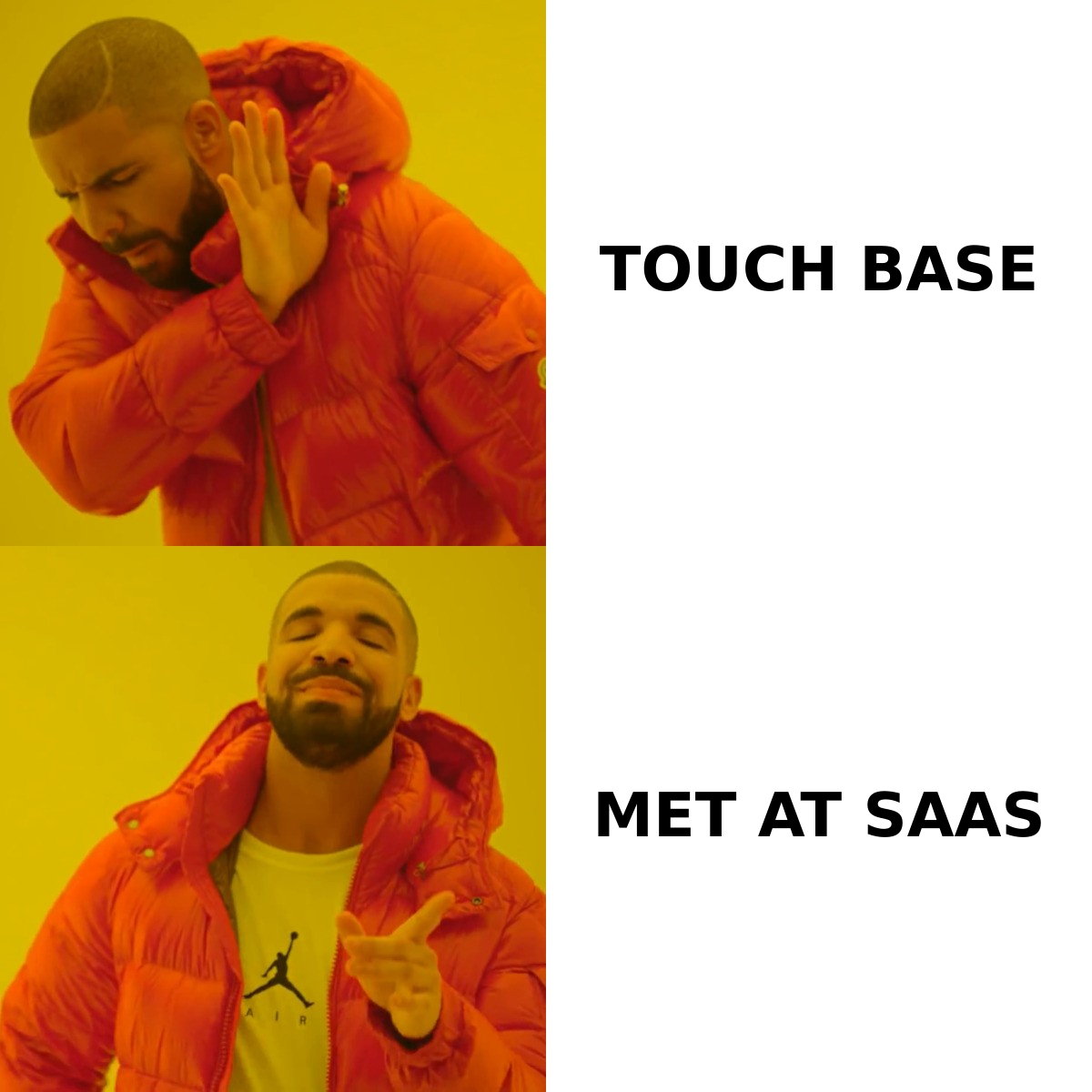
- They're vague on purpose. "Quick question", "Touching base", "Following up" are curiosity plays that got burned out around 2016. Buyers now read them as sales-sequence tells, because that's what they usually are.
- They front-load the sender. "Sarah from Acme Solutions here" puts your name and company in the first 20 characters — the most valuable real estate you own — to deliver information the recipient does not yet care about.
- They over-personalize into creepiness. "Saw you were at the Hilton in Austin last Tuesday" is technically personalized and completely disqualifying.
- They promise something the body doesn't deliver. If the subject says "Question about your API docs" and the body is a generic demo pitch, you've traded one open for permanent distrust. Bait-and-switch subject lines are also a common trigger for spam complaints, which does real damage to your sender reputation.
How Long Should an Introduction Subject Line Be?#
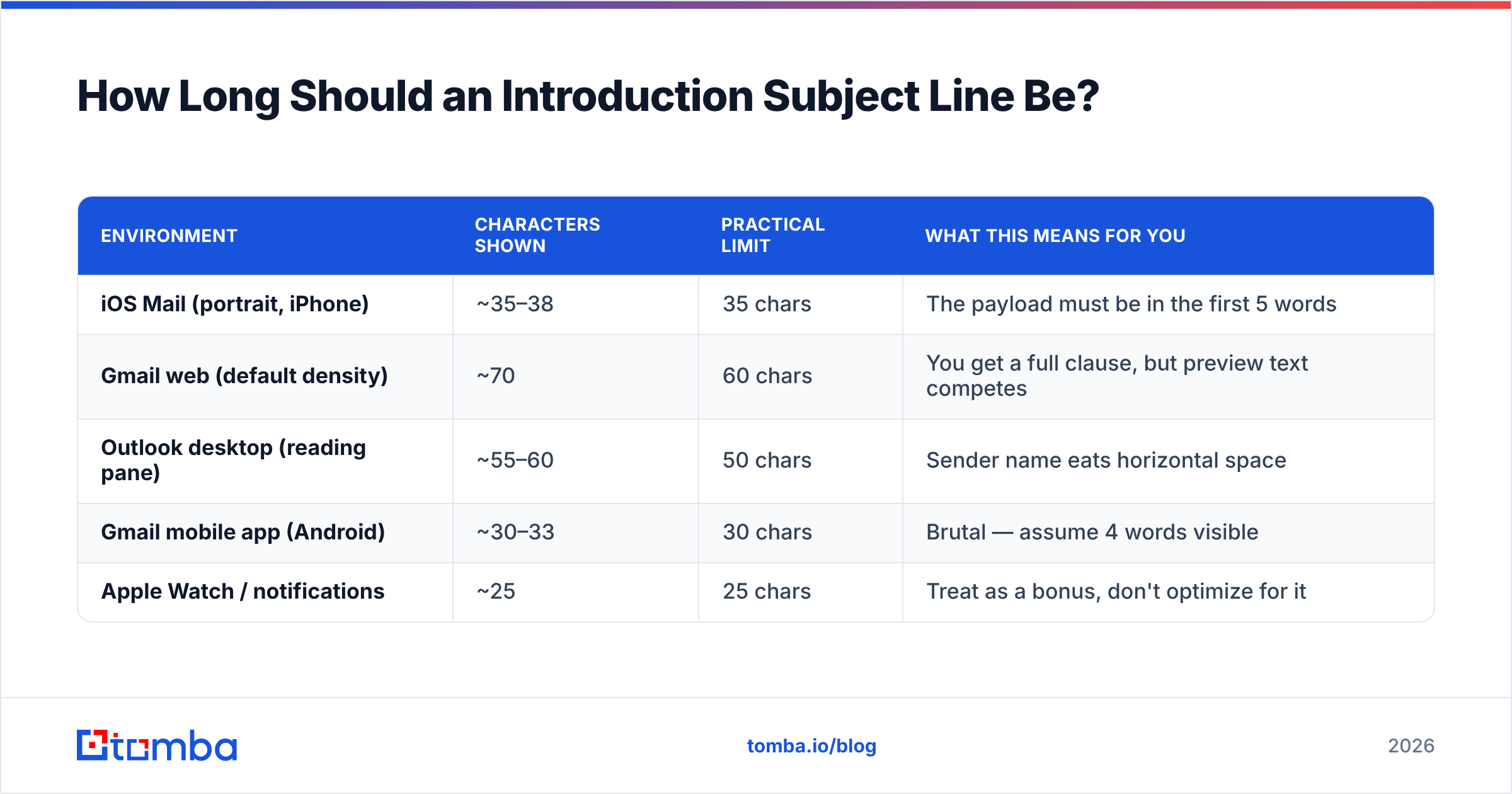
Short — but "short" means different things depending on where the email lands. Here's what actually gets displayed before truncation:
| Environment | Characters shown | Practical limit | What this means for you |
|---|---|---|---|
| iOS Mail (portrait, iPhone) | ~35–38 | 35 chars | The payload must be in the first 5 words |
| Gmail web (default density) | ~70 | 60 chars | You get a full clause, but preview text competes |
| Outlook desktop (reading pane) | ~55–60 | 50 chars | Sender name eats horizontal space |
| Gmail mobile app (Android) | ~30–33 | 30 chars | Brutal — assume 4 words visible |
| Apple Watch / notifications | ~25 | 25 chars | Treat as a bonus, don't optimize for it |
The safe target: 30–45 characters, 3–7 words. If your subject line still makes sense when you cut everything after character 35, you've written it correctly.
One caveat on the "shorter is always better" advice you'll see repeated everywhere: shorter wins on open rate but not automatically on reply rate. A three-word subject line like "Quick question" opens well and replies terribly, because the specificity that earns a reply never appears. Optimize for the reply, then compress.
What Are the Four Formats That Actually Work?#
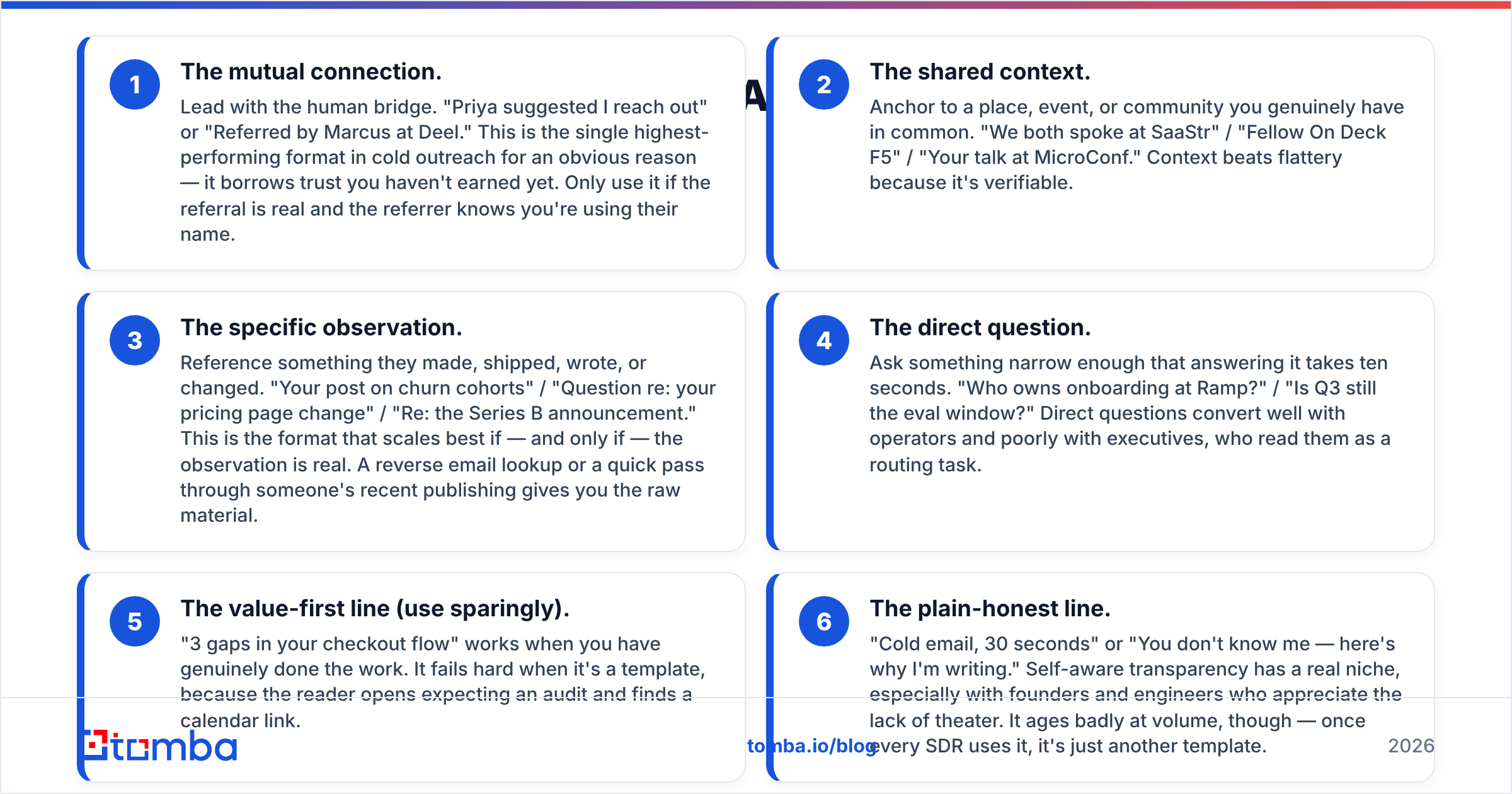
Nearly every high-performing email subject line to introduce yourself is one of these four shapes.
The mutual connection. Lead with the human bridge. "Priya suggested I reach out" or "Referred by Marcus at Deel." This is the single highest-performing format in cold outreach for an obvious reason — it borrows trust you haven't earned yet. Only use it if the referral is real and the referrer knows you're using their name.
The shared context. Anchor to a place, event, or community you genuinely have in common. "We both spoke at SaaStr" / "Fellow On Deck F5" / "Your talk at MicroConf." Context beats flattery because it's verifiable.
The specific observation. Reference something they made, shipped, wrote, or changed. "Your post on churn cohorts" / "Question re: your pricing page change" / "Re: the Series B announcement." This is the format that scales best if — and only if — the observation is real. A reverse email lookup or a quick pass through someone's recent publishing gives you the raw material.
The direct question. Ask something narrow enough that answering it takes ten seconds. "Who owns onboarding at Ramp?" / "Is Q3 still the eval window?" Direct questions convert well with operators and poorly with executives, who read them as a routing task.
The value-first line (use sparingly). "3 gaps in your checkout flow" works when you have genuinely done the work. It fails hard when it's a template, because the reader opens expecting an audit and finds a calendar link.
The plain-honest line. "Cold email, 30 seconds" or "You don't know me — here's why I'm writing." Self-aware transparency has a real niche, especially with founders and engineers who appreciate the lack of theater. It ages badly at volume, though — once every SDR uses it, it's just another template.
What Are 27 Examples You Can Adapt Today?#
Grouped by scenario, because "best subject line" is meaningless without context.
Cold B2B outreach (no prior connection)
Question about [Company]'s onboardingIdea for your Q3 pipelineWho owns demand gen at [Company]?Noticed [Company] is hiring 4 SDRsRe: your [specific page/feature]30 seconds on [pain point][Competitor] switched last month
Warm intro via mutual connection
[Name] said we should talkIntro from [Name] — [topic][Name] pointed me your wayReferred by [Name] at [Company]
After meeting at an event
Great chat at [Event]Following [Event] — the [topic] thing[Event] booth 42 — as promisedWe met by the coffee at [Event]
Job seeking / recruiter outreach
[Role] applicant — 6 yrs in fintech RevOpsYour [Company] posting — one questionBackend eng, shipped [notable thing]Application for [Role] — portfolio inside
New role / internal introduction
New [Role] on the [Team] sideTaking over [Account] from [Name]Your new point of contact at [Company]
Partnership / BD outreach
[Your Company] + [Their Company]?Integration idea — [specific use case]Our users keep asking for [their product]
Networking / peer outreach
Fellow [Community] member — [topic]Your [article/talk] on [topic]
Every one of these is under 45 characters when the brackets are filled with normal-length values. Test yours in a subject line tester before you commit to a sequence — truncation is invisible until it isn't.
Which Subject Line Style Wins?#
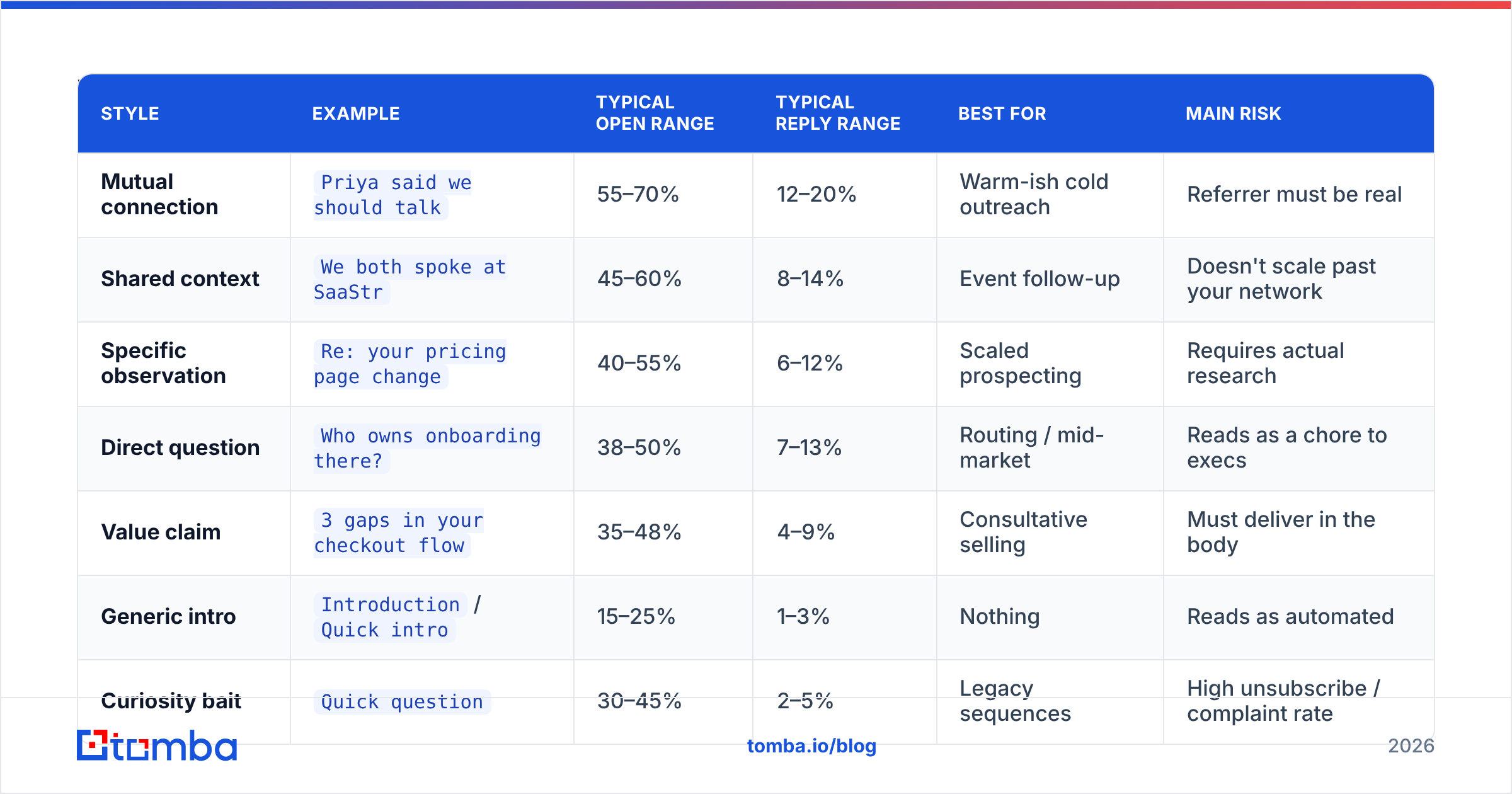
Reported benchmarks vary wildly by industry and list quality, so treat these as directional ranges rather than promises. What's consistent across the data is the ordering.
| Style | Example | Typical open range | Typical reply range | Best for | Main risk |
|---|---|---|---|---|---|
| Mutual connection | Priya said we should talk |
55–70% | 12–20% | Warm-ish cold outreach | Referrer must be real |
| Shared context | We both spoke at SaaStr |
45–60% | 8–14% | Event follow-up | Doesn't scale past your network |
| Specific observation | Re: your pricing page change |
40–55% | 6–12% | Scaled prospecting | Requires actual research |
| Direct question | Who owns onboarding there? |
38–50% | 7–13% | Routing / mid-market | Reads as a chore to execs |
| Value claim | 3 gaps in your checkout flow |
35–48% | 4–9% | Consultative selling | Must deliver in the body |
| Generic intro | Introduction / Quick intro |
15–25% | 1–3% | Nothing | Reads as automated |
| Curiosity bait | Quick question |
30–45% | 2–5% | Legacy sequences | High unsubscribe / complaint rate |
Two things stand out. First, the gap between the best and worst format is roughly 3–4x on opens and closer to 8x on replies — subject line choice is not a rounding error. Second, curiosity bait opens acceptably and replies terribly, which is exactly how bad subject lines survive in sequences for years: the dashboard metric looks fine.

How Do You Personalize at Scale Without Sounding Like a Bot?#
The tension is real: format #3 (specific observation) scales best but requires per-prospect research, and 200 manual research passes a week isn't a job anyone should have.
The workable compromise is tiered personalization:
- Tier 1 (top 50 accounts): Genuine manual research. Read the last thing they published, note the specific thing, write the subject line by hand. Budget 5 minutes each.
- Tier 2 (next 300): Templated observation with one real variable — a funding round, a job posting, a product launch, a stack change. The variable comes from data, the sentence structure is reused.
- Tier 3 (the long tail): Category-level relevance only. "Question about [Company]'s onboarding" is honest, non-creepy, and doesn't pretend to knowledge you don't have.
The failure mode to avoid is fake Tier 1: using a merge field to sound like you did the research when you didn't. Recipients spot it, and it's worse than sending an obviously generic line, because now you're generic and dishonest.
Whatever tier you're in, the mechanical prerequisite is the same — you need a valid, deliverable address attached to the right person. Use a domain search to map who's actually at the company, then run the list through an email verifier before the first send. A well-crafted subject line delivered to a dead mailbox is a rounding error; a batch of them is a deliverability incident.
How Do You Test Subject Lines Properly?#
Most subject-line "testing" is theater. Two rules make it real:
Rule 1: Test one variable, with enough volume. Changing "Quick question about onboarding" to "Question re: your onboarding" is not a test worth running. Test formats against each other — mutual connection vs. specific observation — not synonyms. And you need roughly 300–500 sends per variant before the difference means anything; below that you're reading noise.
Rule 2: Measure replies, not opens. Open rate has been structurally unreliable since Apple's Mail Privacy Protection started pre-fetching images, inflating opens for a large share of recipients. HubSpot's sales research and most credible vendor benchmarks now caveat open data for exactly this reason. Reply rate and meetings booked are the only numbers that survive the change.
A practical cadence: run two formats for two weeks, keep the winner, introduce a new challenger. Don't A/B/C/D test four variants at once on a 400-contact list — you'll conclude nothing with confidence.
If you're stuck for angles, a subject line generator is useful for breaking out of your own patterns, but treat the output as raw material. Every generated line still needs a human pass for the "would I actually say this out loud?" test. Peer review sites like G2 are also a decent source for the language your prospects use to describe their own problems — reading reviews of the tools they already own beats guessing at their vocabulary.
What About Deliverability and Spam Filters?#
Subject lines rarely trigger filters on their own anymore — modern filtering weighs sender reputation, authentication, and engagement history far more heavily than keywords. That said, a few patterns still correlate with trouble:
- ALL CAPS or excessive punctuation ("FREE!!!") — obvious, but it still shows up.
- Re: or Fwd: on a first-touch email. This is deception, recipients recognize it, and complaint rates on fake-reply subject lines are measurably higher. Using
Re: your pricing pagewhere "re:" honestly means "regarding" is defensible; usingRe:to fake a thread is not. - Emoji in B2B cold outreach. Neutral-to-negative in most B2B contexts, and it renders inconsistently across Outlook versions.
- Mismatched subject and body. The strongest long-term signal you can send a filter is people opening and not engaging.
The bigger levers are upstream: authenticated sending, warmed domains, and a clean list. Salesforce's own sales guidance and virtually every deliverability vendor land on the same conclusion — list hygiene outranks copy tweaks by a wide margin. A subject line can only underperform. A 12% bounce rate can get your domain blocked.
Where Should You Start?#
If you're writing your first introduction email today: pick format #1 if you have a real referral, format #2 if you have real shared context, and format #3 otherwise. Cap it at seven words. Make sure the first five words survive truncation. Then make the body deliver exactly what the subject implied.
If you're rewriting a sequence that's underperforming: pull your current subject lines into a spreadsheet, sort by reply rate, and look at what the bottom quartile has in common. It will almost always be the same thing — they describe the email instead of giving the reader a reason.
And before any of it ships, make sure you're writing to real people at real addresses. Tomba's Email Finder locates verified professional addresses by name, domain, or company, with a free tier at 25 searches a month and paid plans starting at $49/mo — enough to build and validate a targeted first list without committing to an enterprise contract. Get the address right, then let the subject line do the job it's actually good at.
Related guides#
Ready to find emails that actually work?
Join 150,000+ professionals who stopped guessing and started sending. Free credits on signup — no credit card required.
Get the Tomba newsletter
Practical outbound tactics and product updates — once every two weeks.
About the author