Email Subject Lines for Networking: 45 That Get Replies
Networking emails fail at the subject line, not the pitch. Here are 45 tested subject lines by scenario — conference follow-ups, cold intros, alumni asks, reconnects — plus the length, personalization, and timing rules behind them.
TL;DR
- Networking subject lines win on context, not cleverness. "Met at SaaStr — the churn thing" beats "Quick question" every time.
- Keep it 3–7 words / 30–50 characters. Mobile clients truncate around 35 characters, and roughly two-thirds of B2B email is opened on a phone.
- Name the shared thing — event, mutual contact, article, alumni year, company. That's the only real personalization that moves open rates.
- Avoid sales-shaped words ("opportunity", "partnership", "free", "ROI"). They flag the email as a pitch before anyone reads a line of it.
- A great subject line can't rescue a bad address. Verify the email first, then worry about the words.
Most networking emails never get judged on their content. They get judged on 40 characters in an inbox preview, next to 60 other unread messages, on a phone, in about 1.2 seconds. If that line reads like a pitch, a template, or a favor request, the email is dead — no matter how good the paragraph underneath it is.
This guide covers what actually separates a networking subject line from a cold sales one, 45 examples sorted by scenario, and the length/personalization rules that hold up across formats.
What makes email subject lines for networking different from cold sales?#
The goal is different, so the mechanics are different. A cold sales subject line is trying to create interest in a problem. A networking subject line is trying to prove you're not a stranger — or that you're a stranger with a specific, legitimate reason to exist in this inbox.
That changes three things:
- Curiosity gaps hurt you. "You're going to want to see this" works in marketing email and reads as manipulation in a peer-to-peer message. Networking runs on trust, and vague teasers spend trust you haven't earned.
- The shared context is the hook. Event name, mutual connection, podcast episode, shared alma mater, the specific line in their post you disagreed with. Anything that answers "why is this person emailing me?" before the email is opened.
- The ask stays out of the subject. "Can I pick your brain?" in the subject line converts worse than the same phrase in the body, because it front-loads a cost. Lead with the connection; put the ask in sentence two of the body.
Business networking has always run on warm signals. Email just compresses the signal into a single line of text.
What does a good networking subject line actually look like?#
Five components, and you rarely need more than two or three in the same line:
- The anchor — the shared context. "SaaStr", "Emily Chen said hi", "Your Substack post on pricing", "Stanford '19". This does 80% of the work.
- The specific detail — the part that proves you were actually there. Not "great talk" but "your slide on negative churn".
- Length discipline — 30–50 characters. Anything past ~60 truncates on iOS Mail and Gmail mobile, which is where most of these get triaged.
- A plain, human register — sentence case, no title case, no exclamation marks, no emoji. Write it like you'd text a colleague.
- Zero sales vocabulary — drop "synergy", "opportunity", "partnership", "quick call", "circle back", "touch base". These read as automated even when they aren't.
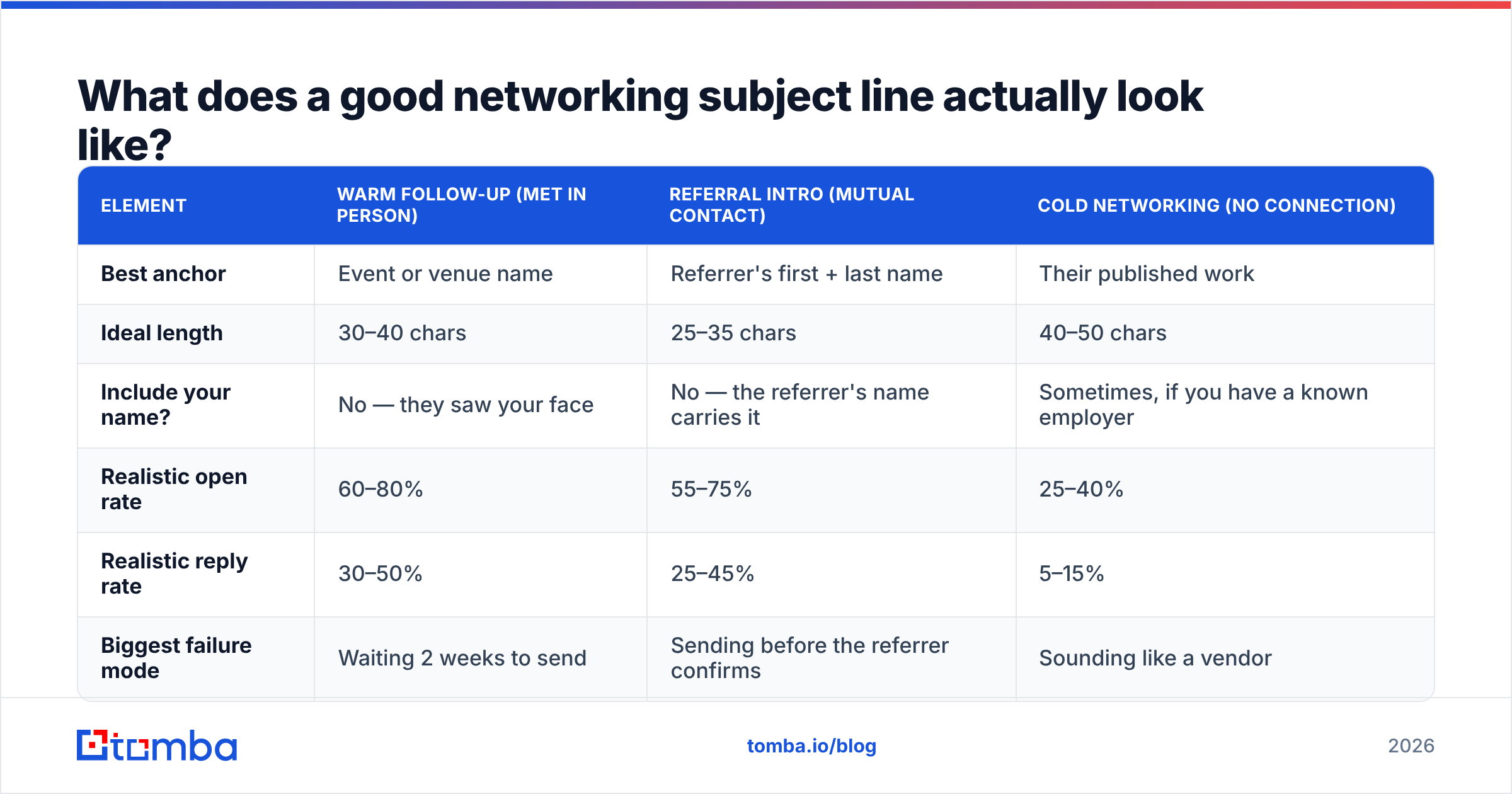
Here's how those components map to the three formats you'll actually send:
| Element | Warm follow-up (met in person) | Referral intro (mutual contact) | Cold networking (no connection) |
|---|---|---|---|
| Best anchor | Event or venue name | Referrer's first + last name | Their published work |
| Ideal length | 30–40 chars | 25–35 chars | 40–50 chars |
| Include your name? | No — they saw your face | No — the referrer's name carries it | Sometimes, if you have a known employer |
| Realistic open rate | 60–80% | 55–75% | 25–40% |
| Realistic reply rate | 30–50% | 25–45% | 5–15% |
| Biggest failure mode | Waiting 2 weeks to send | Sending before the referrer confirms | Sounding like a vendor |
Those reply ranges assume a verified address and a body under 120 words. Both matter more than the subject line — see the response rate definition for how to measure it consistently across campaigns.
Which networking subject lines work by scenario?#
Here are 45, grouped by the situation you're actually in. Swap the bracketed parts; don't swap the structure.
After meeting at a conference or event (1–10)#
Met at [Event] — the [topic] thing[Event] hallway chat, continuedThe [X] question I couldn't answer at [Event]From the [booth/panel/dinner] at [Event]Following up — [Event], Tuesday[Event]: that article I mentionedNice meeting you at [Event]You were right about [topic][Event] + the [tool] recommendationYour [talk title] slide on [specific point]
Send within 48 hours. After a week, the anchor stops working because they've forgotten your face, and the subject line becomes a memory test they'll fail.
Referral and mutual-connection intros (11–18)#
[Referrer first + last] suggested I reach outIntro from [Referrer][Referrer] said you'd know about [topic][Referrer]'s recommendationWe both know [Referrer]Sent by [Referrer] re: [topic][Referrer] → [Your name] → youQuestion [Referrer] couldn't answer
Use the referrer's full name. First names alone are ambiguous in a crowded contact list, and ambiguity reads as fake.
Cold networking with someone you admire (19–27)#
Your [article/episode] on [topic]Disagreeing with your take on [topic][Topic] question from a [your role]Built the thing you described in [post]Data point on [topic] you might wantRe: your [platform] post about [topic]One correction on [specific claim][Their company] + [your company], no pitchReader of [newsletter], quick note
Number 20 and 25 outperform flattery consistently. A respectful disagreement signals you actually read the thing; "loved your post!" signals a template.
Reconnecting after months or years (28–35)#
Long overdue helloFrom your [old company] daysIt's been [X] yearsStill thinking about [shared project]Saw you moved to [new company]Congrats on [new role][Old company] alum checking inRan into [mutual name] — thought of you
Do not open a reconnect with an ask in the subject line. "Long overdue hello" gets opened; "quick favor" gets archived.
Alumni, community, and industry-peer outreach (36–41)#
[School] '[year] → [their city]Fellow [community] member[Industry] peer, same problem[School] alum working in [field][Slack/Discord community] introSame [certification/program], different path
Job-search and career-conversation networking (42–45)#
[Role] at [Company] — 15 min?Career question, not a resumeHow you got from [X] to [Y]Advice on breaking into [field]
Number 43 works because it removes the exact fear that causes non-replies. Say what you're not asking for.
Do shorter subject lines really get opened more?#
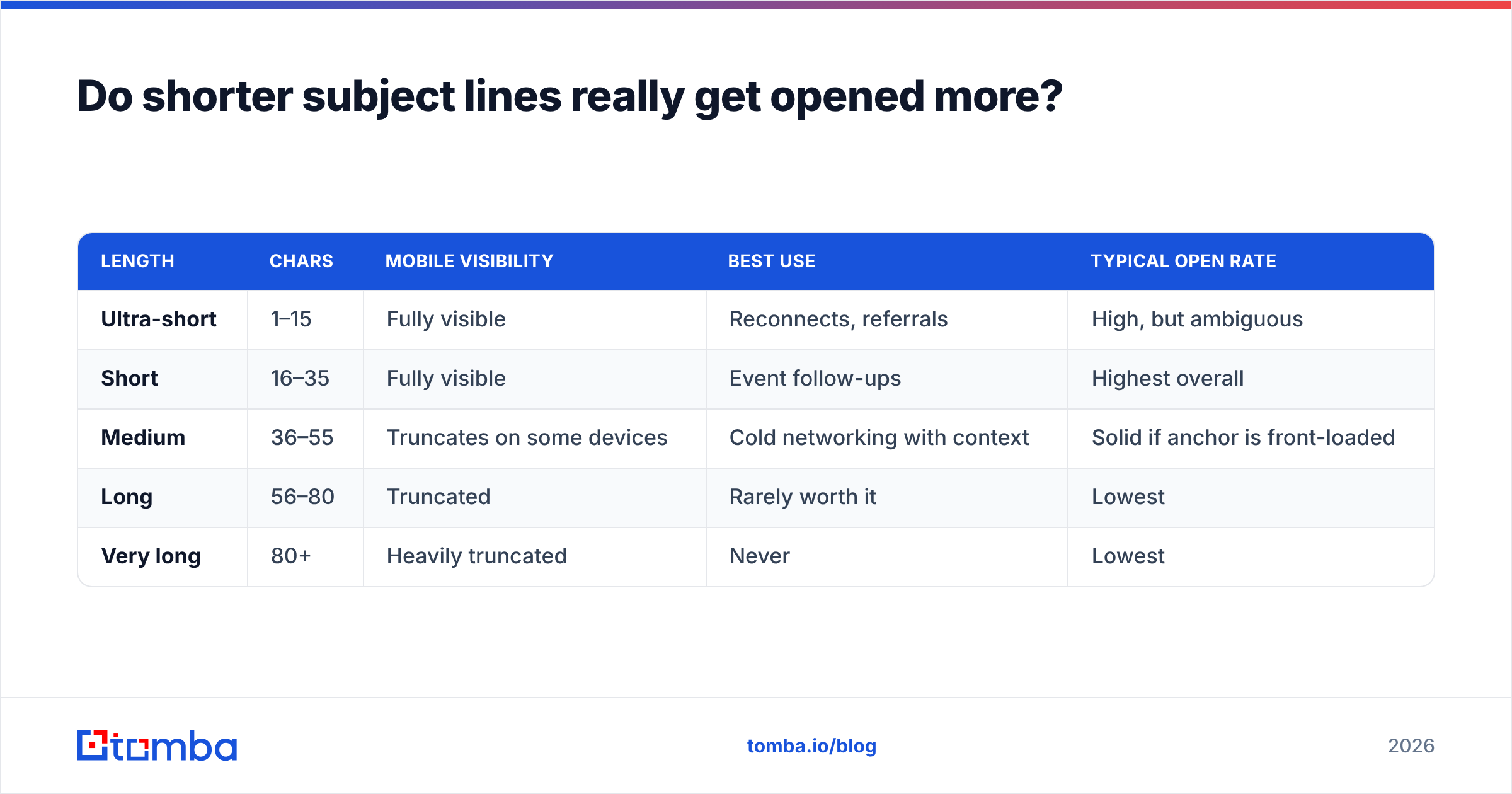
Mostly yes, but the real variable is where the meaning sits. Mobile clients cut off around 33–43 characters depending on device and orientation, so anything after that is invisible in the preview. The anchor has to land in the first 35 characters.
| Length | Chars | Mobile visibility | Best use | Typical open rate |
|---|---|---|---|---|
| Ultra-short | 1–15 | Fully visible | Reconnects, referrals | High, but ambiguous |
| Short | 16–35 | Fully visible | Event follow-ups | Highest overall |
| Medium | 36–55 | Truncates on some devices | Cold networking with context | Solid if anchor is front-loaded |
| Long | 56–80 | Truncated | Rarely worth it | Lowest |
| Very long | 80+ | Heavily truncated | Never | Lowest |
Two practical rules fall out of that table. First, put the proper noun first: "SaaStr — quick follow-up" beats "Quick follow-up from SaaStr" because truncation eats the end, not the beginning. Second, ultra-short lines like "Hey" or "You" get opened at high rates but reply at low ones — you bought attention with a bait-and-switch, and people notice.
If you want to pressure-test variants before sending, run them through a subject line tester to check length, spam-trigger words, and mobile truncation, or generate a batch with the subject line generator and cut everything that sounds like marketing.
Should you use their name, their company, or the mutual connection?#
Rank order, based on how much trust each signal transfers:
- Mutual connection's full name — strongest. It borrows an existing relationship and is nearly impossible to fake at scale.
- A specific shared event or artifact — nearly as strong. "Your Q3 pricing post" proves effort.
- Their company name — weak on its own. Every automated sequence in existence merges
{{company}}, so it now reads as spam rather than research. - Their first name — weakest, and slightly negative in 2026. "John, quick question" is the single most template-flagged pattern in B2B inboxes.
The test: could a script have written this line for 10,000 people? If yes, it's not personalization — it's a mail merge wearing a costume.
What kills a networking email before it's ever opened?#
Three things, in order of damage:
1. The address is wrong. A bounce doesn't just lose one contact; it damages the sending domain that carries every other email you send. If you're building a networking list from conference attendee pages, podcast guests, or LinkedIn exports, run it through an email verifier before the first send. Guessed patterns like first.last@company.com are right maybe 60% of the time — and wrong the rest.
2. The subject line trips a filter. Words like "free", "guarantee", "act now", "$$$", excessive capitals, and multiple exclamation marks still carry weight in content scoring. Networking language rarely trips these by accident, but "Partnership Opportunity!!" manages all three at once.
3. You send from a domain with no authentication. SPF, DKIM, and DMARC are table stakes now. Google and Yahoo's bulk-sender requirements pushed enforcement into the mainstream, and unauthenticated mail from a new domain lands in spam regardless of how good your copy is. Google's Postmaster Tools is the free way to see whether your domain is the problem.
The uncomfortable part: you can't tell which of these killed your email. Open tracking is unreliable in a world of image proxies and privacy filters, so "no reply" is an ambiguous signal. Fix the mechanical layer first, then iterate on the copy — otherwise you're A/B testing words while the pipe is broken.
How do you test networking subject lines without a big list?#
Networking outreach is low-volume by nature — you might send 40 emails a month, not 40,000. Classic A/B testing needs more volume than that to reach significance, so use these instead:
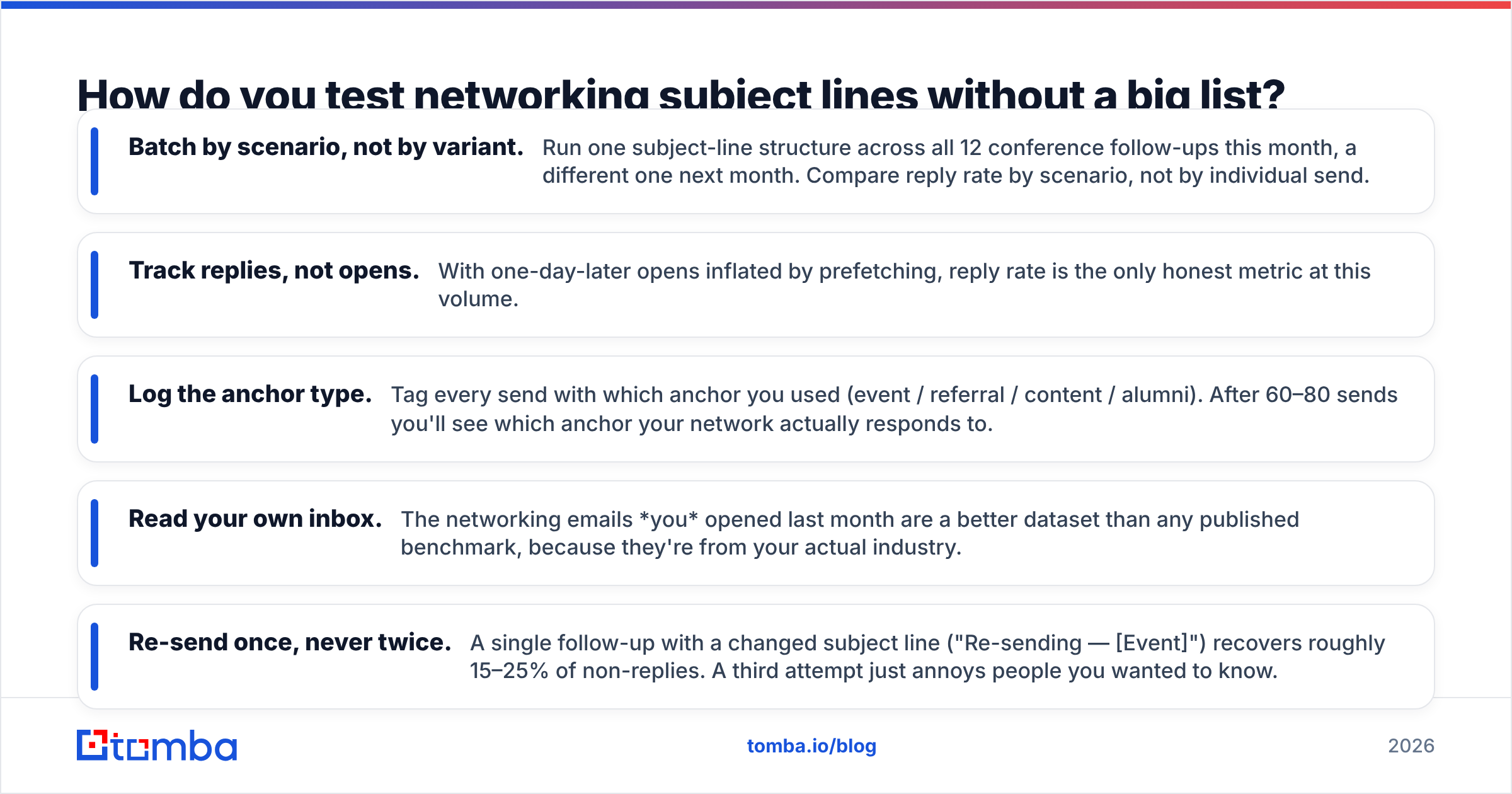
- Batch by scenario, not by variant. Run one subject-line structure across all 12 conference follow-ups this month, a different one next month. Compare reply rate by scenario, not by individual send.
- Track replies, not opens. With one-day-later opens inflated by prefetching, reply rate is the only honest metric at this volume.
- Log the anchor type. Tag every send with which anchor you used (event / referral / content / alumni). After 60–80 sends you'll see which anchor your network actually responds to.
- Read your own inbox. The networking emails you opened last month are a better dataset than any published benchmark, because they're from your actual industry.
- Re-send once, never twice. A single follow-up with a changed subject line ("Re-sending — [Event]") recovers roughly 15–25% of non-replies. A third attempt just annoys people you wanted to know.
HubSpot's sales blog publishes reasonable aggregate benchmarks if you want a sanity check, but treat any published open-rate number as directional only — measurement methodology varies enormously between vendors, which is also why G2 reviews of email tools disagree so often on "accuracy".
What does a complete networking email look like end to end?#
Subject line, body, and address quality are one system. Here's the full stack for a conference follow-up:
- Subject:
Met at SaaStr — the churn thing - First line: Reference the exact moment. "You mentioned your team rebuilt churn scoring in-house after the vendor tool missed seasonality."
- Second line: Give before you ask. Share the article, the data point, the intro.
- Third line: One specific, small ask with an escape hatch. "Worth 15 minutes in the next two weeks? Totally fine if not."
- Signature: Real name, real role, real company. No 400px logo.
- Send window: Tuesday–Thursday, 7–9am their time. Not because of magic, but because that's when people triage rather than firefight.
Total: under 120 words. If your networking email needs scrolling, it's a proposal, not a networking email.
Where do you find the addresses for all this?#
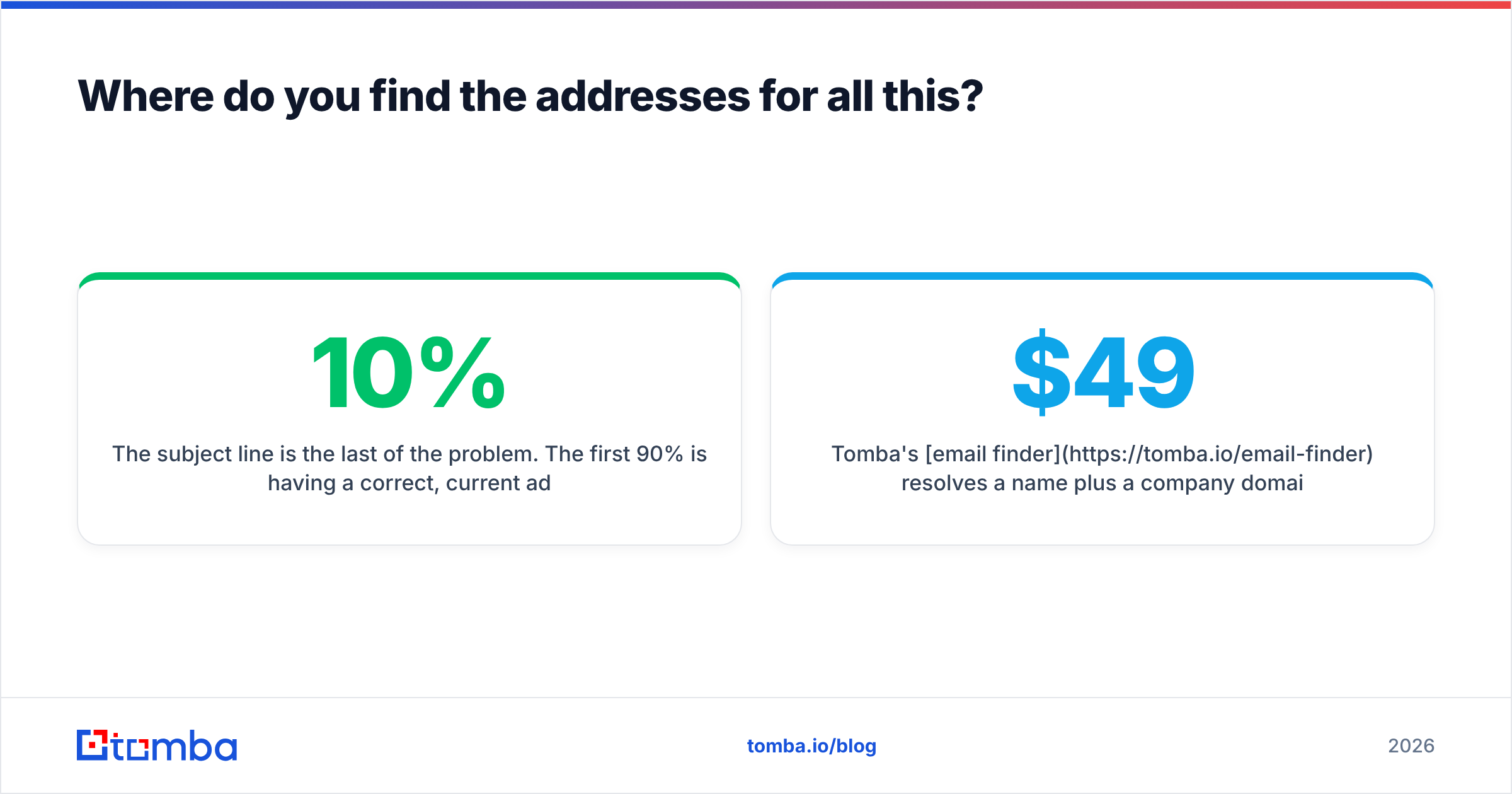
The subject line is the last 10% of the problem. The first 90% is having a correct, current address for the person you met at the booth, the podcast guest you want to reach, or the alum who just changed jobs — because job changes invalidate business email at roughly 25–30% per year.
Tomba's email finder resolves a name plus a company domain into a verified professional address, with a confidence score and the sources behind it, so you're not sending your best subject line to a mailbox that stopped existing eight months ago. The free tier covers 25 searches a month, which is realistic volume for genuine networking; paid plans start at $49/mo if you're running structured outbound alongside it. Full Tomba pricing is public, and there's no credit-card wall on the free tier.
Write the subject line like a human. Verify the address like an engineer. That combination is what turns a conference badge scan into an actual relationship.
Related guides#
Ready to find emails that actually work?
Join 150,000+ professionals who stopped guessing and started sending. Free credits on signup — no credit card required.
Get the Tomba newsletter
Practical outbound tactics and product updates — once every two weeks.
About the author