Email Template for Collaboration: 9 Proven Formats for 2026
Nine collaboration email templates you can copy today — partnership, guest post, co-marketing, affiliate, podcast and more — plus the structure, subject lines, and follow-up cadence that decide whether anyone replies.
TL;DR
- A collaboration email works when it leads with what the other side gets, not with who you are. Reverse that order and reply rates collapse.
- Nine templates below cover the realistic scenarios: partnership, guest post, co-marketing, podcast, affiliate, influencer, product integration, event, and content swap.
- The single biggest predictor of a reply is not the copy — it's whether the email reached a real, verified person with decision authority. Generic
info@inboxes kill otherwise good pitches. - Keep the first email under 150 words with exactly one ask. Two asks reads as a favour request; one ask reads as a proposal.
- Follow up twice, spaced 4 and 9 days out, each adding new information. After that, move on.
What is an email template for collaboration?#
An email template for collaboration is a reusable message structure for proposing joint work between two organisations — a guest post, a co-hosted webinar, a product integration, an affiliate arrangement, a newsletter swap. It is not a cold sales email. You are not asking someone to buy; you are asking them to spend time and audience attention with you.
That distinction changes everything about the copy. A sales email can lean on pain points and urgency. A collaboration email has to demonstrate that the exchange is roughly symmetrical, and it has to do that in the first three lines, because the recipient is scanning for "what does this cost me?"
Think of it like proposing a joint venture between two shops on the same street. You don't open with your shop's history. You open with the customers you'd send through their door.
The template is a skeleton — context, value, ask, proof, exit. The specifics change per recipient. Templates that get sent unedited are why partnership inboxes are graveyards.
Why do most collaboration emails get ignored?#
Four failure modes account for most of it, and only one of them is about writing.
1. The email never reached a human who can say yes. Most collaboration pitches land in partnerships@, hello@, or info@ — shared inboxes triaged by someone with no authority and no incentive. If you want a decision, you need the name and address of the person who owns the outcome: the content lead for guest posts, the growth or demand gen lead for co-marketing, the BD or product lead for integrations.
2. The value is asserted, not shown. "We think this would be a great fit for both our audiences" is a claim with zero evidence attached. "Your post on schema markup ranks #4 for a term our newsletter subscribers search 2,000 times a month — here's the segment" is evidence.
3. There are three asks. A first email asking for a call, a content swap, and a logo placement gets no reply, because answering requires a meeting with the recipient's own team. One ask, one decision.
4. It's too long. Partnership leads read on mobile between meetings. If your pitch needs scrolling before the ask appears, it isn't read.

What are the parts of a collaboration email that get replies?#
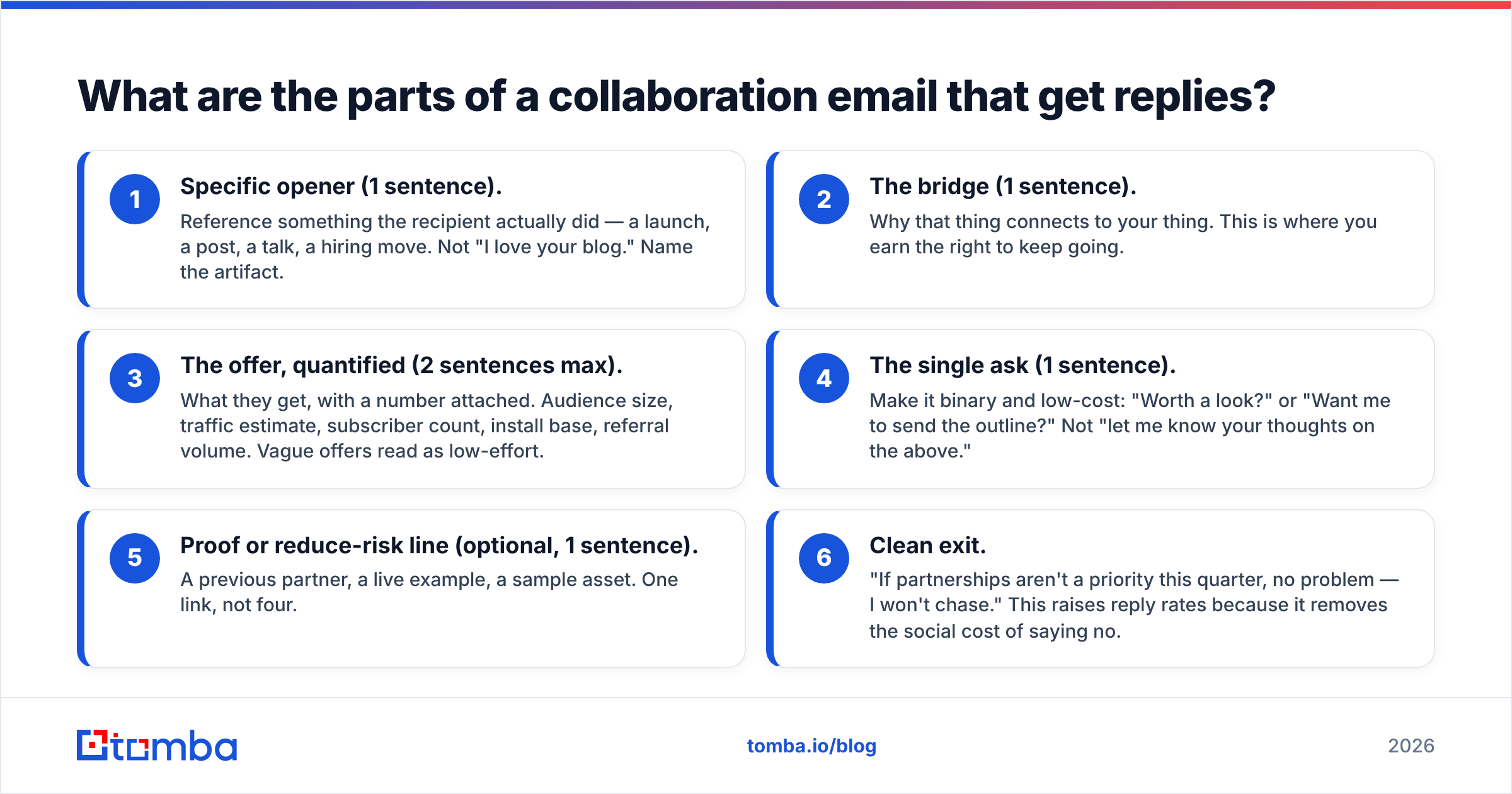
Every template below is built from the same six blocks. Learn the blocks and you can write a fresh pitch in four minutes without a template at all.
- Specific opener (1 sentence). Reference something the recipient actually did — a launch, a post, a talk, a hiring move. Not "I love your blog." Name the artifact.
- The bridge (1 sentence). Why that thing connects to your thing. This is where you earn the right to keep going.
- The offer, quantified (2 sentences max). What they get, with a number attached. Audience size, traffic estimate, subscriber count, install base, referral volume. Vague offers read as low-effort.
- The single ask (1 sentence). Make it binary and low-cost: "Worth a look?" or "Want me to send the outline?" Not "let me know your thoughts on the above."
- Proof or reduce-risk line (optional, 1 sentence). A previous partner, a live example, a sample asset. One link, not four.
- Clean exit. "If partnerships aren't a priority this quarter, no problem — I won't chase." This raises reply rates because it removes the social cost of saying no.
Total: 90–150 words. Anything longer and you're negotiating in an email that hasn't been answered yet.
Which collaboration email template should you use?#
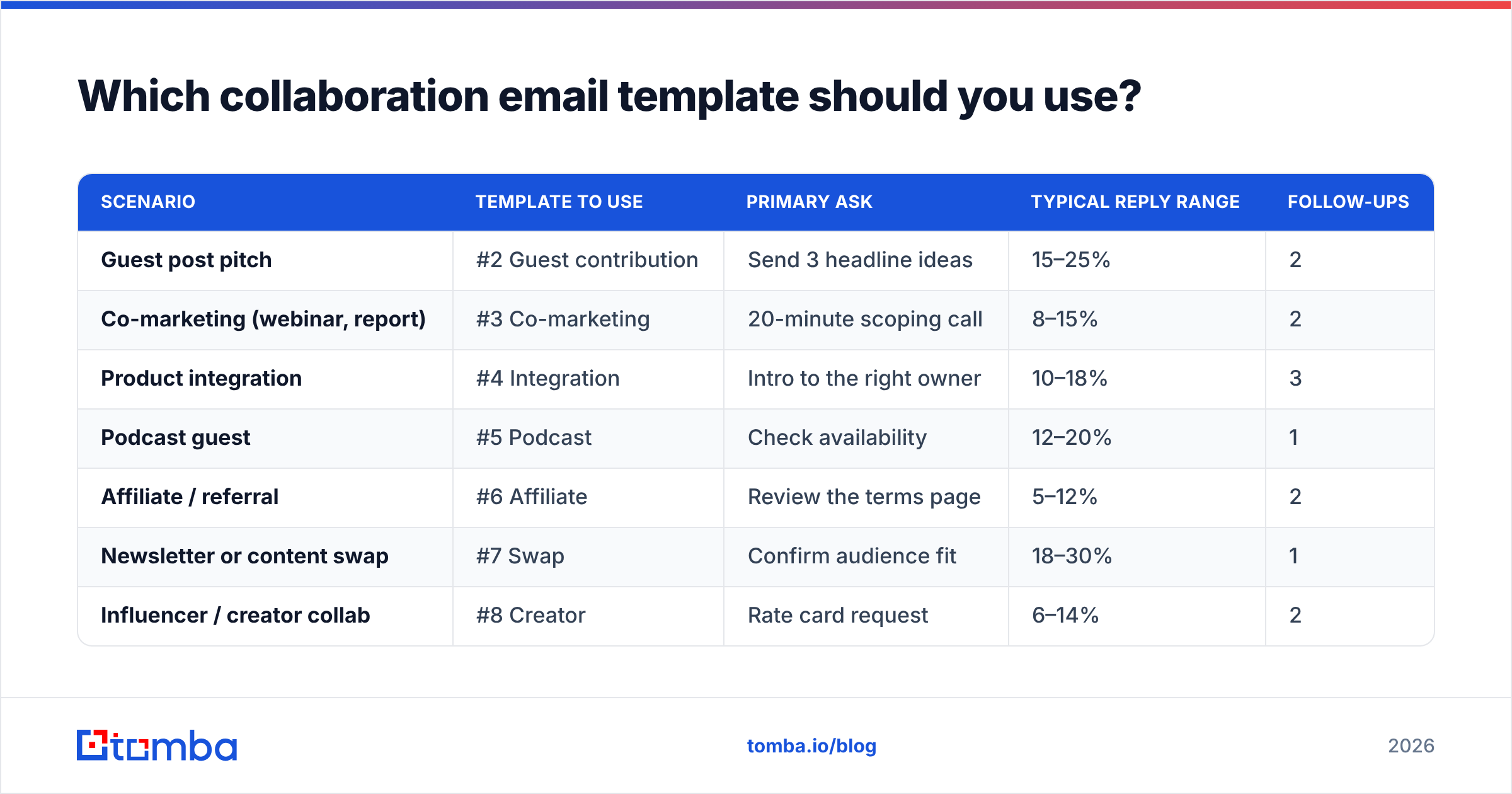
Match the template to the ask, not to your preference. Reply rates below reflect typical ranges for warm-ish B2B outreach to a verified individual — cold sends to generic inboxes run far lower.
| Scenario | Template to use | Primary ask | Typical reply range | Follow-ups |
|---|---|---|---|---|
| Guest post pitch | #2 Guest contribution | Send 3 headline ideas | 15–25% | 2 |
| Co-marketing (webinar, report) | #3 Co-marketing | 20-minute scoping call | 8–15% | 2 |
| Product integration | #4 Integration | Intro to the right owner | 10–18% | 3 |
| Podcast guest | #5 Podcast | Check availability | 12–20% | 1 |
| Affiliate / referral | #6 Affiliate | Review the terms page | 5–12% | 2 |
| Newsletter or content swap | #7 Swap | Confirm audience fit | 18–30% | 1 |
| Influencer / creator collab | #8 Creator | Rate card request | 6–14% | 2 |
| Event or booth share | #9 Event | Split cost confirmation | 10–20% | 2 |
The pattern: the cheaper the ask is for the recipient, the higher the reply rate. Swaps and guest posts outperform integrations because they require one person's yes instead of a committee's.
What do the nine collaboration email templates look like?#
Copy these, then rewrite the first two lines for each recipient. The first two lines are the entire job.
1. The general partnership opener#
Subject: Quick partnership idea — [Your Company] x [Their Company]
Hi [First name],
Saw [Their Company] shipped [specific feature/report] last month — the [specific detail] part stood out.
We run [your product] for roughly [X] [role] teams, and about [Y]% of them ask us for exactly what you've built. There's a clean overlap: we send you qualified referrals, you become the recommended option in our [docs/directory/onboarding].
Worth a 20-minute call to see if the numbers work?
If partnerships aren't on the roadmap this quarter, no problem — I won't follow up twice.
[Name]
2. The guest contribution pitch#
Subject: Guest post idea for [Blog name]: [specific angle]
Hi [First name],
Your piece on [topic] ranks well for [keyword] but stops short of [gap]. I've been running [relevant experiment/data set] and can fill that gap with original numbers.
Three angles I could write, 1,500–2,000 words, no promotional links:
- [Angle one]
- [Angle two]
- [Angle three]
Want me to send a full outline for whichever one fits?
[Name] — previously published at [Publication 1], [Publication 2]
3. The co-marketing proposal#
Subject: Co-hosted [webinar/report] on [topic] — splitting the audience
Hi [First name],
We're producing a [report/webinar] on [topic] in [month]. Our list is [X] [ICP description]; yours looks like the same buyer from the other side of the workflow.
Proposal: we build the asset and handle production, you co-brand and promote to your list. Leads are shared 50/50, and both teams get the raw data.
Free for a 20-minute scoping call [two specific date options]?
[Name]
4. The product integration ask#
Subject: [Your product] integration — 40+ mutual customers asking
Hi [First name],
We've had [X] customers this quarter ask whether [Your Product] connects to [Their Product]. Right now they're exporting CSVs between the two.
Our API is documented and we can build the connector on our side — we'd need a sandbox account and one technical contact. We'll handle the launch post and co-marketing.
Are you the right person for this, or can you point me to whoever owns the partner ecosystem?
[Name]
5. The podcast guest pitch#
Subject: [Podcast name] guest: [specific, contrarian angle]
Hi [First name],
Episode [number] with [previous guest] touched on [topic] but nobody pushed back on [assumption]. I've got data from [N] [companies/campaigns] that argues the opposite.
Happy to bring the raw numbers so your audience gets something they can't find elsewhere.
Are you booking guests for [month]?
[Name]
6. The affiliate or referral invite#
Subject: Referral arrangement for your [audience] readers
Hi [First name],
Your [resource/list/review] sends readers looking for [category]. We pay [X]% recurring on referrals, tracked for [N] days, paid monthly with no minimum.
Average partner in your bracket earns [$Y]/month from a single placement.
Want the terms page to review? Takes two minutes.
[Name]
7. The newsletter or content swap#
Subject: Swap? [Your newsletter] ([X] subs) x [Their newsletter]
Hi [First name],
Our lists look like near-twins — [audience description], [X] subscribers, [Y]% open rate.
Straight swap: one dedicated mention each, same week, both sides write their own copy so it stays authentic.
Sound fair? I can go first.
[Name]
8. The creator collaboration#
Subject: Paid collab — [specific format], [platform]
Hi [First name],
Your [specific post/video] on [topic] is the best explanation of it I've seen, and it maps directly to what our users struggle with.
We'd like to sponsor [format] — full creative control on your side, one link, no scripted claims. Budget is set and we move fast.
Can you send your rate card?
[Name]
9. The event or booth share#
Subject: Splitting a booth at [Event] — [month]
Hi [First name],
We're attending [Event] in [month]. A shared booth halves the cost for both of us and doubles the draw, since our audiences overlap without competing.
[Organiser] confirmed shared exhibitors are allowed. Cost per side would be roughly [$X].
In or out by [date]? I need to confirm with them by then.
[Name]
How do you find the right person to send a collaboration email to?#
This is where most collaboration campaigns are won or lost, and it's the least glamorous part.
Start from the role, not the company. For guest posts, target the content or SEO lead. For co-marketing, target demand generation. For integrations, target partnerships or product. Then find that person's actual work address.
A practical workflow:
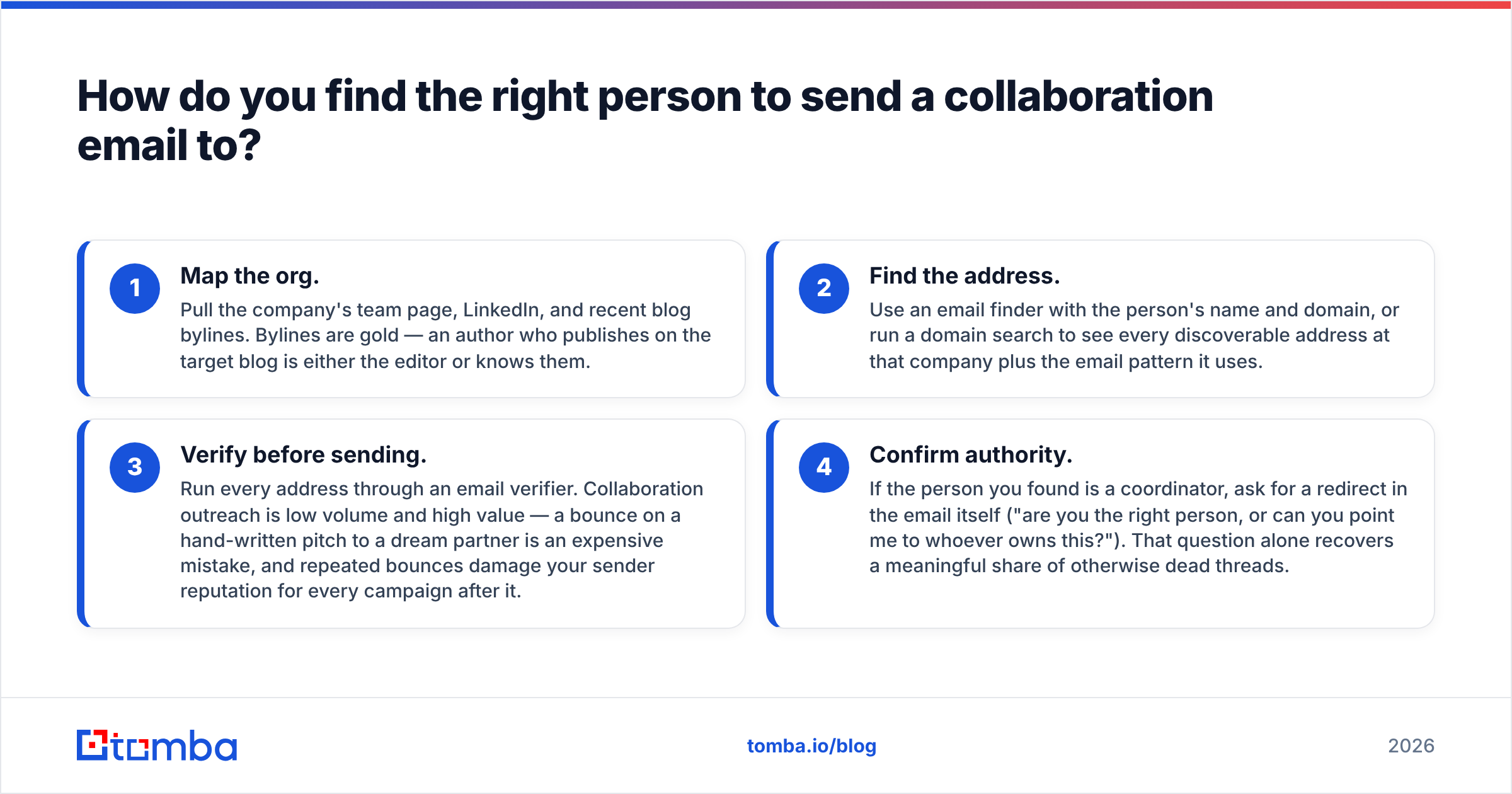
- Map the org. Pull the company's team page, LinkedIn, and recent blog bylines. Bylines are gold — an author who publishes on the target blog is either the editor or knows them.
- Find the address. Use an email finder with the person's name and domain, or run a domain search to see every discoverable address at that company plus the email pattern it uses.
- Verify before sending. Run every address through an email verifier. Collaboration outreach is low volume and high value — a bounce on a hand-written pitch to a dream partner is an expensive mistake, and repeated bounces damage your sender reputation for every campaign after it.
- Confirm authority. If the person you found is a coordinator, ask for a redirect in the email itself ("are you the right person, or can you point me to whoever owns this?"). That question alone recovers a meaningful share of otherwise dead threads.
For volume campaigns — say, 200 guest post targets — the same steps run through bulk email finder and bulk verification instead of one at a time. The logic is identical, just batched.
How should you follow up on a collaboration email?#
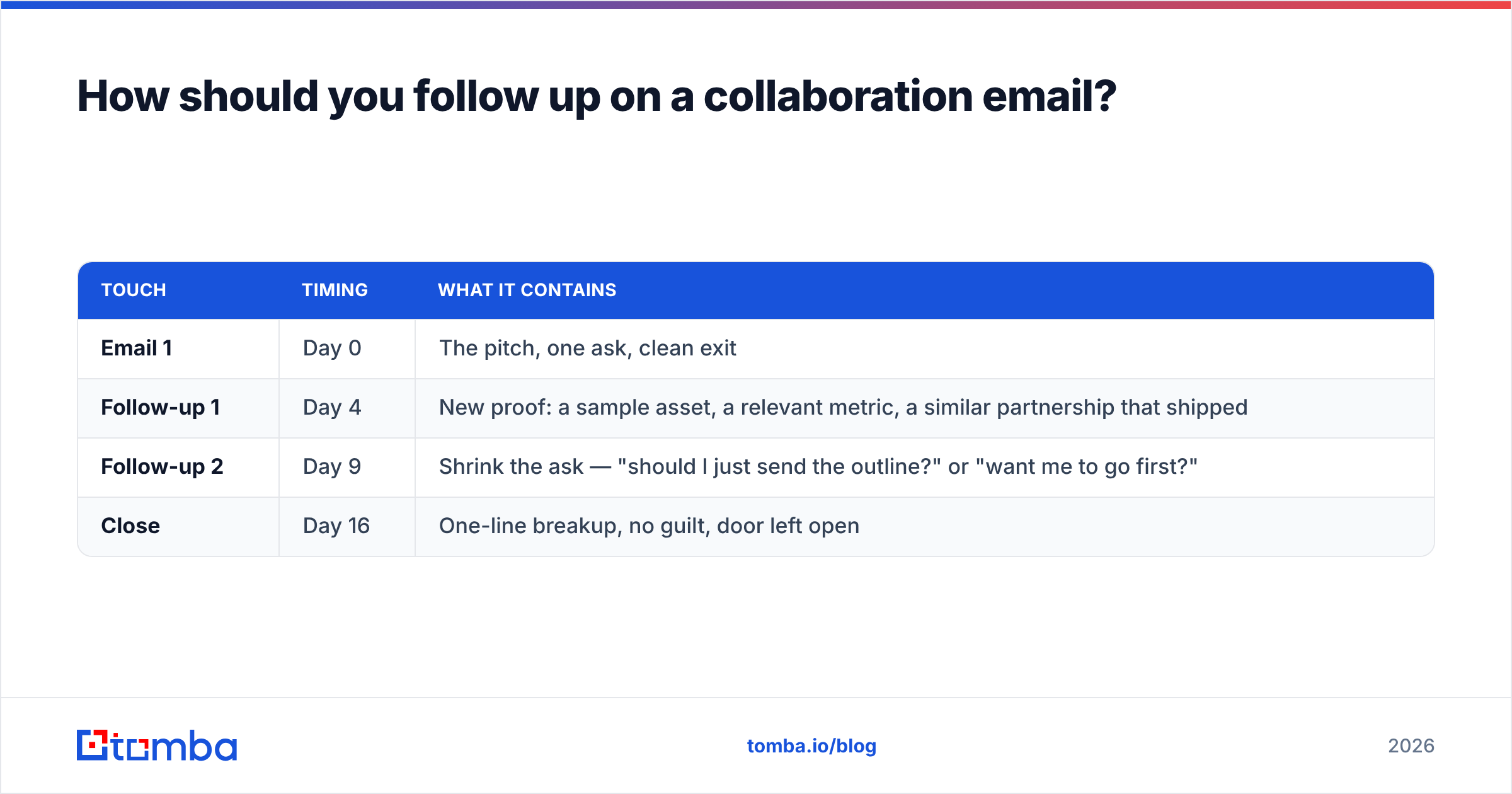
Two follow-ups, each carrying new information. A bare "just bumping this" adds nothing and trains the recipient to ignore you.
| Touch | Timing | What it contains |
|---|---|---|
| Email 1 | Day 0 | The pitch, one ask, clean exit |
| Follow-up 1 | Day 4 | New proof: a sample asset, a relevant metric, a similar partnership that shipped |
| Follow-up 2 | Day 9 | Shrink the ask — "should I just send the outline?" or "want me to go first?" |
| Close | Day 16 | One-line breakup, no guilt, door left open |
Shrinking the ask on the second follow-up is the highest-leverage move in the sequence. If a call didn't land, a two-minute review of an asset might. You're lowering the price, not raising the pressure.
Track response rate per template and per segment, not per campaign. Aggregate numbers hide the fact that your swap template is at 28% while your integration template is at 3%.
What mistakes kill collaboration emails most often?#
- Attaching a deck to a first email. Nobody opens a PDF from a stranger. Put the number in the body.
- Templated personalisation tokens that misfire. "I loved your recent post on {{topic}}" that renders literally has ended more partnerships than bad offers ever have.
- Sending on Monday morning. Partnership inboxes get triaged Monday; you're competing with the weekend backlog. Tuesday–Thursday, mid-morning in the recipient's timezone, does better.
- Asking for a call before establishing value. A call is expensive. Earn it with a cheaper first yes.
- Ignoring deliverability basics. If your domain lacks proper authentication, a beautifully written pitch may never render in the primary tab. HubSpot's guidance on email deliverability fundamentals is a solid starting checklist, and it's worth understanding how email authentication works before you scale sends.
- No tracking of who said no and why. A "not this quarter" is a calendar reminder, not a rejection. Log it.
If you're comparing outreach and partnership tooling before committing budget, verified user reviews on G2 are more useful than vendor comparison pages — filter by company size to see whether a tool holds up at your scale.
What does a good collaboration program look like at scale?#
One-off pitches produce one-off results. A functioning program has four pieces:
- A target list built on fit criteria — audience overlap, non-competing product, similar company stage. Fifty well-chosen targets beat five hundred scraped ones.
- Verified contact data refreshed quarterly. B2B contact data decays roughly 2–3% per month through job changes. A list built in January is meaningfully stale by June.
- Three to four templates in rotation, each tied to a specific ask, each measured separately.
- A shared record of every conversation, including the nos, so nobody on your team pitches the same partner twice with the same offer.
The tooling matters less than the discipline, but bad data makes discipline impossible. If half your list bounces, you can't tell whether your copy is failing or your addresses are.
Where should you start?#
Pick one template from the nine above, build a list of twenty-five genuinely well-matched targets, find and verify the decision-maker at each, and send. Measure replies by template. Rewrite the two weakest openers. Repeat.
The copy is the easy half. The half that actually decides your reply rate is whether the message reached a named human with authority instead of a shared inbox nobody owns.
That's the part Tomba Email Finder handles — find the content lead, the partnerships owner, or the growth manager by name and domain, verify the address before you send, and keep your bounce rate low enough that your collaboration pitches actually land in a primary inbox. The free tier covers 25 searches a month if you just want to test it against your first target list; paid plans start at $49/mo when you're ready to run the program properly.
Related guides#
Ready to find emails that actually work?
Join 150,000+ professionals who stopped guessing and started sending. Free credits on signup — no credit card required.
Get the Tomba newsletter
Practical outbound tactics and product updates — once every two weeks.
About the author