Email Verification Free: 9 Tools Tested and Compared (2026)
Free email verification is real, but every free tier hides a limit somewhere: daily caps, no catch-all handling, or no API. Here's what nine free verifiers actually deliver in 2026 and when paying starts to make sense.
TL;DR
- Free email verification exists at almost every vendor, but the free tier is a sampling tool, not a production pipeline. Typical caps: 25–100 checks per month, sometimes per day.
- Syntax and MX checks are free everywhere and worth almost nothing on their own. The expensive part is the SMTP handshake and catch-all resolution, and that is where free tiers stop.
- If your list is under ~100 addresses a month, a free tier plus a manual checker is genuinely enough. Above that, the cost of one blocked sending domain dwarfs a $49/mo plan.
- Never trust a single "valid" verdict on a catch-all domain. Free tools mark these as "unknown" or, worse, silently mark them "valid" and you eat the bounce.
- Benchmark before you commit: run the same 100 known-good and known-dead addresses through two or three free tiers and compare the verdicts.
What does "email verification free" actually mean?#
It means one of three very different things, and vendors are happy to let you confuse them.
Free forever, capped. You get a permanent account with a small monthly allowance — 25, 50, or 100 verifications. Tomba's free tier works this way (25 searches per month), as do most email-finder platforms. Good for spot checks and for testing accuracy before you buy.
Free trial, then paid. You get 100–1,000 credits once, and after that the tool is a paywall. ZeroBounce and most dedicated verifiers use this model. Useful for a one-off list clean, useless as a workflow.
Free tools, no account. Single-address checkers you paste an email into. Tomba's free email checker is one; there are dozens. No bulk, no API, no CSV export, but no signup either.
The trap is treating the third category as if it were the first. A browser tool that validates one address at a time cannot clean a 4,000-row export, and pasting 4,000 addresses one by one is not a plan.
How does free email verification actually work?#
Every verifier runs the same ladder of checks. The cheap rungs are free; the expensive rungs are what you pay for.
- Syntax validation — Does the string parse as a valid address per RFC 5322? Catches typos like
john@gmail,com. Costs the vendor nothing, so it is always free. - Domain and MX record lookup — Does
acme.comexist, and does it publish mail exchanger records? A DNS query costs fractions of a cent. Also always free. - Disposable and role detection — Is this
mailinator.com, orinfo@,sales@,noreply@? Requires a maintained blocklist. Usually free, quality varies wildly. - SMTP handshake — The verifier opens a connection to the receiving mail server and asks, without sending anything, whether the mailbox exists. This needs clean IP pools, rate limiting, and retry logic. This is the part you are actually paying for.
- Catch-all resolution — Some domains accept mail for every address, so the SMTP answer is always "yes." Resolving these needs pattern data and historical engagement signals. This is the most expensive rung, and free tiers almost never include it.
A tool that only does steps 1–3 will happily tell you jennifer.smith@acme.com is valid when Jennifer left in 2023. You will find out when your bounce rate hits 9% and your domain reputation tanks.
Which free email verification tools are worth using in 2026?#
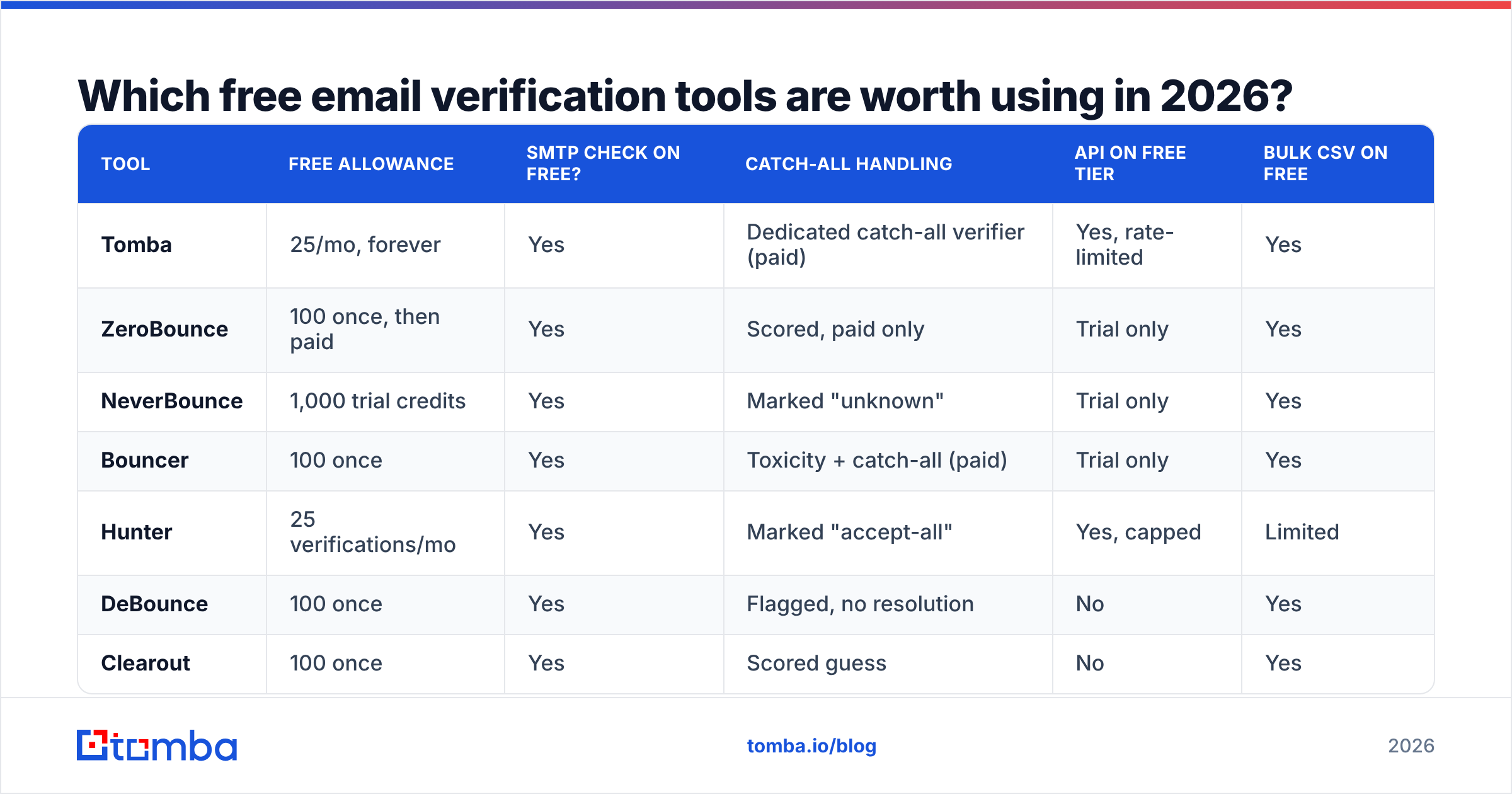
Here's how the main free offers compare. Figures are the publicly advertised free tiers as of early 2026 — always re-check before you build a workflow on one.
| Tool | Free allowance | SMTP check on free? | Catch-all handling | API on free tier | Bulk CSV on free |
|---|---|---|---|---|---|
| Tomba | 25/mo, forever | Yes | Dedicated catch-all verifier (paid) | Yes, rate-limited | Yes |
| ZeroBounce | 100 once, then paid | Yes | Scored, paid only | Trial only | Yes |
| NeverBounce | 1,000 trial credits | Yes | Marked "unknown" | Trial only | Yes |
| Bouncer | 100 once | Yes | Toxicity + catch-all (paid) | Trial only | Yes |
| Hunter | 25 verifications/mo | Yes | Marked "accept-all" | Yes, capped | Limited |
| DeBounce | 100 once | Yes | Flagged, no resolution | No | Yes |
| Clearout | 100 once | Yes | Scored guess | No | Yes |
| MailTester-style free checkers | Unlimited, 1 at a time | Yes | None | No | No |
| Spreadsheet regex / manual | Unlimited | No | None | n/a | Yes |
Two things jump out. First, "unlimited free" only exists where the tool does no SMTP work — regex in a spreadsheet, or a single-address web checker with a per-minute throttle. Second, the difference between vendors on the free tier is almost entirely about what happens to ambiguous results, not about whether they can detect an obviously dead mailbox. Everyone catches asdfgh@acme.com. Nobody agrees on sales@acme.com when acme.com is catch-all.
If you want a broader vendor landscape rather than just free tiers, G2's email verification category is a reasonable starting point for review volume, though the rankings are heavily influenced by review-collection budgets.
How accurate is free email verification?#
Accuracy on free tiers is the same engine as paid — vendors do not run a worse algorithm for free users. What changes is volume and ambiguity handling.

Three numbers matter and vendors rarely publish all three:
- True-valid rate — of addresses marked valid, what share actually deliver? Good tools sit at 95–98%. Anything below 92% will hurt you at scale.
- Unknown rate — what share come back unresolvable? On free tiers this is often 15–25%, because catch-all resolution is gated. Those addresses are neither usable nor discardable without more work.
- False-invalid rate — good addresses wrongly killed. This is the silent one. A tool that marks 6% of your best prospects invalid to protect its true-valid headline number is costing you pipeline, and you will never see the bounce that did not happen.

Run your own test. Take 50 addresses you know deliver (colleagues, customers who replied last week, your own aliases) and 50 you know are dead (bounced contacts from an old campaign). Push both sets through two or three free tiers. Any tool that misclassifies more than 2–3 of the known-good set is out, regardless of what its marketing page claims.
Is free email verification enough for cold outreach?#
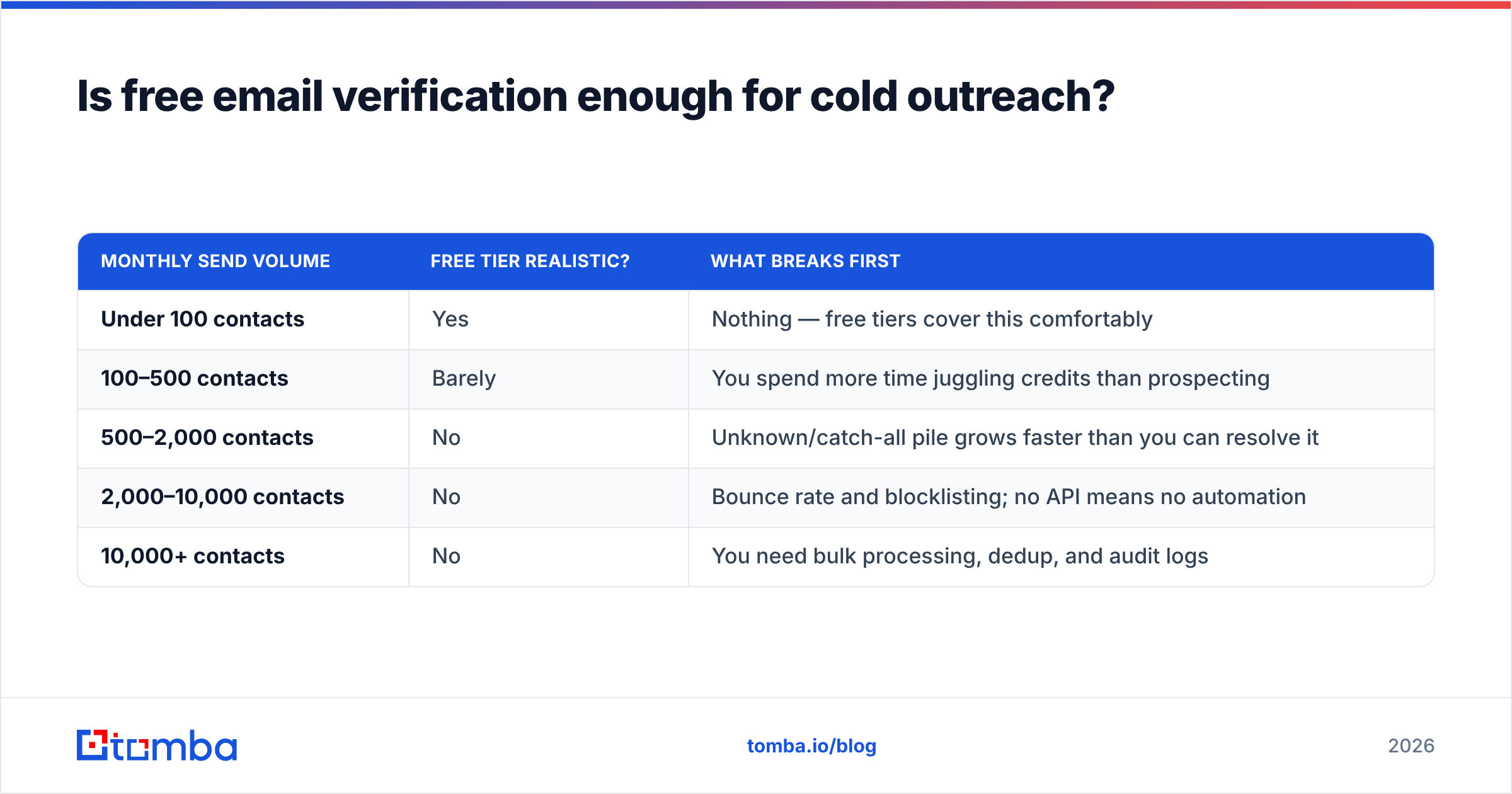
Only if your volume is genuinely small. Here's the arithmetic that decides it.
Mailbox providers now enforce bounce thresholds explicitly. Google's bulk sender guidelines put the spam-complaint ceiling at 0.3% and expect senders to keep invalid-recipient rates low; Microsoft applies similar logic without publishing the numbers. At a 2% bounce rate you are fine. At 5% you are being throttled. At 8%+ on a new domain you are being filtered into spam within a week, and recovering a burned sending domain takes 4–8 weeks of email deliverability repair work.
So the real question is not "can I get verification for free" but "how many unverified addresses can I afford to send to before the cost of a burned domain exceeds a subscription."
| Monthly send volume | Free tier realistic? | What breaks first |
|---|---|---|
| Under 100 contacts | Yes | Nothing — free tiers cover this comfortably |
| 100–500 contacts | Barely | You spend more time juggling credits than prospecting |
| 500–2,000 contacts | No | Unknown/catch-all pile grows faster than you can resolve it |
| 2,000–10,000 contacts | No | Bounce rate and blocklisting; no API means no automation |
| 10,000+ contacts | No | You need bulk processing, dedup, and audit logs |
The crossover point is roughly 300–500 contacts a month. Below it, stitching together free tiers is rational. Above it, you are doing unpaid ops work to avoid a $49/mo line item.
What do you actually give up on a free tier?#
Beyond the raw credit count, four things disappear:
Catch-all resolution. Roughly 15–20% of B2B domains are catch-all, and they skew toward mid-market and enterprise — exactly the accounts you want. Free tiers return "unknown" and leave you to guess. A dedicated catch-all verifier uses pattern history and engagement signals to give a usable confidence score instead of a shrug.
API access. Manual CSV round-trips are fine for one list. They are not fine when a form submission needs verification before it hits your CRM, or when your enrichment job runs nightly. Free API access, where it exists at all, is throttled to a few calls a minute.
Bulk throughput. Free tools that accept CSVs usually cap the file at a few hundred rows and queue you behind paying customers. A 20,000-row clean that takes 90 minutes on a paid plan can take a day on free.
Support and audit trail. When a client asks why you emailed someone who opted out, "the free tool said it was fine" is not an answer.

How do you build a workflow that stays mostly free?#
You can push the free-to-paid crossover further out with sequencing. The principle: spend your scarce verification credits only on addresses that survived cheaper filters.
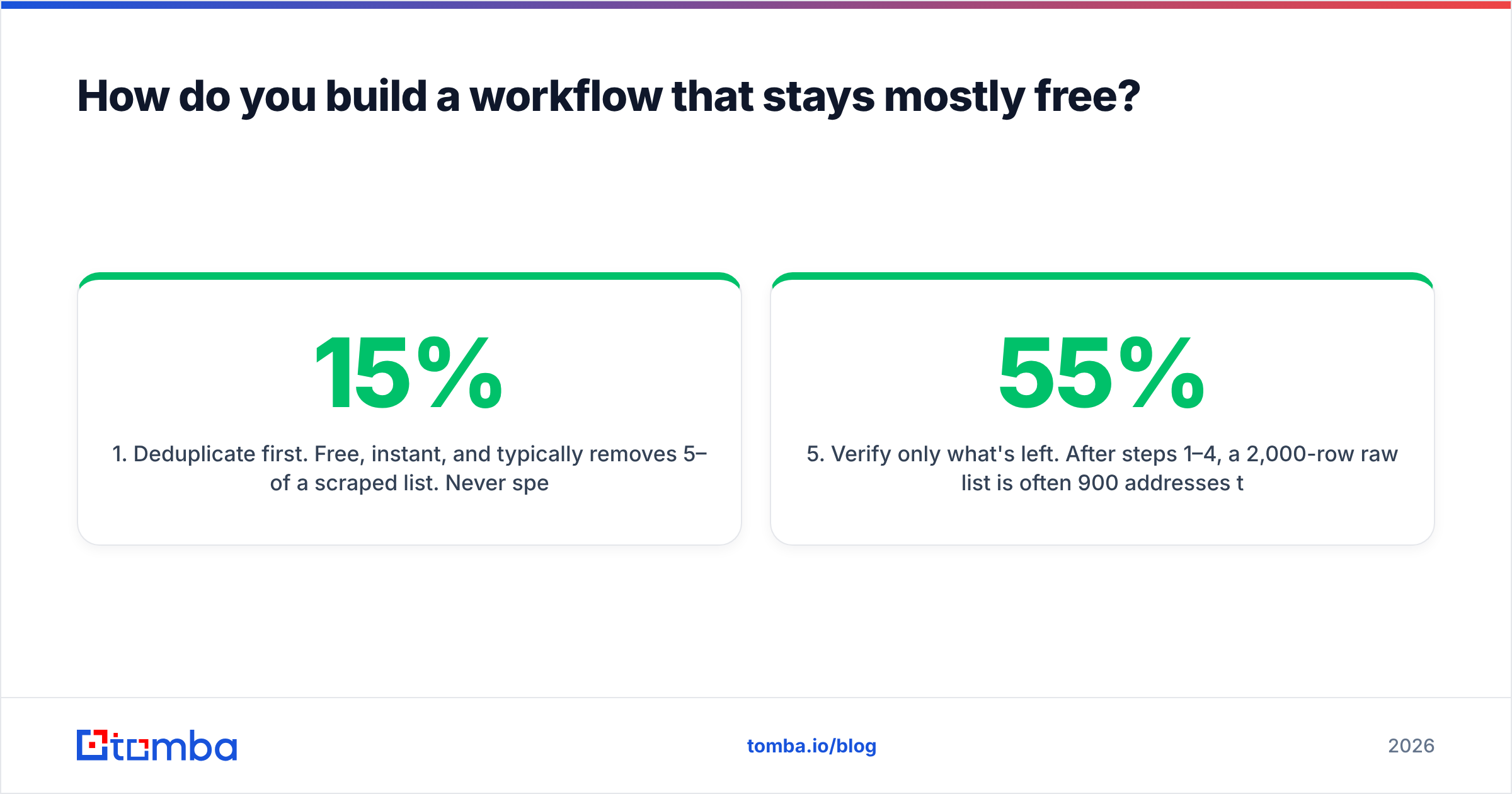
- Deduplicate first. Free, instant, and typically removes 5–15% of a scraped list. Never spend a credit twice on the same address.
- Strip roles and disposables locally.
info@,admin@,support@,noreply@, plus a disposable-domain blocklist. This is regex work — no credits needed — and it removes addresses you should not be cold-emailing anyway. - Filter on domain, not address. Run one MX check per domain instead of one per address. A list of 2,000 contacts often has only 300 unique domains. Dead domains kill every address under them for the price of one lookup.
- Use pattern inference before verification. If you already know
acme.comusesfirst.last@, generating and verifying one candidate beats verifying six permutations. A domain search gives you the pattern and the known addresses in a single call. - Verify only what's left. After steps 1–4, a 2,000-row raw list is often 900 addresses that actually need an SMTP check. That's a 55% credit saving before you spend anything.
- Segment by verdict, not by binary. Valid → send. Invalid → delete. Unknown/catch-all → a separate, slower sequence from a secondary domain so ambiguity never touches your primary sender reputation.
Steps 1 through 4 cost nothing and are where most of the savings live. Teams that skip straight to "upload the CSV and buy credits" routinely pay 2–3x more than they need to.
Free verification vs. buying pre-verified data#
There's a third path people forget: skip verification by buying data that's already clean. Providers like BookYourData sell pay-as-you-go B2B contacts with delivery guarantees attached, which shifts the bounce risk onto the vendor rather than your sending domain. That's a legitimately different economic model — you pay per contact rather than per check — and for teams doing infrequent, targeted campaigns it can work out cheaper than a subscription plus a verification budget.
The tradeoff is freshness and fit. Purchased lists are a snapshot; job changes invalidate roughly 2–3% of B2B contacts per month. If your ICP is narrow and you're sourcing contacts continuously from LinkedIn, events, or inbound signals, you'll still need a verification step on your own sourced data. Most teams end up running both: purchased data for broad coverage, self-sourced and verified data for the accounts they actually care about.
When should you stop using free tools?#
Four concrete signals:
- You're managing more than two accounts to farm free credits. The ops overhead has already exceeded the subscription cost.
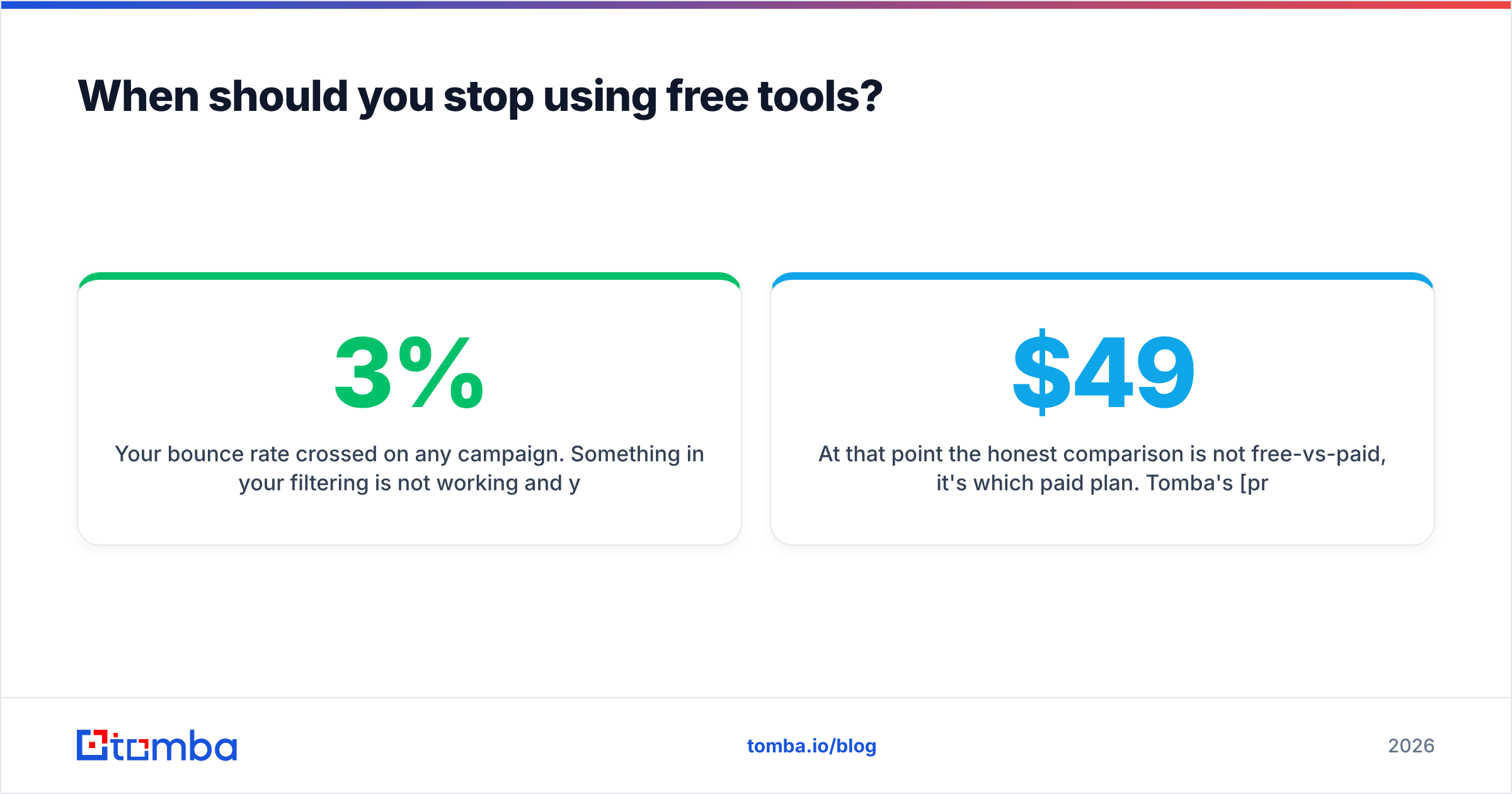
- Your bounce rate crossed 3% on any campaign. Something in your filtering is not working and you need catch-all resolution plus a real audit of the verdicts.
- You need verification inside another system — CRM, form handler, enrichment job. That means an API, and free tiers do not ship a usable one.
- You're verifying the same list monthly. Recurring work needs automation, and automation needs paid throughput.
At that point the honest comparison is not free-vs-paid, it's which paid plan. Tomba's pricing starts at $49/mo for Starter with Growth at $99/mo and Pro at $249/mo; dedicated verifiers like ZeroBounce price per credit instead, which is cheaper for one-off cleans and more expensive for continuous use. Bundled platforms make sense when you're finding and verifying; standalone verifiers make sense when your data comes from somewhere else and you only need the last mile.

One more consideration: if you're already paying for a finder, check whether verification is included before buying a second tool. Most finders verify on discovery, which means a separate verifier is only worth it for lists you sourced elsewhere — imports, event scans, purchased data, or old CRM records that have decayed.
What's the fastest way to test a free tier honestly?#
Twenty minutes, no credit card:
- Build a 100-address control set — 50 addresses you can prove deliver, 50 you can prove bounce. Include at least 10 from catch-all domains if you know any.
- Sign up for two or three free tiers and run the identical set through each.
- Score each tool on false-invalids first (good addresses killed), then unknowns, then false-valids.
- Check how each one labels the catch-all subset. "Valid" with no caveat is a red flag; "unknown" is honest; a confidence score is best.
- Pick on the false-invalid number. Everything else can be worked around; contacts silently deleted from your pipeline cannot.
Run this before you commit budget, not after your first campaign underperforms. The whole exercise costs you one afternoon and it's the only comparison that reflects your data rather than a vendor's benchmark deck.
Start free, scale when the math says so#
Free email verification is a legitimate starting point — genuinely useful for solo founders, small agencies, and anyone validating an ICP before scaling. It stops being enough somewhere around 300–500 contacts a month, and the transition is usually forced by catch-all domains and API needs rather than raw credit exhaustion.
If you want to test the accuracy side without spending anything, start with the Tomba Email Finder free tier — 25 searches a month, verification included on discovery, no card required. Run your control set through it, compare the verdicts against whatever you're using now, and only upgrade when the numbers justify it. That's the right order of operations: prove the accuracy, then pay for the volume.
Related guides#
Ready to find emails that actually work?
Join 150,000+ professionals who stopped guessing and started sending. Free credits on signup — no credit card required.
Get the Tomba newsletter
Practical outbound tactics and product updates — once every two weeks.
About the author