Email vs Direct Mail in 2026: Cost, ROI, and Response Rates
Direct mail gets opened more often. Email costs a fraction as much and scales instantly. Here is the honest cost-per-reply math for both channels in 2026 — and the hybrid sequence that beats either one alone.
TL;DR
- Direct mail wins on attention per piece; email wins on cost, speed, and iteration. The channel that wins your campaign depends on deal size, not on which stat you quote.
- Realistic B2B cost per contact: roughly $0.01–$0.08 for a cold email (tool + data), versus $0.60–$5.00+ for a mailed piece once you count print, postage, and list accuracy.
- Direct mail only pencils out above roughly $15k–$25k average contract value, or when you are targeting fewer than ~500 named accounts.
- Both channels die on bad data. A wrong email bounces and hurts your sender reputation; a wrong mailing address costs you real money and never tells you it failed.
- The highest-performing 2026 pattern is neither/or — it is mail-then-email on named accounts, with the email referencing the physical piece.
What is the real difference between email and direct mail?#
Email is a probability game played at volume. Direct mail is a certainty game played at cost.
Think of it like fishing. Email is a net: cheap to cast, cheap to recast, and you accept that most of what you pull up is empty. Direct mail is a spear: expensive per throw, slow to aim, but when it lands on the right person it is very hard to ignore. Neither tool is "better." You pick based on how big the fish is.
Technically, the differences that matter to a revenue team are these:
- Unit economics. Email cost is dominated by data and tooling and is close to flat per send. Direct mail cost is dominated by physical production and postage and scales linearly forever — there is no volume point where a postcard becomes free.
- Feedback latency. An email campaign gives you open, click, and reply signal within 48 hours. A mail campaign gives you meaningful signal in two to four weeks, which means you get roughly one learning cycle per month instead of ten.
- Failure visibility. Email fails loudly (bounces, spam complaints, blocklists). Mail fails silently — undeliverable pieces mostly vanish unless you pay for address correction service.
- Attention competition. The average B2B inbox receives dozens of cold emails a week. The average B2B desk receives almost none of anything physical, which is exactly why mail still works.
- Compliance surface. Email is governed by CAN-SPAM, GDPR, and increasingly by mailbox-provider authentication rules. Direct marketing by post carries a far lighter technical compliance load but a heavier data-privacy one in the EU.
That last point matters more than most teams realize. Since Google and Yahoo tightened bulk-sender requirements, email is no longer a channel where sloppy senders can hide behind volume. Your email deliverability is now a hard gate on whether the channel works at all.
How much does each channel actually cost per contact?#
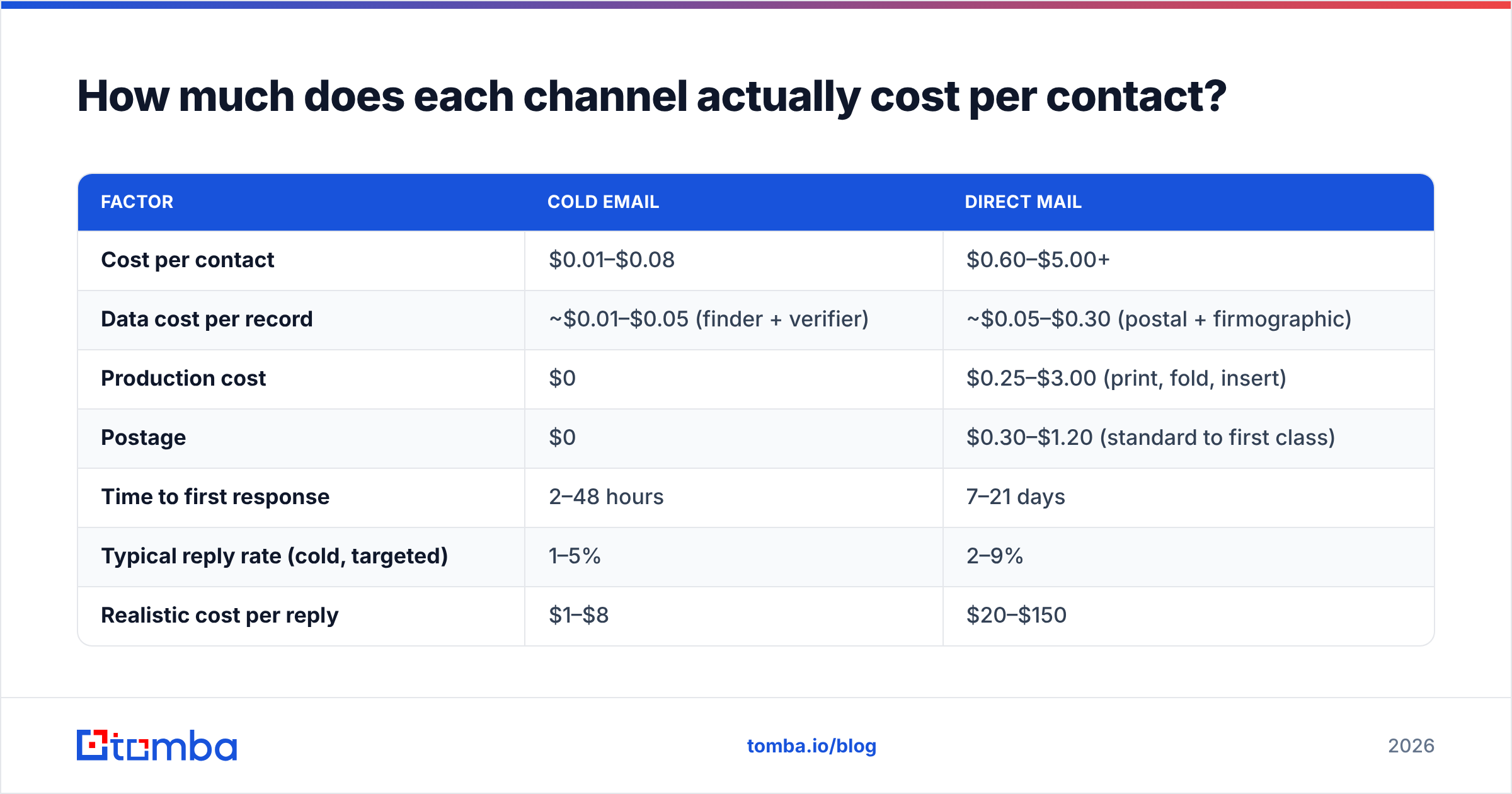
Here is the honest side-by-side. Figures reflect typical mid-2026 B2B pricing for a US campaign; your print vendor and data provider will move these by 20–30% in either direction.
| Factor | Cold email | Direct mail |
|---|---|---|
| Cost per contact | $0.01–$0.08 | $0.60–$5.00+ |
| Data cost per record | ~$0.01–$0.05 (finder + verifier) | ~$0.05–$0.30 (postal + firmographic) |
| Production cost | $0 | $0.25–$3.00 (print, fold, insert) |
| Postage | $0 | $0.30–$1.20 (standard to first class) |
| Time to first response | 2–48 hours | 7–21 days |
| Typical reply rate (cold, targeted) | 1–5% | 2–9% |
| Realistic cost per reply | $1–$8 | $20–$150 |
| Iteration speed | Same-day A/B tests | 3–6 weeks per cycle |
| Scales to 10,000 contacts? | Yes, same unit cost | Yes, but cost scales 1:1 |
| Fails silently? | No (bounce data) | Mostly yes |
| Personalization ceiling | High (text, dynamic fields) | Very high (physical objects, handwriting) |
Read the "cost per reply" row twice. Direct mail frequently produces a higher response rate and a worse cost per reply at the same time. Both facts are true, and vendors on each side quote only the one that flatters them.
The tell is what happens when you multiply. A 1,000-piece mail drop at $1.80 all-in costs $1,800 before a single conversation. The same 1,000 contacts emailed cost about $40 in data and tooling. If your average contract value is $4,000, mail has to convert absurdly well to survive that math. If your ACV is $80,000, mail is the cheapest thing on your marketing budget.
Which channel gets better response rates?#
Direct mail, on a per-piece basis — and it is not particularly close.
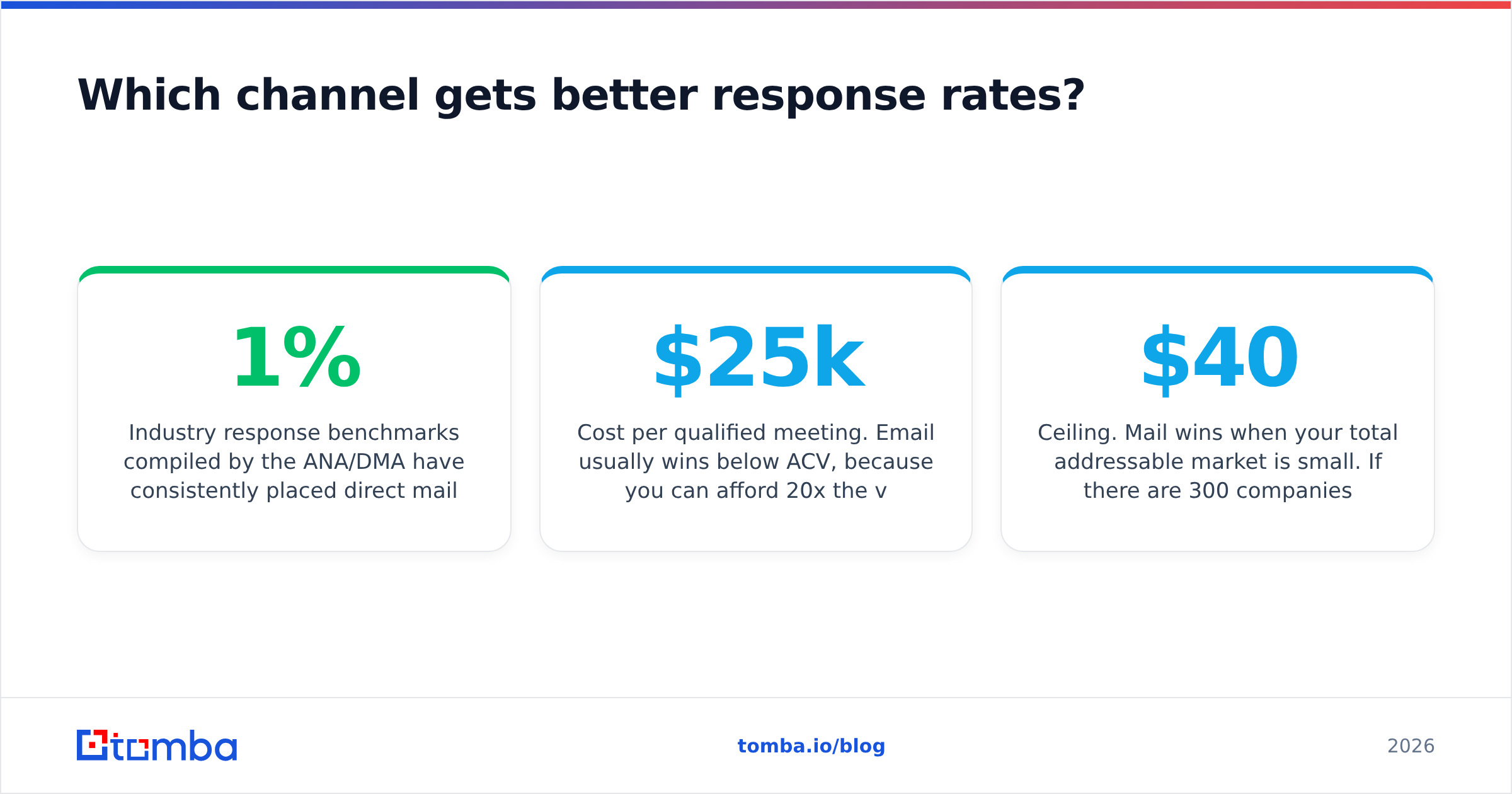
Industry response benchmarks compiled by the ANA/DMA have consistently placed direct mail response to house lists in the high single digits and prospect lists in the low-to-mid single digits, while cold email to prospect lists typically lands between 1% and 5% for well-targeted B2B campaigns. Marketing benchmark roundups from vendors like HubSpot tell a similar story: physical mail is opened far more often than email is even seen.
But per-piece response is the wrong denominator for most teams. What you actually care about:
- Cost per qualified meeting. Email usually wins below $25k ACV, because you can afford 20x the volume.
- Speed to pipeline. Email wins outright. A mail campaign designed in week one produces pipeline in week six.
- Ceiling. Mail wins when your total addressable market is small. If there are 300 companies on earth who can buy your product, sending 300 boxes at $40 each is a rounding error against one closed deal.
- Durability. A physical piece sits on a desk for days. An email is gone in 90 seconds if it does not earn a reply.
There is also a channel-fatigue argument that gets overstated. Yes, inboxes are crowded. But mailboxes are getting crowded again too as more GTM teams rediscover mail. The advantage is real but shrinking, and it is concentrated in high-effort formats — dimensional packages, handwritten notes, personalized books — not in generic postcards.
What does the math look like for a 1,000-prospect campaign?#
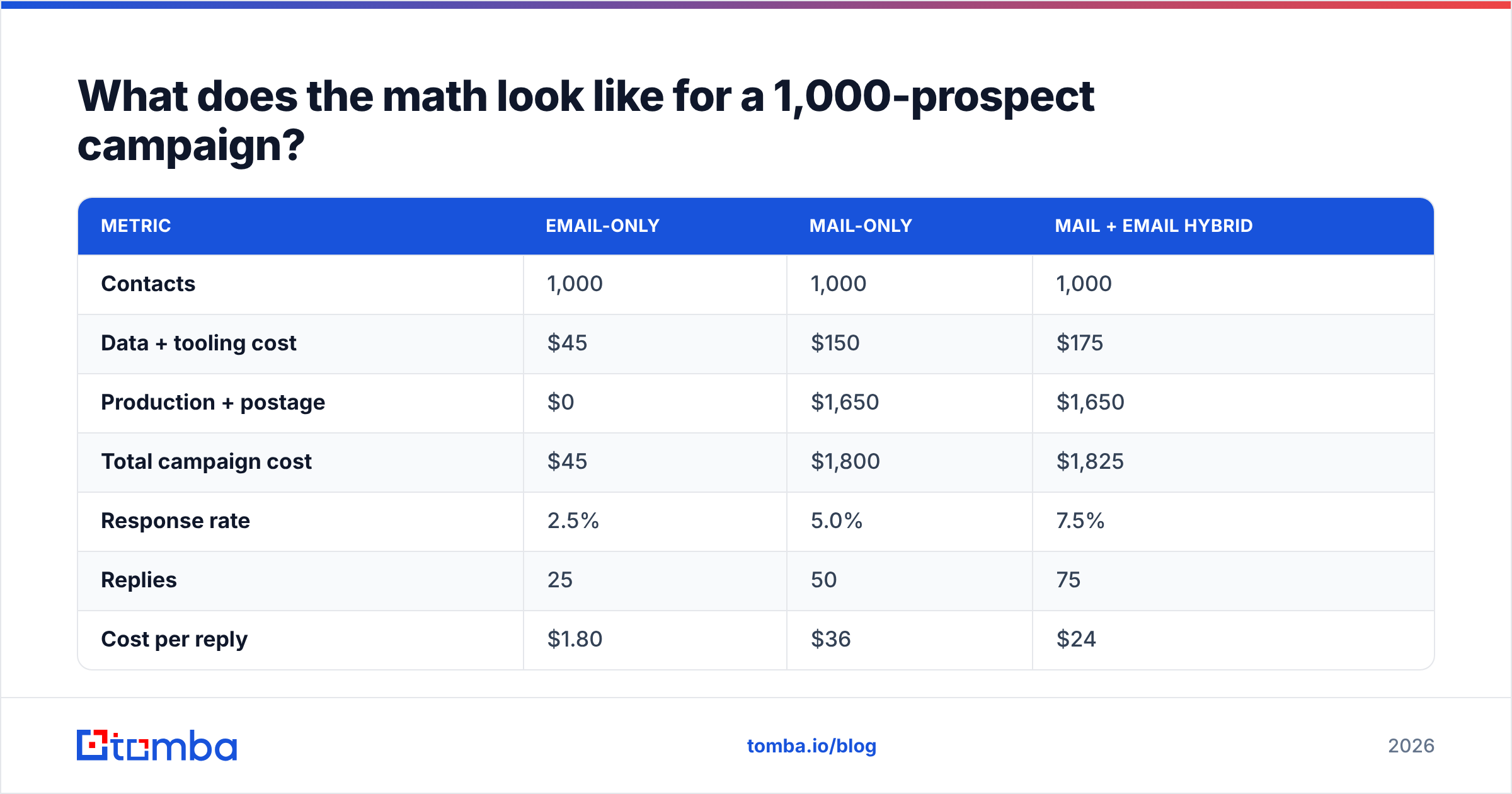
Run the same target list through both channels and the trade-off becomes concrete.
| Metric | Email-only | Mail-only | Mail + email hybrid |
|---|---|---|---|
| Contacts | 1,000 | 1,000 | 1,000 |
| Data + tooling cost | $45 | $150 | $175 |
| Production + postage | $0 | $1,650 | $1,650 |
| Total campaign cost | $45 | $1,800 | $1,825 |
| Response rate | 2.5% | 5.0% | 7.5% |
| Replies | 25 | 50 | 75 |
| Cost per reply | $1.80 | $36 | $24 |
| Meetings booked (35% of replies) | 9 | 18 | 26 |
| Cost per meeting | $5 | $100 | $70 |
| Days to full result | 10 | 30 | 35 |
The hybrid column is the interesting one. Adding email to a mail drop costs almost nothing incrementally and typically lifts total response meaningfully, because the email gives the recipient a zero-friction way to respond to the physical piece. Mail creates recall; email harvests it.
The catch is that the hybrid only works if you have both a postal address and a verified work email for the same person. That is a data problem, not a creative problem — and it is where most hybrid campaigns quietly fall apart.
What data quality does each channel actually require?#
Different failure modes, same root cause.
Email needs verified, deliverable addresses. A 5% bounce rate is enough to get a sending domain throttled. Above 8–10%, mailbox providers start routing everything you send to spam, including your replies to warm conversations. This is why running an email verifier before a send is not optional hygiene — it is the difference between a working channel and a dead domain. Catch-all domains complicate this further, which is why a dedicated catch-all verifier matters for enterprise targets where the MX accepts everything.
Direct mail needs correct, current postal data. Nothing bounces back to warn you. The piece is printed, stamped, mailed, and discarded. USPS offers move-update and address-correction services through programs documented on usps.com, and using them is the only way to avoid paying full freight for undeliverable volume. B2B postal data also decays faster than consumer data because companies relocate, downsize offices, and go remote.
For sourcing, teams typically split the job: a B2B email and firmographic layer from a provider like Tomba, and postal/mailing data from a specialist. Vendors such as BookYourData are commonly used on the postal and verified-contact side and are worth evaluating alongside your primary enrichment stack — the right answer is usually a combination, not a single source of truth.
A practical sequencing rule: build the account list first, enrich for email, verify, then decide which subset earns a physical piece. Running data enrichment before you commit print spend means you only mail contacts you can also follow up with digitally.
When should you choose direct mail over email?#
Pick mail when at least three of these are true:
- Your ACV is above $25,000. The cost per meeting stops mattering when one deal pays for 400 campaigns.
- Your target list is under 500 named accounts. ABM territory. Mail is a precision instrument.
- You are trying to reach executives who delegate email. A VP's inbox is filtered by an assistant, an AI summarizer, and a spam engine. A package on the desk is not.
- You already burned the inbox. If you have emailed an account four times with no response, changing channels beats changing subject lines.
- Your product is physical, visual, or hard to explain in text. A sample, a printed report, or a dimensional prop does work that a paragraph cannot.
- You need to break into a regulated or offline-heavy industry. Construction, manufacturing, healthcare administration, local government — sectors where email hygiene is poor and physical mail still commands attention.
Skip mail when your ACV is under $10k, your list is over 5,000 contacts, your sales cycle is under three weeks, or you cannot verify postal addresses. In those cases mail is a tax on your CAC.
When is email the obviously better bet?#
Email wins whenever you need volume, speed, or iteration — which is most of the time for most teams.
- You are still finding product-market fit in a segment. You need 10 message tests, not one.
- Your buyer is a knowledge worker who lives in a browser. Marketers, developers, RevOps, finance. They respond in the channel they already inhabit.
- You need attribution. Email gives you clean per-variant reply data. Mail attribution is mostly vibes plus a QR code.
- Your budget is under $2,000/month. At that level, mail buys you one small drop; email buys you an entire quarter of experiments.
- You want to layer channels. Email is the cheapest thing to add to LinkedIn, calls, or ads.
The prerequisite is finding the addresses in the first place. That is a solved problem now — a domain search returns the pattern and known contacts for a company, and an email finder resolves a specific name at a specific domain. Where teams still lose money is skipping verification and paying for it in deliverability three weeks later.
How do you run email and direct mail as one sequence?#
The hybrid play, in order:
- Week 0 — Build and verify. Pull the target account list, enrich contacts, verify emails, and confirm postal addresses. Drop anyone missing either. Your mail list should be a subset of your verified email list, never the other way around.
- Week 1 — Send the physical piece. Include a specific, low-friction response path: a short URL, a QR code, or a named person to reply to. Do not include a generic "learn more."
- Week 2 — Email referencing the mail. Subject lines that name the object work: "the report I mailed you," "did the box arrive?" This is not a trick; it is a legitimate shared context that most cold emails lack.
- Week 3 — LinkedIn or phone touch. Same reference, different channel. Response rates compound when the story is consistent.
- Week 5 — Value follow-up. Send something useful with no ask. This is where a surprising share of hybrid replies actually land.
- Week 8 — Breakup email. Close the loop and recycle non-responders into nurture, not into another mail drop.
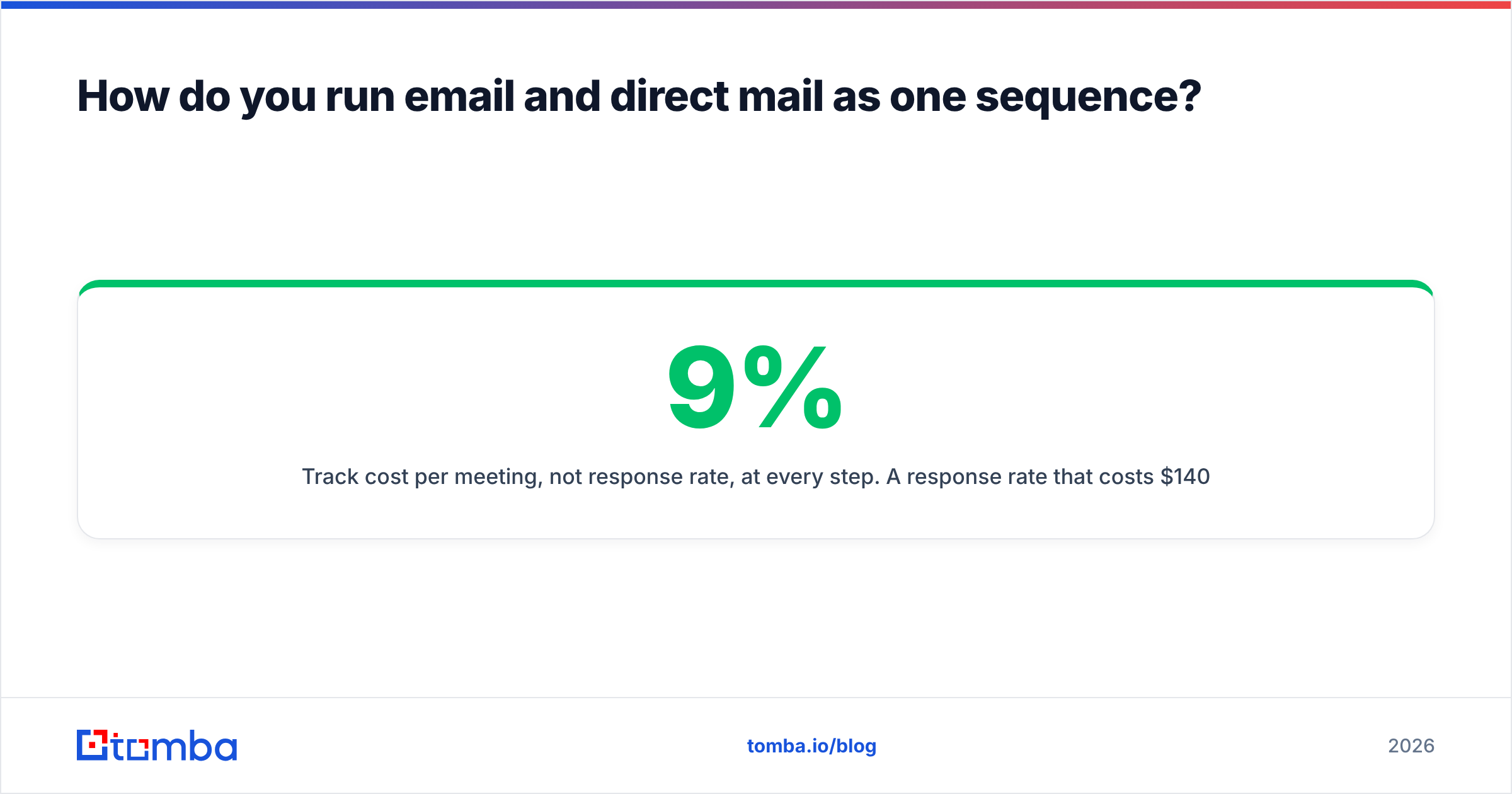
Track cost per meeting, not response rate, at every step. A 9% response rate that costs $140 per meeting is worse than a 2% rate at $8 — unless your ACV says otherwise. Check both against Tomba pricing and your print quote before you commit the quarter's budget.
One more discipline: cap the mail spend at a fixed percentage of the target segment's expected pipeline, and set it before you fall in love with the creative. Physical campaigns are seductive precisely because they are tangible, and tangible things are easy to over-invest in. Read vendor comparisons on G2 for tooling on both sides, but do your own unit-economics math — nobody else's benchmark knows your ACV.
Which one should you actually pick?#
If you are under $15k ACV: email, almost always, with the budget you saved going into better data and more sequences.
If you are above $25k ACV with a defined account list: run both, mail first, email second, and expect the hybrid to beat either channel alone by a meaningful margin.
If you are somewhere in the middle: start email-only, find the message that converts, then apply mail only to the accounts that engaged but stalled. Mail is best used as an escalation, not an opener.
Either way, the constraint is the same. Both channels are downstream of knowing exactly who you are contacting and how to reach them. Start by building a clean, verified contact list with the Tomba Email Finder — find work emails by name and domain, verify them before they cost you a sender reputation, and use the free tier's 25 monthly searches to test a segment before you spend a dollar on postage.
Related guides#
Ready to find emails that actually work?
Join 150,000+ professionals who stopped guessing and started sending. Free credits on signup — no credit card required.
Get the Tomba newsletter
Practical outbound tactics and product updates — once every two weeks.
About the author