Emailable vs Generect (2026): Which Tool Should You Pick?
Emailable verifies emails. Generect finds leads. They get compared constantly, but they solve different halves of the same problem — here's which one your outbound stack actually needs in 2026.
Emailable vs Generect is a strange matchup. One tool cleans the list you have. The other builds a list you don't.
TL;DR
- Emailable is a verifier, not a finder. Give it a list you already own. It tells you which addresses are safe to mail. It will not source a single new contact.
- Generect is a lead-generation layer. It pulls company and people data, mostly LinkedIn-shaped. It returns emails and phones, and pushes them to your CRM or sequencer through an API.
- They barely overlap. In the Emailable vs Generect matchup, only one of them fills an empty pipeline.
- Is your bounce rate the problem? Buy verification. Is your pipeline empty? Buy sourcing. Diagnose before you swipe the card.
- Want both on one bill? A combined find-plus-verify platform (Tomba, Hunter, Dropcontact-class tools) usually beats stitching two vendors together at small-team scale.
What are Emailable and Generect, actually?#
Most "Emailable vs Generect" searches start from category confusion. So start there.
Emailable is an email verification service. You upload a CSV, call the API, or connect your ESP. It returns a verdict per address: deliverable, undeliverable, risky, or unknown. It also flags role accounts (info@, sales@), throwaway domains, and free-mail providers. It tries to resolve catch-all domains too. Those domains accept every address at the SMTP layer, so a naive check tells you nothing. Emailable's natural home is list hygiene. Run it before an ESP send, before a cold sequence, or live on form submit.
Generect sits at the other end of the funnel. It is a B2B data platform built around LinkedIn-style search. Filter companies and people by industry, size, location, job title, and tech stack. Get back enriched records with work emails, plus phone numbers on some plans. Delivery is API-first. You wire it into your own tooling instead of clicking around a UI all day.
So the honest framing: Emailable improves data you already own. Generect gives you data you don't.
There is a thin overlap. Generect checks the emails it returns, as any credible data vendor does. Emailable's catch-all logic looks a lot like the check a finder runs inside itself. That small overlap is why the two names land in the same query. It is also why buying both can feel redundant when it usually isn't.

Emailable vs Generect: the head-to-head spec sheet#
Here is the practical comparison. Treat pricing as directional. Both vendors have repriced in the last two years, so check their own pages before you budget.
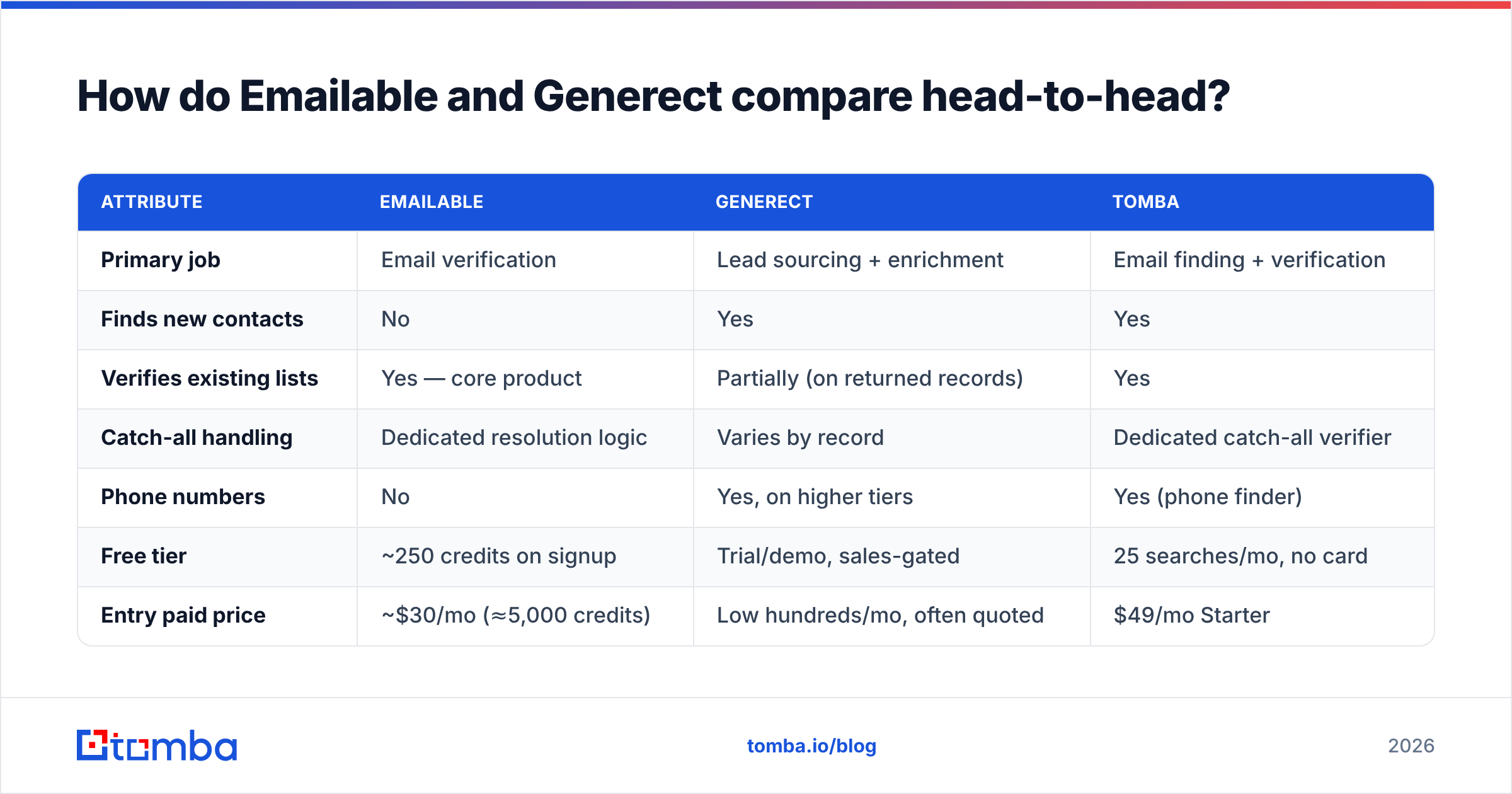
| Attribute | Emailable | Generect | Tomba |
|---|---|---|---|
| Primary job | Email verification | Lead sourcing + enrichment | Email finding + verification |
| Finds new contacts | No | Yes | Yes |
| Verifies existing lists | Yes — core product | Partially (on returned records) | Yes |
| Catch-all handling | Dedicated resolution logic | Varies by record | Dedicated catch-all verifier |
| Phone numbers | No | Yes, on higher tiers | Yes (phone finder) |
| Free tier | ~250 credits on signup | Trial/demo, sales-gated | 25 searches/mo, no card |
| Entry paid price | ~$30/mo (≈5,000 credits) | Low hundreds/mo, often quoted | $49/mo Starter |
| API | Yes, real-time + bulk | Yes — the main delivery method | Yes, plus CLI and MCP |
| Native integrations | ESPs, Zapier, forms | CRM/sequencer via API | HubSpot, Salesforce, Sheets, Excel, Airtable |
| Best fit | Marketers protecting sender reputation | Dev-led teams building a lead pipeline | SDR teams needing both halves |

Two things jump out of that table.
First, the free tiers are not comparable. Emailable's signup credits let you test accuracy on your own list in ten minutes. Generect's path runs through a sales call. That is fine for a $20k annual data contract. It is annoying when you just want to know if the emails are good.
Second, the APIs differ in kind, not degree. Emailable's API is a utility you call at one decision point. Generect's API is the product. If wiring endpoints into your own stack is not your thing, you will underuse it.
Which one is more accurate — and accurate at what?#
Accuracy means two different things here. That is where most comparisons go wrong.
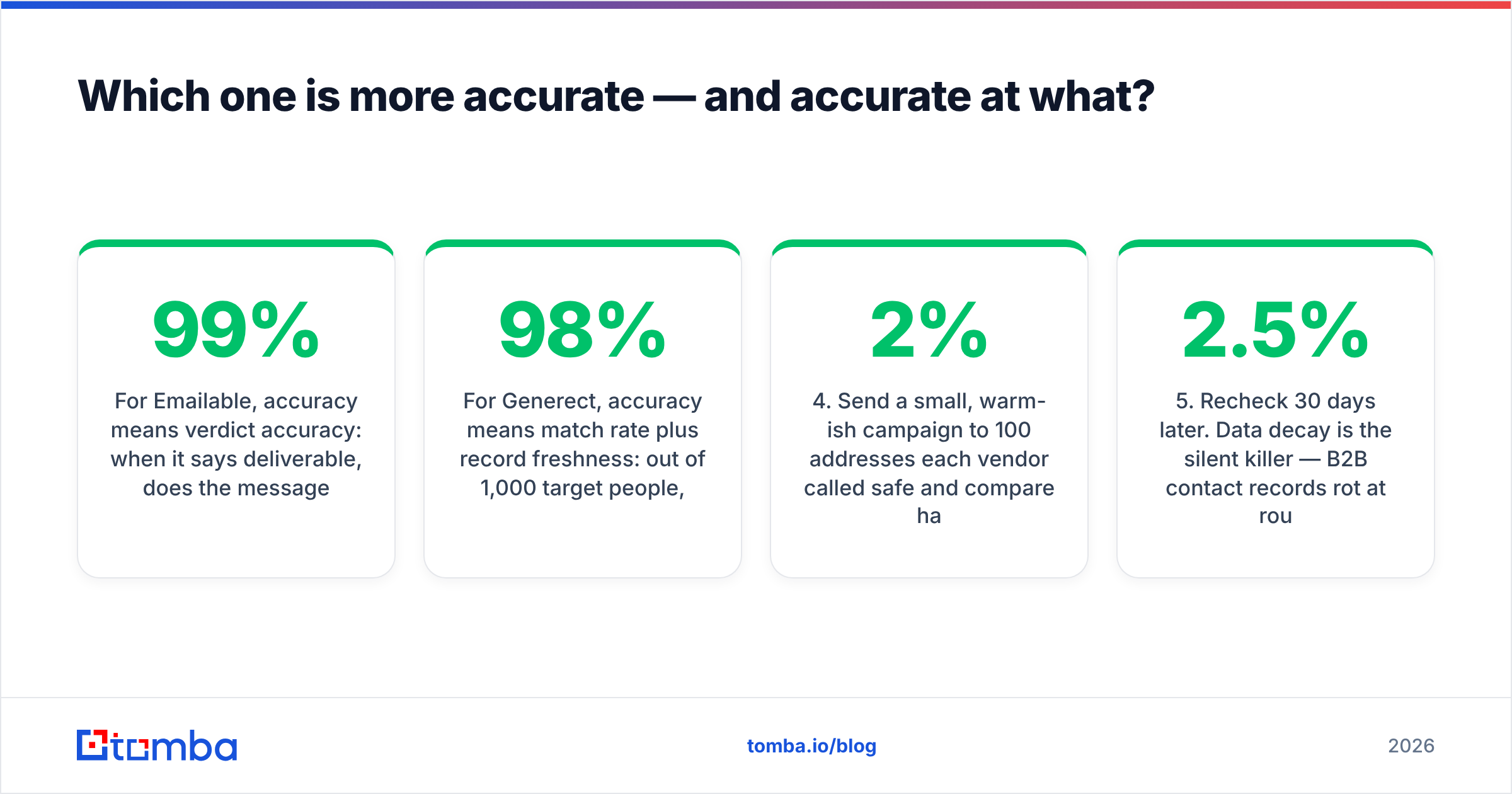
For Emailable, accuracy means verdict accuracy. When it says deliverable, does the message land? Top-tier verifiers agree with real send data 95–99% of the time on the big mailbox providers. They get worse on catch-all and heavily protected domains. Buyer reviews in G2's email verification category are the least-bad public signal. They are also self-reported. Your own list is the only benchmark that counts.
For Generect, accuracy means match rate plus freshness. Out of 1,000 target people, how many come back with a usable email? And how stale is it? A vendor claiming 98% validity on a 40% match rate tells you less than one claiming 92% validity on an 80% match rate.

One test settles the Emailable vs Generect question in about an hour:
- Build a 200-row control list. Use accounts you know well. Include 20–30 people whose real address you can confirm from a signature or a reply.
- Run it through the verifier. Record the verdict split. A high "unknown" or "risky" share is the number that hurts you later.
- Ask the data vendor to enrich the same 200 rows, blind. Measure match rate. Then verify their output with a different tool. Never grade a vendor's homework with its own marker.
- Mail 100 addresses that each vendor called safe. Compare hard bounces. Anything above 2% means the verdict layer is weaker than advertised.
- Recheck 30 days later. Decay is the silent killer. B2B contact records rot at roughly 2–2.5% per month as people change jobs.
Run that on any pairing and you get a defensible answer in an afternoon. If you want a referee inside step 3, a standalone email verifier or a catch-all verifier is the cheapest one you can buy.
How does pricing work for each?#
The two models are built differently. Per-credit math will mislead you.
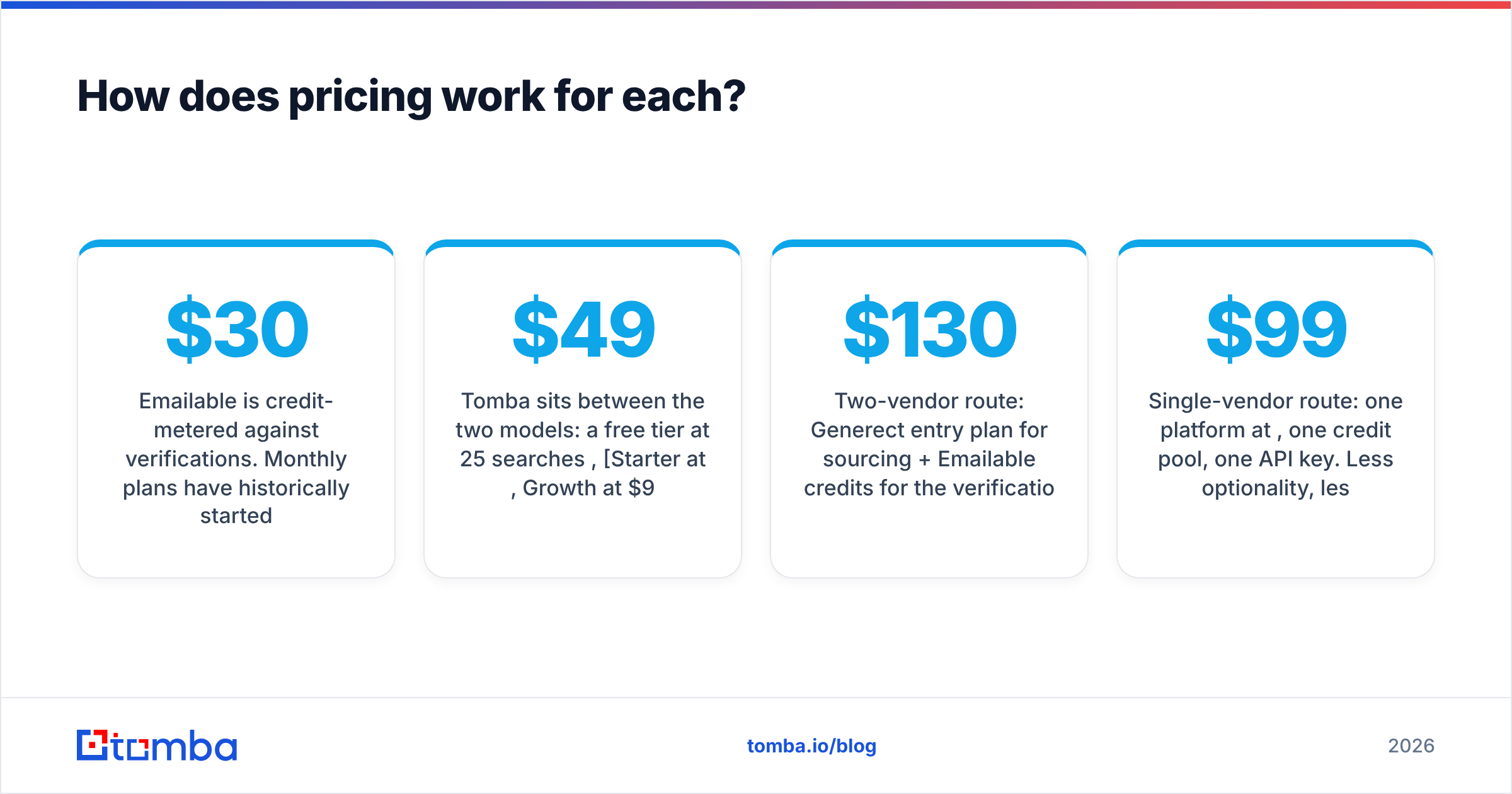
Emailable meters credits against verifications. Plans have started near $30/mo for about 5,000 credits. Pay-as-you-go packs exist, and the unit price drops with volume. You pay per address checked, good news or bad. Budgeting is simple: list size × how often you clean.
Generect prices on data volume and access. Self-serve entry runs in the low hundreds of dollars per month. Above that, you get a custom quote. API throughput and phone data are the usual upsells. Budgeting is harder here. Your cost tracks how much you search, not how many records you can use. A low match rate quietly inflates your true cost per contact.
Tomba sits between the two. The free tier is 25 searches a month. Starter is $49/mo, Growth $99/mo, and Pro $249/mo. Finding, verifying, domain search, and enrichment all draw on one credit pool. That detail matters more than the headline number. One pool means one consumption curve to forecast.
A quick worked example. Say you need 3,000 net-new verified contacts a month.
- Two-vendor route: a Generect entry plan for sourcing, plus Emailable credits for the cleanup pass. Call it $130–$200 a month. Also two dashboards, two support queues, two invoices, and a glue script you maintain forever.
- Single-vendor route: one platform at $99 a month, one credit pool, one API key. Less optionality, less overhead.
Neither is wrong. Below about 10k contacts a month, the two-vendor tax usually outweighs the best-of-breed gain. Above that, specialization starts to pay for itself.
Who should choose Emailable?#
Pick Emailable when your problem shows up as a bounce rate, not an empty pipeline.
- You already own a big list. An ESP database, ten years of form fills, an inherited CRM. You have no idea how much of it is still real.
- Sender reputation is at risk. Gmail or Outlook is throttling you. You need bounces under 2% before the next send.
- You want a real-time API gate on signup forms, so junk never enters the database.
- You are a marketer, not a developer. The UI-first workflow needs no engineering time to be useful.
Where it disappoints: it finds nothing. Verification is a filter, and a filter with nothing flowing through it does nothing.
Who should choose Generect?#
Pick Generect when the pipeline itself is the bottleneck.
- Your ICP is clearly defined and you want every matching company and person.
- You have engineering capacity. An API-first data vendor rewards teams that can build against it. It frustrates teams that can't.
- You need firmographic filters and contact data in one call, not a list in one tool and enrichment in another.
- Phone coverage matters to your motion. Email plus dial still beats email alone in most mid-market segments.
Where it disappoints: sales-gated evaluation, murky unit economics, and verification that is a feature rather than the whole product. If deliverability is the acute pain, a dedicated verifier wins.

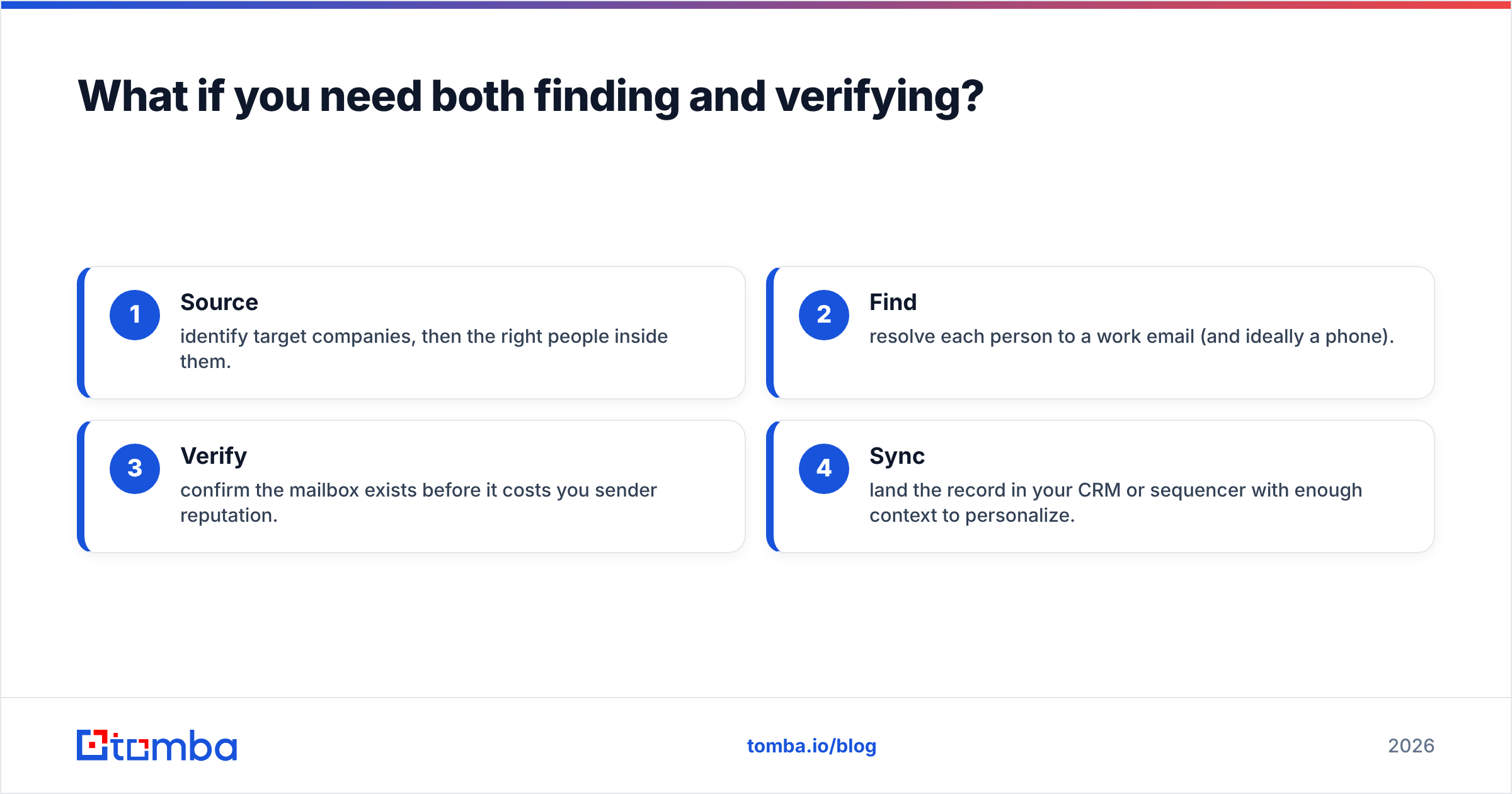
What if you need both finding and verifying?#
Most outbound teams do. That is the quiet answer to the whole Emailable vs Generect debate.
The workflow never changes, whatever logos you use:
- Source — pick target companies, then the right people inside them.
- Find — resolve each person to a work email, and ideally a phone.
- Verify — confirm the mailbox exists before it costs you sender reputation.
- Sync — land the record in your CRM or sequencer with enough context to personalize.
Buying steps 1–2 from one vendor and step 3 from another is a fair design. It is also two contracts, two rate limits, two failure modes, and a mapping layer that breaks when either side renames a field.
The consolidated route runs the same pipeline through one credential. With Tomba, that means domain search to list a company's contacts, the email finder to resolve named people, verification on the same record, and bulk processing when you work in thousands rather than dozens. Same four steps, one invoice, one API.
There is a third pattern too. If you would rather buy a finished list than build one, prepaid verified-list vendors like BookYourData are a reasonable fit. You trade real-time freshness for zero setup. That suits one-off campaigns and market tests.
Emailable vs Generect: which tool wins for cold outbound in 2026?#
Verdict: neither, on its own. That is the useful answer.
- Emailable wins the narrow contest of "is this address safe to mail." If the list exists and the bounce rate is embarrassing, it is the faster fix and the cheaper one.
- Generect wins the narrow contest of "get me contacts matching this ICP through an API." With engineers and an empty pipeline, it does what Emailable structurally cannot.
- A combined platform wins the contest most teams are really in: verified, mailable, enriched contacts every week, with no two-vendor integration project.
Two things changed the math since 2024. Gmail and Yahoo's bulk-sender rules turned email deliverability into a hard gate. Verification stopped being optional at volume. At the same time, AI-assisted prospecting pushed list sizes up. So the metric worth watching is cost per verified contact, not the sticker price of either tool.
Whatever you pick, measure it. Track match rate, bounce rate, and reply rate by data source. One quarter in, you will know which vendor earns its line item. You will also stop needing comparison posts, this one included, to make the call.
Ready to skip the two-vendor stitch-up?#
Your job is to produce verified, mailable B2B contacts every week. Start with the tool that finds and verifies in the same call. The Tomba Email Finder resolves work emails by name, company, or domain. It verifies them from the same credit pool. Then it pushes clean records into HubSpot, Salesforce, Sheets, or your own stack over the API. The free tier gives you 25 searches a month with no card. That is enough to run the 200-row control test above and see the match rate for yourself.
Related guides#
Ready to find emails that actually work?
Join 150,000+ professionals who stopped guessing and started sending. Free credits on signup — no credit card required.
Get the Tomba newsletter
Practical outbound tactics and product updates — once every two weeks.
About the author