Emailchaser vs Apollo.io: Honest 2026 Comparison for Cold Email
Emailchaser is a lean cold email sender. Apollo.io is a giant contact database with a sequencer attached. Here is which one actually wins on price, data quality, and deliverability control in 2026.
Emailchaser vs Apollo.io comes down to one question: is your bottleneck sending the email, or finding who to email? Emailchaser sends. Apollo finds. Everything below is the price of that difference.
TL;DR
- Emailchaser is a lightweight cold email sender with a built-in finder and verifier. It is cheap and fast to learn, and it is priced per user with generous sending. But its contact database is shallow next to a real data vendor.
- Apollo.io is a sales intelligence platform first (Apollo publicly claims a database in the hundreds of millions of contacts) and a sequencer second. You get filters, intent signals, and a CRM-lite layer, plus per-seat pricing and credit ceilings.
- Cost reality: Emailchaser sits in the ~$20–$40/user/month band. Apollo's paid tiers run roughly $49–$149/user/month, depending on tier and annual commit. A three-rep team feels that gap fast.
Two points most buyers miss:
- Deliverability: neither tool fixes bad data. Apollo's bulk exports are where most bounce problems start. A separate verification step is not optional.
- The unbundled option: a dedicated finder like Tomba Email Finder plus your existing sender is usually cheaper and more accurate than either bundle. It also does not lock your data behind a seat license.
Emailchaser vs Apollo.io: what are they, actually?#
They are not the same category of product. Pretending otherwise is how teams end up paying twice.
Emailchaser (emailchaser.com) is a cold email tool. You connect a mailbox, build a sequence, add contacts, and send. It bundles a modest email-finding feature and basic verification, so a solo founder can go from "I know the company" to "the email is sent" without buying three products. The design bias is simplicity: fewer knobs, fewer dashboards, per-user pricing, no credit math to memorize.
Apollo.io (apollo.io) is a database with an outbound engine attached. The core asset is the contact graph — filter by title, headcount, tech stack, funding, hiring signals. The sequencer exists so you can act on that filter without exporting a CSV. It also includes a lightweight CRM, dialer, and enrichment API. Apollo is what you buy when the hard part is finding who to email, not sending the email.
That distinction drives everything below. Emailchaser assumes you already have a target list. Apollo assumes you do not.
How do the two products differ structurally?#
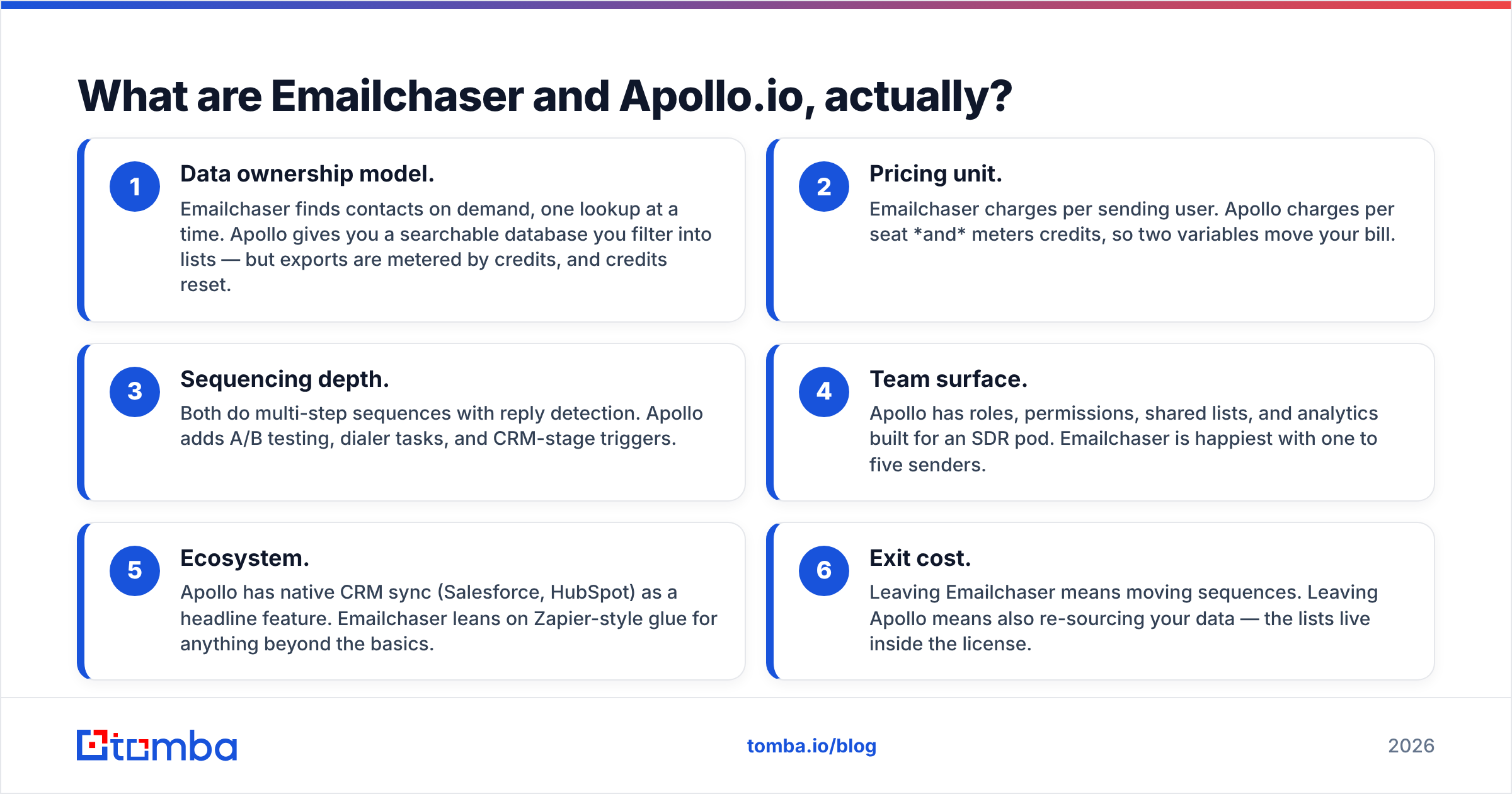
- Data ownership model. Emailchaser finds contacts on demand, one lookup at a time. Apollo gives you a searchable database you filter into lists — but exports are metered by credits, and credits reset.
- Pricing unit. Emailchaser charges per sending user. Apollo charges per seat and meters credits, so two variables move your bill.
- Sequencing depth. Both do multi-step sequences with reply detection. Apollo adds A/B testing, dialer tasks, and CRM-stage triggers.
- Team surface. Apollo has roles, permissions, shared lists, and analytics built for an SDR pod. Emailchaser is happiest with one to five senders.
- Ecosystem. Apollo has native CRM sync (Salesforce, HubSpot) as a headline feature. Emailchaser leans on Zapier-style glue for anything beyond the basics.
- Exit cost. Leaving Emailchaser means moving sequences. Leaving Apollo means also re-sourcing your data — the lists live inside the license.
Emailchaser vs Apollo.io: a feature-by-feature comparison#
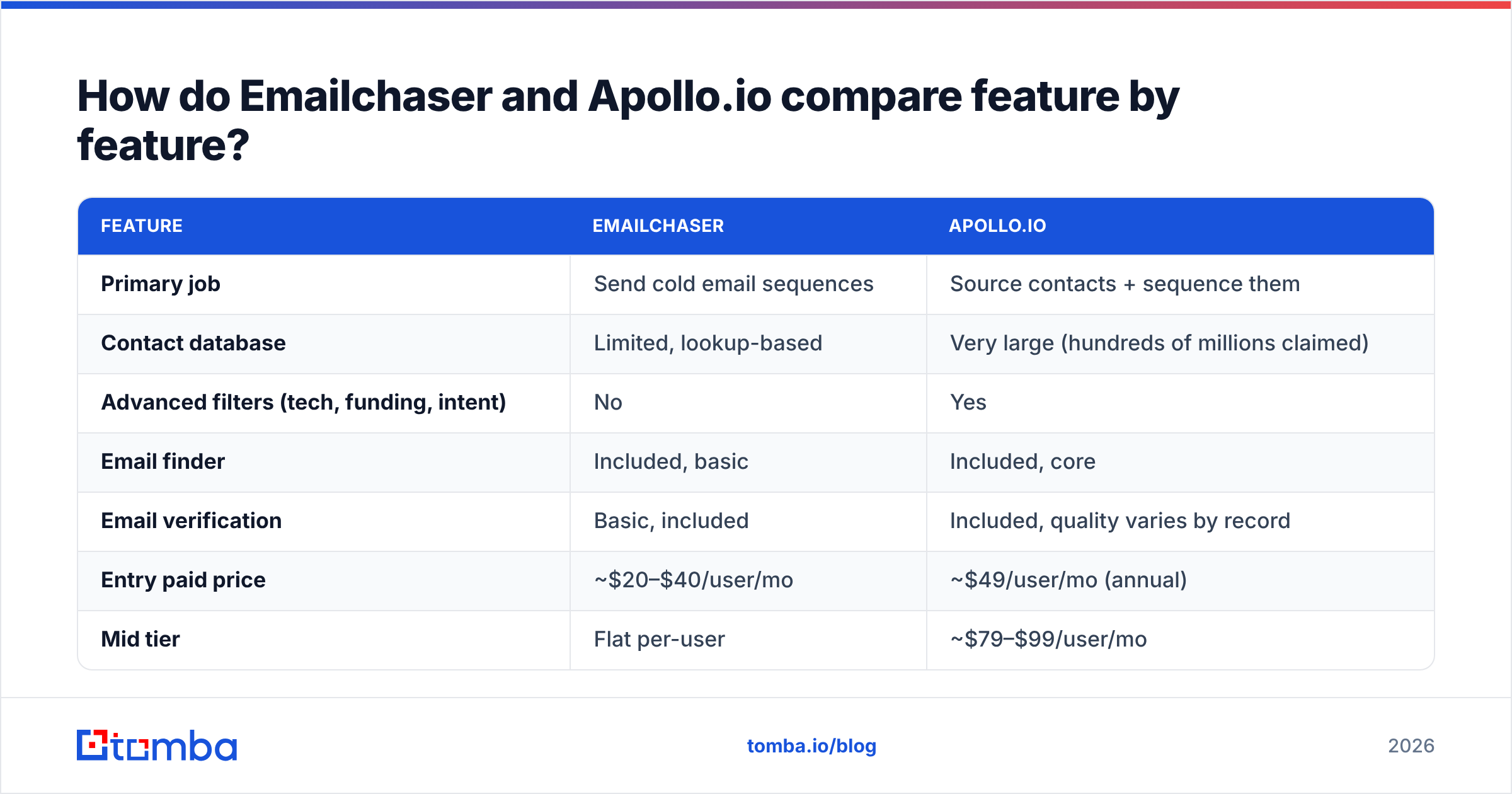
Here is the head-to-head. Treat pricing as directional, and confirm it on each vendor's page before you buy. Both companies repackage tiers often.
| Feature | Emailchaser | Apollo.io |
|---|---|---|
| Primary job | Send cold email sequences | Source contacts + sequence them |
| Contact database | Limited, lookup-based | Very large (hundreds of millions claimed) |
| Advanced filters (tech, funding, intent) | No | Yes |
| Email finder | Included, basic | Included, core |
| Email verification | Basic, included | Included, quality varies by record |
| Entry paid price | ~$20–$40/user/mo | ~$49/user/mo (annual) |
| Mid tier | Flat per-user | ~$79–$99/user/mo |
| Free tier | Trial | Yes, limited credits |
| Multichannel (LinkedIn, dialer) | No | Dialer + LinkedIn tasks |
| Native CRM sync | Limited | Salesforce, HubSpot |
| API access | Minimal | Full enrichment + search API |
| Best for | Founders, 1–5 senders | SDR teams, 5+ seats |
| Learning curve | Hours | Days to weeks |

Two rows in that table matter more than the rest. First, advanced filters. If you cannot describe your ICP as a database query, Apollo's main advantage evaporates, and you pay platform prices for a sequencer. Second, API access. If you want to enrich records inside your own product or warehouse, Emailchaser will not get you there, and Apollo's API sits behind higher tiers.
Which one has better email data accuracy?#
Apollo wins on coverage. Accuracy is a closer call than the marketing suggests.
Large databases carry a structural problem: records age. A contact scraped 14 months ago and never re-verified still looks perfect in a UI. Coverage and freshness are different metrics. Vendors report coverage, because it is the flattering one. In practice, big Apollo exports bounce at a fine rate on well-known enterprise domains. On SMB, agency, and non-US domains, they bounce far more.
Emailchaser's finder is narrower. It does well on the obvious pattern cases — first.last@company.com at a company with a public mail setup. On harder targets it returns nothing. Nothing is better than a wrong guess, because a wrong guess costs you domain reputation.

One rule holds no matter which tool you pick: verify right before you send, not at list-build time. A record verified in March and mailed in July is an unverified record. Run the list through a dedicated email verifier as a pre-send gate. Route ambiguous domains to a catch-all verifier instead of guessing. Catch-all domains accept everything at the SMTP layer, so a naive "valid" result tells you nothing about whether a human reads that inbox.
Want the technical background on why bounces turn into blocked domains? Google's own sender guidelines are the source worth reading. Those thresholds govern your inbox placement, not any vendor's dashboard.
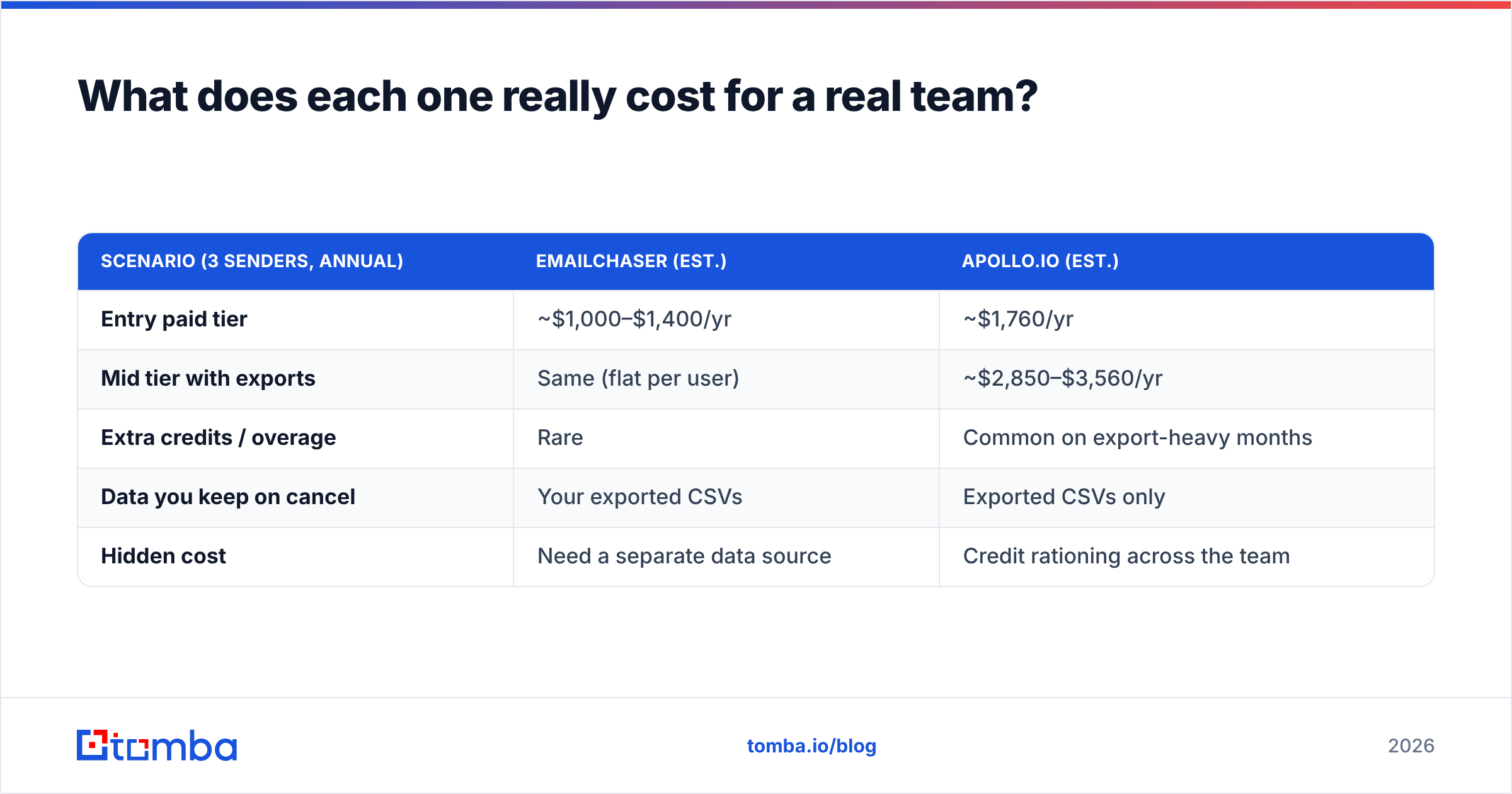
What does each one really cost for a real team?#
Model three senders for twelve months. That is where per-seat pricing stops being abstract.
| Scenario (3 senders, annual) | Emailchaser (est.) | Apollo.io (est.) |
|---|---|---|
| Entry paid tier | ~$1,000–$1,400/yr | ~$1,760/yr |
| Mid tier with exports | Same (flat per user) | ~$2,850–$3,560/yr |
| Extra credits / overage | Rare | Common on export-heavy months |
| Data you keep on cancel | Your exported CSVs | Exported CSVs only |
| Hidden cost | Need a separate data source | Credit rationing across the team |
The Apollo trap is not the sticker price. It is the way seats and credits interact. Add a fourth rep mid-quarter and you pay for a seat and drain the shared credit pool faster. Teams respond by rationing exports, which is a strange thing to do with a tool you bought to remove friction. Check Apollo's pricing page yourself, and read the fine print on annual versus monthly. The headline figures quoted around the web are almost always the annual-commit rate.
Emailchaser's cost profile is boring in a good way: one line item, predictable, and cheap enough that a solo founder does not have to justify it. The catch is that you are buying a sender. Your data budget is still ahead of you.
For reference, both products carry hundreds of public reviews on G2, and the pattern is consistent. Apollo complaints cluster around stale data and billing surprises. Emailchaser complaints cluster around missing features. Those are the two failure modes you are choosing between.
Who should pick Emailchaser?#
Pick Emailchaser if three of these describe you:
- You already know your accounts. You work a defined territory, an event list, an investor portfolio, or an inbound backlog. Discovery is not your bottleneck.
- You send from one to five mailboxes. Per-user pricing stays cheap and you do not need role permissions.
- You want to be sending this afternoon. Setup is measured in hours.
- Your CRM is a spreadsheet or something light. You are not going to miss deep Salesforce object mapping.
- You are cost-sensitive and honest about it. Paying platform prices for features nobody opens is the most common outbound waste.
Where it breaks: someone asks for "every Series B fintech in DACH with a Head of RevOps." Emailchaser has no answer. You will bolt on a data source. At that point, compare the bolted-on total against Apollo's all-in price.
Who should pick Apollo.io?#
Pick Apollo if:
- Discovery is the hard part. You need to build lists from filters, not from knowledge you already have.
- You run five or more SDRs who need shared lists, ownership rules, and pipeline reporting in one place.
- You want multichannel in one seat — email, calls, and LinkedIn tasks sequenced together.
- Your CRM is Salesforce or HubSpot and bidirectional sync is a hard requirement, not a nice-to-have.
- You will actually use the intent signals. Job-change and hiring triggers are genuinely useful, if someone owns the workflow. If nobody owns it, you are paying for a feature that exists in a tab.
Where it breaks: small teams. At one or two seats, Apollo is an enormous amount of surface area for a workflow you could run with a finder and a sender. And if your ICP sits outside Apollo's strongest coverage — regional SMB, non-English markets, niche verticals — the database advantage shrinks while the price does not.
Is an unbundled stack cheaper than either one?#
Usually, yes. Most comparison posts skip it because it does not fit a two-column layout.
The unbundled pattern is: source → verify → send, with the best tool in each slot.
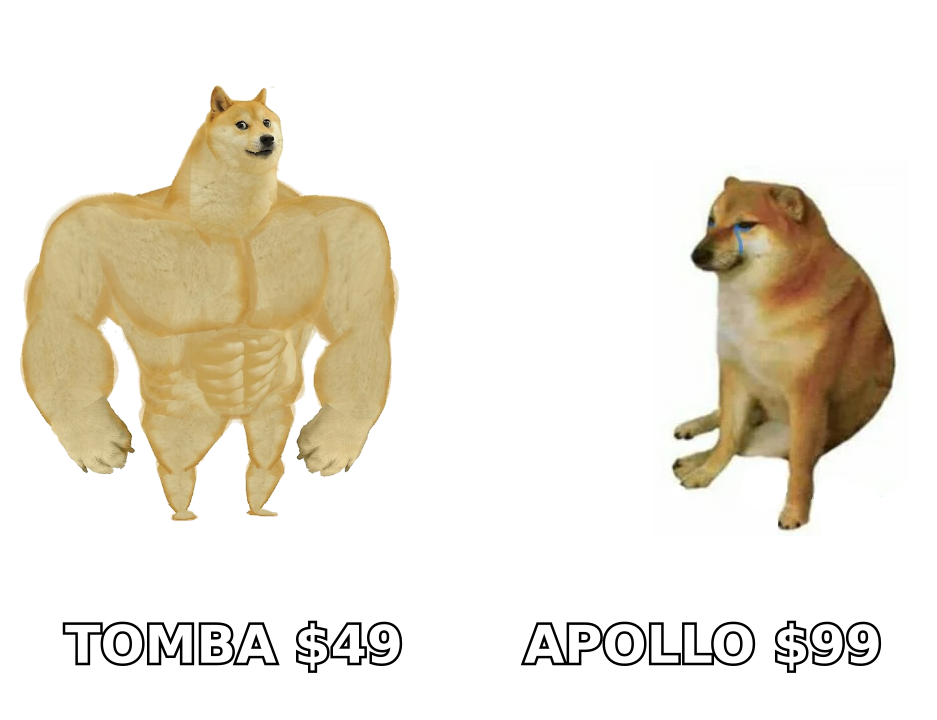
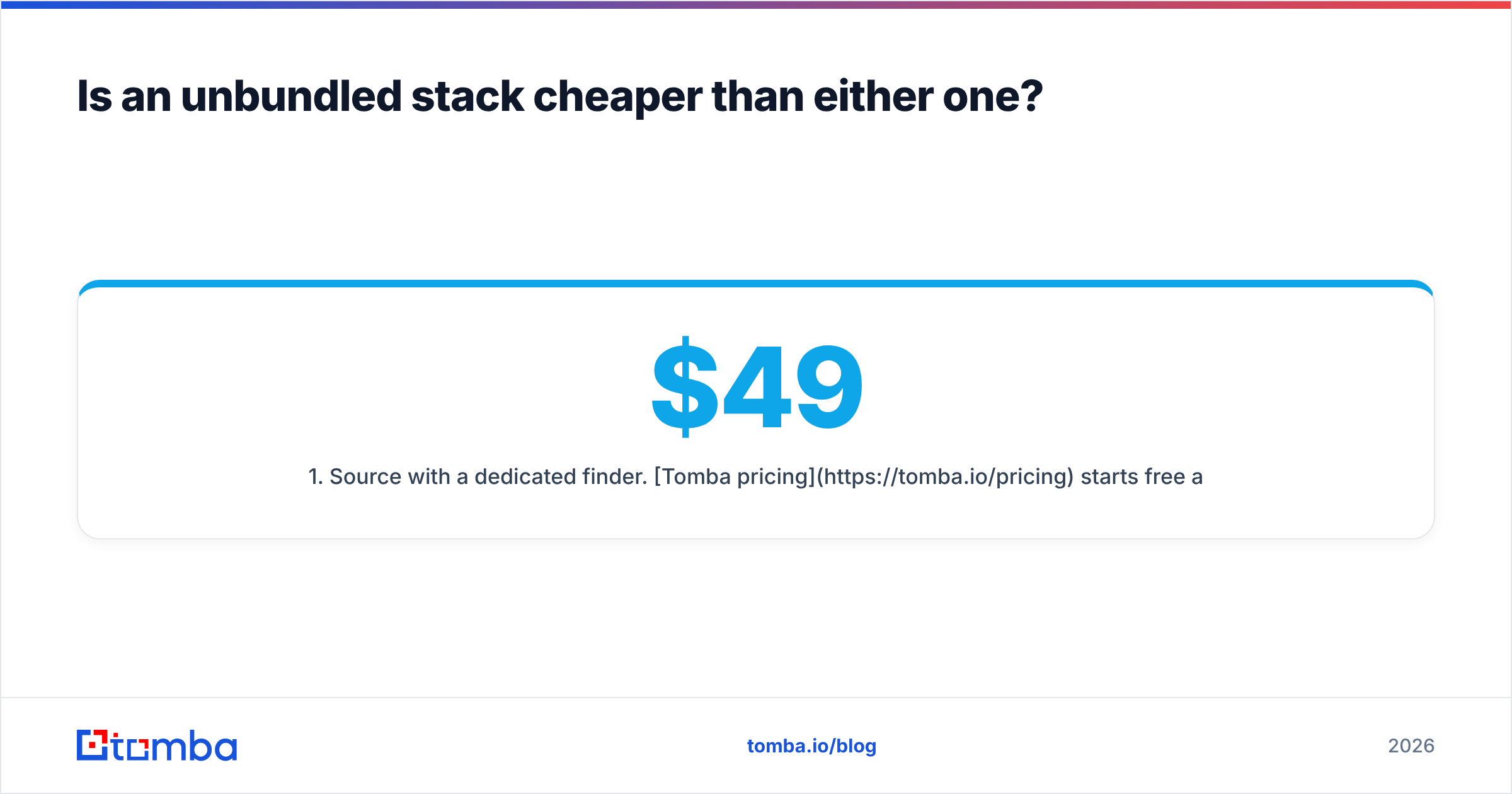
- Source with a dedicated finder. Tomba pricing starts free at 25 searches/month, then $49/mo Starter, $99/mo Growth, $249/mo Pro. It is priced on volume, not on how many people log in. No per-seat multiplier means adding a teammate does not re-price your data.
- Enrich in bulk when you have a list. A bulk email finder run against a CSV of names and domains is far cheaper than exporting from a platform database, and you keep the output for good.
- Verify as a pre-send gate. Verification is the cheapest insurance in outbound. Skipping it is how a warmed domain dies in a week.
Then the sending layer, which is now the commodity part of the stack:
- Send with whatever you already like. Emailchaser, Instantly, Smartlead, or plain Gmail with a sequencer.
- Buy a prebuilt list when speed beats precision. Vendors like BookYourData are a legitimate shortcut for a well-defined segment, when you need volume today rather than a repeatable process.
The economics are simple. Platform bundles charge you per person for data you use per record. Decoupling those two units is where the savings live. It also removes a real risk: if your sender degrades, you swap it without re-sourcing a single contact.
If you want the workflow programmatic, the Tomba API covers find, verify, and enrich in the same contract. You can push results into your warehouse or CRM without a human touching a CSV.
What is the verdict for 2026?#
Emailchaser wins for lean senders. Apollo wins for teams whose bottleneck is discovery. Neither wins on data freshness, so do not let either one be your only quality control.
Concretely:
- Solo founder or two-person team with a known account list → Emailchaser, plus a dedicated finder for the gaps.
- Five-plus SDRs building lists from filters, synced to Salesforce or HubSpot → Apollo, with a mandatory verification step before every send.
- Anyone optimizing cost per verified contact rather than cost per seat → unbundle. Source and verify separately, then send with the cheapest reliable mailer.
The one mistake to avoid: buying a platform seat to solve a data problem, then finding out the data was the weak part. Test accuracy on a sample of 200 records in your actual ICP before you sign an annual contract. Any vendor confident in their coverage will let you.
Start with the data layer, because everything downstream inherits its errors. Run 25 free searches through Tomba Email Finder against the exact segment you sell into. Compare the hit rate and bounce rate to whatever your current tool returns, and let the numbers pick your stack instead of the pricing page.
Related guides#
Ready to find emails that actually work?
Join 150,000+ professionals who stopped guessing and started sending. Free credits on signup — no credit card required.
Get the Tomba newsletter
Practical outbound tactics and product updates — once every two weeks.
About the author