Emailchaser vs LakeB2B: Which One Actually Fills Your Pipeline?
Emailchaser sends cold email. LakeB2B sells you contacts. Comparing them head-to-head only makes sense once you know which half of the outbound problem you're actually trying to fix — here's the honest breakdown.
TL;DR
- Emailchaser and LakeB2B are not competitors. Emailchaser is cold email sending software; LakeB2B is a B2B data and list vendor. Comparing them is like comparing a delivery van to the warehouse.
- If your problem is "I have a list and nowhere to send it from," Emailchaser is the cheaper, faster answer — flat monthly pricing, unlimited-ish inbox connections, simple sequencing.
- If your problem is "I don't know who to email," LakeB2B sells contact records, but you buy them on a custom quote and you inherit whatever decay is baked into the file.
- The failure mode nobody warns you about: bought lists age at roughly 2–2.5% per month, so a file quoted in January can be 25%+ stale by December. Verify before you send, always.
- The stack most teams land on: a per-lead sourcing tool (find + verify on demand) → a sending tool → a warmed domain. Buying a static list is usually the most expensive path per booked meeting.
What are Emailchaser and LakeB2B, actually?#
They solve two different halves of the same job.
Emailchaser is cold outreach software. You connect mailboxes, upload contacts, write a sequence, and it sends and tracks replies. Its pitch is simplicity and inbox count — it's aimed at agencies and small teams who got tired of paying per-seat prices at Outreach or Salesloft and just want mail to go out reliably. It does not sell you data. You bring the list.
LakeB2B is a data provider. It's a decades-old database marketing company selling B2B contact lists, healthcare data, technology install-base data, and appended/enriched records, usually segmented by industry, job title, geography, or tech stack. It does not send your campaigns. You bring the sending tool.
So "Emailchaser vs LakeB2B" is really the question: which gap in my outbound stack is currently costing me more money? If you're sitting on 4,000 qualified contacts and sending them manually from Gmail, your bottleneck is sending. If you have a great sequence and 40 names, your bottleneck is data.
Most teams discover the answer the painful way — by paying for one and finding out the other was the actual problem.
How do Emailchaser and LakeB2B compare side by side?#
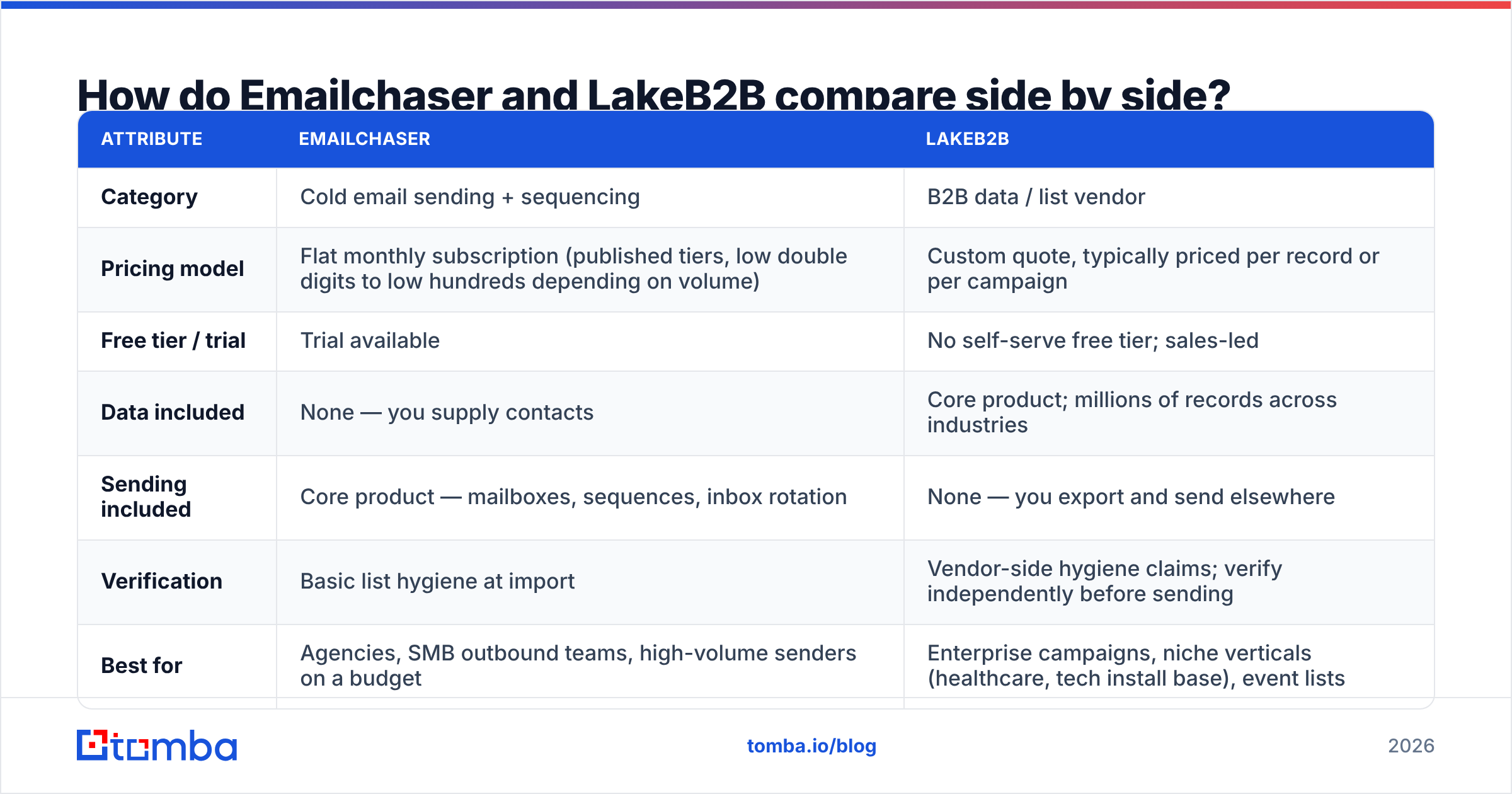
Here's the honest matrix. Note that LakeB2B, like most enterprise list vendors, does not publish flat pricing — you get a quote based on record count, filters, and exclusivity, so anyone showing you a precise "$X/mo" for it is guessing.
| Attribute | Emailchaser | LakeB2B |
|---|---|---|
| Category | Cold email sending + sequencing | B2B data / list vendor |
| Pricing model | Flat monthly subscription (published tiers, low double digits to low hundreds depending on volume) | Custom quote, typically priced per record or per campaign |
| Free tier / trial | Trial available | No self-serve free tier; sales-led |
| Data included | None — you supply contacts | Core product; millions of records across industries |
| Sending included | Core product — mailboxes, sequences, inbox rotation | None — you export and send elsewhere |
| Verification | Basic list hygiene at import | Vendor-side hygiene claims; verify independently before sending |
| Best for | Agencies, SMB outbound teams, high-volume senders on a budget | Enterprise campaigns, niche verticals (healthcare, tech install base), event lists |
| Speed to first send | Same day | Days to weeks (scoping, quote, delivery) |
| Main risk | Deliverability is on you — bad data burns your domain | Data decay and duplicate exposure across buyers |
The row that matters most is the last one. Neither tool protects you from the other's weakness.
Is buying a list from LakeB2B better than building one?#
It depends entirely on how narrow your target is — and how fast you need it.
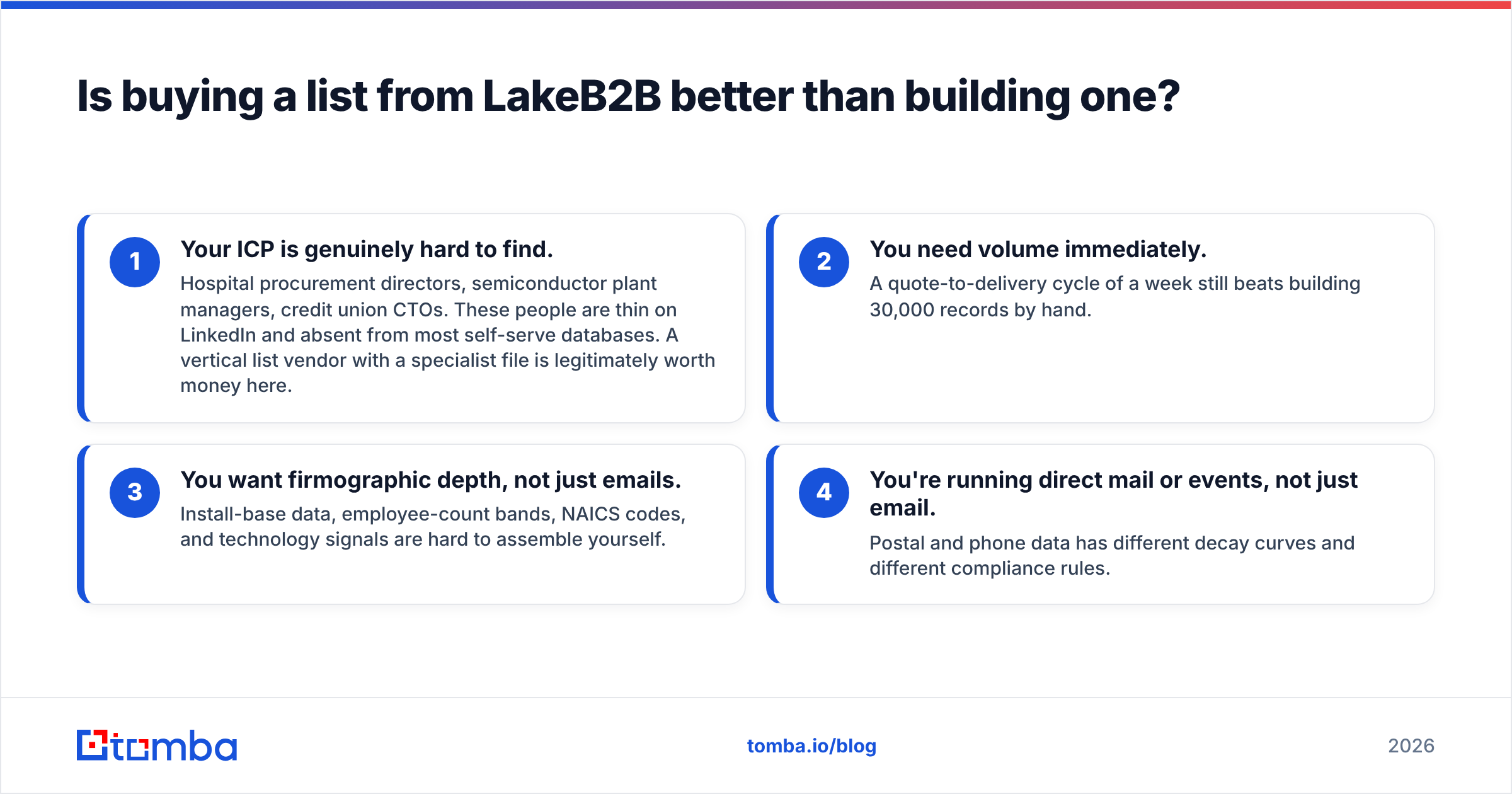
Buying makes sense when:
- Your ICP is genuinely hard to find. Hospital procurement directors, semiconductor plant managers, credit union CTOs. These people are thin on LinkedIn and absent from most self-serve databases. A vertical list vendor with a specialist file is legitimately worth money here.
- You need volume immediately. A quote-to-delivery cycle of a week still beats building 30,000 records by hand.
- You want firmographic depth, not just emails. Install-base data, employee-count bands, NAICS codes, and technology signals are hard to assemble yourself.
- You're running direct mail or events, not just email. Postal and phone data has different decay curves and different compliance rules.
Building (or sourcing on demand) makes more sense when:
- Your ICP is describable by domain. If you can name the companies, you can find the people — a domain search gets you every published address at a company in seconds, at a fraction of per-record list pricing.
- You want exclusivity. Purchased lists are rarely exclusive. If three competitors bought the same healthcare CFO file this quarter, your "cold" prospect has already deleted four similar emails this week.
- Freshness beats coverage. A 500-contact list you verified yesterday will out-convert a 50,000-contact file assembled 18 months ago. Every time.
The 2–2.5%-per-month job-change rate is the number to internalize. Industry deliverability guidance from vendors and analysts alike converges on roughly 25–30% annual B2B data decay. That means a list is a depreciating asset from the moment it's invoiced.
What actually breaks when you plug a bought list into a sending tool?#
Your domain reputation. That's the whole answer, and it's why the "Emailchaser vs LakeB2B" framing is dangerous when you treat it as an either/or.
Here's the chain of events teams keep repeating:
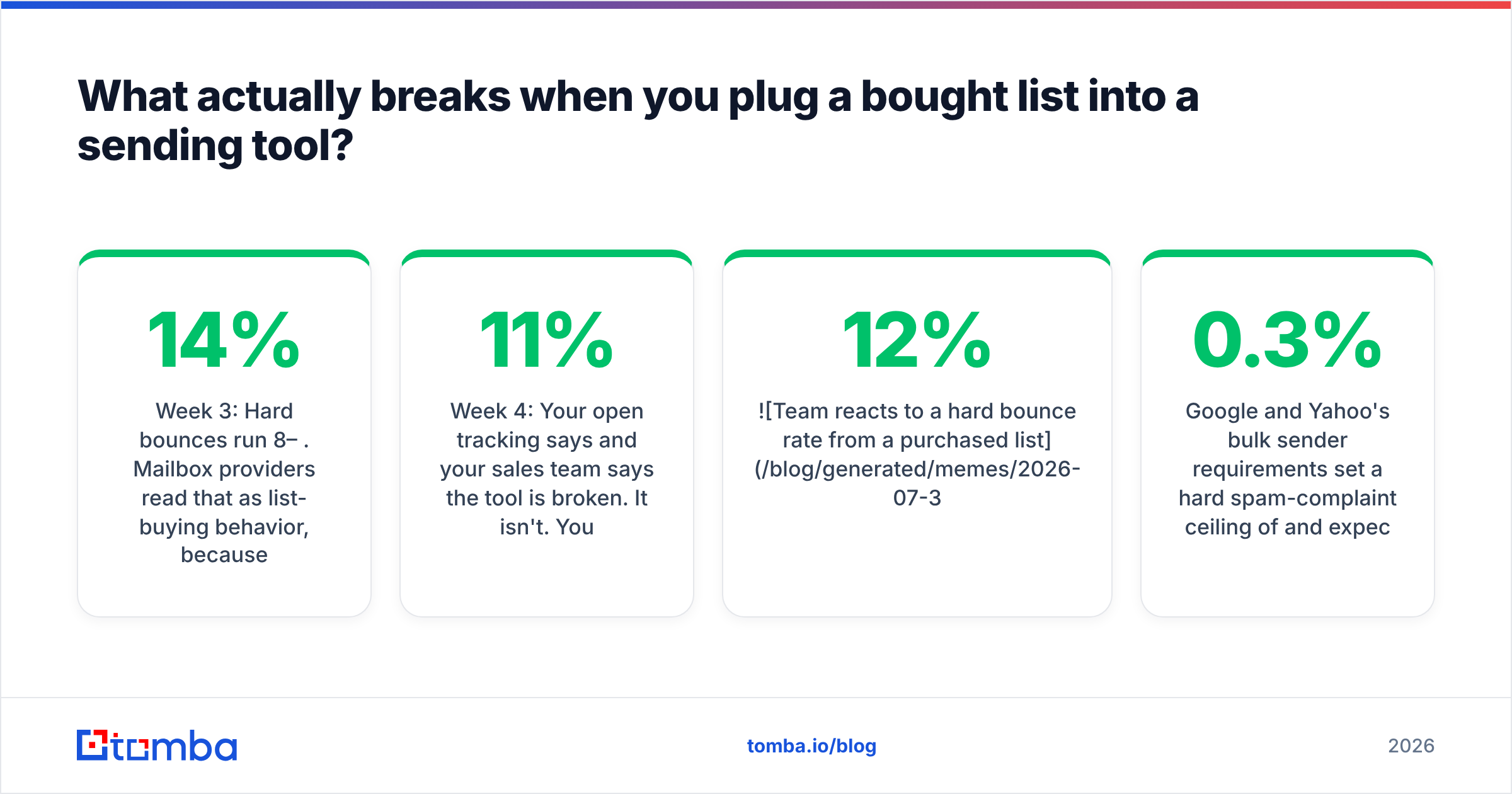
- Week 1: You buy 20,000 records. They look great in a spreadsheet.
- Week 2: You import them into a sending tool and start blasting 500/day from a domain with three months of history.
- Week 3: Hard bounces run 8–14%. Mailbox providers read that as list-buying behavior, because it is.
- Week 4: Your open tracking says 11% and your sales team says the tool is broken. It isn't. Your mail is in spam.
- Week 6: You're buying new domains and warming them for a month, having spent the list budget and the sending budget with nothing to show.

Google and Yahoo's bulk sender requirements set a hard spam-complaint ceiling of 0.3% and expect authenticated, low-bounce sending — thresholds a raw purchased file will violate immediately. Both providers document this openly; there's no grey zone left.
The fix is unglamorous and cheap: run every record through an email verifier before it touches your sequencing tool, drop anything that isn't deliverable, and treat catch-all domains as a separate, slower segment. A 20,000-record file that verifies down to 12,600 valid addresses is not a loss — it's 7,400 bounces you didn't send.
If you want to understand why bounce rate translates so directly into inbox placement, the email deliverability fundamentals are worth twenty minutes.
Which should you pick for your situation?#
Skip the tool comparison and start from your constraint.
Pick Emailchaser if: you already have a sourcing method that works, you're running multiple client accounts or multiple domains, and per-seat pricing at the incumbent sequencers has become the biggest line item in your outbound budget. It's a sending problem. Solve the sending problem.
Pick LakeB2B if: your target market is a vertical where self-serve databases genuinely thin out — regulated healthcare, industrial, education, specific install-base plays — and you have the budget and patience for a sales-led procurement cycle. Ask for a sample file, verify the sample yourself, and negotiate on the verified deliverable rate, not the raw record count. That single move changes the economics of the deal.
Pick neither (yet) if: you're pre-product-market-fit and testing messaging. At that stage you need 200 precisely correct contacts, not 20,000 approximately correct ones. Source them on demand, verify them, send from a warmed mailbox, and read the replies.
Pick both if: you're running a mature outbound motion with a specialist vertical, in which case the list vendor feeds the top of funnel and the sending tool executes — with a verification layer welded between them, non-negotiable.
What does a healthier outbound stack look like in 2026?#
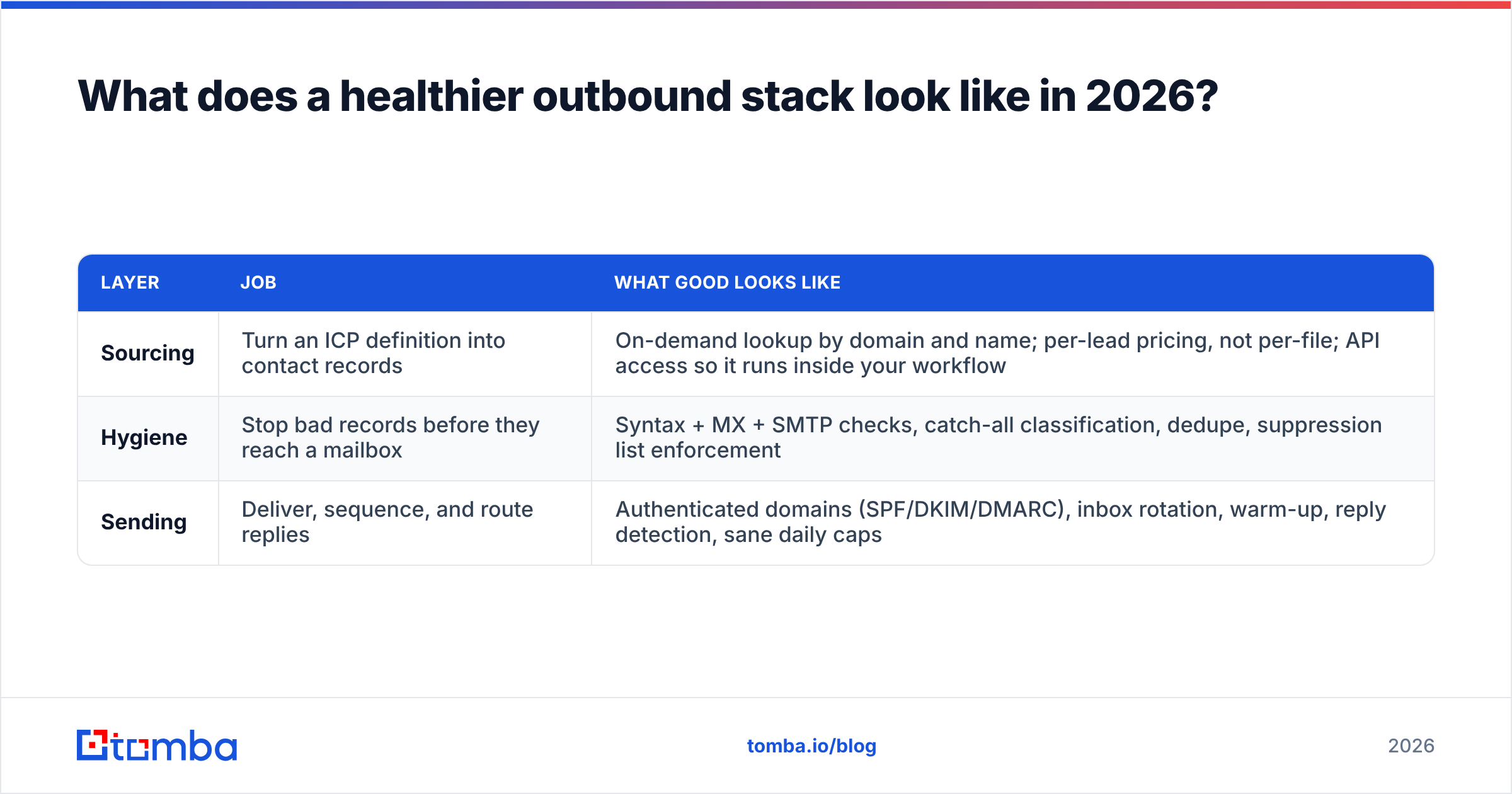
Three layers, in this order, with no gaps between them.
| Layer | Job | What good looks like |
|---|---|---|
| Sourcing | Turn an ICP definition into contact records | On-demand lookup by domain and name; per-lead pricing, not per-file; API access so it runs inside your workflow |
| Hygiene | Stop bad records before they reach a mailbox | Syntax + MX + SMTP checks, catch-all classification, dedupe, suppression list enforcement |
| Sending | Deliver, sequence, and route replies | Authenticated domains (SPF/DKIM/DMARC), inbox rotation, warm-up, reply detection, sane daily caps |
Most stack failures are gaps between layers, not weaknesses inside them. LakeB2B is a strong layer-one option for hard verticals. Emailchaser is a reasonable layer-three option for cost-sensitive senders. Neither covers layer two, and layer two is where the money leaks.
For sourcing plus hygiene in one place, Tomba covers the first two layers with per-lead economics instead of per-file: find addresses by domain, name, or company, verify them in the same pass, and push the clean output into whichever sender you chose. The free tier runs 25 searches/month, Starter is $49/mo, Growth $99/mo, and Pro $249/mo — full Tomba pricing is public, which is itself a useful contrast with quote-only list vendors. For anything at list scale, the bulk email finder handles the whole CSV in one job.
How do you evaluate a data vendor before you sign?#
Whether it's LakeB2B or anyone else, run this checklist. It takes an afternoon and routinely saves five figures.
- Demand a 100-record sample from your actual segment. Not a generic sample. Your filters, your geography, your titles.
- Verify that sample independently. Anything below ~90% deliverable on a fresh sample tells you what the full file looks like.
- Ask when each record was last confirmed — not when it was added. "Last verified" and "last updated" are different fields and vendors sometimes blur them.
- Ask about exclusivity and resale. If the file is non-exclusive, price it accordingly and expect competitors in the same inboxes.
- Confirm the compliance basis. GDPR legitimate interest, CAN-SPAM, CASL — get the answer in writing, especially for EU and Canadian records.
- Check independent reviews. Vendor pages on G2 and similar directories surface the complaints that never make it into a sales deck.
If a vendor resists step one or step two, that's your answer. Reputable providers expect the request. It's also worth reading HubSpot's guidance on purchased lists before committing budget — it's an aggressive take, but the deliverability mechanics it describes are accurate and provider-agnostic.
The verdict#
Emailchaser wins if your bottleneck is sending; LakeB2B wins if your bottleneck is a genuinely hard-to-source vertical. For most teams, neither is the first purchase.
The first purchase should be a sourcing-and-verification layer that lets you build small, fresh, exclusive lists on demand — because that's the input every other tool in the chain depends on. A great sequencer sending to decayed data produces bounces faster. A great list sent from an unauthenticated domain produces spam folder placement faster. Fix the input first.
Start with the Tomba Email Finder: point it at the companies in your ICP, pull verified, deliverable addresses one domain at a time, and hand your sending tool a list that won't cost you your domain reputation in week three. The free tier is enough to test the workflow before you commit to anyone's annual contract.
Related guides#
Ready to find emails that actually work?
Join 150,000+ professionals who stopped guessing and started sending. Free credits on signup — no credit card required.
Get the Tomba newsletter
Practical outbound tactics and product updates — once every two weeks.
About the author