Emailchaser vs Leadzenai: Which B2B Outreach Tool Wins in 2026?
Emailchaser sends cold email. Leadzenai builds lead lists. They get compared constantly and they solve different halves of the same problem. Here is the honest breakdown, plus what both leave you to fix yourself.
TL;DR
- These tools are not really competitors. Emailchaser is a cold email sending platform with a light contact-finding layer. Leadzenai (leadzen.ai) is a lead intelligence and list-building platform. Picking one over the other usually means you picked the wrong half of your funnel.
- Emailchaser wins if your bottleneck is sequencing, inbox rotation, and reply handling at a low, predictable monthly cost.
- Leadzenai wins if your bottleneck is finding companies and people in the first place — especially in India and APAC, where its coverage is stronger than most US-first databases.
- Both leave the same gap: neither is a best-in-class email verification layer. Bounce risk is the failure mode that quietly kills either setup.
- Most teams end up with a stack, not a winner: a data/finder layer, a verification layer, and a sending layer. Budget for all three.
What are Emailchaser and Leadzenai?#
Different products that show up in the same search results.
Emailchaser is a cold email outreach tool. You connect mailboxes, upload or build a list, write a sequence, and it sends and follows up until someone replies. Its pitch has consistently been simplicity and flat pricing — no per-mailbox tax, no enterprise sales call, no six-week onboarding. It bundles a basic email-finding feature so you are not completely stranded without a data provider, but finding contacts is not the core engine. Sending is. You can check current plan details on emailchaser.com — pricing on small tools changes often enough that any number in a blog post is a snapshot, not a contract.
Leadzenai (leadzen.ai) sits on the other side of the workflow. It is a lead intelligence platform: search a database of companies and people, filter by industry, headcount, location, and role, then pull out contact details and enrich what you already have. It has a browser extension, bulk search, and an API. Its strongest differentiator is regional — coverage of Indian and broader APAC companies where Apollo, ZoomInfo, and other US-first databases go thin. See leadzen.ai for their current feature set.
So the honest framing of emailchaser vs leadzenai is: sending engine vs data source. If you buy Emailchaser and have no list, you have an empty machine. If you buy Leadzenai and have no sender, you have a spreadsheet.

How do Emailchaser and Leadzenai compare head-to-head?#
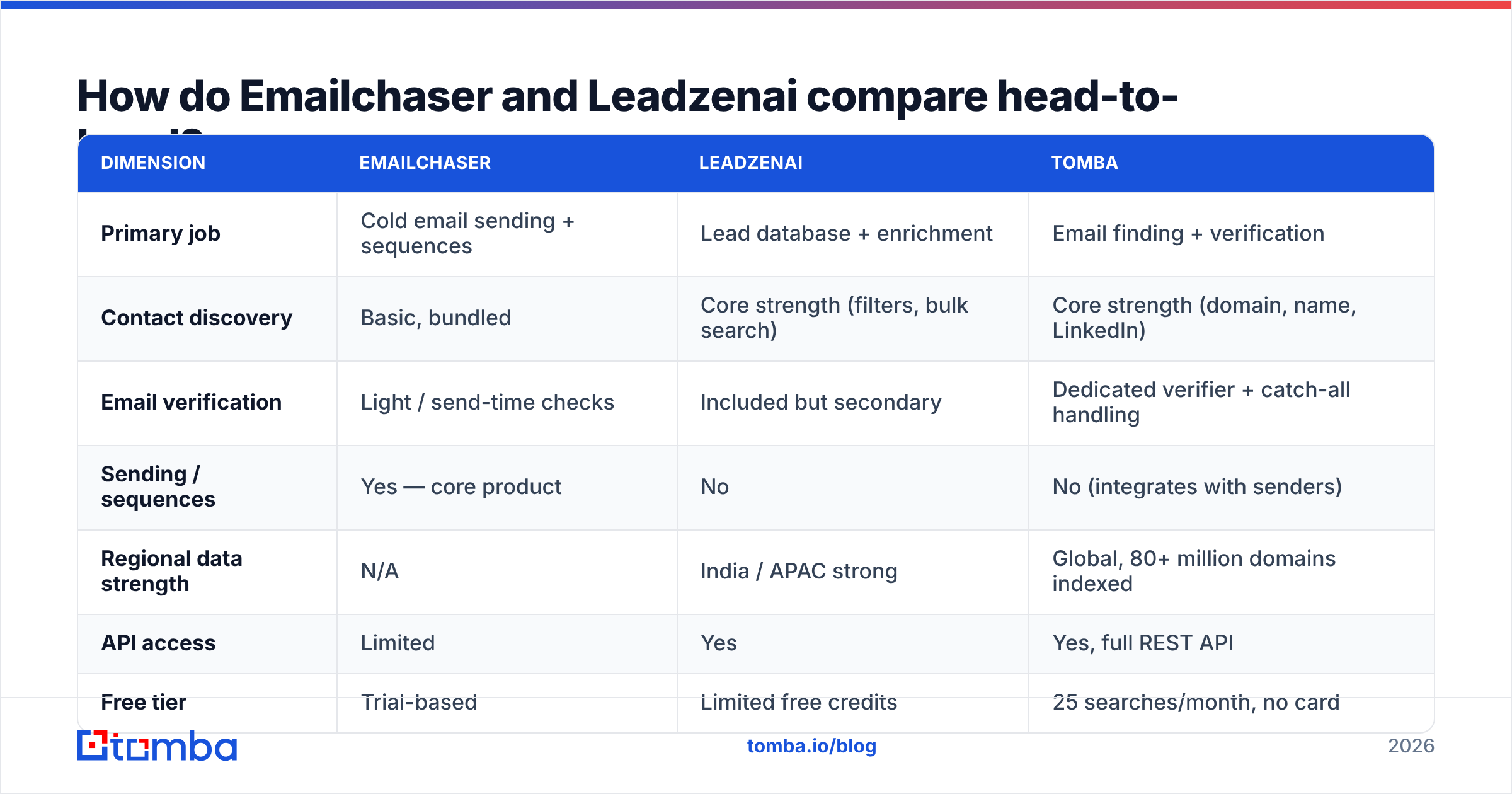
Here is the side-by-side, with Tomba included as the data-and-verification reference point most teams end up adding anyway.
| Dimension | Emailchaser | Leadzenai | Tomba |
|---|---|---|---|
| Primary job | Cold email sending + sequences | Lead database + enrichment | Email finding + verification |
| Contact discovery | Basic, bundled | Core strength (filters, bulk search) | Core strength (domain, name, LinkedIn) |
| Email verification | Light / send-time checks | Included but secondary | Dedicated verifier + catch-all handling |
| Sending / sequences | Yes — core product | No | No (integrates with senders) |
| Regional data strength | N/A | India / APAC strong | Global, 80+ million domains indexed |
| API access | Limited | Yes | Yes, full REST API |
| Free tier | Trial-based | Limited free credits | 25 searches/month, no card |
| Entry paid price | Low flat monthly | Credit-pack based | $49/mo Starter |
| Best for | Solo founders, small agencies | APAC-focused list building | Accuracy-first prospecting at any scale |
Two things stand out. First, the feature overlap between Emailchaser and Leadzenai is genuinely small — roughly one column each. Second, neither covers the whole row. That is why comparison posts framed as "which one should I buy" tend to mislead: the real question is which one you buy first.
Which one actually finds better email addresses?#
Leadzenai, by a wide margin — but with a regional asterisk.
Leadzenai is a database product. You are querying an index that already exists, so results come back fast and in volume. If your ICP is a 200-person SaaS company in Bengaluru, Pune, or Singapore, Leadzenai will surface people that US-centric databases simply do not have. That is a real, defensible edge and worth paying for if it matches your market.
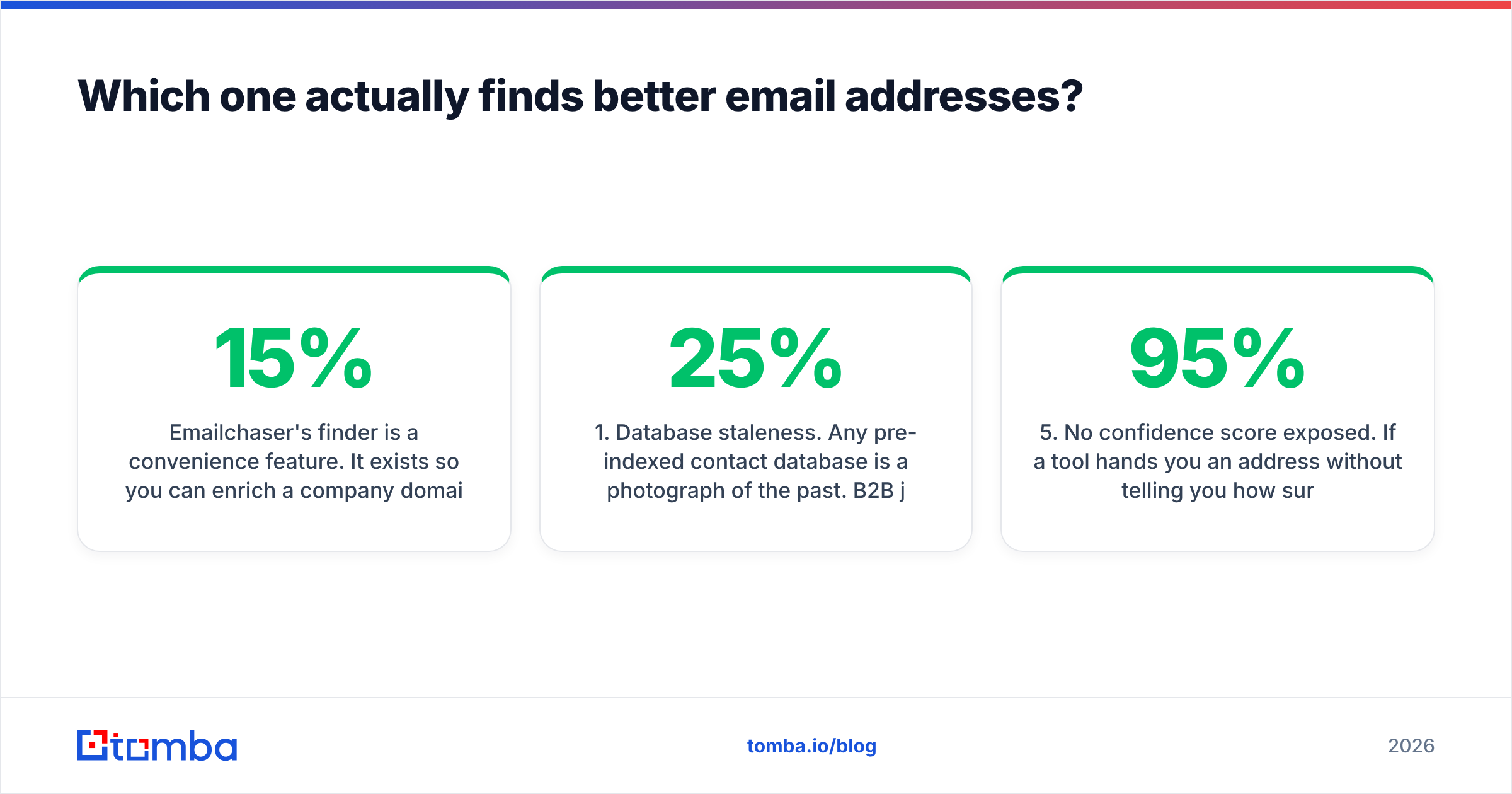
Emailchaser's finder is a convenience feature. It exists so you can enrich a company domain without leaving the tool, not so you can build a 10,000-row list. Treating it as your primary data source is the most common way people end up with a 15% bounce rate and a burned domain.
Both approaches share a structural weakness that nobody markets loudly:
- Database staleness. Any pre-indexed contact database is a photograph of the past. B2B job-change rates run around 20–25% annually across many roles, so a record captured 14 months ago has a meaningful chance of being wrong today.
- Catch-all domains. A large share of B2B domains accept every address at the SMTP layer, which means a "valid" result is often unproven. You need a dedicated catch-all verifier to separate real mailboxes from black holes.
- Pattern guessing dressed up as discovery. Some tools return
first.last@domain.combecause that is the company's dominant pattern, not because that mailbox was confirmed. That is a hypothesis, not a contact. - Role-based addresses.
info@,sales@, andcontact@inflate result counts and destroy reply rates. Filter them before they hit your sequence. - No confidence score exposed. If a tool hands you an address without telling you how sure it is, you cannot triage. A finder that returns a score lets you send confidently to the 95%+ tier and re-verify the rest.
This is exactly where a dedicated email finder earns its place next to either tool. Tomba returns a confidence score with every result and pairs the finder with a separate email verifier, so "found" and "confirmed" stay two distinct states instead of getting blurred into one green checkmark.
How does the pricing actually work?#
Different billing models, which makes direct comparison harder than it looks.
| Plan attribute | Emailchaser | Leadzenai | Tomba |
|---|---|---|---|
| Model | Flat monthly, sending-focused | Credit packs / tiered subscription | Tiered subscription with credits |
| Free option | Trial | Limited free credits | Free: 25 searches/mo |
| Entry tier | Low flat monthly (single seat) | Entry credit pack | Starter $49/mo |
| Mid tier | Volume-based step up | Mid credit tier | Growth $99/mo |
| High tier | Agency / multi-client | Enterprise quote | Pro $249/mo |
| Enterprise | Custom | Custom | Custom |
| What burns budget | Extra mailboxes / contacts | Credits per revealed contact | Searches + verifications |
Check both vendors' live pricing pages before you commit — small tools revise tiers frequently, and any figure in a blog post ages badly.
The practical warning is about credit models generally. A credit-based lead platform charges you for the reveal, not for the accuracy. If 20% of revealed contacts bounce, you paid full price for a list that is 80% usable, then paid again in domain reputation. When you compare cost, compare cost per contact that actually receives an email, not cost per row exported. On a 5,000-contact list, a tool at half the sticker price with a 12% bounce rate is more expensive than a tool at full price with a 2% bounce rate — because the cheap one also costs you inbox placement.
Tomba's pricing is deliberately flat and readable for this reason: Free (25 searches/mo), Starter $49/mo, Growth $99/mo, Pro $249/mo, Enterprise custom. No per-seat surprise, and verification credits are part of the same pool as finding credits.
Is Emailchaser better than Leadzenai for cold email sending?#
Yes — this one is not close, because Leadzenai does not send.
If sending is your requirement, evaluate Emailchaser against actual sending platforms, not against a database. What matters in that category:
- Mailbox rotation and per-mailbox caps. Sending 500 emails a day from one mailbox is how domains get flagged. You want 20–40 per mailbox per day spread across many mailboxes.
- Warmup. Either built in or bring-your-own. New domains need weeks of ramp before real volume.
- Reply detection and auto-pause. A sequence that keeps following up after someone replies is a reputation and credibility leak.
- Deliverability plumbing. SPF, DKIM, DMARC configured correctly on every sending domain. Google and Yahoo's bulk-sender requirements made this non-optional, and the Google Postmaster documentation remains the clearest statement of what they expect.
- Unsubscribe handling. One-click unsubscribe is now table stakes, not a nice-to-have.
Emailchaser covers this list at a small-team level competently and cheaply. It is not trying to be Outreach or Salesloft, and it does not price like them. For a founder sending 1,000–5,000 emails a month, that trade is usually correct.
What it will not do is fix a bad list. No sending platform can. Deliverability is downstream of data quality — you can have perfect SPF records and still land in spam if a tenth of your recipients do not exist.

Where does Leadzenai genuinely win?#
Three places, and they are worth being specific about.
Regional coverage. If you sell into India, Southeast Asia, or the Middle East, Leadzenai's index is materially better than most US-first alternatives. This is not a marketing claim you should discount — data coverage is geographic, and vendors are strongest where their crawling and partnerships are concentrated.
Filtered discovery. You can start from "who do I want" rather than "here is a domain, find me people." That is a fundamentally different workflow. Domain-first tools assume you already have a target account list; database-first tools help you build one.
Enrichment of existing records. If you have 3,000 half-complete CRM rows, a database platform can fill gaps in bulk. That is a legitimate, high-ROI use case that sending tools cannot touch.
Where it is weaker: coverage outside its core regions thins out, credit consumption is easy to misjudge on your first month, and — like most database products — freshness varies by segment. Review reads on G2 are useful here, provided you filter for reviewers whose company size and region match yours.
Which should you pick for your stack in 2026?#
Pick by bottleneck, not by feature count.
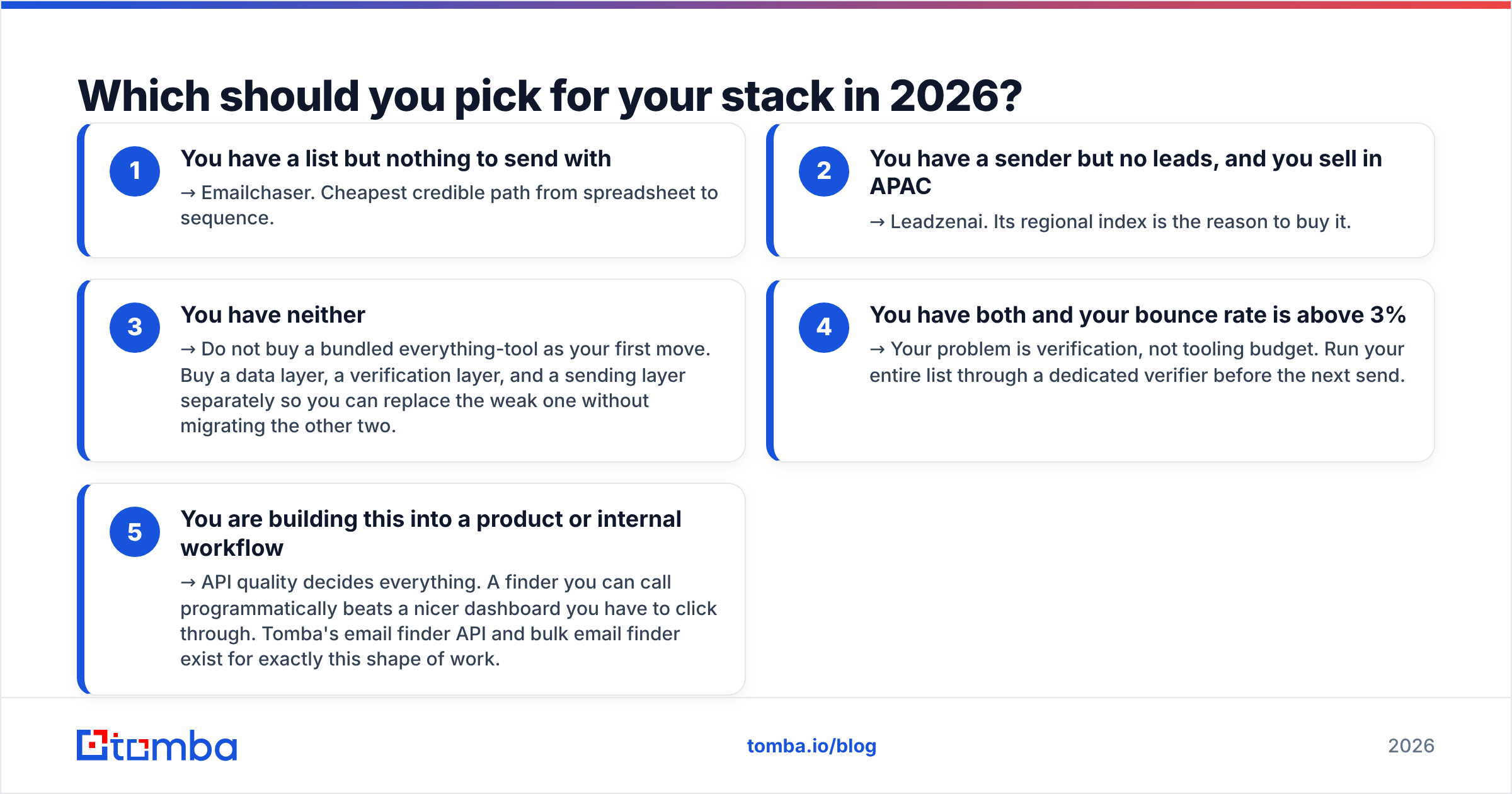
- You have a list but nothing to send with → Emailchaser. Cheapest credible path from spreadsheet to sequence.
- You have a sender but no leads, and you sell in APAC → Leadzenai. Its regional index is the reason to buy it.
- You have neither → Do not buy a bundled everything-tool as your first move. Buy a data layer, a verification layer, and a sending layer separately so you can replace the weak one without migrating the other two.
- You have both and your bounce rate is above 3% → Your problem is verification, not tooling budget. Run your entire list through a dedicated verifier before the next send.
- You are building this into a product or internal workflow → API quality decides everything. A finder you can call programmatically beats a nicer dashboard you have to click through. Tomba's email finder API and bulk email finder exist for exactly this shape of work.
The honest summary of emailchaser vs leadzenai: Emailchaser is a good, unpretentious sender that will not pretend to be your database. Leadzenai is a strong regional database that will not pretend to be your sender. Both are reasonable buys. Neither is a complete outbound stack, and the seam between them — verified, current, deliverable email addresses — is where most campaigns actually fail.
What should you fix before your next campaign?#
Run this checklist before you send another thousand emails, regardless of which tool you chose:
- Deduplicate the list. Exported lists from two sources overlap more than you think.
- Strip role-based addresses.
info@,admin@,support@— delete, do not send. - Verify every address, including ones a database marked valid. Treat vendor validity flags as input, not truth.
- Segment catch-all domains into their own low-volume batch instead of mixing them into the main send.
- Check your own sending domain health — SPF, DKIM, DMARC, blacklist status — before volume, not after the bounce report.
Do those five things and a mediocre tool combination outperforms a premium one used carelessly.
Ready to fix the data layer?#
Whichever side of the emailchaser vs leadzenai decision you land on, the contact data underneath decides your results. Tomba Email Finder gives you confidence-scored addresses from domain, name, or company — with verification, catch-all handling, and a full API in the same plan. Start free with 25 searches a month, no card required, and see what your current list is really worth before you spend another month of sending reputation finding out the hard way.
Related guides#
Ready to find emails that actually work?
Join 150,000+ professionals who stopped guessing and started sending. Free credits on signup — no credit card required.
Get the Tomba newsletter
Practical outbound tactics and product updates — once every two weeks.
About the author