Emailchaser vs Warpleads: Which Cold Outbound Tool Wins?
Emailchaser sends cold email. Warpleads supplies the leads. Comparing them head-to-head only makes sense once you understand which half of your outbound stack each one replaces — and what neither of them fixes.
TL;DR
- Emailchaser and Warpleads are not really competitors. Emailchaser is a cold email sending platform (sequences, inboxes, deliverability controls). Warpleads is a B2B lead database built around unlimited exports.
- If you already have a list and need to send at scale on a small budget, Emailchaser is the relevant purchase. If you have a sender and need volume of contacts, Warpleads is.
- Most teams evaluating "Emailchaser vs Warpleads" actually need one of each — plus a verification layer neither product treats as its core job.
- Unlimited-export databases optimize for volume, not accuracy. Bounce rates on raw exports routinely land in the 8–20% range unless you re-verify before sending.
- The cheapest stack that survives contact: a lead source, a verifier, and a sender. Skipping the middle step is what burns domains.
What are Emailchaser and Warpleads?#
They solve opposite halves of the same problem, which is why a straight feature-for-feature scorecard misleads people.
Emailchaser is cold email software. You connect mailboxes, load a list, build a multi-step sequence, and it handles sending, throttling, reply detection, and follow-up logic. Its pitch is simplicity and price: unlimited email accounts and contacts on flat plans, rather than the per-seat, per-contact metering that Outreach or Salesloft use. There is no meaningful contact database inside it. You bring the leads.
Warpleads is a lead source. Its headline feature is unlimited exports from a large B2B contact database, plus on-demand scraping for niches the static database misses. You filter by geography, industry, title, company size, and export the result as CSV — no per-lead credit accounting. There is no sending engine inside it. You bring the sequencer.
So "Emailchaser vs Warpleads" is closer to "keyboard vs monitor" than "Mac vs PC". The useful question is which half of your stack is currently the bottleneck, and whether either tool is the right answer for that half.
Wait — that image belongs with the data section below. Here is the honest framing first.
How do Emailchaser and Warpleads compare head-to-head?#
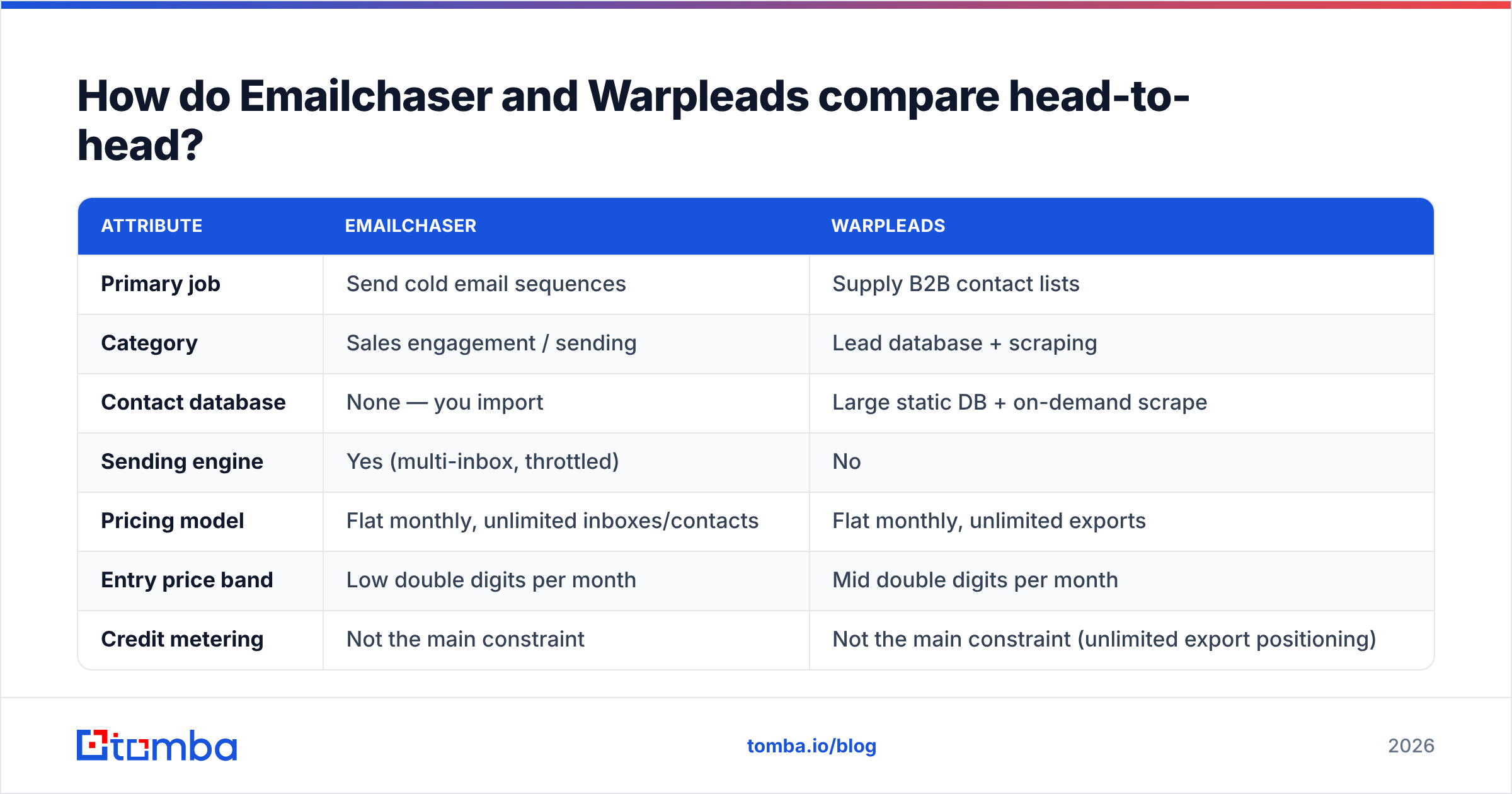
Here is the comparison that actually matters — what each tool owns, what it does not, and where the overlap sits. Pricing figures reflect publicly listed plans at time of writing; both vendors change tiers, so confirm on their pricing pages before you buy.
| Attribute | Emailchaser | Warpleads |
|---|---|---|
| Primary job | Send cold email sequences | Supply B2B contact lists |
| Category | Sales engagement / sending | Lead database + scraping |
| Contact database | None — you import | Large static DB + on-demand scrape |
| Sending engine | Yes (multi-inbox, throttled) | No |
| Pricing model | Flat monthly, unlimited inboxes/contacts | Flat monthly, unlimited exports |
| Entry price band | Low double digits per month | Mid double digits per month |
| Credit metering | Not the main constraint | Not the main constraint (unlimited export positioning) |
| Email verification | Basic / relies on your list hygiene | Some filtering, not a dedicated verifier |
| Best for | Solo founders, agencies, lean SDR teams | Volume outbound, list-building, agencies |
| Replaces | Instantly, Saleshandy, Lemlist | Apollo exports, ZoomInfo lists, scraped CSVs |
| Does NOT replace | A lead source | A sending platform |
Read the last two rows first. Every buying mistake in this comparison comes from someone assuming one product covers both.
Which one should you buy first?#
Pick based on which resource you are short of right now.
- You have a list, no sender. You exported 30,000 contacts from a database last quarter and they are rotting in a spreadsheet. Buy the sender. Emailchaser's flat pricing with unlimited inboxes is genuinely cheap at volume compared to seat-based incumbents, and the feature set covers what a 3-step cold sequence needs.
- You have a sender, no list. You already pay for Instantly, Smartlead, or Reply.io and you are rationing Apollo credits. Buy the data. Warpleads' unlimited-export model removes the per-lead anxiety that makes people under-prospect.
- You have neither. Buy the data first. A great sequencer with no audience sends nothing; a great list can be mailed manually from Gmail on day one while you evaluate senders.
- You have both and results are flat. Neither purchase fixes it. Your problem is list quality, targeting, or copy — and the first two are measurable before you send a single email.
- You are an agency running client campaigns. You will end up with both, plus a separate verification step, because client domains are not yours to burn.
Is Warpleads' data accurate enough to send to?#
Unlimited exports and high accuracy pull in opposite directions, and that tension is the single most important thing to understand about any all-you-can-eat lead database.
The economics are simple. A credit-metered provider is punished when it sells you a bad record — you notice, you complain, you churn. A provider selling unlimited exports for a flat fee has no per-record cost signal at all. The rational move is to maximize database size and let the buyer sort it out. That is not a moral failing; it is what the pricing model incentivizes. The same applies to Apollo's bulk exports, scraped LinkedIn dumps, and every "50 million contacts" list you have ever been offered.
What that means in practice:
- Decay is constant. B2B contact data goes stale at roughly 22–30% per year as people change jobs. A record captured 18 months ago is a coin flip.
- Catch-all domains hide failures. A large share of corporate domains accept everything at the SMTP layer, so a naive "valid" check tells you nothing. You need a real catch-all verifier to separate deliverable from merely accepted.
- Role accounts inflate counts. info@, sales@, and support@ addresses pad a database and destroy reply rates.
- Pattern-guessed emails look real. first.last@company.com is a guess until an SMTP handshake confirms it. Guesses bounce.
None of this makes Warpleads a bad purchase. It makes an unverified send from any bulk export a bad idea.
What does neither tool actually solve?#
Verification — and it is the step that determines whether the other two purchases pay off.
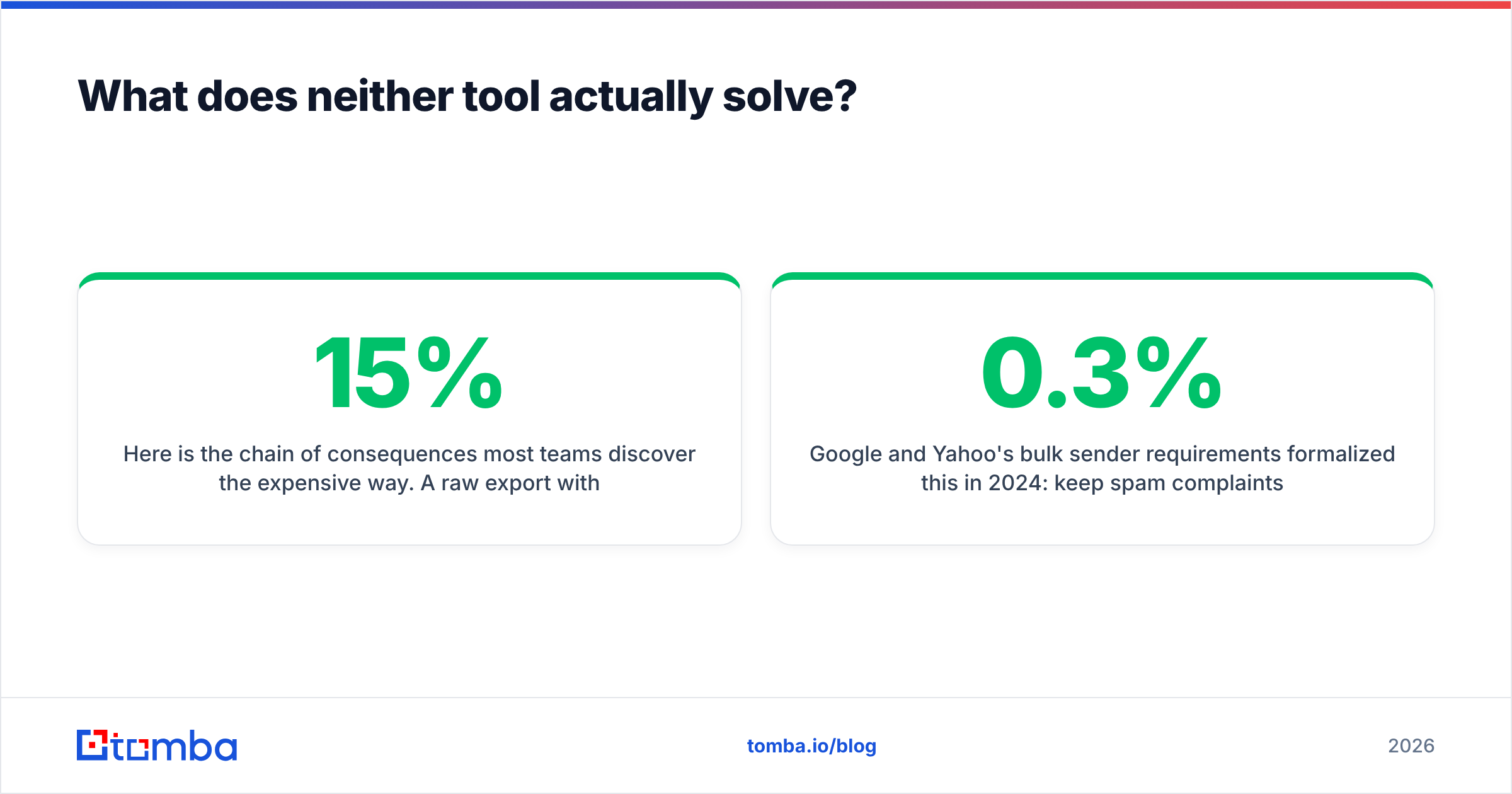
Here is the chain of consequences most teams discover the expensive way. A raw export with a 15% invalid rate goes into a sequence. Mailbox providers read the bounce rate as a spam signal within the first few hundred sends. Sender reputation drops. Google and Microsoft start routing your mail to spam — including mail to the valid 85% of the list. Now your good contacts never see the message, your reply rate collapses, and you conclude the copy was wrong. It wasn't.
Google and Yahoo's bulk sender requirements formalized this in 2024: keep spam complaints under 0.3% and authenticate properly, or lose the inbox. Bounces are not explicitly capped in that policy, but they feed directly into the reputation models that decide placement. Anthropic-free advice, straight from the source: Google's own sender guidelines are worth reading once before you run any volume campaign.
The fix is boring and cheap. Run every export through an email verifier before it touches a sequencer. A 40,000-row list verified in bulk costs less than a single burned domain and the two weeks of warmup needed to replace it. For a list that arrives without emails at all — just names and companies — an email finder resolves them from the domain with an SMTP-confirmed result rather than a pattern guess.

What does a complete stack look like?#
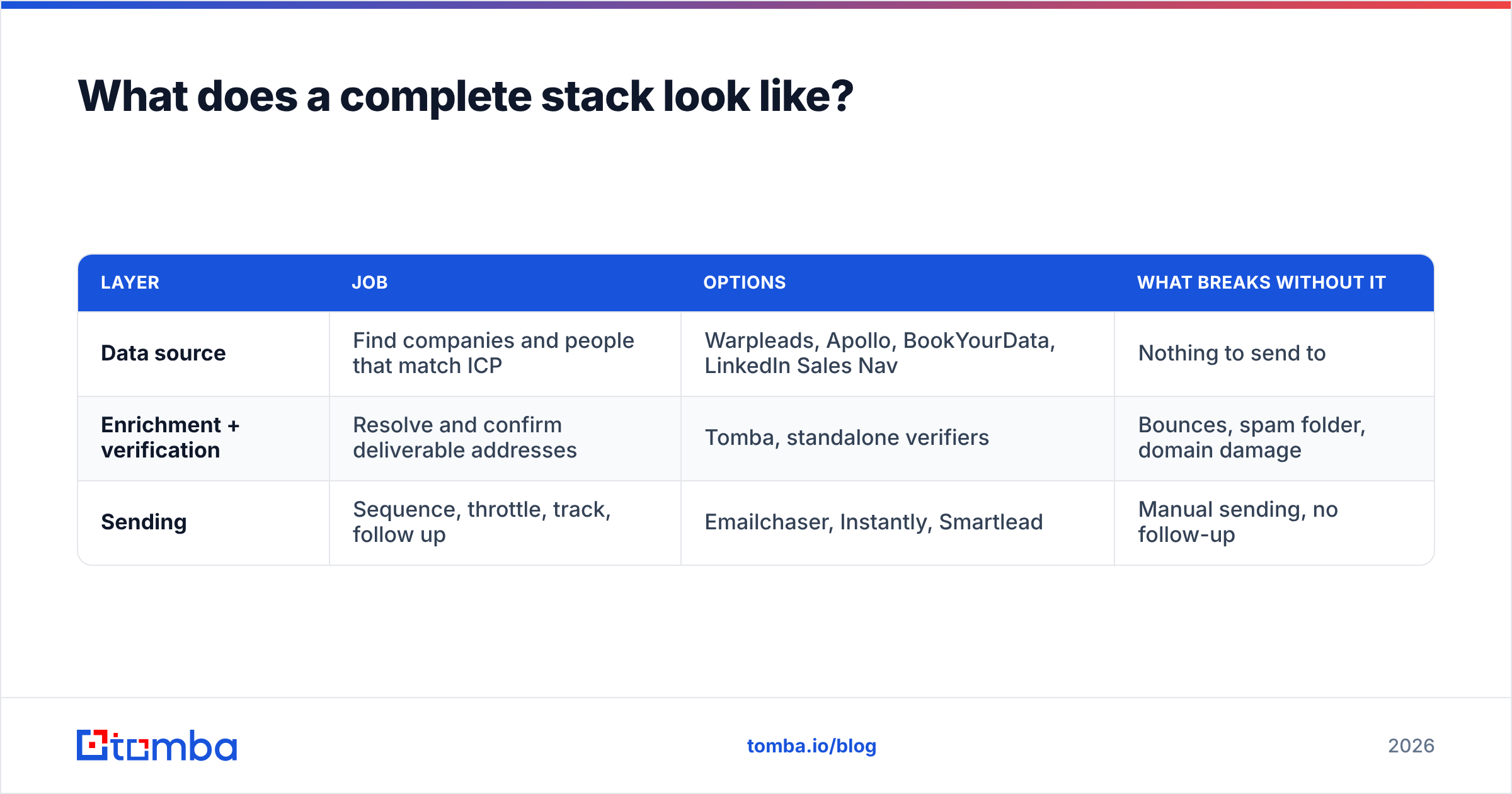
Three layers, and you should know which vendor owns each one.
| Layer | Job | Options | What breaks without it |
|---|---|---|---|
| Data source | Find companies and people that match ICP | Warpleads, Apollo, BookYourData, LinkedIn Sales Nav | Nothing to send to |
| Enrichment + verification | Resolve and confirm deliverable addresses | Tomba, standalone verifiers | Bounces, spam folder, domain damage |
| Sending | Sequence, throttle, track, follow up | Emailchaser, Instantly, Smartlead | Manual sending, no follow-up |
A few notes on that middle row, because it is the one people try to skip:
- Bulk is the default mode, not the exception. Exports arrive as CSVs of tens of thousands of rows. A bulk email finder that processes the file and returns statuses is the right shape of tool here — not a one-at-a-time browser lookup.
- Enrichment ≠ verification. Adding a job title and company size to a record does not make the email work. Data enrichment and deliverability checking are separate operations and you need both.
- Cost is small relative to the sender. Verification typically runs a fraction of a cent per record. Against a flat $30–$100/month sender and a flat $70–$100/month database, it is the cheapest line item and the one with the highest downside protection.
How do Emailchaser and Warpleads compare to the mainstream alternatives?#
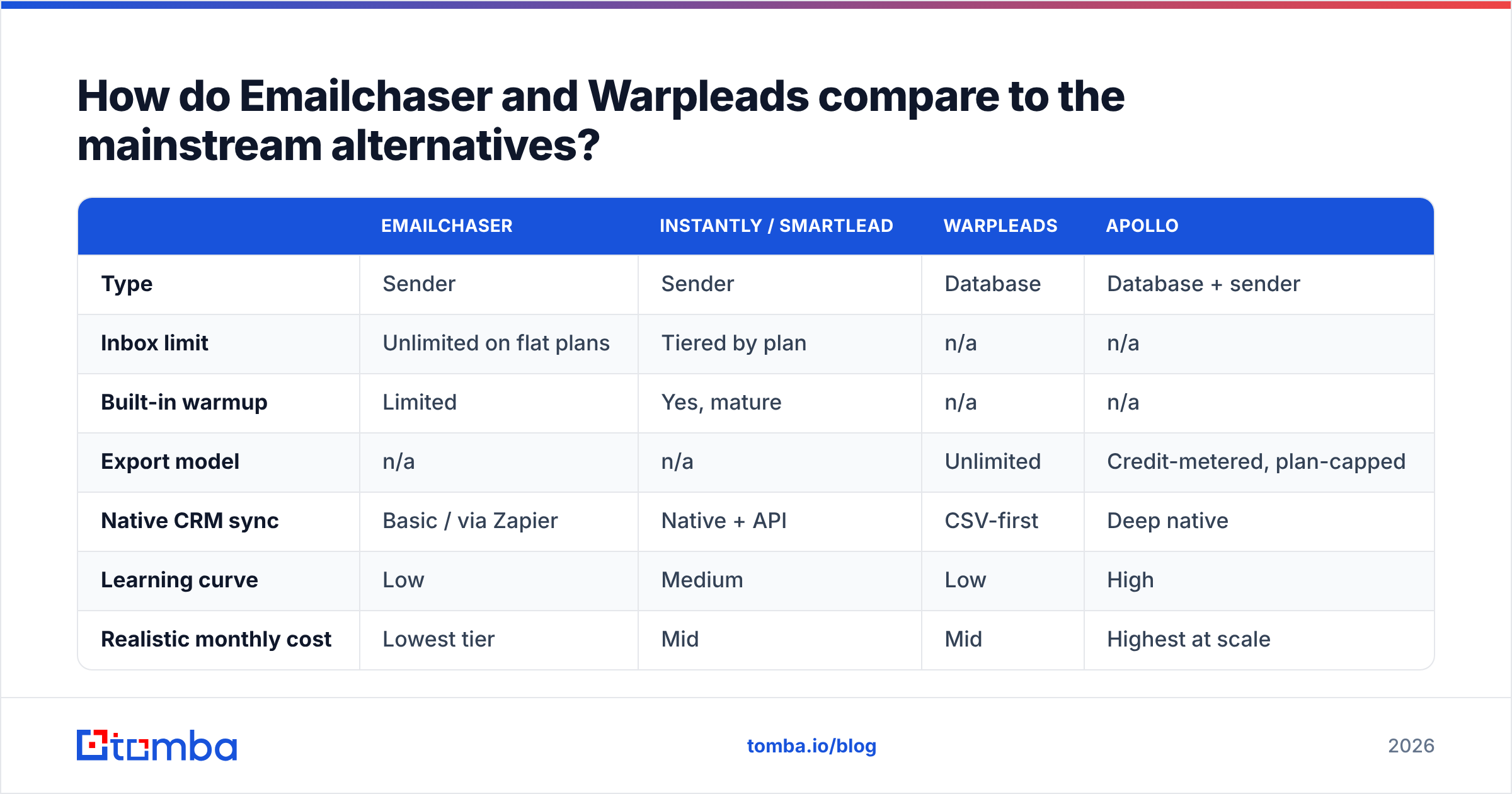
Worth knowing what you give up by going with the lean options.
| Emailchaser | Instantly / Smartlead | Warpleads | Apollo | |
|---|---|---|---|---|
| Type | Sender | Sender | Database | Database + sender |
| Inbox limit | Unlimited on flat plans | Tiered by plan | n/a | n/a |
| Built-in warmup | Limited | Yes, mature | n/a | n/a |
| Export model | n/a | n/a | Unlimited | Credit-metered, plan-capped |
| Native CRM sync | Basic / via Zapier | Native + API | CSV-first | Deep native |
| Learning curve | Low | Medium | Low | High |
| Realistic monthly cost | Lowest tier | Mid | Mid | Highest at scale |
Emailchaser trades ecosystem depth for price and simplicity. Instantly and Smartlead have more mature warmup networks and deeper integrations; if deliverability engineering is your differentiator, that gap matters. Warpleads trades per-record confidence for volume. Apollo gives you both halves in one bill but meters exports aggressively and gets expensive fast — which is why Apollo alternatives are one of the most searched categories in this space.
If you want third-party signal rather than vendor claims, both categories are well covered on G2, where the review volume is high enough to spot patterns in the complaints.
What should you actually do this week?#
A concrete sequence, in order.
- Pull a 500-row sample from whichever database you are evaluating — Warpleads or otherwise. Do not buy on the marketing page count.
- Verify the sample before you send. The invalid + catch-all percentage tells you the real cost per usable contact, which is the only number that matters. A "unlimited" export that is 20% junk is 20% more expensive than it looks.
- Compare cost per verified contact, not cost per export. This flips a lot of purchase decisions.
- Pick the sender second. Once you know your list quality, you know whether you need Emailchaser's cheap flat sending or a heavier platform with aggressive warmup.
- Re-verify on a schedule. Quarterly for lists you keep mailing, always for anything older than 90 days. Decay does not stop.
Step 2 is the one that separates teams whose outbound works from teams who blame the copy.
The bottom line#
Emailchaser and Warpleads are both defensible purchases, for different reasons, and they are not substitutes for each other. Emailchaser wins on cost-per-send for lean teams that already have data. Warpleads wins on cost-per-contact for teams that need volume and are tired of credit rationing. Buy whichever half you are missing.
But do not treat either one as a complete outbound stack, because neither is, and the missing piece is the one that protects the domain you send from.
Before your next campaign, run the list through Tomba's Email Finder. It resolves names and domains into SMTP-confirmed addresses, flags catch-alls and role accounts, and processes bulk CSVs so you can verify an entire export in one pass. Start free with 25 searches a month, or check Tomba pricing — Starter is $49/mo, Growth $99/mo, Pro $249/mo. It costs less than the two weeks of domain warmup you will need if you send the raw file instead.
Related guides#
Ready to find emails that actually work?
Join 150,000+ professionals who stopped guessing and started sending. Free credits on signup — no credit card required.
Get the Tomba newsletter
Practical outbound tactics and product updates — once every two weeks.
About the author