Emailchaser vs ZoomInfo: Which B2B Data Tool Wins in 2026?
Emailchaser is a lightweight cold email tool with a built-in finder. ZoomInfo is a six-figure data platform. We compare pricing, data depth, accuracy, and contract traps to show which one fits your team.
TL;DR#
- Emailchaser is a small, cheap cold-email sending tool with a bundled email finder. ZoomInfo is an enterprise B2B data and go-to-market platform with annual contracts that routinely land between $15,000 and $40,000+.
- They are not really the same product. Emailchaser sells you sequences; ZoomInfo sells you a database. Comparing them fairly means comparing what each does badly outside its lane.
- If you send fewer than 5,000 cold emails a month and buy contacts one company at a time, Emailchaser wins on cost by an order of magnitude.
- If you need intent data, org charts, direct dials, and CRM enrichment at scale for a 20+ rep team, ZoomInfo is the only one of the two that qualifies — but expect a procurement cycle and a multi-year commitment.
- Most teams end up in the middle: a dedicated finder/verifier for data quality plus a sending tool they actually like. That stack costs a fraction of ZoomInfo and beats Emailchaser's bundled data.
What is Emailchaser?#
Emailchaser is a cold email outreach platform built around one idea: sending sequences should be cheap and simple. You connect a mailbox (Google Workspace or Microsoft 365), upload or find contacts, write a multi-step sequence, and it sends from your inbox with automatic reply detection and follow-up stopping.
The product bundles a basic email finder so you can look up a prospect by name and domain without leaving the app. That's convenient. It is also the weakest part of the product — a sending tool's finder is almost never as deep as a company that does nothing but find and verify emails.
Where Emailchaser is strong:
- Price. Entry plans sit in the low tens of dollars per month per mailbox, not thousands per year.
- Setup speed. You can be sending in under an hour. No implementation call, no CSM onboarding deck.
- Inbox-native sending. It sends through your real mailbox rather than a separate relay, which keeps email deliverability behavior predictable.
- No annual lock-in. Monthly billing, cancel whenever.
Where it's thin: no intent signals, no firmographic filtering worth the name, no org charts, no direct dials, and a contact database that can't compete with a purpose-built provider on either coverage or freshness.
What is ZoomInfo?#
ZoomInfo is the enterprise end of the market. It's a data platform first — hundreds of millions of contact and company profiles, firmographics, technographics, intent signals from Bidstream and its content network, org charts, direct dial phone numbers, and deep CRM sync into Salesforce and HubSpot.
On top of that data sits a growing pile of GTM tooling: Engage for sequences, Chat for website conversations, Copilot for AI account prioritization, and Websights for visitor identification. ZoomInfo's pitch is that you replace five vendors with one.
The catch is well documented in G2 reviews and every procurement thread you'll find: annual contracts, credit-based limits that run out mid-quarter, auto-renewal clauses that bite teams who forget the notice window, and per-seat pricing that scales fast. There is no self-serve checkout and no meaningful free tier — you talk to sales, you get a quote, you negotiate.
How do Emailchaser and ZoomInfo compare head to head?#
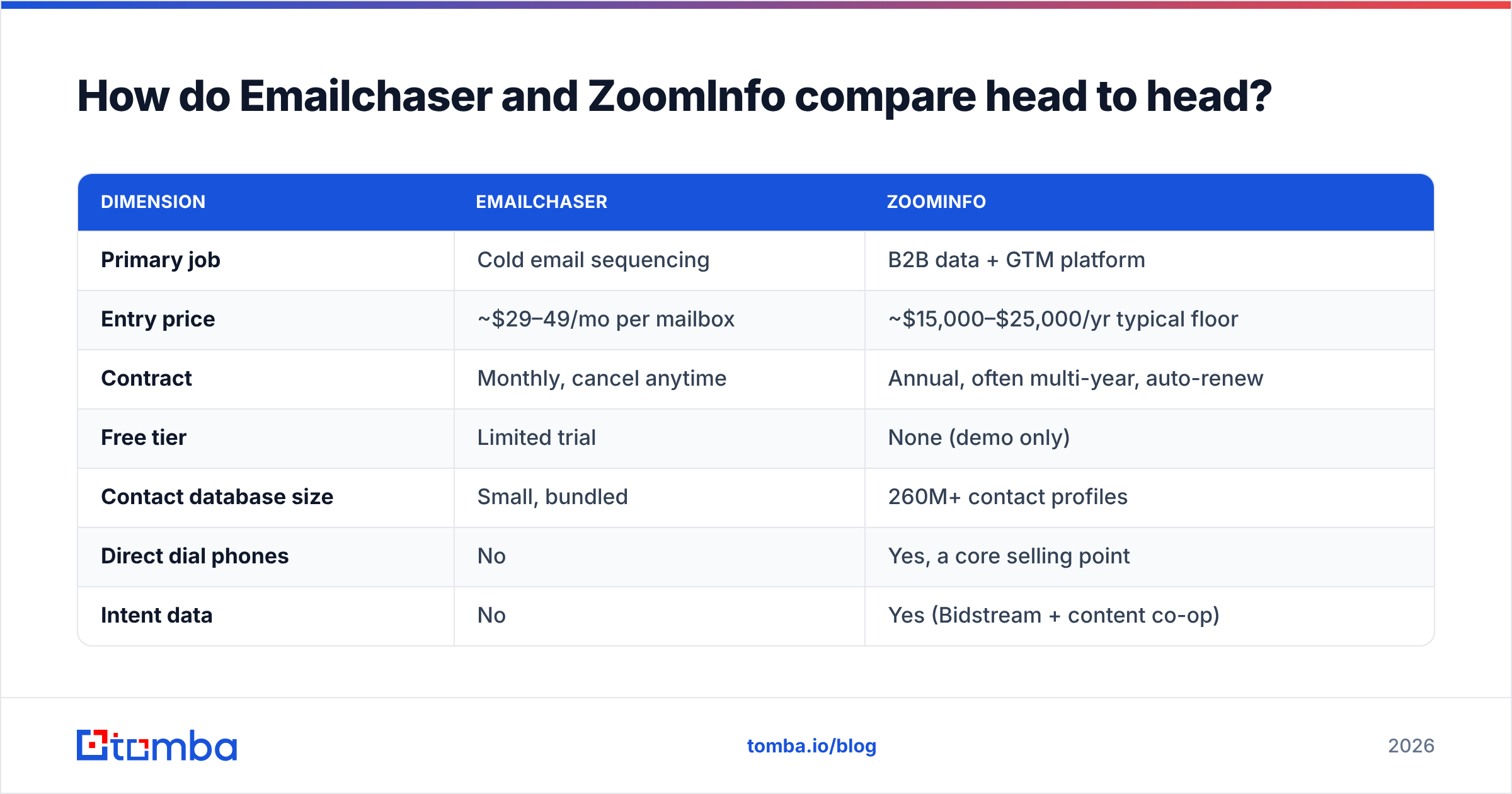
Here's the honest matrix. Prices reflect publicly reported ranges as of early 2026; ZoomInfo's are quote-based and vary wildly by seat count and module mix.
| Dimension | Emailchaser | ZoomInfo |
|---|---|---|
| Primary job | Cold email sequencing | B2B data + GTM platform |
| Entry price | ~$29–49/mo per mailbox | ~$15,000–$25,000/yr typical floor |
| Contract | Monthly, cancel anytime | Annual, often multi-year, auto-renew |
| Free tier | Limited trial | None (demo only) |
| Contact database size | Small, bundled | 260M+ contact profiles |
| Direct dial phones | No | Yes, a core selling point |
| Intent data | No | Yes (Bidstream + content co-op) |
| Org charts / hierarchy | No | Yes |
| Email verification | Basic | Yes, plus bounce guarantees on some tiers |
| Sequencing / sending | Yes, core product | Yes, via ZoomInfo Engage (extra cost) |
| CRM enrichment | Minimal | Deep Salesforce/HubSpot/Dynamics sync |
| API access | Limited | Yes, metered by credits |
| Time to first send | Under an hour | 2–6 weeks including onboarding |
| Best for | Solo founders, 1–5 person outbound | 20+ rep sales orgs with RevOps support |
Read that table twice before you shortlist either one. The row that decides most evaluations isn't features — it's contract. A $30/mo tool you can kill next Tuesday and a $22,000 annual commitment are different categories of decision, and they deserve different levels of diligence.
Is ZoomInfo's data actually worth the price?#
Sometimes. It depends on what you're buying it for.
ZoomInfo's genuine moat is phone numbers and intent. If your motion is cold calling enterprise buyers, the direct dial coverage is hard to replicate at similar quality from cheaper vendors. If your marketing team runs account-based campaigns and needs to know which accounts are researching your category this week, intent data has real value — Forrester's research on ABM and intent consistently finds that account prioritization lifts conversion when the signal is fresh.
What ZoomInfo is not uniquely good at is B2B email addresses. Independent accuracy tests routinely put dedicated email-finding tools at parity or better, at a fraction of the cost per contact. Email discovery is a solved-enough problem that paying enterprise database prices for it is bad math.
The other cost people underestimate: credits. ZoomInfo meters exports and enrichment. Teams regularly burn a quarter's allocation in six weeks, then either ration usage or buy a mid-cycle top-up at non-negotiated rates. Ask, in writing, what happens when credits run out — that single question changes more deals than any feature demo.
What are the real alternatives to both?#
Most teams evaluating Emailchaser vs ZoomInfo are actually asking a different question: how do I get accurate contact data without an enterprise contract?
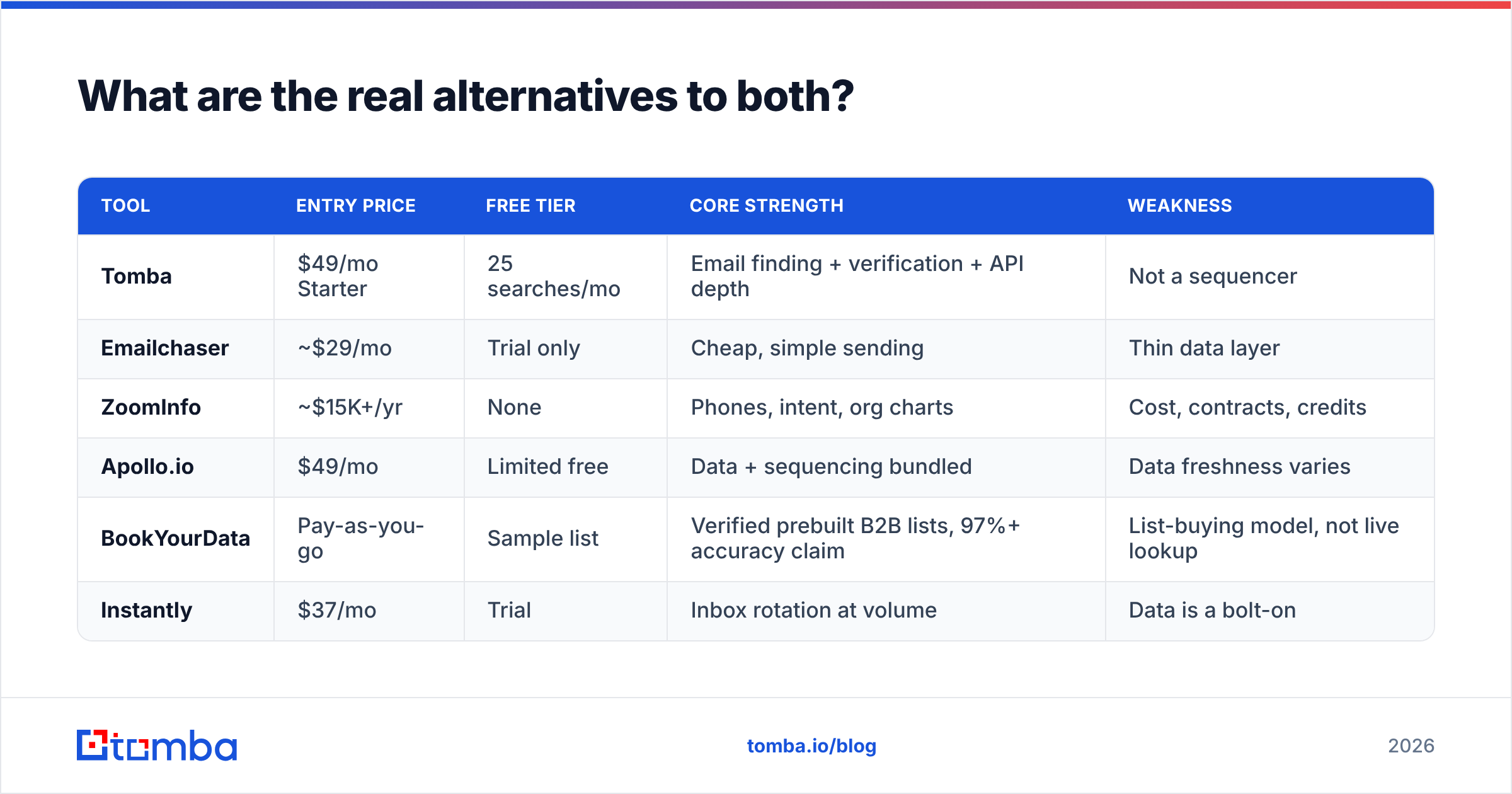
The answer is usually an unbundled stack. Buy data from a data specialist, buy sending from a sending specialist, and connect them with an API or a native integration. Here's how the main options break down:
| Tool | Entry price | Free tier | Core strength | Weakness |
|---|---|---|---|---|
| Tomba | $49/mo Starter | 25 searches/mo | Email finding + verification + API depth | Not a sequencer |
| Emailchaser | ~$29/mo | Trial only | Cheap, simple sending | Thin data layer |
| ZoomInfo | ~$15K+/yr | None | Phones, intent, org charts | Cost, contracts, credits |
| Apollo.io | $49/mo | Limited free | Data + sequencing bundled | Data freshness varies |
| BookYourData | Pay-as-you-go | Sample list | Verified prebuilt B2B lists, 97%+ accuracy claim | List-buying model, not live lookup |
| Instantly | $37/mo | Trial | Inbox rotation at volume | Data is a bolt-on |
BookYourData is worth a specific mention if your motion is list-first rather than lookup-first — you buy a filtered, pre-verified list and load it into whatever sender you already use, which suits agencies and one-off campaign pushes better than a per-seat subscription does.

Where Tomba fits: it's the data half of the stack without the enterprise contract. The email finder resolves a name plus domain to a verified address, domain search pulls every discoverable address at a company with role and department labels, and the email verifier runs SMTP-level checks before you send. Pricing is public — Free at 25 searches/month, Starter $49/mo, Growth $99/mo, Pro $249/mo — and you can read the full Tomba pricing page without booking a call.


Which one should you pick for your team size?#
Team size predicts the right answer better than any feature list.
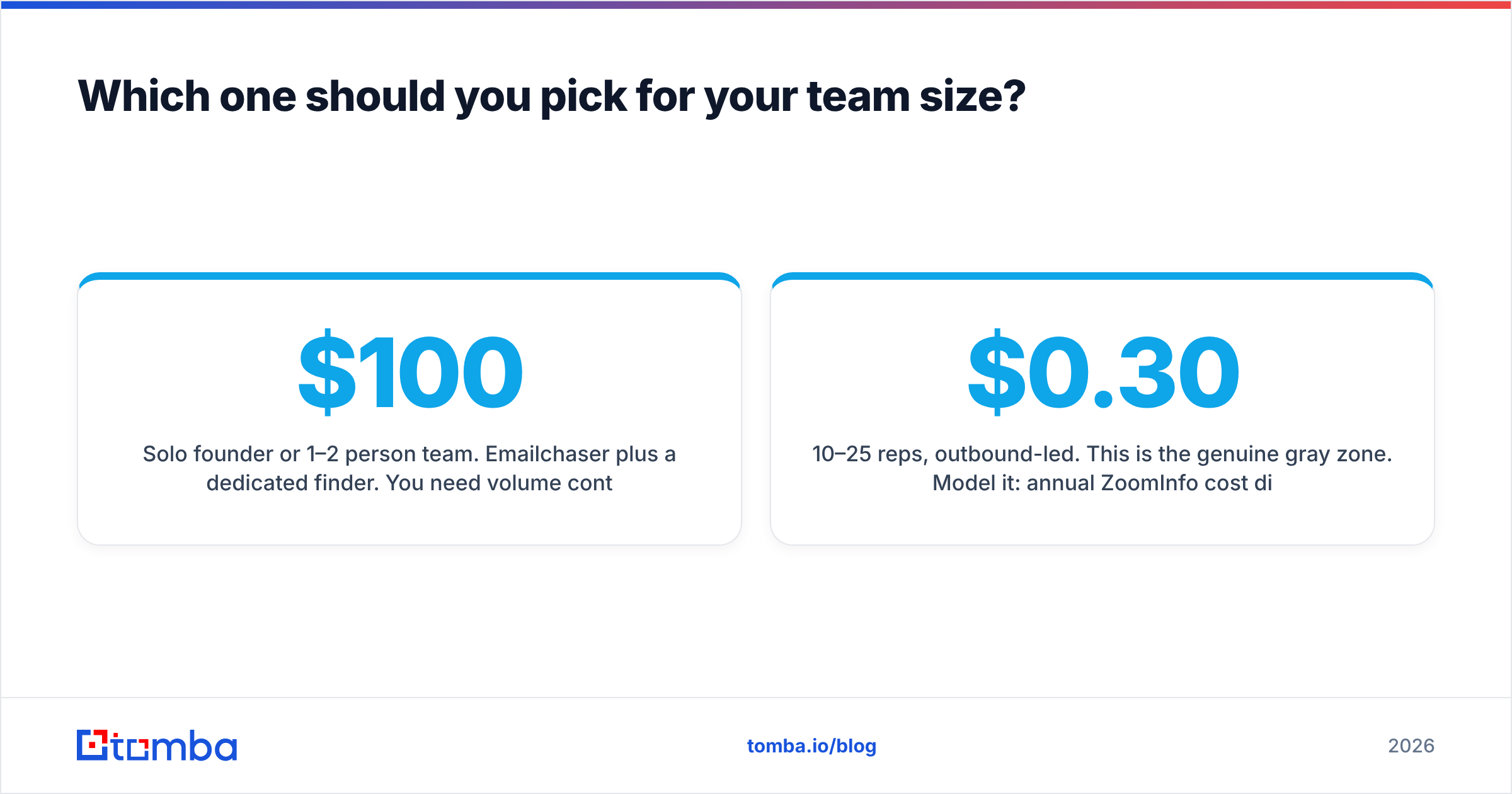
- Solo founder or 1–2 person team. Emailchaser plus a dedicated finder. You need volume control and low fixed cost, not intent data. Total spend: under $100/mo.
- 3–10 person sales team, inbound-heavy. A finder with a good API plus your existing CRM's sequencing. ZoomInfo is overkill until you're doing outbound at real volume.
- 10–25 reps, outbound-led. This is the genuine gray zone. Model it: annual ZoomInfo cost divided by contacts you'll actually export. If that per-contact cost exceeds $0.30–0.50, unbundle instead.
- 25+ reps with RevOps headcount. ZoomInfo starts making sense — but only if someone owns credit governance and CRM hygiene. Without that owner, you're paying enterprise prices for a very expensive contact list.
- Agency running campaigns for clients. Neither, alone. You need per-client data segregation, which usually means a pay-as-you-go data source plus a multi-workspace sender.
One number to run before any decision: your cost per booked meeting, not cost per contact. A tool that costs 5x more but produces contacts that connect twice as often can still be the cheaper option. Most teams never calculate this, which is exactly why ZoomInfo renewals go through unchallenged.
How do you evaluate data quality before you commit?#
Don't take anyone's accuracy claim at face value — including Tomba's. Run this test on every vendor you shortlist:
- Build a 100-row control list. Pull real contacts from accounts you already sell to, where you know the correct email. Mix seniority: 30 VP+, 40 manager-level, 30 individual contributors.
- Run it through each tool's trial. Record hit rate (found vs not found) and accuracy (found and correct) separately. Vendors conflate these on purpose.
- Send a real verification pass. Use a neutral verifier — not the vendor's own — to catch addresses that are syntactically valid but dead. A free email checker works for spot checks.
- Segment by company size. Most tools are strong on 500+ employee companies and weak on sub-50. If you sell to SMBs, an enterprise-tuned database will disappoint you regardless of headline accuracy.
- Check catch-all handling. Roughly 15–20% of B2B domains are catch-all, meaning standard verification returns "accept all" and tells you nothing. A catch-all verifier that actually resolves these is worth more than two points of headline accuracy.
- Test the API, not just the UI. If you'll automate, the email finder API rate limits and response schema matter more than the dashboard you'll stop opening after week two.
This takes an afternoon and will tell you more than six vendor demos. It also gives you leverage: showing a ZoomInfo rep your measured hit rate on their own trial data is the fastest way to move a quote.
What about deliverability and compliance?#
Neither tool solves deliverability for you, and both will happily let you torch a domain.
Emailchaser sends from your real mailbox, which is generally good for sender reputation — but it also means one bad list burns your primary domain rather than a throwaway. Set up authentication before your first send: SPF, DKIM, and a DMARC policy. Google and Yahoo's bulk sender requirements have been enforced since 2024 and non-compliant senders get filtered silently, not bounced.
ZoomInfo's data comes with its own compliance surface. It operates under GDPR legitimate-interest arguments in the EU and offers CCPA opt-out handling, but the practical burden of suppression lists and opt-out honoring still sits with you. If you sell into Germany or France, get your legal team involved before you export a single European contact — the fines are real and the "our vendor said it was compliant" defense has not aged well.
Practical baseline for either tool:
- Verify every address before sending, not after bounces teach you.
- Keep bounce rates under 2%. Above 3% and mailbox providers start throttling you.
- Warm new domains for at least three weeks before volume sending.
- Maintain a global suppression list across every tool in the stack, not per-tool.
The verdict: Emailchaser or ZoomInfo?#
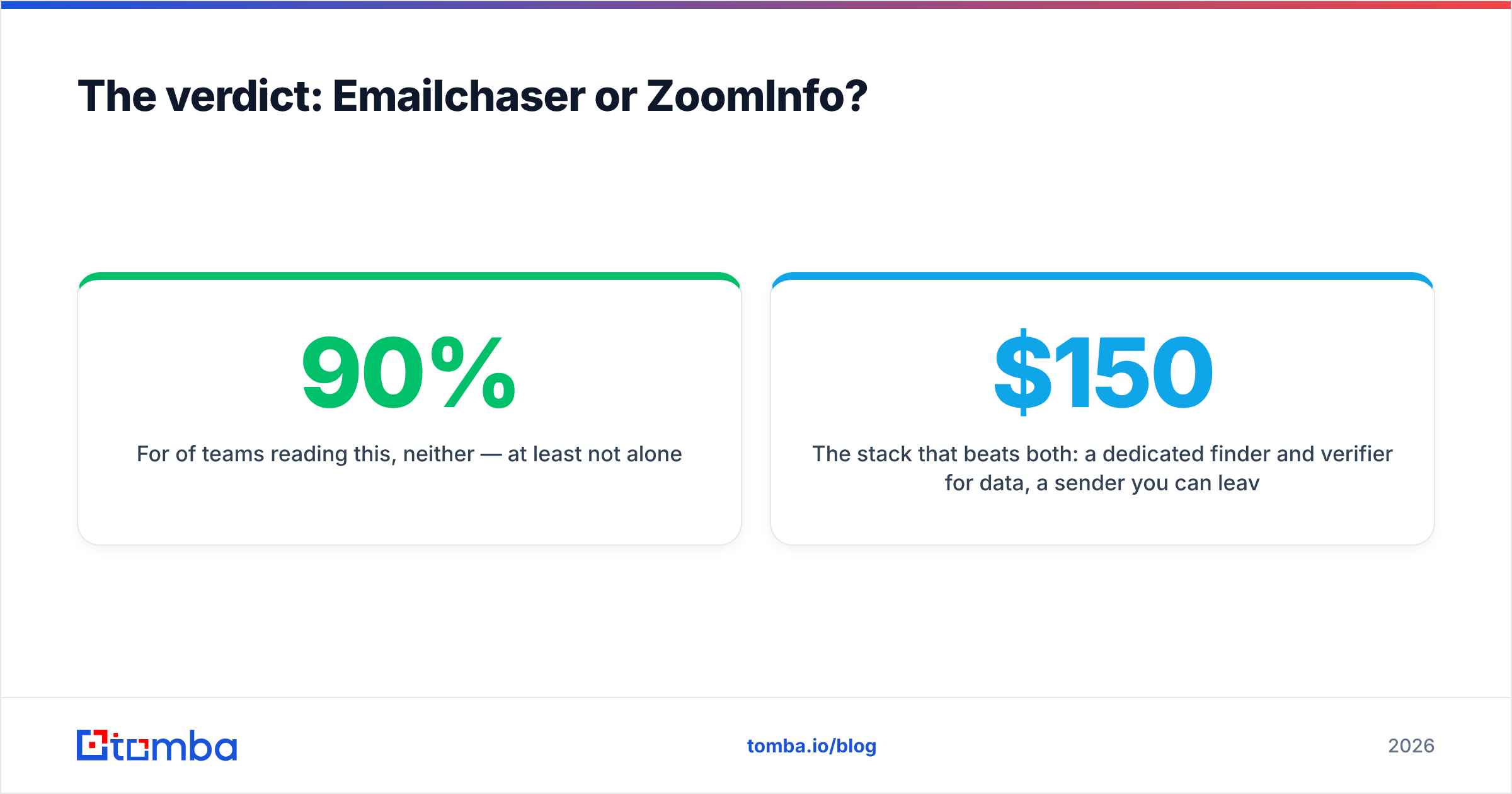
For 90% of teams reading this, neither — at least not alone.
Emailchaser is a fine sending tool at a fair price, and if sending is your bottleneck it will solve that. But its bundled data layer isn't good enough to be the foundation of an outbound program, and pretending otherwise costs you in bounce rates and wasted sequence slots.
ZoomInfo is genuinely best-in-class for direct dials, org charts, and intent — and genuinely overpriced if what you actually need is verified B2B email addresses. The contract structure punishes teams whose needs change mid-year, which is most teams.
The stack that beats both: a dedicated finder and verifier for data, a sender you can leave whenever you want, and a written policy on list hygiene. It costs under $150/month for a small team, and it does not require you to explain a $25,000 line item to your CFO.
Start with the data half. Run the 100-contact control test on the Tomba Email Finder free tier — 25 searches a month, no card, no sales call — and compare the hit rate against whatever Emailchaser or ZoomInfo quotes you. If Tomba wins on your own list, you've just saved yourself an annual contract. If it doesn't, you've learned something real about your market for the price of an afternoon.
Related guides#
Ready to find emails that actually work?
Join 150,000+ professionals who stopped guessing and started sending. Free credits on signup — no credit card required.
Get the Tomba newsletter
Practical outbound tactics and product updates — once every two weeks.
About the author