Emailhippo Verify Email: 2026 Review, Pricing and Accuracy
Email Hippo is one of the oldest verification engines on the market, but the credit-pack pricing and the "unverifiable" bucket catch people out. Here is what it actually does, what it costs, and when a different tool fits better.
TL;DR
- Email Hippo is a UK-based email verification specialist. Its "verify email" products (MORE for bulk, CORE for API, ASSESSMENT for risk scoring) check syntax, DNS, MX and mailbox existence and return one of three verdicts: Ok, Bad, or Unverifiable.
- The free single-address checker on their site is genuinely useful for one-off lookups. Real volume runs on prepaid credit packs, which means your cost per check drops as you buy bigger blocks and your unused credits become a planning problem.
- The "Unverifiable" bucket is where most of the confusion lives. Catch-all domains, greylisting servers and timeouts all land there, and Email Hippo deliberately will not guess. That is honest engineering, and it is also why some users feel like they paid for a non-answer.
- If you already have clean lists and only need a verdict, Email Hippo does the job. If you need to find the addresses first, you will be paying two vendors for one workflow.
- Best fit: compliance-heavy teams, signup-form fraud screening, and one-time database cleanups. Weaker fit: outbound teams who need finding, verifying, and enrichment in a single credit pool.
What is Emailhippo verify email?#
Email Hippo Ltd is an email verification vendor that has been running since 2013, which makes it one of the older independent engines still operating on its own infrastructure rather than reselling someone else's. The product line splits into a few distinct things that people lump together under "Emailhippo verify email":
- The free checker — a single-address web form on emailhippo.com that returns a verdict without an account. Fine for checking one prospect before you send. Useless at scale.
- MORE — the bulk web app. Upload a CSV, get a scored file back. This is what most marketing teams actually buy.
- CORE — the real-time API, designed to sit on your signup form and reject junk at the point of entry rather than after it has polluted your CRM.
- ASSESSMENT — a risk/fraud layer that goes beyond "does this mailbox exist" into "should you trust this person," using signals like domain age, disposable-provider detection and social footprint.
- WHOIS and supporting APIs — domain-level metadata that supports the fraud use case.
The distinction matters because the pricing, the SLA and the accuracy conversation are different for each. A team asking "is Email Hippo accurate?" for a cold outbound list is asking about MORE. A fintech asking the same question about signup fraud is asking about ASSESSMENT, and the answer is not the same.
How does Email Hippo actually verify an address?#
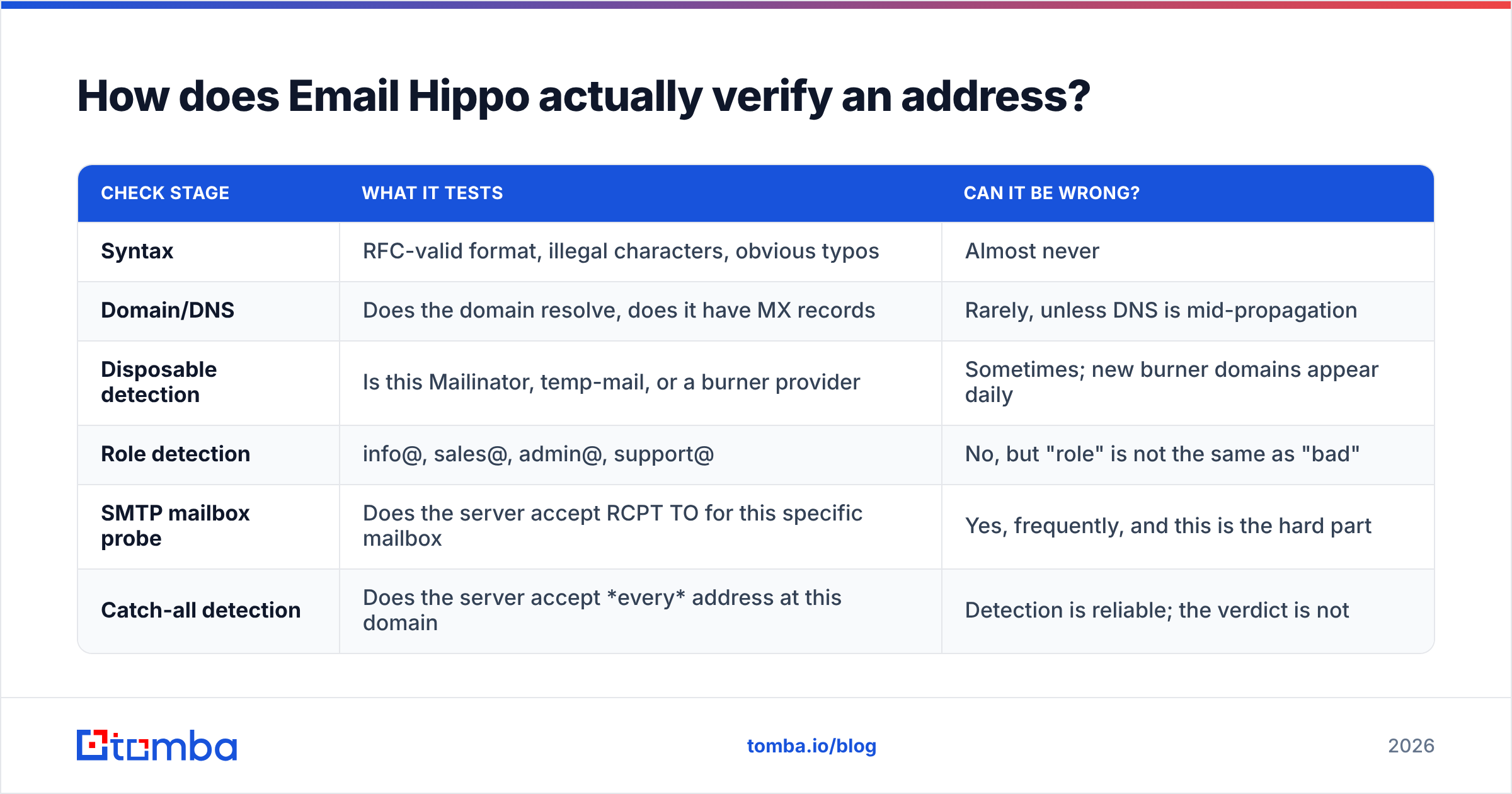
Every serious verifier runs roughly the same ladder of checks, and understanding the ladder tells you exactly where any vendor can and cannot help you.
| Check stage | What it tests | Can it be wrong? |
|---|---|---|
| Syntax | RFC-valid format, illegal characters, obvious typos | Almost never |
| Domain/DNS | Does the domain resolve, does it have MX records | Rarely, unless DNS is mid-propagation |
| Disposable detection | Is this Mailinator, temp-mail, or a burner provider | Sometimes; new burner domains appear daily |
| Role detection | info@, sales@, admin@, support@ | No, but "role" is not the same as "bad" |
| SMTP mailbox probe | Does the server accept RCPT TO for this specific mailbox | Yes, frequently, and this is the hard part |
| Catch-all detection | Does the server accept every address at this domain | Detection is reliable; the verdict is not |
The SMTP probe is where vendors separate. Email Hippo opens a conversation with the receiving mail server and reads the response codes. When the server answers cleanly, you get a definitive Ok or Bad. When the server greylists, rate-limits, times out, or accepts everything, Email Hippo returns Unverifiable with a sub-reason instead of guessing.
That design choice is defensible and it is also the single most common complaint in reviews. Buyers expect a binary answer for a paid check. What they get on a chunk of their list is "we could not tell." If 12% of your list is on Microsoft 365 tenants configured as accept-all, 12% of your file comes back unverifiable and you still have a decision to make.

What do Email Hippo's result codes mean in practice?#
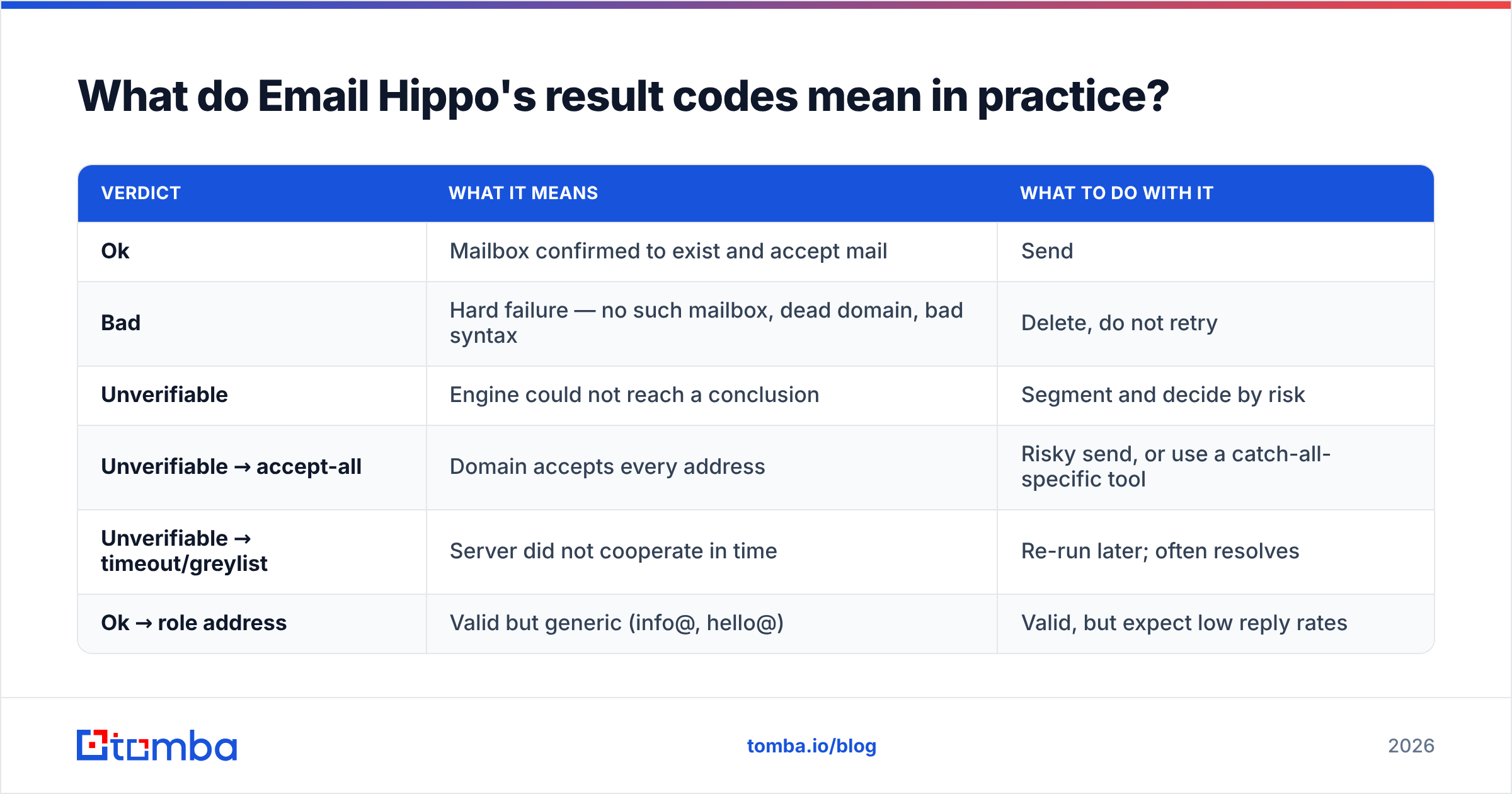
| Verdict | What it means | What to do with it |
|---|---|---|
| Ok | Mailbox confirmed to exist and accept mail | Send |
| Bad | Hard failure — no such mailbox, dead domain, bad syntax | Delete, do not retry |
| Unverifiable | Engine could not reach a conclusion | Segment and decide by risk |
| Unverifiable → accept-all | Domain accepts every address | Risky send, or use a catch-all-specific tool |
| Unverifiable → timeout/greylist | Server did not cooperate in time | Re-run later; often resolves |
| Ok → role address | Valid but generic (info@, hello@) | Valid, but expect low reply rates |
The practical rule: never treat "Unverifiable" as a synonym for "invalid." Retrying greylisted addresses 24 hours later recovers a meaningful share of them at no accuracy cost. Deleting them wholesale throws away real prospects.
Catch-all domains are a different problem and deserve their own tooling. A generic verifier can only tell you the domain accepts everything. A catch-all verifier uses pattern confidence, historical send data and secondary signals to estimate whether that specific mailbox is likely real. For enterprise prospecting where half your target accounts run accept-all, that difference decides whether the segment is workable at all.
How much does Emailhippo verify email cost in 2026?#
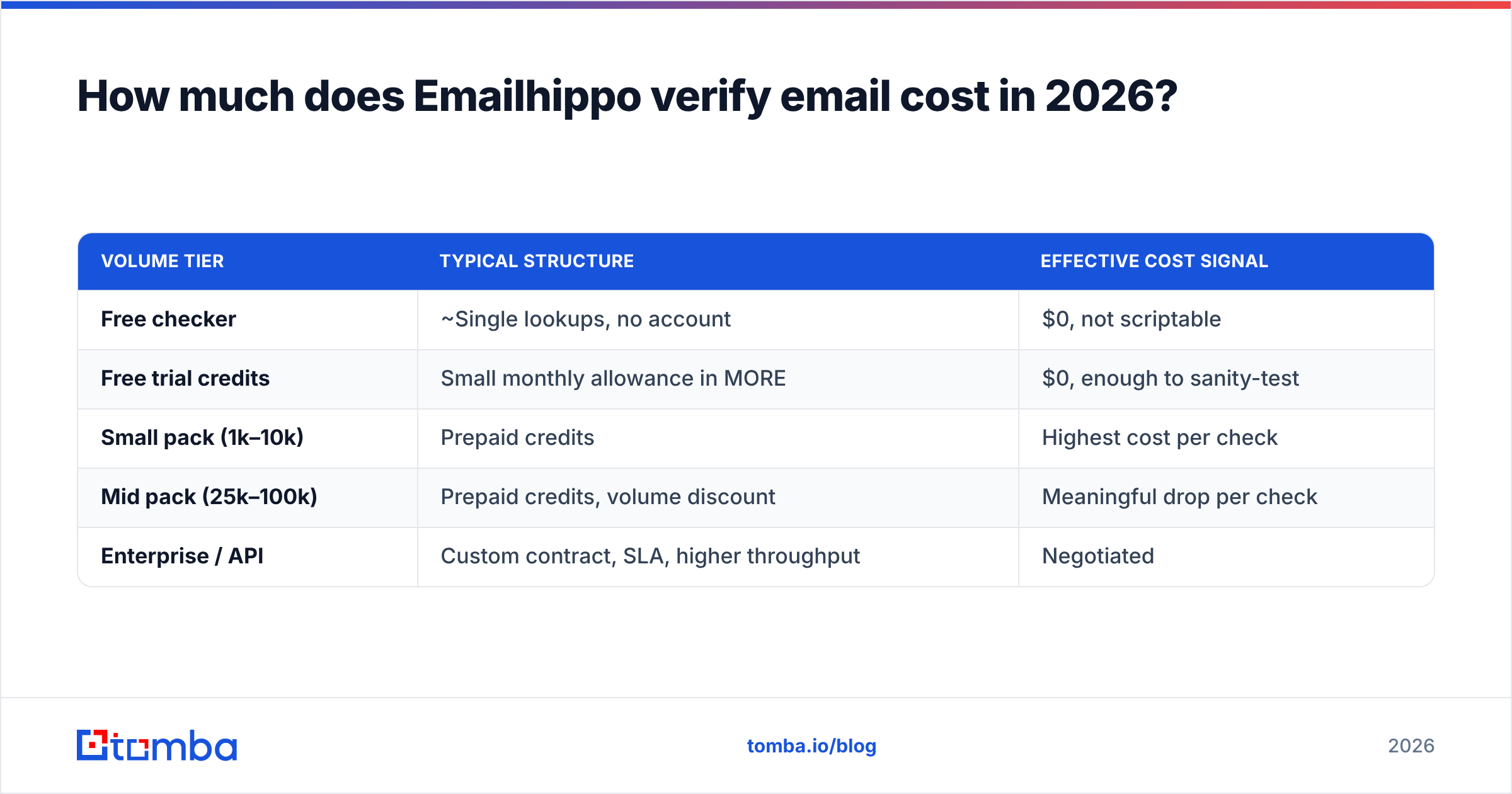
Email Hippo sells credits, not seats. You buy a prepaid pack, each verification burns one credit, and the unit price falls as the pack grows. Roughly, the shape looks like this (confirm current numbers on their pricing page before you budget — vendors adjust these):
| Volume tier | Typical structure | Effective cost signal |
|---|---|---|
| Free checker | ~Single lookups, no account | $0, not scriptable |
| Free trial credits | Small monthly allowance in MORE | $0, enough to sanity-test |
| Small pack (1k–10k) | Prepaid credits | Highest cost per check |
| Mid pack (25k–100k) | Prepaid credits, volume discount | Meaningful drop per check |
| Enterprise / API | Custom contract, SLA, higher throughput | Negotiated |
Two things to model before you commit:
- Credit expiry. Prepaid credits that expire turn a discount into a penalty. If you clean a database twice a year, a 100k pack bought for the unit price can quietly cost more per used check than a smaller one.
- Double-paying across the stack. Verification credits only cover the last step. If you are also buying an email finder, a data provider and an enrichment tool, the per-contact cost you actually pay is the sum, not the verification line item.
That second point is the real cost story for outbound teams. A platform with a shared credit pool across finding, verifying and enrichment removes an entire vendor from the bill. Tomba pricing runs Free (25 searches/mo), Starter at $49/mo, Growth at $99/mo, Pro at $249/mo, and custom Enterprise, with finder and verifier drawing on the same plan. Email Hippo is priced as a specialist and behaves like one.
How does Email Hippo compare to other verification tools?#
| Attribute | Email Hippo | ZeroBounce | Tomba |
|---|---|---|---|
| Primary focus | Verification + fraud scoring | Verification + deliverability suite | Email finding + verification |
| Free entry point | Free single checker + trial credits | ~100 free credits/mo | Free tier, 25 searches/mo |
| Pricing model | Prepaid credit packs | Credit packs + subscriptions | Subscription from $49/mo |
| Finds new addresses | No | No | Yes (domain, name, LinkedIn) |
| Catch-all handling | Flags as unverifiable | Flags with scoring | Dedicated catch-all verifier |
| Fraud / risk scoring | Yes (ASSESSMENT) | Partial (activity data) | No |
| Bulk CSV workflow | Yes (MORE) | Yes | Yes (bulk verify) |
| API + integrations | Yes (CORE) | Yes | Yes (Tomba API) |
| Best for | Signup fraud, compliance cleanups | Marketing list hygiene | Outbound teams sourcing + verifying |
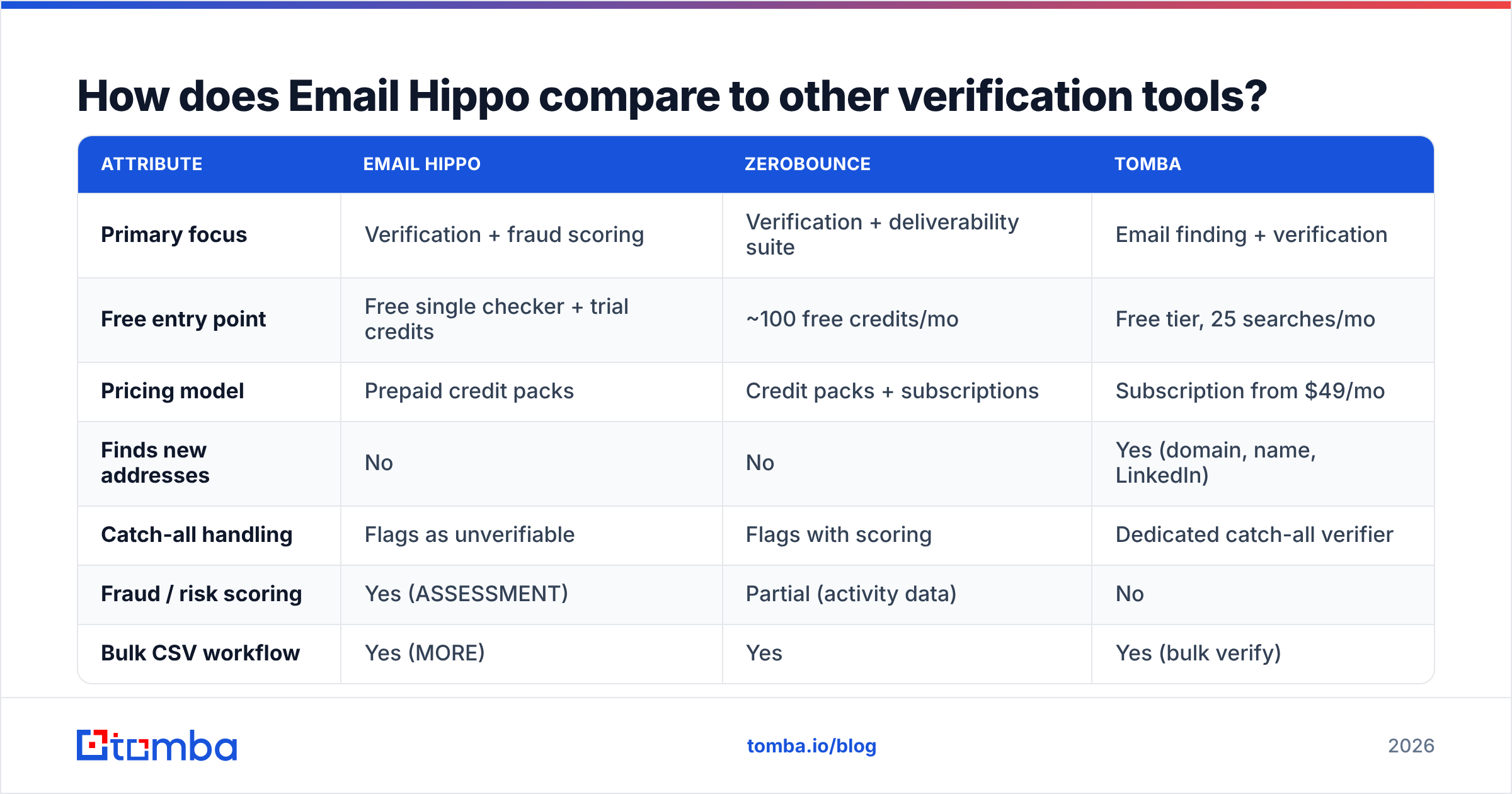
Read that table as a fit question, not a scoreboard. Email Hippo's fraud layer is a genuine differentiator that neither of the other two matches, and if you are screening signups for abuse, it is the reason to pick them. But if your job is "build a list of 3,000 heads of ops at Series B SaaS companies and email them," verification is one step of five, and buying it as a standalone vendor adds a CSV round-trip to every campaign.
Where your list comes from matters as much as how you clean it. Some teams buy verified lists outright from providers like BookYourData, which ships pre-verified contact data and removes the sourcing step entirely — a reasonable route if your ICP is well-defined and you would rather buy than build. Other teams source continuously from domains and LinkedIn and want verification inline. Those are different stacks, and the second one is where a combined email finder and email verifier beats a verification-only vendor on both cost and cycle time.
Is Email Hippo accurate enough for cold outbound?#
Accuracy claims in this category are close to meaningless without knowing the test set. Every vendor advertises a high-nineties number, and every vendor is measuring against a list where the easy cases dominate. Syntax errors and dead domains are trivial to catch. The 8–15% of any B2B list sitting on catch-all or aggressively-filtered servers is where the number is actually decided.
A more useful way to evaluate any verifier, Email Hippo included:
- Build a known-truth sample. Take 200 addresses you have personally received replies from and 100 you know bounced. Run them. Count how many known-good addresses get marked Bad — false positives are the expensive error, because you delete real prospects.
- Measure the unverifiable rate on your ICP. Not on a generic list. If you sell to enterprises, run 500 enterprise-domain addresses. A 20% unverifiable rate on your actual target market changes the ROI completely.
- Check the bounce rate after sending. The only number that matters. Verify, send to a 500-address segment, and read the real bounce rate from your ESP. Anything under 2% is healthy for cold outbound; over 4% and your sender reputation is taking damage.
- Test the same file twice, a week apart. Consistency is a proxy for engine quality. Wild swings mean you are seeing server-side noise, not verification.
- Read recent reviews, not the vendor page. Verification quality drifts as mail providers change their SMTP behaviour. G2's Email Hippo reviews are more current than any blog post, this one included.
Run that on two vendors side by side and you will have a defensible answer in an afternoon, which is faster than arguing about advertised percentages.
On the general question: yes, Email Hippo is accurate enough for cold outbound in the sense that clean sends stay clean. The caveat is coverage, not correctness. It tells you the truth or tells you it does not know, and the "does not know" pile is yours to solve.
Who should use Email Hippo, and who should not?#
Good fit:
- Signup-form fraud screening. The ASSESSMENT product is doing something most verifiers do not. If disposable emails and fake accounts cost you money, this is a real reason to buy.
- One-time database cleanups. You inherited a 400k-record CRM of unknown vintage. Buy a pack, clean it, move on. No subscription hangover.
- Compliance and data-quality teams who need a documented, auditable verification step and value a vendor with a long operating history and UK data handling.
- Developers embedding verification in a product where you need a stable API and clear response codes rather than a sales workflow.
Weaker fit:
- Outbound SDR teams. You need to find addresses before you verify them. Two vendors, two credit pools, two CSV exports, and a bounce you only discover after the export.
- Anyone who needs enrichment alongside verification. Job title, company size and phone are separate problems Email Hippo does not solve. Contact enrichment and B2B phone numbers live elsewhere in your stack.
- Teams with lumpy volume. Prepaid credits reward predictable usage. If some months are 50k checks and some are 500, subscription pricing is usually cheaper in aggregate.
- Catch-all-heavy target markets. If your ICP is enterprise, get a tool that scores catch-alls instead of one that flags and stops.
How should verification fit into your actual workflow?#
Verification is not a step you run once before a campaign. It is a state you maintain, because B2B data decays somewhere between 2% and 3% per month as people change jobs. The workflow that holds up:
- Verify at capture. API call on form submit, so junk never enters the database. This is Email Hippo's CORE use case and it is the highest-leverage placement.
- Verify at enrichment. Whenever you find a new address, verify it in the same operation. If your finder and verifier are the same platform, this costs one step instead of three.
- Re-verify on a rolling window. Everything older than 90 days that you are about to email gets re-checked. Not the whole database — just the segment you are touching.
- Segment, do not delete, the unknowns. Unverifiable addresses go into a low-priority pool you send to separately, on a secondary domain, at low volume. You learn from the bounce data instead of guessing.
- Watch the outcome metric. Bounce rate by segment, tracked weekly. If a segment's bounce rate climbs, the problem is upstream of your verifier.
Get those five in place and the vendor choice matters less than people think. Get none of them in place and no verifier will save the campaign.
The verdict#
Email Hippo is a credible, long-running verification engine with an unusually honest approach to uncertainty and a fraud-scoring layer most competitors do not offer. If verification and risk screening are your problem, it is a straightforward buy.
If verification is the last step of a prospecting workflow, the calculus changes. You are paying a specialist for one link in a chain, and the CSV shuttle between your finder and your verifier is a tax on every campaign. The Tomba Email Finder sources addresses by domain, name, or LinkedIn profile and verifies them in the same pass, on the same credits — starting free with 25 searches a month, and $49/mo on Starter when you outgrow it. Run your next list through both and compare the bounce rate that actually shows up in your ESP. That is the only benchmark that pays.
Related guides#
Ready to find emails that actually work?
Join 150,000+ professionals who stopped guessing and started sending. Free credits on signup — no credit card required.
Get the Tomba newsletter
Practical outbound tactics and product updates — once every two weeks.
About the author