Emailing a CEO in 2026: How to Get a Reply From the Top
CEOs read more cold email than their gatekeepers admit — they just delete 95% of it in under four seconds. Here is what actually earns a reply from the corner office.
TL;DR
- CEOs open more cold email than people assume — the failure point is the first four seconds of scanning, not the send.
- Shorter wins: emails under 100 words consistently outperform longer pitches to executives, and 5–7 word subject lines beat clever ones.
- The single biggest lever is relevance to a board-level metric — revenue, risk, cost, or speed. Feature lists get deleted.
- Get the address right before you get the copy right. A bounce to a CEO's inbox damages your sending domain far more than a "no."
- Follow up 3–4 times over 14 days, changing the angle each time. Most replies from executives arrive on touch two or three.
Why Is Emailing a CEO Different From Emailing Anyone Else?#
Because a CEO's inbox is a triage queue, not a to-do list.
Think of it like an emergency room. A director-level buyer is a walk-in clinic — they have time to hear your symptoms. A CEO is triage: they scan, categorize, and route in seconds. Nothing gets a full read unless it screams "this affects the business, and I am the only person who can decide."
That changes three practical things about emailing a CEO:
- Your window is roughly four seconds. Subject line, sender name, and the first visible line on mobile. That's the entire pitch. Everything below the fold is for people who already decided to keep reading.
- They forward more than they reply. A large share of "successful" CEO emails never get a direct answer — they get pushed to a VP with "take a look." Write the email so it survives that forward. If your message only makes sense to the CEO, the VP kills it.
- They punish vagueness harder. A director might reply "can you tell me more?" A CEO deletes. There is no cost to them for ignoring you, and no obligation to be polite about it.
The corollary: emailing a CEO is not a harder version of normal cold email. It is a different format with a different unit of value. Normal cold email sells a solution. CEO email sells a decision that is already partially made.
What Do CEOs Actually Read?#
Executives read email that maps to something already on their agenda. Their agenda in 2026 is narrower than most sales reps assume: efficient growth, headcount productivity, security/compliance exposure, and margin.
Here's a concrete filter. Before you write, answer: which line item on this company's earnings call, board deck, or hiring page does my email touch? If you can't name one, you're not ready to send.
Things that reliably earn a read:
- A number from their own world. "You're hiring 14 SDRs this quarter" beats "we help sales teams scale."
- A named peer or competitor. Executives benchmark obsessively. "Two of your three closest competitors moved off X last year" is a hook.
- A risk they haven't priced. Compliance deadlines, contract renewals, a dependency that's being deprecated.
- A short, specific ask. "Worth 15 minutes with your VP of Rev Ops?" is easier to say yes to than "can we set up a call?"
- Brevity that signals seniority. Long emails read as junior. Executives write in fragments and expect the same.
Things that get deleted on sight: "I hope this finds you well," a feature list, a calendar link before any value has been established, a paragraph about your funding round, and any subject line containing "quick question" — a phrase so overused it now reads as a tell.
Should You Email the CEO at All?#
Sometimes no. This is the part most guides skip.
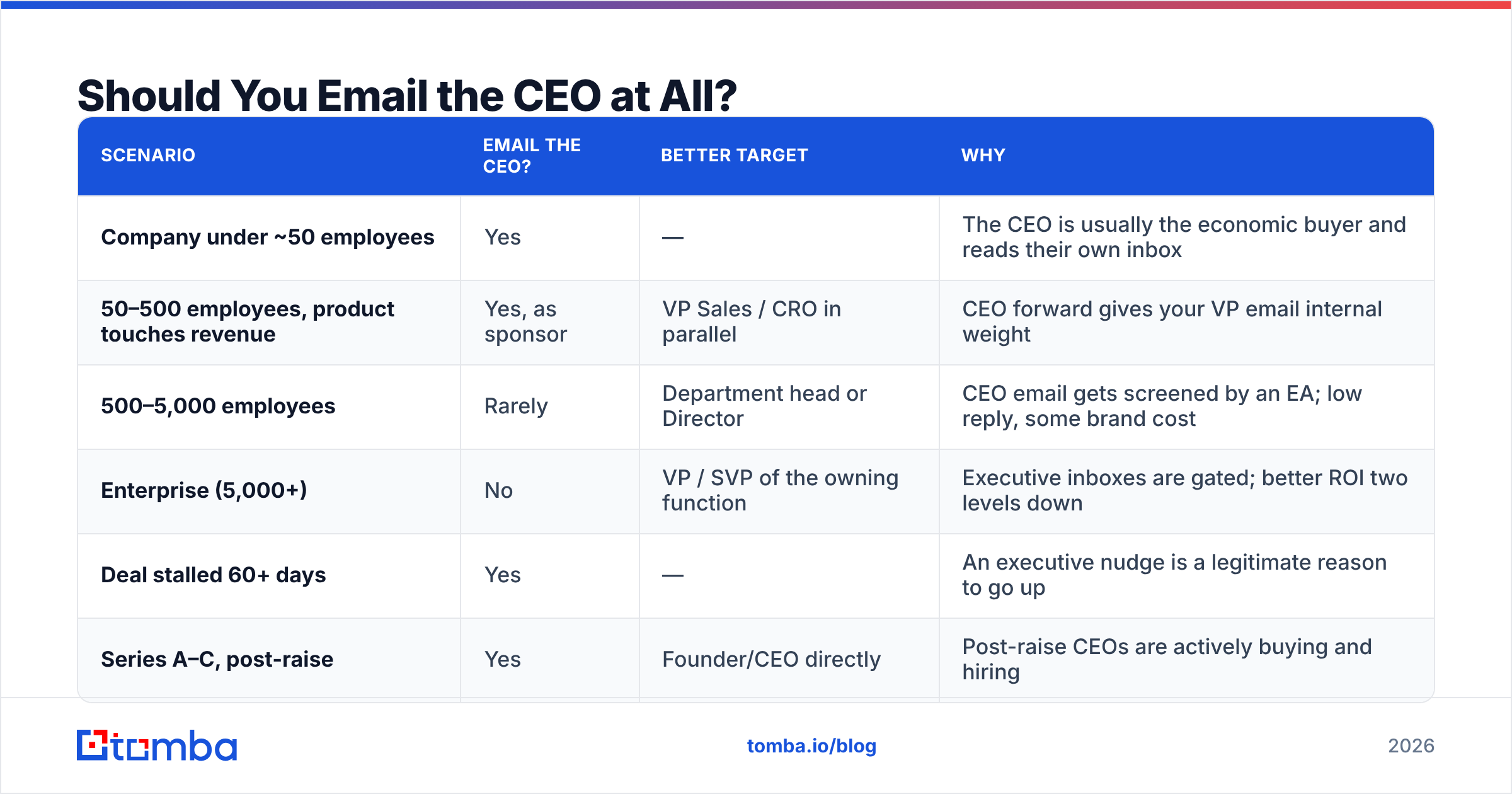
Emailing a CEO makes sense when the company is small enough that the CEO is the buyer, when your product touches a board-level metric, or when you need an executive sponsor to unblock a stalled deal. It makes sense far less often at enterprise scale, where a CEO email routes straight to a shared inbox monitored by an EA.
| Scenario | Email the CEO? | Better target | Why |
|---|---|---|---|
| Company under ~50 employees | Yes | — | The CEO is usually the economic buyer and reads their own inbox |
| 50–500 employees, product touches revenue | Yes, as sponsor | VP Sales / CRO in parallel | CEO forward gives your VP email internal weight |
| 500–5,000 employees | Rarely | Department head or Director | CEO email gets screened by an EA; low reply, some brand cost |
| Enterprise (5,000+) | No | VP / SVP of the owning function | Executive inboxes are gated; better ROI two levels down |
| Deal stalled 60+ days | Yes | — | An executive nudge is a legitimate reason to go up |
| Series A–C, post-raise | Yes | Founder/CEO directly | Post-raise CEOs are actively buying and hiring |
The multi-thread play beats the single CEO shot almost every time: email the CEO and the functional owner within the same week, referencing nothing about each other. If the CEO forwards, your second email lands with pre-built context.
How Do You Find a CEO's Email Address?#
You need the address to be right the first time. Guessing burns your domain.
CEO addresses are the hardest tier of B2B data — they're stripped from scraped databases faster than anyone else's, and a stale record in a resold list has a genuinely high bounce probability. Executives also skew toward personal aliases (first@ or a nickname) that pattern-guessers miss.
A workable sequence:
- Confirm the company's email pattern first. Most companies use one dominant format. A company email pattern check on a handful of known employees tells you whether it's
first.last@,first@, orflast@before you spend a credit on the CEO. - Run a domain-level search. A domain search returns known addresses at the company along with confidence scores, which often surfaces the executive tier directly.
- Use an email finder for the named person. Feed the CEO's full name plus domain into an email finder rather than relying on a permutator. Pattern guessing produces plausible-looking addresses that bounce.
- Verify before you send — always. Run the result through an email verifier. If the domain is catch-all (common at companies that route everything to a central mailbox), a standard verify returns "unknown" and you need a catch-all verifier to get a real signal.
- Cross-check with a second source. Conference speaker pages, SEC filings, podcast show notes, and GitHub commits leak executive addresses constantly.
One hard rule: never send to an unverified CEO address at a domain you care about. Executive addresses attract spam traps and abandoned aliases, and a bounce rate above 3% will visibly degrade your sender reputation — which then suppresses every other email you send that month. The cost of a bad CEO send isn't the lost reply; it's the deliverability tax on the next 500 messages.
What Does a CEO Email That Actually Works Look Like?#
Four structures cover almost every real situation. Each is under 90 words, because that's the ceiling before an executive scrolls past.
1. The peer-benchmark open
Subject: your competitor's SDR ramp
Hi Dana — noticed you're hiring 6 SDRs this quarter.
Two companies in your space cut new-rep ramp from 90 to 55 days by fixing their contact data before onboarding, not after. Their AEs stopped losing week one to bad numbers.
Worth a 15-minute look with whoever owns your outbound stack? Happy to send the breakdown instead if that's easier.
— Sam
2. The risk flag
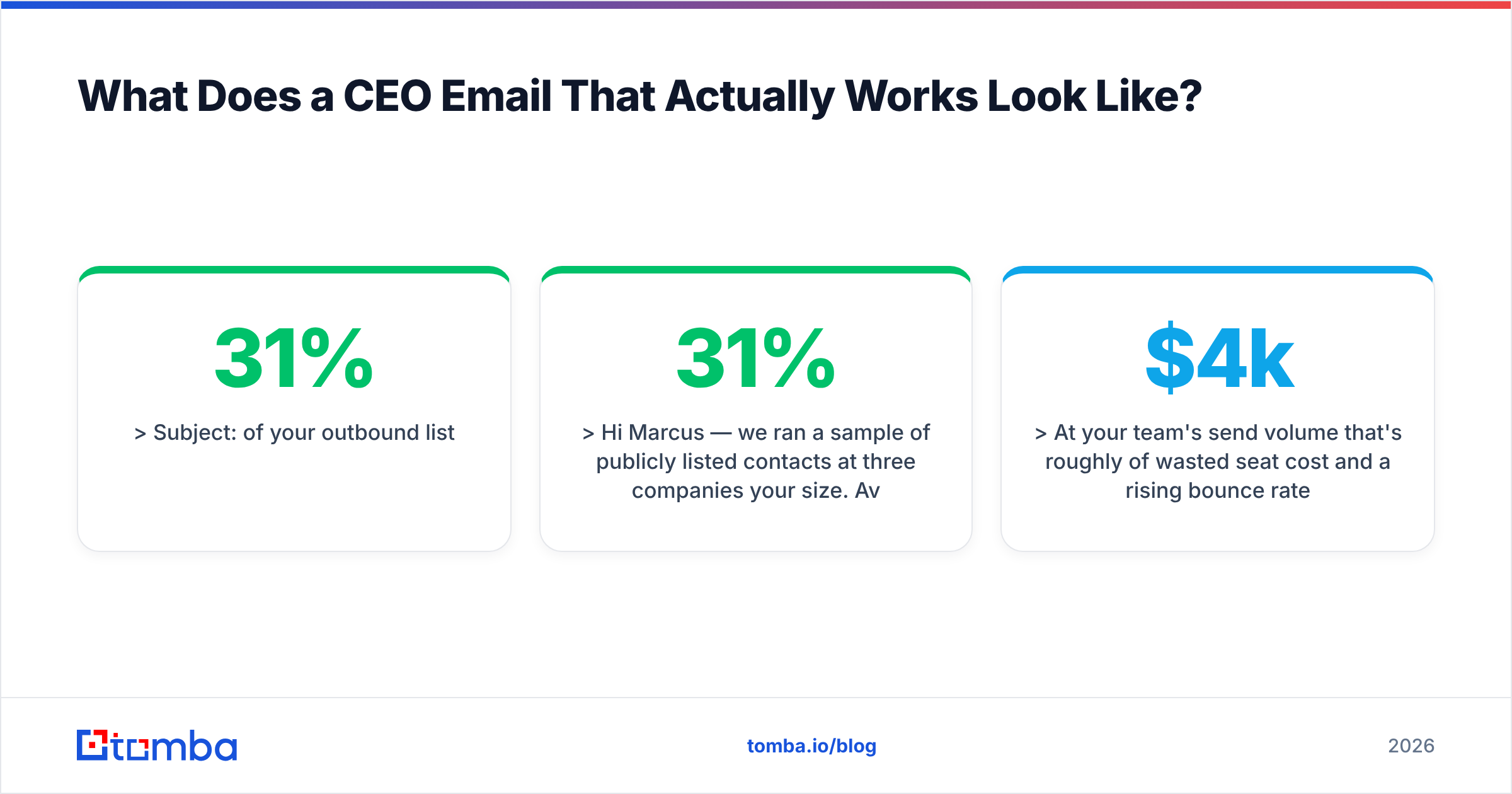
Subject: 31% of your outbound list
Hi Marcus — we ran a sample of publicly listed contacts at three companies your size. Average 31% were stale or role-changed.
At your team's send volume that's roughly $4k/month of wasted seat cost and a rising bounce rate.
Want the sample for your own domain? No pitch attached.
— Priya
3. The referral-down
Subject: pointing me to the right person
Hi Elena — I'd normally start with your VP Rev Ops but couldn't tell who owns data quality post-reorg.
We cut list-decay costs for teams running 20k+ sends/month. If that's not a priority right now, no problem — just tell me to go away.
Who should I be talking to?
— Jordan
4. The stalled-deal escalation
Subject: closing the loop on [project name]
Hi Tom — your team evaluated us in Q1 and stalled at security review. We've since closed that gap (SOC 2 Type II, completed March).
Not asking you to re-open it. Just wanted the file to be accurate on your side.
— Alex
Notice what's absent: no "hope you're well," no company boilerplate, no calendar link in the first touch, no more than one question mark. Every one gives the CEO a graceful exit, which paradoxically raises reply rate — executives answer emails that are cheap to answer.
For more reusable structures, the cold email templates library covers the adjacent personas you'll need for multi-threading.
How Many Times Should You Follow Up?#
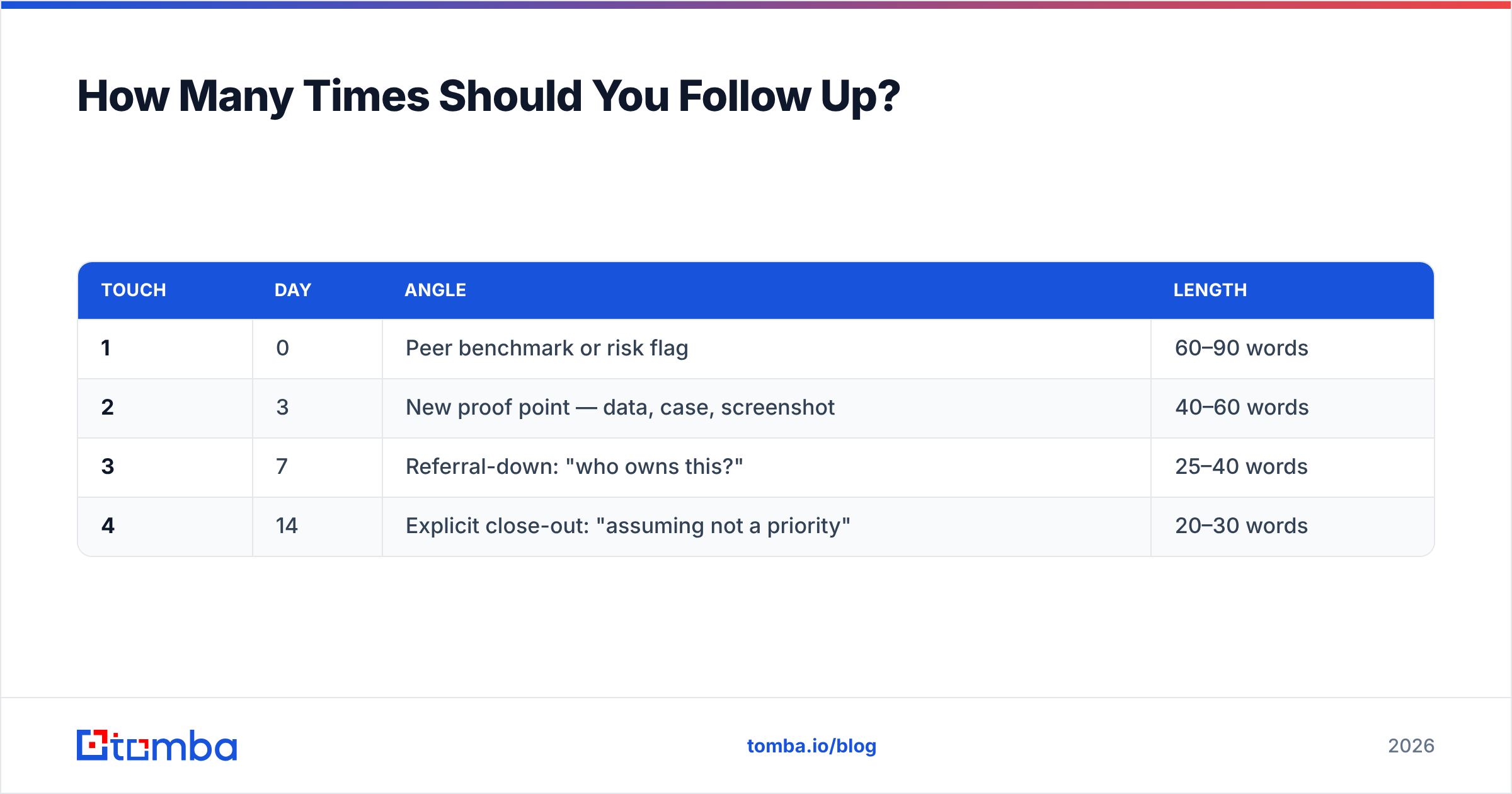
Three to four touches over roughly 14 days, each with a different angle — not a different reminder.
The mistake is the "just bumping this up" follow-up. It adds no information, so it gets treated exactly like the first email that already failed. Change the reason for writing each time.

| Touch | Day | Angle | Length |
|---|---|---|---|
| 1 | 0 | Peer benchmark or risk flag | 60–90 words |
| 2 | 3 | New proof point — data, case, screenshot | 40–60 words |
| 3 | 7 | Referral-down: "who owns this?" | 25–40 words |
| 4 | 14 | Explicit close-out: "assuming not a priority" | 20–30 words |
The close-out email is the highest-yielding message in most executive sequences. "I'll assume this isn't a priority and stop here" triggers a reply from people who genuinely intended to answer. Keep it free of guilt-tripping — the tone is administrative, not wounded.
Send timing matters less than most blogs claim, but there is a real pattern: executives clear inboxes early, so 6:00–7:30am in the recipient's timezone lands near the top of the scan. Tuesday through Thursday is marginally better than Monday. Don't over-optimize this; a 6% relevance improvement beats a 0.4% timing improvement every time.
Track response rate by touch number, not just by campaign. If touch one carries all your replies, your later emails are filler. If touch three carries them, your first email is too vague.
What Are the Most Common Mistakes When Emailing a CEO?#
Ranked by how much damage they do:
- Sending to a guessed address. Bounces at executive domains are disproportionately costly. Verify or don't send.
- Writing to impress rather than to inform. Adjective density is inversely correlated with reply rate. "Revolutionary AI-powered platform" is four words that mean nothing to someone who evaluates vendors weekly.
- Asking for 30 minutes. Nobody at that level has 30 uncommitted minutes. Ask for 15, or ask for a forward.
- Attaching a deck to a cold email. It triggers spam filters and signals you expect unpaid homework.
- Personalizing the wrong thing. Referencing a CEO's marathon time or alma mater reads as surveillance. Reference their business.
- No exit ramp. Give a one-line way to decline. It costs you nothing and materially raises reply rates.
- Ignoring deliverability entirely. If your domain has no SPF alignment or a broken DMARC policy, your carefully crafted executive email lands in a folder no one opens. Check the basics with an SPF checker before you blame the copy.
On that last point: HubSpot's research on email engagement consistently shows that list quality and subject-line relevance move reply rates far more than send-time tuning, and Google's own Gmail sender guidelines make authentication a hard requirement for bulk senders rather than a nice-to-have. Both apply doubly when the recipient's inbox is professionally defended.
How Should You Measure Whether It's Working?#
Reply rate alone is misleading for executive outreach, because the outcome you often want is a forward, not a response.
Track four things:
- Positive reply rate (interested + referred), not raw replies. Referrals are wins.
- Forward-detected meetings — meetings booked by someone who was not on your original list. These are your CEO emails working invisibly.
- Bounce rate by tier. If your C-level bounce rate is more than double your director-level rate, your data source is failing at the top of the org chart.
- Time-to-first-reply. Executives who reply usually reply fast — within 48 hours or never. A long tail of week-three replies usually means you're reaching EAs, not principals.
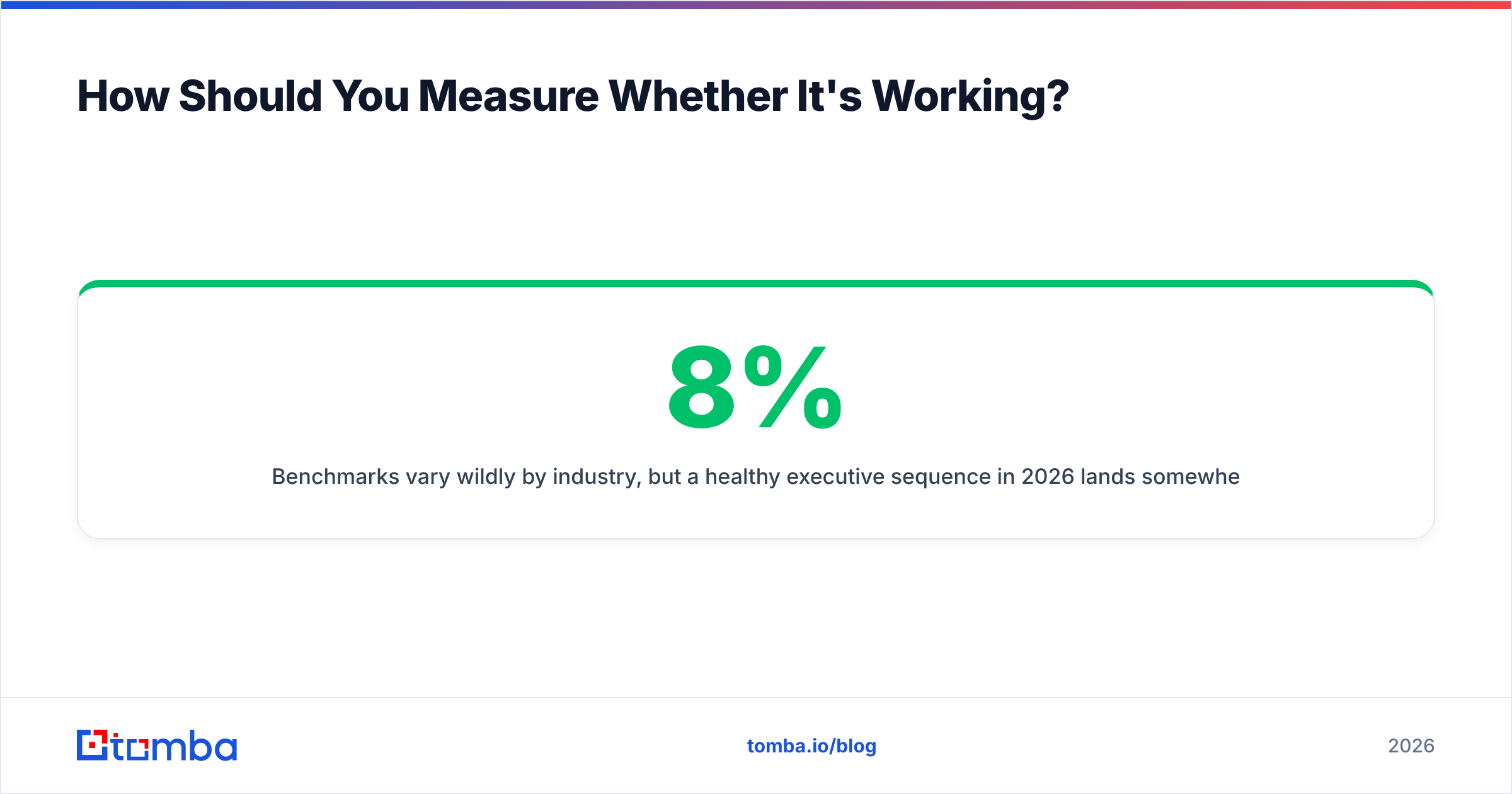
Benchmarks vary wildly by industry, but a healthy executive sequence in 2026 lands somewhere around 3–8% positive reply on a well-verified, well-targeted list of 200–400 contacts. If you're under 1%, the problem is almost always targeting or data quality — not your copy. If you're above 15%, your list is probably warm and you should stop calling it cold outreach. Vendor-neutral review sites like G2's sales engagement category are useful for sanity-checking what tools claim versus what practitioners report.
Where Should You Start?#
Start with the address, then the angle, then the copy — in that order. Most teams do it backwards and spend three weeks polishing an email that gets sent to a mailbox that no longer exists.
Build a list of 50 CEOs at companies where the CEO plausibly is the buyer. Confirm each company's email pattern, resolve each name to a verified address, and check for catch-all domains before a single send. Then write four emails per prospect — one per touch, each with a distinct angle — and measure positive reply, not opens.
If you want the data half handled reliably, the Tomba Email Finder resolves executive names to verified addresses with confidence scoring, catch-all detection, and bulk processing for list-level work. The free tier gives you 25 searches a month to test accuracy against names you already know, and paid plans start at $49/mo on Starter — see Tomba pricing for the Growth and Pro tiers if you're running executive sequences at volume. Get the address right, and the rest of emailing a CEO becomes a copy problem you can actually solve.
Related guides#
Ready to find emails that actually work?
Join 150,000+ professionals who stopped guessing and started sending. Free credits on signup — no credit card required.
Get the Tomba newsletter
Practical outbound tactics and product updates — once every two weeks.
About the author