EmailListValidation vs SignalHire: Which Tool Wins in 2026?
One tool cleans email lists. The other finds contacts and phone numbers. Here's how EmailListValidation and SignalHire compare on accuracy, pricing, and real outbound workflows — plus where a combined stack beats both.
TL;DR
- EmailListValidation and SignalHire are not really competitors. One verifies email addresses you already have; the other finds contact details you don't have yet.
- Pick EmailListValidation if your problem is a dirty list and a rising bounce rate. Pick SignalHire if your problem is an empty list and you live inside LinkedIn.
- SignalHire's headline advantage is phone numbers and a browser extension bolted onto profile browsing. Its weakness is per-credit cost at scale and thin support for domain-level discovery.
- EmailListValidation is cheap per check and strong on bulk hygiene, but it will never hand you a new prospect.
- If you need both halves — discovery and verification — running two vendors doubles the billing, the API surface, and the failure points. A combined platform like Tomba covers finding, verifying, and enriching under one key.
What do EmailListValidation and SignalHire actually do?#
Start here, because most comparison posts blur the line and leave you buying the wrong thing.
EmailListValidation is an email verification service. You upload a CSV, or hit an API endpoint, and it tells you whether each address is deliverable, risky, invalid, a role account, a disposable domain, or a catch-all. It performs syntax checks, MX record lookups, and SMTP handshakes, then hands the list back with statuses attached. It does not source addresses. Nothing about it helps you decide who to email.
SignalHire is a contact discovery tool. It sits on a crowdsourced-plus-scraped contact database, exposes a search UI and a Chrome extension, and reveals emails and phone numbers for people you look up — typically starting from a LinkedIn profile, a name, or a company. Verification exists in the product, but it's a supporting feature, not the main engine.
Analogy: EmailListValidation is the water filter. SignalHire is the well. Arguing about which is "better" only makes sense once you know whether you're thirsty or your water is muddy.
Wait — that's the wrong framing for most teams anyway. In practice you need both, which is why the interesting question isn't "which one wins" but "what does a two-vendor stack cost you versus one."
How do you decide which problem you actually have?#
Four questions settle it in about ninety seconds:
- Where does your list come from today? If leads arrive from webforms, conferences, an old CRM export, or a purchased file, your problem is hygiene — you need verification. If your list is a blank spreadsheet, your problem is sourcing.
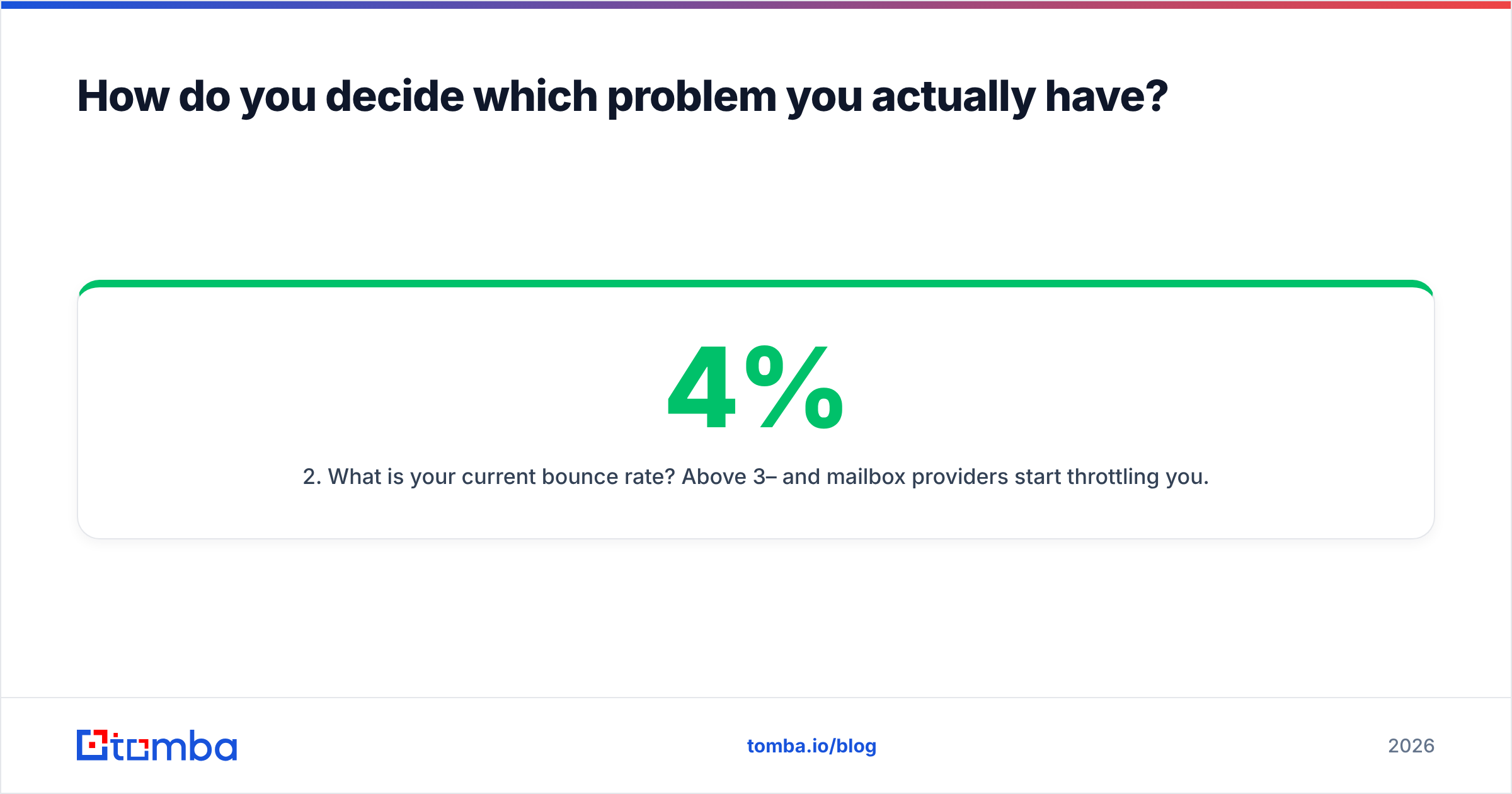
- What is your current bounce rate? Above 3–4% and mailbox providers start throttling you. Under 2% with a shrinking list means you're running out of prospects, not clean data. Google and Yahoo's bulk sender rules put a hard 0.3% spam-complaint ceiling on senders, and bounces feed the same reputation signal.
- Do you need phone numbers? Verification vendors never provide them. If your motion is call-plus-email, that pushes you toward a discovery tool with a phone dataset.
- How many contacts per month, realistically? Verification is priced in fractions of a cent. Contact reveals are priced in dimes. Ten thousand rows a month costs very different money depending on which side of the line you're on.
- Who's touching the tool? SDRs clicking through LinkedIn profiles want an extension. A RevOps engineer piping records into a warehouse wants an API with predictable rate limits.
Answer those and the "versus" mostly dissolves. Now let's put real numbers on both.
Which one is more accurate — and how would you even know?#
Accuracy means different things for each tool, and vendors exploit that ambiguity.
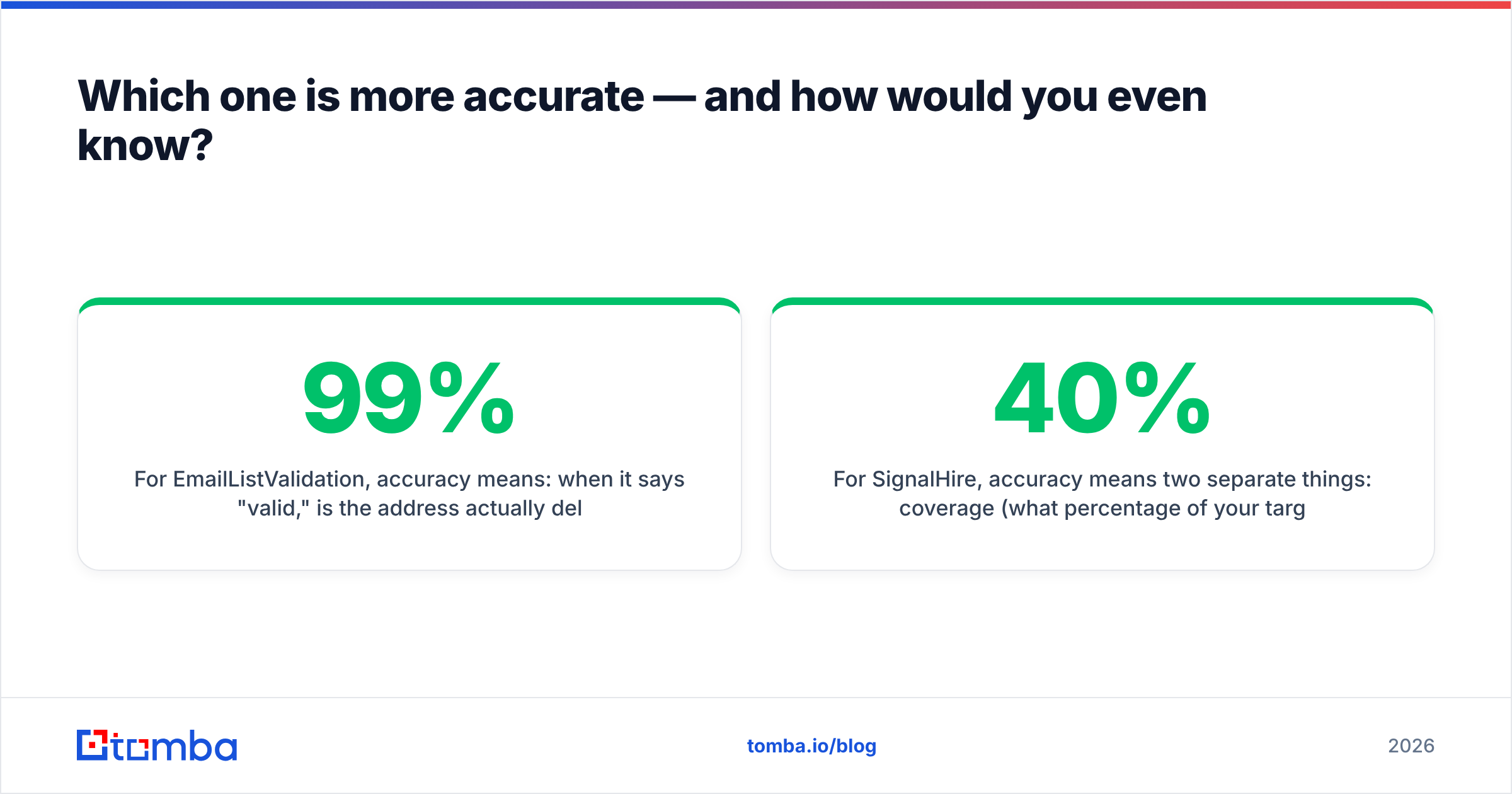
For EmailListValidation, accuracy means: when it says "valid," is the address actually deliverable? That's testable. Take a list of 1,000 addresses you have ground truth on — ones that received a reply in the last 90 days, plus a set of known-dead addresses — and measure false positives and false negatives separately. A verifier that marks everything "risky" has great false-positive numbers and is useless. Published verifier accuracy claims cluster in the 97–99% range across the category, which tells you nothing; the spread shows up on catch-all domains, where SMTP handshakes cannot resolve a definitive answer.
For SignalHire, accuracy means two separate things: coverage (what percentage of your target list returns any contact at all) and correctness (of the emails returned, how many are deliverable). A tool with 40% coverage and 95% correctness may beat one with 80% coverage and 60% correctness — because the second one is quietly filling your sequence with bounces.

The practical test: build a 200-row sample of your actual ICP, run it through both tools, and measure hit rate and bounce rate yourself. Vendor benchmarks are marketing artifacts. Your ICP — a niche vertical, a non-US region, a company under 50 employees — will produce numbers nothing like a generic benchmark. Tomba publishes where its data comes from so you can sanity-check the methodology instead of taking a percentage on faith.
One more accuracy trap: catch-all domains. Roughly a fifth of B2B domains accept mail for any address, so a plain SMTP check returns "unknown." Some verifiers count those as valid (inflating accuracy claims), some as invalid (destroying your usable list). Ask specifically how each vendor treats them, and consider a dedicated catch-all verifier if those domains make up a big slice of your market.
How do EmailListValidation and SignalHire compare feature by feature?#
Pricing below reflects publicly listed plans as of early 2026 — always confirm on the vendor's own page before you commit, since credit bundles change often.
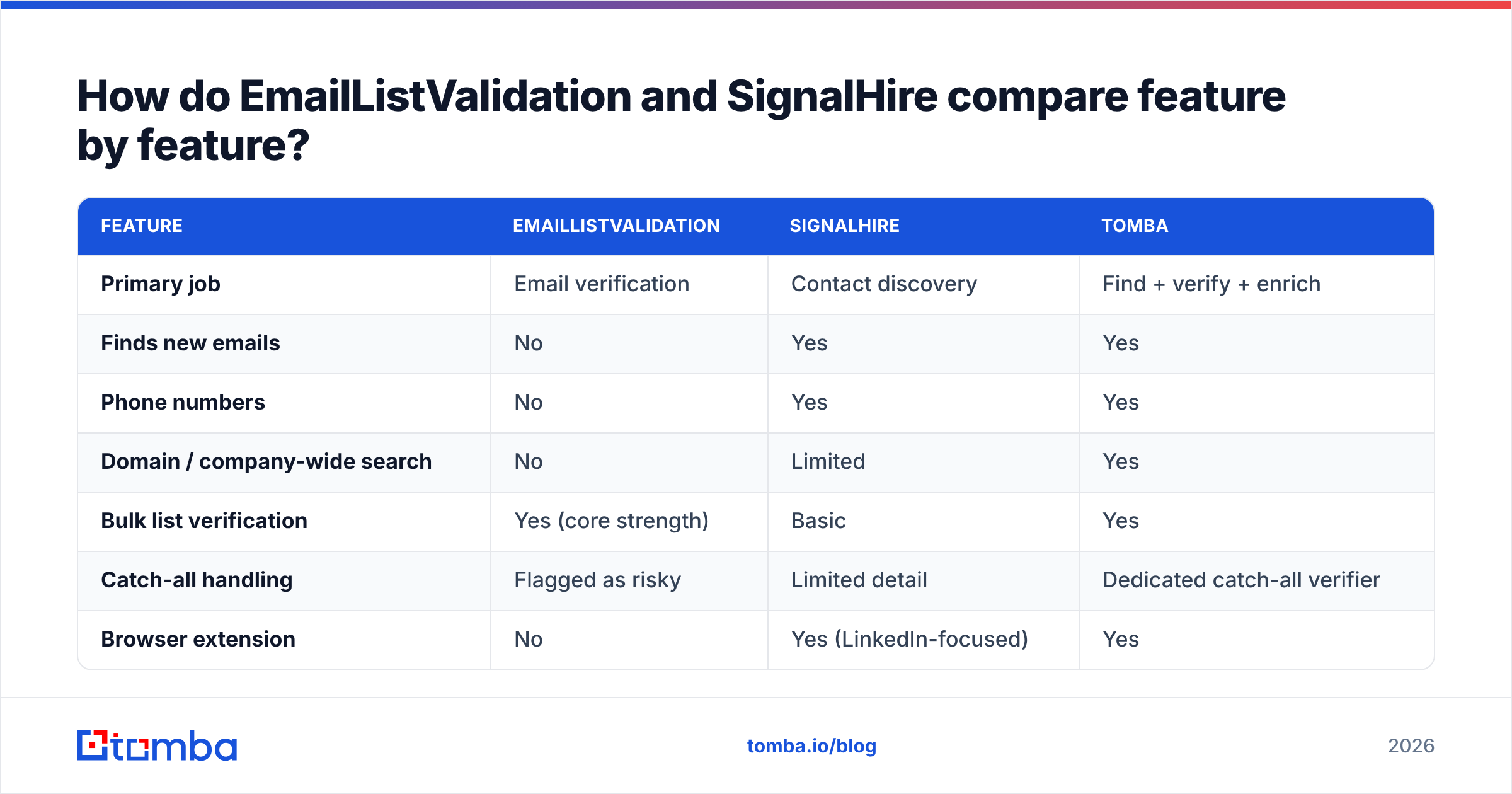
| Feature | EmailListValidation | SignalHire | Tomba |
|---|---|---|---|
| Primary job | Email verification | Contact discovery | Find + verify + enrich |
| Finds new emails | No | Yes | Yes |
| Phone numbers | No | Yes | Yes |
| Domain / company-wide search | No | Limited | Yes |
| Bulk list verification | Yes (core strength) | Basic | Yes |
| Catch-all handling | Flagged as risky | Limited detail | Dedicated catch-all verifier |
| Browser extension | No | Yes (LinkedIn-focused) | Yes |
| Free tier | ~100 trial credits | 5 credits/mo | 25 searches/mo |
| Entry paid price | Pay-as-you-go, from ~$14 per 5k checks | ~$49/mo (approx. 350 credits) | $49/mo Starter |
| API access | Yes | Yes | Yes, plus CLI and MCP |
| Native CRM integrations | Limited | Moderate | HubSpot, Salesforce, Pipedrive, Zapier |
| Best for | Cleaning lists you already own | LinkedIn-led sourcing with phones | Full pipeline in one vendor |

Read the table as three columns of jobs, not three products competing on the same axis. EmailListValidation is priced like infrastructure — fractions of a cent per check, no seat fees, designed to be forgotten about in a cron job. SignalHire is priced like a seat tool — monthly credits, extension-driven, aimed at an individual recruiter or SDR.
That pricing shape has consequences. Verify 100,000 addresses on a pay-as-you-go verifier and you'll spend low hundreds of dollars. Reveal 100,000 contacts on a per-credit discovery tool and you're in enterprise-contract territory. If your plan involves "we'll just reveal everyone in the ICP and sort it out later," check the arithmetic before the quarter starts.
What does each tool get wrong?#
EmailListValidation's weak spots:
- It's blind to intent and fit. A clean list of the wrong people is still the wrong list.
- Catch-all domains stay ambiguous. You'll get a "risky" bucket you have to decide about yourself, and for some verticals that bucket is 25% of your file.
- No enrichment. Job title, seniority, company size, tech stack — none of it. You'll bolt on a second vendor anyway.
- UI is functional, not delightful. Fine for a RevOps engineer, less fine for a rep who wants one-click workflows.
SignalHire's weak spots:
- Credit burn. Every reveal costs, including the ones that come back empty or wrong. Read the refund policy for failed lookups carefully.
- Coverage varies hard by geography and company size. Strong on US tech, thinner on EU mid-market and on companies under 50 headcount.
- LinkedIn dependency. When the extension breaks after a LinkedIn UI change — and every extension in this category breaks periodically — the workflow stalls.
- Verification depth. Returned addresses get a basic check, not the multi-layer treatment a dedicated verifier applies. Reviews on G2 across this category consistently flag revealed-but-bouncing addresses as the top complaint.
Do you need both — and what does that stack cost?#
Most teams that start with one end up buying the other within two quarters. The sequence is predictable: you buy a discovery tool, bounce rates creep past 4%, deliverability tanks, and you add a verifier to patch it. Or you buy a verifier, clean the list beautifully, and then run out of prospects.
Running both means:
- Two contracts, two renewal dates, two procurement conversations.
- Two APIs to integrate, with different auth schemes, rate limits, and error semantics.
- A handoff step in the middle — export from tool A, import to tool B, reconcile on email as a join key, hope nothing gets mangled.
- Double-counting waste. You pay a reveal credit for a contact, then a verification credit to discover the reveal was wrong. You paid twice for a bounce.
That's the argument for a single platform. Tomba's email finder and email verifier share one credit pool and one API key, so a found address is verified before it's returned rather than after you've paid for it twice. Bulk processing handles the CSV workflow that EmailListValidation is good at, domain search covers the company-wide discovery SignalHire only partly addresses, and phone finder covers the dialer motion. Plans run Free (25 searches/month), Starter $49/mo, Growth $99/mo, Pro $249/mo — see Tomba pricing for current credit allocations.
To be fair to both vendors: if your only job is verifying a 2-million-row database once a quarter, a pure pay-as-you-go verifier will beat any bundled platform on raw cost per check. And if you're a recruiter whose entire day happens on LinkedIn profiles and who needs mobile numbers more than emails, SignalHire's extension is a genuinely good fit for that narrow motion. Neither is a bad product. They're just each half of a job.
Which should you choose in 2026?#
Match the tool to the bottleneck:
- Dirty list, no sourcing problem → EmailListValidation. Cheap, focused, does one thing well.
- Empty list, LinkedIn-native team, needs phones → SignalHire, with a verification step downstream.
- Both problems, or you'd rather not run two vendors → a combined platform. Fewer integrations, one credit pool, no export-import shuffle.
- Developer-led, API-first pipeline → whichever vendor's docs and rate limits survive your load test. Run it before you sign, not after.
- Under $100/month budget → be honest about volume. At small scale, a bundled Starter plan usually beats two separate subscriptions.
Whatever you pick, instrument it. Track hit rate, bounce rate, and cost per replied contact — not cost per credit. A tool that's 30% cheaper per lookup and produces half the deliverable addresses is more expensive where it counts.
Ready to stop stitching two tools together?#
If you're comparing EmailListValidation and SignalHire because you need discovery and deliverability, you're comparing two halves of one workflow. The Tomba Email Finder handles both: search by domain, name, or company, get addresses that are verified before they hit your CRM, and pull phone numbers and enrichment from the same key. Start free with 25 searches a month, run your own 200-row ICP test against whatever you're using now, and let the bounce rate decide.
Related guides#
Ready to find emails that actually work?
Join 150,000+ professionals who stopped guessing and started sending. Free credits on signup — no credit card required.
Get the Tomba newsletter
Practical outbound tactics and product updates — once every two weeks.
About the author