EmailListVerify vs Generect: Which B2B Data Tool Wins in 2026
One cleans the list you already have. The other builds the list from scratch. Here's how EmailListVerify and Generect actually compare on accuracy, pricing, API depth, and which one belongs in your outbound stack.
EmailListVerify vs Generect is a common shortlist for outbound teams. The two tools do different jobs, though. One cleans a list you already own. The other builds a new one from scratch. Here is how they stack up on price, accuracy, and API depth.
TL;DR
- They are not true competitors. EmailListVerify is a bulk email verification engine. Generect is a B2B lead-sourcing platform built on LinkedIn-derived company and people data. One cleans; the other creates.
- Pick EmailListVerify if you already own a list — scraped, bought, or inherited from an old CRM. It gets your bounce rate under 2% before you press send.
- Pick Generect if you have no list at all. It pulls targeted contacts in real time by title, headcount, geo, or tech stack, and ships them through an API.
- Cost profiles differ sharply. EmailListVerify is credit-based and cheap at volume. Generect is subscription and quote-led, priced against data volume and API seats.
- Most teams end up needing both jobs done. A single platform that finds and verifies — Tomba, for example — trims the stack. One vendor, one invoice, one hookup.
What is EmailListVerify?#
EmailListVerify is a dedicated email validation service. You upload a CSV or call the API. It returns a status for each address: valid, invalid, catch-all (accept-all), disposable, role-based, or unknown.
The pipeline behind it is standard for the category. It is worth a look, because it shows where every verifier hits a wall:
- Syntax check — malformed addresses die at once. Free, instant, catches typos.
- Domain and MX lookup — does the domain resolve, and does it have mail exchange records? Dead domains get filtered here.
- Disposable and role detection — flags
mailinator.comstyle throwaways. It also flagsinfo@,sales@, andsupport@inboxes, which rarely belong to a decision-maker. - SMTP handshake — the verifier opens a chat with the receiving mail server. It asks whether the mailbox exists, without sending a message.
- Catch-all classification — when a domain accepts everything, the SMTP step can't answer. This is where verifiers earn or lose their name.
EmailListVerify has been around since roughly 2016. It sells on throughput and price per thousand, not on enrichment or discovery. You get a bulk uploader, a browser dashboard, an API, and hooks into the usual ESPs. What it does not do is tell you who to email. There is no people search, no company filter, no firmographics. You bring the list.
For a deeper look at how validation logic behaves on hard domains, our breakdown of catch-all verification covers the specific failure modes.
What is Generect?#
Generect is a B2B lead generation and data platform. Its pitch is real-time data. Instead of a static database refreshed every quarter, it pulls contact and company records at query time. Most of that data comes from LinkedIn-adjacent sources, and it arrives enriched.
The typical Generect workflow looks like this:
- Define an ICP using filters — industry, headcount, seniority, job title, location, and sometimes tech signals.
- Pull the list through the web app or, more often for their customer base, through the API.
- Receive enriched records with names, roles, company data, LinkedIn URLs, and email addresses where available.
- Push into your stack — CRM, sequencer, or a custom pipeline.
Generect skews toward developers and agencies. They want lead data as an API primitive, not a UI to click around in. That is a real difference, and it explains the pricing posture: less self-serve, more talking to sales.
Here is the important asymmetry. Generect produces emails, but it is not a validation specialist. Sourcing platforms usually return a confidence score, not a hard SMTP verdict on every address. That gap is why the two tools so often show up in the same stack.

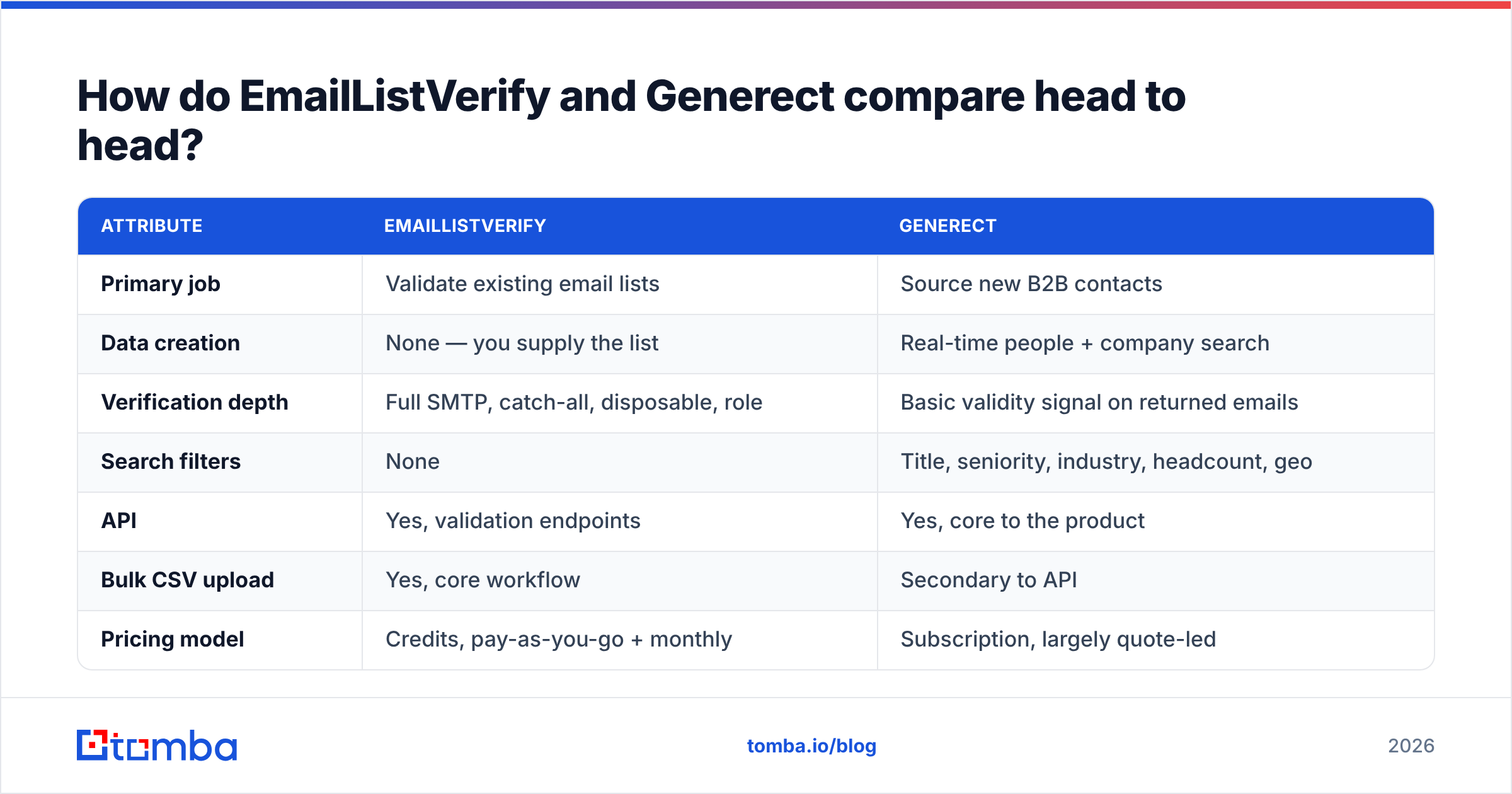
EmailListVerify vs Generect: how do they compare head to head?#
| Attribute | EmailListVerify | Generect |
|---|---|---|
| Primary job | Validate existing email lists | Source new B2B contacts |
| Data creation | None — you supply the list | Real-time people + company search |
| Verification depth | Full SMTP, catch-all, disposable, role | Basic validity signal on returned emails |
| Search filters | None | Title, seniority, industry, headcount, geo |
| API | Yes, validation endpoints | Yes, core to the product |
| Bulk CSV upload | Yes, core workflow | Secondary to API |
| Pricing model | Credits, pay-as-you-go + monthly | Subscription, largely quote-led |
| Free trial | Small free credit allowance | Demo / trial on request |
| Best for | Deliverability teams, list hygiene | SDR teams and devs building pipelines |
| Weakness | Can't build a list | Not a verification specialist |
Read that table twice before you decide. The most common mistake we see is simple. A team treats these two as if they solve the same problem. It buys one. Three weeks later, it learns it still needs the other.
Which one is more accurate?#
In an EmailListVerify vs Generect comparison, accuracy means two different things. Mixing them up is how buyers end up let down.
For EmailListVerify, accuracy means one thing: how often does a "valid" verdict survive a real send? Verifiers in this tier usually land in the 95–98% range on standard corporate domains. Think Google Workspace, Microsoft 365, or self-hosted Postfix. That is genuinely good. It reflects a mature SMTP pipeline.
The number drops in two cases. First, catch-all domains, which now cover a large slice of mid-market and enterprise. When a server accepts every address, SMTP checks cannot confirm the mailbox. So you get "unknown" — honest, but useless — or a guess dressed up as a score. Second, well-defended domains that rate-limit or tarpit verification traffic. A lot of finance and healthcare sits here.
For Generect, accuracy means something else: is this the right person, at the right company, in the right role, with a working address? That is a compound claim. Role and company data from LinkedIn-derived sources tends to be strong, because the source updates itself. The email attached to that person is the softer part. It comes from pattern inference and source matching, not from an SMTP-confirmed mailbox.

The practical consequence is clear. A Generect export is not send-ready in the way a verified list is. Most careful teams run sourced data through a verification pass before it touches a sequencer. If you plan to do that anyway, the question changes. It is no longer "which vendor" but "how many vendors do I want in this chain".
Buyer reviews on G2 are worth skimming for both tools. Keep the usual caveat in mind: review volume tracks marketing spend more than product quality.
What does each one cost?#
| Cost factor | EmailListVerify | Generect | Tomba |
|---|---|---|---|
| Entry point | Pay-as-you-go credits, single-digit dollars per 1,000 at small volume | Quote-led; entry subscription then sales conversation | Free tier, 25 searches/mo |
| Mid tier | Volume credit packs, cost per 1,000 drops steeply | Subscription scaled by data volume + API access | Starter $49/mo, Growth $99/mo |
| High volume | Sub-dollar per 1,000 at million-scale | Enterprise contract | Pro $249/mo, Enterprise custom |
| Credits expire? | Pay-as-you-go credits generally persist | Subscription allowance, period-bound | Monthly allowance on subscription |
| Finding included? | No | Yes | Yes |
| Verification included? | Yes | Partial | Yes |
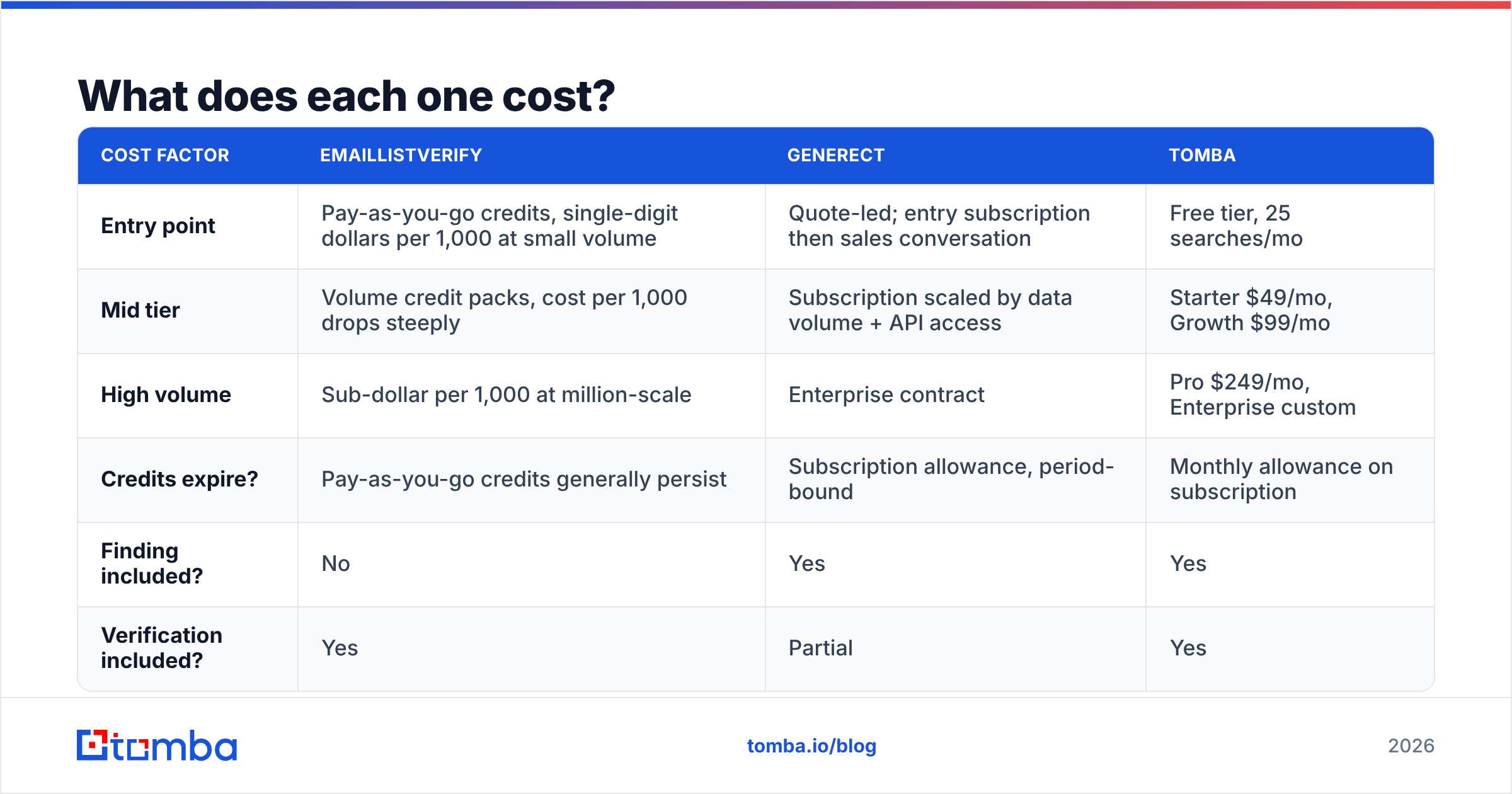
Pricing is where the EmailListVerify vs Generect gap gets obvious. Two honest caveats first. Vendor pricing pages move, so check current numbers at emaillistverify.com and generect.com before you build a business case. And a headline price per thousand is not your real cost. The number that matters is cost per usable, replied-to contact. That folds in match rate, bounce rate, and the hours your team spends stitching two tools together.
On pure verification cost per thousand, EmailListVerify is genuinely aggressive. That is the whole strategy. On sourcing, Generect's quote-led model ties your cost to negotiated volume. Good news for large buyers. Awkward for a two-person team that just wants a credit card checkout.
Who should use EmailListVerify?#
Choose it when the list already exists and the problem is hygiene:
- You inherited a CRM with 60,000 contacts of unknown age. You need to know what is still deliverable before a re-engagement campaign.
- You run a newsletter or ESP account where bounce rate threatens your sender reputation and, in time, your account.
- You buy or scrape lists from many sources and need one quality gate in front of them all.
- Your budget logic is per-thousand and you validate in large, rare batches rather than all day long.
If any of those describe you, a dedicated verifier earns its keep. Just be clear that it is a single-function buy. Our EmailListVerify alternative comparison shows what changes if you fold that function into a broader platform.
Who should use Generect?#
Choose it when the bottleneck is list creation, not list quality:
- You are a developer or RevOps engineer building an automated pipeline. You want lead data as an API call, not a CSV download.
- Your ICP shifts often and static database snapshots go stale faster than you can refresh them.
- You sell into markets with strong LinkedIn coverage — tech, SaaS, professional services, and most of North America and Western Europe.
- You are an agency running sourcing for several clients with different filter sets.
Where it gets awkward: a small team with no engineers faces a slow start here. An API-first, sales-led tool takes longer to switch on than a self-serve one with a free tier.

Do you actually need both tools?#
This is the real decision, and it has three fair answers.
- Run both. Generect sources, EmailListVerify validates. You get the best result at each step. The cost is two contracts, two APIs, two support queues, and a glue layer someone has to fix when a schema changes.
- Run one and accept the gap. Source with Generect and send without a hard verification pass. Or verify with EmailListVerify and source by hand. It is cheaper and faster to set up. You pay for it in bounce rate or in SDR hours.
- Consolidate into a platform that does both. Find, verify, and enrich under one API and one invoice.
Option three is why the EmailListVerify vs Generect framing is a little artificial. A combined email finder plus email verifier workflow checks the address the moment it is found. Nothing gets exported, re-imported, and re-checked days later, once the data has already started to decay. Tomba's pipeline works that way. A domain search or name lookup gives you a candidate. An SMTP check confirms it. Extra data fills in the company context. It all happens in one call through the Tomba API.
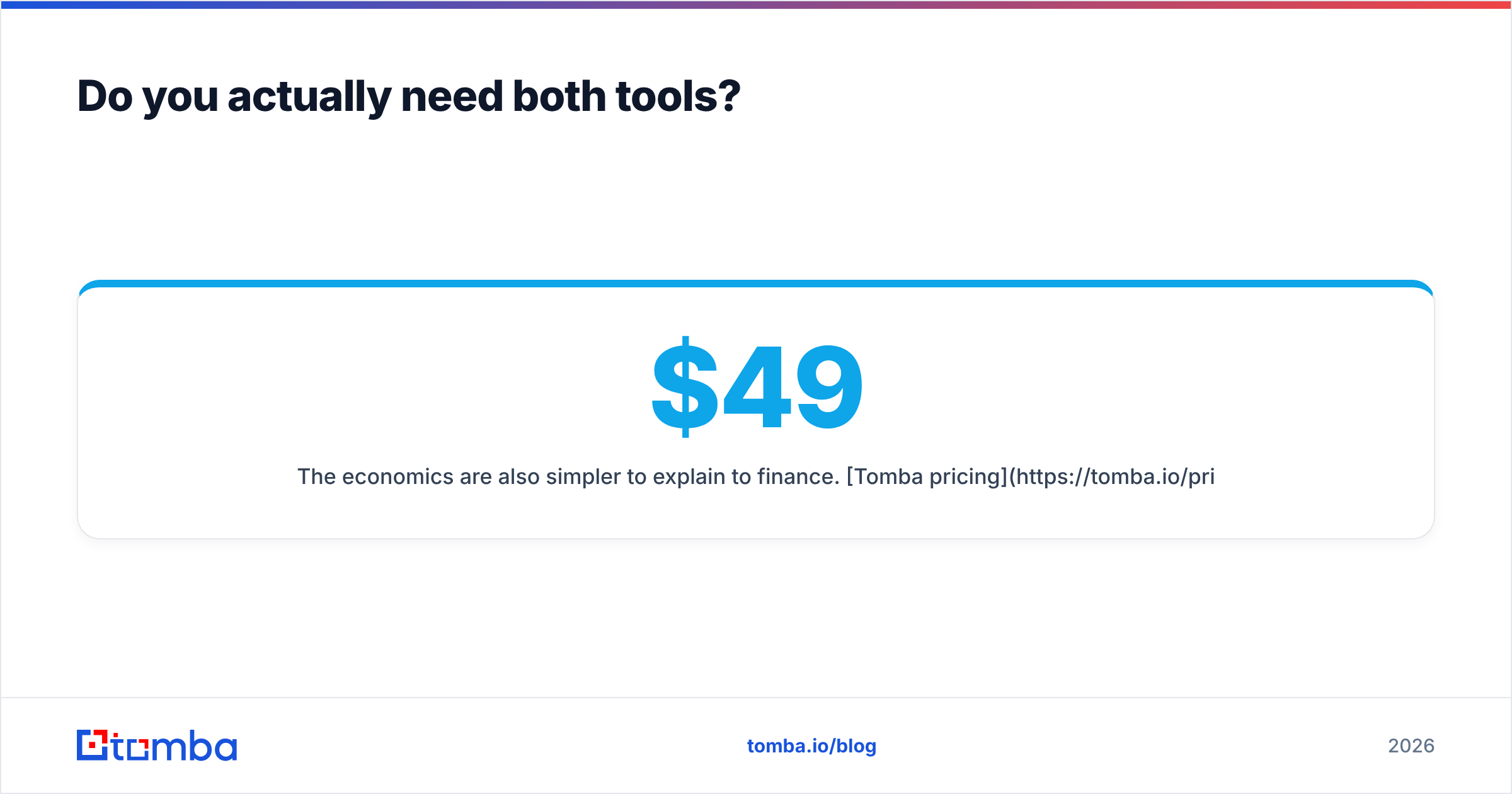
The math is also easier to explain to finance. Tomba pricing runs a free tier at 25 searches per month. Paid plans start at $49/mo for Starter, then $99/mo for Growth and $249/mo for Pro. Enterprise runs on custom terms. Finding and verifying are both included, not billed as two line items.

What should you check before you commit?#
Run this checklist against any vendor in this category, including the two here:
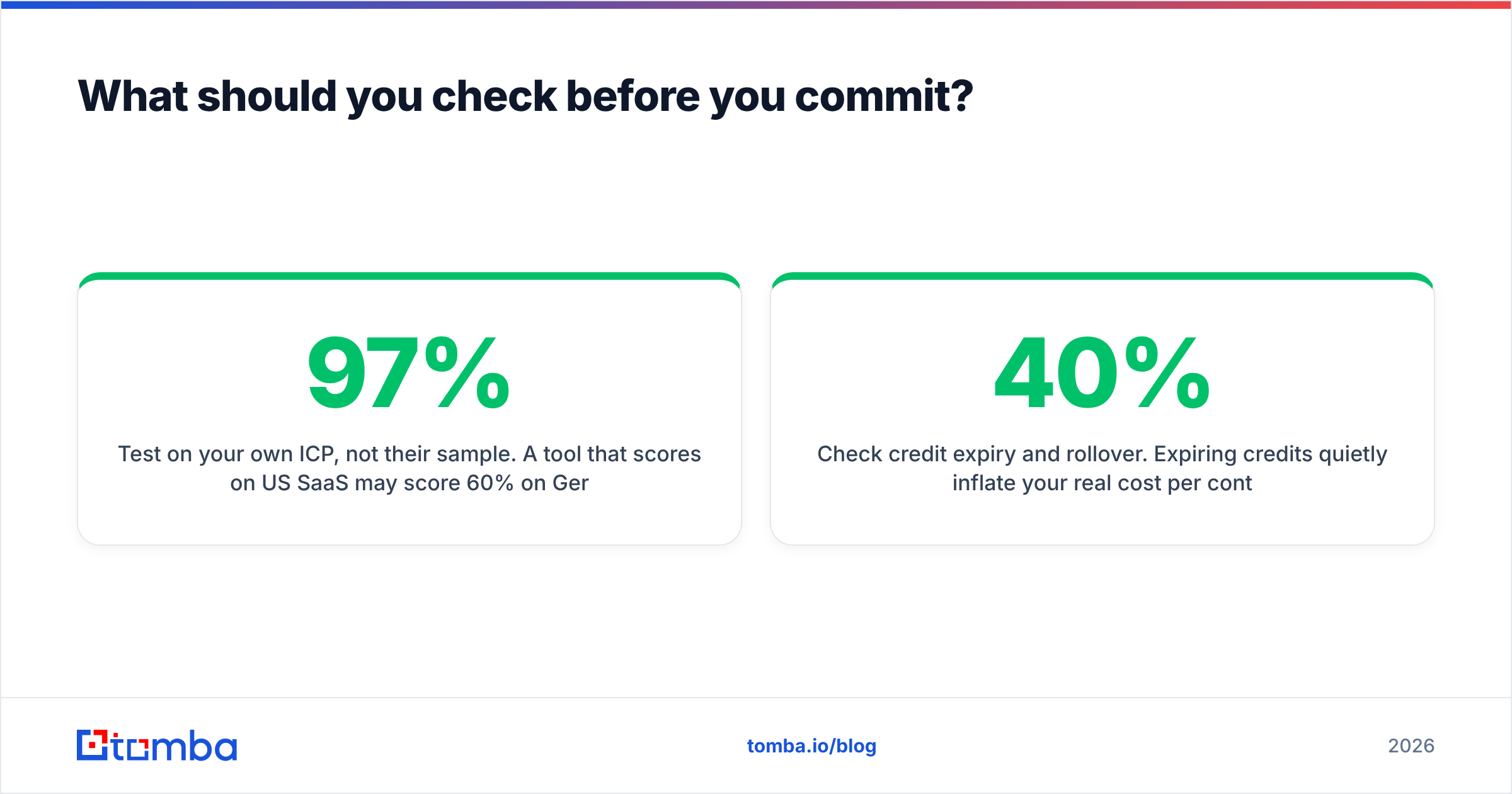
- Test on your own ICP, not their sample. A tool that scores 97% on US SaaS may score 60% on German manufacturing. Pull 200 real target accounts and measure the match rate yourself.
- Ask how catch-all domains are reported. "Valid" on a catch-all is a marketing claim, not a verdict. You want a clear accept-all flag, so you can weigh the risk yourself.
- Check credit expiry and rollover. Expiring credits quietly inflate your real cost per contact by 20–40% if your usage is lumpy.
- Confirm compliance posture. Ask about GDPR and CCPA handling, data sources, and opt-out rules. Ask where the data comes from, and get the answer in writing.
- Measure the integration tax. How many hours does it take to move data from the tool into your sequencer, with no human touching a spreadsheet? That hidden cost usually dwarfs the subscription.
Frequently asked questions#
Is EmailListVerify a Generect competitor? Not really. They sit in adjacent slots in the same workflow. Generect builds the list; EmailListVerify cleans it. Teams comparing them usually want to solve one budget line with one purchase, and have not yet split the two jobs apart.
Can Generect replace a dedicated verifier? For low-stakes campaigns on well-covered domains, sometimes. For cold outbound at volume, a dedicated verification pass is the safer default. A 5% bounce rate can damage your sending domain within a week.
Which is cheaper? EmailListVerify, per thousand, because it does one narrower job. But comparing a verifier's per-thousand price to a sourcing platform's subscription is like comparing a wiper blade to a car. Compare the total cost to reach a qualified prospect instead.
What if I want one vendor instead of two? That is the one-vendor case. Platforms that find, check, and enrich in one place cut vendor count. They also close the decay window between sourcing and sending.
The bottom line#
The EmailListVerify vs Generect choice comes down to one question: do you have a list, or do you need one? If your list is dirty, EmailListVerify is a sharp, cheap tool that fixes it. If you have no list at all, Generect is a fair way to build one. Its real-time, API-first sourcing works well, especially if you have engineers to wire it up.
What neither does alone is take you from "I know my ICP" to "I have a verified, send-ready contact" in one step. That is the gap worth closing.
Ready to close it? Start with the Tomba Email Finder. It finds professional email addresses by domain, name, or company, with SMTP verification built into the same call. The free tier gives you 25 searches a month with no card required. Run 200 of your real prospects through it. Compare the verified hit rate to what your current stack returns. Let the numbers decide.
Related guides#
Ready to find emails that actually work?
Join 150,000+ professionals who stopped guessing and started sending. Free credits on signup — no credit card required.
Get the Tomba newsletter
Practical outbound tactics and product updates — once every two weeks.
About the author