EmailListVerify vs GrowMeOrganic (2026): Which One Wins?
One tool cleans the list you already have. The other builds a list from scratch and emails it. Here is where EmailListVerify and GrowMeOrganic actually overlap, where they don't, and which one belongs in your 2026 stack.
EmailListVerify vs GrowMeOrganic is an odd matchup. One tool cleans the list you already own. The other builds a new list and emails it.
TL;DR
- These two tools barely compete. EmailListVerify is a bulk email verification engine. GrowMeOrganic is a prospecting and outreach suite built on LinkedIn scraping and sequences.
- Pick EmailListVerify if you already own a list (a CRM export, webinar signups, bought data). It cuts bounce risk before you send.
- Pick GrowMeOrganic if you have no list yet. You get scraping, enrichment, and sending under one login, with seat-based pricing.
- Neither one is a strong email finder. GrowMeOrganic leans on scraped LinkedIn data. EmailListVerify never finds an address at all.
- The cheapest 2026 stack is simple. Use a dedicated finder plus verifier (Tomba starts at $49/mo, with a free 25-search tier) and the sending tool you already pay for.
What are EmailListVerify and GrowMeOrganic?#
EmailListVerify is a bulk email checker. It has been around since about 2015. You upload a CSV. It runs syntax checks, MX lookups, and SMTP handshakes. It also flags throwaway domains, role accounts, and catch-all servers. You get a sorted file back: valid, invalid, unknown, catch-all. It sells credits, mostly pay-as-you-go, and plugs into ESPs like Mailchimp and Klaviyo. That is the whole product. It does not source contacts.
GrowMeOrganic is the opposite shape. It is an all-in-one B2B prospecting platform. A Chrome extension scrapes LinkedIn and Sales Navigator. A database holds company and contact records. An email finder runs on those records. A sequence builder sends from your own mailbox. There is light CRM-style pipeline tracking too. You pay per user per month, and extraction limits are generous rather than metered.
So the honest way to frame EmailListVerify vs GrowMeOrganic is not "which is better." Ask which stage of the pipeline you are stuck at. One tool guards your sender reputation. The other fills your pipeline. Buy the wrong one and you do not get a worse version of what you wanted. You get nothing you wanted.
EmailListVerify vs GrowMeOrganic: how do they differ?#
Here is the split by job. Read the bolded lead and see which line describes your Monday morning.
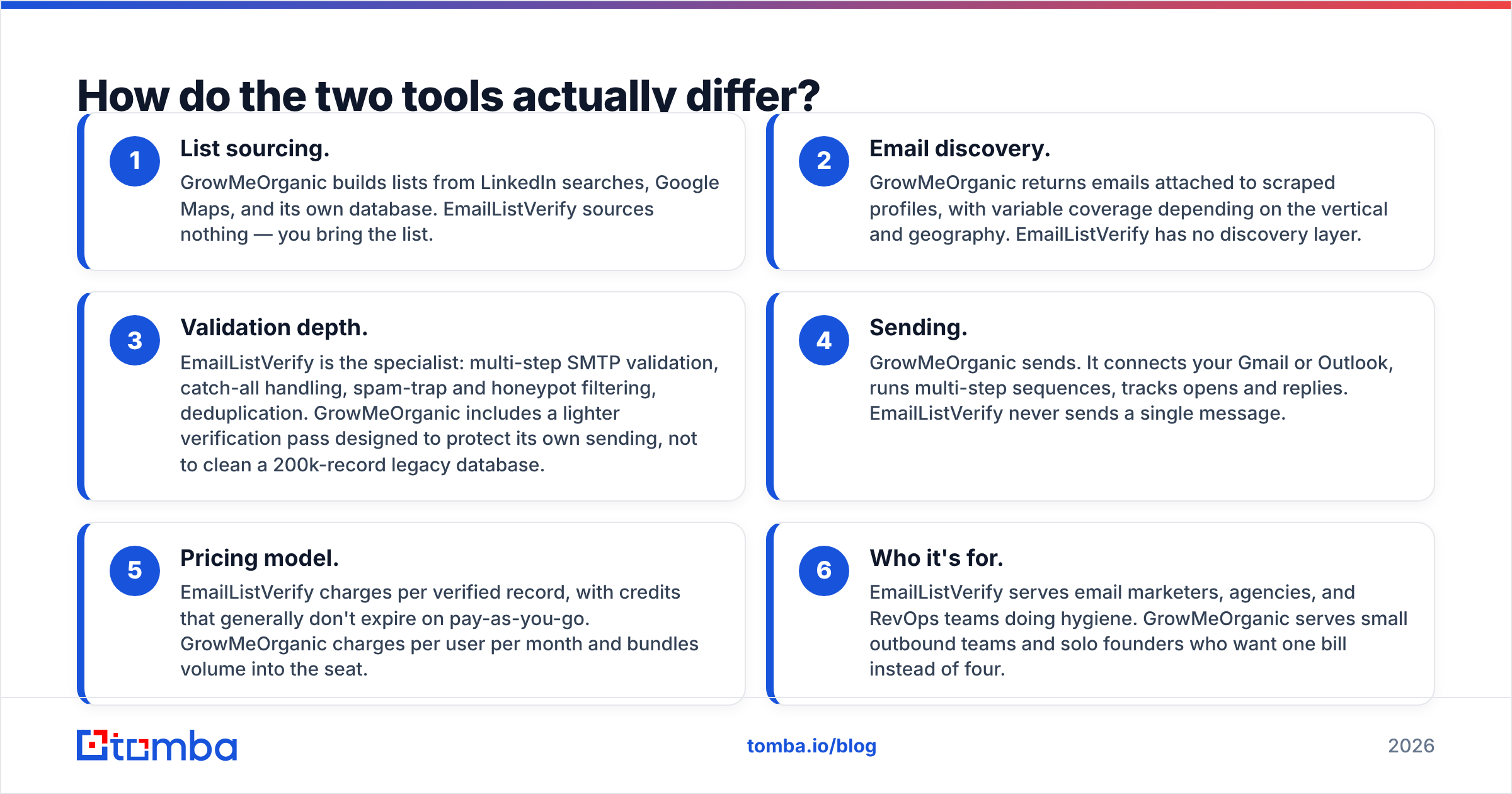
- List sourcing. GrowMeOrganic builds lists from LinkedIn, Google Maps, and its own database. EmailListVerify sources nothing. You bring the list.
- Email discovery. GrowMeOrganic returns emails tied to scraped profiles. Coverage swings by industry and country. EmailListVerify has no discovery layer.
- Validation depth. EmailListVerify is the specialist. It runs multi-step SMTP checks, sorts catch-all domains, filters spam traps, and removes duplicates. GrowMeOrganic ships a lighter check. It guards its own sending. It will not clean a 200k-record legacy database.
- Sending. GrowMeOrganic sends. It connects Gmail or Outlook, runs multi-step sequences, and tracks opens and replies. EmailListVerify never sends a message.
- Pricing model. EmailListVerify charges per record checked. Pay-as-you-go credits usually do not expire. GrowMeOrganic charges per seat per month and bundles volume into the seat.
- Who it is for. EmailListVerify suits email marketers, agencies, and RevOps teams doing cleanup. GrowMeOrganic suits small outbound teams and solo founders who want one bill instead of four.
EmailListVerify vs GrowMeOrganic: how do the prices compare?#
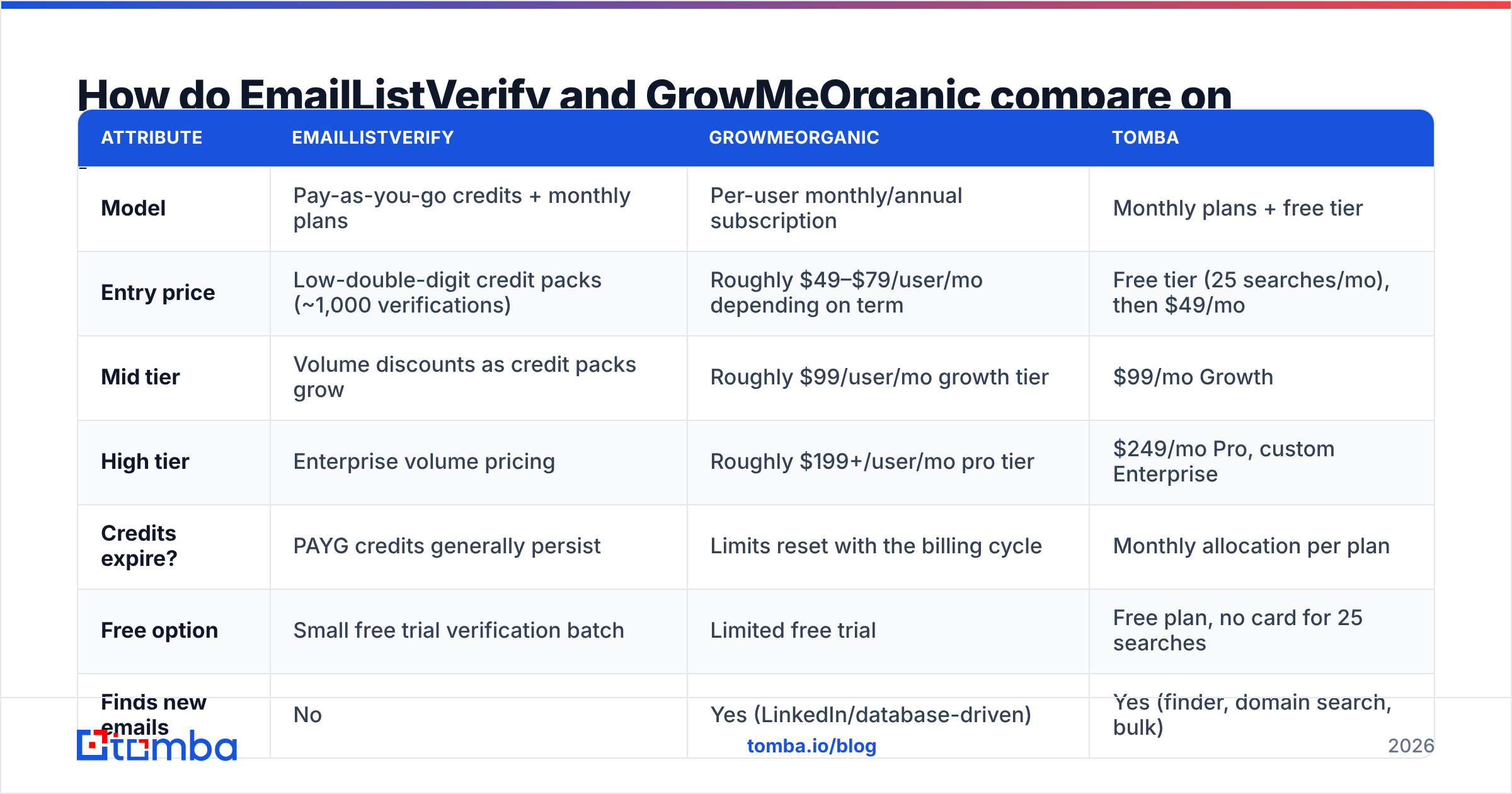
Prices move often on both sides. Both vendors also run promos and lifetime deals. Treat the numbers below as the shape of the offer, not a quote. Check the live pricing page before you buy.
| Attribute | EmailListVerify | GrowMeOrganic | Tomba |
|---|---|---|---|
| Model | Pay-as-you-go credits + monthly plans | Per-user monthly/annual subscription | Monthly plans + free tier |
| Entry price | Low-double-digit credit packs (~1,000 verifications) | Roughly $49–$79/user/mo depending on term | Free tier (25 searches/mo), then $49/mo |
| Mid tier | Volume discounts as credit packs grow | Roughly $99/user/mo growth tier | $99/mo Growth |
| High tier | Enterprise volume pricing | Roughly $199+/user/mo pro tier | $249/mo Pro, custom Enterprise |
| Credits expire? | PAYG credits generally persist | Limits reset with the billing cycle | Monthly allocation per plan |
| Free option | Small free trial verification batch | Limited free trial | Free plan, no card for 25 searches |
| Finds new emails | No | Yes (LinkedIn/database-driven) | Yes (finder, domain search, bulk) |
| Verifies emails | Yes, core product | Basic, bundled | Yes, dedicated verifier + catch-all logic |
| Sends campaigns | No | Yes | No (integrates with your sender) |
One lesson hides in that table. Per-seat tools look cheap until you add a second and third rep. Per-credit tools look cheap until you clean 500k records. Say you are a two-person team doing 5,000 finds a month. A $99/mo credit plan usually beats two $99 seats. You also keep the freedom to swap senders later. Compare that against Tomba pricing before you sign an annual seat deal.
Which tool gives you more accurate data?#
This part is awkward for GrowMeOrganic. It is not really the platform's fault. Any tool that pulls emails from scraped profiles inherits two problems.
First, profiles go stale. People change jobs every two to three years, and Gartner research on B2B buying groups shows the same churn inside accounts. Second, the email is often a pattern guess rather than a confirmed address.

EmailListVerify measures accuracy on another axis. It does not claim to know if the person still works there. It claims to know if the mailbox will accept mail. Those are different questions. Mixing them up is how teams end up with a "verified" list of people who left eight months ago.
Here is a quick accuracy checklist for whichever tool you pick:
- Run a 100-record control test. Take 100 contacts you can confirm on your own. Push them through the tool. Measure hit rate and bounce rate separately.
- Watch the "unknown" bucket. A checker that dumps 20% of your list into unknown hands the risk back to you. Compare unknown rates, not just valid rates.
- Handle catch-all domains head on. Roughly a quarter of B2B domains accept everything at the SMTP layer. If your tool marks these "valid," it is lying by omission. A dedicated catch-all verifier adds pattern confidence and other signals instead of a yes/no.
- Check recency, not just validity. Ask when the record was last confirmed. A 2023 confirmation on a 2026 send is a coin flip.
- Test in your own market. Coverage in US SaaS is not coverage in German manufacturing or Indian logistics. Vendor averages hide huge swings.
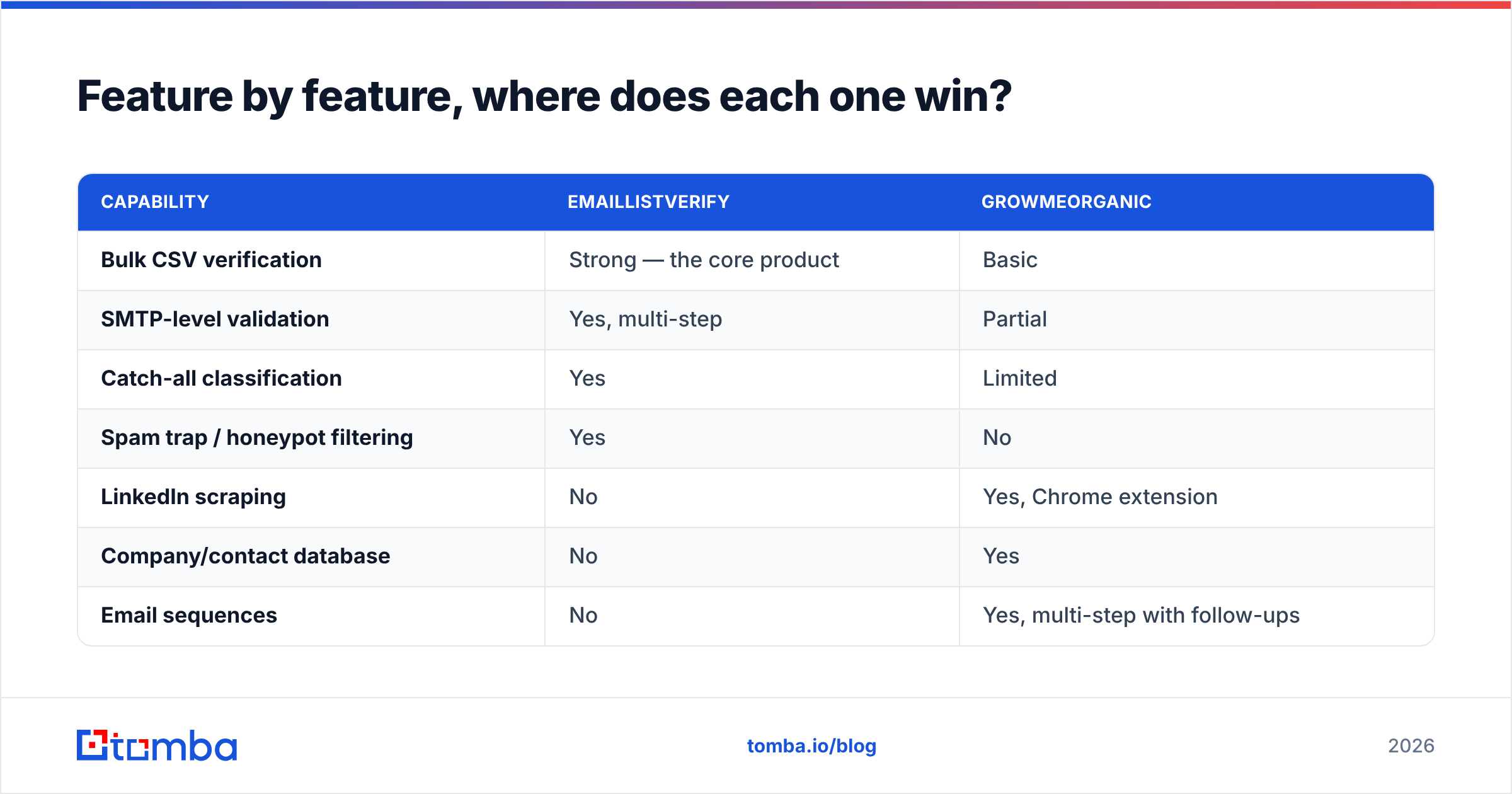
EmailListVerify vs GrowMeOrganic, feature by feature#

| Capability | EmailListVerify | GrowMeOrganic |
|---|---|---|
| Bulk CSV verification | Strong — the core product | Basic |
| SMTP-level validation | Yes, multi-step | Partial |
| Catch-all classification | Yes | Limited |
| Spam trap / honeypot filtering | Yes | No |
| LinkedIn scraping | No | Yes, Chrome extension |
| Company/contact database | No | Yes |
| Email sequences | No | Yes, multi-step with follow-ups |
| Mailbox integration (Gmail/Outlook) | No | Yes |
| API access | Yes | Yes, on higher tiers |
| ESP integrations | Mailchimp, Klaviyo, HubSpot and similar | Native CRM + Zapier-style connectors |
| Team seats | Not seat-based | Seat-based, per-user cost |
| Best for | Cleaning lists you already own | Building and sending to new lists |
Read this table as two shopping lists, not one scoreboard. Do more than three rows in the EmailListVerify column describe your weekly work? Buy the verifier. Do more than three rows in the GrowMeOrganic column? Buy the suite. If rows from both columns matter, read the next section. Buying both is usually the wrong answer.
Should you buy both, or is there a cheaper stack?#
Buy both and you get a scraper that guesses emails, plus a verifier that tells you the guesses bounce. You paid twice to learn that scraped data is soft. A better setup splits the three jobs. Then you buy the best value for each one.
- Find — a dedicated finder that works from a domain, or from a name plus a company. Tomba's email finder and domain search cover both entry points. The bulk email finder handles list-scale jobs without seat pricing.
- Verify — checks built into the same platform, so you are not shipping CSVs between vendors. Tomba's email verifier runs during discovery. The record that lands in your CRM is already scored.
- Send — whatever sequencer your team already knows: Instantly, Smartlead, Lemlist, Saleshandy, or your marketing platform. Senders are commodities in 2026, and switching is cheap.
That setup costs less than a per-seat suite once you pass one person. It survives swapping any single vendor. Your data stays portable.
GrowMeOrganic's bundle is genuinely handy for a solo founder who wants one login. That is a real argument, not a throwaway. But convenience turns into lock-in the day you hire a second rep.
There is a third path. Maybe you would rather buy static contact records than run discovery. List vendors like BookYourData fit that case. They work well for tight verticals where you want a fixed-price file instead of a subscription. Different model, different risk. It competes with both tools on the same question: where do your contacts come from?

What breaks with each tool in real use?#
EmailListVerify's weak points. The interface looks dated. Big file handling works, but it is not pleasant. Support speed varies by plan. The bigger issue: it checks, but it does not enrich. You cannot fix a bad list with it. You can only measure how bad it is. If 40% of your data is stale, it will tell you so and hand back the other 60%. Users on G2 rate the accuracy well while calling the product single-purpose.
GrowMeOrganic's weak points. LinkedIn scraping sits in a legal and ToS gray zone. Account limits are a real risk if you push volume hard. Email coverage drops sharply outside North America and Western Europe. The sequencer is competent but shallow next to dedicated senders. Need branching, A/B tests at scale, or inbox rotation? You will outgrow it. And unlimited-sounding plans usually carry fair-use ceilings in the terms.
What breaks on both. Neither tool fixes the thing that kills cold campaigns: your sending setup. Clean data cuts bounces. But SPF, DKIM, DMARC, domain warmup, and volume ramping decide whether the mail ever lands. Run an SPF checker and audit your email deliverability before you blame data quality for a weak reply rate.
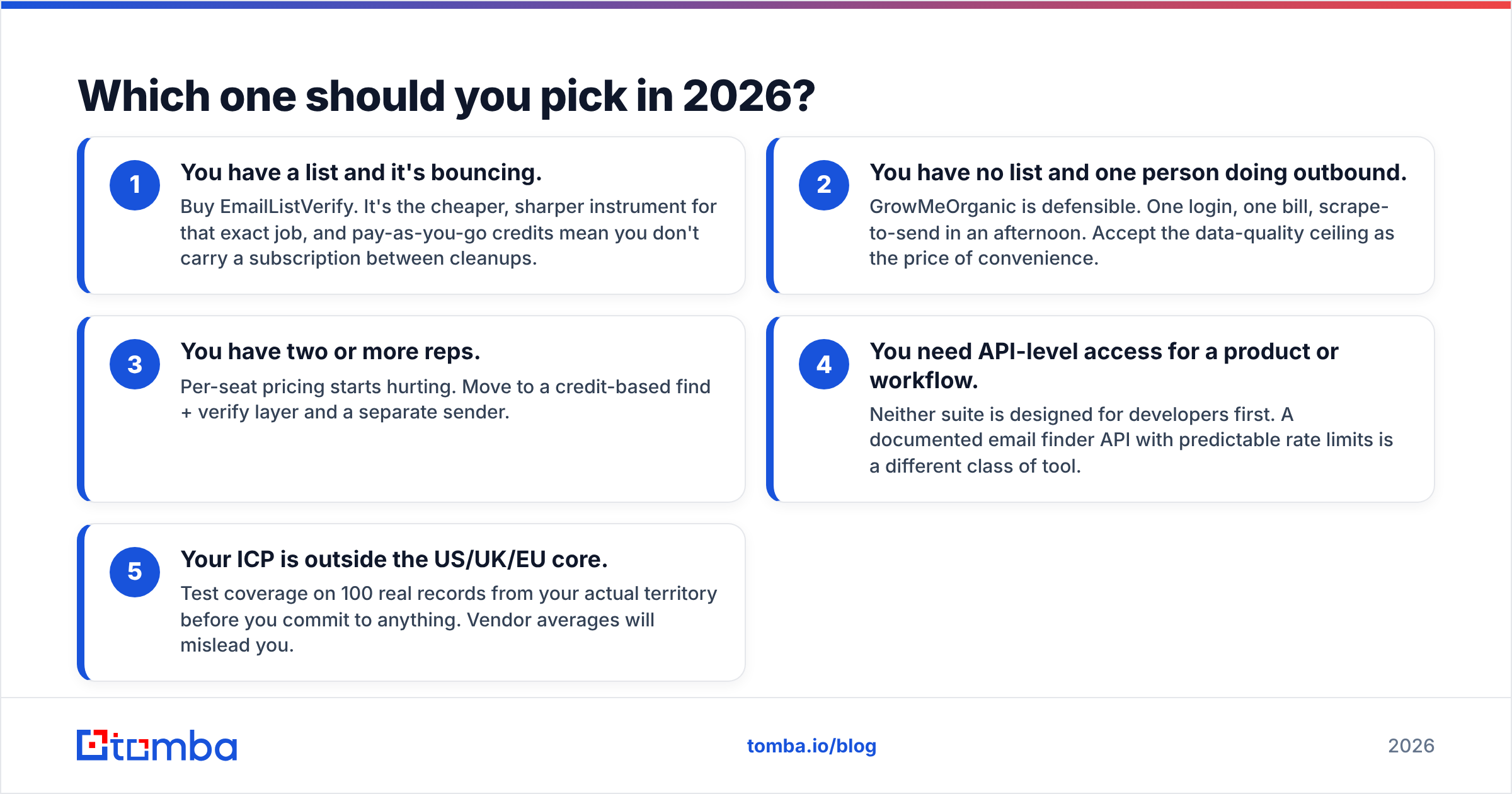
EmailListVerify vs GrowMeOrganic: which one should you pick in 2026?#
Use these five rules. They settle most cases in under a minute.
- You have a list and it bounces. Buy EmailListVerify. It is the cheaper, sharper tool for that job. Pay-as-you-go credits mean no subscription between cleanups.
- You have no list and one person doing outbound. GrowMeOrganic is defensible. One login, one bill, scrape to send in an afternoon. Accept the data-quality ceiling as the cost of convenience.
- You have two or more reps. Seat pricing starts to hurt. Move to a credit-based find and verify layer, plus a separate sender.
- You need API access for a product or workflow. Neither suite is built for developers first. A documented email finder API with clear rate limits is a different class of tool.
- Your buyers sit outside the US, UK, or EU. Test 100 real records from your own territory first. Vendor averages will mislead you.
Here is the uncomfortable truth about EmailListVerify vs GrowMeOrganic. Most teams searching for this comparison are trying to fix a pipeline problem with a purchase. The order matters more than the tool. Source with care. Verify before every send. Warm your domain. Keep your data portable enough that switching takes an afternoon, not a quarter.
Where does Tomba fit?#
Maybe you landed here because you need addresses that are correct on the day you send. Not scraped in 2024 and hopefully still good. Start with the Tomba Email Finder. Search by domain, by name and company, or in bulk. Verification runs in the same pass, so nothing enters your CRM unscored. The free tier gives you 25 searches a month with no card. Starter is $49/mo. Growth is $99/mo, and it covers what most two-to-five-person teams use. Run 50 of your own target accounts through it. Compare the hit rate against your current tool, and let the numbers pick the winner.
Related guides#
Ready to find emails that actually work?
Join 150,000+ professionals who stopped guessing and started sending. Free credits on signup — no credit card required.
Get the Tomba newsletter
Practical outbound tactics and product updates — once every two weeks.
About the author