EmailListVerify vs Jet Leads Pro (2026): Honest Comparison
One cleans lists, the other builds them. We break down EmailListVerify vs Jet Leads Pro on pricing, accuracy, data depth, and API quality — plus when neither is the right call.
EmailListVerify vs Jet Leads Pro is a strange matchup. One tool cleans the list you already have. The other tries to build you a new one. Here is how they differ on price, accuracy, and data depth — and when neither is the right buy.
TL;DR
- EmailListVerify is a verification-first tool. It takes a list you already have and tells you which addresses are safe to send to. It does not build lists for you.
- Jet Leads Pro is a lead-sourcing product — contact discovery and list building — with verification bundled in. But its public docs and pricing are thin next to older vendors. Budget extra time for a trial before you commit.
- They are not really competitors. Comparing them head-to-head only makes sense if you are deciding "do I need cleaner data or more data?"
- On price, EmailListVerify's pay-as-you-go credits are among the cheapest per-check options on the market. Jet Leads Pro quotes you a price instead. That usually means a higher, less predictable bill.
- Need discovery and verification under one API with a published price? A combined platform like Tomba removes the two-vendor tax. Starter is $49/mo, and the free tier covers 25 searches.
What is EmailListVerify and what does it actually do?#
EmailListVerify is a bulk email verification service. You upload a CSV or hit the API. It runs each address through a chain of checks. Then it hands back a labeled file: valid, invalid, catch-all, disposable, role-based, unknown.
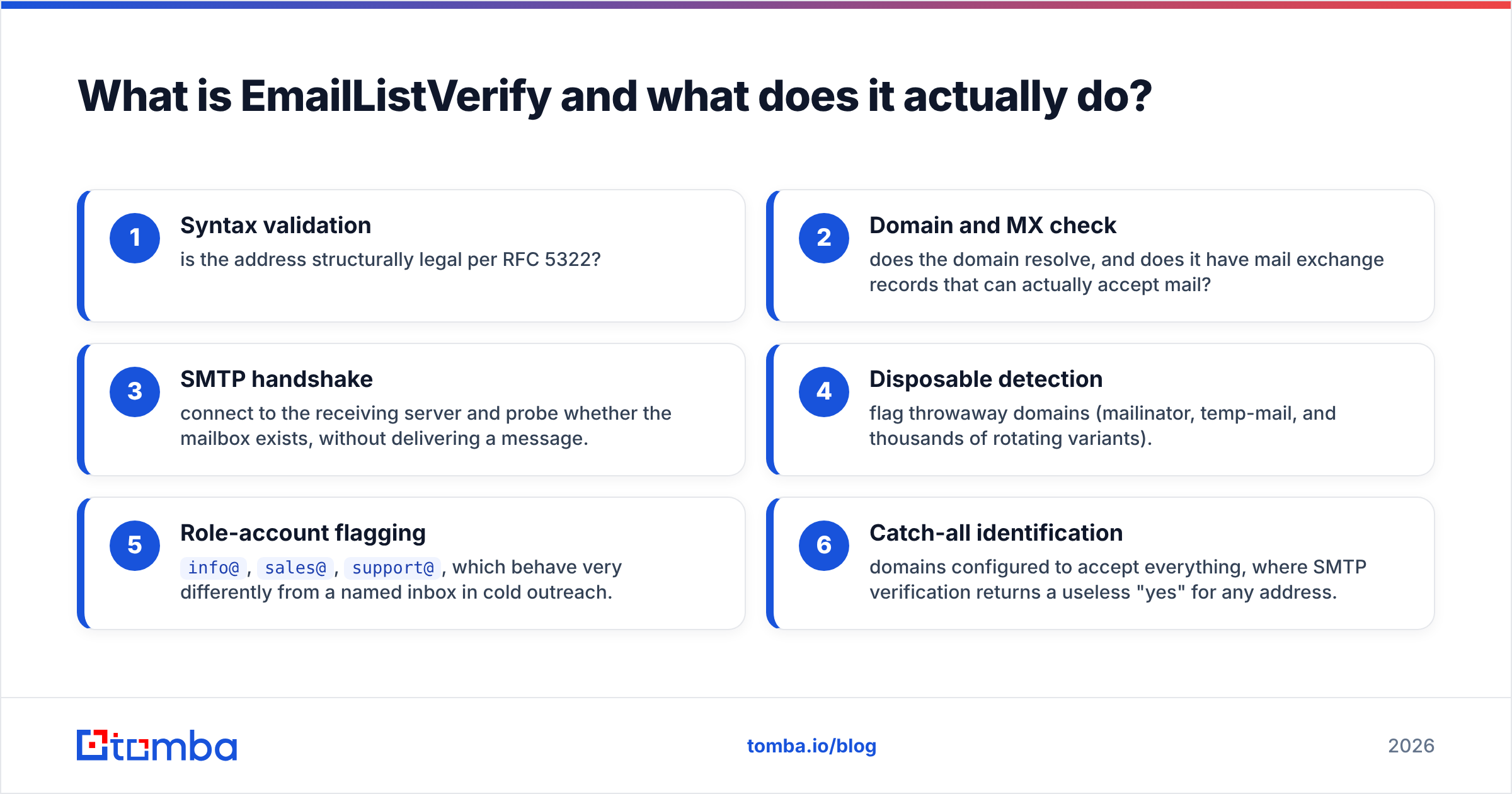
The checks are the standard stack every serious verifier runs:
- Syntax validation — is the address structurally legal per RFC 5322?
- Domain and MX check — does the domain resolve, and can it accept mail?
- SMTP handshake — connect to the receiving server and probe whether the mailbox exists, without delivering a message.
- Disposable detection — flag throwaway domains (mailinator, temp-mail, and thousands of rotating variants).
- Role-account flagging —
info@,sales@,support@. These behave very differently from a named inbox in cold outreach. - Catch-all identification — some domains accept everything. There, an SMTP check returns a useless "yes" for any address.
That last one matters more than most buyers realize. Roughly a fifth of business domains are catch-all. A verifier that quietly marks them "valid" inflates its own accuracy score at your expense. If you send to a lot of catch-all domains, use a dedicated catch-all verifier rather than a coin flip.
What EmailListVerify does not do: find you new contacts. There is no domain-based discovery, no name-to-email lookup, no company database. It is a filter, not a source.
What is Jet Leads Pro and how does it differ?#
Jet Leads Pro sits on the other side of the pipeline. It is sold as a lead generation and contact-sourcing tool. You describe a target — industry, geography, company size, job title. It returns a list of prospects with contact details, usually verified before export.
Here is the honest caveat, and it should shape your evaluation. Jet Leads Pro publishes far less than older vendors do. There is no public accuracy method. There is no per-credit pricing page like EmailListVerify's. Review volume on G2 and Capterra is thin next to Apollo, Hunter, or Clearbit. That does not make it bad. It does mean you buy on a demo, not on docs. Test it against your own known-good sample before you sign an annual deal.
In practice, the split is simple:
- EmailListVerify answers: "Are these 40,000 addresses I already have deliverable?"
- Jet Leads Pro answers: "Who at these 400 companies should I be emailing, and what is their address?"
If you are weighing both, you likely have a gap in one of those two areas. One vendor rarely fills both at once.

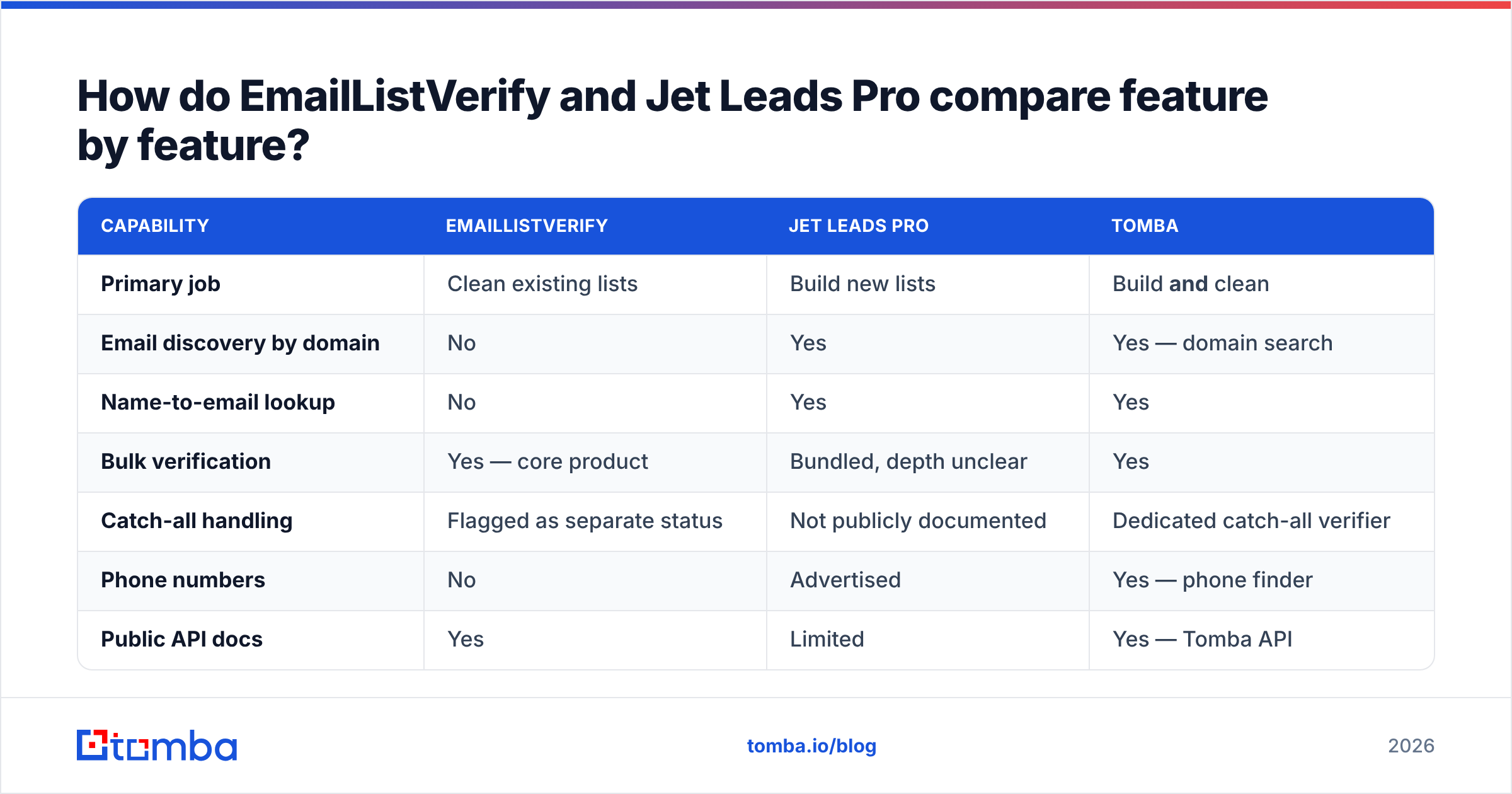
EmailListVerify vs Jet Leads Pro: how do they compare feature by feature?#
| Capability | EmailListVerify | Jet Leads Pro | Tomba |
|---|---|---|---|
| Primary job | Clean existing lists | Build new lists | Build and clean |
| Email discovery by domain | No | Yes | Yes — domain search |
| Name-to-email lookup | No | Yes | Yes |
| Bulk verification | Yes — core product | Bundled, depth unclear | Yes |
| Catch-all handling | Flagged as separate status | Not publicly documented | Dedicated catch-all verifier |
| Phone numbers | No | Advertised | Yes — phone finder |
| Public API docs | Yes | Limited | Yes — Tomba API |
| Published pricing | Yes, per-credit | Quote-driven | Yes — free to $249/mo |
| Free tier | ~100 trial credits | Demo-based | 25 searches/mo |
| Chrome extension | No | Advertised | Yes |
| Spreadsheet add-ons | Limited | Limited | Sheets, Excel, Airtable |
The pattern is familiar. One specialist does a single job cheaply and well. One broader tool shows less of its work. One platform covers the full find-then-verify loop.
What does each one cost in 2026?#
EmailListVerify sells credits, and that is its strongest card. Credits never expire. The cost per check drops sharply with volume. At large tiers it lands well under half a cent per address. Do you clean one big list a quarter? That is hard to beat. You pay nothing in the months you do not send.
Jet Leads Pro does not publish a rate card. Quote-driven pricing in this category usually means:
- A minimum annual commitment
- Credits scoped to exports rather than lookups, which is a much worse deal
- Wasted credits on contacts that turn out to be stale
- No self-serve downgrade path
Ask three questions before you sign a quote-driven data contract. Do credits roll over? Do you pay for results that fail verification? What accuracy does the contract guarantee, in writing?
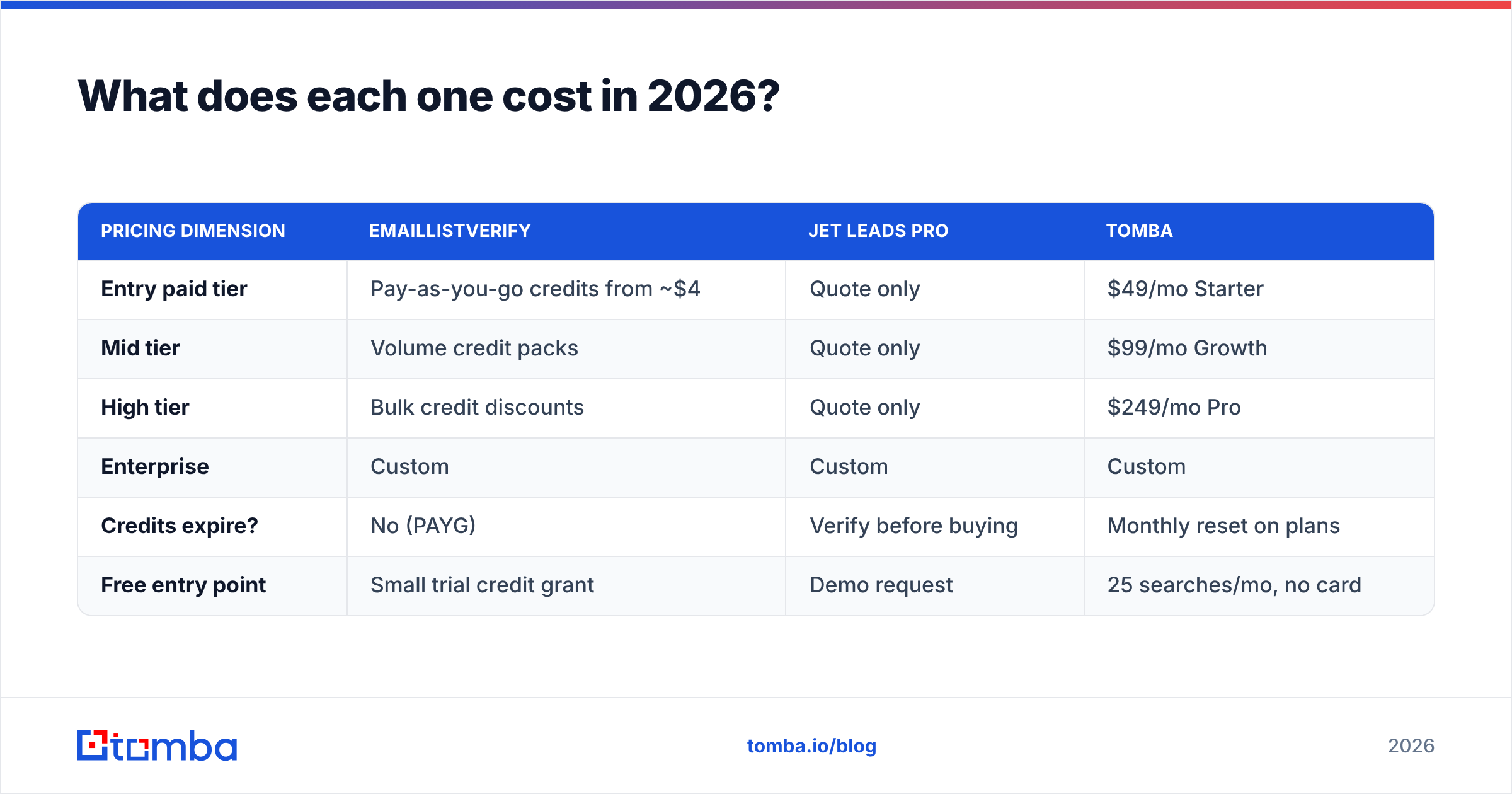
| Pricing dimension | EmailListVerify | Jet Leads Pro | Tomba |
|---|---|---|---|
| Entry paid tier | Pay-as-you-go credits from ~$4 | Quote only | $49/mo Starter |
| Mid tier | Volume credit packs | Quote only | $99/mo Growth |
| High tier | Bulk credit discounts | Quote only | $249/mo Pro |
| Enterprise | Custom | Custom | Custom |
| Credits expire? | No (PAYG) | Verify before buying | Monthly reset on plans |
| Free entry point | Small trial credit grant | Demo request | 25 searches/mo, no card |
See full Tomba pricing for a like-for-like number to hold the quotes against. Cheaper does not always win. But a vendor who hides its price is asking you to negotiate blind.
How accurate are they, and how would you even know?#

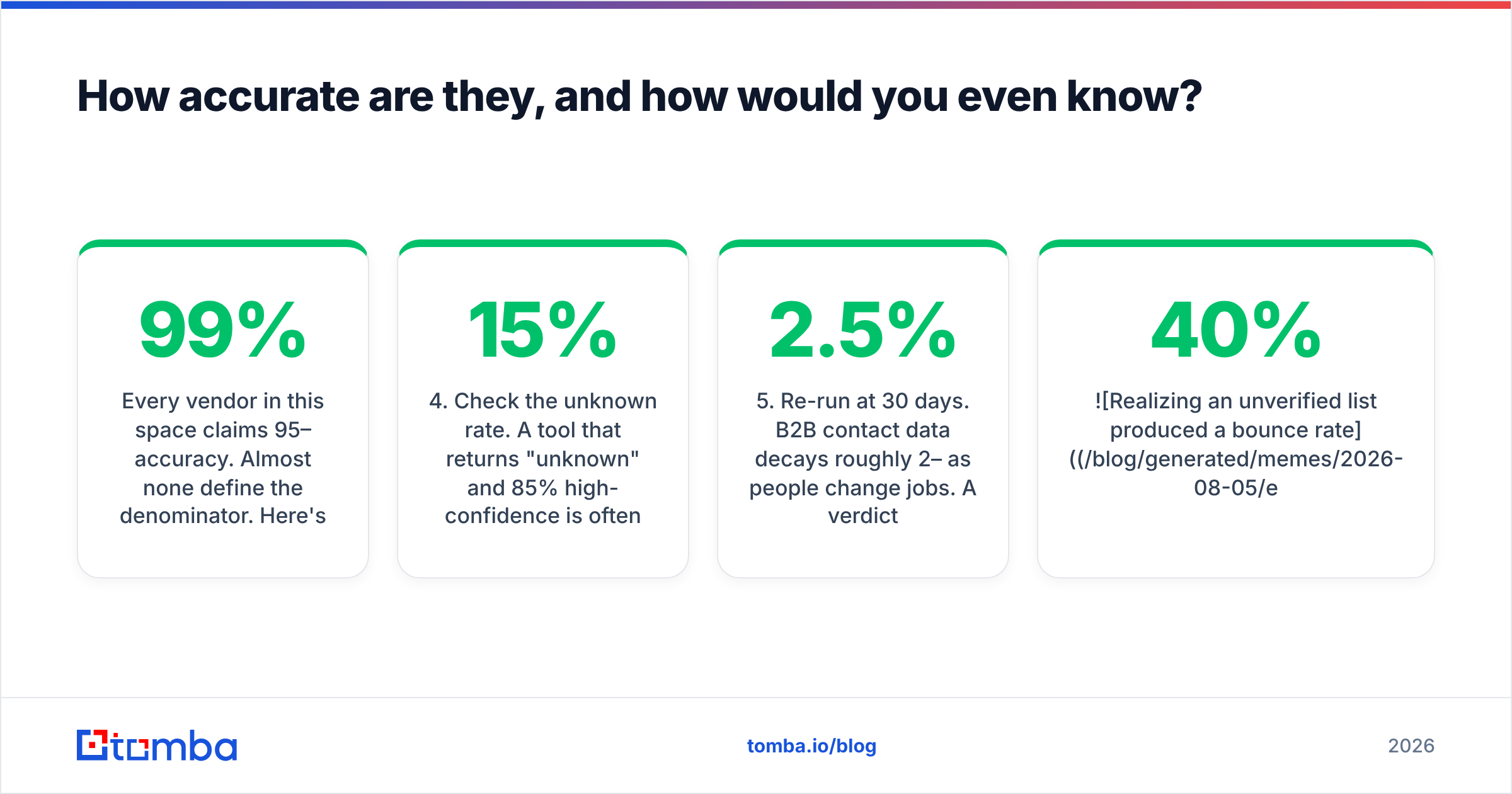
Every vendor here claims 95–99% accuracy. Almost none define the denominator. So run your own test. It takes an afternoon, and it beats any vendor benchmark.
- Build a 200-address control set. Half should be live: colleagues, customers, your own aliases across a few domains. Half should be dead: former staff, retired domains, typo variants.
- Include 30 catch-all domains. This is where verifiers split apart. Note whether the tool returns "valid," "unknown," or an explicit catch-all status. The explicit status is the honest answer.
- Measure both error types. False positives are dead addresses marked valid. They cost you bounce rate and sender reputation. False negatives are live addresses marked invalid. They cost you pipeline, and nobody ever notices.
- Check the unknown rate. Say a tool returns 15% "unknown" and 85% high confidence. That often beats a tool that forces a verdict on every row.
- Re-run at 30 days. B2B contact data decays roughly 2–2.5% per month as people change jobs. A verdict from March is not a verdict in June.
EmailListVerify holds up well on this test for the filtering job. It is a mature product with clear status labels. What it cannot tell you is whether the address was ever the right person. Say a contact left the company 18 months ago. Their old address can still pass an SMTP check at a catch-all domain. The send is still wasted.
Jet Leads Pro is harder to judge from the outside, because the sourcing method is not documented. Ask where the contacts come from: web crawling, opt-in data partnerships, user uploads, or bought databases. The answer sets both your refresh rate and your GDPR risk in EU markets.

Which should you choose for your use case?#

Choose EmailListVerify if:
- You have a big list from events, webinars, form fills, or an old CRM. You need it cleaned before you send.
- You verify in bursts and hate paying a monthly fee in between. Credits that never expire fit that pattern.
- You already have a working source of contacts and only need the hygiene layer.
- Your priority is cost per check, not breadth of features.
Choose Jet Leads Pro if:
- Your bottleneck is finding prospects, not cleaning them.
- You ran a trial against your own control set and the accuracy held up.
- You are fine with quote-based pricing and have room to negotiate.
- They have proven depth in your vertical or region. Ask for a sample export in your exact ICP before you pay.
Choose neither if:
- You need both jobs done and do not want to stitch two vendors together. That means two credit pools and two APIs. Every handoff between a sourcing tool and a verifier is a place where records get duplicated, mismatched, or dropped.
Where does a combined platform fit?#
The two-vendor pattern made sense when finders were bad at verification and verifiers had no data. That is no longer true. Combined platforms run discovery and verification in one pass. The address is checked the moment it is found, not weeks later after it decays in a spreadsheet.
Tomba is built around that loop. The email finder turns a name and domain into an address. Verification runs inline. Catch-all domains route to a dedicated checker instead of a guess. You get all of it through one API key, one credit pool, and one published price. The free tier gives you 25 searches a month with no card. That is enough to run the control-set test above before you spend a dollar.
This is not a claim that Tomba beats EmailListVerify on raw bulk pricing. At very high volume, a dedicated pay-as-you-go verifier is genuinely cheap. The point is total cost. Two vendors, two contracts, two support queues, and a brittle CSV handoff add up faster than the credit-price gap.
What should you check before you sign anything?#
Run this list against whichever vendor you are leaning toward:
- Sample test on your ICP — not their sample data, yours. 200 records minimum.
- Credit rollover policy — in writing, in the contract, not on the sales call.
- API rate limits and uptime — if you enrich in real time, a 10 req/s cap will bite you.
- Data sourcing disclosure — where do contacts come from, and can you get a deletion honored?
- Refund on bad data — does the vendor credit back addresses that bounce? Verifiers usually do. Sourcing tools often do not.
- Exit path — can you export everything you built if you leave next quarter?
Point 5 is the sharpest test. A vendor confident in its accuracy will refund bounces. A vendor that will not is telling you something.
The bottom line#
EmailListVerify vs Jet Leads Pro is really a question about your own pipeline. The two tools solve different problems. The "vs" framing mostly shows which half of your pipeline is broken. If your lists are full of dead addresses, EmailListVerify is a cheap, mature, well-understood fix. If you cannot find prospects at all, you need a sourcing tool. Just do the diligence first, because Jet Leads Pro's public paper trail is thinner than its rivals'.
If the honest answer is "both," stop paying two vendors for one workflow. Start with the Tomba Email Finder. Find the address, verify it inline, and export it clean in a single call. The free tier covers 25 searches a month with no credit card. That is exactly enough to run a real accuracy test before you commit a budget to anyone.
Related guides#
Ready to find emails that actually work?
Join 150,000+ professionals who stopped guessing and started sending. Free credits on signup — no credit card required.
Get the Tomba newsletter
Practical outbound tactics and product updates — once every two weeks.
About the author