EmailListVerify vs LeadZen.ai: Which Tool Wins in 2026?
One cleans the list you already have. The other tries to build it for you. Here's an honest breakdown of EmailListVerify vs LeadZen.ai — pricing, accuracy, coverage, and who each tool actually fits.
EmailListVerify vs LeadZenAI is an odd matchup. One tool cleans the list you already have. The other tries to build the list for you. Here is what each one does, what it costs in 2026, and which half of your outbound stack it fixes.
TL;DR
- These tools do different jobs. EmailListVerify is a bulk email verification engine — you bring the list, it tells you what bounces. LeadZen.ai is a lead intelligence platform — it tries to hand you the contacts in the first place.
- If your problem is bounce rate, EmailListVerify is the cheaper, more focused answer. Pay-as-you-go credits, no seat fees, no CRM to learn.
- If your problem is "I have no list", EmailListVerify does nothing for you. You need a prospecting database — LeadZen.ai, or a finder-plus-verifier platform.
- Coverage is the real dividing line. LeadZen.ai's strength is India and APAC B2B data; its North America and EU depth is thinner than the global players.
- Most teams end up buying both categories anyway. That's why a combined finder + verifier (Tomba, Hunter, Apollo) usually beats stitching two single-purpose vendors together on cost and workflow.
EmailListVerify vs LeadZenAI: what does each tool do?#
Different animals wearing similar marketing copy. Think of it like a kitchen: EmailListVerify is the food safety inspector who tells you which ingredients have gone off. LeadZen.ai is the grocery delivery service. You cannot substitute one for the other, and comparing them only makes sense because both sit in the same "fix my outbound data" budget line.
EmailListVerify launched in 2015 and has stayed narrow on purpose. You upload a CSV, or hit the API. It then runs a validation chain: syntax check, domain and MX record lookup, disposable-address detection, role-account flagging (info@, sales@), spam-trap screening, and an SMTP handshake to confirm the mailbox exists. You get back a list segmented into valid, invalid, catch-all/accept-all, and unknown. That's the whole product. No CRM, no sequencer, no contact database.
LeadZen.ai is the opposite shape. It's a B2B lead database built around search. You filter by industry, headcount, location, tech stack, or job title. It hands back company and person records with emails and phone numbers attached. It ships a Chrome extension for pulling contacts off LinkedIn profiles, plus enrichment and basic list management. Verification exists inside the product, but it's a supporting feature, not the engine.
So the honest framing of EmailListVerify vs LeadZenAI isn't "which is better." It's "which half of the pipeline are you trying to fix?"
EmailListVerify vs LeadZenAI: how do they compare head-to-head?#
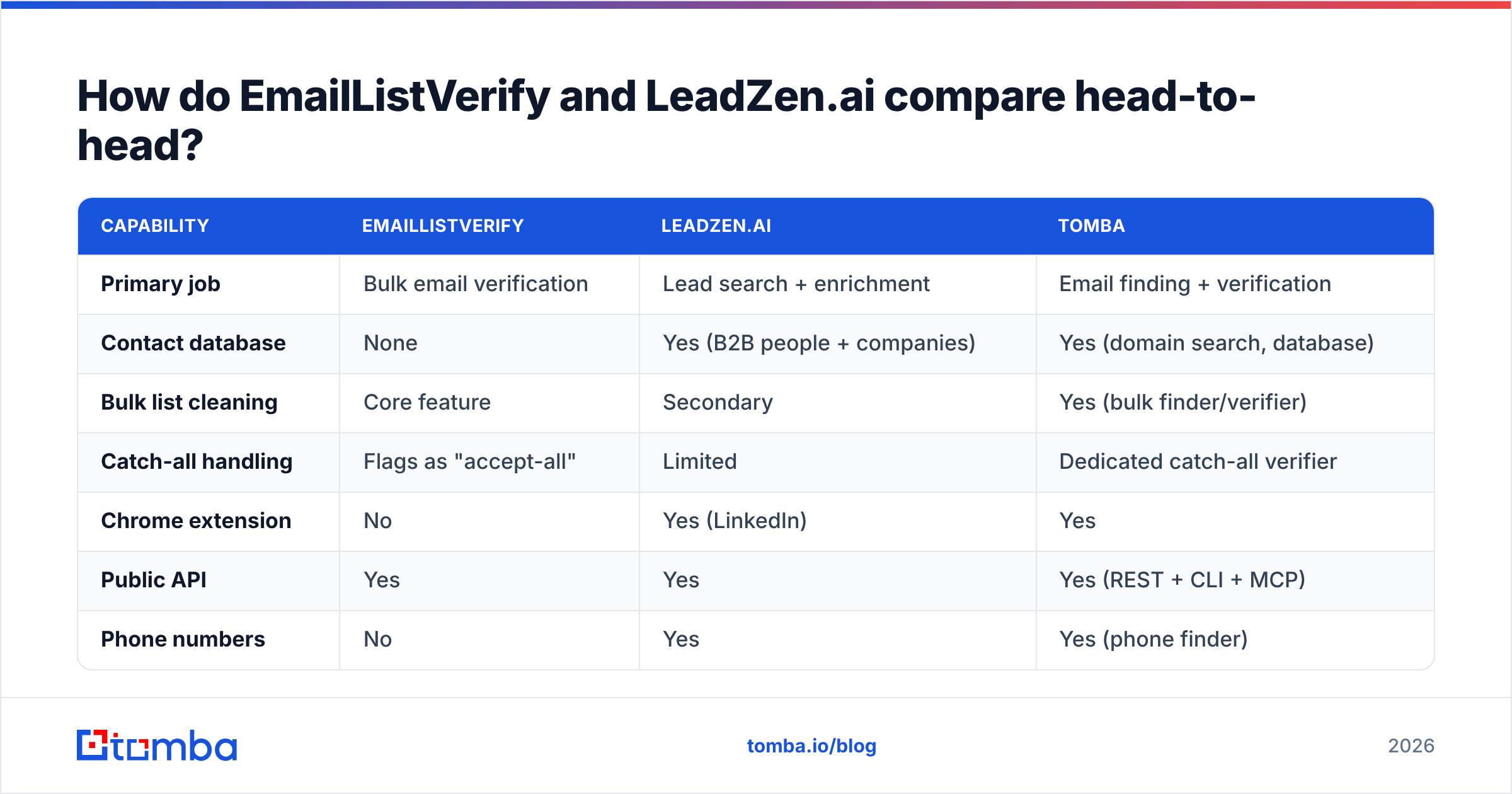
Here's the direct comparison, with Tomba included as a reference point for what a combined finder-plus-verifier looks like.
| Capability | EmailListVerify | LeadZen.ai | Tomba |
|---|---|---|---|
| Primary job | Bulk email verification | Lead search + enrichment | Email finding + verification |
| Contact database | None | Yes (B2B people + companies) | Yes (domain search, database) |
| Bulk list cleaning | Core feature | Secondary | Yes (bulk finder/verifier) |
| Catch-all handling | Flags as "accept-all" | Limited | Dedicated catch-all verifier |
| Chrome extension | No | Yes (LinkedIn) | Yes |
| Public API | Yes | Yes | Yes (REST + CLI + MCP) |
| Phone numbers | No | Yes | Yes (phone finder) |
| Strongest region | Global (verification is region-agnostic) | India / APAC | Global |
| Pricing model | Pay-as-you-go credits + monthly | Subscription tiers | Free tier + $49/$99/$249 monthly |
| Free tier | 100 verification credits | Limited trial credits | 25 searches/mo |
| Best for | Cleaning lists you already own | Sourcing APAC B2B leads | Teams that need both in one bill |
Three things jump out of that table.
First, EmailListVerify has no answer to "where do leads come from." If you're starting from zero, it's not a candidate. It's the tool you buy after you've bought something else.
second, LeadZen.ai's regional bias is a feature or a dealbreaker depending on your ICP. If you're selling into Indian SaaS, manufacturing, or services companies, its coverage is genuinely competitive with the global vendors and usually cheaper. If your ICP is US mid-market or DACH enterprise, you'll hit thin records and stale titles faster than you'd like.
Third, the pricing models aren't comparable. EmailListVerify sells credits that never expire on its pay-as-you-go plans. LeadZen.ai sells monthly seats with credit caps. One is a utility bill, the other is a subscription — and subscriptions are where teams quietly overspend.

What does EmailListVerify actually do well?#
Four things, and they're worth being specific about:
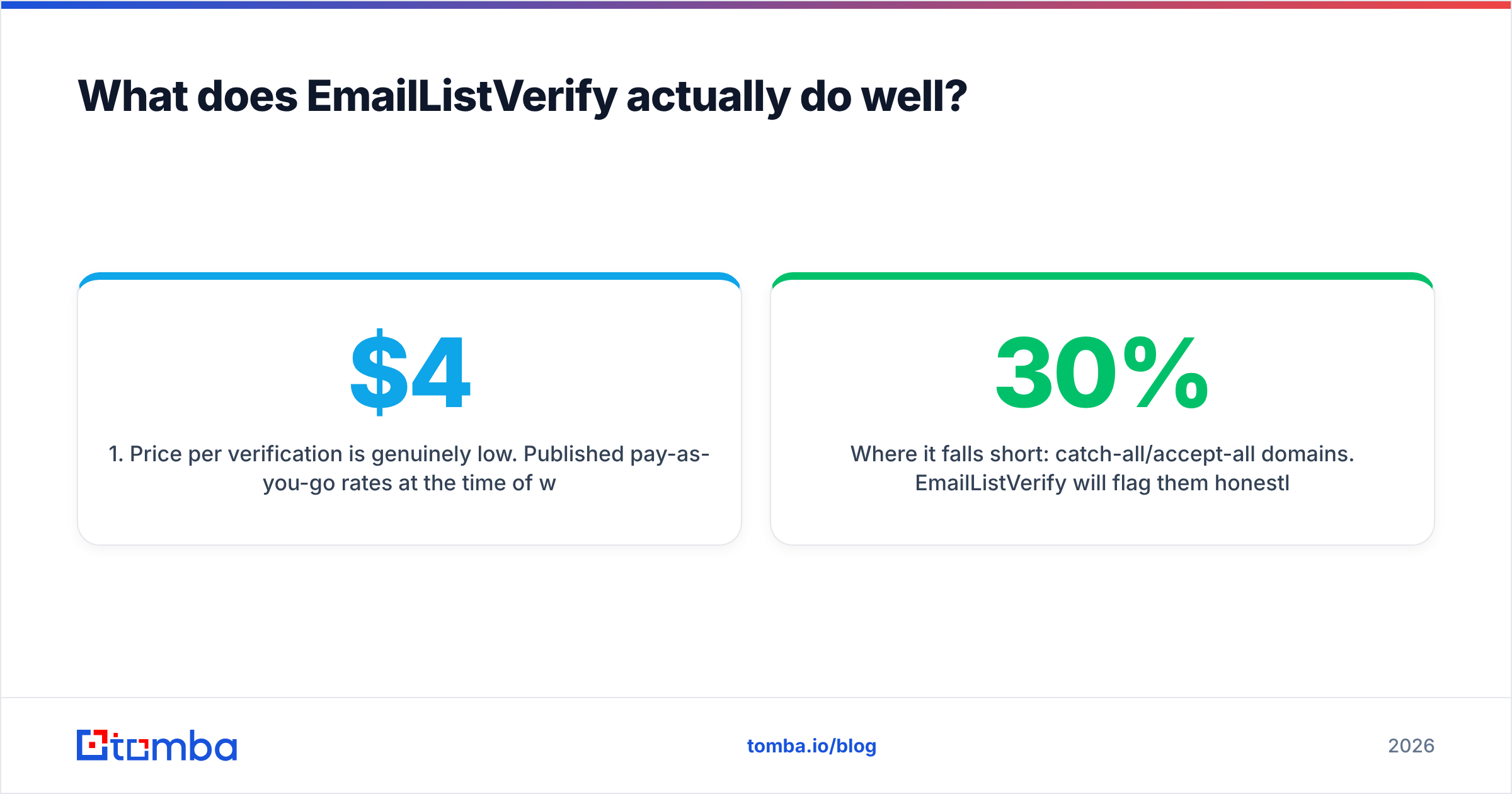
- Price per verification is genuinely low. Published pay-as-you-go rates at the time of writing start around $4 for 1,000 credits and fall to roughly $0.0014 per email at the 100,000+ tier. Against ZeroBounce or NeverBounce at comparable volumes, that's often 30–50% cheaper. Confirm current rates on their pricing page before you budget — verification pricing moves.
- Credits don't expire on PAYG. This matters more than it sounds. If you clean a list once a quarter, subscription-based verifiers burn your allowance every month whether you use it or not.
The other two strengths are technical:
- The multi-step validation chain is thorough. Syntax → DNS/MX → disposable → role → SMTP → spam trap. It catches the categories that actually damage sender reputation, not just the obvious typos.
- Integration surface is decent for a single-purpose tool. API, Zapier, and direct connectors to the major ESPs mean you can wire verification into a signup form or a CRM import without engineering time.
Where it falls short: catch-all/accept-all domains. EmailListVerify will flag them honestly rather than guess, which is the right call ethically but leaves you with a bucket of "unknown" addresses and no path forward. On some B2B lists, catch-all domains are 20–30% of the file. If you just delete them, you're deleting real prospects. That's exactly the gap a dedicated catch-all verifier exists to close.

How accurate is each tool in practice?#
Accuracy claims in this category deserve skepticism. Every vendor publishes a number above 95%, and every number is measured differently.
Here's what's defensible:
- Verification accuracy is easier to validate than discovery accuracy. A verifier is right or wrong within days — you send, and you either bounce or you don't. EmailListVerify's published accuracy sits in the 98–99% range, and independent reviews on G2 broadly support the "low bounce rate after cleaning" claim. Treat 97%+ as realistic.
- Discovery accuracy is much murkier. When LeadZen.ai returns an email, the question isn't just "does the mailbox exist." It's "is this person still in that role, at that company, using that address." Database freshness decays 25–30% per year through job changes alone. No vendor's marketing page accounts for that.
- Region changes everything. A tool with 96% accuracy in its home market can drop to 70% two continents away. This is the single most under-tested variable in every tool comparison, including this one.
The only test that matters is your own. Take 100 real prospects from your actual ICP — not the vendor's demo list — run them through both tools, and send a low-volume campaign. Count hard bounces. That's your number.

EmailListVerify vs LeadZenAI: what does each one cost in 2026?#
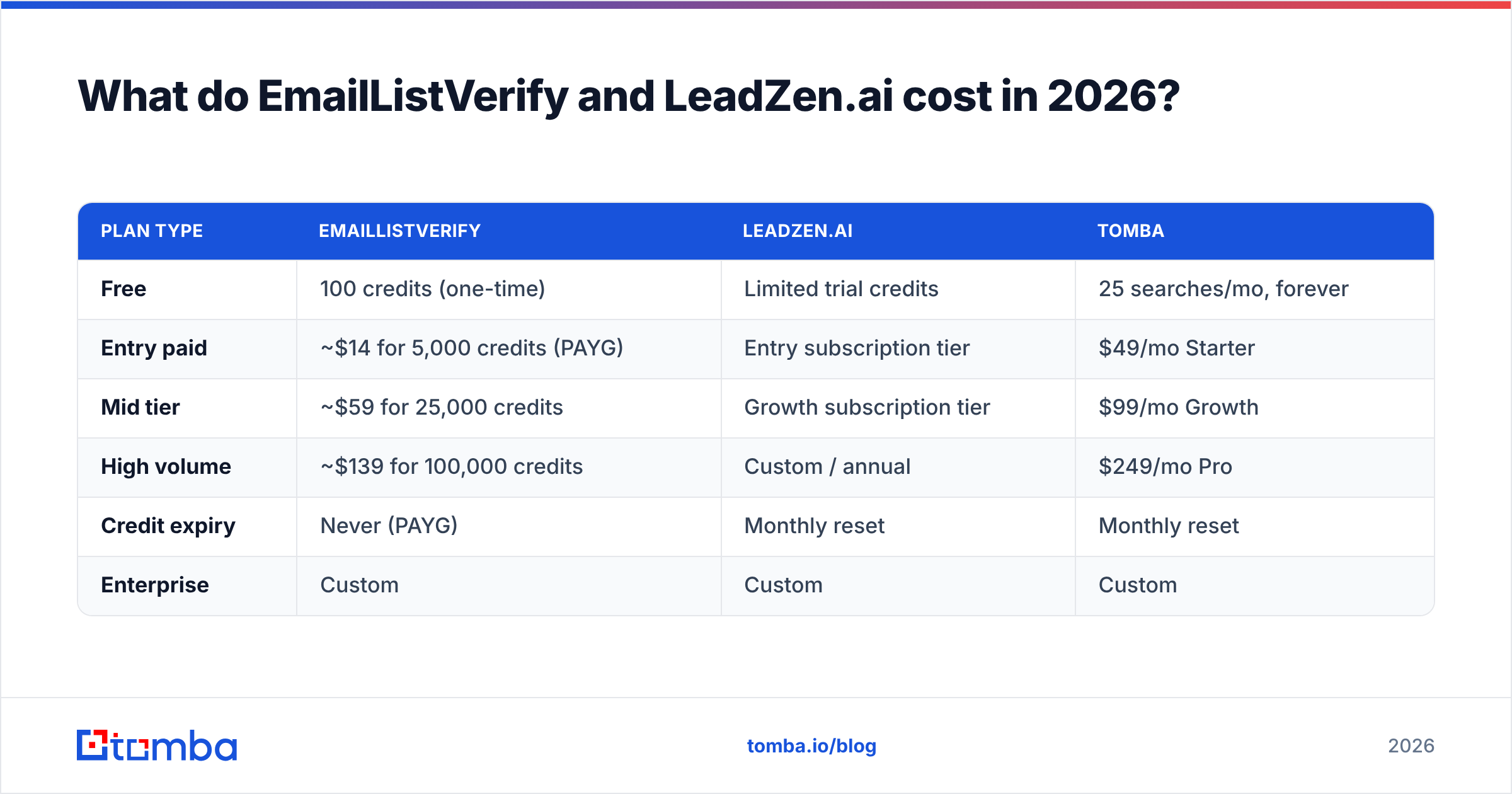
Pricing below reflects published rates at the time of writing. Both vendors change tiers periodically — verify before you commit.
| Plan type | EmailListVerify | LeadZen.ai | Tomba |
|---|---|---|---|
| Free | 100 credits (one-time) | Limited trial credits | 25 searches/mo, forever |
| Entry paid | ~$14 for 5,000 credits (PAYG) | Entry subscription tier | $49/mo Starter |
| Mid tier | ~$59 for 25,000 credits | Growth subscription tier | $99/mo Growth |
| High volume | ~$139 for 100,000 credits | Custom / annual | $249/mo Pro |
| Credit expiry | Never (PAYG) | Monthly reset | Monthly reset |
| Enterprise | Custom | Custom | Custom |
The structural difference: EmailListVerify's PAYG model is better for spiky, occasional workloads. Subscription models are better when you have steady monthly volume and want predictable spend. If you clean one 50,000-row list every six months, PAYG wins easily. If you're prospecting and verifying continuously, a subscription with a bundled finder is usually cheaper per useful contact — see Tomba pricing for a like-for-like comparison of the bundled model.
One cost people forget: the second tool. If you buy EmailListVerify, you still need a source of emails. If you buy LeadZen.ai for APAC coverage, you'll likely still want a stronger verifier before you send at volume. Budget for the pair, not the one.
Which one should you choose for your use case?#
Match the tool to the actual bottleneck. Here is how EmailListVerify vs LeadZenAI breaks down by use case:
- You have a large existing list with a bounce problem → EmailListVerify. This is its exact job, it does it cheaply, and you don't need anything else in the workflow. Run the file, drop the invalids, keep the catch-alls in a separate segment.
- You're selling into India, Southeast Asia, or the Middle East → LeadZen.ai deserves a trial. Its regional data depth is a real advantage over the US-centric databases, and the price point reflects the market it was built for.
- You're selling into North America or Western Europe → Neither is a complete answer. You want a finder with strong Western coverage plus verification built in. Test the email finder alongside a global database and compare hit rates on your own domain list.
The next three cases are about scale and budget:
- You're running high-volume outbound (10k+/month) → You need both functions, and you need them in one API so verification happens at discovery time, not as a separate batch job three days later. Two vendors means two integrations, two bills, and a stale window between them.
- You're a solo founder or a two-person team → Start with a free tier and a manual process. Buying a $99/month subscription before you've validated your ICP is how prospecting budgets get wasted. A free email checker plus 25 free searches will carry you through the first 100 prospects.
- You're an agency managing multiple client lists → EmailListVerify's non-expiring credits are genuinely useful here, because client volume is unpredictable. Pair it with whichever finder matches each client's ICP region.
Is there a better option than either?#
For most B2B teams, yes — a combined platform, and the reason is workflow, not features.
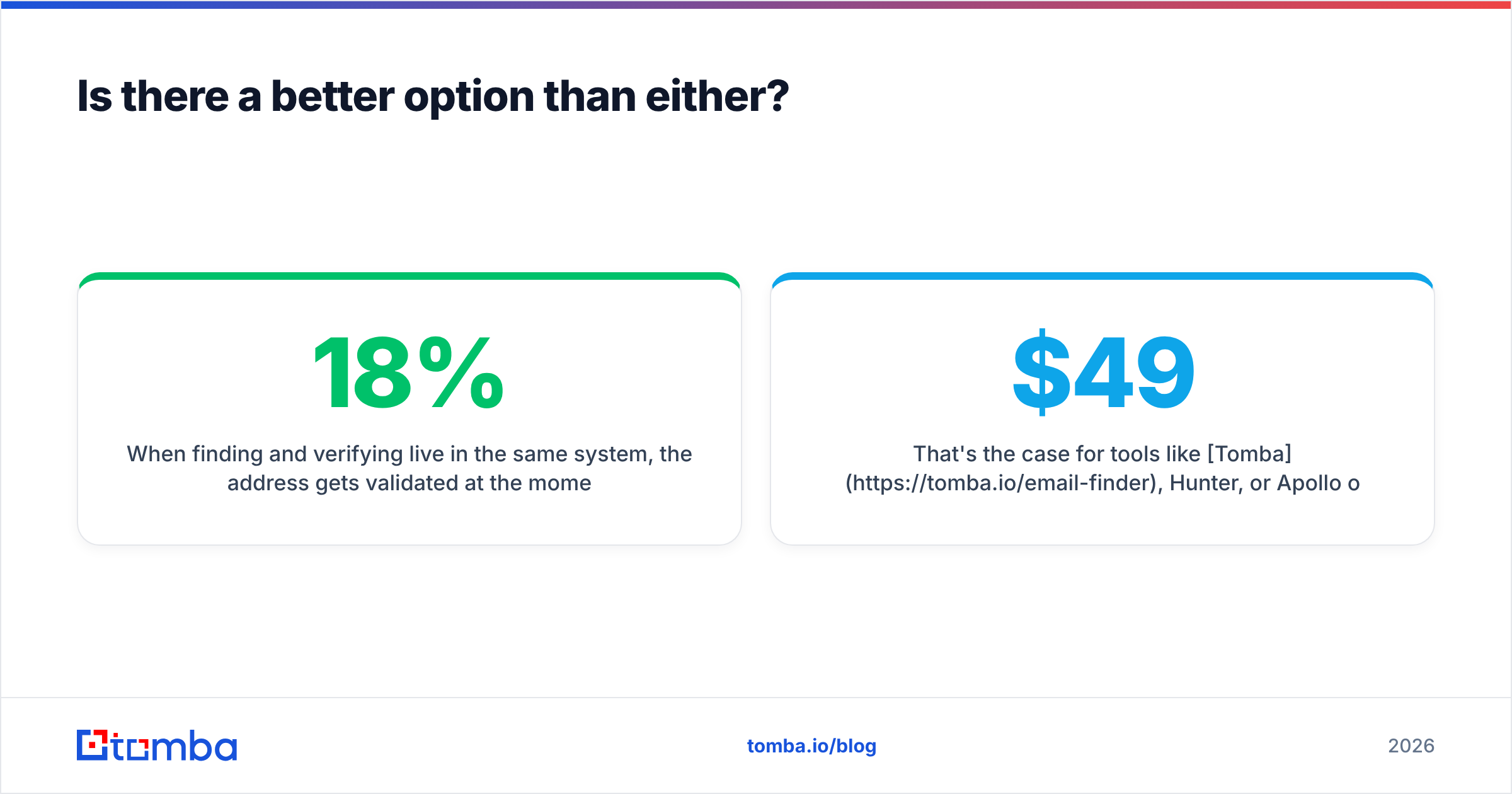
When finding and verifying live in the same system, the address gets validated at the moment it's discovered. You never build a list, wait a week, then discover 18% of it is dead. You never export a CSV, upload it somewhere else, download the result, and re-import it into your sequencer. Every one of those handoffs is a place where data goes stale and someone forgets a step.
That's the case for tools like Tomba, Hunter, or Apollo over the single-purpose stack. Tomba's version: domain search to pull every public address at a target company, plus the finder for named prospects. An email verifier runs inline, a dedicated catch-all verifier picks up the addresses other tools mark "unknown," and bulk processing handles list-scale jobs. One API key, one bill, one credit pool. Starter is $49/month, Growth $99, Pro $249, and there's a free tier at 25 searches per month if you want to test hit rate before paying anything.
The honest caveat: if you only need verification and you're verifying a million addresses a year, a specialist like EmailListVerify will beat a bundled platform on raw cost per check. Specialists usually win on unit economics at extreme volume. That's a real scenario — it's just not most teams' scenario.
What should you test before you buy either one?#
Run this EmailListVerify vs LeadZenAI test in an afternoon:
- Build a 100-contact control set from your real ICP, with addresses you already know are valid (existing customers, partners, people who've replied to you).
- Run the control set through each verifier. Count how many known-good addresses get marked invalid. False positives are the expensive error — they delete real pipeline.
- Search 20 target companies in the discovery tool. Record the hit rate: how many named prospects returned an email at all, before you even check whether it's correct.
- Check the catch-all bucket size. If more than 20% of your list lands in "unknown," you need a tool that resolves catch-alls, not one that just labels them.
- Send 50 emails. Real bounce data beats every vendor accuracy claim ever published.
- Time the workflow end to end. Count the exports, uploads, and manual steps. Multiply by how often you'll repeat it. That's the hidden cost of a two-vendor stack.
The bottom line#
EmailListVerify vs LeadZenAI is not really a contest. They aren't competitors. They are two different purchases that come out of the same budget. EmailListVerify is a sharp, cheap, honest verification utility with no ambitions beyond that. LeadZen.ai is a lead intelligence platform whose value depends almost entirely on whether your ICP sits inside its strongest data regions.
If you need to clean a list, buy the verifier. If you need to build one in APAC, trial LeadZen.ai. If you need both jobs done continuously and globally, stop buying halves.
Start with the Tomba Email Finder — find verified addresses by name, domain, or company, with verification and catch-all resolution running inline instead of as a separate batch job. The free tier gives you 25 searches a month to benchmark hit rate against your own target accounts before you spend anything. If the numbers hold up on your ICP, Starter is $49/month and replaces two line items with one.
Related guides#
Ready to find emails that actually work?
Join 150,000+ professionals who stopped guessing and started sending. Free credits on signup — no credit card required.
Get the Tomba newsletter
Practical outbound tactics and product updates — once every two weeks.
About the author