EmailListVerify vs SalesIntel: Which Tool Should You Buy?
EmailListVerify cleans lists you already have. SalesIntel sells you contacts you don't. Here's an honest breakdown of pricing, accuracy, coverage, and which one your outbound stack actually needs in 2026.
EmailListVerify vs SalesIntel is an odd matchup. One tool cleans the list you own. The other sells you a list you don't. Here's the short version first.
TL;DR
- They don't really compete. EmailListVerify is a bulk email verifier. SalesIntel is a B2B contact list you buy, with records checked by people and intent data.
- The budget gap is huge. EmailListVerify sells pay as you go credits for tens of dollars. SalesIntel is an annual contract, quote only, and it often runs to four or five figures.
- Pick EmailListVerify if bounce rate is your problem. Pick SalesIntel if you need US coverage, direct dials, and buying intent signals — and have the budget.
- Need both jobs on one bill? A tool that finds and checks emails (Tomba, Hunter, Findymail) is often cheaper for teams under 20 reps.
- No tool is 100% right. Catch-all domains break every SMTP checker. How a vendor deals with them matters more than the big number on its home page.
What exactly are EmailListVerify and SalesIntel?#
The most useful thing to know up front: these two tools sit at opposite ends of the same pipeline.
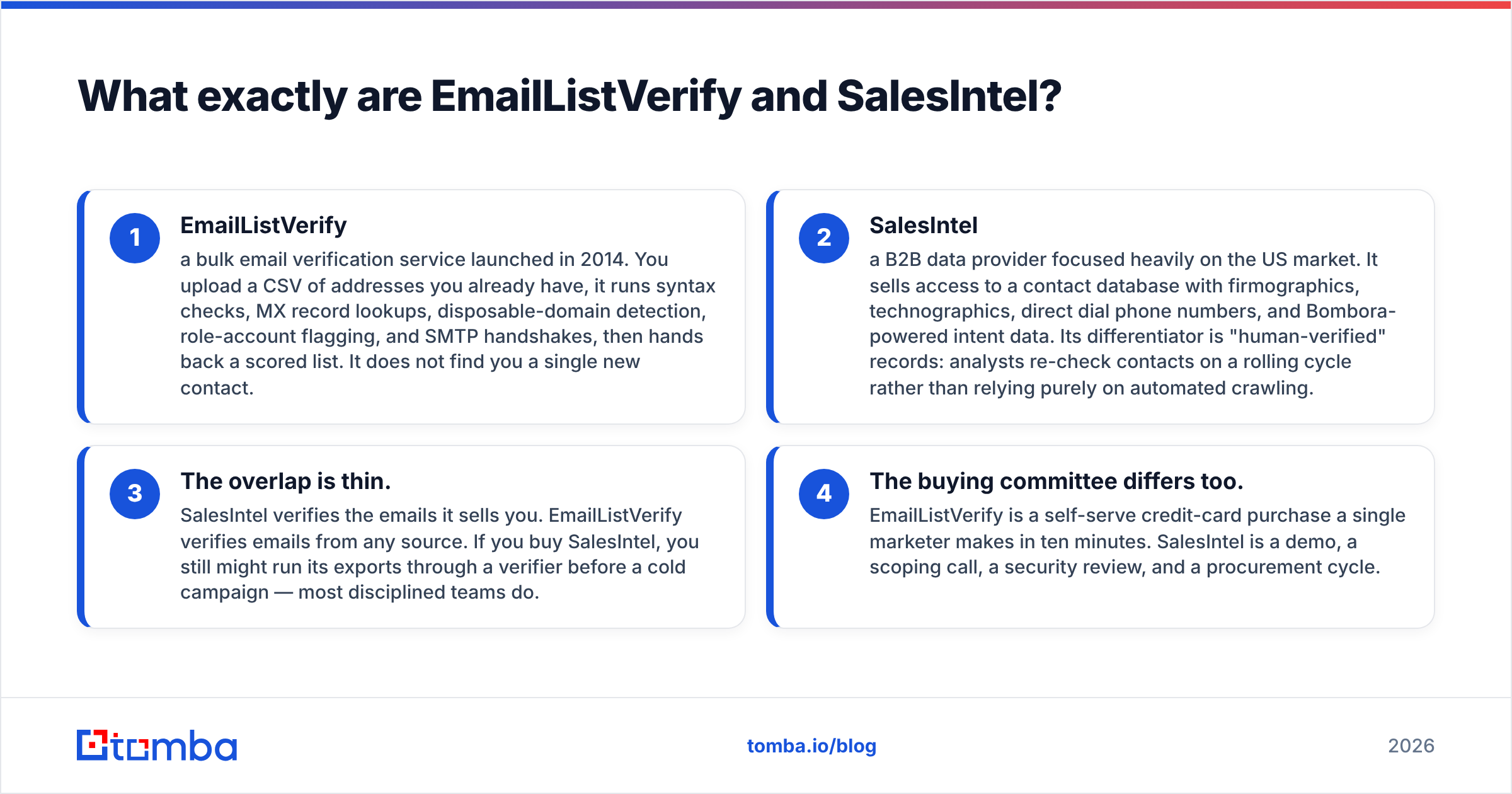
- EmailListVerify — a bulk email verification service, launched in 2014. You upload a CSV of emails you own. It runs syntax checks, MX record lookups, spam trap and role account flags, and SMTP handshakes. Then it hands back a scored list. It finds you no new contacts.
- SalesIntel — a B2B data provider aimed at the US market. It sells a contact list with company data, tech stack data, direct dial phone numbers, and Bombora intent data. Its edge is records checked by people, not by crawlers alone. Staff re-check contacts on a rolling cycle.
The overlap is thin. SalesIntel checks the emails it sells you. EmailListVerify checks emails from any source. Most careful teams still run SalesIntel exports through a checker before a cold campaign.
The buyers differ too. EmailListVerify is a credit card purchase one marketer makes in ten minutes. SalesIntel means a demo, a scoping call, a security review, and a buying cycle.
So the real question isn't "which is better." It's which layer of your problem is on fire right now — an empty pipeline, or a bounce rate that is burning your sender name.
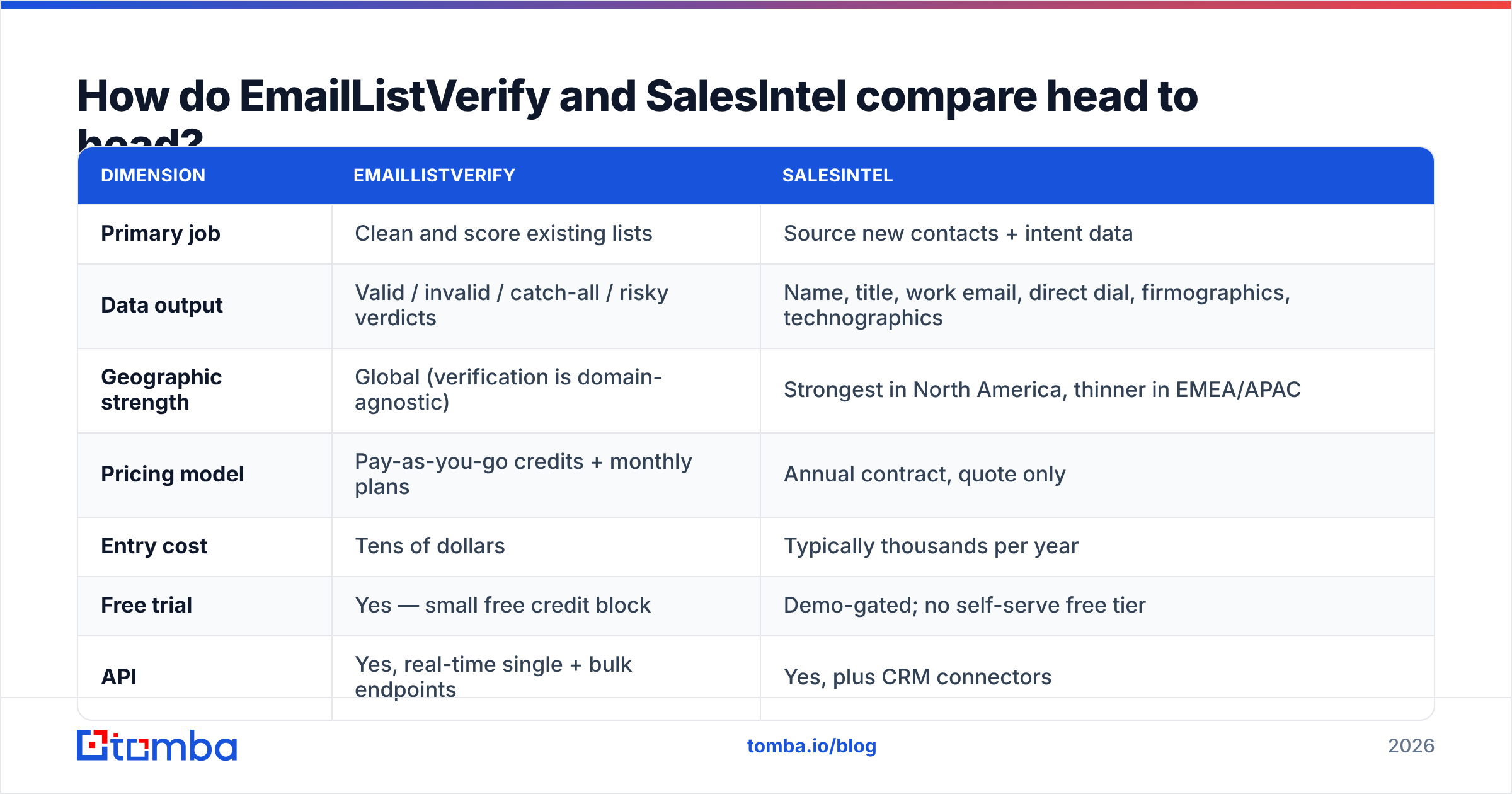
EmailListVerify vs SalesIntel: how do they compare head to head?#
| Dimension | EmailListVerify | SalesIntel |
|---|---|---|
| Primary job | Clean and score lists you own | Source new contacts + intent data |
| Data output | Valid / invalid / catch-all / risky | Name, title, work email, direct dial, company and tech data |
| Where it is strong | Global — any domain works | North America; thinner in EMEA and APAC |
| Pricing model | Credits, plus monthly plans | Annual contract, quote only |
| Entry cost | Tens of dollars | Often thousands per year |
| Free trial | Yes — a small free credit block | Demo first; no free tier |
| API | Yes, single and bulk | Yes, plus CRM apps |
| Direct dials | No | Yes — a core selling point |
| Intent data | No | Yes (Bombora) |
| Best for | Email ops teams, list cleanup, agencies | US enterprise SDR and ABM teams |
| Friction to buy | None — buy in 5 minutes | Sales call, legal, seat minimums |
Read that table as two shopping lists, not a scoreboard. An email ops lead will pick EmailListVerify at once. A VP of Sales chasing US mid-market will pick SalesIntel. Both are right.
Which one has better data quality?#
On EmailListVerify vs SalesIntel data quality, both vendors quote numbers near 95–97%. But they count different things.
The EmailListVerify claim is about the verdict. When it says an email is valid, does mail land? That is easy to test. Upload a list, send, then match the bounce log to the verdicts. In open tests, the main bulk tools — EmailListVerify, ZeroBounce, Bouncer, Clearout — sit within a few points of each other on clean domains. The gap grows on hard cases.
The SalesIntel claim is about how fresh a record is. Is this person still in this role, at this firm, on this number? Checks by staff are a real edge over crawler-only tools. They also explain the thin coverage. People cannot re-check every small firm in Europe.
Three things to test before you sign:
- Catch-all domains. A catch-all domain says yes to every address at the SMTP layer. A naive checker then returns "valid" for
asdfgh@company.com. Ask each vendor what share of your sample lands in "unknown" or "catch-all," and what they do with it. A tool that quietly marks those as valid is padding its own score. That is why a catch-all verifier is a product on its own. - Same sample, both vendors. Give each one the same 500 real target accounts from your ICP, not a generic list. Sample files from vendors are hand-picked.
- A real bounce test. Send the clean list from a warmed domain and count. The score they promise and the bounces you get are two different numbers. Only one of them moves your sender reputation.
One rule from working with both types of tool: treat any claim above 98% as ad copy until your own test says otherwise. Reviews on G2 help more than vendor benchmark pages. Read the two-star ones. They name the exact failure modes.
EmailListVerify vs SalesIntel: what does each one cost?#
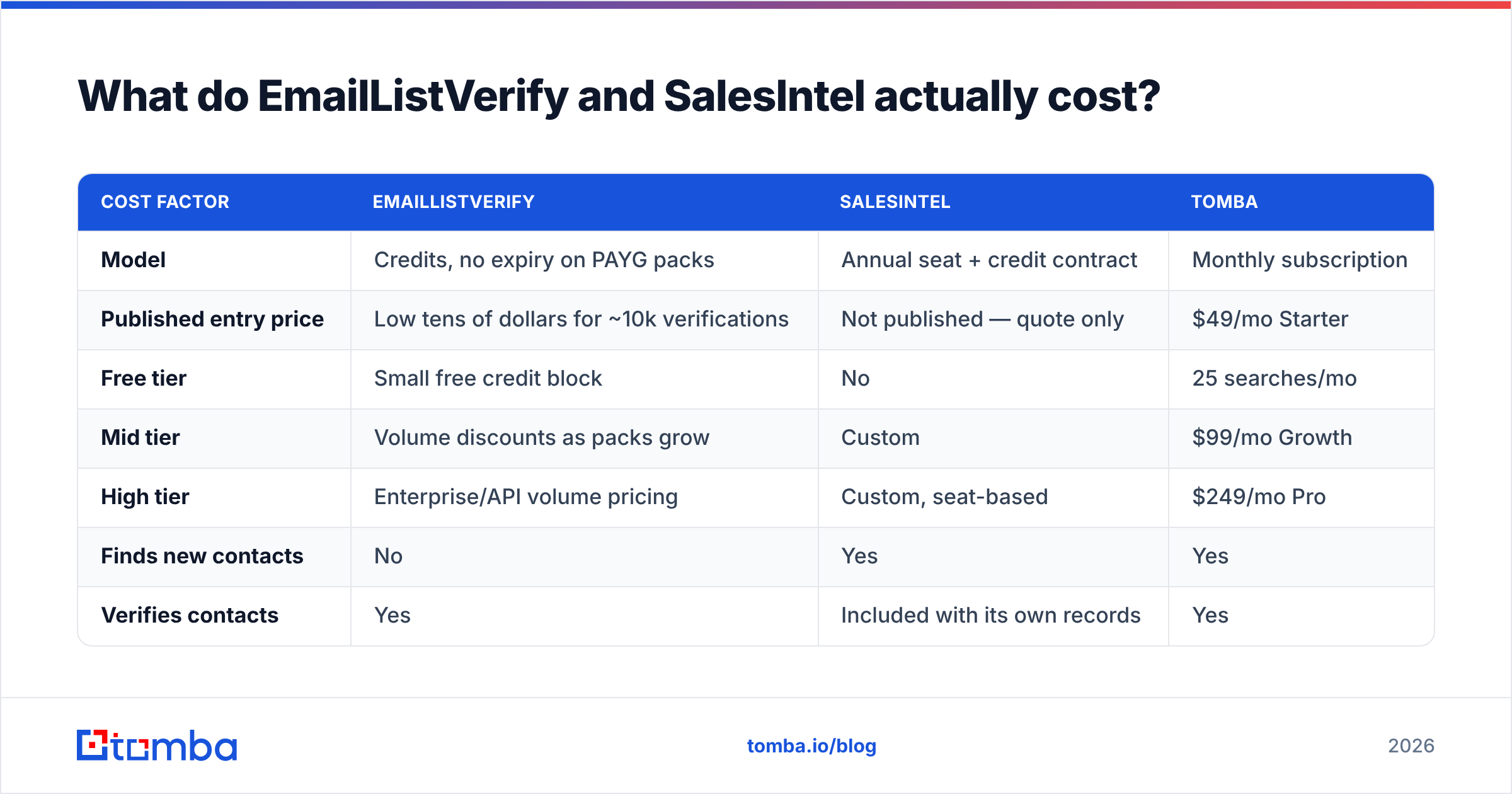
| Cost factor | EmailListVerify | SalesIntel | Tomba |
|---|---|---|---|
| Model | Credits, no expiry on prepaid packs | Annual seats plus credits | Monthly plan |
| Entry price | Low tens of dollars for ~10k checks | Not published — quote only | $49/mo Starter |
| Free tier | Small free credit block | No | 25 searches/mo |
| Mid tier | Bulk discounts as packs grow | Custom | $99/mo Growth |
| High tier | Custom volume and API pricing | Custom, by seat | $249/mo Pro |
| Finds new contacts | No | Yes | Yes |
| Checks contacts | Yes | Yes, for its own records | Yes |
| Commitment | None | 12 months, as a rule | Monthly |
Two notes on this table. First, the EmailListVerify rate per thousand moves with pack size and deals, so check their pricing page and not any blog's number, this one included. Second, SalesIntel publishes no list price at all. The ranges you see on review sites are deals other people cut. Yours will differ by seats, credits, and whether intent data is bundled.
The shape of the spend matters more than the figures. EmailListVerify is a cost you can switch off next month. SalesIntel is a budget line you commit to for a year. If you cannot promise twelve months of use, that gap should weigh on you.
Do you need both — or neither?#
Map your bottleneck onto EmailListVerify vs SalesIntel:
- "My bounce rate is 8% and Google is throttling us." That is a hygiene problem. EmailListVerify fixes it fast and cheap. SalesIntel would be a costly way to dodge cleaning the list you own.
- "We have no list at all for US plant VPs." That is a sourcing problem. A checker cannot create records. SalesIntel, ZoomInfo, Apollo, or BookYourData — a solid name in the bought-list space with strong US B2B reach — are the shortlist.
- "We need both, on a startup budget." This is the most common case. It is also where paying two vendors stops making sense. One tool that finds and checks drops a CSV export step, a second invoice, and a second vendor review.
Two more cases are easy to call:
- "We're doing ABM and need intent signals." Only SalesIntel does that here. Intent data is a real moat, not a check box.
- "We just need emails for firms we already picked." You need neither tool. Domain search on your account list, plus a checker, costs a fraction of a data contract.

Where does Tomba fit between them?#
Honestly: Tomba competes with the pair, not with either tool alone.
The core product is the email finder. Give it a name and a domain, or just a domain, and it returns work emails with a score. Around it sit an email verifier, catch-all checks, a phone finder, bulk processing, and enrichment. One plan covers both jobs, on the same credits.
Where Tomba is the better pick:
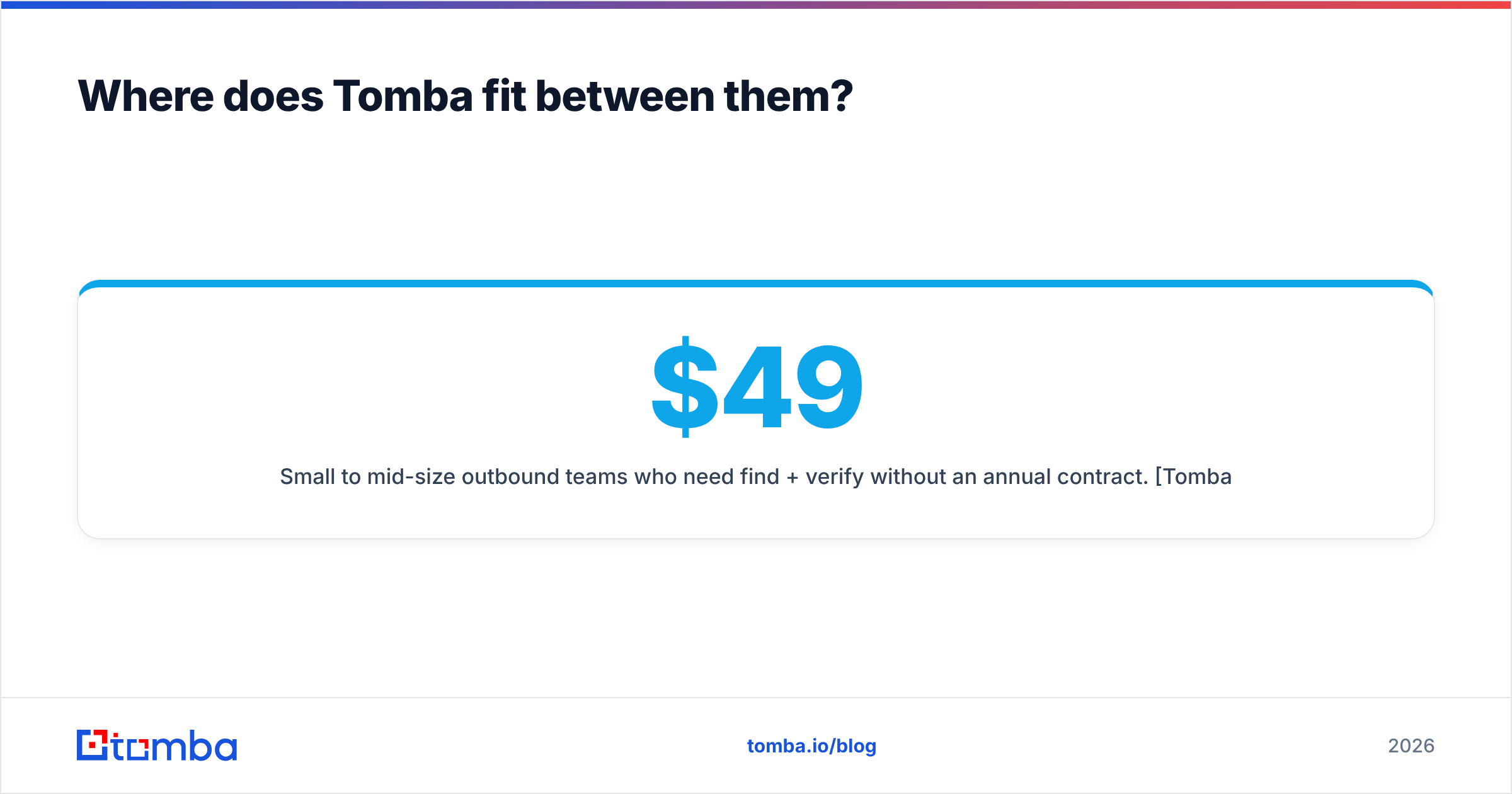
- Small and mid-size outbound teams who need to find and check, with no annual contract. Tomba pricing starts free at 25 searches a month, then $49/mo Starter, $99/mo Growth, and $249/mo Pro.
- Developers and RevOps who wire prospecting into a stack they already run. There is a documented API, a CLI, a Chrome add-on, a Google Sheets add-on, and HubSpot, Salesforce, and Zapier apps.
- Account list work. You know the 400 firms. You need the humans inside them.
Where Tomba is honestly not the answer:
- You need US direct dials at scale, plus buying intent signals. The SalesIntel phone layer and its Bombora tie-in are built for that motion. Tomba has a phone finder, but no intent data.
- You're cleaning a 5 million record legacy list. At that volume, a bulk tool priced per thousand — EmailListVerify included — beats a finder-first platform on unit cost. Use the right tool.
- You need deep filters on firm size, revenue, tech stack, and hiring signals as the main way you search. That is data vendor turf.
How should you run the evaluation?#
Settle EmailListVerify vs SalesIntel with a 90-minute test, not a three-week debate:
- Build one ICP sample. Take 300–500 real contacts across 50 accounts you want. Include some catch-all domains and some firms outside the US.
- Run the sourcing test. Ask SalesIntel, and any finder tool, for contacts at those 50 accounts. Score match rate and job title fit, not raw record count.
- Run the hygiene test. Push the same emails through EmailListVerify and a rival tool. Compare the valid, invalid, and catch-all splits. Big gaps tell you who is guessing.
- Send for real. Warmed domain, 200 emails, count the hard bounces. This is the only number that matters. Add a spam checker run so you don't blame the data for a copy problem.
- Price it per usable contact. Divide the annual spend by the contacts that were both right and reachable. That one metric usually ends the debate.
Most teams who run this test find something they don't like. The costly tool wins on reach in one segment and loses badly in another. The cheap one does just what it says on the tin. Buy on that.
The verdict on EmailListVerify vs SalesIntel#
Under 20 reps and buying one tool? Buy the one that finds contacts, then check them. An empty pipeline hurts more than a bounce rate that runs a bit high, and every serious finder ships checks with it.
Running a US enterprise SDR team with an ABM motion? SalesIntel earns its price. Direct dials checked by people, plus intent data, are hard for cheap tools to match.
Lists from events, webinars, form fills, and a ten-year-old CRM? EmailListVerify is the best $50 you'll spend this quarter. It won't grow your pipeline. It will stop you burning the domain you sell from.
And if the answer is "both jobs, one bill, no annual contract," start with the Tomba Email Finder. The free tier gives you 25 searches a month, so you can test match rates on your own account list before you spend a cent. Every email it returns is checked in the same flow. Run your ICP sample through it next to whichever tool you lean toward, and let the bounce log settle it.
Related guides#
Ready to find emails that actually work?
Join 150,000+ professionals who stopped guessing and started sending. Free credits on signup — no credit card required.
Get the Tomba newsletter
Practical outbound tactics and product updates — once every two weeks.
About the author