EmailOversight Alternatives: 8 Better Options for 2026
EmailOversight bundles validation, hygiene and append into one contract. Here's how eight alternatives — from Tomba to ZeroBounce — compare on price, accuracy, catch-all handling and API depth.
TL;DR
- EmailOversight is strongest at list hygiene — spam traps, complainers, litigators — not at finding new contacts. If your problem is "my list is dirty," it's a reasonable fit. If your problem is "I don't have a list," it's the wrong tool.
- Most teams shopping for EmailOversight alternatives want three things it doesn't lead on: transparent self-serve pricing, an email finder attached to the verifier, and a real developer API.
- For find + verify in one workflow, Tomba is the cheapest entry point at $49/mo Starter with a free tier. For pure high-volume hygiene, ZeroBounce and Bouncer are the closest like-for-like swaps.
- Catch-all domains are where verification vendors quietly diverge. Ask every vendor how they score catch-alls before you sign anything.
- Budget 2–4 hours to run a 500-address head-to-head. The results differ enough between vendors to change your decision.
What is EmailOversight, and what does it actually do?#
EmailOversight is a US-based email list hygiene and validation vendor. Its pitch is "multi-method" verification: instead of only running an SMTP handshake against the mail server, it also cross-references proprietary hygiene lists — known spam traps, chronic complainers, litigators, and bot-generated opens — and flags them before they reach your ESP.
That's a genuinely different product from a syntax-plus-SMTP checker. If you're an email service provider, an affiliate network, or a lead-gen business buying third-party data, spam-trap detection is the difference between a working sending domain and a burned one. EmailOversight also sells email append (give it a postal record, get an email back) and real-time API validation at the form level.
What it does not do is prospecting. There's no "find the email address of the VP of Engineering at Acme" workflow. That's the fault line running through this entire comparison: hygiene vendors clean lists you already own, while email finder platforms create lists you don't. Most go-to-market teams need both, and increasingly want them from one vendor.
Check emailoversight.com for the current feature set — like most vendors in this space, packaging shifts year to year.
Why do teams look for EmailOversight alternatives?#
Four recurring reasons show up in G2 reviews and in the buying conversations I've sat in on:
- Pricing opacity. Credit packs and enterprise quotes are normal for hygiene vendors, but a two-person SDR team doesn't want a sales call to test 1,000 addresses. Self-serve competitors win these buyers by default.
- No prospecting layer. You clean the list, then you still need a separate tool to build the next one. Two vendors, two contracts, two data models to reconcile in your CRM.
- API depth and DX. Teams building internal tooling want documented REST endpoints, SDKs, webhooks, and ideally a CLI. Hygiene-first vendors historically treated the API as an add-on rather than the product.
- Overkill for the job. Spam-trap and litigator detection matters enormously if you're mailing purchased consumer lists. If you're sending 200 personalized B2B emails a week to contacts you sourced yourself, you're paying for insurance against a risk you don't carry.
If reasons 2 and 3 are yours, you're not really looking for a hygiene vendor at all — you're looking for a combined finder-and-verifier.
What should you compare in an EmailOversight alternative?#
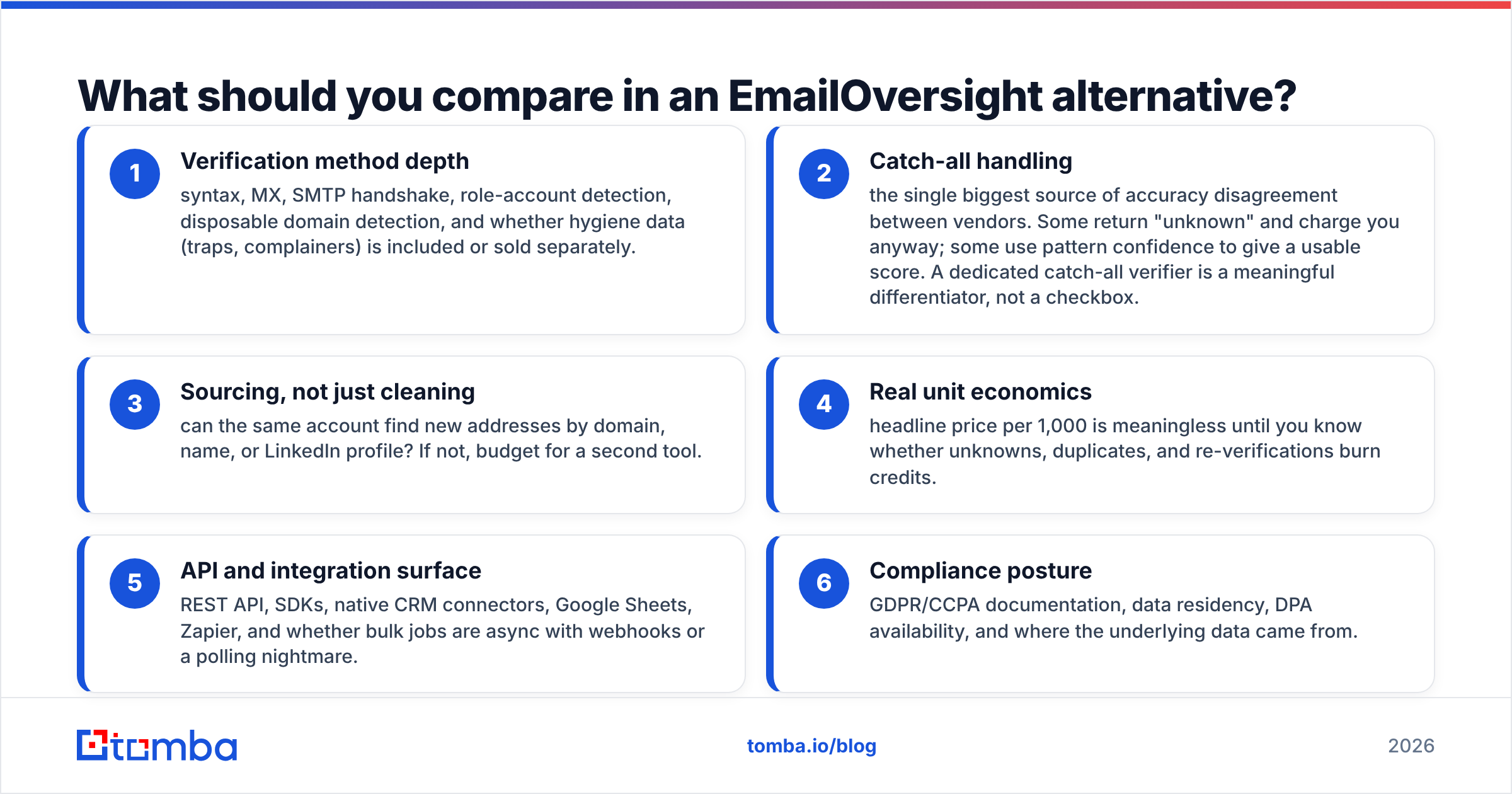
Ignore the marketing pages and score vendors on these six dimensions:
- Verification method depth — syntax, MX, SMTP handshake, role-account detection, disposable domain detection, and whether hygiene data (traps, complainers) is included or sold separately.
- Catch-all handling — the single biggest source of accuracy disagreement between vendors. Some return "unknown" and charge you anyway; some use pattern confidence to give a usable score. A dedicated catch-all verifier is a meaningful differentiator, not a checkbox.
- Sourcing, not just cleaning — can the same account find new addresses by domain, name, or LinkedIn profile? If not, budget for a second tool.
- Real unit economics — headline price per 1,000 is meaningless until you know whether unknowns, duplicates, and re-verifications burn credits.
- API and integration surface — REST API, SDKs, native CRM connectors, Google Sheets, Zapier, and whether bulk jobs are async with webhooks or a polling nightmare.
- Compliance posture — GDPR/CCPA documentation, data residency, DPA availability, and where the underlying data came from.
That last point deserves more weight than it usually gets. Ask any vendor to explain where their data comes from in writing. A vendor that can't answer clearly is a vendor whose contracts your legal team will eventually unwind.
How do the top EmailOversight alternatives compare?#
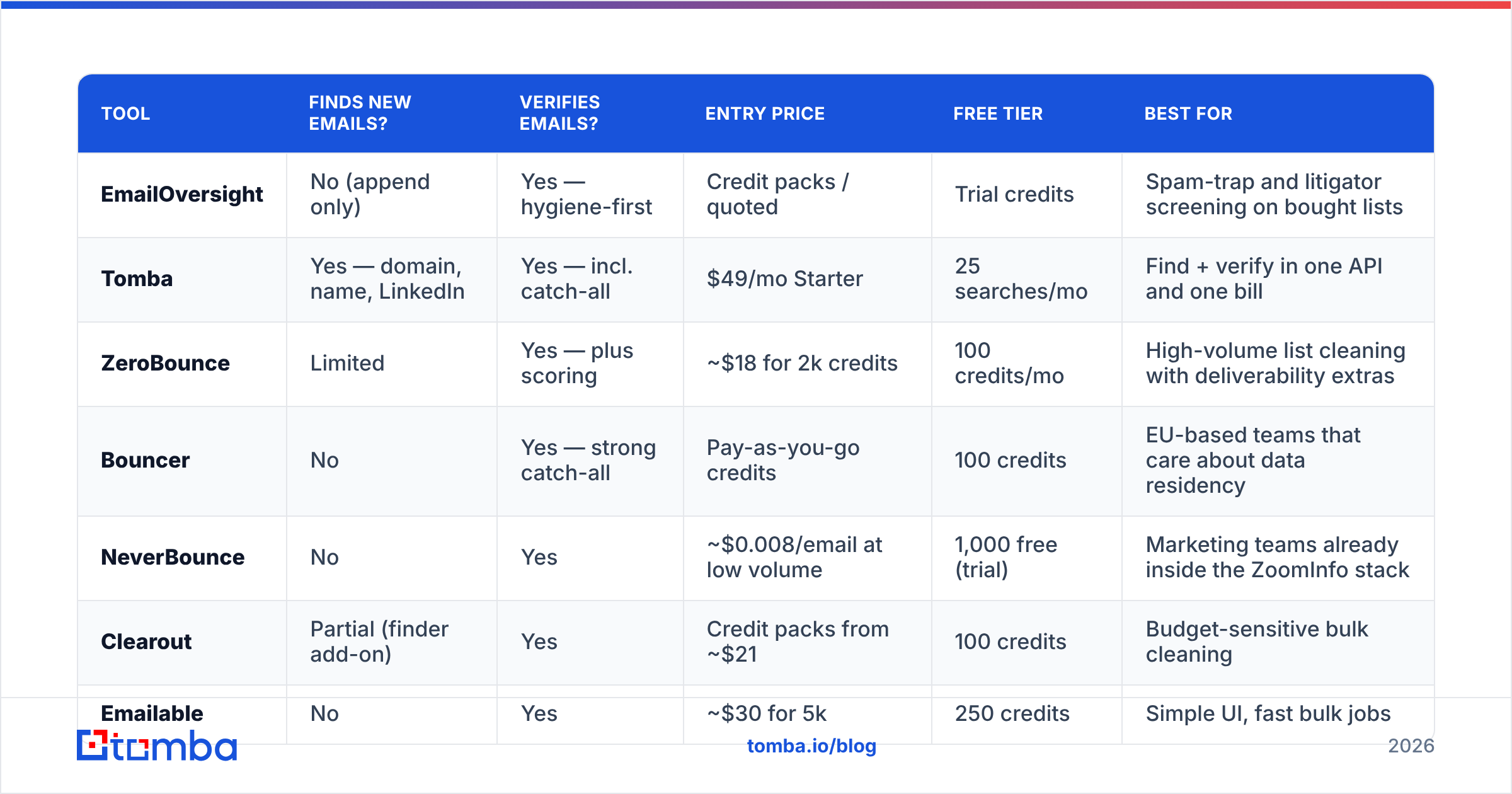
Prices below are approximate self-serve entry points as of early 2026 and move frequently — treat them as a shortlist filter, then confirm on each vendor's own pricing page.

| Tool | Finds new emails? | Verifies emails? | Entry price | Free tier | Best for |
|---|---|---|---|---|---|
| EmailOversight | No (append only) | Yes — hygiene-first | Credit packs / quoted | Trial credits | Spam-trap and litigator screening on bought lists |
| Tomba | Yes — domain, name, LinkedIn | Yes — incl. catch-all | $49/mo Starter | 25 searches/mo | Find + verify in one API and one bill |
| ZeroBounce | Limited | Yes — plus scoring | ~$18 for 2k credits | 100 credits/mo | High-volume list cleaning with deliverability extras |
| Bouncer | No | Yes — strong catch-all | Pay-as-you-go credits | 100 credits | EU-based teams that care about data residency |
| NeverBounce | No | Yes | ~$0.008/email at low volume | 1,000 free (trial) | Marketing teams already inside the ZoomInfo stack |
| Clearout | Partial (finder add-on) | Yes | Credit packs from ~$21 | 100 credits | Budget-sensitive bulk cleaning |
| Emailable | No | Yes | ~$30 for 5k | 250 credits | Simple UI, fast bulk jobs |
| BookYourData | Yes — prebuilt B2B lists | Yes — accuracy guarantee | Pay-per-contact | Sample records | Buying a targeted list outright instead of building one |
| Kickbox | No | Yes — Sendex score | ~$5 for 500 | 100 verifications | ESPs needing a reputation-aware score |
Two things stand out in that table. First, only three entries can find an address you don't already have. Second, the price spread on pure verification is narrow — roughly $0.004 to $0.010 per address across the whole market. Nobody wins on price alone at that range, so accuracy and workflow are what you're actually buying.
Which EmailOversight alternatives are worth testing in 2026?#
Tomba — best when you need to find and verify in one place#
Tomba is an email finder first, with verification built alongside it: email verifier, domain search, catch-all verifier, phone finder, and enrichment all run off the same account and the same credit pool. That matters operationally. Instead of exporting from a finder, importing to a verifier, and reconciling two exports, you call one API and get a scored address back.
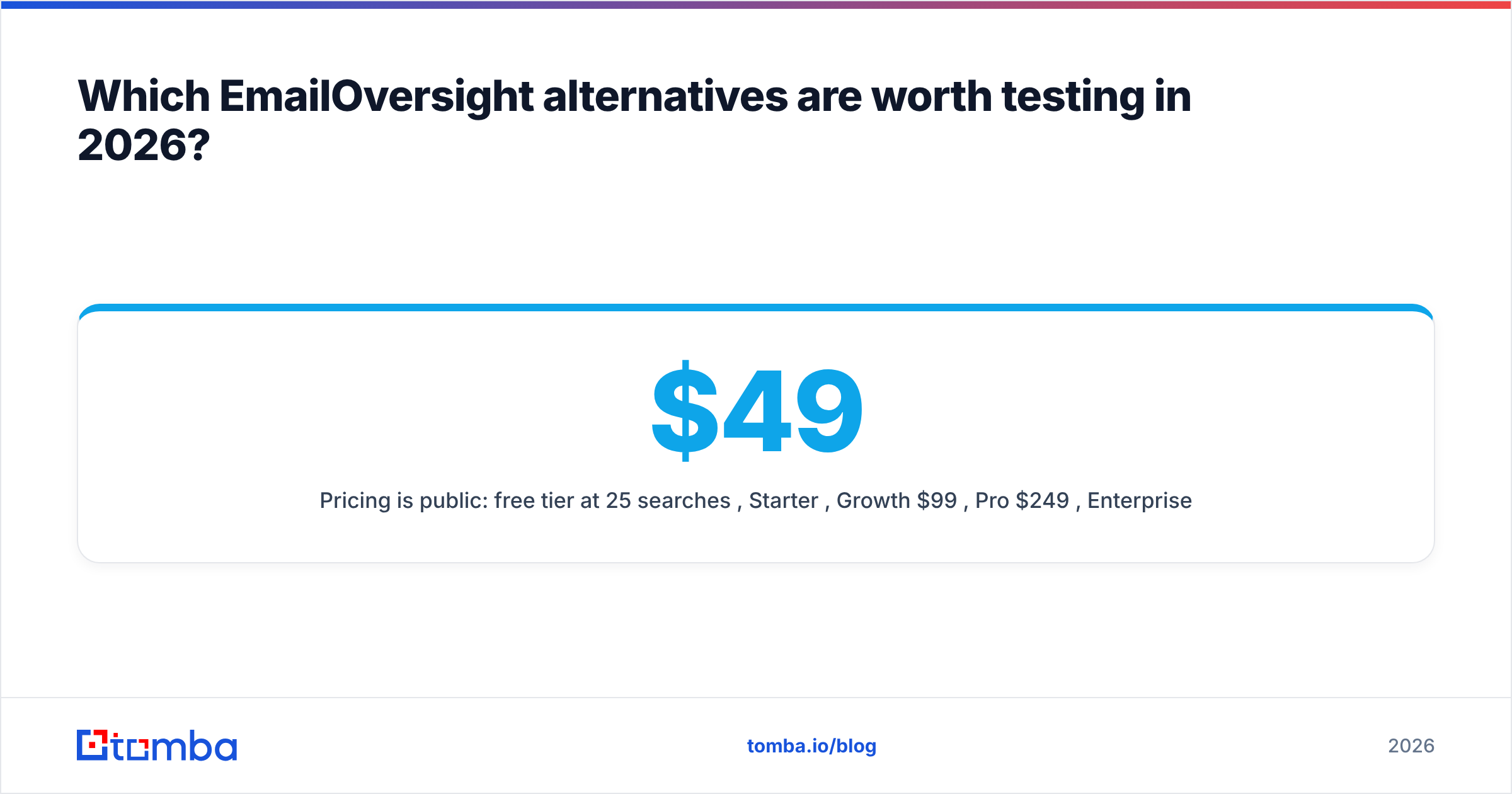
Pricing is public: free tier at 25 searches/mo, Starter $49/mo, Growth $99/mo, Pro $249/mo, Enterprise quoted. Full Tomba pricing is on the site — no sales call to see the numbers. There's a REST API, a CLI, an MCP server, a Chrome extension, and Sheets/Excel/Airtable add-ins, which covers most of the "can my ops person automate this?" objections.
Where it's not the answer: if your core problem is screening a purchased consumer list for litigators and honeypots, a hygiene-specialist vendor is closer to your job to be done.
ZeroBounce — the closest like-for-like hygiene swap#
ZeroBounce is the most direct substitute for EmailOversight's core function. You get validation, abuse/complainer detection, activity data, plus adjacent deliverability tooling like inbox placement testing and blacklist monitoring. Volume pricing gets aggressive above a few hundred thousand records. It's also the safest political choice internally — nobody gets fired for picking the market leader.
Bouncer — strong catch-all logic, EU data residency#
Bouncer's differentiator is how it handles catch-all domains and its European hosting, which shortens the GDPR conversation for EU buyers. Pay-as-you-go credits don't expire on most plans, which suits irregular cleaning cycles better than a monthly subscription.
NeverBounce — fine if you're already in that ecosystem#
Solid, unremarkable, and well-integrated with the broader ZoomInfo product family. If your company already pays for that stack, the marginal cost of adding it is low. If not, there's little reason to prefer it over the others here.
Clearout — cheapest credible bulk option#
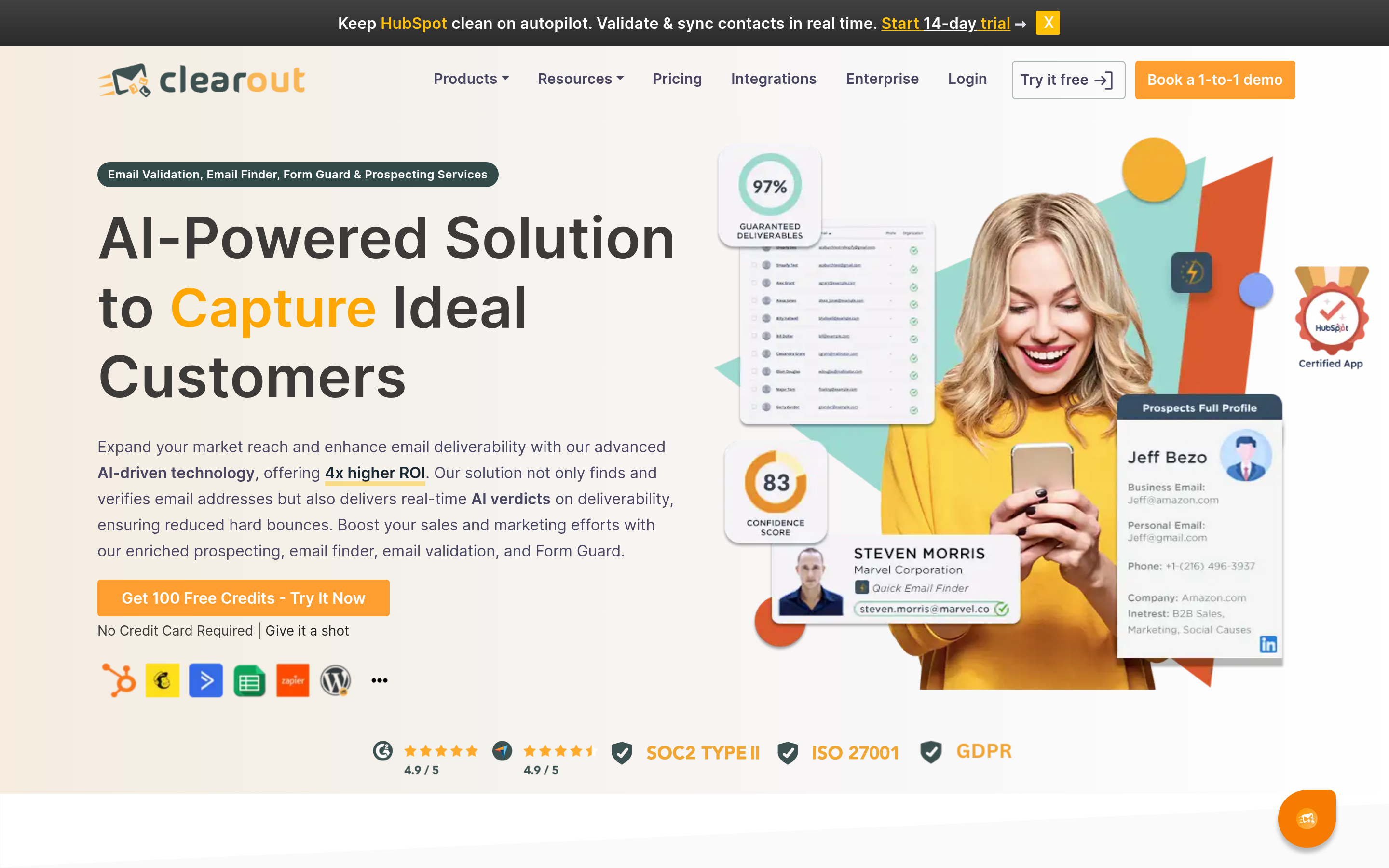
Clearout consistently prices below the field and bundles a light prospecting add-on. The UI is dense and the support experience is less polished than ZeroBounce's, but for a one-off clean of 250,000 records the math is hard to argue with.
Emailable — best plain-English UI#
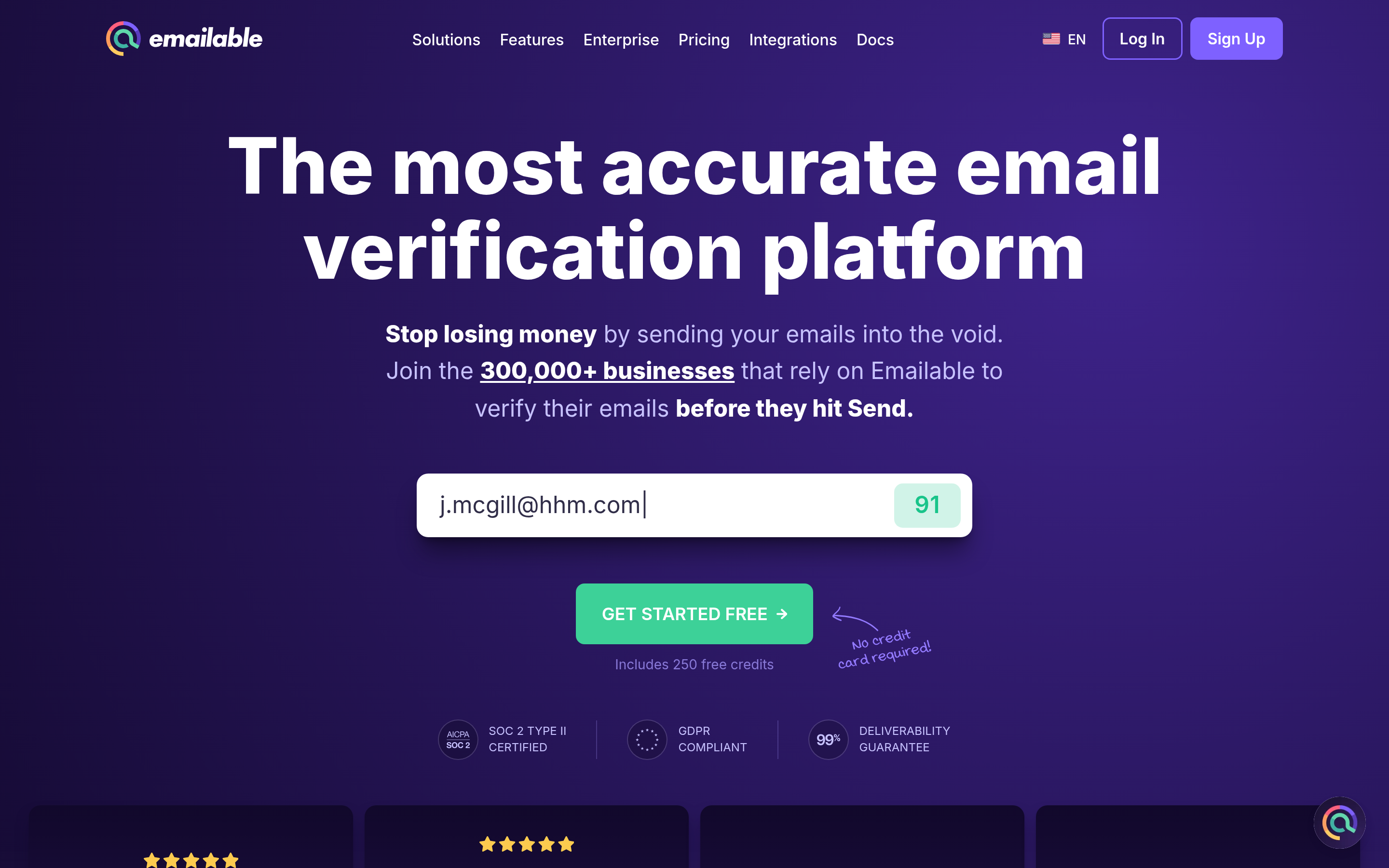
If a non-technical marketer will be the one uploading CSVs every month, Emailable's interface reduces support tickets. Feature depth is narrower than ZeroBounce's, but the core validation is competitive.
BookYourData — when you'd rather buy the list than build it#
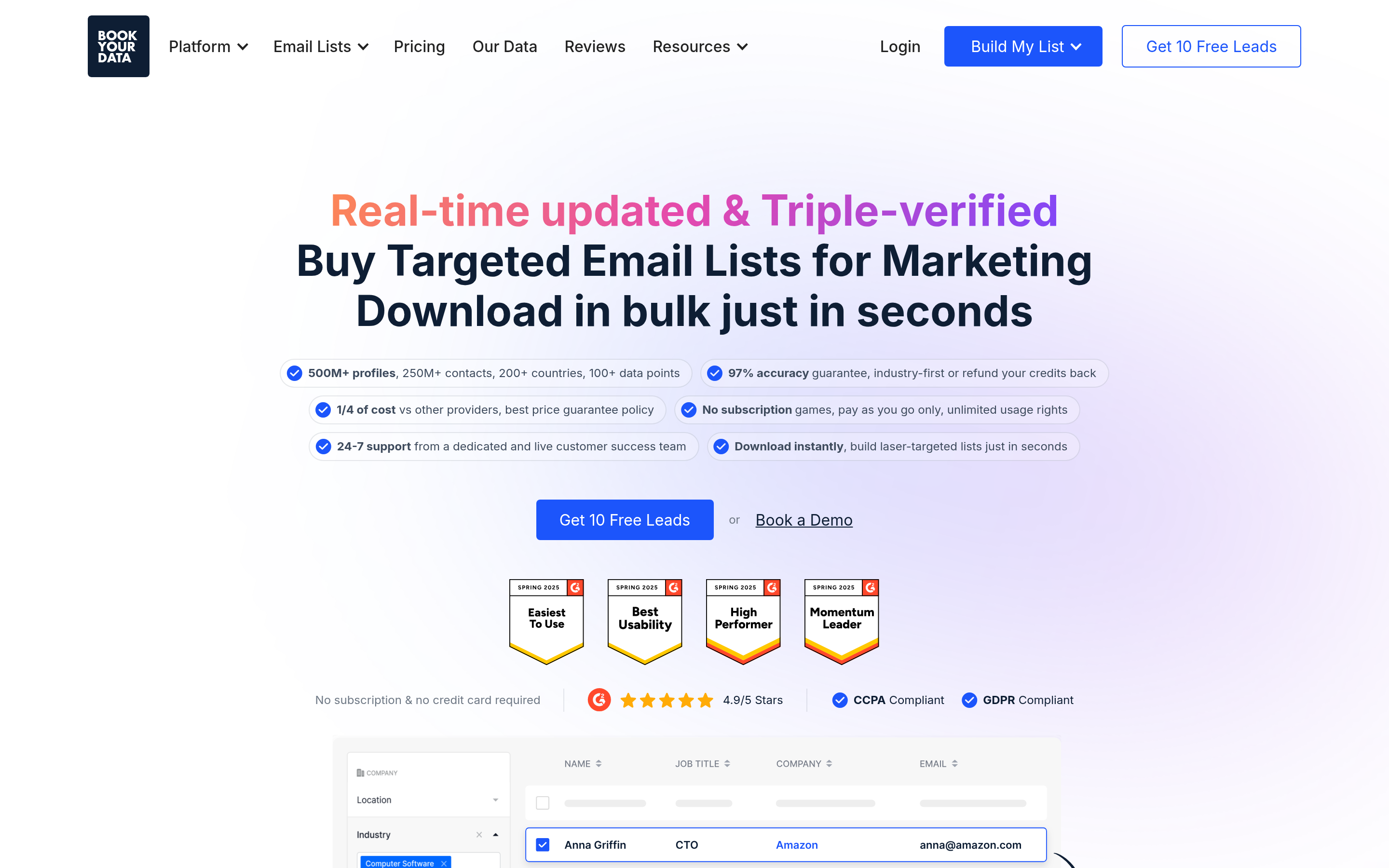
BookYourData solves a different half of the problem: it sells prebuilt, targeted B2B contact lists with an accuracy guarantee and pay-per-contact pricing, so there's no subscription to justify. If your bottleneck is "we need 5,000 verified marketing directors in DACH by Friday" rather than "our existing list is decaying," it's a strong, well-regarded option — and it pairs cleanly with a finder like Tomba for the accounts a prebuilt list doesn't cover.
Kickbox — reputation-aware scoring for senders#
Kickbox's Sendex score blends validity with a reputation signal, which ESPs and high-volume senders find useful for segmenting risky addresses rather than binary accept/reject.
How accurate are these tools really?#
Accuracy claims in this category are close to meaningless as published. Every vendor advertises 95–99%, and every vendor is measuring something slightly different — some exclude catch-alls and unknowns from the denominator, some count "accept-all" as a pass, some benchmark against a hand-curated list that flatters their method.

The only number that matters is your bounce rate on your list, in your ESP. Here's how to get it in an afternoon:
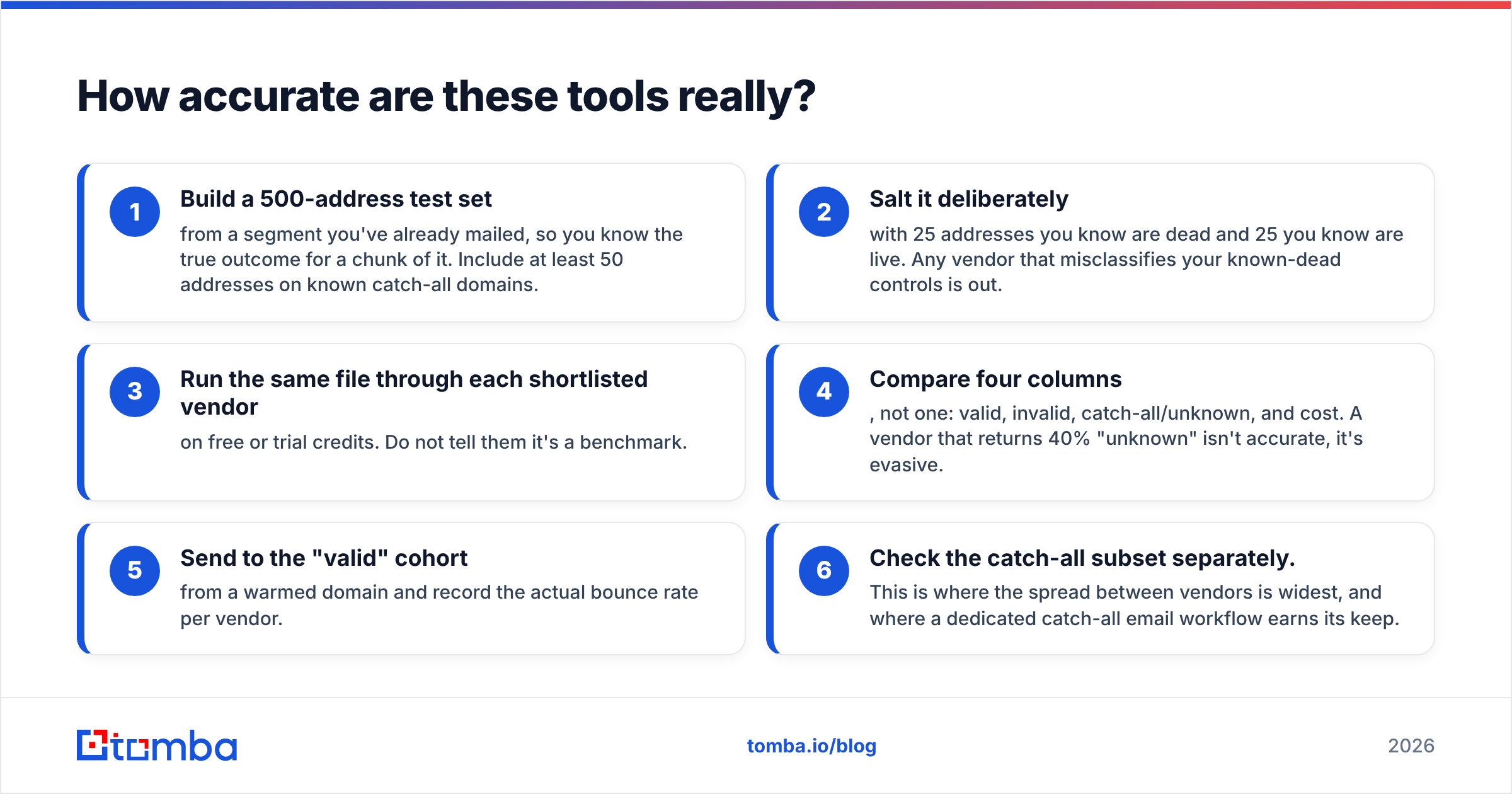
- Build a 500-address test set from a segment you've already mailed, so you know the true outcome for a chunk of it. Include at least 50 addresses on known catch-all domains.
- Salt it deliberately with 25 addresses you know are dead and 25 you know are live. Any vendor that misclassifies your known-dead controls is out.
- Run the same file through each shortlisted vendor on free or trial credits. Do not tell them it's a benchmark.
- Compare four columns, not one: valid, invalid, catch-all/unknown, and cost. A vendor that returns 40% "unknown" isn't accurate, it's evasive.
- Send to the "valid" cohort from a warmed domain and record the actual bounce rate per vendor.
- Check the catch-all subset separately. This is where the spread between vendors is widest, and where a dedicated catch-all email workflow earns its keep.
Teams that run this test are usually surprised. The vendor with the best marketing rarely wins outright, and the gap on catch-alls between best and worst is routinely 20 percentage points or more.
Is EmailOversight still worth keeping?#
Yes — in one specific scenario. If you mail purchased or co-registration consumer data at volume, spam-trap and litigator screening is a real, insurable risk-reduction service, and hygiene specialists do it better than generalist verifiers. Dropping that layer to save a few hundred dollars a month is a bad trade when a single litigator on your list can cost five figures.
For everyone else — B2B teams building targeted outbound lists, agencies running client campaigns, RevOps teams enriching CRM records — the calculus points the other way. You need sourcing as much as cleaning, you need a documented API, and you need pricing you can approve without a procurement cycle. That's a combined finder-verifier, not a hygiene specialist.
A practical middle path: keep a hygiene vendor for the once-a-quarter deep clean of your full database, and run a finder-verifier for day-to-day prospecting and pre-send checks. The costs don't overlap much because the volumes are so different.
Where should you start?#
Shortlist three, not eight. Pick one hygiene specialist (ZeroBounce or Bouncer), one combined platform (Tomba), and one wildcard that matches your specific constraint — BookYourData if you'd rather buy lists than build them, Kickbox if you're an ESP, Clearout if price dominates. Run the 500-address test above. Decide in a week.
If the reason you're reading this is that EmailOversight cleans your list but doesn't grow it, start with the Tomba Email Finder. The free tier gives you 25 searches a month with no card, which is enough to check whether it finds the contacts your current stack misses, and the $49/mo Starter plan is cheaper than most single-purpose verifiers once you account for the second tool you're no longer paying for.
Related guides#
Ready to find emails that actually work?
Join 150,000+ professionals who stopped guessing and started sending. Free credits on signup — no credit card required.
Get the Tomba newsletter
Practical outbound tactics and product updates — once every two weeks.
About the author