EmailValidation.io vs FinalScout: Which Tool Wins in 2026?
One verifies emails you already have. The other scrapes them off LinkedIn. Here's the honest breakdown of EmailValidation.io vs FinalScout — accuracy, pricing, risk, and which one your workflow actually needs.
EmailValidation.io vs FinalScout is an odd matchup. One tool checks emails you already have. The other pulls new ones off LinkedIn. Here is how to tell which job you actually have.
TL;DR
- EmailValidation.io vs FinalScout is not a fair fight. One is a verification API. The other is a LinkedIn email extractor with AI copywriting. Buyers compare them only because both show up in the same search: "how do I get valid B2B emails."
- Pick EmailValidation.io if you already have a list. It is cheap, developer-friendly, and drops into a signup form or CRM.
- Pick FinalScout if your prospecting starts on LinkedIn. You get contacts plus first-draft outreach copy in one tab.
- Neither one closes the loop alone. FinalScout finds but does not verify deeply. EmailValidation.io verifies but never finds.
- Want discovery and verification and an API on one bill? A combined platform like Tomba (free tier, then $49/mo) usually beats stitching two point tools together.
What are EmailValidation.io and FinalScout?#
EmailValidation.io is a REST API that checks whether an email address is real. You send an address. It returns a JSON verdict: syntax valid, domain resolvable, MX records present, mailbox reachable over SMTP, disposable, role-based, free provider, catch-all, plus a quality score. That is the whole product. There is a small web UI, but the endpoint is the real feature. It is built to sit inside your signup form, your lead router, or a nightly cleanup job.
FinalScout sits at the other end of the funnel. It is a Chrome extension plus web app. It pulls business email addresses from LinkedIn profiles, Sales Navigator searches, group members, event attendees, and post engagers. It adds ChatGPT-powered email drafting on top. So you go from "this person looks like a fit" to a personalized first email without leaving the tab. It advertises high deliverability on the addresses it returns.
So the honest framing: EmailValidation.io is a quality gate. FinalScout is a lead source. You are rarely choosing between them for the same job. You are choosing which problem you have.

EmailValidation.io vs FinalScout: how do they differ?#
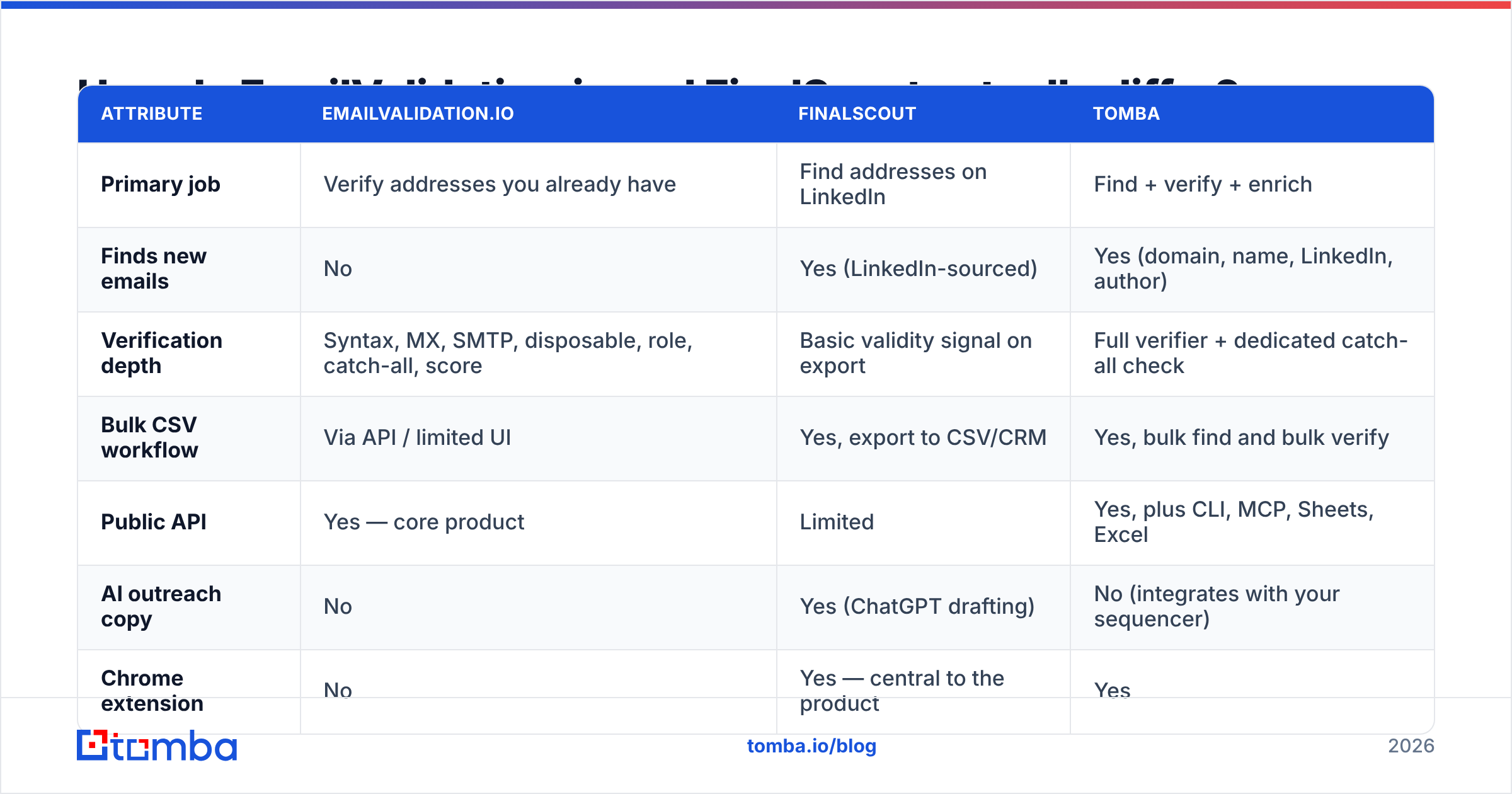
Here is the side-by-side on the details that change your buying decision.
| Attribute | EmailValidation.io | FinalScout | Tomba |
|---|---|---|---|
| Primary job | Verify addresses you already have | Find addresses on LinkedIn | Find + verify + enrich |
| Finds new emails | No | Yes (LinkedIn-sourced) | Yes (domain, name, LinkedIn, author) |
| Verification depth | Syntax, MX, SMTP, disposable, role, catch-all, score | Basic validity signal on export | Full verifier + dedicated catch-all check |
| Bulk CSV workflow | Via API / limited UI | Yes, export to CSV/CRM | Yes, bulk find and bulk verify |
| Public API | Yes — core product | Limited | Yes, plus CLI, MCP, Sheets, Excel |
| AI outreach copy | No | Yes (ChatGPT drafting) | No (integrates with your sequencer) |
| Chrome extension | No | Yes — central to the product | Yes |
| Platform-risk exposure | None | LinkedIn ToS / account risk | Low (extension is opt-in, not the core) |
| Free tier | Yes, small monthly quota | Yes, small monthly quota | Yes — 25 searches/mo |
| Best fit | Engineers, form validation, list hygiene | SDRs living in Sales Navigator | Teams needing one pipeline end to end |
Vendor pricing and quotas move often. Treat the plan figures below as directional. Confirm them on each vendor's own pricing page before you commit.
Which one is more accurate?#
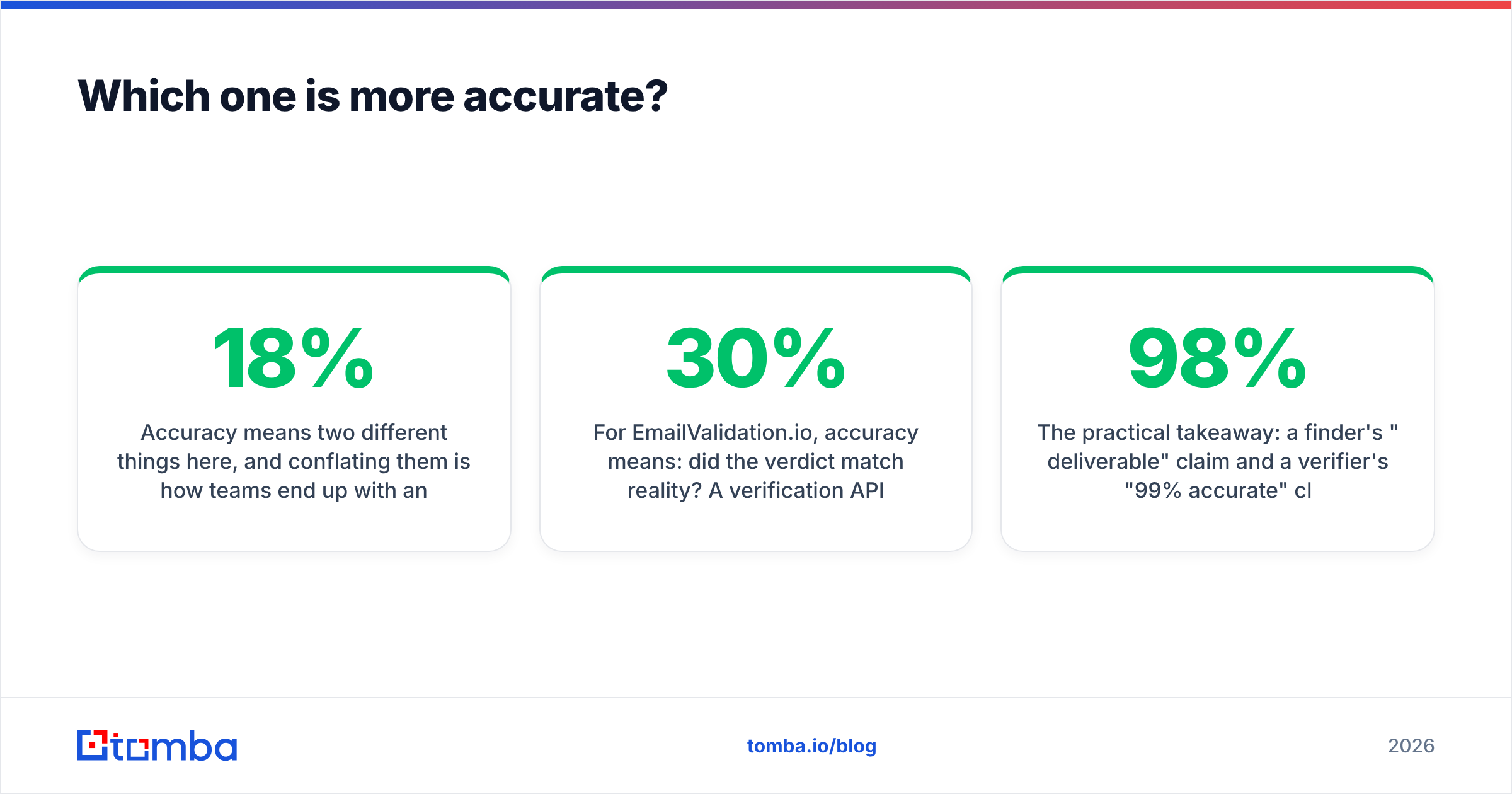
Accuracy means two different things here. Mixing them up is how teams end up with an 18% bounce rate.
For EmailValidation.io, accuracy means one thing: did the verdict match reality? A verification API is judged on false positives and false negatives. A false positive says valid and then bounces. A false negative says invalid on an address that would have landed — a silent revenue leak nobody measures. EmailValidation.io handles the standard stack well: syntax parsing, DNS/MX lookup, SMTP handshake, and disposable-domain detection.
Every SMTP-based verifier struggles with the same thing: catch-all domains. Those servers accept mail for any address at the domain. No handshake can tell jane@acme.com from asdkjh@acme.com there. So most tools return "unknown" or "risky" and hand the problem back to you. If your list is heavy on enterprise domains, that unknown bucket can be 20–30% of your file.
For FinalScout, accuracy means something else: is the address really that person's work email? That is a pattern-matching problem, not a handshake problem. FinalScout claims high deliverability on returned contacts. That is believable for well-covered profiles at companies with predictable email formats. Coverage drops for smaller companies, non-US regions, and contractors. It also drops for anyone who changed jobs and forgot to update the profile. LinkedIn data goes stale fast.

The takeaway is simple. A finder's "98% deliverable" claim and a verifier's "99% accurate" claim measure different things. Neither survives a messy real-world list unless you run both steps. Run only discovery and you ship guesses. Run only verification and you polish a list you had to source somewhere else.
Do a sanity check before you trust any number. Ask the vendor what happens to catch-all domains. Ask whether "unknown" results are billed. Ask what share of your test file came back unknown. Then run 500 of your own records, not their demo list. For a neutral read, where the data comes from matters more than the headline percentage.
What does EmailValidation.io do best?#
Four cases where it is clearly the right call:
- Real-time form validation. One API call at signup blocks typos, disposable addresses, and role accounts before they reach your CRM. This is the highest-ROI use of any verification API. FinalScout does not play here at all.
- Nightly list hygiene. Run a cron job over your active database, flag dead addresses, and suppress them before the next send. B2B email data decays about 2–3% per month. Hygiene is maintenance, not a one-off.
- Developer-first stacks. Clean REST, predictable JSON, per-request pricing. If your team would rather write 30 lines than click through a dashboard, this fits.
- Cheap insurance before a big send. Verifying a 50k list costs far less than a 12% bounce rate on a domain you spent a year warming.
What it will never do is produce a new contact. If your problem is "I don't have enough prospects," this is the wrong purchase.
What does FinalScout do best?#
FinalScout wins when LinkedIn is your prospecting motion:
- Sales Navigator extraction at volume. Run a filtered search, pull the list, and get emails attached to profiles you already qualified by eye. That loop is genuinely fast.
- Event and group scraping. Webinar attendees and niche group members are high-intent segments. Most database tools cannot reproduce them.
- Copy on the same screen. The ChatGPT layer lets an SDR write an opener that references the profile they just read. Whether AI openers beat a good human template is a separate debate. The time saved is real.
- Non-technical users. No API keys and no CSV gymnastics. Install the extension, click, export.
The caveats are just as real. Scraping tools sit in tension with the LinkedIn User Agreement, and heavy extraction can put a rep's personal account at risk. That is a business risk you accept, not a footnote. Coverage is also capped by LinkedIn itself: no profile, no contact. And exported addresses still deserve a pass through a proper email verifier before they hit a sequencer. "High deliverability" at the vendor level says nothing about your specific 400 rows.
What do they cost, and where do the hidden costs hide?#
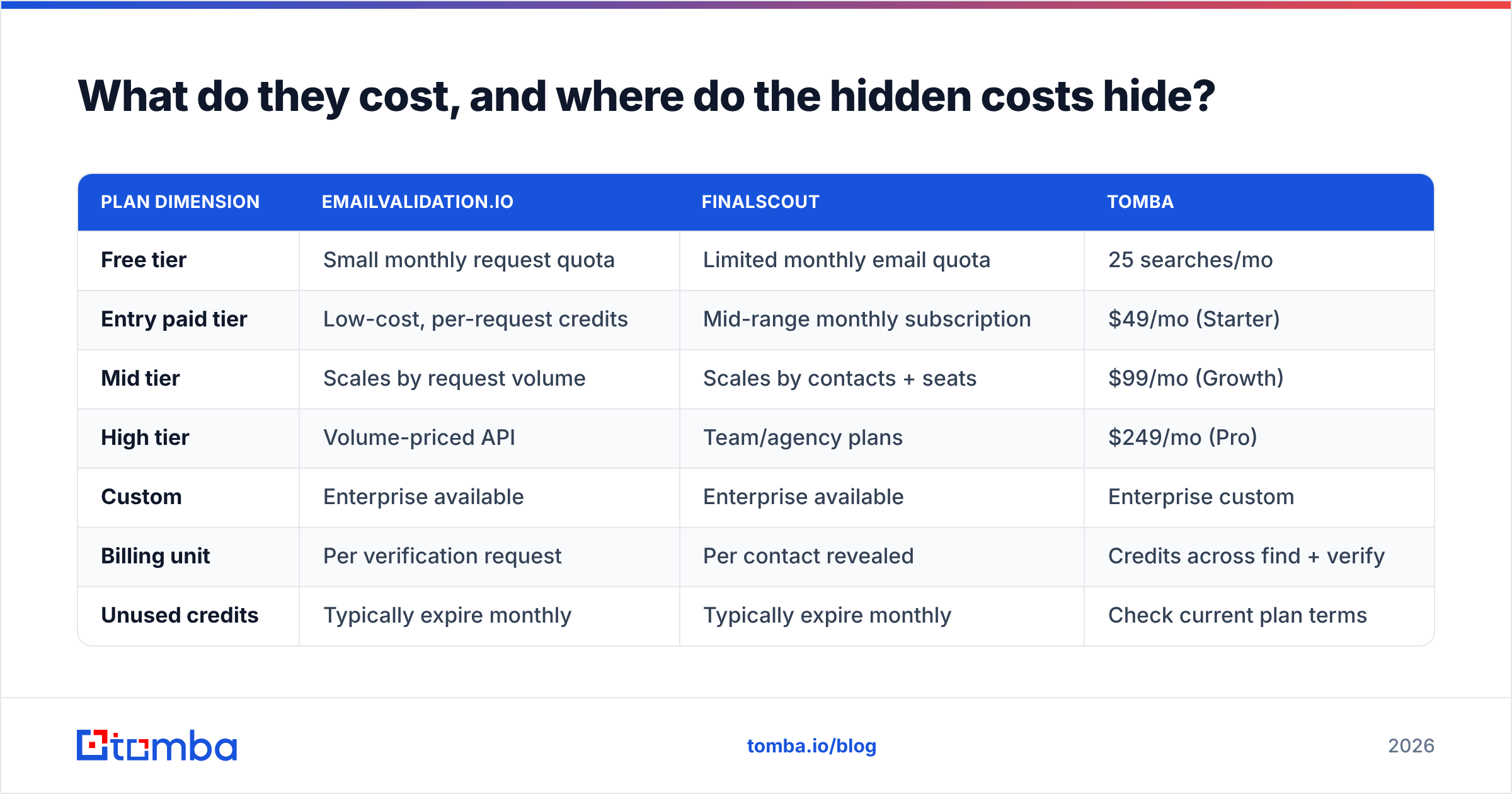
| Plan dimension | EmailValidation.io | FinalScout | Tomba |
|---|---|---|---|
| Free tier | Small monthly request quota | Limited monthly email quota | 25 searches/mo |
| Entry paid tier | Low-cost, per-request credits | Mid-range monthly subscription | $49/mo (Starter) |
| Mid tier | Scales by request volume | Scales by contacts + seats | $99/mo (Growth) |
| High tier | Volume-priced API | Team/agency plans | $249/mo (Pro) |
| Custom | Enterprise available | Enterprise available | Enterprise custom |
| Billing unit | Per verification request | Per contact revealed | Credits across find + verify |
| Unused credits | Typically expire monthly | Typically expire monthly | Check current plan terms |

The hidden costs are where budgets break:
- Double-billing the same contact. You pay FinalScout to reveal an address, then pay EmailValidation.io to verify it. Same record, two invoices, two vendor relationships.
- "Unknown" results you still pay for. Catch-all and unknown verdicts burn credits and give you no decision. Ask about this before you sign.
- Per-seat scaling. Extension tools price by seat. A five-rep team pays five times, even if the fifth rep rarely prospects.
- Engineering glue. Two tools mean one integration you maintain forever. Cheap on day one, annoying in month nine.

Compare that with consolidated Tomba pricing, where discovery and verification draw from one credit pool. The math often favors a single platform long before you hit enterprise volume. Reviews on G2 are worth skimming to see how other teams describe the same tradeoff.
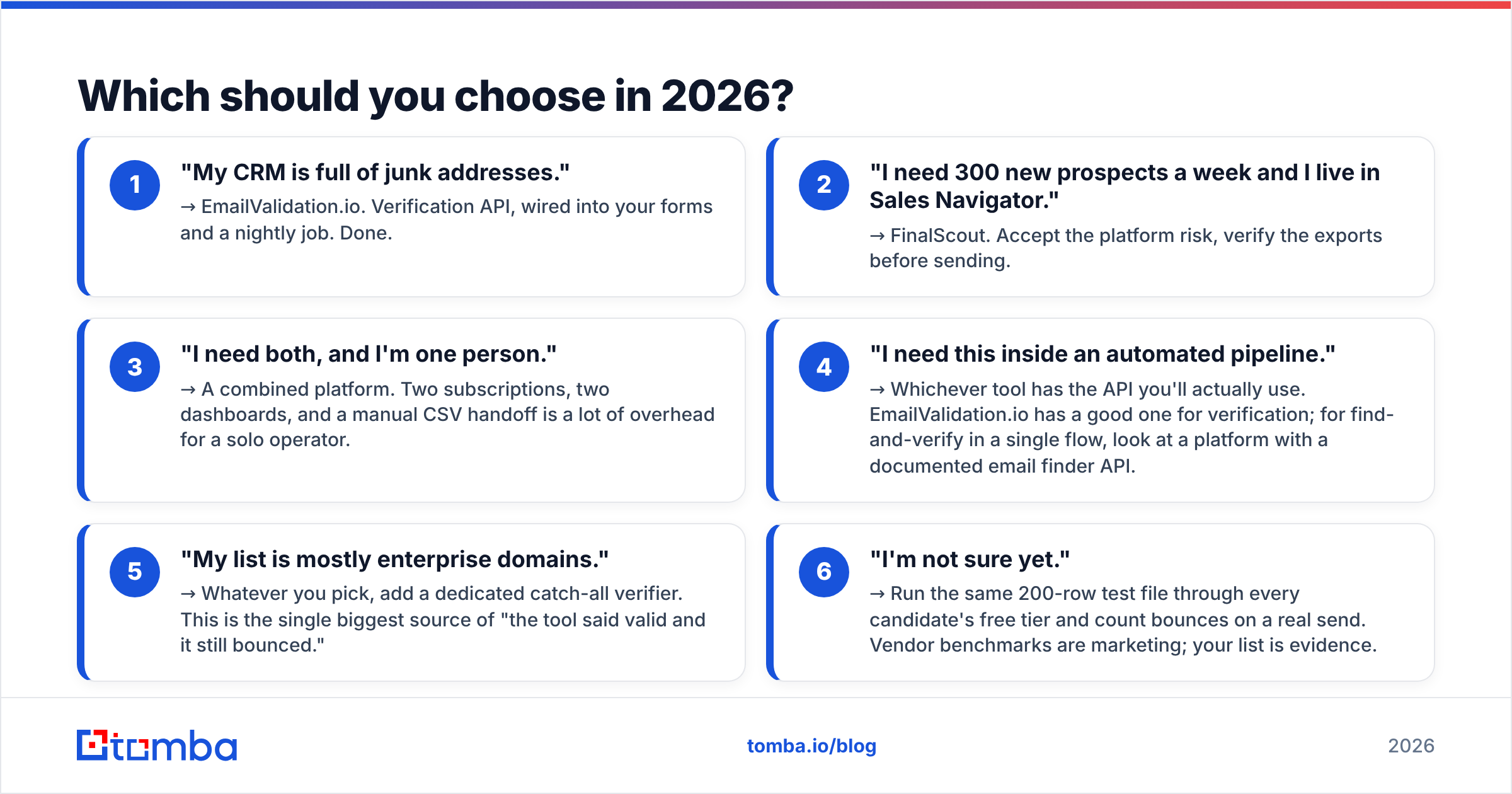
EmailValidation.io vs FinalScout: which should you choose in 2026?#
Match the tool to your real bottleneck:
- "My CRM is full of junk addresses." → EmailValidation.io. Wire the API into your forms and a nightly job. Done.
- "I need 300 new prospects a week and I live in Sales Navigator." → FinalScout. Accept the platform risk, then verify the exports before you send.
- "I need both, and I'm one person." → A combined platform. Two subscriptions, two dashboards, and a manual CSV handoff is a lot of overhead for a solo operator.
- "I need this inside an automated pipeline." → Whichever tool has the API you will actually use. EmailValidation.io has a good one for verification. For find-and-verify in one flow, look at a platform with a documented email finder API.
- "My list is mostly enterprise domains." → Add a dedicated catch-all verifier whatever you pick. Catch-alls are the biggest source of "the tool said valid and it still bounced."
- "I'm not sure yet." → Run the same 200-row test file through every free tier. Then count bounces on a real send. Vendor benchmarks are marketing. Your list is evidence.
Is there a better way to structure this stack?#
"EmailValidation.io vs FinalScout" is a confusing search because it is a category error dressed up as a comparison. The real question is how many vendors your pipeline needs.
A working B2B contact pipeline has four steps. Source the company. Find the person's address. Verify that it is deliverable. Enrich it with context your rep can use. FinalScout covers steps one and two for people visible on LinkedIn, plus a copy assist. EmailValidation.io covers step three. Neither covers step four.
Consolidating matters more than most teams expect. When domain search, finding, verification, and data enrichment run on one platform, verification happens at discovery time. You never export an unverified row in the first place. One credit pool, one API key, one bill, and no CSV shuttling between tabs at 4pm on a Friday.
That is the case for a unified tool. It is not the case for every team. If you only need form validation, a dedicated verification API is cheaper and simpler. Buy that instead. Honest advice beats vendor loyalty.
The bottom line#
EmailValidation.io vs FinalScout comes down to which gap you have. EmailValidation.io is a solid, narrow, developer-friendly verification API. Buy it if verification is your only gap. FinalScout is a capable LinkedIn extraction and outreach tool. Buy it if LinkedIn is your prospecting engine and you accept the platform risk. Buying both to cover one workflow is where the math stops working.
If your bottleneck is "find real, deliverable B2B email addresses and stop paying two vendors for one contact," start with the Tomba Email Finder. The free tier gives you 25 searches a month against your own target accounts. No card, no sales call. Run your hardest 25 domains through it, compare the results with whatever you use now, and let the bounce rate decide.
Related guides#
Ready to find emails that actually work?
Join 150,000+ professionals who stopped guessing and started sending. Free credits on signup — no credit card required.
Get the Tomba newsletter
Practical outbound tactics and product updates — once every two weeks.
About the author