EmailValidation.io vs FindThatLead: Which One in 2026?
One tool verifies addresses you already have. The other finds new ones and emails them. Here's how EmailValidation.io and FindThatLead actually compare on accuracy, pricing, and API depth in 2026.
EmailValidation.io vs FindThatLead is an odd matchup. One tool cleans a list you already own. The other builds a new list and emails it. Here is how to tell which job you actually need done.
TL;DR
- These are not the same product. EmailValidation.io is a verification API — you feed it addresses you already own. FindThatLead is a prospecting suite — it finds addresses and sends the campaign.
- Pick EmailValidation.io if you're a developer who needs a cheap, fast, single-purpose validation endpoint bolted onto a signup form or an existing list-hygiene job.
- Pick FindThatLead if you're a small sales team that wants search, enrichment, and a cold-email sender under one login and doesn't want to stitch tools together.
- Neither covers the full loop well. EmailValidation.io can't find anyone; FindThatLead's verification is a byproduct, not a specialty.
- The middle path is a finder + verifier with one API and one credit pool — that's where Tomba, Hunter, and Findymail sit, starting around $49/mo.
EmailValidation.io vs FindThatLead: what are these tools, actually?#
Start here. Half the comparison articles on this query pretend the two tools compete head-to-head. They barely overlap.
EmailValidation.io is a single-endpoint email verification API. You POST an address and get back a JSON blob. It covers syntax validity, MX records, and an SMTP check, plus flags for disposable, free-provider, and role accounts. You also get a deliverability score. There is a dashboard and a bulk CSV upload, but the API is the real product. It's the kind of thing you wire into a registration form to stop asdf@asdf.com from entering your database.
FindThatLead is a lead generation platform out of Barcelona. It does domain search: give it a company, get emails. It also does name-to-email lookup and a lead database with filters. A Chrome extension pulls data from LinkedIn profiles, and a "Prospector" builds lists by role and location. Most importantly, it ships a built-in cold email sender with sequences and tracking. Verification is a checkbox inside that workflow, not a standalone engine.
So the honest framing: EmailValidation.io is a component. FindThatLead is a workflow. If you're comparing them, you're probably actually asking "do I buy a piece or a platform?"
Is EmailValidation.io the same category as FindThatLead?#
No. The mismatch shows up the moment you list what each one refuses to do.
- EmailValidation.io cannot find an email. There is no domain search, no name-to-email guess, no database. If you don't already have the address, the product is useless to you.
- FindThatLead cannot be your validation layer at scale. Its verification runs inside its own credit system and its own UI. There's an API, but it's built around prospecting calls, not high-throughput hygiene on a 400,000-row list.
- EmailValidation.io has no sending. No sequences, no warmup, no inbox rotation.
- FindThatLead's sender is real but basic. It's fine for a two-step follow-up on 500 contacts. It's not Instantly, Smartlead, or Salesloft.
That gap is why the "which is better" question usually turns into "which problem is bleeding right now?" High bounce rate on an existing list? Verification. Empty pipeline? Prospecting.
How do EmailValidation.io and FindThatLead compare feature by feature?#
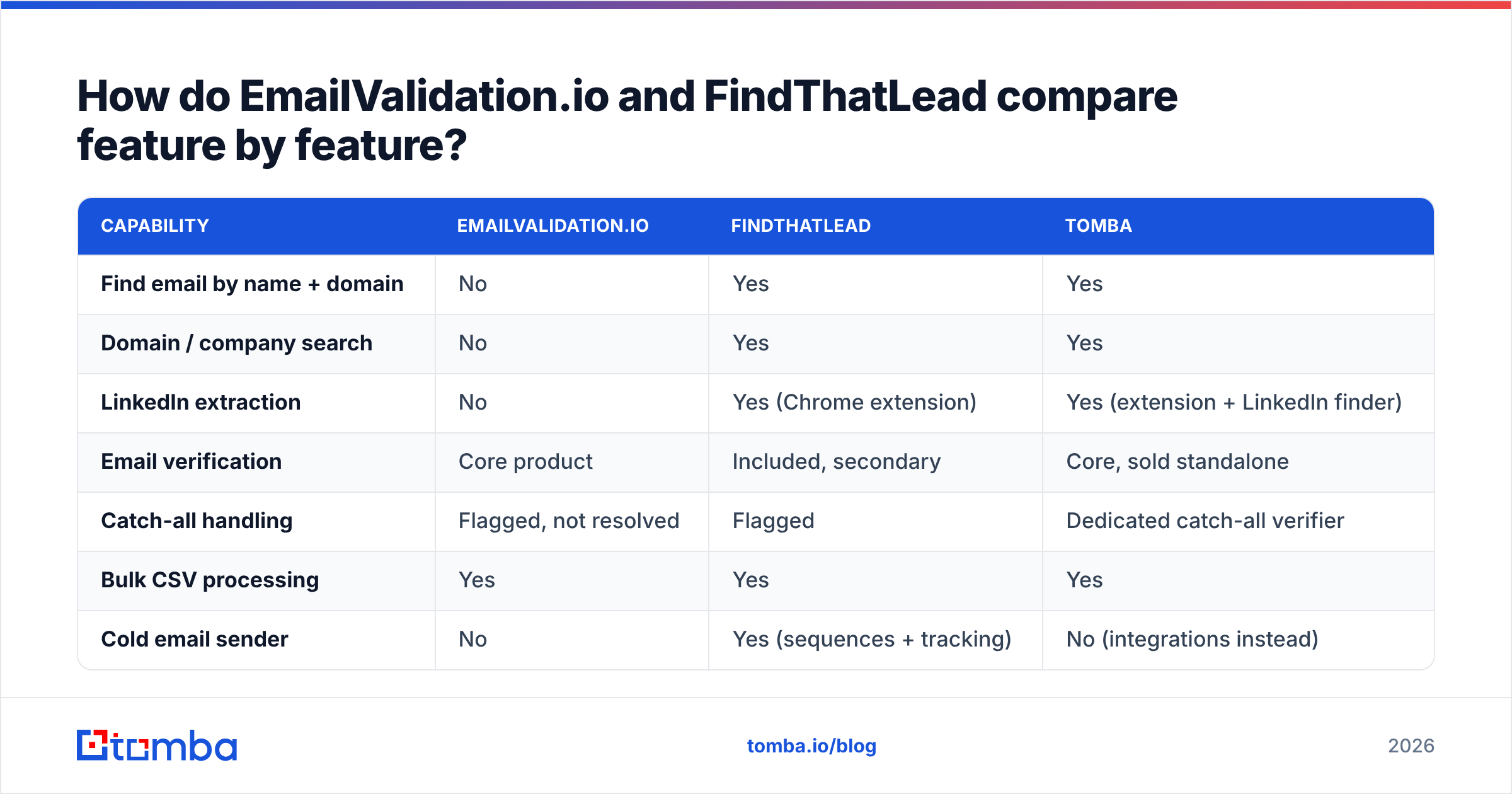
Here's the practical breakdown. Treat vendor pricing as directional — both companies revise tiers, and you should confirm on their own pages before you buy.
| Capability | EmailValidation.io | FindThatLead | Tomba |
|---|---|---|---|
| Find email by name + domain | No | Yes | Yes |
| Domain / company search | No | Yes | Yes |
| LinkedIn extraction | No | Yes (Chrome extension) | Yes (extension + LinkedIn finder) |
| Email verification | Core product | Included, secondary | Core, sold standalone |
| Catch-all handling | Flagged, not resolved | Flagged | Dedicated catch-all verifier |
| Bulk CSV processing | Yes | Yes | Yes |
| Cold email sender | No | Yes (sequences + tracking) | No (integrations instead) |
| Public REST API | Yes, primary interface | Yes, secondary | Yes, primary + CLI + MCP |
| Phone numbers | No | No | Yes |
| Free tier | Limited monthly requests | Limited trial credits | 25 searches/mo |
| Entry paid tier | Low double digits/mo | ~$49/mo (Growth) | $49/mo (Starter) |
| Best for | Developers, form validation | Small sales teams, agencies | Teams wanting find + verify in one API |

The last row decides most purchases. A backend engineer cleaning signups will find FindThatLead's seat-based, campaign-shaped pricing absurd. A two-person sales team will find EmailValidation.io excellent and completely insufficient.
Which one is more accurate?#
Accuracy means two different things here. Mixing them up is how people end up disappointed.
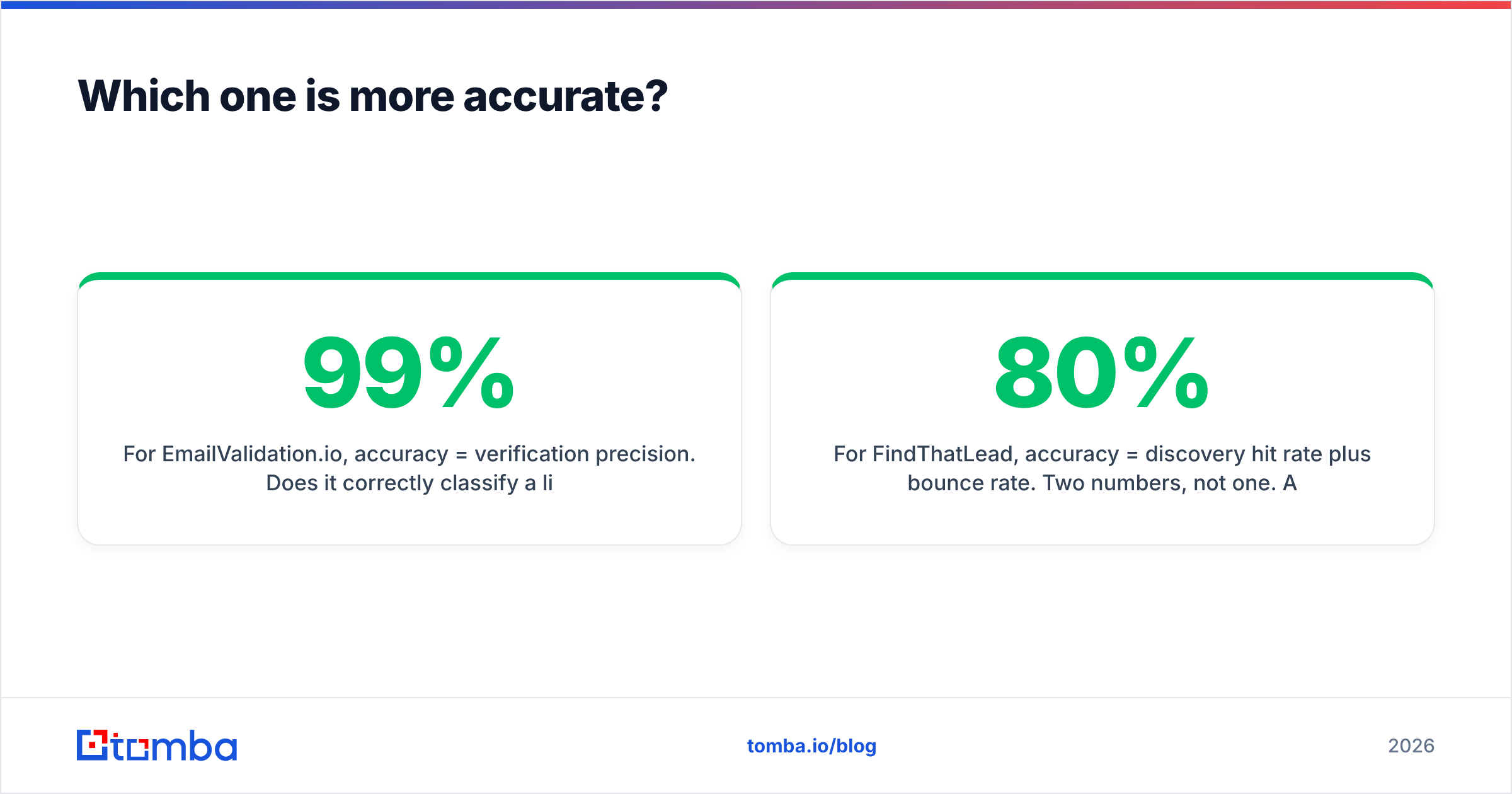
For EmailValidation.io, accuracy = verification precision. Does it call a live mailbox deliverable and a dead one undeliverable? False "valid" results are the ones that hurt, because they bounce anyway. Most verification vendors land in the 95–99% range on clean domains. The real test is the hard cases. Catch-all domains, slow greylisting servers, and providers like Microsoft 365 accept almost anything at the SMTP handshake. EmailValidation.io flags catch-alls honestly instead of guessing. That is the right call, but it leaves you with an "unknown" bucket. On a B2B list, that bucket can be 20–30% of your rows.
For FindThatLead, accuracy = hit rate plus bounce rate. That's two numbers, not one. Say a finder returns an address for 80% of your rows and bounces on 12% of them. A finder that returns 60% at a 2% bounce rate beats it. You just don't feel the difference until the sending domain is burned. FindThatLead's coverage is strongest on European SMB domains, which is where its data comes from. On US enterprise, users on G2 often report weaker coverage than the dedicated finders.

The takeaway: never compare a finder's hit rate to a verifier's precision. Run your own 200-row test instead. Use a domain list you can check by hand — your own customers work best, since you know their real addresses. Measure four things: found rate, bounce rate, catch-all share, and cost per confirmed-deliverable contact. Only that last number maps to money.
If catch-all domains are eating your list, that's a specific problem with a specific fix — a catch-all verifier that probes beyond the SMTP handshake instead of shrugging and returning "unknown."
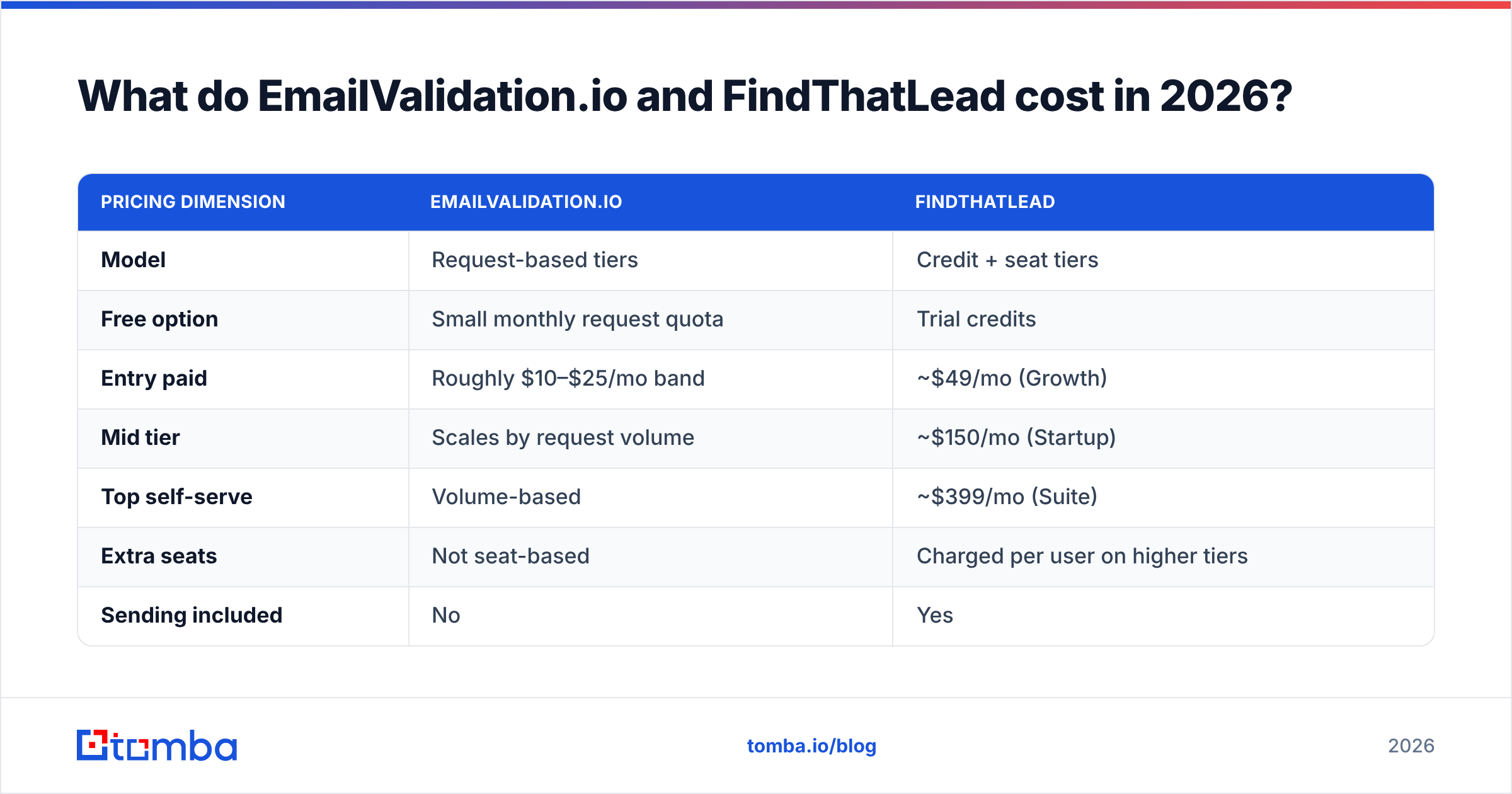
EmailValidation.io vs FindThatLead: what do they cost in 2026?#
The two pricing models are built differently, so a per-credit comparison misleads you.
| Pricing dimension | EmailValidation.io | FindThatLead |
|---|---|---|
| Model | Request-based tiers | Credit + seat tiers |
| Free option | Small monthly request quota | Trial credits |
| Entry paid | Roughly $10–$25/mo band | ~$49/mo (Growth) |
| Mid tier | Scales by request volume | ~$150/mo (Startup) |
| Top self-serve | Volume-based | ~$399/mo (Suite) |
| Extra seats | Not seat-based | Charged per user on higher tiers |
| Sending included | No | Yes |
| Overage behavior | Buy the next tier | Buy credit packs |
EmailValidation.io is cheaper in raw terms because it does one job. That's not a knock. A focused API that costs $20/mo and never fails is a good buy. But comparing it to FindThatLead's $49 is comparing a wrench to a toolbox.
The number that matters is cost per usable contact. Run it like this:
- Count the input rows you actually need contacted this month — not your TAM, your realistic sending volume.
- Apply the finder's hit rate to get discovered addresses. A 65% hit rate on 1,000 rows is 650.
- Subtract the catch-all and risky buckets you won't send to. If 20% land there, you're at 520.
- Subtract projected bounces at your target threshold. At 2%, roughly 510 usable.
- Divide total monthly spend (finder + verifier + sender) by that number.
Teams that run this math honestly often get a surprise. The "cheap" split stack costs more per usable contact than the bundled one. They pay twice for the same rows — once to find, once to verify — and then pay again in engineering time to keep two integrations alive.

Who should pick EmailValidation.io?#
Choose it when all of these are true:
- You already have the addresses. Signup forms, CRM imports, a legacy list, a partner data drop.
- You want an API, not a UI. Your team lives in code and the dashboard is an afterthought.
- Your volume is spiky. Request-based tiers handle a one-time 100k cleanup better than seat-based platforms.
- You don't need prospecting. Inbound-led companies rarely do.
It's a well-scoped tool for a well-scoped problem. The failure mode is buying it and then realizing your actual bottleneck was that nobody had built the list yet.
Who should pick FindThatLead?#
Choose it when all of these are true:
- You're a small outbound team or agency running campaigns for a handful of accounts.
- You want one login. Search, enrich, verify, send — without three vendors and three invoices.
- Your ICP skews European SMB, where its data is comparatively strong.
- Your sending volume is modest. A few thousand emails a month, not tens of thousands across rotating domains.
The failure mode here is scale. Once you run several sending domains, warmup pools, and inbox rotation, the built-in sender becomes the bottleneck. You then move to a dedicated platform — and you're still paying FindThatLead for data you could source more cheaply.
Where does Tomba fit between them?#
Tomba sits deliberately in the gap: the data and verification layer, without the sender.
That matters if you already run Instantly, Smartlead, Lemlist, or Salesloft. Most teams past ten seats do. You don't need another sequencer. You need correct addresses, in one API, on one credit pool.
Concretely, Tomba covers:
- Email finder — name + domain to verified address, with confidence scoring and the sources behind each result.
- Domain search — every discoverable address at a company, with detected pattern and department tags.
- Email verifier — standalone verification with catch-all resolution rather than a shrug.
- Enrichment, phone lookup, and reverse lookup on the same credits, so you're not buying three subscriptions to fill three columns.
- API-first delivery — REST, a CLI, an MCP server, plus Sheets, Excel, Airtable, HubSpot, and Salesforce connectors.
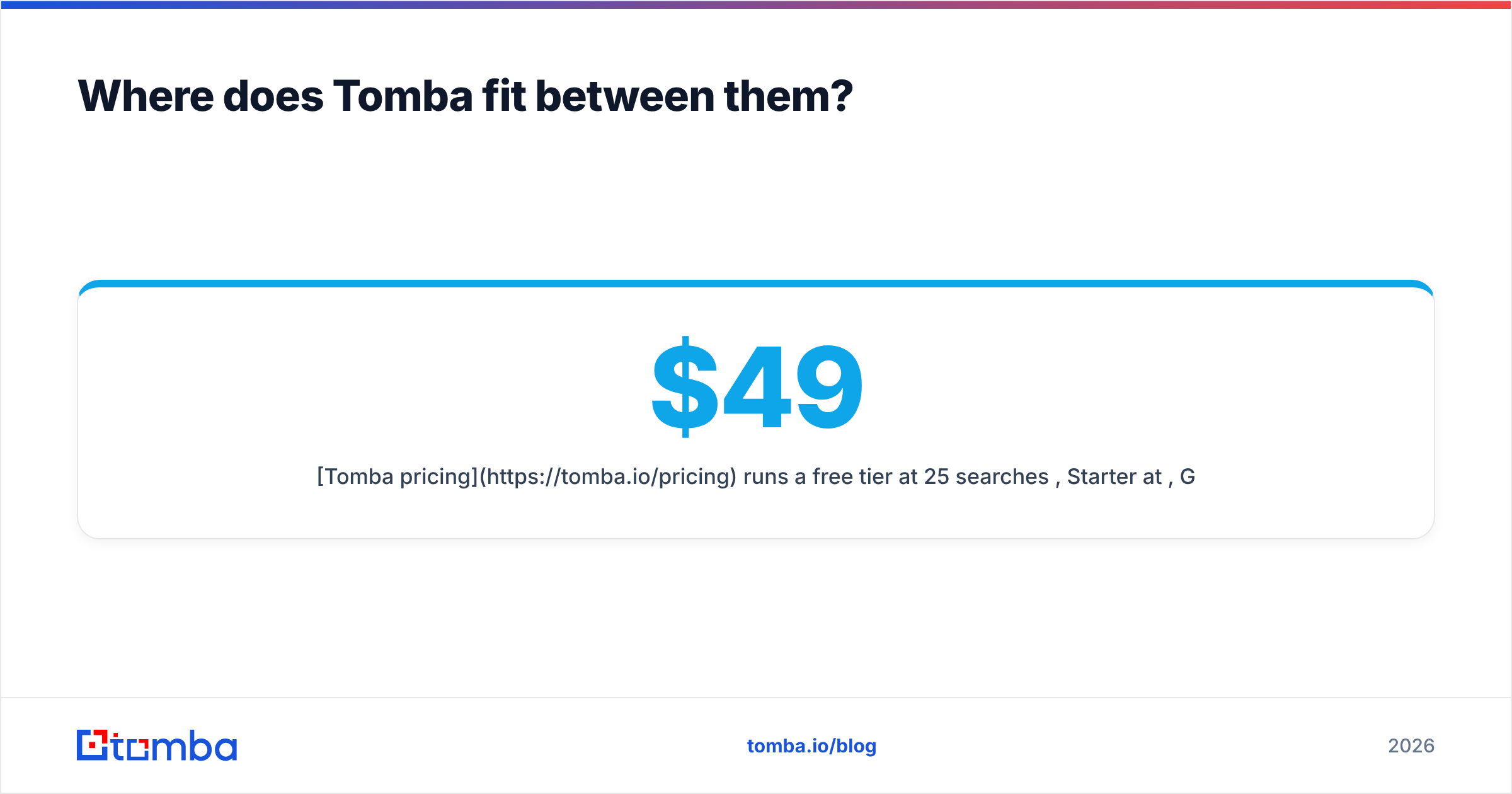
Tomba pricing runs a free tier at 25 searches/mo, Starter at $49/mo, Growth at $99/mo, Pro at $249/mo, and custom Enterprise. Starter matches FindThatLead's Growth on price. It also covers the verification depth EmailValidation.io specializes in. The trade is that you supply your own sender.
Is that a downside? It depends on where you are. If you have no sending stack and want to launch this week, FindThatLead's all-in-one is faster to value. If you already send and just need better data coming in, a dedicated data layer wins on both accuracy and cost.
How should you actually decide?#
Run a 90-minute bake-off instead of reading more comparison posts.
- Build a 200-row truth set. Use companies where you can verify at least 40 addresses manually — current customers, partners, or contacts already in your CRM.
- Run the same rows through each tool's free tier. EmailValidation.io on the addresses you have; FindThatLead and any finder on the name+domain pairs.
- Record four metrics per tool: found rate, verified-deliverable rate, catch-all/unknown share, and false-positive rate against your known-good set.
- Send a 100-address test batch from a warmed secondary domain and log real bounces. Vendor scores are predictions; bounces are facts.
- Compute cost per confirmed-deliverable contact using the five-step method above.
- Weight the integration cost. A tool that saves $30/mo but needs a week of engineering isn't cheaper.
Whichever tool wins on step 5 while surviving step 4 is your answer — regardless of what any review site says.
The bottom line#
EmailValidation.io vs FindThatLead is not a real fight. The two tools solve neighboring problems at opposite ends of the same pipeline. If your list already exists and you need it clean, the verification API is the tighter, cheaper buy. If your list doesn't exist yet, the prospecting suite gets you moving faster.
Are you in the middle? You have a sender, you need reliable contact data, and you don't want two vendors billing you for the same rows. Try the Tomba Email Finder. The free tier gives you 25 searches a month, no card required. That's enough to run the 200-row bake-off above and let the numbers decide instead of the marketing pages.
Related guides#
Ready to find emails that actually work?
Join 150,000+ professionals who stopped guessing and started sending. Free credits on signup — no credit card required.
Get the Tomba newsletter
Practical outbound tactics and product updates — once every two weeks.
About the author