EmailValidation.io vs Kipplo: Which Email Tool Wins in 2026?
One is a bare-metal verification API. The other bundles finding, verifying, and outreach. Here is how EmailValidation.io and Kipplo actually differ on accuracy, pricing, and catch-all handling — and when neither is the right pick.
EmailValidation.io vs Kipplo is the wrong fight to pick blind. One is a verification API. The other is a lead-data platform. Here is what each one does, what it costs, and how to test both on your own list in under a week.
TL;DR
- EmailValidation.io is a verification API, not a prospecting tool. You bring the list; it tells you which addresses are deliverable. No discovery layer.
- Kipplo sits on the other side of the line. It markets itself as a lead-data and outreach layer, so verification is one feature among several.
- They are not really substitutes. The choice comes down to one question: is your bottleneck finding contacts or cleaning the ones you already have?
- Pricing shapes differ: pay-per-verification credits versus seat-and-plan bundles. That gap matters more than the sticker price above ~50k records a month.
- Need both find and verify in one API? A combined platform like Tomba usually beats stitching two vendors together — fewer wasted credits, one schema, one bill.
What are EmailValidation.io and Kipplo?#
Start with the category question. Half the confusion here comes from treating both as the same kind of product.
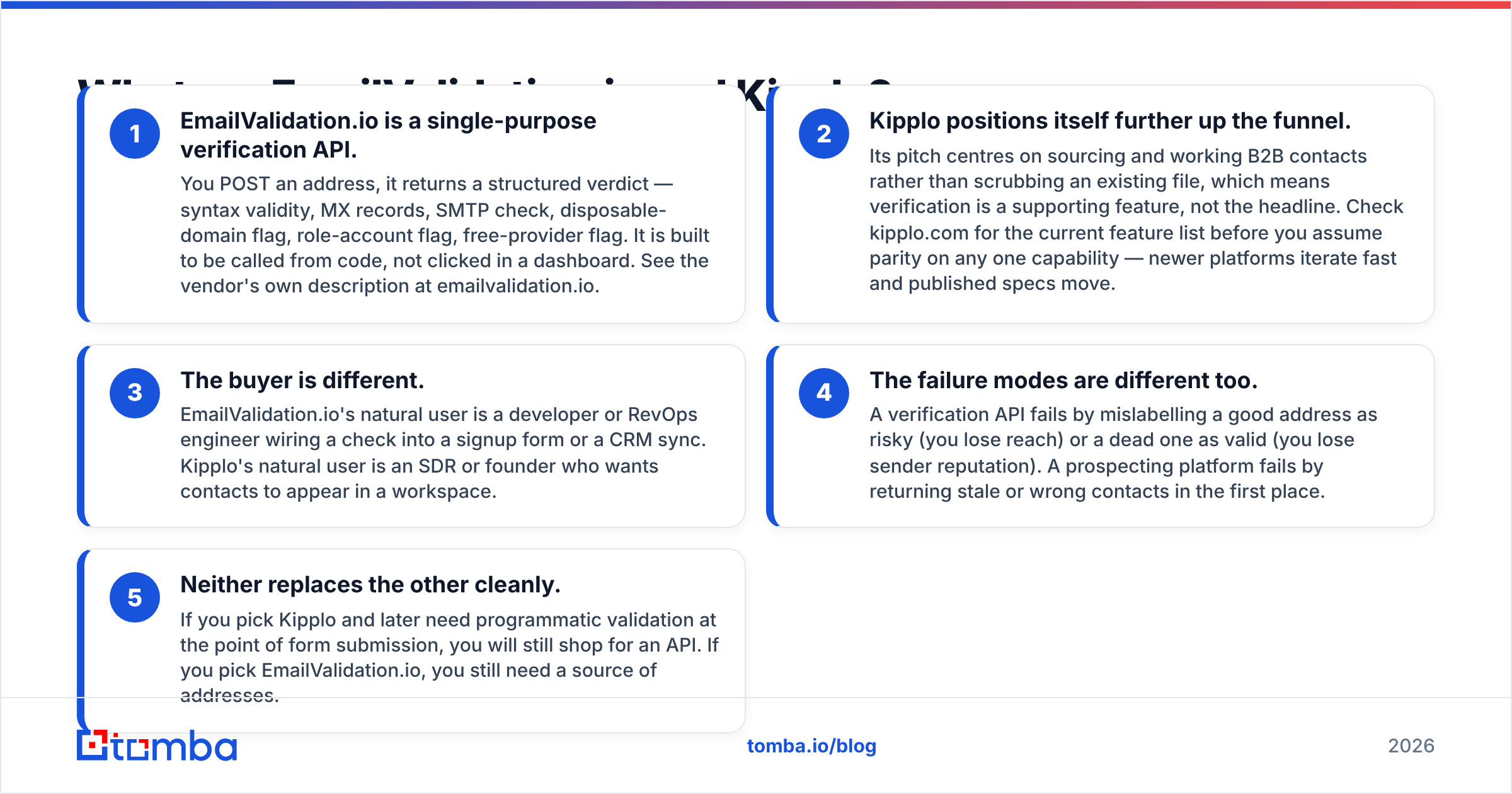
- EmailValidation.io is a single-purpose verification API. You POST an address and get a structured verdict: syntax, MX records, SMTP check, disposable domain, role account, free provider. It is built to be called from code, not clicked in a dashboard. See the vendor's own description at emailvalidation.io.
- Kipplo sits further up the funnel. Its pitch is sourcing and working B2B contacts, not scrubbing a file you already have. Verification is a supporting feature, not the headline. Check kipplo.com before you assume parity — newer platforms ship fast and published specs move.
- The buyer is different. EmailValidation.io suits a developer or RevOps engineer wiring a check into a signup form or a CRM sync. Kipplo suits an SDR or founder who wants contacts to appear in a workspace.
The failure modes split along the same line.
- A verification API fails quietly. It marks a good address as risky and you lose reach, or marks a dead one as valid and you lose sender reputation. A prospecting platform fails earlier, by handing you stale or wrong contacts in the first place.
- Neither replaces the other cleanly. Pick Kipplo and you will still shop for an API the day you need validation at form submission. Pick EmailValidation.io and you still need a source of addresses.
That last point is the one most comparison posts skip. Hold onto it.
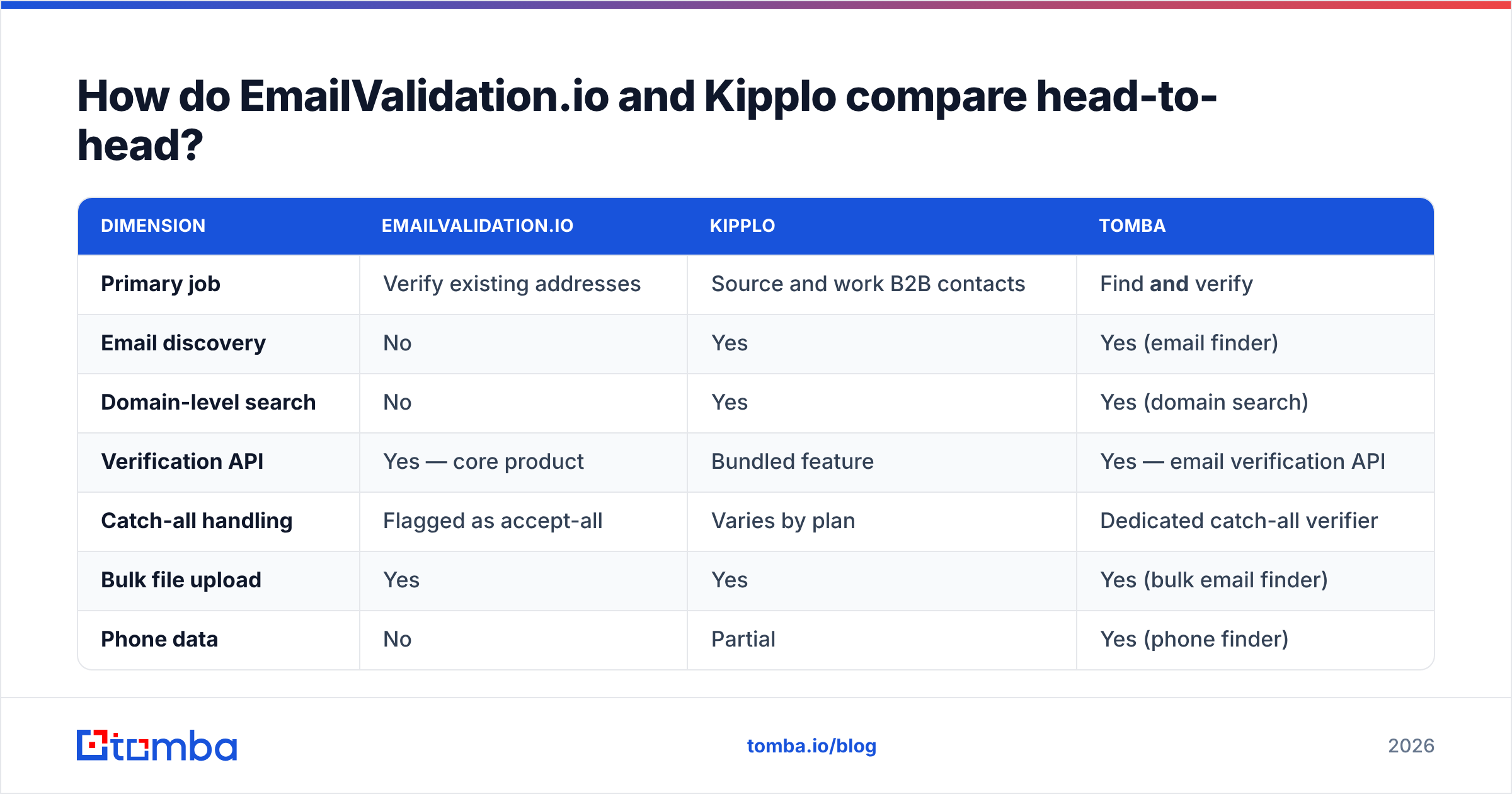
EmailValidation.io vs Kipplo: how do they compare head-to-head?#
Here is the practical breakdown. Treat the pricing column as directional. Every vendor in this category repriced at least once in the last 18 months, so confirm on the live pricing page before you sign anything.
| Dimension | EmailValidation.io | Kipplo | Tomba |
|---|---|---|---|
| Primary job | Verify existing addresses | Source and work B2B contacts | Find and verify |
| Email discovery | No | Yes | Yes (email finder) |
| Domain-level search | No | Yes | Yes (domain search) |
| Verification API | Yes — core product | Bundled feature | Yes — email verification API |
| Catch-all handling | Flagged as accept-all | Varies by plan | Dedicated catch-all verifier |
| Bulk file upload | Yes | Yes | Yes (bulk email finder) |
| Phone data | No | Partial | Yes (phone finder) |
| Pricing shape | Credit packs / volume tiers | Plan + seat based | Free tier, then $49/$99/$249 per month |
| Free tier | Limited trial credits | Limited trial | 25 searches/month, no card |
| Best for | Form-level and CRM hygiene | SDRs who want one workspace | Teams needing both in one API |

Two things stand out when you lay EmailValidation.io vs Kipplo out this way.
First, the overlap is narrow — roughly one column. If you are genuinely torn between them, you probably have not decided what problem you are solving yet.
Second, the shape of the pricing matters more than the headline number. Credit-based verification scales with list size. Seat-based platforms scale with headcount. A three-person team verifying 500k records a quarter and a fifteen-person team verifying 20k records a quarter will get very different answers on which is cheaper.

How accurate is each tool, and how would you know?#
Published accuracy claims in this category are almost impossible to check. Every vendor quotes a number in the high nineties, and every number is measured on a different sample.
Here is the test that actually settles it. It takes about 40 minutes:
- Build a 500-row control file from your own data: 100 addresses you have confirmed replies from, 100 that hard-bounced in the last 90 days, 100 role accounts (info@, sales@), 100 from known catch-all domains, and 100 random unknowns.
- Run the identical file through each vendor. Do not sample. The whole point is comparing verdicts on the same rows.
- Score three things separately. False valids (dead addresses marked deliverable — the expensive error), false invalids (good addresses marked bad — the silent revenue leak), and unknowns (rows the tool refuses to judge).
Then weigh what you found.
- Weight false valids about 5x. A bounce costs you deliverability. A false invalid only costs you one prospect.
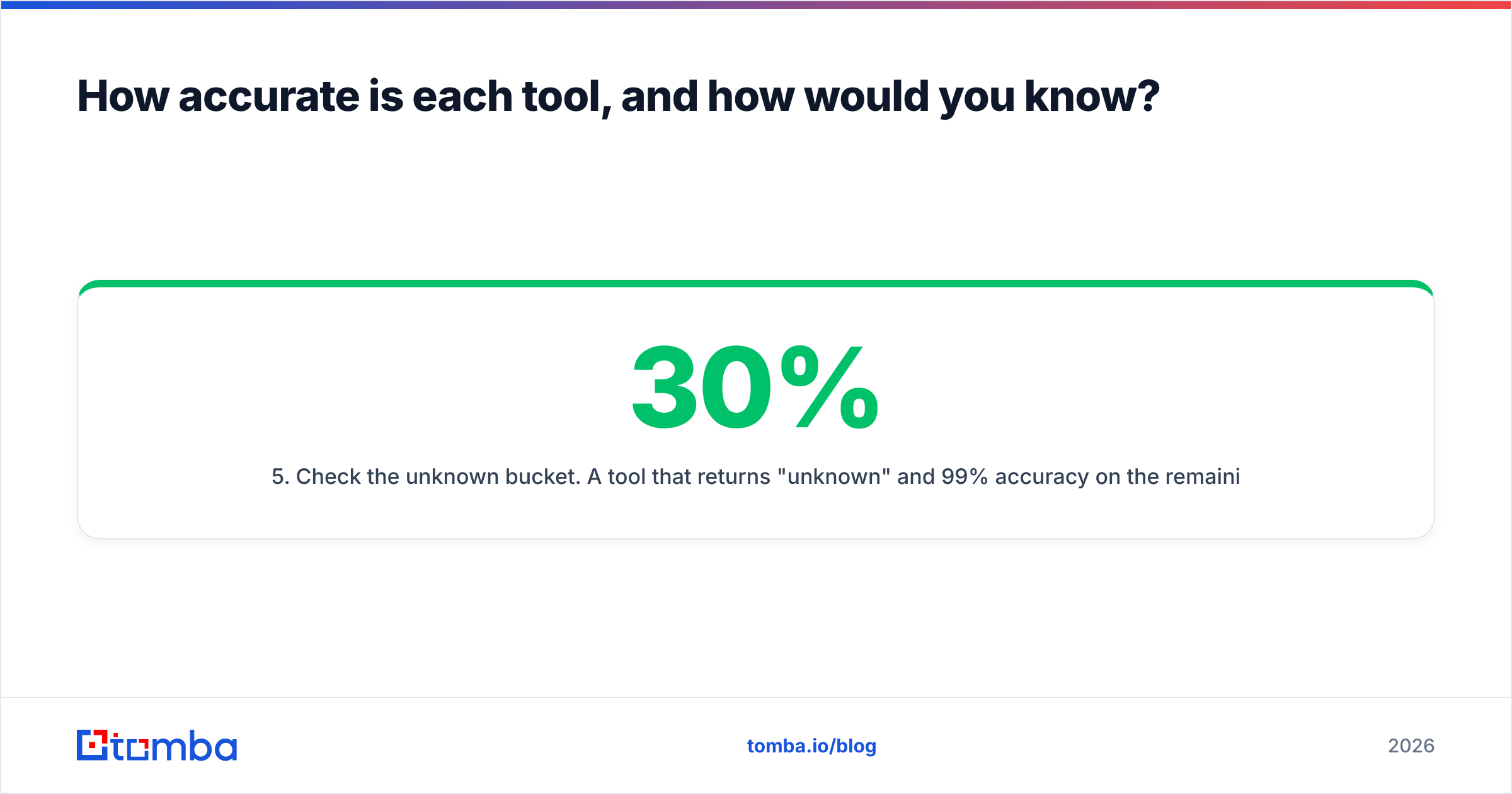
- Check the unknown bucket. A tool that returns 30% unknown and 99% accuracy on the remaining 70% is worse than one that hits 96% across the board.

The unknown rate is where most head-to-head tests get decided, and it is almost never disclosed in marketing material.
A verification-first product like EmailValidation.io tends to be conservative and explicit about accept-all domains. That is honest, but it pushes the decision back to you. A platform that bundles verification with sourcing has a commercial reason to return fewer unknowns, because "unknown" looks like a failed lookup to a user who came for contacts.
Neither behaviour is wrong. You just need to know which one you are buying.
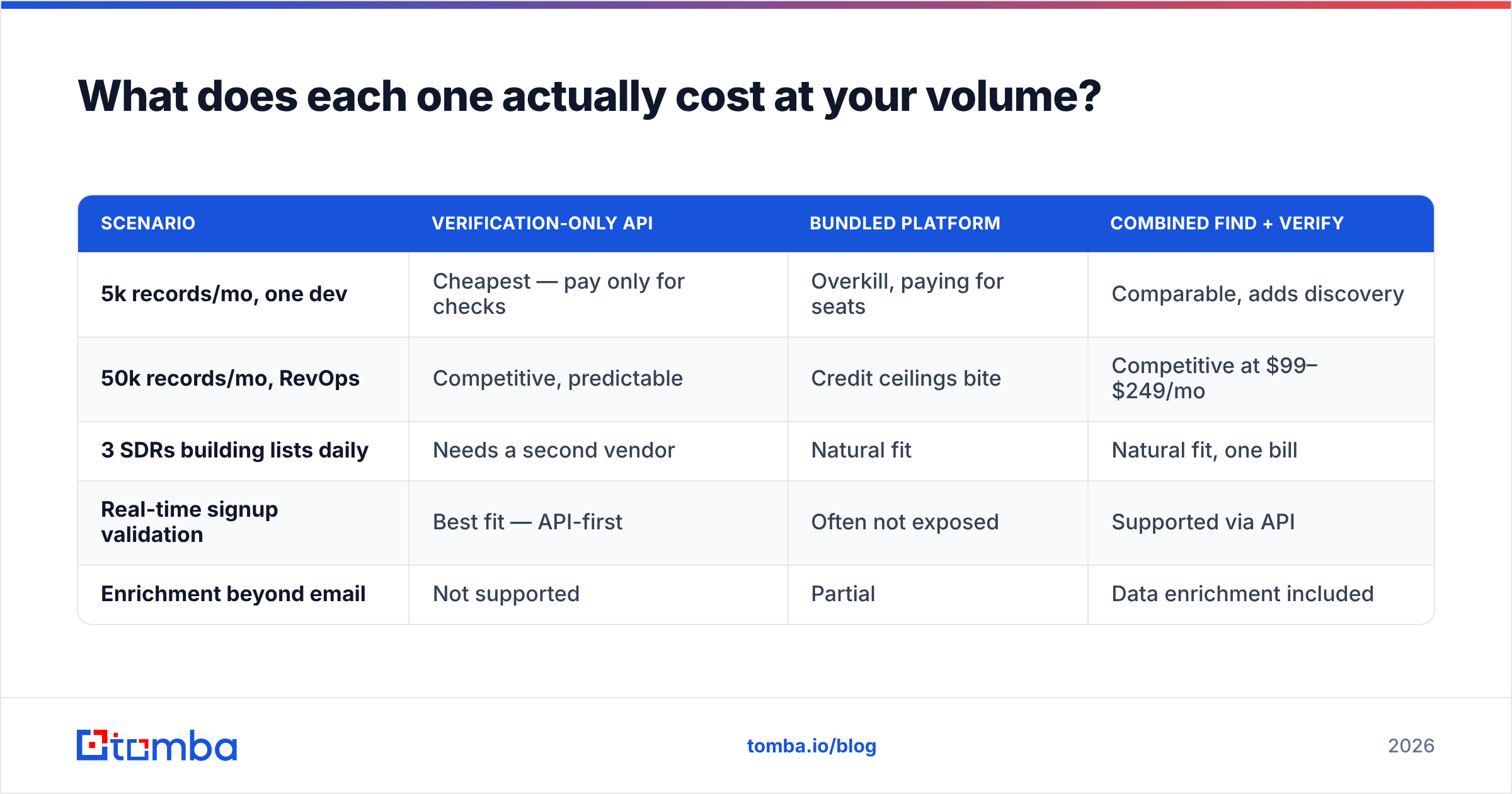
What does each one actually cost at your volume?#
Run the numbers per usable contact, not per credit. Credits burned on unknowns and duplicates are real money.
| Scenario | Verification-only API | Bundled platform | Combined find + verify |
|---|---|---|---|
| 5k records/mo, one dev | Cheapest — pay only for checks | Overkill, paying for seats | Comparable, adds discovery |
| 50k records/mo, RevOps | Competitive, predictable | Credit ceilings bite | Competitive at $99–$249/mo |
| 3 SDRs building lists daily | Needs a second vendor | Natural fit | Natural fit, one bill |
| Real-time signup validation | Best fit — API-first | Often not exposed | Supported via API |
| Enrichment beyond email | Not supported | Partial | Data enrichment included |
For reference, Tomba's published pricing runs a free tier at 25 searches per month, Starter at $49/mo, Growth at $99/mo, and Pro at $249/mo, with Enterprise quoted.
That matters here not because it is the cheapest line item — against a pure verification API at low volume, it usually is not — but because it covers both jobs. Two vendors at $30 and $40 is $70 plus an integration you maintain forever.
Before you commit, do the boring thing. Export last quarter's actual verification volume and last quarter's actual number of new contacts sourced. Most teams find the two numbers are an order of magnitude apart, and that alone picks the winner.
Where do catch-all domains break the comparison?#
Catch-all (accept-all) domains are the biggest source of disagreement between any two verification tools, and they keep getting more common. A large share of corporate domains now accept mail to any local part at the SMTP layer, then bounce it silently afterward.
An SMTP-only verifier cannot resolve these. It gets a 250 OK for asdkjhasd@company.com and has to report "accept-all" or guess. What separates tools is what they do next:
- Report and stop. Honest, but it leaves you a bucket you cannot mail. This is classic verification-API behaviour.
- Guess from pattern data. Riskier. Quality depends on how much first-party pattern data the vendor holds for that domain.
- Cross-reference multiple signals — known-good addresses on the same domain, pattern confidence, past engagement. That is what a dedicated catch-all finder is for.
If catch-all domains are more than about 20% of your list — common in enterprise SaaS, finance, and healthcare outbound — this one dimension should outweigh everything else. Test it with the control file above rather than trusting a feature checkbox.

EmailValidation.io vs Kipplo: which one should you choose?#
Sort yourself into one of these, in order:
- You have a list, need it clean, and you write code. Take the verification API. EmailValidation.io is built for exactly this, the integration surface is small, and you are not paying for a workspace nobody logs into. Add a free email checker for one-off manual lookups.
- You have no list and need contacts in a UI today. A bundled platform like Kipplo is the shorter path. You trade some API depth for speed of setup, which is the right trade when the constraint is "we have nothing to email on Monday."
- You need both, permanently, at team scale. Stop shopping for two vendors. The integration tax — mismatched schemas, double credit burn, two rate limits, two support queues — reliably costs more than the price gap.
Two edge cases are worth calling out separately.
- You need real-time validation at the point of capture. Filter hard on API quality: latency under 500ms, documented status codes, sensible retry semantics, and a sandbox. Feature lists tell you nothing here. Read the docs.
- You verify under 1,000 addresses a month. Use a free tier and revisit in six months. At that volume, none of this analysis pays for the hour you spent reading it.
Independent reviews on G2 are worth skimming first, mostly for the complaints. The pattern in one-star reviews across this category is credits expiring, unknown rates running higher than advertised, and slow support — not core accuracy.
What does a sane evaluation look like in practice?#
Give yourself a week and a shared spreadsheet:
- Day 1 — Build the 500-row control file. This is the only real work.
- Day 2 — Run it through each candidate's free tier. Record false valids, false invalids, unknowns, and wall-clock time separately.
- Day 3 — Send a 200-address test campaign to the "valid" verdicts from each tool. Measure actual bounce rate. This is the only number no vendor controls.
- Day 4 — Price out 12 months at your real volume, including expected overage. Include the engineering hours for integration.
- Day 5 — Decide, and write down why. In nine months, when someone asks "why are we paying for this," you will want the note.
That process beats any comparison post, including this one, because it runs on your data rather than a vendor's sample.
The bottom line#
EmailValidation.io and Kipplo are not competing for the same job. One cleans lists you already have with an API-first, developer-shaped product. The other hands you contacts and a place to work them.
Compare them on the axis that matches your real bottleneck. Test with your own control file. Weight catch-all handling and unknown rates far higher than any headline accuracy percentage.
If your honest answer is "both" — you need to find addresses and trust them before you send — running two vendors is the expensive way to get there. The Tomba Email Finder covers discovery by domain, name, or company and hands results straight to verification through the same API and the same credit pool. The free tier gives you 25 searches a month, so you can run the control-file test before you spend anything. Start there, measure your real bounce rate, and let the data pick the vendor.
Related guides#
Ready to find emails that actually work?
Join 150,000+ professionals who stopped guessing and started sending. Free credits on signup — no credit card required.
Get the Tomba newsletter
Practical outbound tactics and product updates — once every two weeks.
About the author