EmailValidation.io vs LeadsForge: Which Should You Use in 2026?
One is a verification API that tells you if an address is safe to mail. The other builds the list in the first place. Here is where each one wins, where each one leaks money, and which stack actually lowers your bounce rate.
EmailValidation.io vs LeadsForge is an odd matchup. One tool checks the emails you already have. The other finds emails you do not have yet. Pick the wrong one and you pay twice for a single pipeline.
TL;DR
They are not the same category. EmailValidation.io is a syntax-and-SMTP verification API. LeadsForge is a lead-list builder that sources contacts. A head-to-head only makes sense if you are deciding where in the pipeline to spend your budget.
If your list already exists, a verifier is the cheaper fix — you are paying to stop bounces, not to find people.
If your list does not exist yet, a verifier buys you nothing. You need discovery first, then verification.
The expensive mistake is buying a list builder with weak validation and a validation API with no discovery. You then pay twice for a workflow one platform can do end to end.
Our pick for most B2B teams: a discovery-plus-verification platform (Tomba, Hunter, or a similar combined tool) beats stitching a single-purpose verifier to a single-purpose list builder. The exception is real API-scale validation volume, where a dedicated verification endpoint still earns its place.
What is EmailValidation.io?#
EmailValidation.io is a REST API. You send it an address and it returns a verdict: is the syntax valid, does the domain have MX records, is it a disposable or free-mail address, is it a role account (info@, sales@), and does the mailbox answer an SMTP probe.
It is a checker, not a finder. You feed it addresses you already have — from a form signup, a CRM import, a scraped list, a partner file — and it tells you which ones will bounce. The product surface is deliberately narrow: one endpoint, a handful of boolean fields, a quality score. You can see the current spec on the official EmailValidation.io site.
That narrowness is the selling point. Teams who pick it usually want one thing: a fast, cheap validation call they can drop into a signup form or an ETL job without buying a whole sales platform.
Where it falls down is everything upstream. Say your problem is "I have 40 target accounts and no contact emails." A verification API is the wrong tool. It has nothing to validate.
What is LeadsForge?#
LeadsForge sits on the other side of the pipeline. It is positioned as an AI-assisted lead-list builder: describe your ideal customer profile in plain language, and it returns a list of matching companies and contacts with emails attached.
The pitch is speed. Instead of building filters across industry, headcount, geography, and job title, you type "SaaS marketing directors in the UK at companies with 50–200 staff" and get a CSV back. For teams that hate filter-heavy database UIs, that is a genuine workflow win.
One honest caveat: LeadsForge is a smaller, newer vendor than the established players here. Its public pricing and coverage claims have changed more than once. Treat any number you read — including ours — as directional. Confirm it on the vendor's own page before you commit budget. Check current reviews on G2 too. Verified-user counts tell you a lot about how battle-tested a data source is.

EmailValidation.io vs LeadsForge: how do they actually differ?#
| Dimension | EmailValidation.io | LeadsForge | Tomba |
|---|---|---|---|
| Primary job | Verify addresses you already have | Generate new contact lists | Find + verify in one workflow |
| Discovery (find emails by name/domain) | No | Yes | Yes |
| SMTP-level verification | Yes | Limited / bundled | Yes |
| Catch-all handling | Flagged, not resolved | Varies | Dedicated catch-all verifier |
| Bulk CSV processing | Yes | Yes (export-first) | Yes, via bulk email finder |
| Public API | Yes — core product | Partial | Yes — Tomba API |
| Free tier | Limited monthly credits | Trial credits | 25 searches/mo |
| Entry paid price | Low per-credit, usage-based | Seat/credit hybrid | $49/mo Starter |
| Best for | Form validation, data hygiene at scale | Fast ICP list generation | Teams doing both |
The table makes the real decision obvious: these two products barely overlap. You are not choosing between two versions of the same thing. You are choosing which half of the problem to solve with money and which half to solve with effort.
Which one is more accurate?#
Accuracy means two different things here, and conflating them is how teams end up disappointed.
For EmailValidation.io, accuracy means: when the API says "deliverable," does the message actually land? That depends on SMTP probe quality, greylisting handling, and how honestly the tool reports catch-all domains. A verifier that marks every catch-all address as "valid" is inflating its own score. Those addresses accept everything at the gateway and bounce later, or worse, route silently to a spam trap.
For LeadsForge, accuracy means: is the person real, still in that role, and reachable at the address provided? A list builder can return a perfectly well-formed address for someone who left the company eight months ago. Syntax-valid, MX-valid, SMTP-accepted — and completely useless.

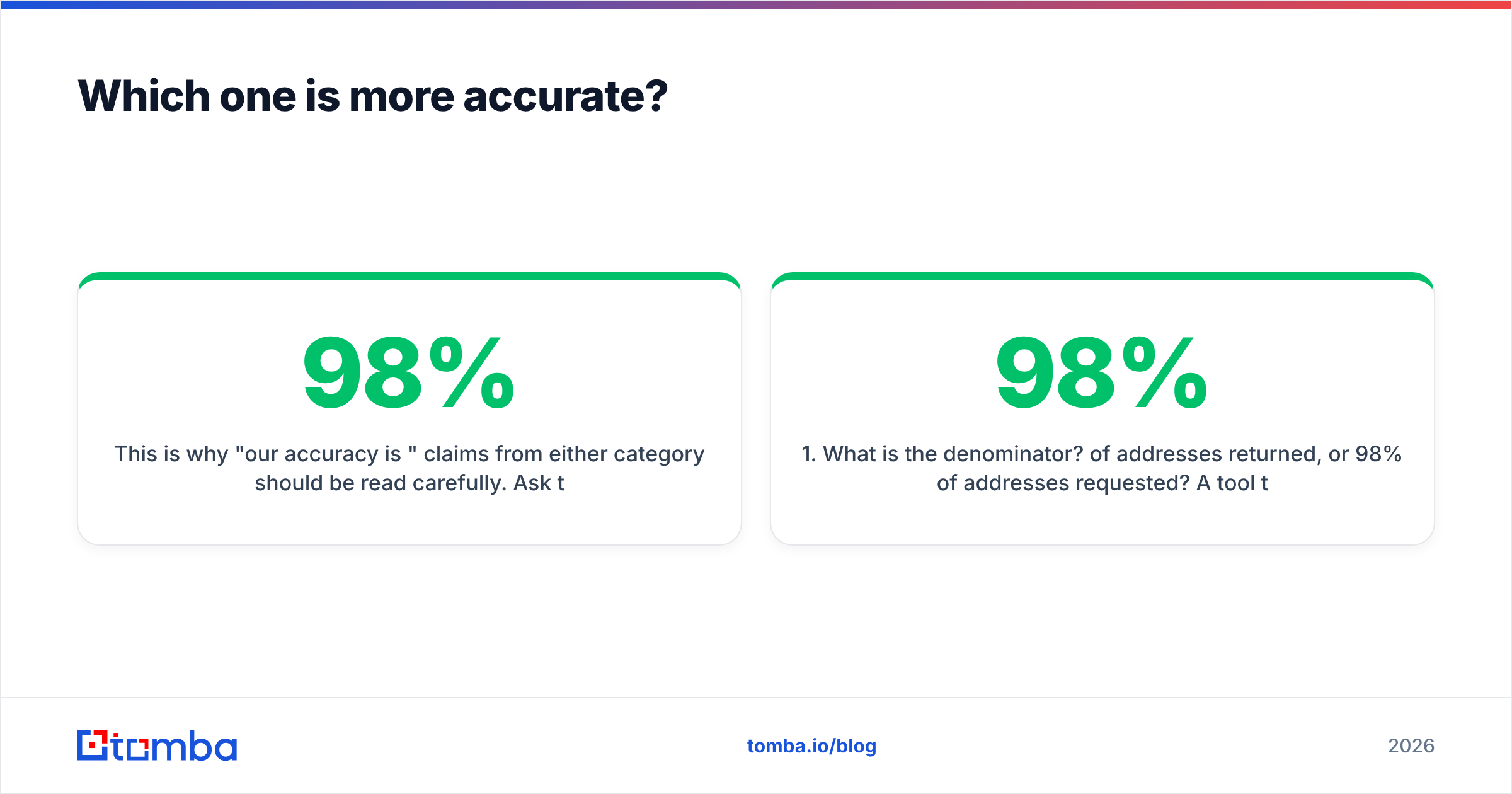
This is why "our accuracy is 98%" claims from either category should be read carefully. Ask the vendor two questions:
What is the denominator? 98% of addresses returned, or 98% of addresses requested? A tool that returns nothing for 60% of queries can post a gorgeous number on the 40% it does answer.
How are catch-alls counted? If they are excluded from the calculation, the headline number is not the number you will experience.
In practice, a stacked workflow beats either tool alone: discovery from one source, independent verification from another. The second pass catches the first pass's optimism. A combined platform gives you that natively, without a second contract.
What does each cost in 2026?#
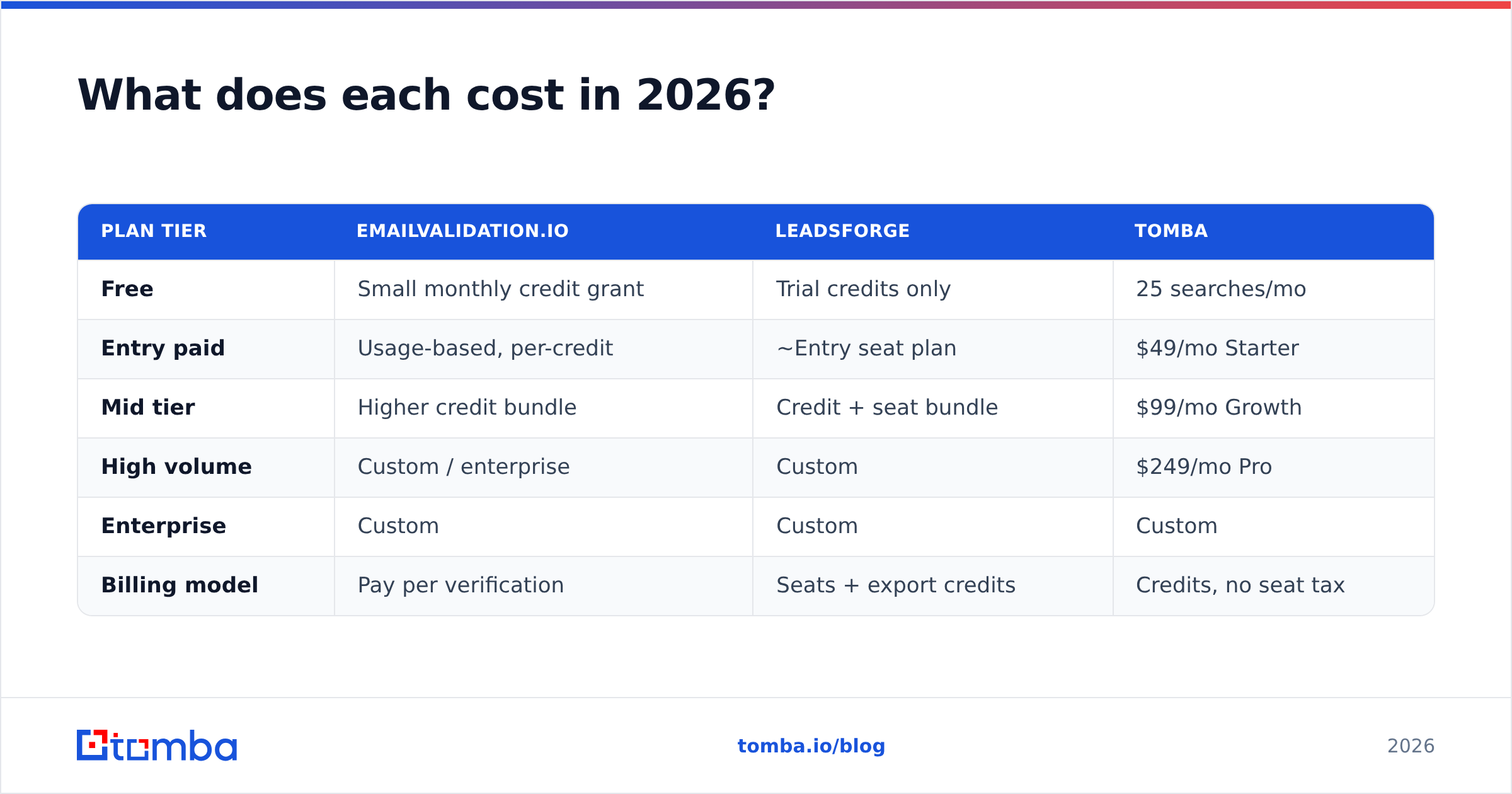
| Plan tier | EmailValidation.io | LeadsForge | Tomba |
|---|---|---|---|
| Free | Small monthly credit grant | Trial credits only | 25 searches/mo |
| Entry paid | Usage-based, per-credit | ~Entry seat plan | $49/mo Starter |
| Mid tier | Higher credit bundle | Credit + seat bundle | $99/mo Growth |
| High volume | Custom / enterprise | Custom | $249/mo Pro |
| Enterprise | Custom | Custom | Custom |
| Billing model | Pay per verification | Seats + export credits | Credits, no seat tax |
Vendor pricing changes; confirm on each vendor's own page before purchase. Tomba's tiers are published at Tomba pricing.
The line item people forget is the second contract. Buy LeadsForge for discovery, then find you still need independent verification before sending, and you now have two subscriptions. Two credit pools expire on different dates. A CSV shuttles between them. Two $60/month tools cost more than one $99/month tool and take more of your ops person's Tuesday.
Conversely, if you already have a 200,000-row CRM to clean and no need for new contacts, paying for a discovery platform is waste. A pure verification API is genuinely the cheaper answer there.
Which should you pick for your use case?#
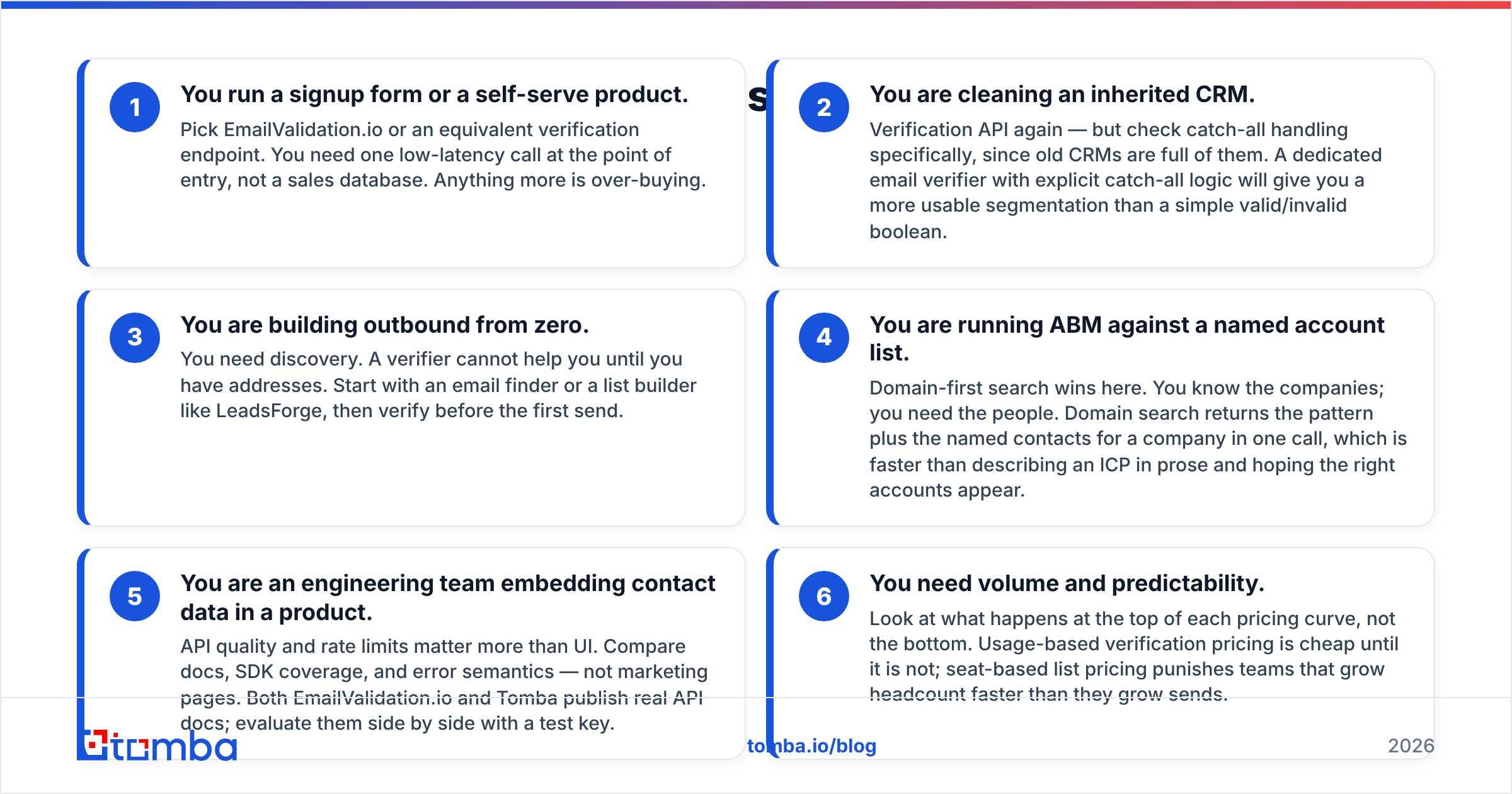
You run a signup form or a self-serve product. Pick EmailValidation.io or an equivalent verification endpoint. You need one low-latency call at the point of entry, not a sales database. Anything more is over-buying.
You are cleaning an inherited CRM. Verification API again — but check catch-all handling specifically, since old CRMs are full of them. A dedicated email verifier with explicit catch-all logic gives you better segmentation than a simple valid/invalid boolean.
You are building outbound from zero. You need discovery. A verifier cannot help you until you have addresses. Start with an email finder or a list builder like LeadsForge, then verify before the first send.
You are running ABM against a named account list. Domain-first search wins here. You know the companies; you need the people. Domain search returns the pattern plus the named contacts for a company in one call. That beats describing an ICP in prose and hoping the right accounts appear.
You are an engineering team embedding contact data in a product. API quality and rate limits matter more than UI. Compare docs, SDK coverage, and error semantics — not marketing pages. Both EmailValidation.io and Tomba publish real API docs; evaluate them side by side with a test key.
You need volume and predictability. Look at the top of each pricing curve, not the bottom. Usage-based verification pricing is cheap until it is not. Seat-based list pricing punishes teams that grow headcount faster than they grow sends.

Is a combined platform better than two specialist tools?#
For most B2B teams under 50 seats: yes.
The specialist argument is real when volume is extreme. If you verify millions of addresses a month as an infrastructure function — marketplace signups, transactional email hygiene, fraud screening — a dedicated verification API is the right architecture. That is a different job from sales prospecting, and it deserves its own vendor.
But the median outbound team is not doing that. It builds a few thousand contacts a month, sends sequences, and tries to keep bounce rate under 2% so the domain reputation survives. For that team, the handoff between two tools is the weakest link:
- Credits expire in one system while the other still has balance
- Export formats drift, so someone maintains a mapping spreadsheet
- Verification happens after export, so you pay discovery credits for contacts you then throw away
- Nobody owns the number, because the bounce rate is a function of two vendors
A combined platform collapses that. You find the address and verify it in the same call, so you never pay to export a dead contact. You can also enrich it in the same pass — see data enrichment for what a single record can carry beyond the email.
What about the other options in this category?#
Neither EmailValidation.io nor LeadsForge is the only game. Worth a look depending on your angle:
- BookYourData — strong when you want a pre-built, human-verified B2B list with a pay-as-you-go model rather than a subscription. Good fit for one-off campaigns and teams who want to own the data outright.
- Hunter and Tomba — discovery-first platforms with verification built in, priced by credits rather than seats.
- ZeroBounce, Bouncer, Clearout — dedicated verification vendors with deeper hygiene features (spam-trap detection, activity data) than a minimal API.
- Apollo, Clay — heavier GTM platforms where contact data is one module among sequencing, scoring, and workflow.
If you want a neutral baseline, HubSpot's research on email deliverability benchmarks shows what "good" bounce and reply rates look like in your segment. Use it to judge whether a tool actually moved your numbers.

How should you run the evaluation?#
Do not evaluate on marketing pages. Run the same test against every candidate:
Build a 100-row control list. Take 100 contacts you already know are good — colleagues, customers, people who replied to you last quarter. Include a deliberate mix: 20 at catch-all domains, 10 role accounts, 10 free-mail addresses, 10 who have left their company.
Run it through each tool. For verifiers, score how many known-good addresses get marked invalid. False negatives cost you pipeline. Then score how many known-dead ones get marked valid. False positives cost you reputation. For discovery tools, score coverage: of 100 known people, how many does it find at all?
Weight false positives heavily. A tool that says "unknown" honestly is more useful than one that guesses "valid" confidently. Your domain reputation cannot tell the difference between a bad guess and a lie.
Then check the boring stuff. Rate limits, support response time, contract length, and whether credits roll over. These decide how the tool feels in month six, not month one.
The verdict#
The short answer on EmailValidation.io vs LeadsForge: pick by the job you actually have, not by the feature list.
EmailValidation.io wins if verification is your whole problem: form-level checks, CRM hygiene, high-volume API validation where you already own the addresses.
LeadsForge wins if you want a fast, prompt-driven way to generate an ICP list and you are comfortable running a separate verification pass before you send.
Neither wins if you are doing both jobs. You will pay two vendors for one pipeline and own the seam between them yourself.
If you want find-and-verify in one workflow — with catch-all resolution, bulk processing, and an API you can automate against — start with the Tomba Email Finder. The free tier gives you 25 searches a month, enough to run the 100-row control test above before you spend anything. Starter is $49/mo when you are ready to scale. Test it against whatever you use now on the same list, and let the bounce rate pick the winner.
Related guides#
Ready to find emails that actually work?
Join 150,000+ professionals who stopped guessing and started sending. Free credits on signup — no credit card required.
Get the Tomba newsletter
Practical outbound tactics and product updates — once every two weeks.
About the author