EmailValidation.io vs SignalHire: Honest 2026 Comparison
One cleans lists, the other finds people. Here's how EmailValidation.io and SignalHire actually differ on accuracy, credits, pricing, and which one belongs in your outbound stack in 2026.
EmailValidation.io vs SignalHire is an odd matchup. One tool cleans lists. The other builds them. Here is the short answer, then the detail.
TL;DR
- EmailValidation.io and SignalHire are not real rivals. One is a verification API that tells you if an address is deliverable. The other is a contact-discovery tool that hands you emails and phone numbers for people you find on LinkedIn.
- Pick EmailValidation.io if you already have lists. It is cheap, fast, and built for high-volume checks behind an API.
- Pick SignalHire if your problem is finding people at all. Recruiters who need mobile numbers get the most out of it.
- Buying both means two bills, two credit systems, and two sets of API docs. One combined finder plus verifier usually costs less and breaks less.
- The real question in EmailValidation.io vs SignalHire is simple. Are you short on contacts, or short on trust in the contacts you already have?
EmailValidation.io vs SignalHire: what is each tool?#
They solve opposite halves of the same problem.
EmailValidation.io checks email addresses. You send it an address. It runs syntax checks, spots throwaway domains, flags role accounts, looks up the MX record, and opens an SMTP handshake.
Then it returns a verdict: valid, invalid, risky, or unknown. You also get flags like disposable, free, role, and catch_all. There is a REST API, a bulk upload path, and a free tier for testing. It finds no one. Feed it an empty list and you get an empty list back.
SignalHire sits at the other end. It finds contact details for people on LinkedIn, GitHub, and other public profiles, mostly through a browser extension.
Its edge is multi-channel data. You get work email, personal email, and mobile numbers. That is why recruiters and staffing agencies like it more than B2B SaaS sales teams do. It also ships light ATS features: candidate pipelines, team seats, and basic tracking.
So the honest framing of EmailValidation.io vs SignalHire is this: input cleaner vs input generator. That split drives every tip below.

EmailValidation.io vs SignalHire: a head-to-head comparison#
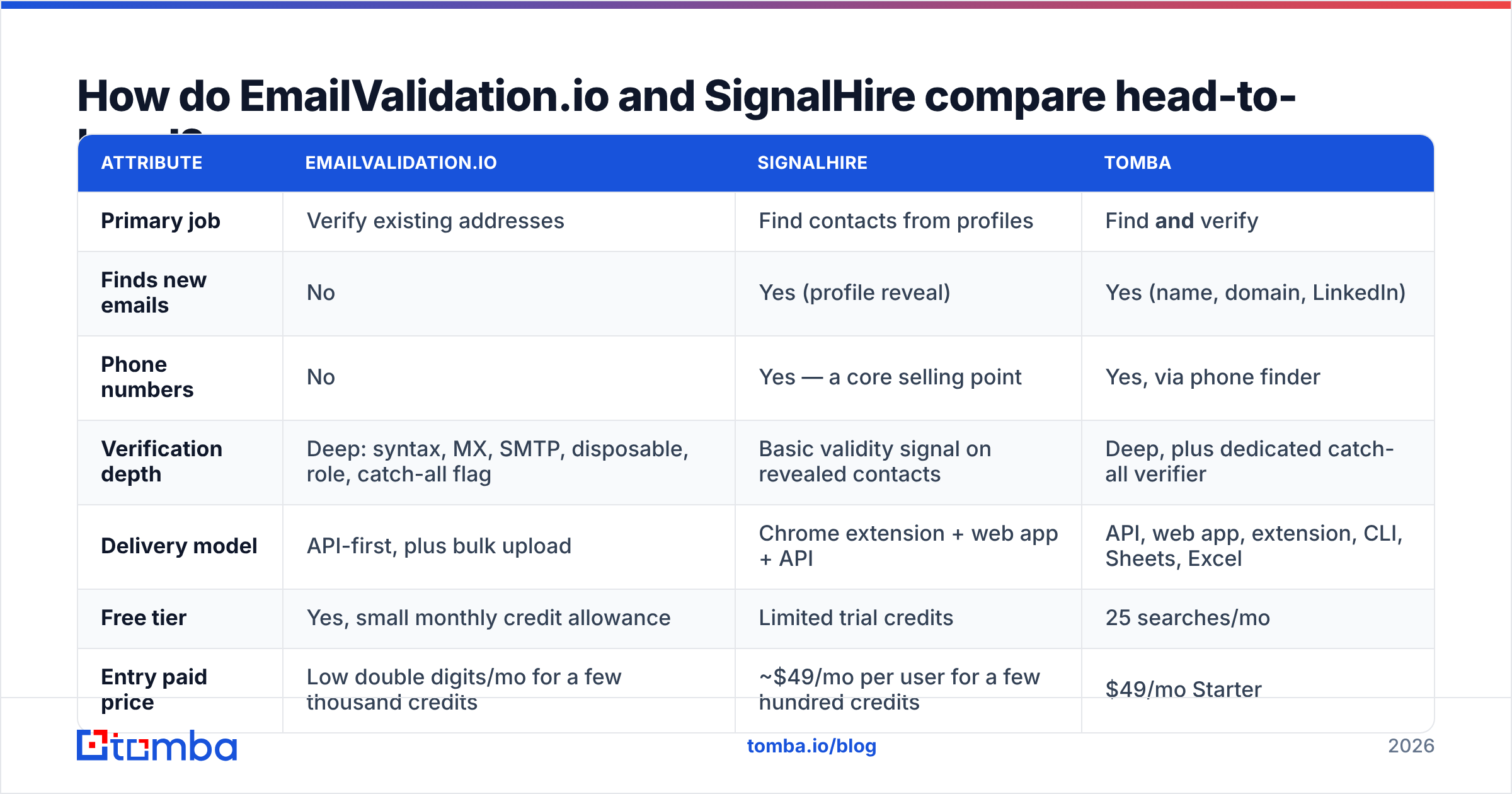
Here is the practical split. Prices are list prices at the time of writing. Both vendors change their tiers, so check their sites before you set a budget.
| Attribute | EmailValidation.io | SignalHire | Tomba |
|---|---|---|---|
| Primary job | Verify existing addresses | Find contacts from profiles | Find and verify |
| Finds new emails | No | Yes (profile reveal) | Yes (name, domain, LinkedIn) |
| Phone numbers | No | Yes — a core selling point | Yes, via phone finder |
| Verification depth | Deep: syntax, MX, SMTP, disposable, role, catch-all flag | Basic validity signal on revealed contacts | Deep, plus dedicated catch-all verifier |
| Delivery model | API-first, plus bulk upload | Chrome extension + web app + API | API, web app, extension, CLI, Sheets, Excel |
| Free tier | Yes, small monthly credit allowance | Limited trial credits | 25 searches/mo |
| Entry paid price | Low double digits/mo for a few thousand credits | ~$49/mo per user for a few hundred credits | $49/mo Starter |
| Best fit | Devs cleaning large lists | Recruiters and sourcers | Sales/GTM teams doing both |
| Credit burn risk | Low — verification credits are cheap | High — reveals cost far more per unit | Medium |
Two things stand out.
First, credit costs are not comparable across categories. A verify credit is cheap. The work is a DNS lookup and a short SMTP chat. A reveal credit costs far more, because the tool must match a person to a contact record across sources.
So a price per 1,000 tells you nothing here. Compare the cost per usable, verified contact that reaches your sequence instead.
Second, the overlap is close to zero. If you are truly torn between these two, you have not scoped your problem yet.
How accurate is EmailValidation.io vs SignalHire?#
Accuracy means different things for each product. That is why head-to-head accuracy scores mislead people.
For EmailValidation.io, accuracy is verdict precision. When it says valid, does the address accept mail? When it says invalid, is it a hard bounce?
Purpose-built verification APIs, this one included, land in the high 90s on clean domains. The hard case is catch-all domains. Those servers accept every address at SMTP time and tell you nothing.
Every SMTP-based checker returns unknown there. That is physics, not a product flaw. What matters is what the vendor does next. A dedicated catch-all verifier uses pattern confidence and past signal instead of a single handshake. That beats a headline accuracy number.
For SignalHire, accuracy is match rate and coverage. When you reveal a profile, do you get a contact at all? Is it the right person's current work address?
Coverage on tech and North American profiles is decent. It thins out at smaller European and APAC firms. Personal email results skew older, since people change jobs more often than they change personal addresses.

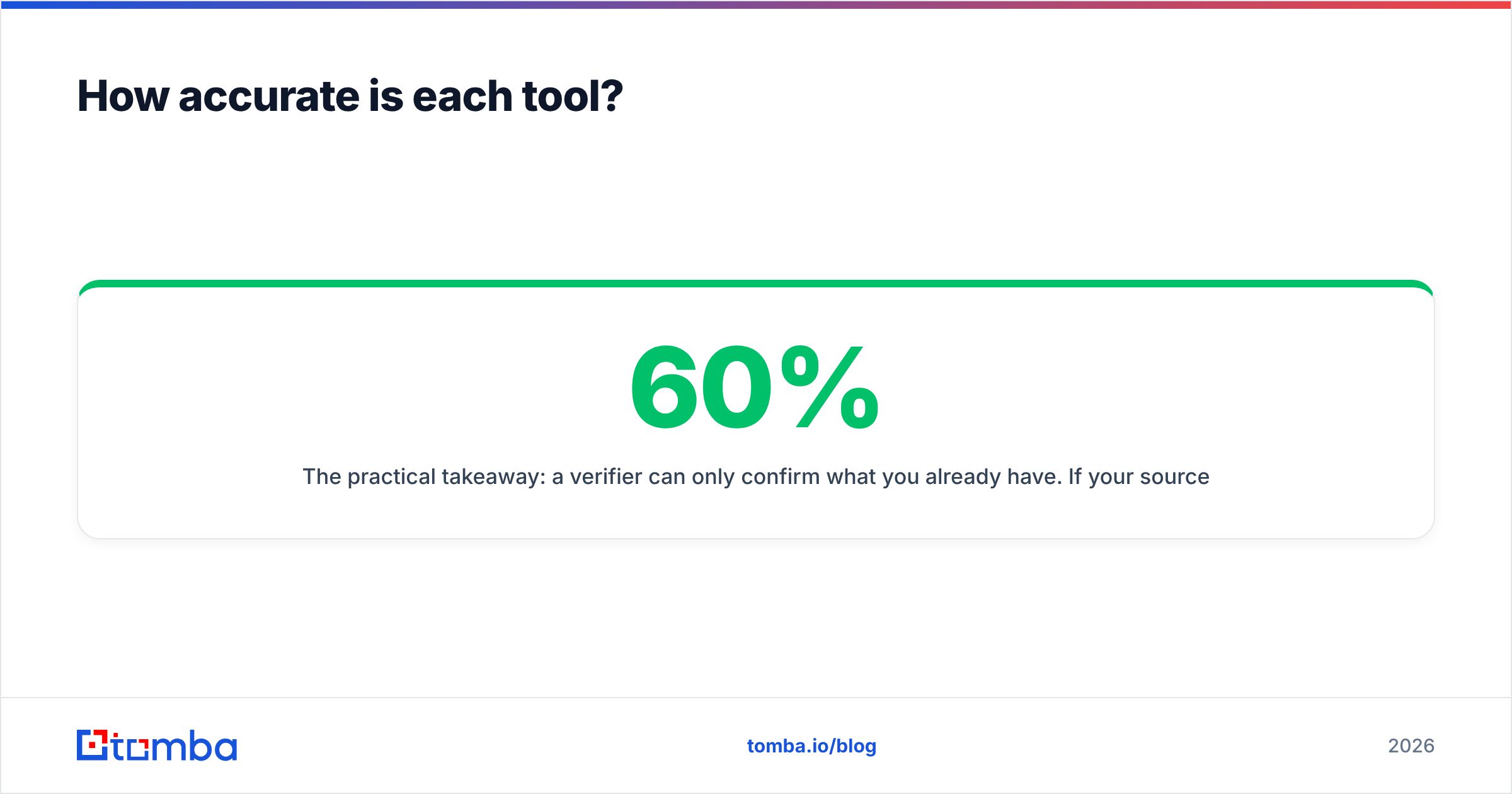
The takeaway: a verifier only confirms what you already have. If your source data covers 60% of your targets, a 99% accurate verifier still leaves you at 60%. It just tells you the truth faster.
Coverage problems need a finder. Bounce problems need a verifier. Do not buy one and expect it to fix the other.
What does EmailValidation.io vs SignalHire cost in practice?#
Model it per campaign, not per credit. Say you want 1,000 verified contacts at target accounts this month.
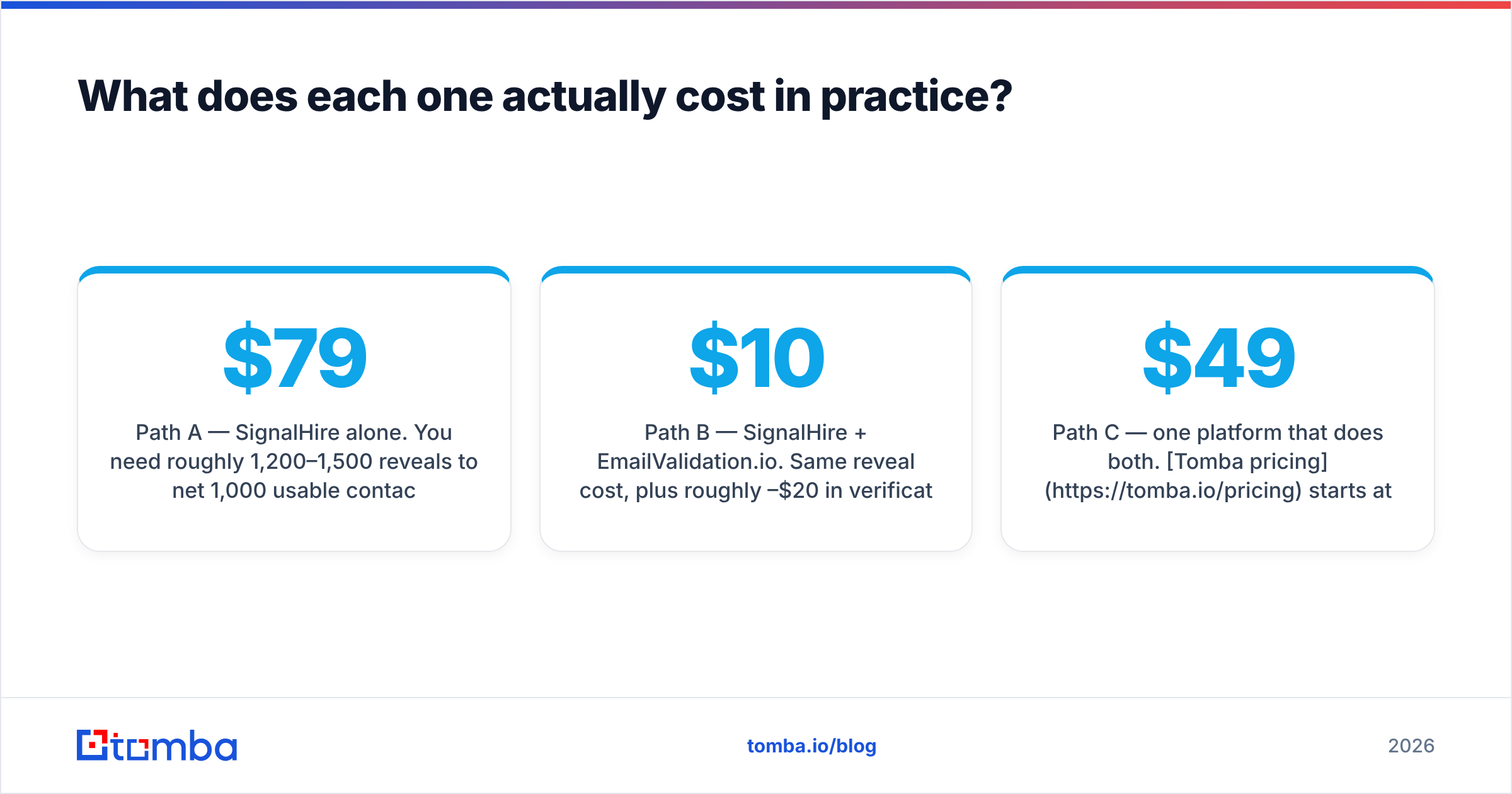
Path A — SignalHire alone. You need roughly 1,200 to 1,500 reveals to net 1,000 usable contacts. Misses and role addresses eat the rest. That puts you on an upper-mid plan. You also trust SignalHire's own validity signal with no outside check. Estimated: $79–$150/mo plus risk.
Path B — SignalHire plus EmailValidation.io. Same reveal cost, plus $10 to $20 to verify. You get a real second opinion on deliverability, and that is worth paying for. Estimated: $90–$170/mo, two dashboards, two APIs, two invoices.
Path C — one platform for both. Tomba pricing starts at $49/mo for Starter and $99/mo for Growth. The email finder and email verifier share one credit pool and one API key. Estimated: $49–$99/mo, one integration.
Path B is the honest best-of-breed answer, and it is a fair choice. Some teams want a specialist verifier kept apart from their data source. Separation of concerns is a real engineering argument.
But most sales and GTM teams pay a hidden tax to run two vendors. That cost tends to beat the small gain in accuracy.

Which one fits your workflow?#
Match the tool to your real bottleneck.
- 200k rows and a 9% bounce rate. Use EmailValidation.io. You do not need more contacts. You need to protect your sender reputation. Run bulk checks, drop invalid and role addresses, and recheck anything older than six months.
- A recruiter sourcing passive candidates. Use SignalHire. Mobile numbers and personal emails matter more here than domain patterns, and the LinkedIn extension fits profile-by-profile work.
- An SDR building account lists from domains. Neither one is enough alone. Use domain search to pull every public address at a target company, then verify the output.
- An engineer adding validation to a signup form. Use EmailValidation.io, or any fast verification API. Real-time form checks are a verifier-only job. A finder adds nothing.
- Outbound at 2,000+ contacts a month. Consolidate. Two credit systems at that volume mean constant math and a surprise overage every quarter.
- Enrichment on inbound leads. Neither. You want data enrichment that turns an email or domain into company data. That is a third product category.

EmailValidation.io vs SignalHire: what are the deal-breakers?#
EmailValidation.io limits
- No discovery at all. It is a dead end if you do not already own the data.
- Catch-all domains come back unknown. Roughly a fifth of B2B domains are catch-all, so a real chunk of your list stays in limbo.
- No CRM-native flow. It is an API and a bulk uploader. Non-technical users will need help to wire it up.
- Thin context. You learn whether an address works, not who owns it or whether they still work there.
SignalHire limits
- Per-seat pricing adds up on teams. Five sourcers means five subscriptions.
- Reveal credits burn fast and roll over poorly. Misses still count against you on most plans.
- Verification is a side effect, not the product. If deliverability is your KPI, you still want an outside check.
- Extension workflows break easily. They depend on the source site's markup and rate limits staying stable.
Neither list is disqualifying. Both tools are good at the job they were built for. The mistake is buying one for a job it was never meant to do, then deciding these tools do not work.
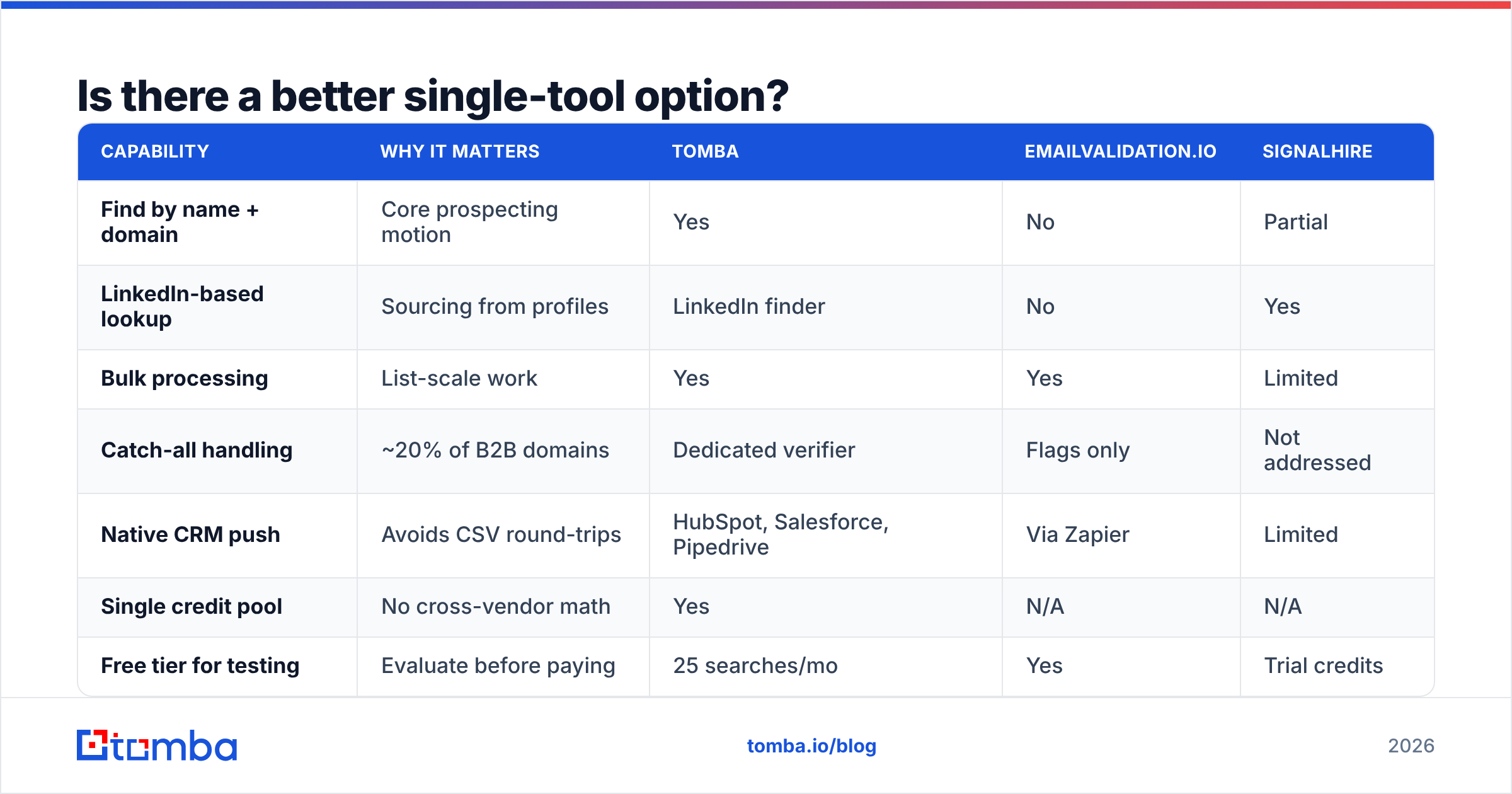
Is there a better single-tool option?#
Your workflow may be find B2B contacts, confirm they are deliverable, push to CRM. If so, one combined platform removes a whole class of problems. Here is an honest comparison against both.
| Capability | Why it matters | Tomba | EmailValidation.io | SignalHire |
|---|---|---|---|---|
| Find by name + domain | Core prospecting motion | Yes | No | Partial |
| LinkedIn-based lookup | Sourcing from profiles | LinkedIn finder | No | Yes |
| Bulk processing | List-scale work | Yes | Yes | Limited |
| Catch-all handling | ~20% of B2B domains | Dedicated verifier | Flags only | Not addressed |
| Native CRM push | Avoids CSV round-trips | HubSpot, Salesforce, Pipedrive | Via Zapier | Limited |
| Single credit pool | No cross-vendor math | Yes | N/A | N/A |
| Free tier for testing | Evaluate before paying | 25 searches/mo | Yes | Trial credits |
Two other names are worth a look. BookYourData suits teams that would rather buy a pre-verified list than run discovery. You get volume on day one, with no sourcing motion to build.
And if phone coverage is what drew you to SignalHire, compare a dedicated phone finder first. A full sourcing suite is not the only route.
Check current reviews on G2 before you decide. Review volume and recency say more about a vendor than any comparison post, this one included.
EmailValidation.io vs SignalHire: which should you pick in 2026?#
Short version:
- Verification only, high volume, developer-owned: EmailValidation.io. It is focused, cheap, and the API is simple. Nothing beats it at this exact job for the money.
- Sourcing people from profiles, with phone numbers: SignalHire. That holds most in recruiting, where the fallback is manual research.
- B2B outbound that needs both, at team scale: consolidate onto one platform. Two vendors work, but you will spend real hours on upkeep, and the accuracy gain is smaller than that cost.
The costly mistake here is not picking the wrong vendor. It is buying a verifier when your problem is coverage. Or a finder when your problem is bounces. Then you blame the tool for six months.
Diagnose first. Pull a sample of 100 target contacts. If you can only build 40, you have a discovery problem. If you build 95 and 12 bounce, you have a verification problem. If both, you have a stack problem.
Ready to stop running two subscriptions?#
Your loop may be find, verify, export, repeat. If so, try the Tomba Email Finder. Search by domain, name, or LinkedIn profile. Every result runs through built-in verification, catch-all checks included. Export straight to your CRM with one API key, one credit pool, and one invoice.
The free tier gives you 25 searches a month. Test it on your own target accounts before you spend a cent. Starter is $49/mo when you are ready to scale. Run your next 100 prospects through it, then compare the bounce rate with whatever you use now.
Related guides#
Ready to find emails that actually work?
Join 150,000+ professionals who stopped guessing and started sending. Free credits on signup — no credit card required.
Get the Tomba newsletter
Practical outbound tactics and product updates — once every two weeks.
About the author