EmailValidation.io vs ZoomInfo: Which One Do You Actually Need?
EmailValidation.io vs ZoomInfo is not a fair fight. One is a verification API that never finds you an email. The other is a five-figure data platform. Here's how they really compare in 2026 — and when neither is the right buy.
TL;DR
- EmailValidation.io vs ZoomInfo is not a fair fight. One tool checks addresses you already have. The other sells you the contacts in the first place.
- EmailValidation.io is a small verification API. It is fast, cheap, and easy to wire up. It will never hand you a new prospect.
- ZoomInfo is a big B2B data platform. You get intent signals, org charts, and phone numbers. You also get a yearly contract, often $15,000–$40,000+ with seat minimums.
- Most teams comparing these two really want a third thing: accurate contact emails without an enterprise contract. A mid-market finder plus verifier wins there.
- Pick by workflow, not by feature list. API-only cleanup → EmailValidation.io. Full data layer with intent → ZoomInfo. Find and verify at $49–$249/mo → Tomba or a similar finder.
EmailValidation.io vs ZoomInfo: what does each tool do?#
Start with a restaurant analogy. ZoomInfo is the wholesale market that sells you ingredients: companies, contacts, phone numbers, buying signals. EmailValidation.io is the food safety inspector. It tells you whether what is in your fridge has gone bad. You cannot cook with the inspector. And the wholesaler will not promise the food is still fresh six months later.
EmailValidation.io is a single-purpose REST API. Send it an address and it returns a JSON verdict. You get syntax checks, MX records, the SMTP result, disposable-domain flags, free-provider flags, role-account flags, and a score. There is a free tier, self-serve paid plans, and no sales call. A backend engineer can wire it into a signup form in an afternoon.
ZoomInfo is a full go-to-market data platform. It holds contact and company records, tech stacks, org charts, and intent data. It adds call intelligence, workflow automation, and native CRM sync. You buy it as a yearly platform contract with seats and credit pools. Expect a rep, a demo, and a few weeks of paperwork.
So the honest framing of EmailValidation.io vs ZoomInfo is not "which is better." It is: which layer of the data problem are you paying for?
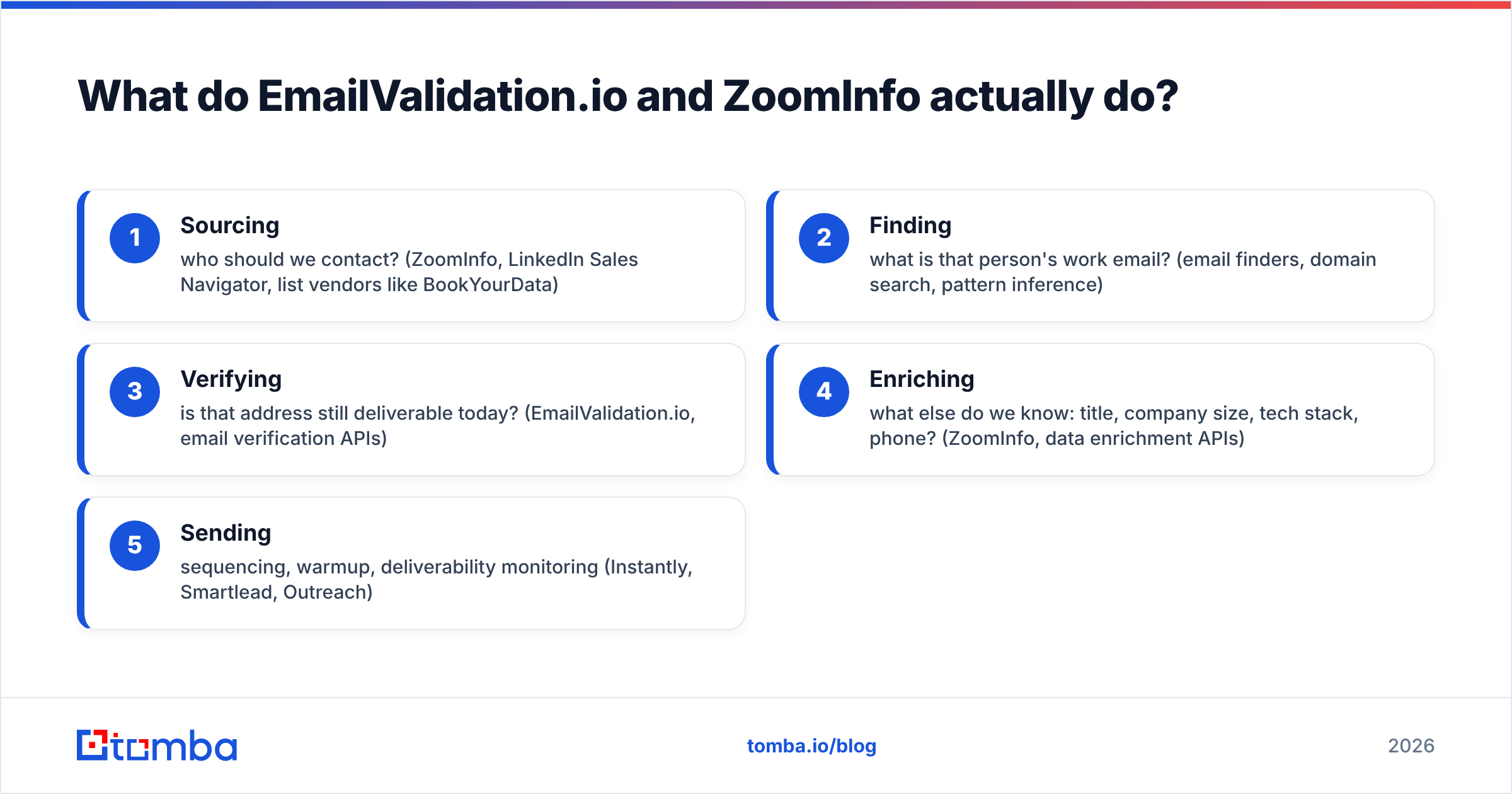
Here is how the work splits across a normal outbound stack:
- Sourcing — who should we contact? (ZoomInfo, LinkedIn Sales Navigator, list vendors like BookYourData)
- Finding — what is that person's work email? (email finders, domain search, pattern inference)
- Verifying — is that address still live today? (EmailValidation.io and other verification APIs)
- Enriching — what else do we know? Title, company size, tech stack, phone. (ZoomInfo, data enrichment APIs)
- Sending — sequencing, warmup, deliverability monitoring (Instantly, Smartlead, Outreach)
ZoomInfo covers 1, 2 and 4. EmailValidation.io covers 3. Neither covers 5. Buy only one of them and you still have a hole in your pipeline.

EmailValidation.io vs ZoomInfo head-to-head#
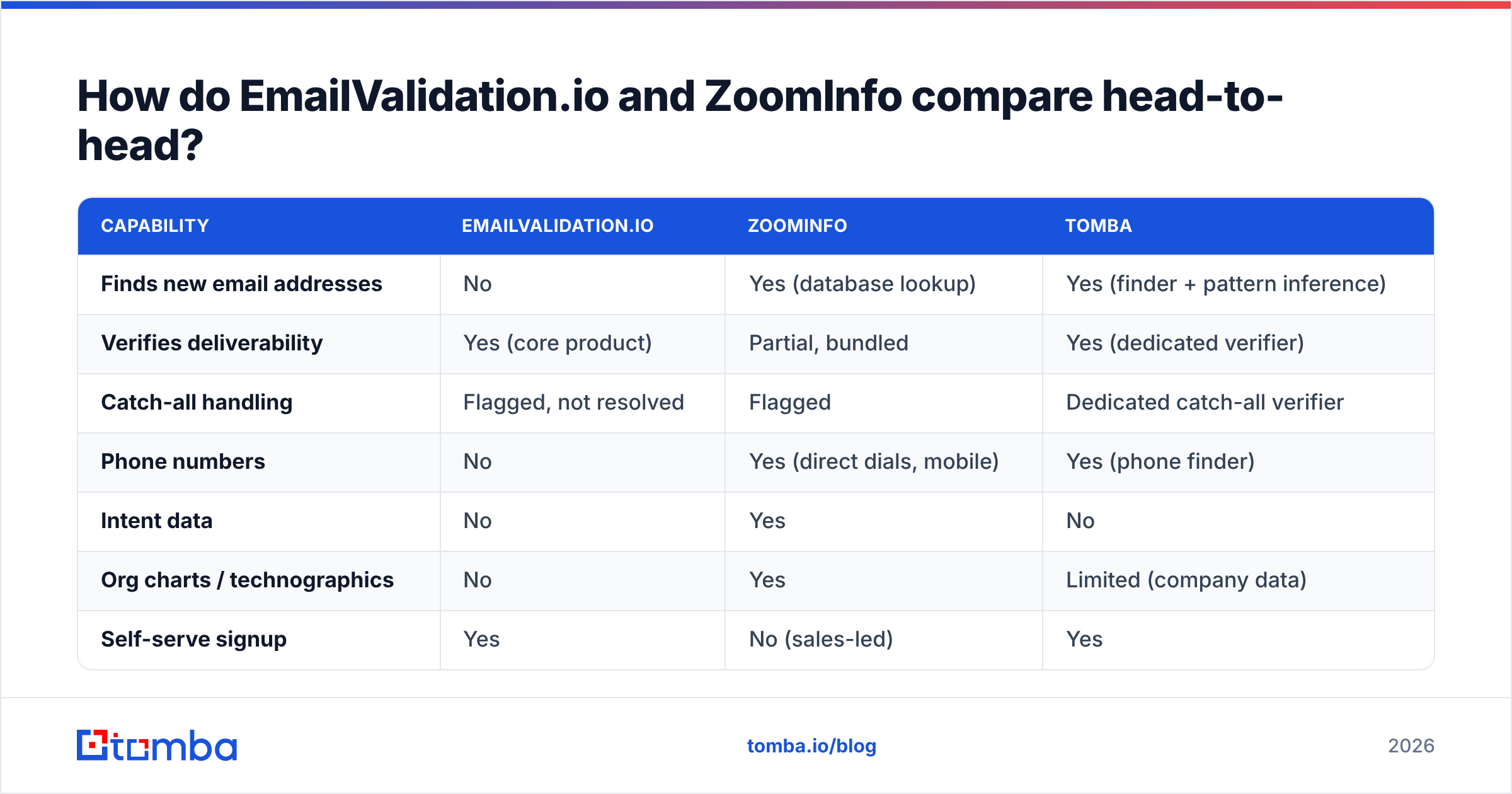
The table below assumes a B2B outbound motion: cold email, list hygiene, and CRM data quality.
| Capability | EmailValidation.io | ZoomInfo | Tomba |
|---|---|---|---|
| Finds new email addresses | No | Yes (database lookup) | Yes (finder + pattern inference) |
| Verifies deliverability | Yes (core product) | Partial, bundled | Yes (dedicated verifier) |
| Catch-all handling | Flagged, not resolved | Flagged | Dedicated catch-all verifier |
| Phone numbers | No | Yes (direct dials, mobile) | Yes (phone finder) |
| Intent data | No | Yes | No |
| Org charts / technographics | No | Yes | Limited (company data) |
| Self-serve signup | Yes | No (sales-led) | Yes |
| Contract | Monthly, cancel anytime | Annual, seat minimums | Monthly or annual |
| Free tier | Yes (limited requests) | Trial only, gated | 25 searches/mo |
| API-first | Yes | Yes (enterprise tier) | Yes |
| Typical buyer | Developer, RevOps | VP Sales, enterprise GTM | Founder, SDR team, agency |

The pattern is clear once you lay it out. EmailValidation.io wins every row about simplicity and cost. ZoomInfo wins every row about breadth. They only overlap on "email quality," and even there they measure different things. EmailValidation.io asks whether an address accepts mail right now. ZoomInfo asks whether an address exists in its database.
EmailValidation.io vs ZoomInfo pricing in 2026#
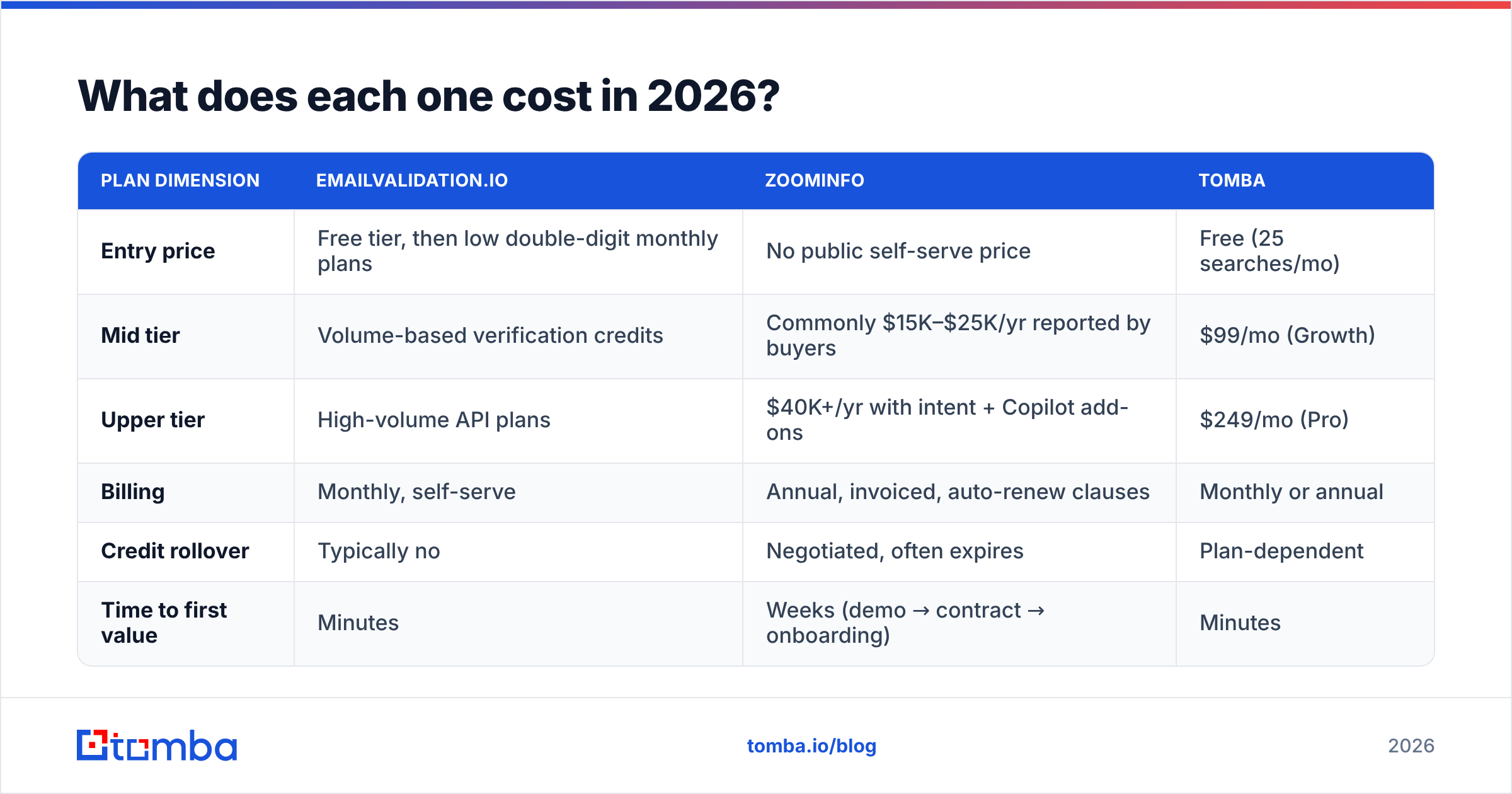
Pricing is where the two products stop looking comparable at all.
| Plan dimension | EmailValidation.io | ZoomInfo | Tomba |
|---|---|---|---|
| Entry price | Free tier, then low double-digit monthly plans | No public self-serve price | Free (25 searches/mo) |
| Mid tier | Volume-based verification credits | Commonly $15K–$25K/yr reported by buyers | $99/mo (Growth) |
| Upper tier | High-volume API plans | $40K+/yr with intent + Copilot add-ons | $249/mo (Pro) |
| Billing | Monthly, self-serve | Annual, invoiced, auto-renew clauses | Monthly or annual |
| Credit rollover | Typically no | Negotiated, often expires | Plan-dependent |
| Time to first value | Minutes | Weeks (demo → contract → onboarding) | Minutes |
Two caveats. First, EmailValidation.io changes its published tiers, so check the vendor page before you budget. Second, ZoomInfo publishes no prices at all. Every number in circulation comes from buyer reports on G2, procurement forums, and public sector contracts. Treat the range as a guide, not a quote.
The shape of the spend matters more than the sticker price. EmailValidation.io is variable cost: you pay for what you verify. ZoomInfo is fixed cost: you commit for twelve months whether your team ramps or not. That second model punishes teams with rep churn, seasonal agencies, and anyone testing a new market. Tomba pricing sits in between. Plans run $49 to $249 per month, and a free tier lets you test data quality before you commit.
How accurate is the data on each side?#
Accuracy means two different things here. Mixing them up is the most common evaluation mistake.
Verification accuracy is what EmailValidation.io reports: does this mailbox accept mail? Good verifiers handle syntax, MX records, disposable domains, and the SMTP handshake well. Every verifier struggles with catch-all domains. Those servers accept mail for any address, so the SMTP check tells you nothing. EmailValidation.io flags them as "accept-all" and hands the risk back to you. That is honest behavior. It still leaves you with a decision to make.
Coverage accuracy is what ZoomInfo is judged on. Of your 500 target accounts, how many contacts does it hold, and how stale are they? ZoomInfo's coverage in North American mid-market and enterprise is genuinely strong. It thins out in European small business, in young startups, and in roles that turn over fast. A live-lookup finder often wins in those segments. It queries current sources at request time instead of serving a record refreshed nine months ago.

The practical takeaway: no single vendor gets you both. Buy ZoomInfo and skip verification, and you will mail addresses that died since the last crawl. Buy EmailValidation.io and skip sourcing, and you own a very sharp knife with nothing to cut. Real stacks run a finder first, then an email verifier pass, then send. Re-verify anything older than 60 days.

Which one should you pick for your use case?#
Match the tool to the job, not to the feature count.
You have a large list and a bounce problem. Buy verification only. EmailValidation.io, ZeroBounce, or a bulk verify pass will fix this for a fraction of any platform contract. ZoomInfo is the wrong purchase here.
You need to build lists from scratch on a startup budget. Skip both. Pull your target company list, run domain search to get named contacts per domain, verify, then send. That is the cheapest path from zero to a working outbound motion.
You run enterprise ABM with intent-based routing. ZoomInfo earns its price here. No $99/mo tool copies intent topics, org charts, and CRM-native workflows. Just budget for verification on top, because platform data still decays.
You are a developer adding validation to a signup flow. EmailValidation.io is close to ideal: one endpoint, predictable JSON, no contract. Compare it against the email verification API options on latency and price per 10K checks.
You are an agency running outbound for many clients. Neither model fits well. You need per-client credit isolation and month-to-month terms, not a seat-based annual license.
You need phone numbers as well as email. EmailValidation.io is out by definition. Your options are ZoomInfo, a dedicated phone finder, or both.
What do buyers actually complain about?#
Read the review sites with the marketing filter off. The complaint patterns are consistent, and worth knowing before you sign.
For ZoomInfo, the theme is contract friction. Buyers cite auto-renewal clauses, hard downgrades mid-term, and credit pools that expire. Data outside the US also ages faster. None of that makes the product bad. It makes it a buying decision rather than a tooling decision. Have legal read the renewal terms.
For EmailValidation.io, the theme is scope. Teams sign up expecting lookup or enrichment and find a pure validation endpoint. That is a positioning mismatch, not a product defect. The other recurring note is catch-all ambiguity. It is universal across verifiers, and anyone claiming 100% certainty on an accept-all domain is overselling. A dedicated catch-all verifier narrows the gray zone but never closes it.
One more option sits outside both. List vendors like BookYourData sell pre-built, human-verified contact lists by the record. That suits teams who want a clean file today without building a sourcing pipeline. Price it alongside both tools if your need is one-off rather than continuous.
Is there a middle ground between a verifier and a data platform?#
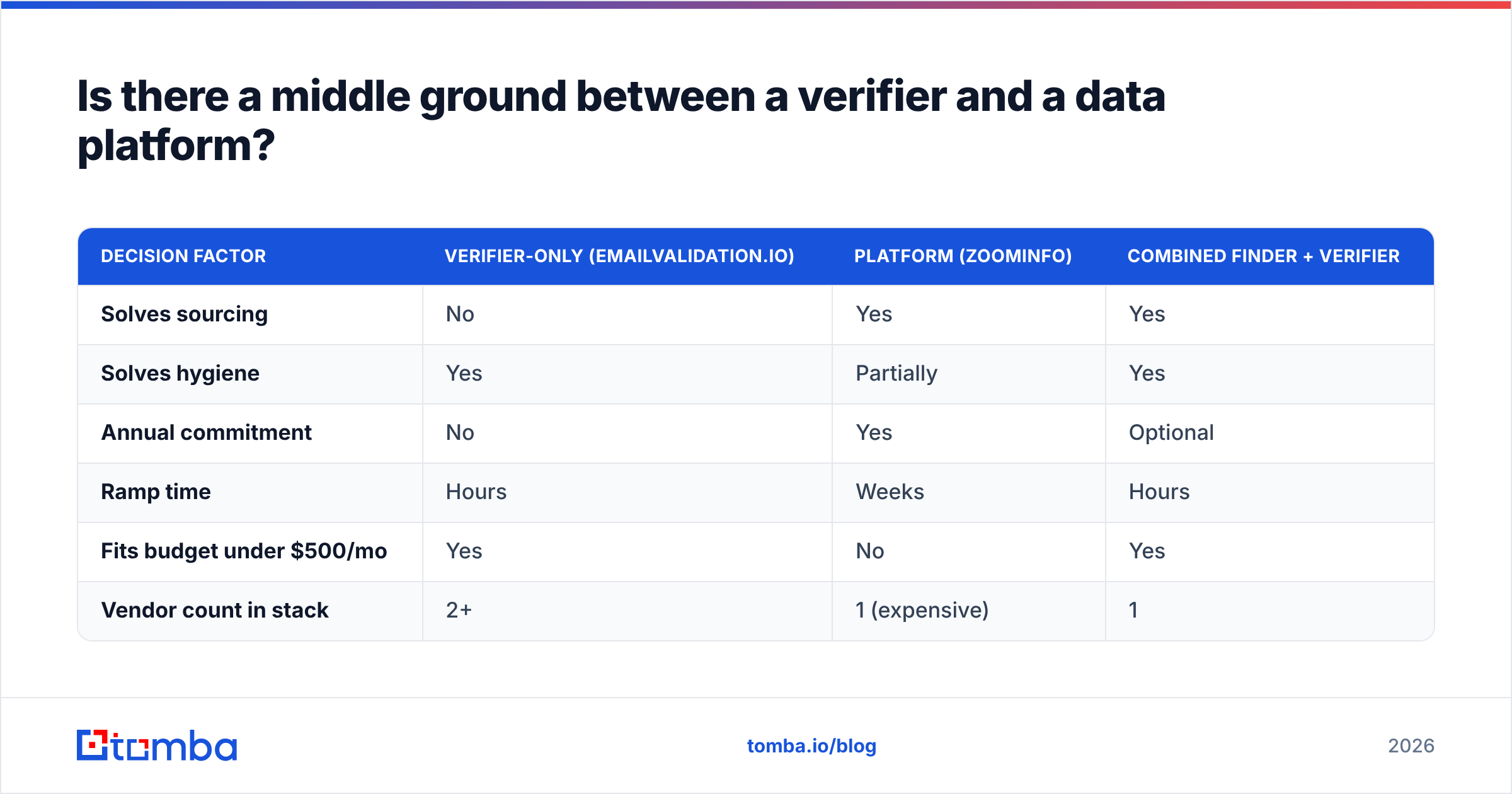
Yes. Most GTM teams under 100 people land there: one tool that finds and verifies, billed monthly.
Find-and-verify is a single workflow, not two. Split it across two vendors and you get two APIs, two credit pools, two invoices, and a manual join step in the middle. A combined tool finds the address, scores the confidence, verifies the result, and returns one record. That is what your CRM wanted in the first place.
| Decision factor | Verifier-only (EmailValidation.io) | Platform (ZoomInfo) | Combined finder + verifier |
|---|---|---|---|
| Solves sourcing | No | Yes | Yes |
| Solves hygiene | Yes | Partially | Yes |
| Annual commitment | No | Yes | Optional |
| Ramp time | Hours | Weeks | Hours |
| Fits budget under $500/mo | Yes | No | Yes |
| Vendor count in stack | 2+ | 1 (expensive) | 1 |
Tomba sits in that last column. You get an email finder with verification, domain search, catch-all checks, phone lookup, and enrichment behind one API and one plan. It does not do intent data. It will not replace ZoomInfo for a 400-seat sales org. That is an honest limit, not a hedge. But plenty of teams compare a $200/year verifier against a $25,000/year platform and find nothing sensible in between. That gap is exactly the point.
What's the verdict on EmailValidation.io vs ZoomInfo?#
Buy EmailValidation.io if your only problem is bounce rate and you already have contacts. Buy ZoomInfo if intent data, org charts, and CRM-native workflows justify a five-figure yearly deal, and you have the seats to spread that cost. Buy neither if what you really need is a reliable way to turn target companies into verified, deliverable emails this week.
Start with the free tier — 25 searches, no card — and test Tomba's Email Finder on a sample of your own target accounts. Run the same domains through whatever you use today. Compare hit rate and bounce rate side by side. Let the numbers decide instead of the pricing page. If the data holds up, the Starter plan is $49/mo. If it doesn't, you lost twenty minutes and nothing else.
Related guides#
Ready to find emails that actually work?
Join 150,000+ professionals who stopped guessing and started sending. Free credits on signup — no credit card required.
Get the Tomba newsletter
Practical outbound tactics and product updates — once every two weeks.
About the author