Eminer Pricing Reviews Pros and Cons: A 2026 Breakdown
A neutral look at what Eminer actually costs once credits, verification, and failed lookups are counted — plus the pros, the cons, and when a cheaper email finder is the smarter buy.
This Eminer pricing reviews pros and cons guide has one job. It tells you what the tool really costs per usable email, what users praise, and where it falls short.
TL;DR
- Eminer is a credit-based B2B email finder. Its list price looks cheap. But the number that matters is cost per verified, deliverable email, not cost per credit.
- Three things inflate the real bill: credits burned on catch-all domains, verification billed as a separate line item, and monthly credits that do not roll over.
- Reviewers praise the interface and the speed. The common complaint is coverage gaps on non-US, non-tech, and sub-50-employee firms.
- Eminer fits solo founders and small teams. Think a few hundred lookups a month against mid-market SaaS targets.
- Need API volume, catch-all resolution, or bulk enrichment on one bill? Tomba pricing starts at $49/mo Starter or $99/mo Growth, and usually lands cheaper per usable contact.
Before anything else: verify every number below on the vendor's own page. Eminer's site is the source of truth for its current tiers. Email-finder vendors reprice quietly. Treat what follows as a framework for judging cost, not a price guarantee.
What is Eminer, and who is it for?#
Eminer is an email-finding tool. It sits in the same category as Hunter, Findymail, and Tomba. You give it a name plus a company domain, or just a domain. It returns work email addresses with a confidence score. Most tools here also add a Chrome extension, a CSV upload path, and an API.
The buyer profile is clear from how Eminer packages itself. It targets small outbound teams and solo operators who want a clean interface and a low entry price. It is not a full go-to-market platform. There is no sequencer, no dialer, no intent data. That is a design choice, and for many teams it is the right one. You already pay for a sending tool and a CRM. You just need contact data that does not bounce.
The pricing model is where it gets complicated. Nearly every tool here sells credits, and "credit" means something different at every vendor. That one ambiguity drives most of the buyer's remorse in this category.
How does Eminer pricing actually work?#
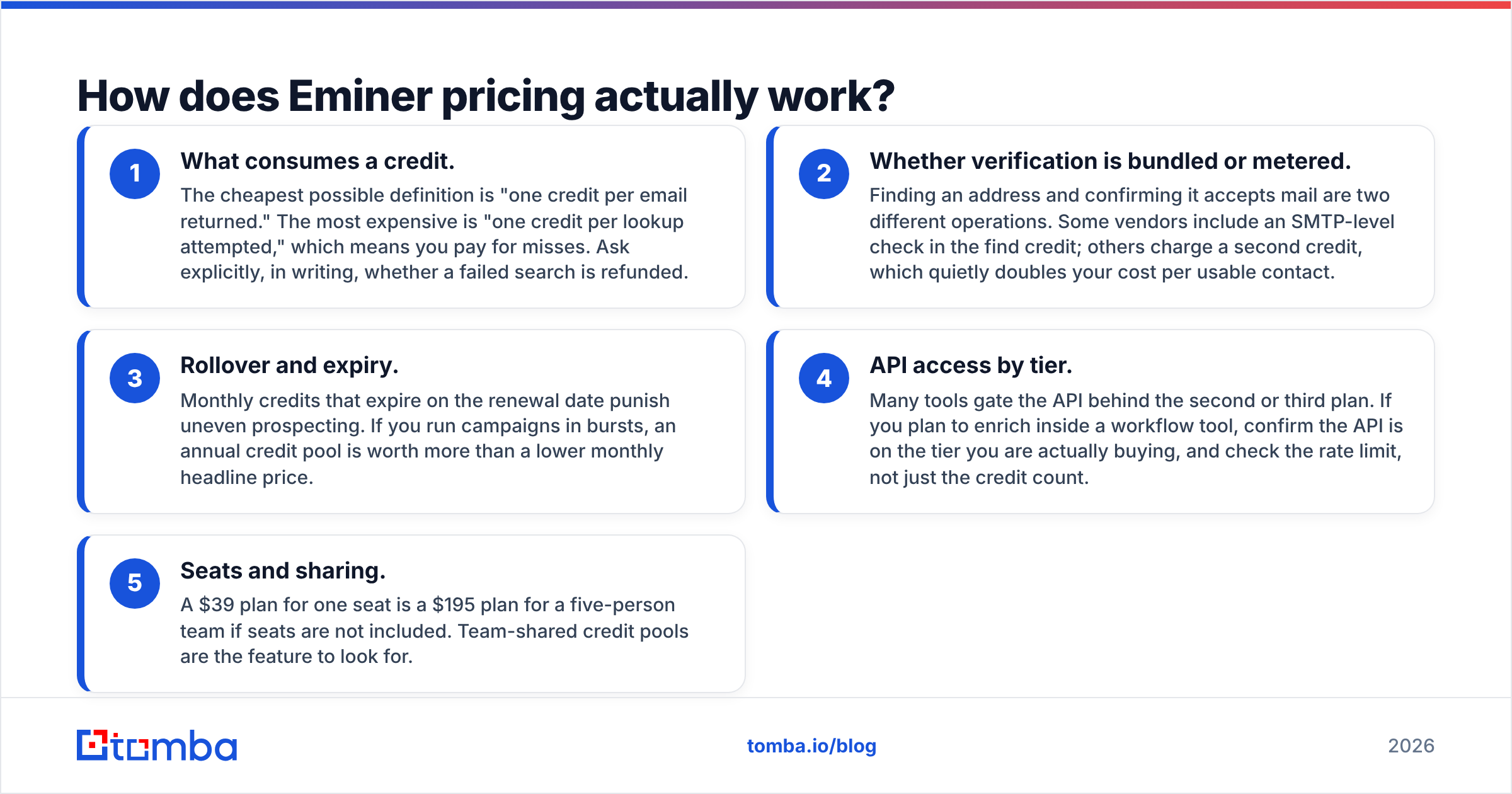
Credit-based pricing has five moving parts. Check each one on the current plan page before you sign an annual contract.
- What consumes a credit. The cheap definition is "one credit per email returned." The costly one is "one credit per lookup attempted." That means you pay for misses. Ask in writing whether a failed search is refunded.
- Bundled or metered verification. Finding an address and confirming it accepts mail are two jobs. Some vendors include an SMTP check in the find credit. Others charge a second credit, which doubles your cost per usable contact.
- Rollover and expiry. Credits that expire on the renewal date punish uneven prospecting. If you run campaigns in bursts, an annual credit pool beats a lower monthly headline price.
The last two parts only bite after you buy.
- API access by tier. Many tools gate the API behind the second or third plan. Check that the API is on the tier you are buying. Check the rate limit too, not just the credit count.
- Seats and sharing. A $39 plan for one seat is a $195 plan for a five-person team. Look for team-shared credit pools.
Run those five questions against any vendor. The "cheap" plan often stops being the cheapest. A tool at half the list price can still cost more per deliverable address, if it charges per attempt, meters verification, and expires credits monthly.

What do Eminer reviews say?#
Public sentiment on Eminer splits along a predictable line. It is the same line that runs through this whole category.
What reviewers like: the interface is fast and clean. Onboarding takes minutes. The Chrome extension does what it says, and support replies. For a tool that competes on price, that is a strong showing. Newer rivals often ship a clunky UI and hope the data covers for it. Eminer does not have that problem.
What reviewers complain about: coverage. The gap shows up on non-US companies, non-tech industries, and firms under roughly 50 employees. That is not unique to Eminer. Smaller providers lean on the same public sources and hit the same walls. It still matters if your ICP is European manufacturing or local services rather than North American SaaS.
The second theme is confidence-score inflation. Some tools label a guessed address as high-confidence with no SMTP check. That passes risk to your sending domain. Always test a sample of 100 addresses with an independent email verifier first. If 8% come back risky or invalid, that is your real accuracy number, not the one on the marketing page.

On review sites like G2, weight reviews by ICP match, not star count. A five-star review from an agency chasing US startups says little about coverage on 30-person German logistics firms. Filter for reviewers whose company size and region match yours. Read only those.
Eminer Pricing Reviews Pros and Cons: What Are the Trade-offs?#
| Eminer | |
|---|---|
| Ease of use | Strong. Clean UI, quick onboarding, working Chrome extension |
| Entry price | Low list price relative to enterprise platforms |
| Coverage | Solid on US/tech mid-market; thinner on SMB, EMEA, and non-tech verticals |
| Verification depth | Basic. Catch-all domains are typically returned as "accept-all" with no resolution |
| Bulk workflows | CSV upload works; large-volume enrichment is not the core strength |
| API maturity | Functional but limited compared to established providers; check tier gating |
| Ecosystem | Few native integrations; expect to route through Zapier or Make |
| Best fit | Solo founders and 1–3 person outbound teams, a few hundred lookups per month |
The short version of Eminer pricing reviews pros and cons: it is a competent point solution. It does not try to be a data platform, so do not price it against one. The failure mode is buying it as a platform. You then find you need three more subscriptions to cover verification, catch-all resolution, and phone data.
How does Eminer pricing compare to other email finders?#
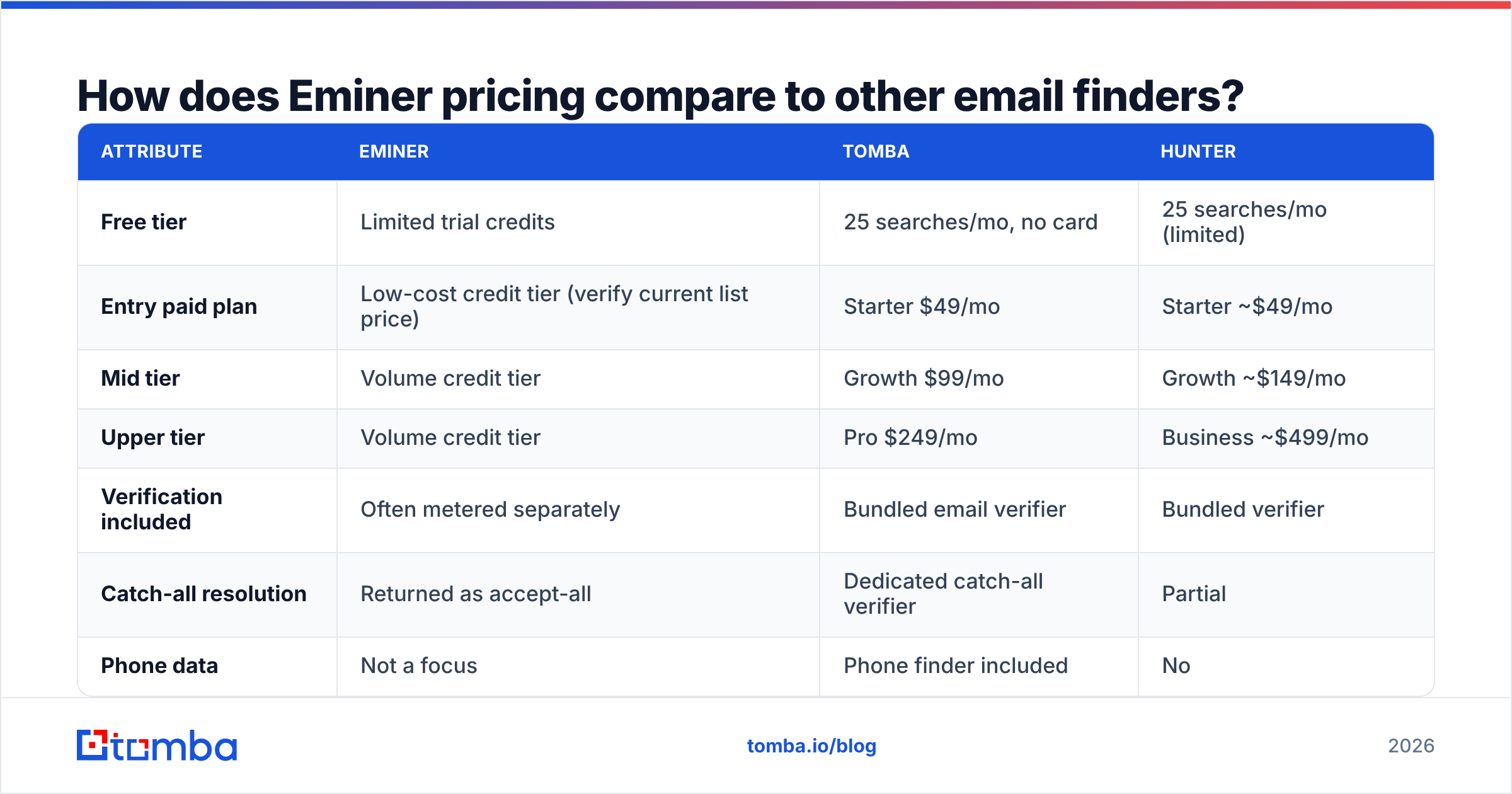
This is where the decision gets made. Compare capability per dollar at the tier you will really use, not at the headline entry price.
| Attribute | Eminer | Tomba | Hunter |
|---|---|---|---|
| Free tier | Limited trial credits | 25 searches/mo, no card | 25 searches/mo (limited) |
| Entry paid plan | Low-cost credit tier (verify current list price) | Starter $49/mo | Starter ~$49/mo |
| Mid tier | Volume credit tier | Growth $99/mo | Growth ~$149/mo |
| Upper tier | Volume credit tier | Pro $249/mo | Business ~$499/mo |
| Verification included | Often metered separately | Bundled email verifier | Bundled verifier |
| Catch-all resolution | Returned as accept-all | Dedicated catch-all verifier | Partial |
| Phone data | Not a focus | Phone finder included | No |
| Bulk + API | Available, tier-gated | Bulk tools and full REST API | Available |
| Native integrations | Minimal | HubSpot, Salesforce, Sheets, Airtable, Zapier | Broad |
| Best for | Solo / very small teams | Teams needing find + verify + enrich on one bill | Teams already in the Hunter ecosystem |
Competitor figures reflect published list prices at the time of writing. Confirm them on Hunter's pricing page and each vendor's own site. Tomba's figures are firm: Free (25 searches/mo), Starter $49/mo, Growth $99/mo, Pro $249/mo, Enterprise custom.

Two structural differences drive most of the cost gap.
The first is catch-all handling. A quarter to a third of B2B domains accept all mail. A standard SMTP probe returns "valid" for any address on them. A tool that stops there hands you a list that looks clean and bounces anyway. A dedicated catch-all verifier resolves a good share of those. That is the gap between a 3% bounce rate and a 12% one. At 12%, mailbox providers throttle you, and tool price stops mattering next to a burned domain.
The second is bundling. If verification, catch-all checks, and phone lookups each carry a subscription, your real monthly spend at 2,000 contacts can run 40–60% above the headline. Price the whole stack you need, then compare. That is where a $99/mo plan with everything bundled beats a $39/mo plan with three add-ons.

Is Eminer worth it in 2026?#
Yes, in a narrow band. Buy Eminer if all of these are true:
- You are one to three people doing outbound, not a team with a data ops function.
- Your ICP is US or Western European tech and professional services firms above roughly 50 employees.
- Your monthly volume is in the hundreds, not the thousands.
- You already own a verification tool, or you accept a higher bounce rate on small volume.
- You do not need the API, phone numbers, or CRM-native enrichment.
Skip it if you need catch-all resolution at scale, bulk email finder throughput for list building, one bill for find plus verify plus enrich, or solid coverage outside the US and EU tech mid-market.
One broader point applies to every tool in the category. The metric to optimize is cost per meeting booked. Email data is only one input to it. Say a tool is $20/month cheaper but returns 8% fewer valid addresses. If that pushes your bounce rate past the line where Google filters you, it has cost you far more than $20. Price the downstream cost, not the line item.
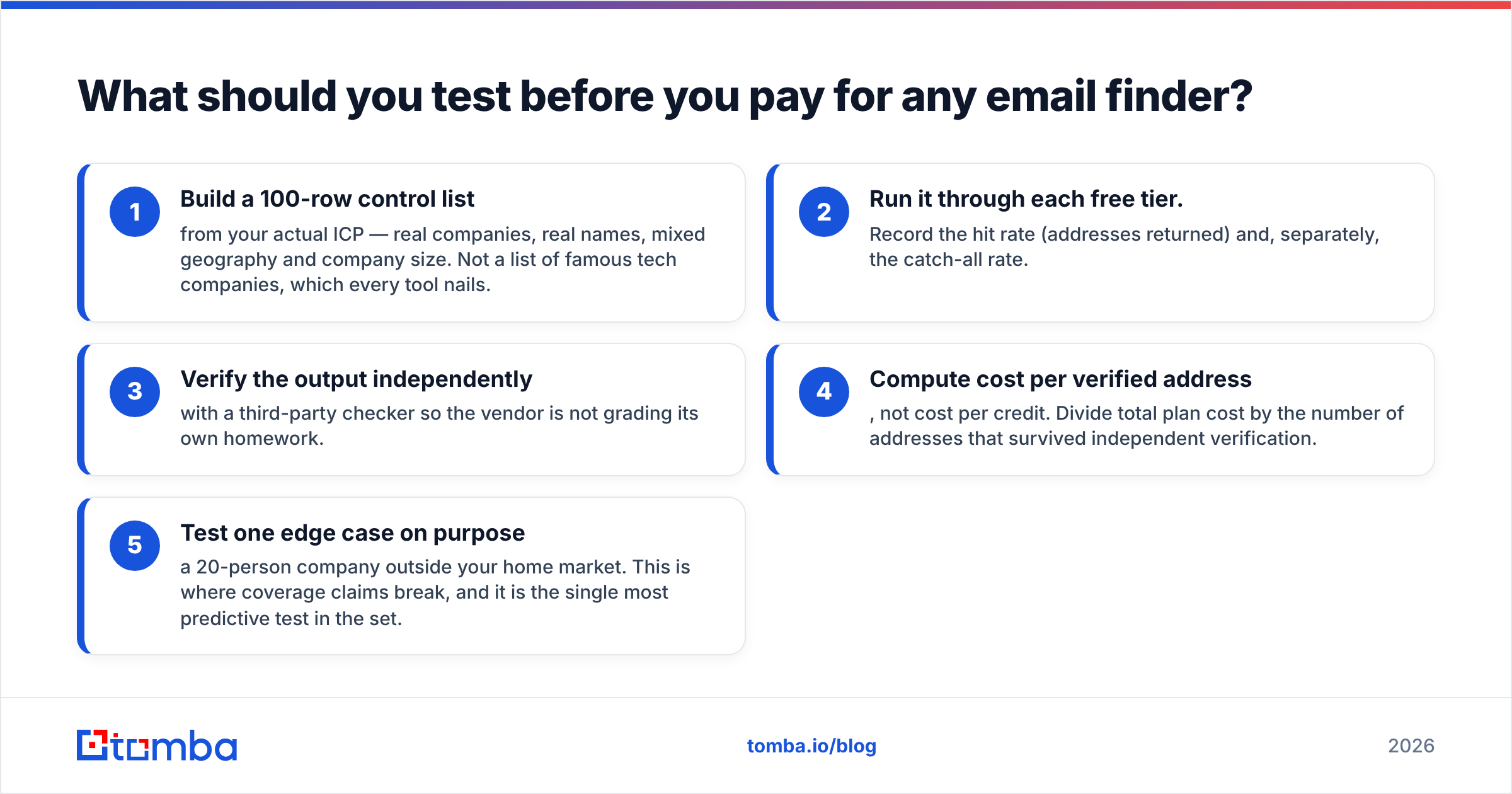
What should you test before you pay for any email finder?#
Run the same 30-minute test on every candidate, using the free tier so it costs nothing:
- Build a 100-row control list from your real ICP. Real companies, real names, mixed region and company size. Not a list of famous tech firms, which every tool nails.
- Run it through each free tier. Record the hit rate, and record the catch-all rate on its own.
- Verify the output independently with a third-party checker, so the vendor is not grading its own homework.
- Compute cost per verified address, not cost per credit. Divide plan cost by the addresses that survived that check.
- Test one edge case on purpose. Try a 20-person company outside your home market. This is where coverage claims break, and it is the most telling test in the set.
That last number, cost per independently verified address, is the only comparison that survives contact with reality. It often reorders the ranking you get from pricing pages, and it takes half an hour. The other half of the diligence is where the data comes from. A provider that documents its sources is easier to trust than one that does not.
Where does Tomba fit?#
If you need more than a point solution, here is the honest pitch. Tomba bundles the pieces Eminer leaves as separate buys. The Tomba Email Finder covers find-by-name and find-by-domain. The same plan includes email verification, catch-all verification, domain search, phone lookup, and enrichment, plus a documented REST API on paid tiers.
Start on the free tier with 25 searches a month. Run your own 100-row control list against whatever you use today, then let the cost-per-verified-address number decide. If Eminer wins that test for your ICP, buy Eminer. If it does not, you will know exactly why.
Related guides#
Ready to find emails that actually work?
Join 150,000+ professionals who stopped guessing and started sending. Free credits on signup — no credit card required.
Get the Tomba newsletter
Practical outbound tactics and product updates — once every two weeks.
About the author