Emotional Sales Pitch: How to Sell to Feelings, Not Logic
Buyers decide with emotion and defend the decision with logic. Here is the framework, the exact language, and the data-backed reasons an emotional sales pitch outperforms a feature list in 2026.
TL;DR
- Buyers make decisions emotionally and justify them with logic afterward — your pitch has to serve both, in that order.
- An emotional sales pitch is not manipulation. It's naming the stake (career risk, wasted budget, team frustration) that the buyer already feels but hasn't said out loud.
- The sequence that works: Tension → Stake → Proof → Relief. Feature lists live inside "Proof," not at the top.
- Emotion without data reads as hype. Data without emotion reads as a spec sheet. Deals close where the two meet.
- Personalization is the delivery mechanism. If your contact data is wrong, the most emotionally intelligent pitch in the world lands in a dead inbox.
What is an emotional sales pitch?#
An emotional sales pitch is a pitch built around what the buyer stands to gain or lose personally — not around what your product does.
Here's the everyday version: nobody buys a smoke detector because they enjoy ionization sensors. They buy it because they picture their kid's bedroom at 3 a.m. The sensor spec matters — but only after the fear does. Technically, you're sequencing limbic-system engagement before prefrontal justification. Practically, you're saying "here's what happens to you if this stays broken" before you say "here's our API."
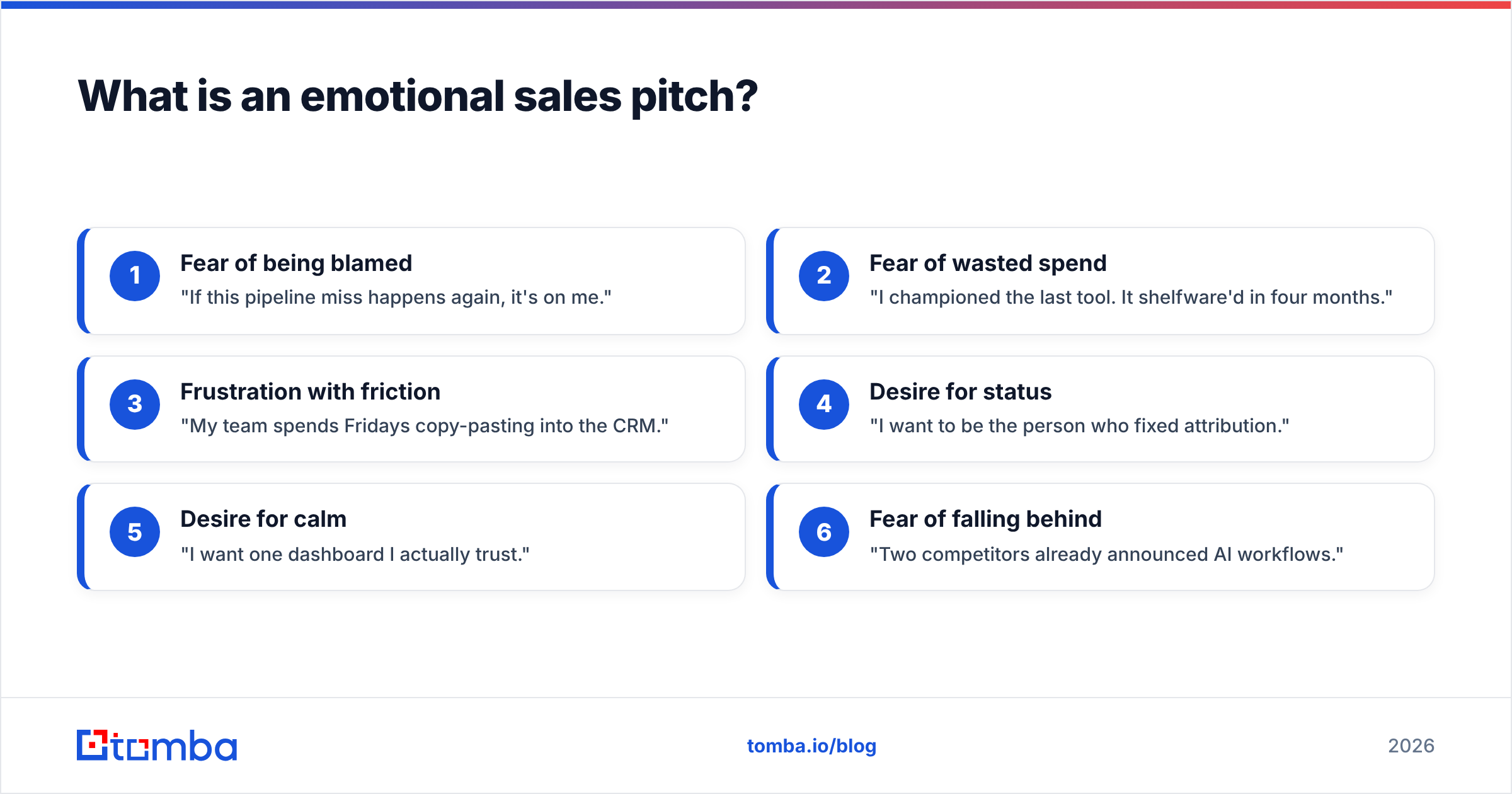
The mistake most reps make is assuming "emotional" means "dramatic." It doesn't. In B2B, the operative emotions are quieter and more specific:
- Fear of being blamed — "If this pipeline miss happens again, it's on me."
- Fear of wasted spend — "I championed the last tool. It shelfware'd in four months."
- Frustration with friction — "My team spends Fridays copy-pasting into the CRM."
- Desire for status — "I want to be the person who fixed attribution."
- Desire for calm — "I want one dashboard I actually trust."
- Fear of falling behind — "Two competitors already announced AI workflows."
Notice none of these are "we want a 12% lift in MQL volume." That's the justification the buyer will use in the business case. Your job is to hit the real driver first, then arm them with the numbers they'll need to defend it internally.

Why does emotion beat logic in B2B buying?#
Because logic is what buyers use to defend a choice, not to make one.
Harvard Business School's Gerald Zaltman has argued for years that the vast majority of purchase decision-making happens below conscious awareness. B2B research points the same way: Google and CEB's "From Promotion to Emotion" study found B2B buyers were significantly more emotionally connected to vendors than consumer buyers — because the personal stakes are higher. A consumer who buys a bad blender loses $80. A VP who buys a bad platform loses credibility, a quarter, and sometimes a job.
That's the asymmetry worth internalizing: in B2B, the personal downside of a bad decision is larger than the personal upside of a good one. Which means the most reliable emotional lever isn't excitement — it's risk reduction. "You will not look stupid for choosing us" outsells "we have 40 integrations" almost every time.
Where reps get this wrong is by treating emotion as a coat of paint applied to a feature list. It isn't a tone. It's a structure.
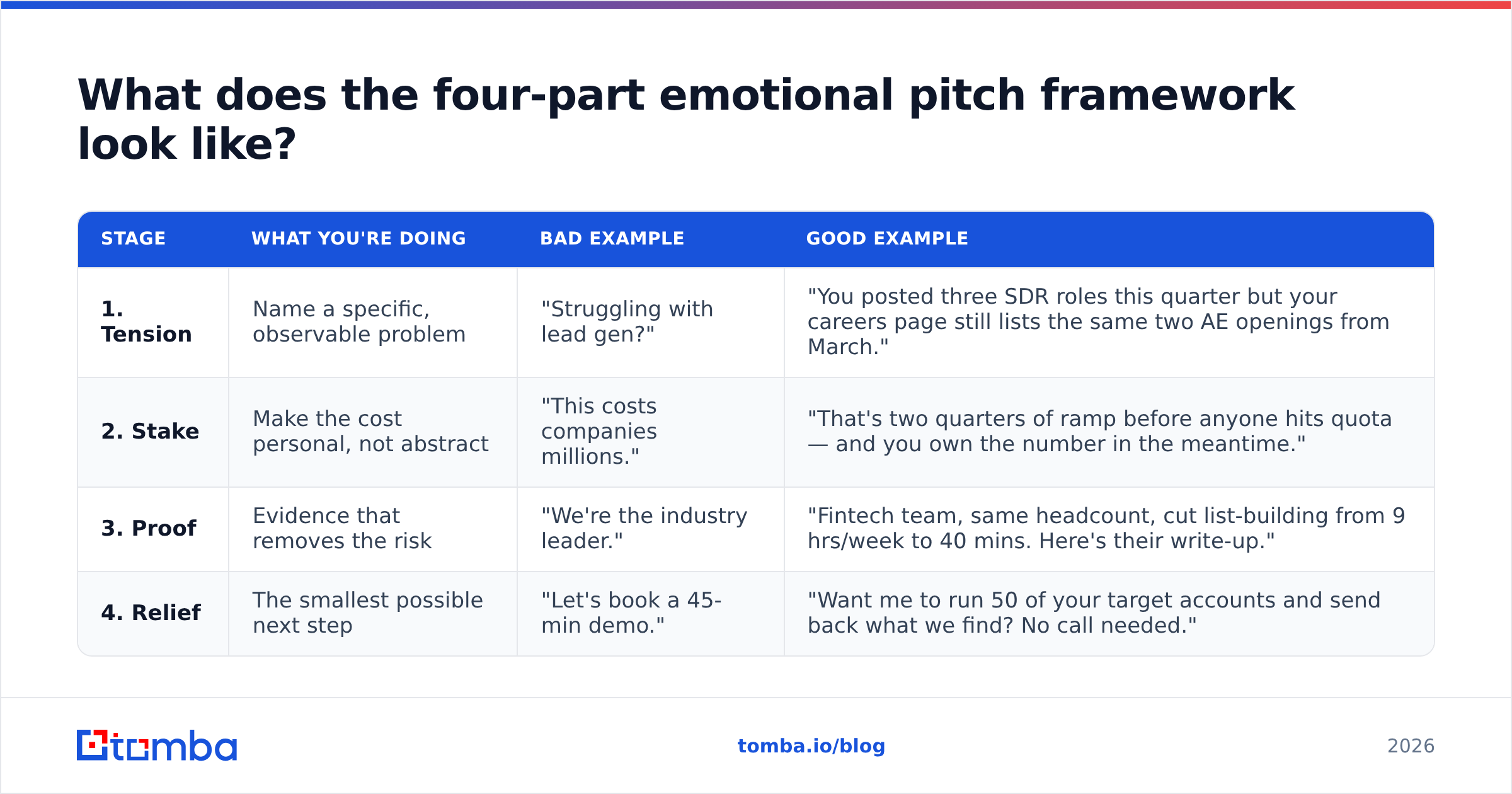
What does the four-part emotional pitch framework look like?#
| Stage | What you're doing | Bad example | Good example |
|---|---|---|---|
| 1. Tension | Name a specific, observable problem | "Struggling with lead gen?" | "You posted three SDR roles this quarter but your careers page still lists the same two AE openings from March." |
| 2. Stake | Make the cost personal, not abstract | "This costs companies millions." | "That's two quarters of ramp before anyone hits quota — and you own the number in the meantime." |
| 3. Proof | Evidence that removes the risk | "We're the industry leader." | "Fintech team, same headcount, cut list-building from 9 hrs/week to 40 mins. Here's their write-up." |
| 4. Relief | The smallest possible next step | "Let's book a 45-min demo." | "Want me to run 50 of your target accounts and send back what we find? No call needed." |
The framework is deliberately front-loaded on tension because attention decays fast. If your first two sentences describe your company, you've spent the buyer's attention on the least interesting subject in the email.
A few rules that make each stage land:
- Tension must be observable. If you can't point to a job post, a funding round, a stack change, a review, or a launch, you're guessing — and guessing reads as spam.
- Stake must be theirs, not the market's. "The industry loses $X billion" is a statistic. "You'll spend Q3 rebuilding a list you already paid for" is a stake.
- Proof must be adjacent. A case study from a company 50x their size proves nothing. A peer at similar headcount proves everything.
- Relief must be small. The bigger the ask, the more the emotional pitch reads as a setup. A low-commitment offer confirms you meant it.
Is an emotional pitch different from manipulation?#
Yes — and the line is cleaner than people assume.
Manipulation creates an emotion that isn't warranted by reality: fake scarcity, invented urgency, fabricated social proof, a "your competitor just signed" claim you made up. Emotional selling names an emotion the buyer already has and connects it to a real remedy.
The practical test: would the buyer feel deceived if they could see your internal notes? If your email says "I noticed your team is drowning in manual research" and your notes say "generic template #4, sent to 8,000 people," that's manipulation. If your notes say "3 SDR openings, no ops hire, using a scraper that broke in the last LinkedIn change," it isn't.
Three specific practices that cross the line, and what to do instead:
- Fake deadlines ("pricing goes up Friday") → use real constraints ("our onboarding queue is booked through October").
- Invented peer pressure ("everyone in your space uses us") → name actual, referenceable customers, or say nothing.
- Manufactured shame ("most teams your size figured this out already") → describe the problem without implying incompetence.
Trust is the asset the whole pitch runs on. An emotional appeal from a source the buyer doesn't trust doesn't just fail — it actively increases resistance for every subsequent touch.
How do you write an emotional cold email that doesn't feel fake?#
Start with the smallest true observation you can make, then escalate to the stake. Here's the same pitch written badly and well.
Version A — feature-led (typical):
Hi Sarah,
I wanted to reach out about our platform. We help B2B companies with lead generation through AI-powered data enrichment, real-time verification, and 20+ native integrations. We're trusted by over 10,000 companies worldwide.
Do you have 30 minutes this week for a demo?
Version B — emotion-led:
Hi Sarah,
Saw your two new SDRs started in June and you're still hiring a third. Curious how you're handling list building for them — most teams at that stage have the reps but not the ops person, so prospecting time gets eaten by research.
A fintech team we work with was at 9 hours a week on list building before they fixed the data layer. They're at about 40 minutes now, same headcount.
Happy to run 50 of your target accounts and send back what we find — no call, no deck. Just want to see if the problem's real on your side.
— Ben
Version B is shorter, contains fewer claims, and mentions the product zero times. It works because it names something true and specific, connects it to a cost Sarah personally carries, and offers relief with almost no commitment attached.
Notice what's doing the heavy lifting: the observation. That's a data problem before it's a copywriting problem. You can't write "your two new SDRs started in June" without knowing it, and you can't send it at all without a deliverable address. This is why teams that invest in a real email finder and clean email verification get more out of copy improvements than teams that don't — better targeting multiplies better writing, and bad data cancels it out entirely.
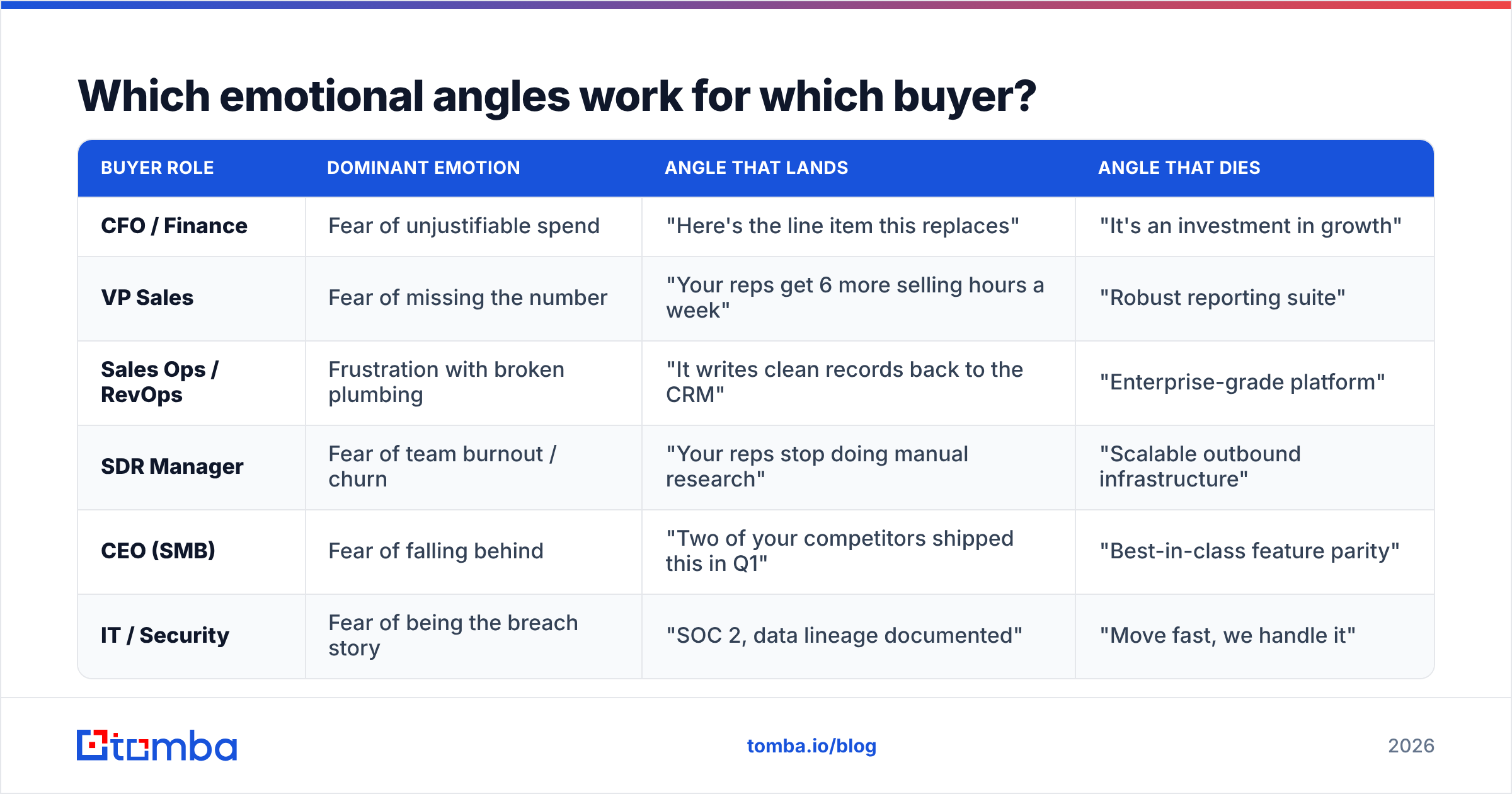
Which emotional angles work for which buyer?#
Different roles carry different fears. Pitching a CFO on "your team will love the UI" is as off-target as pitching a frontline manager on "3-year TCO reduction."
| Buyer role | Dominant emotion | Angle that lands | Angle that dies |
|---|---|---|---|
| CFO / Finance | Fear of unjustifiable spend | "Here's the line item this replaces" | "It's an investment in growth" |
| VP Sales | Fear of missing the number | "Your reps get 6 more selling hours a week" | "Robust reporting suite" |
| Sales Ops / RevOps | Frustration with broken plumbing | "It writes clean records back to the CRM" | "Enterprise-grade platform" |
| SDR Manager | Fear of team burnout / churn | "Your reps stop doing manual research" | "Scalable outbound infrastructure" |
| CEO (SMB) | Fear of falling behind | "Two of your competitors shipped this in Q1" | "Best-in-class feature parity" |
| IT / Security | Fear of being the breach story | "SOC 2, data lineage documented" | "Move fast, we handle it" |
One caveat: seniority changes the register, not the existence of emotion. Executives are not more rational — they're better at hiding the driver behind clean business language. When a CRO says "we need better pipeline visibility," the emotion underneath is usually "I got surprised on a board call and it will not happen twice."

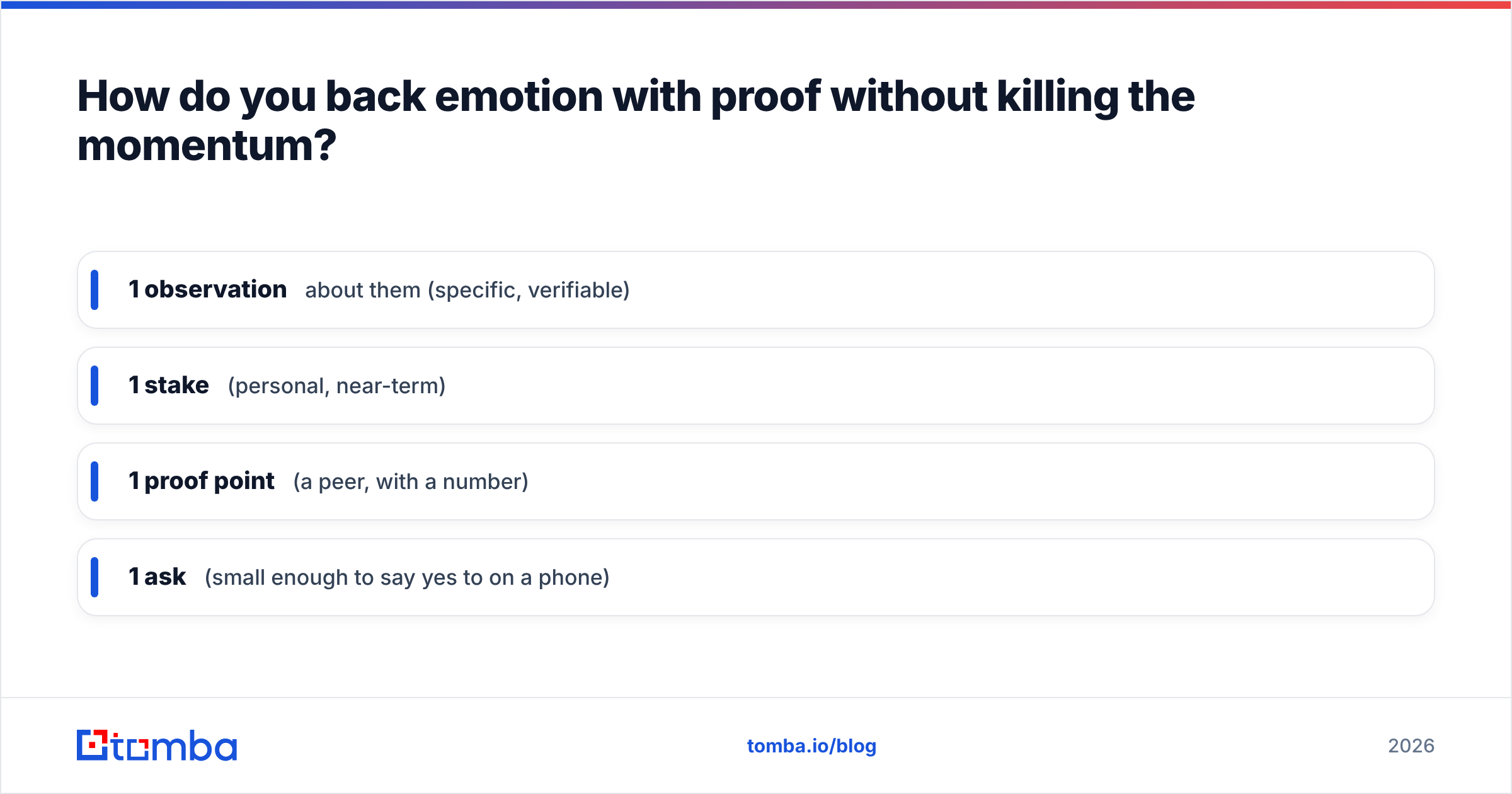
How do you back emotion with proof without killing the momentum?#
Put the numbers after the emotional hook and keep them concrete, small, and checkable.
Big round numbers ("increase revenue 300%") read as fiction. Odd, specific numbers ("cut list building from 9 hours to 40 minutes") read as measured. The specificity itself is a trust signal — it implies someone actually counted.
A working ratio for a first-touch message:
- 1 observation about them (specific, verifiable)
- 1 stake (personal, near-term)
- 1 proof point (a peer, with a number)
- 1 ask (small enough to say yes to on a phone)
That's roughly 90 words. Anything longer and you're asking for a research session, not a reply. If you want to pressure-test wording before sending, run drafts through a subject line tester and a spam checker — an emotionally perfect pitch that lands in Promotions never gets the chance to work.
For deeper reading on the underlying research, Gartner's B2B buying research is worth the time — particularly the finding that buyers spend only a small fraction of the buying cycle with any individual vendor. That scarcity of attention is exactly why the emotional hook has to come first: you may only get one shot at 20 seconds of it. HubSpot's sales research publishes ongoing benchmark data on response rates and message length if you want to calibrate against current norms.
What are the most common emotional-pitch mistakes?#
1. Leading with your own excitement. "I'm thrilled to introduce…" centers you. The buyer's emotional state is the subject; yours is noise.
2. Borrowing someone else's pain. Copying a pain point from a competitor's landing page produces pitches that sound emotionally intense and factually generic. Buyers notice instantly.
3. Escalating too fast. Going from "hi" to "your team is failing" in two sentences triggers defensiveness. The stake has to be earned by the observation preceding it.
4. Emotion in the email, spec sheet on the call. If the discovery call reverts to a 40-slide feature tour, you've confirmed the email was a costume. Carry the same structure through the whole cycle.
5. Great pitch, dead inbox. The most preventable failure. Bounce rates above 5% damage sender reputation, which suppresses delivery of every subsequent message — including the ones that would have worked. Verify before you send, every time.
6. No follow-through on the small ask. If you offer "50 accounts, no call," deliver 50 accounts and don't book a call. Breaking the relief promise costs more trust than never making it.
How do you scale emotional pitching across a team?#
The instinct is to write one great emotional template and blast it. That defeats the mechanism — the emotion works because the observation is specific, and a template can't hold a specific observation.
What scales instead is the structure, plus a research layer that makes specificity cheap:
- Standardize the four stages, not the sentences. Every rep writes their own tension line; the framework stays fixed.
- Build a trigger library. Funding, hiring, tooling changes, leadership moves, product launches, review-site activity. Each trigger maps to a known stake.
- Automate the data, not the empathy. Use a bulk email finder or the Tomba API to handle contact discovery and verification, so reps spend their time on the observation rather than on hunting addresses.
- Review pitches by structure. In coaching sessions, ask "what's the stake?" not "did you mention the integration?"
- Measure replies, not opens. Emotional resonance shows up in reply rate and reply sentiment. Open rate is now too noisy to coach against.
Teams that do this well end up with reps who sound like themselves and still hit the same structural beats — which is the whole point. Uniform templates produce uniform ignoring.
Getting the pitch in front of the right person#
An emotional sales pitch is only as good as its delivery. You can name the exact fear a VP of Sales carries into every forecast call, and it means nothing if the message bounces or reaches someone who left in 2024.
That's the unglamorous half of this work. Before you spend another hour rewriting hooks, make sure the contact layer underneath is solid: real people, current roles, verified addresses. Tomba Email Finder finds professional email addresses by domain, name, or company, with verification built in so your carefully written pitch actually reaches a human. Start on the free tier (25 searches/month) to test your best-performing angle against a real list, and scale up from $49/mo on Starter when the structure proves out. Full Tomba pricing is public if you want to model the cost before committing.
Write for the feeling. Verify for the delivery. Both, or neither works.
Related guides#
Ready to find emails that actually work?
Join 150,000+ professionals who stopped guessing and started sending. Free credits on signup — no credit card required.
Get the Tomba newsletter
Practical outbound tactics and product updates — once every two weeks.
About the author