End of Year Sales Strategies: How to Close Q4 in 2026
December is the shortest selling month disguised as a full one. Here are the end of year sales strategies that actually move deals across the line — plus the ones that just burn margin.
TL;DR
- December has roughly 15 real selling days once holidays, PTO, and frozen budgets are removed. Plan against that number, not against 31.
- The highest-return end of year sales strategies are pipeline triage, multithreading into economic buyers, and January pre-booking — not discounting.
- Discounts close deals faster but cost you 4–8 points of margin and reset next year's price anchor. Use them last, and only with a signed date attached.
- Contacts rot fastest in Q4 because of layoffs, promotions, and role changes. Re-verify your target list before the push, or you'll spend December emailing people who left in October.
- The best December work is often January work: book Q1 meetings while everyone else sends "circling back before the holidays."
What counts as an end of year sales strategy?#
An end of year sales strategy is any deliberate change to how you prioritize, contact, and close deals during the final 6–8 weeks of your fiscal year. It is not "work harder in December." It's a reallocation decision: which deals get your remaining hours, which get parked, and which get a hard-dated ask.
Three things change in Q4 that don't apply the rest of the year:
- Buyer availability collapses. Between US Thanksgiving and January 2, decision-makers are out, in planning offsites, or in budget lock. Response windows narrow from days to hours.
- Budget behaves oddly in both directions. Some accounts have use-it-or-lose-it money and want to spend it before December 31. Others have already frozen spend and are shopping for next fiscal year. Same industry, same size, opposite urgency.
- Your own math changes. A deal that slips from December 18 to January 8 costs you nothing in ARR but everything in quota attainment. That asymmetry makes reps do irrational things — like discounting a deal that was going to close anyway.
Good year-end selling starts by sorting accounts on those three axes. Everything after is execution.
Why do most Q4 deals actually stall?#
They stall because of coverage, not interest. Most stalled year-end deals have exactly one champion, and that champion is on PTO from December 20.
Here's the pattern I see in almost every year-end postmortem:
- The rep has a single contact — usually a manager or director who liked the demo.
- Procurement, legal, security review, and finance were never engaged.
- The champion promised to "push it through before the break."
- The champion's actual December priority was their own year-end review.
Gartner's sales research has been consistent for years on the size of B2B buying groups — a typical enterprise purchase involves six to ten stakeholders. If you have one name in the CRM in mid-November, you are not running a Q4 close plan. You are running a hope.

The fix is unglamorous: add contacts. For every open deal above your average deal size, identify the finance approver, the technical reviewer, and the executive sponsor by name before December 1. If those names aren't in your CRM, find them. A domain search across the account's company domain will surface the org's email pattern and the people attached to it in a couple of minutes, which beats guessing at firstname.lastname@ and getting a bounce that damages your sender reputation two weeks before your biggest send.
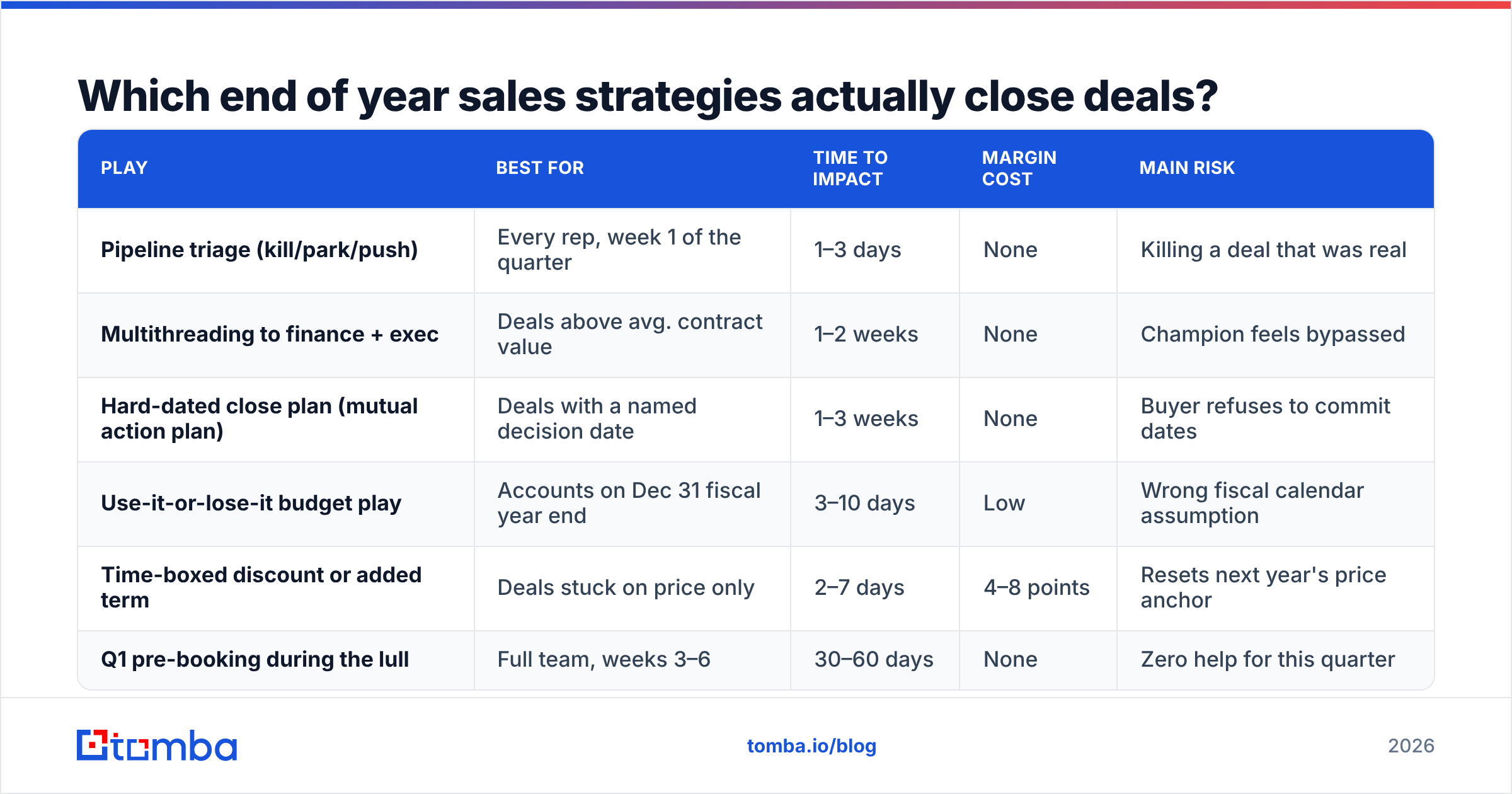
Which end of year sales strategies actually close deals?#
Not all Q4 plays are equal. Some pay off inside two weeks; others are really Q1 investments wearing a December costume. Here's how they compare:
| Play | Best for | Time to impact | Margin cost | Main risk |
|---|---|---|---|---|
| Pipeline triage (kill/park/push) | Every rep, week 1 of the quarter | 1–3 days | None | Killing a deal that was real |
| Multithreading to finance + exec | Deals above avg. contract value | 1–2 weeks | None | Champion feels bypassed |
| Hard-dated close plan (mutual action plan) | Deals with a named decision date | 1–3 weeks | None | Buyer refuses to commit dates |
| Use-it-or-lose-it budget play | Accounts on Dec 31 fiscal year end | 3–10 days | Low | Wrong fiscal calendar assumption |
| Time-boxed discount or added term | Deals stuck on price only | 2–7 days | 4–8 points | Resets next year's price anchor |
| Q1 pre-booking during the lull | Full team, weeks 3–6 | 30–60 days | None | Zero help for this quarter |
The ordering matters. Run triage first because it's free and it decides where everything else goes. Discounting sits second-to-last for a reason: it is the only play on this list that permanently costs you money, and it's the one most teams reach for first.
The triage pass, in four buckets#
Give yourself two hours and sort every open opportunity:
- Commit — verbal yes, budget confirmed, procurement engaged, close date agreed in writing. These need logistics, not selling. Chase signatures and PO numbers.
- Winnable with pressure — real need, real champion, missing one approver or one document. This is where 80% of your December hours belong.
- Q1 real — genuine fit, but the buyer's budget starts in January. Stop pushing. Book the January meeting now while you have their attention, and take the pressure off the relationship.
- Dead but undeclared — no meeting in 30+ days, no multithreading, no answer to a direct close-plan question. Mark them closed-lost. Your forecast gets honest and your calendar gets 10 hours back.
Reps hate bucket 4. Managers should insist on it. A forecast that's 60% accurate is more useful to the business than one that's 90% optimistic, and win rate only becomes a usable planning number when losses get declared on time.
Should you discount to close by December 31?#
Only when price is the last remaining objection, and only with a date attached to the concession.
The test is simple: ask the buyer directly, "If we solved the commercial piece today, is there anything else standing between us and a signature this month?" If the answer contains a security review, a legal redline, or a stakeholder you haven't met — the problem was never price. A discount will buy you nothing except a smaller invoice on the same slipped timeline.
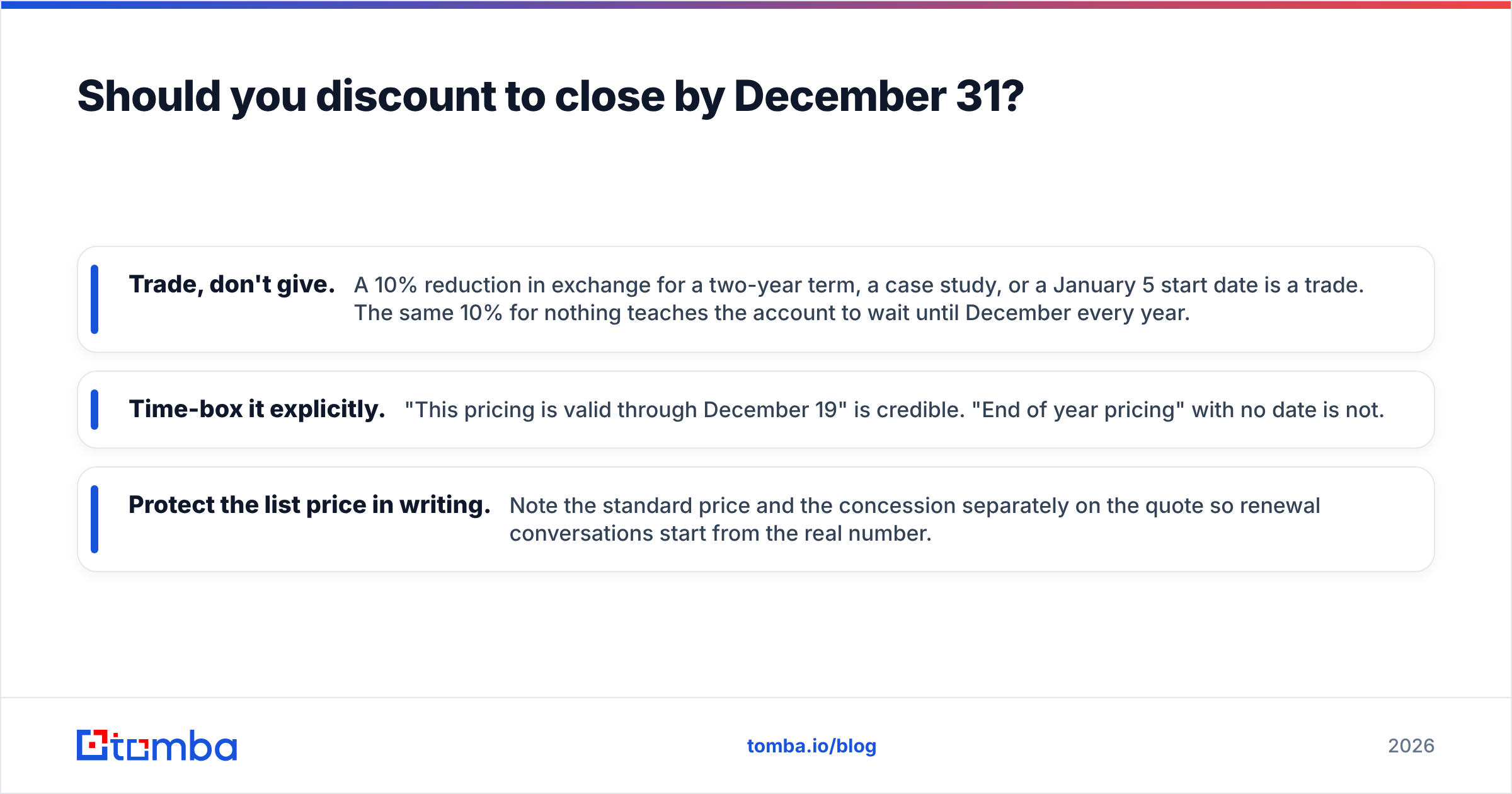
When you do concede, structure matters more than size:
- Trade, don't give. A 10% reduction in exchange for a two-year term, a case study, or a January 5 start date is a trade. The same 10% for nothing teaches the account to wait until December every year.
- Time-box it explicitly. "This pricing is valid through December 19" is credible. "End of year pricing" with no date is not.
- Protect the list price in writing. Note the standard price and the concession separately on the quote so renewal conversations start from the real number.
HubSpot's sales blog has covered this repeatedly, and the pattern holds across teams: the reps with the best Q4 attainment aren't the ones giving the deepest discounts. They're the ones who ran a close plan in October.
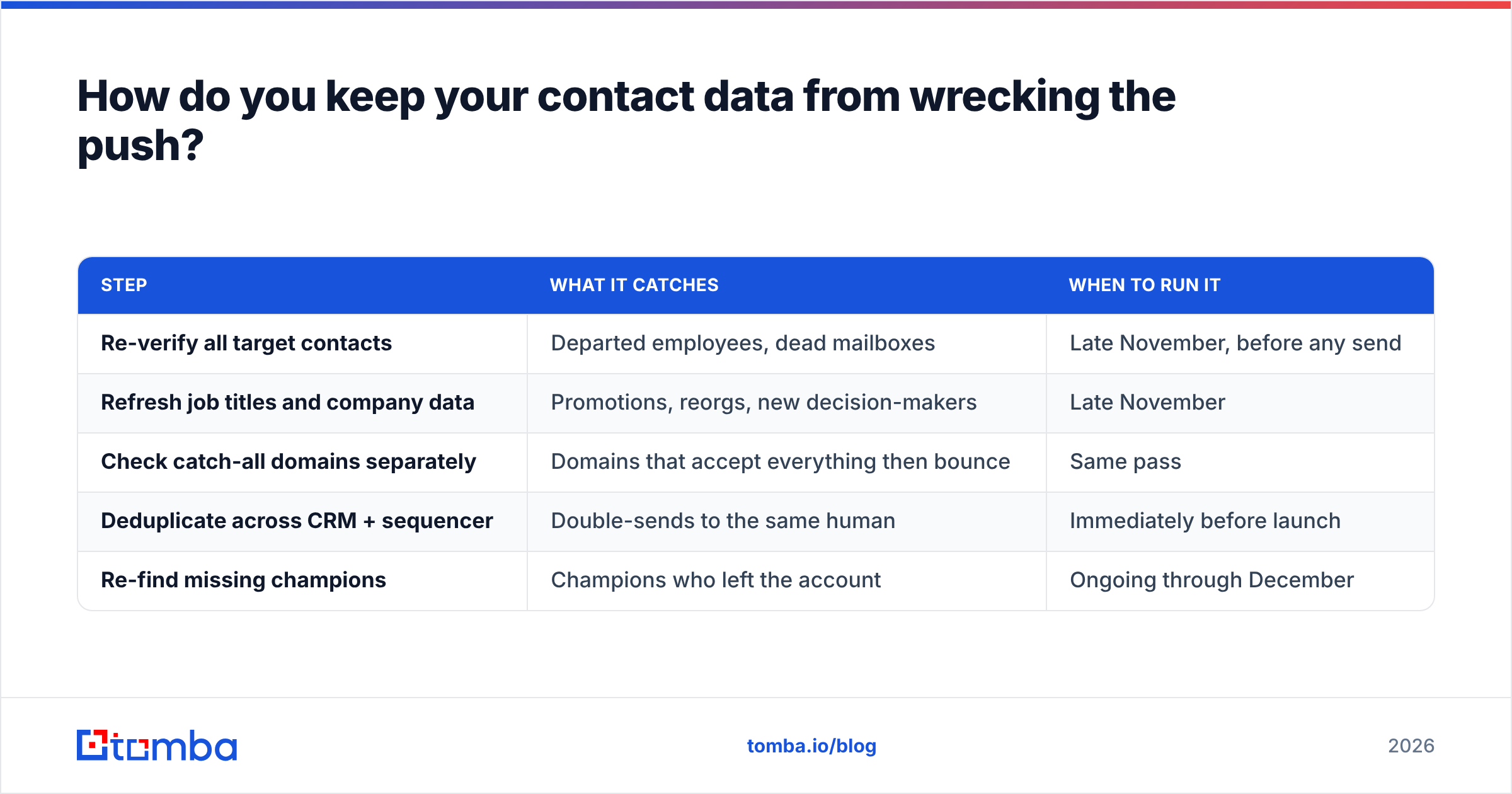
How do you keep your contact data from wrecking the push?#
Q4 is when contact data quality gets exposed. Reorgs, layoffs, promotions, and end-of-year departures all cluster in Q3 and Q4, which means the list you built in August is measurably worse in November. B2B contact data decays somewhere around 22–30% per year depending on the segment, and it doesn't decay evenly — it decays hardest in the quarters where people change jobs.
That's a deliverability problem, not just a coverage problem. A December blast into a stale list produces bounces exactly when your domain reputation matters most, and a damaged domain in week 1 of December cannot be repaired by week 3.
The pre-push hygiene sequence:
| Step | What it catches | When to run it |
|---|---|---|
| Re-verify all target contacts | Departed employees, dead mailboxes | Late November, before any send |
| Refresh job titles and company data | Promotions, reorgs, new decision-makers | Late November |
| Check catch-all domains separately | Domains that accept everything then bounce | Same pass |
| Deduplicate across CRM + sequencer | Double-sends to the same human | Immediately before launch |
| Re-find missing champions | Champions who left the account | Ongoing through December |
Run a bulk pass rather than a contact-by-contact one — a bulk email finder plus an email verifier sweep over your Q4 target list will typically flag 10–20% of a mid-year list as risky or invalid. Every one of those is a bounce you didn't send, and a rep-hour you didn't waste. If you're buying supplemental lists to fill coverage gaps, providers like BookYourData and similar B2B data vendors can help, but treat every purchased record the same way: verify before it touches your sending domain.
What should the December calendar actually look like?#
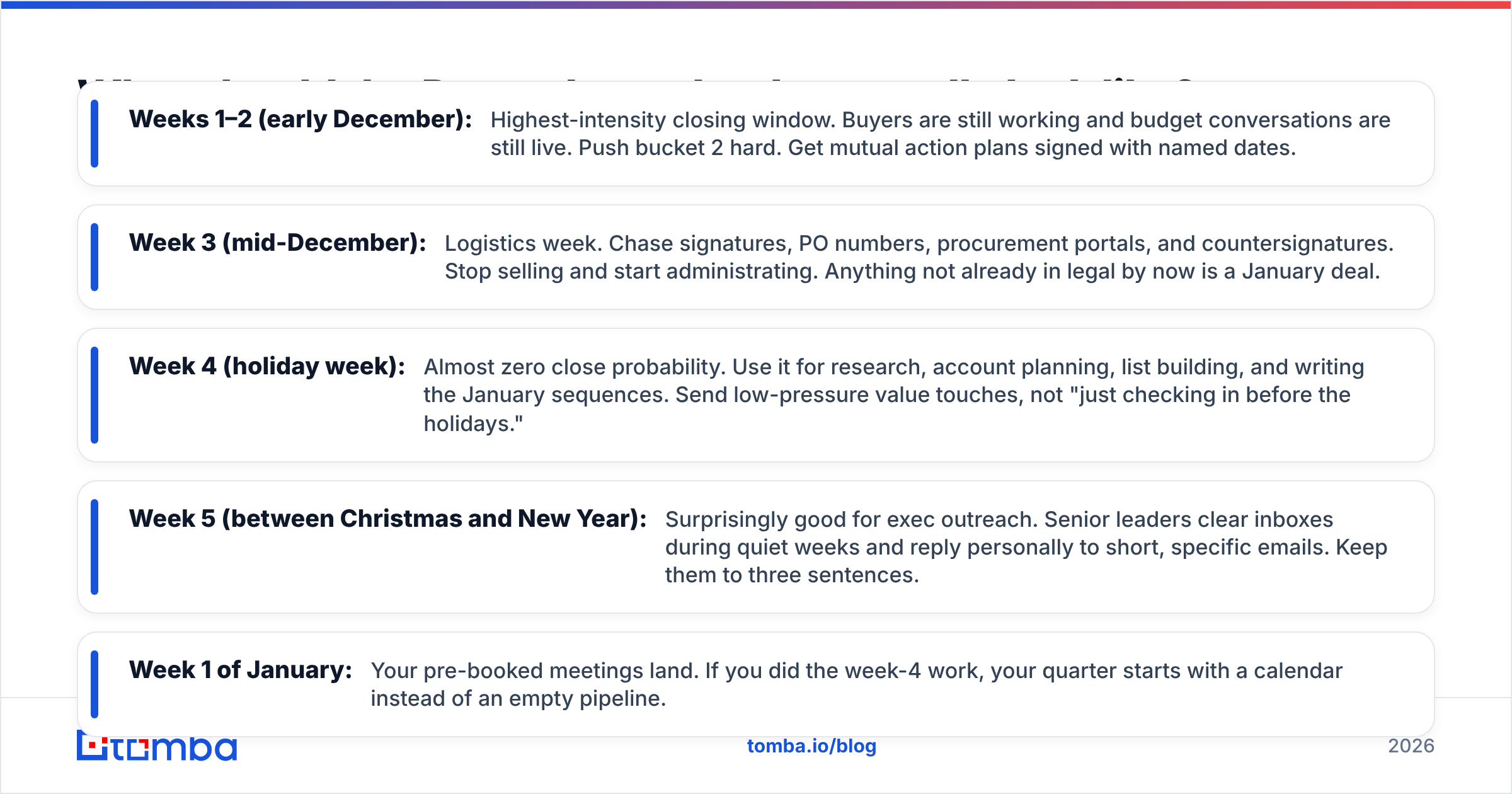
Map the quarter against real selling days, then assign a job to each week.
- Weeks 1–2 (early December): Highest-intensity closing window. Buyers are still working and budget conversations are still live. Push bucket 2 hard. Get mutual action plans signed with named dates.
- Week 3 (mid-December): Logistics week. Chase signatures, PO numbers, procurement portals, and countersignatures. Stop selling and start administrating. Anything not already in legal by now is a January deal.
- Week 4 (holiday week): Almost zero close probability. Use it for research, account planning, list building, and writing the January sequences. Send low-pressure value touches, not "just checking in before the holidays."
- Week 5 (between Christmas and New Year): Surprisingly good for exec outreach. Senior leaders clear inboxes during quiet weeks and reply personally to short, specific emails. Keep them to three sentences.
- Week 1 of January: Your pre-booked meetings land. If you did the week-4 work, your quarter starts with a calendar instead of an empty pipeline.
The last two bullets are where the compounding happens. Salesforce's sales resources and most enterprise sales orgs make the same observation about Q1: the teams that start January strong booked those meetings in December. The lull isn't dead time — it's the cheapest meeting-booking window of the year, because your competitors have stopped working.
How do you build January pipeline while everyone else coasts?#
Three concrete moves, all doable in the last two weeks of the year:
- Build the Q1 target list now. Pull the accounts you'll work in January, find the right contacts, and enrich them while you have downtime. An email finder run over your ICP account list turns a research task into a batch job.
- Write the sequences in December, launch them January 5. Copy written under quota pressure is worse copy. Draft it while calm.
- Send the year-in-review touch. A short, genuinely useful message — what changed in their market this year, what you're seeing in similar accounts — outperforms holiday-greeting spam by a wide margin, because it's the only email in the inbox that isn't a template.
For the January push, enrich the list with more than an email. Titles, company size, tech stack, and direct dials all raise connect rates, and contact enrichment done in December means January starts with zero research overhead. If phone is part of your motion, a phone finder pass over the same list gives your SDRs a second channel from day one.
What metrics prove the year-end push worked?#
Don't grade the quarter on bookings alone — bookings hide whether you got lucky or got good. Track four things:
- Forecast accuracy delta. How far off was your November 30 forecast from the December 31 actual? Under 10% means your triage is working.
- Average discount given vs. same quarter last year. If bookings held and discounting fell, your close plans improved. If both rose, you bought the quarter.
- Stakeholders per closed-won deal. Compare it against closed-lost. This is the clearest signal on whether multithreading is happening.
- Q1 meetings booked before January 1. The single best predictor of a strong first quarter, and the metric most teams don't track at all.
Set those four now, measure them on January 2, and next year's end of year sales strategies stop being improvisation and start being a repeatable playbook.
Close the year with a list you can trust#
Every play above assumes one thing: that the names in your CRM are real, current, and reachable. In Q4 that assumption is at its weakest, and a bounced December email costs more than a bounced May one.
Run your Q4 and Q1 target lists through the Tomba Email Finder before you launch the push. Find the finance approvers and exec sponsors you're missing, verify the contacts you already have, and start January with a clean list instead of a cleanup project. The free tier covers 25 searches a month if you want to test it on a single account, and paid plans start at $49/mo — see Tomba pricing for the full breakdown.
Related guides#
Ready to find emails that actually work?
Join 150,000+ professionals who stopped guessing and started sending. Free credits on signup — no credit card required.
Get the Tomba newsletter
Practical outbound tactics and product updates — once every two weeks.
About the author