End of Year Sales Tips: 12 Plays to Close Q4 Strong
Most end-of-year sales advice is just "work harder in December." Here are 12 plays that actually move deals — plus the pipeline math that tells you which ones are worth your last three weeks.
TL;DR
- The last six weeks of the year are not one selling period. They're three: the close window (through mid-December), the dead zone (Dec 20–Jan 2), and the Q1 head start (which you build now or lose in January).
- Discounting to hit a December number is the most expensive end-of-year sales tip in circulation. It costs you renewal price, next year's baseline, and your negotiating position.
- Your two highest-ROI December activities are unsexy: cleaning your pipeline of deals that will never close, and building a verified January prospecting list while everyone else is at holiday parties.
- Budget-flush buying is real but narrow. It applies to use-it-or-lose-it departmental budgets, not to committee-approved annual contracts.
- Data decay accelerates in Q4 and Q1 — job changes spike in January. A list you scraped in October is measurably worse by February unless you re-verify it.
Every year, the same advice recirculates: "create urgency," "offer a year-end discount," "get the deal signed before the holidays." Most of it is written by people who have never watched a deal die on December 22nd because the CFO left for two weeks and nobody told the rep.
This is a different take. Below are the end of year sales tips that survive contact with an actual Q4 — organized by which of the three December periods they belong to, with a frank assessment of what each one costs you.
Why do most end-of-year sales tips fail?#
Because they assume the buyer's calendar looks like yours.
Think of Q4 selling like trying to catch someone at an airport. You know they're in the building. You know roughly when their flight leaves. But between you and them are security lines, gate changes, and a dozen other people trying to get their attention — and at some point the plane leaves whether you reached them or not.
Standard advice treats December as a compressed version of a normal month. It isn't. Three structural things change:
- Decision-maker availability collapses. Not gradually — in steps. Legal goes quiet around Dec 15. Finance goes quiet after the last check run. Procurement often stops accepting new vendor requests entirely in the final two weeks.
- Signature authority gets delegated or frozen. Some organizations push through anything to spend remaining budget. Others freeze new commitments until the new fiscal year opens. You cannot guess which one you're dealing with — you have to ask.
- Your own attention becomes the scarce resource. You have maybe fifteen real selling days. Spending them evenly across a 40-deal pipeline is the single most common Q4 mistake.
The fix for all three is triage, not effort.

How should you triage your Q4 pipeline?#
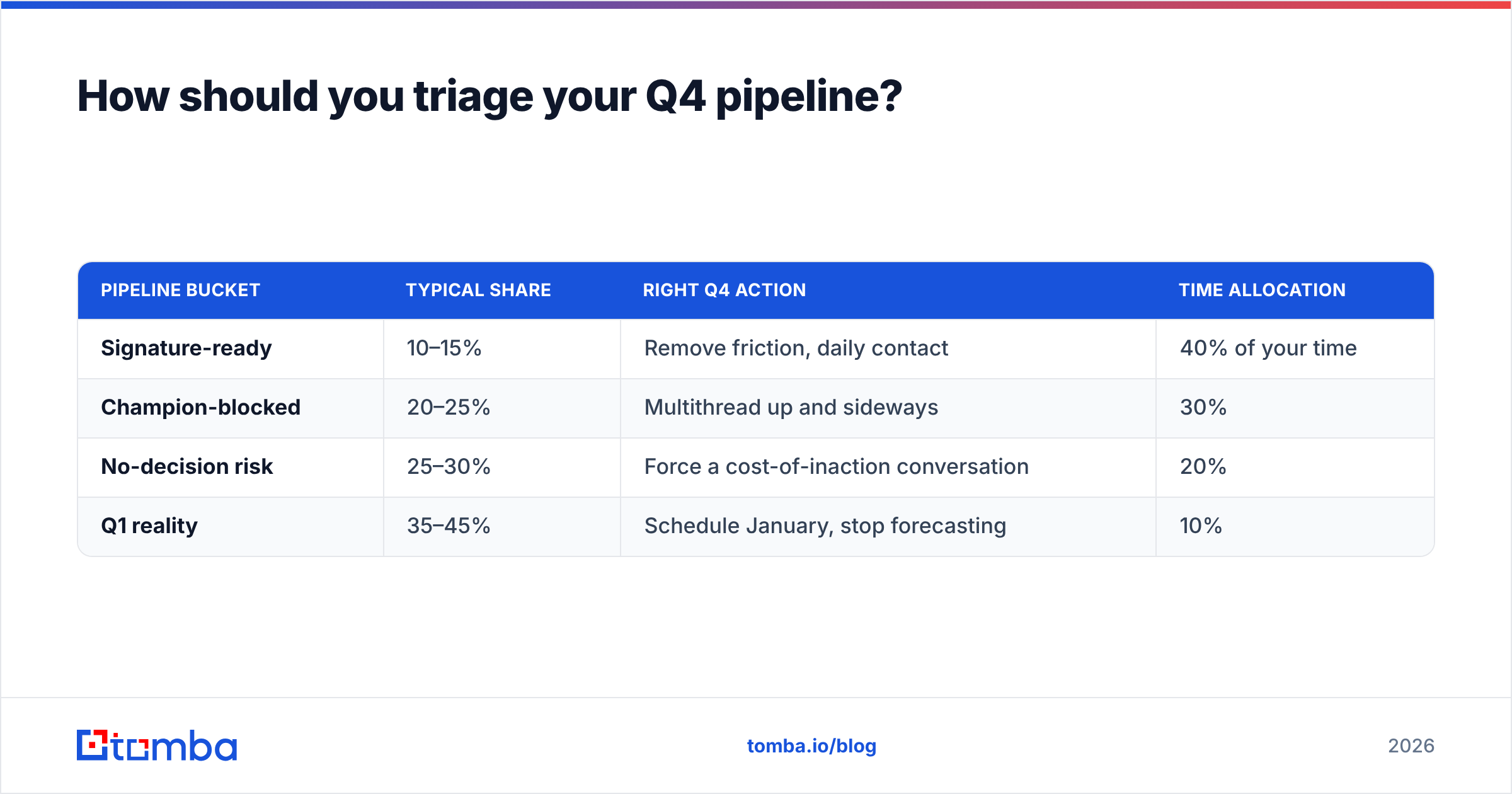
Sort every open opportunity into exactly four buckets. Do it in one sitting, and be brutal — the point is to stop spending December on deals that were never closing this year.
- Signature-ready — Verbal yes, pricing agreed, only paperwork remains. These get daily contact and white-glove handling. Your job is removing friction, not selling.
- Champion-blocked — Your champion wants it; someone above them hasn't engaged. These need a multithreading push this week, not next. If you can't get a second contact by mid-December, they're Q1 deals.
- No-decision risk — The prospect is engaged but hasn't articulated a cost of inaction. Statistically, these lose to "do nothing," not to a competitor. Either surface a hard deadline on their side or move them out.
- Q1 reality — Everything else. Stop forecasting these for December. Schedule a January touchpoint, write a genuinely useful handoff note, and free the calendar space.
Here's the uncomfortable math: if 40% of your pipeline is in bucket 4 and you keep working it evenly, you're donating roughly six of your fifteen selling days to deals that were never going to sign this year.
| Pipeline bucket | Typical share | Right Q4 action | Time allocation |
|---|---|---|---|
| Signature-ready | 10–15% | Remove friction, daily contact | 40% of your time |
| Champion-blocked | 20–25% | Multithread up and sideways | 30% |
| No-decision risk | 25–30% | Force a cost-of-inaction conversation | 20% |
| Q1 reality | 35–45% | Schedule January, stop forecasting | 10% |
Is a year-end discount ever worth it?#
Sometimes — but almost never in the form reps offer it.
A blanket "10% off if you sign by December 31" teaches your buyer three things you'll regret: your list price is fiction, waiting produces concessions, and your urgency is about your quota rather than their outcome. Sophisticated procurement teams explicitly wait for it. Gartner's research on B2B buying behavior consistently shows buyers moving through longer, more committee-driven evaluations — which means an artificial deadline mostly signals desperation to a group that has already planned its timeline.
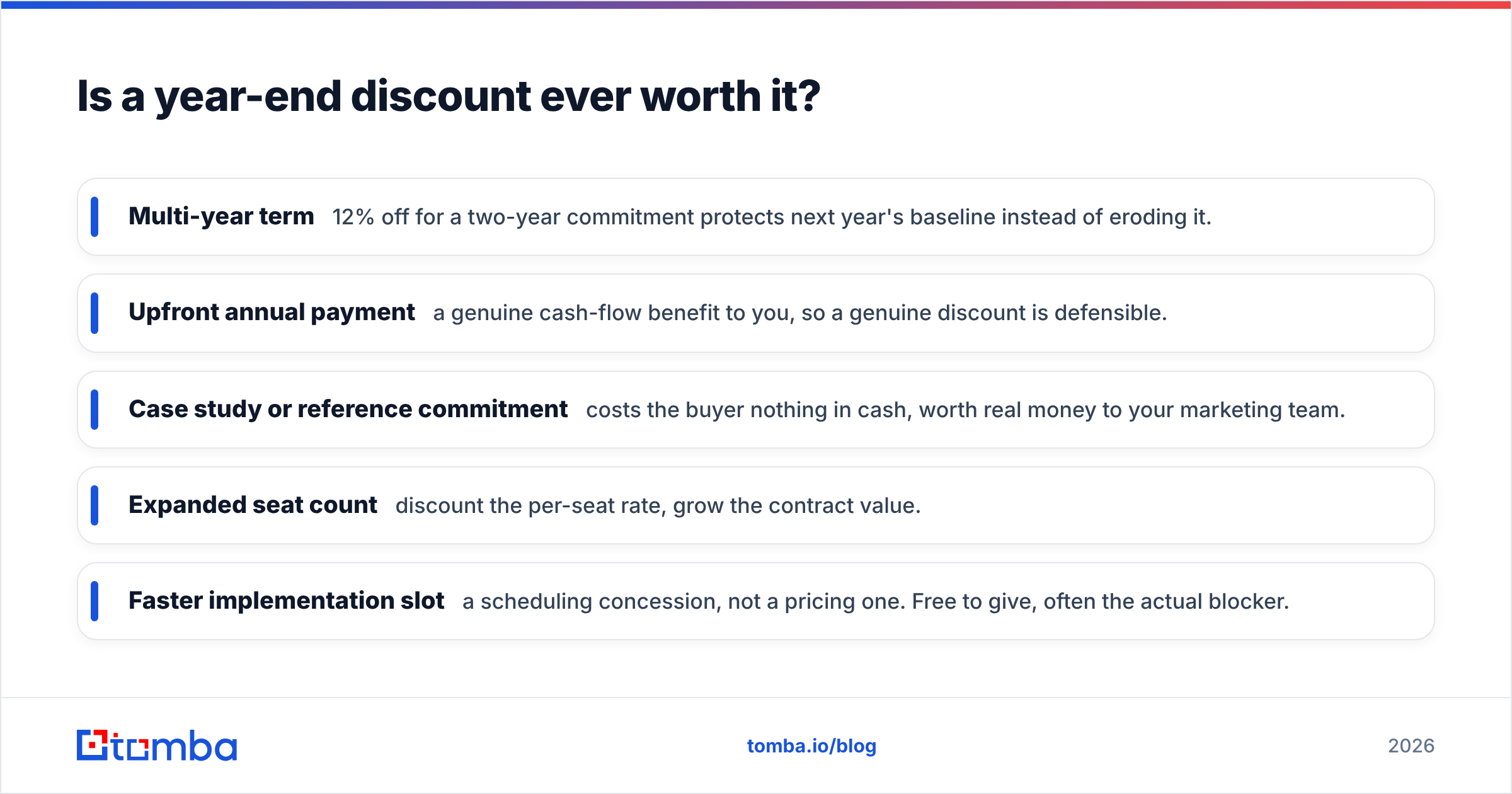
Trade concessions for structure, not for speed alone:
- Multi-year term — 12% off for a two-year commitment protects next year's baseline instead of eroding it.
- Upfront annual payment — a genuine cash-flow benefit to you, so a genuine discount is defensible.
- Case study or reference commitment — costs the buyer nothing in cash, worth real money to your marketing team.
- Expanded seat count — discount the per-seat rate, grow the contract value.
- Faster implementation slot — a scheduling concession, not a pricing one. Free to give, often the actual blocker.
If you must discount on time alone, make it decreasing: the concession available on December 10 is bigger than the one on December 20. That's a real deadline with an honest mechanic behind it, and it rewards buyers who move rather than the ones who stall.
What actually works in the final two weeks?#
Four plays, in rough order of return.
The reverse close. Instead of asking "can we get this signed by the 31st?", ask: "Walk me through what happens on your side between a yes and a countersigned contract. Who touches it, and are any of them out before the holidays?" You'll learn in ninety seconds whether the deal is real. Half the time the answer reveals a legal review nobody mentioned.
The budget-expiry check. Ask directly whether the budget for this is annual-use-or-lose or rolling. Departmental discretionary budgets often genuinely expire — that's real urgency you didn't manufacture. Committee-approved annual contracts usually don't. Knowing which one you're in changes your entire approach.
The dormant-deal sweep. Pull every closed-lost and stalled opportunity from the past nine months. Q4 is when reorganizations, new budget lines, and departed blockers surface. A short, non-desperate note — "we spoke in April about X, curious whether the situation changed with your new fiscal year" — outperforms most cold outreach because you already have context.
The January calendar grab. People book January meetings in December because their calendars are empty and saying yes to a future commitment feels costless. A meeting held on January 8 that you booked on December 12 is worth more than a December 30 call that gets rescheduled twice.
How do you build January pipeline in December?#
This is where most teams lose the year — and it's the single highest-leverage item on this list.
December is the cheapest month to build a prospecting list, for a reason nobody talks about: everyone else has stopped. Your competitors' reps are coasting on "nobody's buying in December." Which means the list you build in the dead zone lands in inboxes on January 5, when the first-mover advantage is enormous and everyone else is still updating their CRM.
The work splits into three parts.
Rebuild the target account list from current reality, not last January's. Companies that raised funding, changed leadership, launched products, or entered new markets during the year belong on it. Companies that laid off half their team probably don't.
Find and verify contacts before you need them. This is the part reps postpone and then regret. B2B contact data decays continuously, and January is the worst month for it — job changes cluster after year-end bonuses pay out. An email list built in October and left untouched will bounce noticeably harder by February. Running your list through an email verifier before the first send is the difference between a January campaign and a January sender reputation problem.
Warm the infrastructure. If you're launching new sending domains or ramping volume in January, December is when the warmup happens. Not January 2nd.
For finding contacts at scale, the practical approach is domain-first: identify target companies, pull the relevant roles, then verify. A domain search returns the people at a company by department, which is faster than name-by-name guessing when you're building a 500-account list from scratch.
What should you look for in a Q4 prospecting stack?#
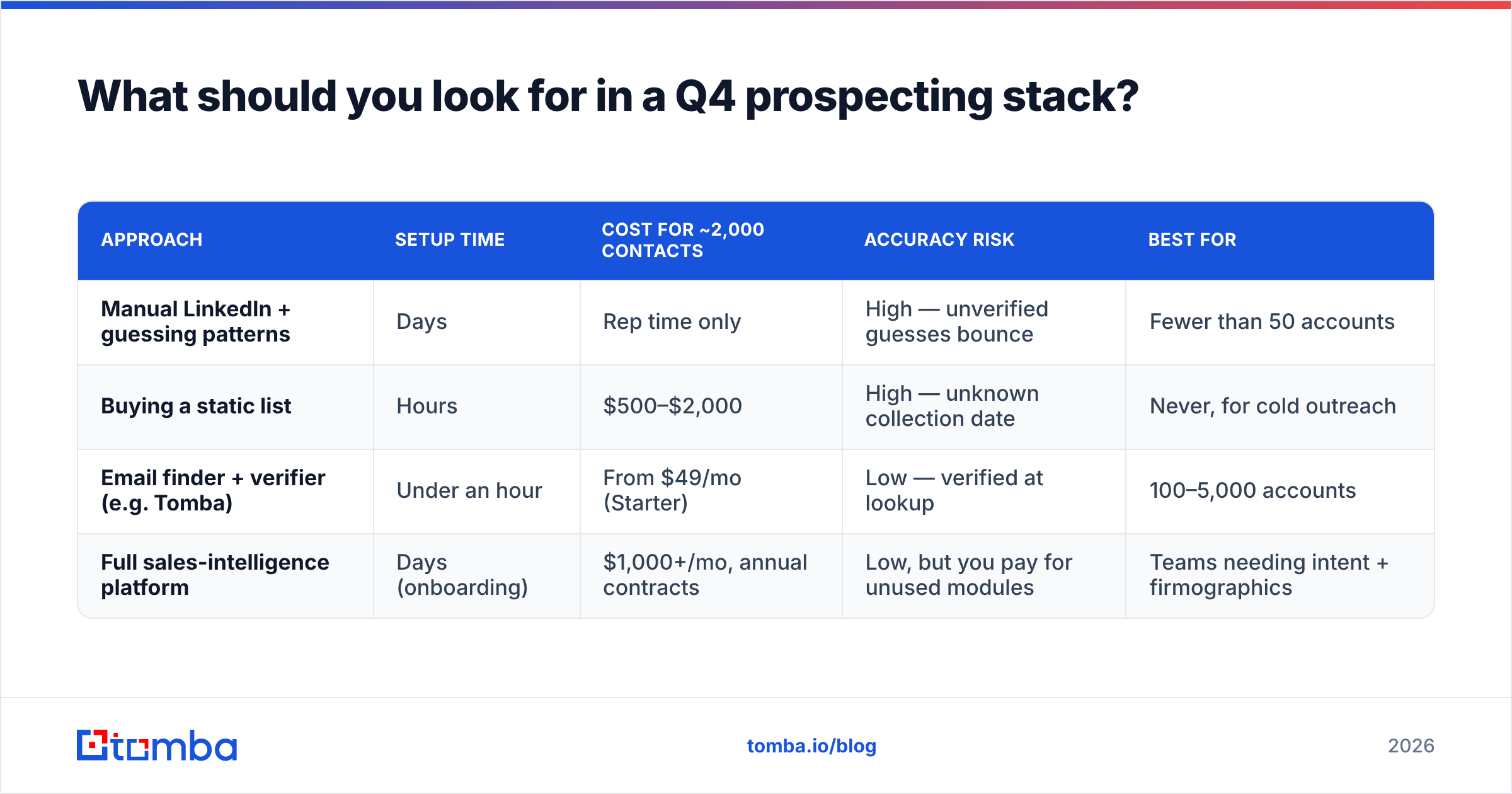
You don't need new tooling in December. You need the tooling you have to produce clean data before January 5. Here's how the common approaches compare when your constraint is time, not budget.
| Approach | Setup time | Cost for ~2,000 contacts | Accuracy risk | Best for |
|---|---|---|---|---|
| Manual LinkedIn + guessing patterns | Days | Rep time only | High — unverified guesses bounce | Fewer than 50 accounts |
| Buying a static list | Hours | $500–$2,000 | High — unknown collection date | Never, for cold outreach |
| Email finder + verifier (e.g. Tomba) | Under an hour | From $49/mo (Starter) | Low — verified at lookup | 100–5,000 accounts |
| Full sales-intelligence platform | Days (onboarding) | $1,000+/mo, annual contracts | Low, but you pay for unused modules | Teams needing intent + firmographics |
A note on the third row: if you're a small team building a January list, a focused finder-plus-verifier is usually the right call over a platform. Tomba pricing starts with a free tier at 25 searches/month, then $49/mo Starter, $99/mo Growth, and $249/mo Pro — you can validate the workflow on the free tier during the dead zone before committing budget in January. Peers like BookYourData take a database-first approach that suits teams who want to buy pre-built, filterable contact sets rather than search company by company; both models work, and the right one depends on whether your list is defined by account names or by filter criteria.
Whatever you choose, verify before you send. Mailbox providers tightened bulk-sender requirements over the last two years, and Google's published sender guidelines are explicit that keeping spam complaint rates low and maintaining valid recipients is now a condition of inbox placement, not a best practice. A January blast to a stale list is how a domain gets throttled in week one of the new year.
How do you handle the dead zone without wasting it?#
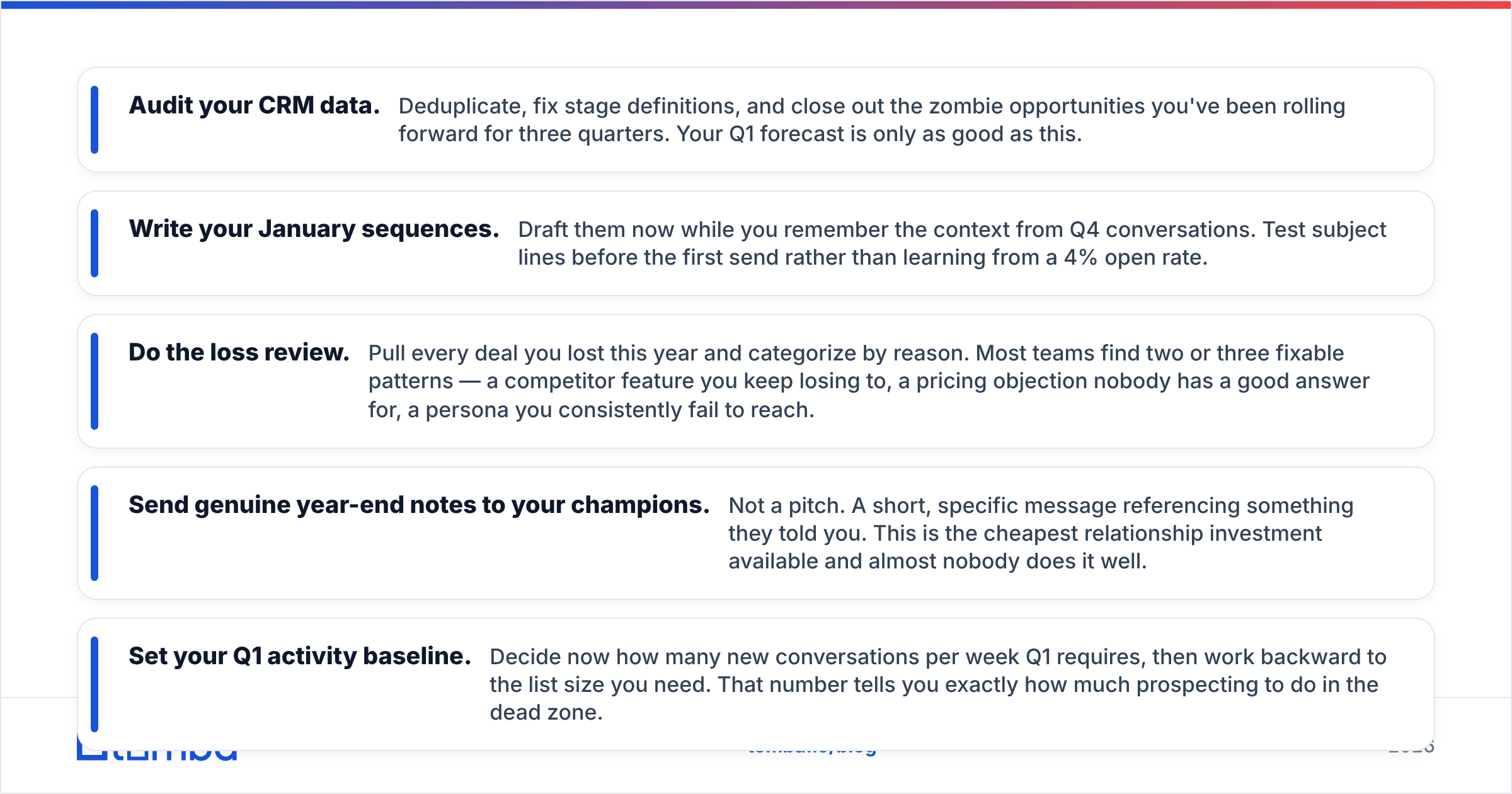
Roughly December 20 through January 2, nothing closes. Accept it and reallocate.
- Audit your CRM data. Deduplicate, fix stage definitions, and close out the zombie opportunities you've been rolling forward for three quarters. Your Q1 forecast is only as good as this.
- Write your January sequences. Draft them now while you remember the context from Q4 conversations. Test subject lines before the first send rather than learning from a 4% open rate.
- Do the loss review. Pull every deal you lost this year and categorize by reason. Most teams find two or three fixable patterns — a competitor feature you keep losing to, a pricing objection nobody has a good answer for, a persona you consistently fail to reach.
- Send genuine year-end notes to your champions. Not a pitch. A short, specific message referencing something they told you. This is the cheapest relationship investment available and almost nobody does it well.
- Set your Q1 activity baseline. Decide now how many new conversations per week Q1 requires, then work backward to the list size you need. That number tells you exactly how much prospecting to do in the dead zone.
What should you do on January 2?#
Have the list ready, verified, and loaded — that's the whole answer.
The teams that start Q1 strong aren't the ones who worked hardest in December. They're the ones who spent the dead zone building the thing everyone else builds in the first two weeks of January, and therefore got a fourteen-day head start on a market where response rates are at their annual peak because inboxes are still relatively empty.
Concretely, by January 2 you should have: a target account list reflecting current reality, verified contacts for each account with a real response rate expectation attached, sequences written and tested, sending infrastructure warmed, and a clean CRM whose forecast you actually trust.
None of that requires a buyer to be at their desk. All of it has to happen before they get back.
If your January depends on a list you haven't built yet, start with the accounts you already know you want. The Tomba Email Finder finds professional email addresses by domain, name, or company, and every result is verified at lookup — so the list you build during the quiet weeks is the list that actually lands on January 5. The free tier gives you 25 searches a month to test the workflow before you commit; Starter is $49/mo when you're ready to build at volume. Spend the dead zone building. Everyone else will spend the first week of January doing it.
Related guides#
Ready to find emails that actually work?
Join 150,000+ professionals who stopped guessing and started sending. Free credits on signup — no credit card required.
Get the Tomba newsletter
Practical outbound tactics and product updates — once every two weeks.
About the author