Energy Sales Pitch: The 2026 Framework That Closes Deals
Most energy pitches lose because they sell sustainability instead of arithmetic. Here is the segment-by-segment framework, opener scripts, objection answers, and follow-up cadence that actually move commercial energy deals in 2026.
TL;DR
- An energy sales pitch fails when it leads with sustainability adjectives instead of a defensible number tied to the prospect's own load profile, tariff, and contract end date.
- The pitch changes completely across four buyer segments — facilities, CFO, procurement, and sustainability lead — and each needs a different first sentence.
- Your strongest opener is a trigger event: a contract expiry, a tariff change, a new site, or a published emissions target. Not "we help companies save on energy."
- Five objections kill most deals (incumbent lock-in, capex, disruption, data trust, and "we already looked"). Prepare literal sentences for each, not talking points.
- The pitch only works if it reaches the person who signs. Contact accuracy — not creativity — is the most common reason good energy pitches never get read.
Why do most energy sales pitches fail?#
Because they open with a benefit the buyer cannot audit.
"We'll cut your energy costs by up to 30%" is a claim about a company the seller has never analysed. Every facilities director in a mid-market manufacturer has heard it forty times this year. It carries zero information, so it gets zero attention. The reply rate on that kind of opener sits somewhere under half a percent in most outbound datasets, and the meetings it does book skew heavily toward tire-kickers who were already shopping.
The energy pitches that work invert the order. They lead with something the prospect already knows to be true about their own operation — a contract that expires in Q1, a demand charge spike that shows up in the winter bill, a second shift that was added last year, a distribution centre that opened in March — and then attach the offer to that fact.
That is the whole discipline. Specific fact first, offer second, number third.
Here is the more uncomfortable diagnosis: most energy sales teams write a decent pitch and then send it to the wrong person. A retrofit proposal that lands in a facilities coordinator's inbox dies there, because that person cannot approve $400,000 of capex and has no incentive to forward it. The pitch was fine. The routing was wrong.
What is an energy sales pitch, exactly?#
It is a structured argument that a specific site or portfolio is currently paying more than it needs to, and that the cost of switching is smaller than the cost of not switching. Nothing more.
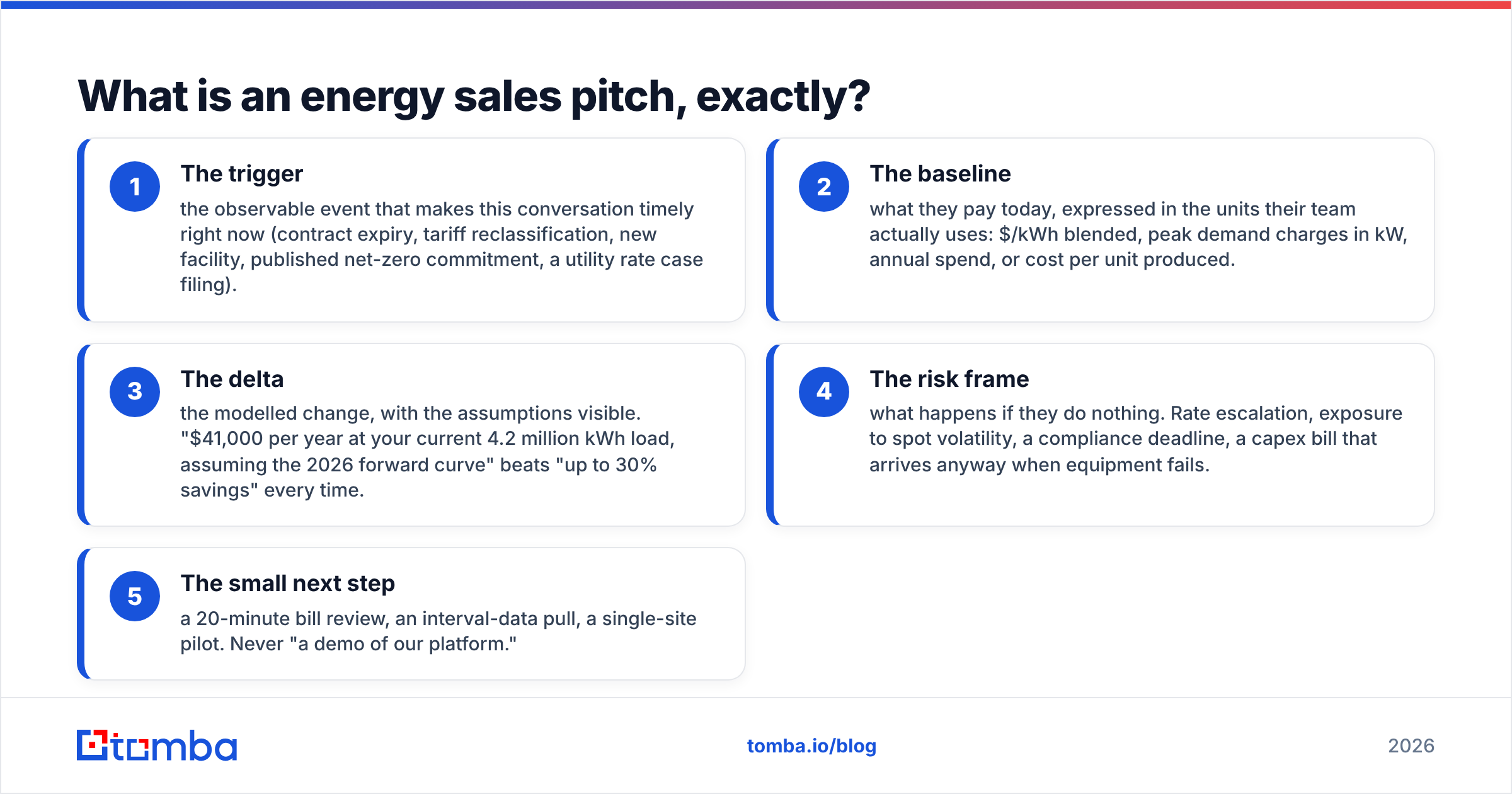
A complete pitch has five parts, and skipping any one of them is where deals stall:
- The trigger — the observable event that makes this conversation timely right now (contract expiry, tariff reclassification, new facility, published net-zero commitment, a utility rate case filing).
- The baseline — what they pay today, expressed in the units their team actually uses: $/kWh blended, peak demand charges in kW, annual spend, or cost per unit produced.
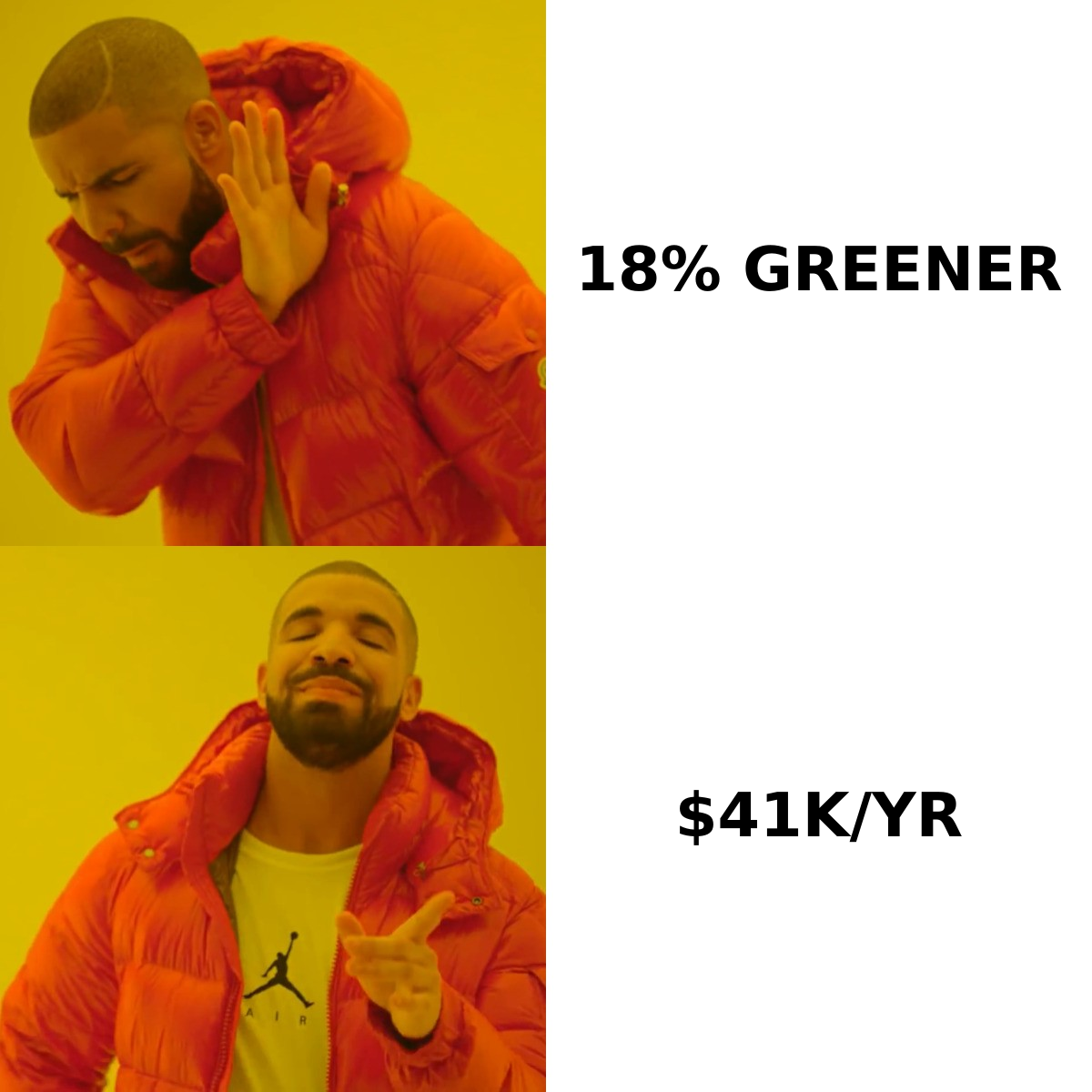
- The delta — the modelled change, with the assumptions visible. "$41,000 per year at your current 4.2 million kWh load, assuming the 2026 forward curve" beats "up to 30% savings" every time.
- The risk frame — what happens if they do nothing. Rate escalation, exposure to spot volatility, a compliance deadline, a capex bill that arrives anyway when equipment fails.
- The small next step — a 20-minute bill review, an interval-data pull, a single-site pilot. Never "a demo of our platform."
Sellers who lead with part 3 and skip parts 1 and 2 sound like every other vendor. Sellers who lead with part 1 sound like someone who did homework.
How does the pitch change by buyer type?#
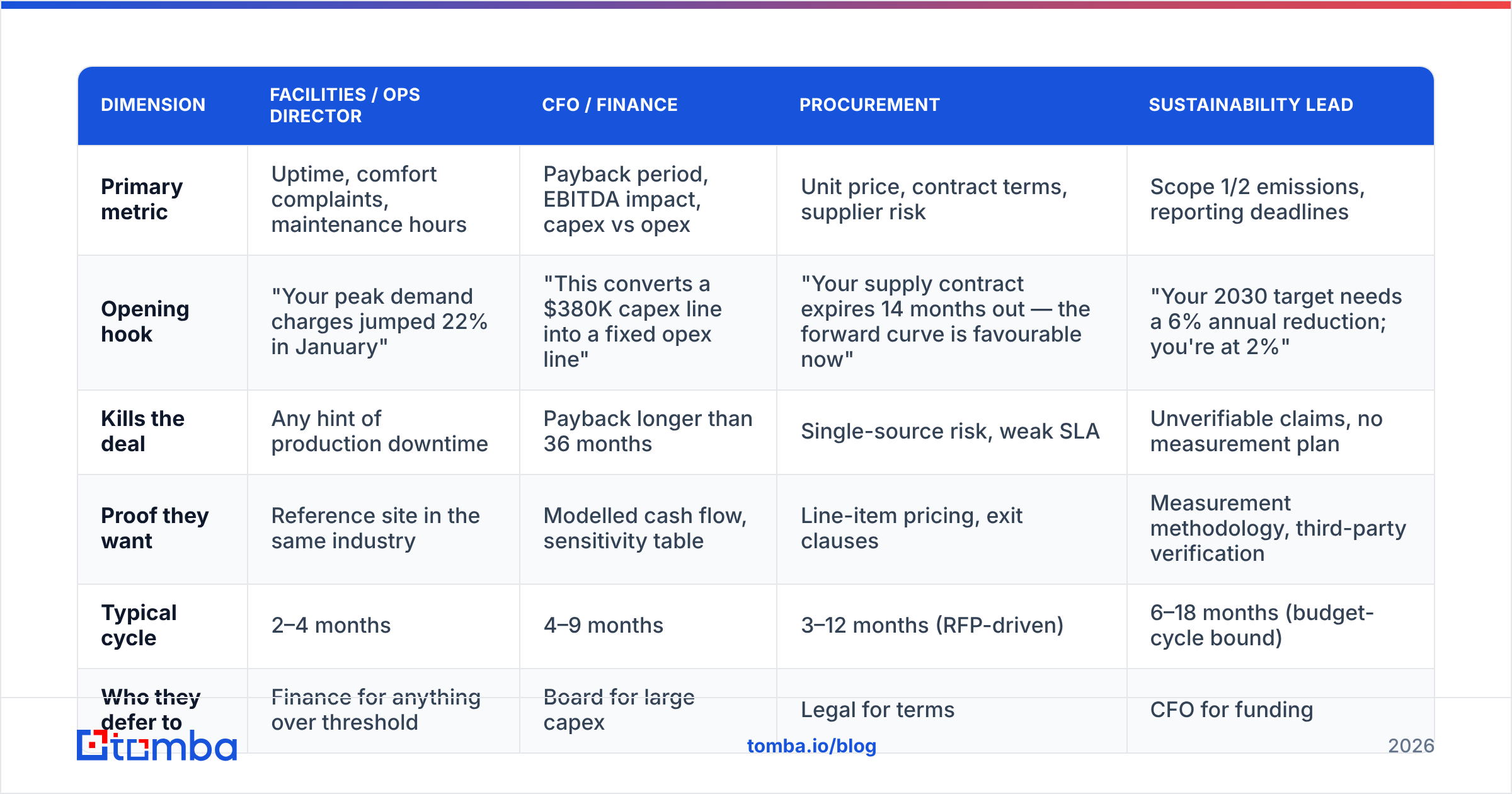
Dramatically. The same proposal needs four different first sentences depending on who opens it, because each role is measured on something different.
| Dimension | Facilities / Ops Director | CFO / Finance | Procurement | Sustainability Lead |
|---|---|---|---|---|
| Primary metric | Uptime, comfort complaints, maintenance hours | Payback period, EBITDA impact, capex vs opex | Unit price, contract terms, supplier risk | Scope 1/2 emissions, reporting deadlines |
| Opening hook | "Your peak demand charges jumped 22% in January" | "This converts a $380K capex line into a fixed opex line" | "Your supply contract expires 14 months out — the forward curve is favourable now" | "Your 2030 target needs a 6% annual reduction; you're at 2%" |
| Kills the deal | Any hint of production downtime | Payback longer than 36 months | Single-source risk, weak SLA | Unverifiable claims, no measurement plan |
| Proof they want | Reference site in the same industry | Modelled cash flow, sensitivity table | Line-item pricing, exit clauses | Measurement methodology, third-party verification |
| Typical cycle | 2–4 months | 4–9 months | 3–12 months (RFP-driven) | 6–18 months (budget-cycle bound) |
| Who they defer to | Finance for anything over threshold | Board for large capex | Legal for terms | CFO for funding |
The practical consequence: a multithreaded energy deal needs three or four different pitches running in parallel, not one deck emailed to whoever answered. Send the payback model to finance and the uptime guarantee to operations, and let them compare notes internally. That internal conversation is what actually closes the deal — your job is to arm both sides of it.
What does a strong opener actually sound like?#
Short. Factual. Ending in a question that is easy to answer.
Cold email, facilities director at a manufacturer:
Subject: your Jan demand charges
Noticed [Company] added the second line at the Fresno plant last spring. In our experience that pushes peak demand into a higher tariff band, and the January bill is where it shows up.
We modelled a similar plant (same SIC, 3.8M kWh) and found $37K/yr sitting in demand charges alone — no production change required.
Worth 20 minutes to look at your interval data? I can tell you in one call whether there's anything there.
Cold call, procurement at a multi-site retailer:
"I'm calling because your supply contract for the Midwest sites comes up in about eleven months, and the forward curve for that window is unusually flat right now. Most buyers wait until month three and lose the option. I'm not asking you to switch anything today — I want to know whether you've already locked the renewal."
LinkedIn message, sustainability lead:
"Saw the 2030 target in your latest report. The gap between a stated target and a funded plan is usually the hard part — is procurement funding the reduction path, or is it still sitting with your team?"
Notice what none of these do. They don't describe the seller's company. They don't say "innovative" or "market-leading." They don't ask for a demo. They present a fact about the buyer's world and ask a question the buyer can answer in one line.
How do you build the numbers section without overpromising?#
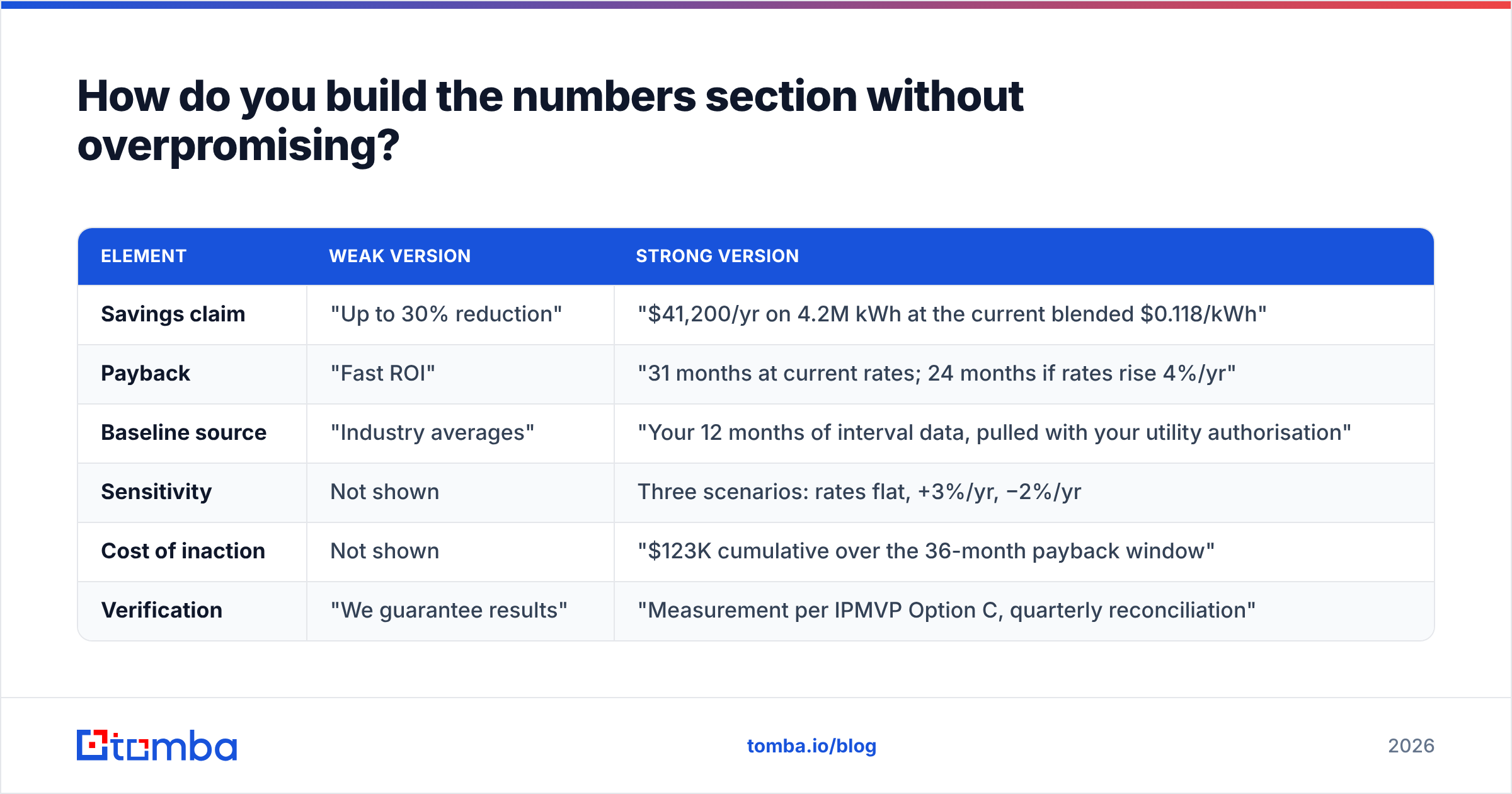
Show the assumptions. Every credible energy proposal makes its math auditable, because the buyer's finance team will rebuild your model in a spreadsheet, and if your inputs are hidden they will assume the worst.
| Element | Weak version | Strong version |
|---|---|---|
| Savings claim | "Up to 30% reduction" | "$41,200/yr on 4.2M kWh at the current blended $0.118/kWh" |
| Payback | "Fast ROI" | "31 months at current rates; 24 months if rates rise 4%/yr" |
| Baseline source | "Industry averages" | "Your 12 months of interval data, pulled with your utility authorisation" |
| Sensitivity | Not shown | Three scenarios: rates flat, +3%/yr, −2%/yr |
| Cost of inaction | Not shown | "$123K cumulative over the 36-month payback window" |
| Verification | "We guarantee results" | "Measurement per IPMVP Option C, quarterly reconciliation" |
The counterintuitive part: showing a worse number in one scenario makes the whole model more believable. When you present the downside case unprompted, the buyer stops looking for the catch and starts evaluating the range. Sales research from HubSpot and buyer-review data on G2 both point the same direction — transparency in pricing and assumptions correlates with shorter cycles, not longer ones.
If you sell power purchase agreements, this matters even more. A PPA is a 10–20 year commitment, and no CFO signs one on the strength of a headline percentage. Public load and price data from the U.S. Energy Information Administration is a useful neutral anchor when a prospect disputes your baseline assumptions.
Which five objections kill energy deals, and what do you say?#
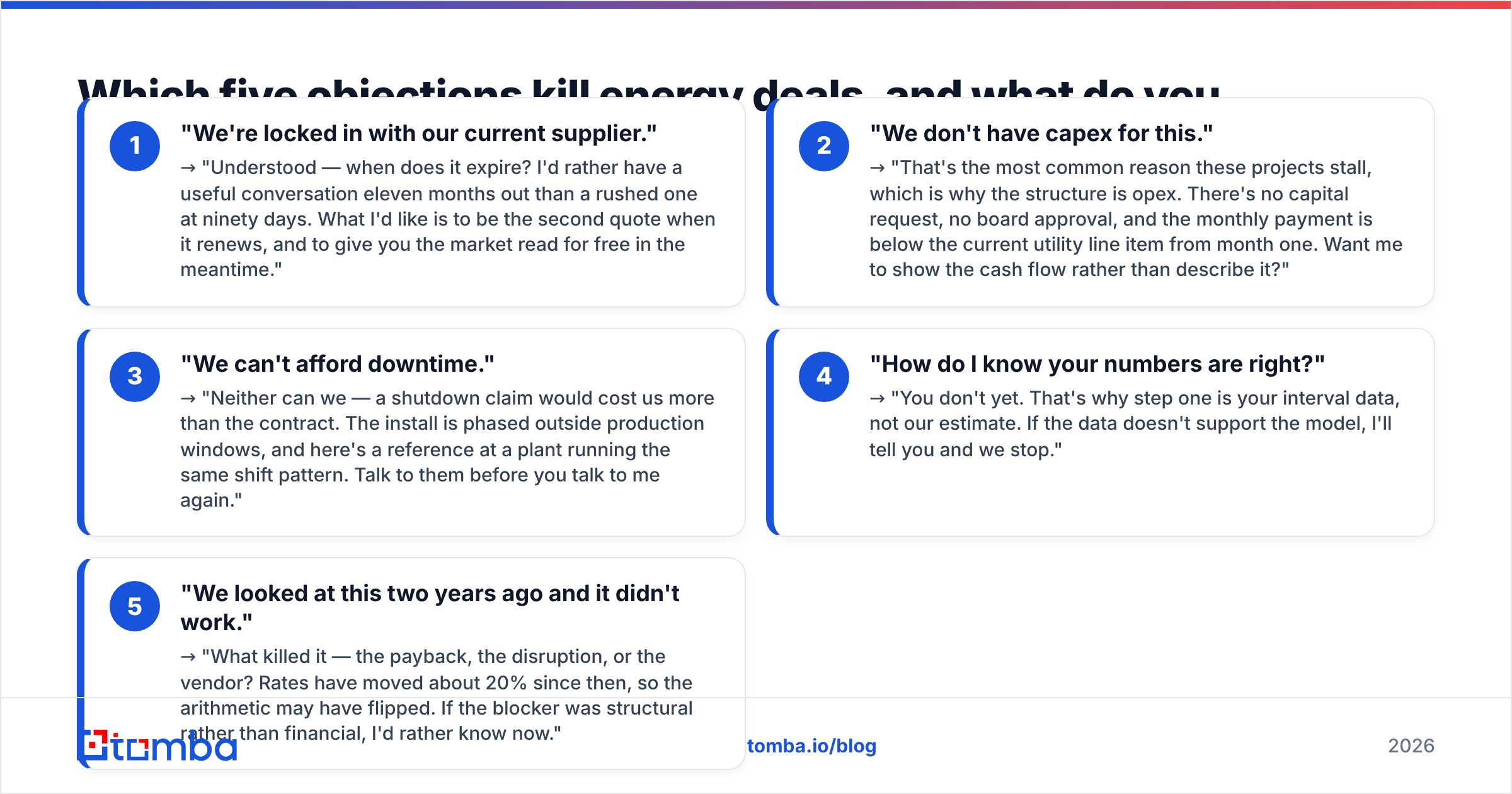
Write the literal sentence in advance. Improvising at the moment of objection is how good pitches lose.
- "We're locked in with our current supplier." → "Understood — when does it expire? I'd rather have a useful conversation eleven months out than a rushed one at ninety days. What I'd like is to be the second quote when it renews, and to give you the market read for free in the meantime."
- "We don't have capex for this." → "That's the most common reason these projects stall, which is why the structure is opex. There's no capital request, no board approval, and the monthly payment is below the current utility line item from month one. Want me to show the cash flow rather than describe it?"
- "We can't afford downtime." → "Neither can we — a shutdown claim would cost us more than the contract. The install is phased outside production windows, and here's a reference at a plant running the same shift pattern. Talk to them before you talk to me again."
- "How do I know your numbers are right?" → "You don't yet. That's why step one is your interval data, not our estimate. If the data doesn't support the model, I'll tell you and we stop."
- "We looked at this two years ago and it didn't work." → "What killed it — the payback, the disruption, or the vendor? Rates have moved about 20% since then, so the arithmetic may have flipped. If the blocker was structural rather than financial, I'd rather know now."
Every one of those answers does the same thing: it accepts the objection as legitimate, converts it into a diagnostic question, and offers a smaller next step. None of them argue.

What does the follow-up cadence look like?#
Energy deals are long, budget-bound, and trigger-driven. That makes cadence design different from SaaS outbound — you are not trying to wear someone down over ten days, you are trying to be present at the moment a trigger fires.
A workable structure for commercial energy:
- Days 1–14, four touches. Email → call → LinkedIn → email. Each one carries a new piece of information: a rate filing, a comparable site result, a regulatory change. Never "just following up."
- Days 15–90, monthly value drop. One short message a month with something genuinely useful — the regional rate outlook, a tariff change affecting their class, a peer case study. No ask.
- Trigger re-entry. The moment a contract renewal window opens, a new site is announced, or a rate case is filed, break cadence and send a direct, specific message referencing it.
- Quarterly multithread. Add one new contact at the account each quarter. Deals that stall on a single champion are the single largest source of pipeline decay in this category.
Your response rate on the monthly value drop will look poor in isolation. Judge it on re-engagement at trigger moments instead — that is where the sequence pays.
How do you make sure the pitch reaches the right person?#
This is where most energy sales teams quietly lose the majority of their effort. A perfectly built pitch sent to a stale, guessed, or role-mismatched address produces exactly nothing, and worse, a high bounce rate damages your sending domain so the next campaign underperforms too.
Three practical fixes:
- Map the buying group before you write. For any commercial energy deal, that is typically facilities/operations, finance, procurement, and — increasingly — a sustainability or ESG owner. Four names, not one. Use a domain search to pull the contactable people at a target company and their email pattern in one pass, then filter by role.
- Verify before you send, every time. Contact data at industrial and multi-site companies decays fast, especially in facilities roles. Running the list through an email verifier before a campaign protects deliverability and keeps your bounce rate in the range that inbox providers tolerate.
- Enrich so the pitch can be specific. Site count, headcount, industry code, and location are what let you write "the Fresno plant" instead of "your facility." Contact data enrichment fills those fields at scale so personalisation doesn't cost you an hour per prospect.
The economics here are blunt. If a rep sends 200 pitches a month and 18% of the addresses are wrong, that is 36 pitches that never existed — plus a deliverability penalty on the 164 that did. Fixing contact accuracy is usually a larger uplift than rewriting the pitch, and it takes an afternoon rather than a quarter.
What should you do this week?#
Pick your ten best-fit accounts. For each, find the contract expiry or the most recent trigger event, identify four contacts across facilities, finance, procurement, and sustainability, and write one segment-specific opener per role using the structure above. Ten accounts, forty messages, four hours of work. That beats a 2,000-name blast on every metric that matters.
Then measure one thing: how many of those forty produced a reply that referenced the specific fact you opened with. That number tells you whether your energy sales pitch is landing as research or as noise.
Ready to route your pitch to the people who can actually sign? Tomba Email Finder locates verified professional email addresses by company domain, name, or role — so your facilities, finance, and procurement contacts are current before your first send, not after your first bounce report. Start free with 25 searches a month, or check Tomba pricing if you need bulk volume for a full territory build.
Related guides#
Ready to find emails that actually work?
Join 150,000+ professionals who stopped guessing and started sending. Free credits on signup — no credit card required.
Get the Tomba newsletter
Practical outbound tactics and product updates — once every two weeks.
About the author