Enginy Pricing in 2026: Plans, Real Costs, and Alternatives
Enginy sells credits, not contacts. Here's how to translate its pricing into a real cost per verified email, where the overage traps sit, and which alternatives cost less for the same output.
TL;DR
- Enginy prices like most modern B2B data platforms: a monthly credit pool plus seat and feature gating, not a flat "per contact" fee. The sticker price tells you almost nothing until you convert it to cost per verified contact.
- The three numbers that actually decide your bill are hit rate, verification pass rate, and whether unused credits roll over. Ignore them and a "cheap" plan can cost 3-4x more per usable email than a pricier one.
- Watch for the usual annual-contract mechanics: credit resets, seat minimums, API access parked on a higher tier, and enrichment calls that burn a credit even when they return nothing.
- Enginy is a reasonable fit if you want an all-in-one prospecting workflow in one dashboard. It's a poor fit if you mainly need raw email discovery at volume through an API.
- If your bottleneck is finding and verifying work emails, a focused tool is cheaper: Tomba pricing starts free (25 searches/mo), then $49/mo Starter, $99/mo Growth, $249/mo Pro — with API access included rather than sold as an upsell.
Pricing pages in this category are designed to be hard to compare. Enginy is no exception. This post is not a rewrite of the vendor's plan grid — it's the arithmetic you should run before you sign anything, plus an honest look at where cheaper options do the same job.
What is Enginy and what are you actually paying for?#
Enginy positions itself as an AI-assisted B2B prospecting and lead-intelligence platform: you define an ideal customer profile, it surfaces matching companies and contacts, and it hands you enriched records you can push into outreach. That bundle — search, enrichment, contact data, and workflow — is the product.
That bundle is also the pricing problem. When one subscription covers company search, contact reveal, enrichment, and export, you cannot see which part is consuming your budget. Most teams discover after two months that 80% of their credits went to one activity (usually contact reveals) and the rest of the platform was decoration they still paid for.
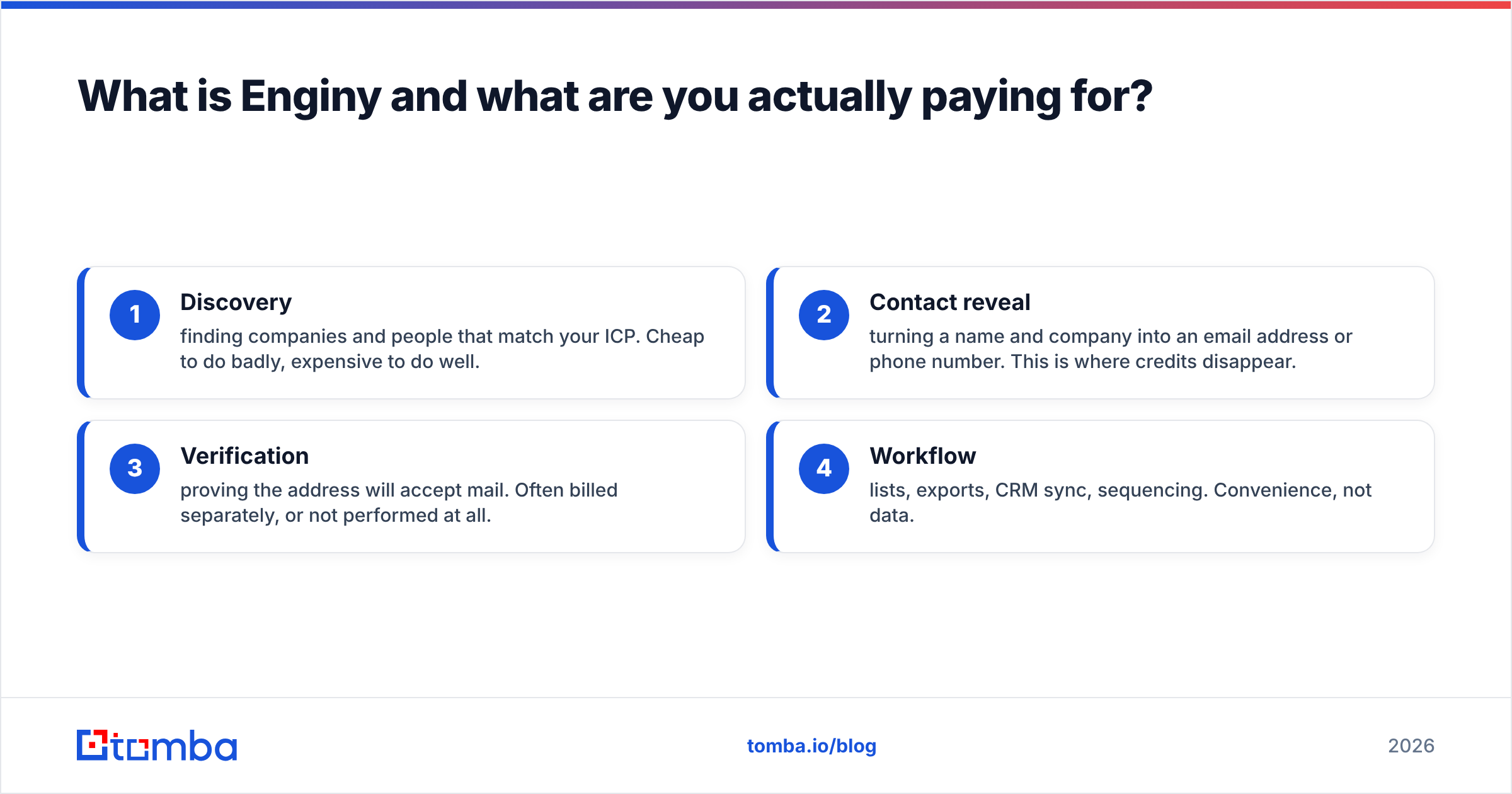
Before you compare Enginy pricing to anything, split what you're buying into four separate line items:
- Discovery — finding companies and people that match your ICP. Cheap to do badly, expensive to do well.
- Contact reveal — turning a name and company into an email address or phone number. This is where credits disappear.
- Verification — proving the address will accept mail. Often billed separately, or not performed at all.
- Workflow — lists, exports, CRM sync, sequencing. Convenience, not data.
If three of those four are things you already own — you have a CRM, you have a sequencer, you have a list-building motion — you're paying platform prices for a email finder you could buy standalone for a fraction of it.
How does Enginy pricing actually work?#
Enginy, like nearly every tool in this bracket, uses a credit model. Vendors in this space re-price frequently, so check the official Enginy site for today's numbers before you budget — what matters here is the structure, which changes far more slowly than the dollar figures.
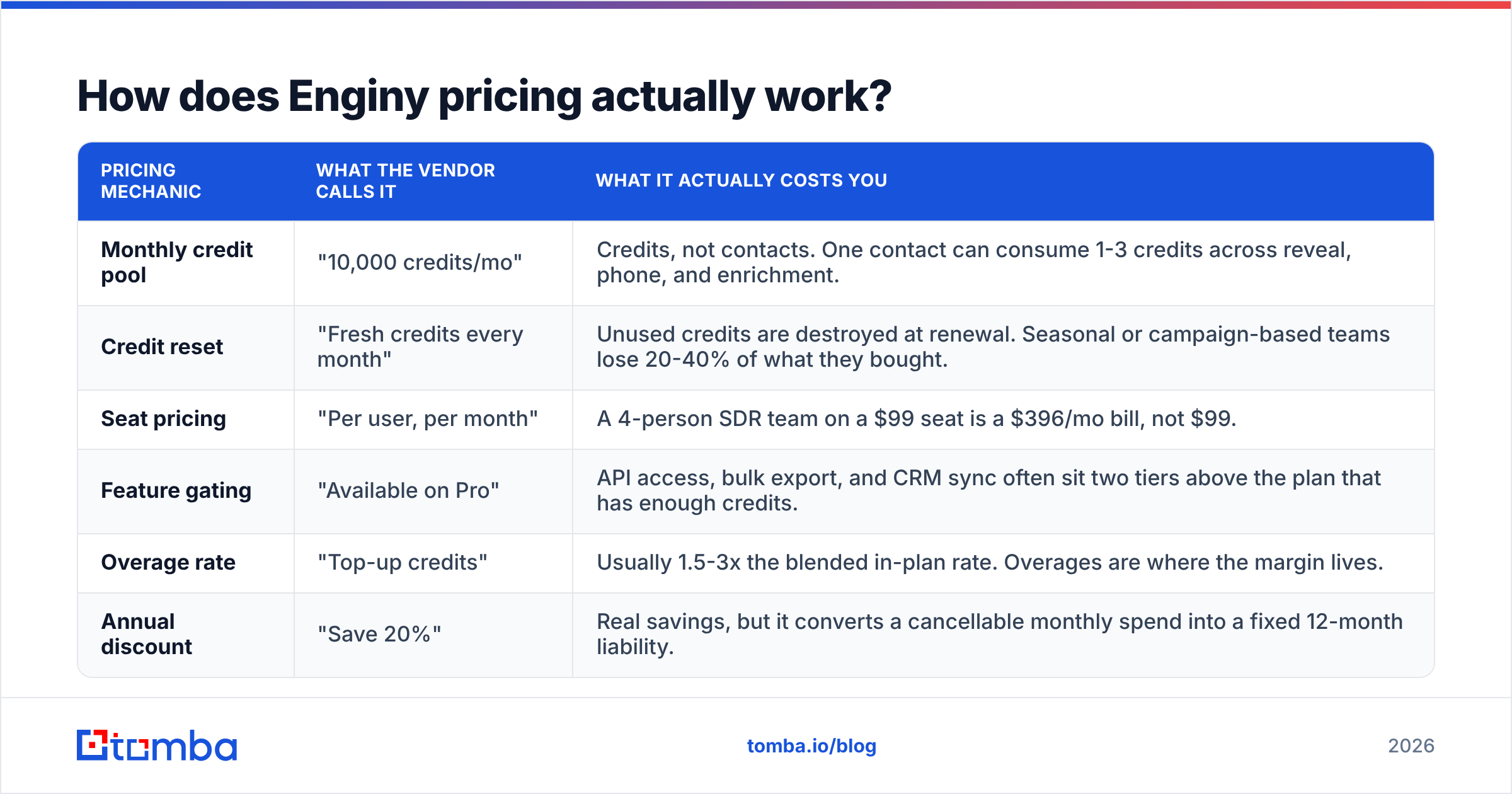
Here is how credit-based plans are typically built and what each mechanic does to your effective cost:
| Pricing mechanic | What the vendor calls it | What it actually costs you |
|---|---|---|
| Monthly credit pool | "10,000 credits/mo" | Credits, not contacts. One contact can consume 1-3 credits across reveal, phone, and enrichment. |
| Credit reset | "Fresh credits every month" | Unused credits are destroyed at renewal. Seasonal or campaign-based teams lose 20-40% of what they bought. |
| Seat pricing | "Per user, per month" | A 4-person SDR team on a $99 seat is a $396/mo bill, not $99. |
| Feature gating | "Available on Pro" | API access, bulk export, and CRM sync often sit two tiers above the plan that has enough credits. |
| Overage rate | "Top-up credits" | Usually 1.5-3x the blended in-plan rate. Overages are where the margin lives. |
| Annual discount | "Save 20%" | Real savings, but it converts a cancellable monthly spend into a fixed 12-month liability. |
None of these are unique to Enginy, and none are dishonest. They just mean the headline price is a poor proxy for cost. Two plans at the same monthly price can differ by 3x in cost per usable contact depending on reset policy and hit rate alone.
One mechanic deserves special attention: do failed lookups consume credits? Some platforms charge only for results returned; others burn a credit on every query. On a 55% hit rate, a charge-on-attempt policy nearly doubles your effective price. Ask this in writing before you buy — it is the single highest-leverage question on the whole call.
What does Enginy cost per verified contact?#
This is the only number worth comparing across vendors. The formula:
Cost per verified contact = (Monthly price ÷ Credits) ÷ (Hit rate × Verification pass rate)
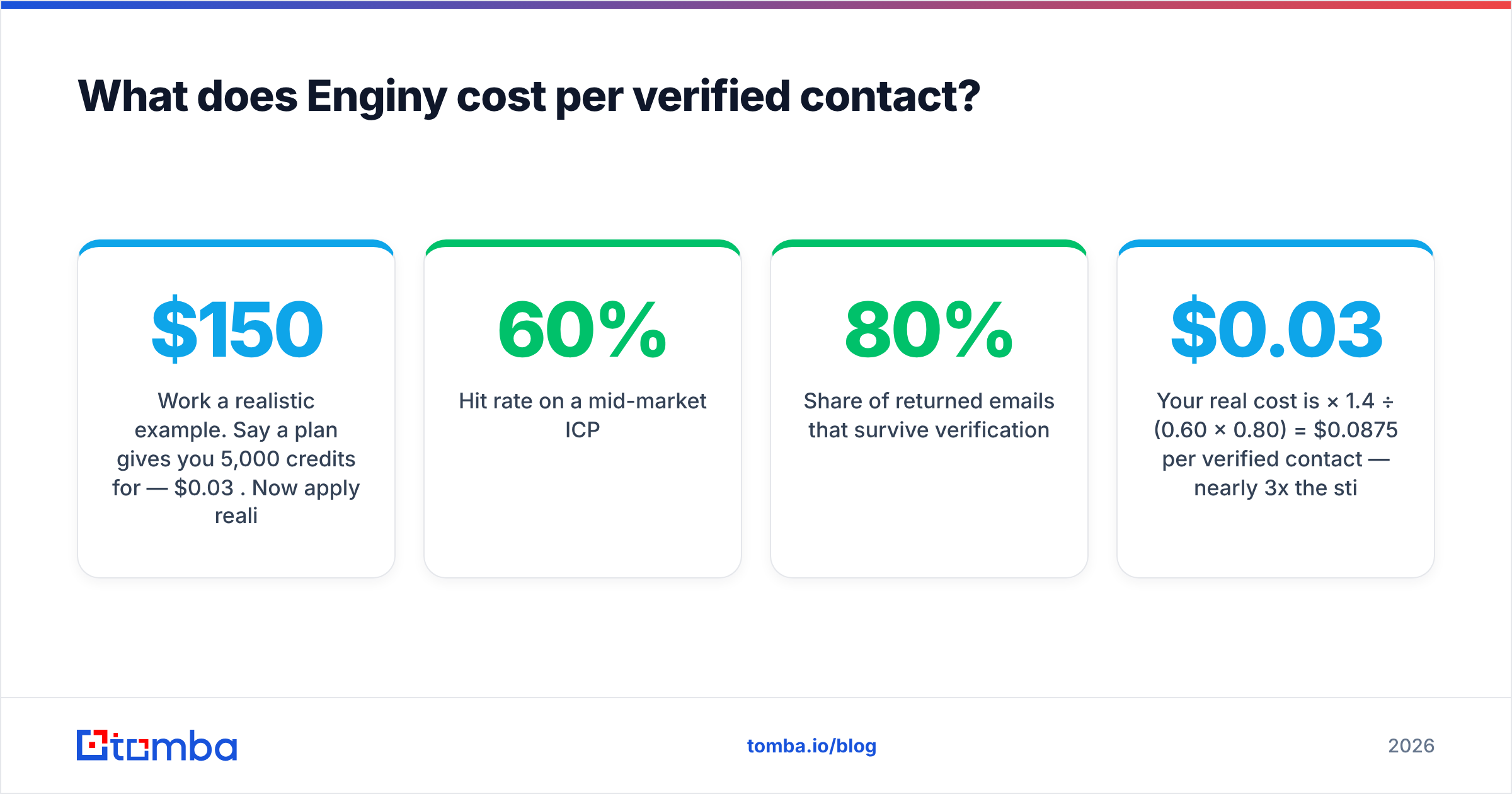
Work a realistic example. Say a plan gives you 5,000 credits for $150/mo — $0.03 per credit. Now apply reality:
- Average credits consumed per contact record: 1.4 (reveal plus one enrichment call)
- Hit rate on a mid-market ICP: 60%
- Share of returned emails that survive verification: 80%
Your real cost is $0.03 × 1.4 ÷ (0.60 × 0.80) = $0.0875 per verified contact — nearly 3x the sticker rate. On 5,000 credits, you end up with roughly 1,700 contacts you'd actually mail.

Accuracy is a pricing feature, not a quality feature. A tool with a 75% hit rate at $0.04/credit beats a tool with a 50% hit rate at $0.025/credit, every time. That's why the cheapest-looking contract is so often the most expensive one — and why running your own verification pass matters. Sending to unverified data doesn't just waste credits; it damages email deliverability in a way no discount compensates for.
Run the same formula on every quote you receive, using your ICP, not the vendor's demo list. Ask for a trial against 100 of your own target accounts and count the survivors. Vendors happily demo on Fortune 500 domains where every tool looks great; the gap opens up on 50-person companies in unglamorous industries.
Where do the hidden costs show up?#
Four places, consistently:
- The verification gap. If contact data ships without SMTP-level validation, you'll pay a second vendor to clean it — or pay in bounces. Budget for an email verifier either way, and check whether catch-all domains are flagged or silently passed through as "valid."
- The API tier jump. Teams start in the UI, then want to automate. If API access lives on a plan two steps up, the automation project costs 2-3x the data itself. Compare against tools where the email finder API is included at entry level.
- Seat creep. Data platforms are priced per seat but used by one or two people. Audit who logs in monthly; most teams over-provision by 30-50% at renewal because nobody checks.
- Dead credits. Outbound is lumpy. You'll burn 12,000 credits in launch month and 1,200 in December. Without rollover, you're paying peak-month prices for average-month usage. Either negotiate rollover in writing or size the plan to your median month and top up on peaks — even at overage rates, that's usually cheaper.
There's a fifth, softer cost: switching. Once your lists, sequences, and CRM mappings live inside one platform, migrating gets expensive in hours, not dollars. That's the real reason annual contracts are pushed so hard. If you're unsure about the fit, take the monthly price and keep your leverage.
How does Enginy pricing compare to the alternatives?#
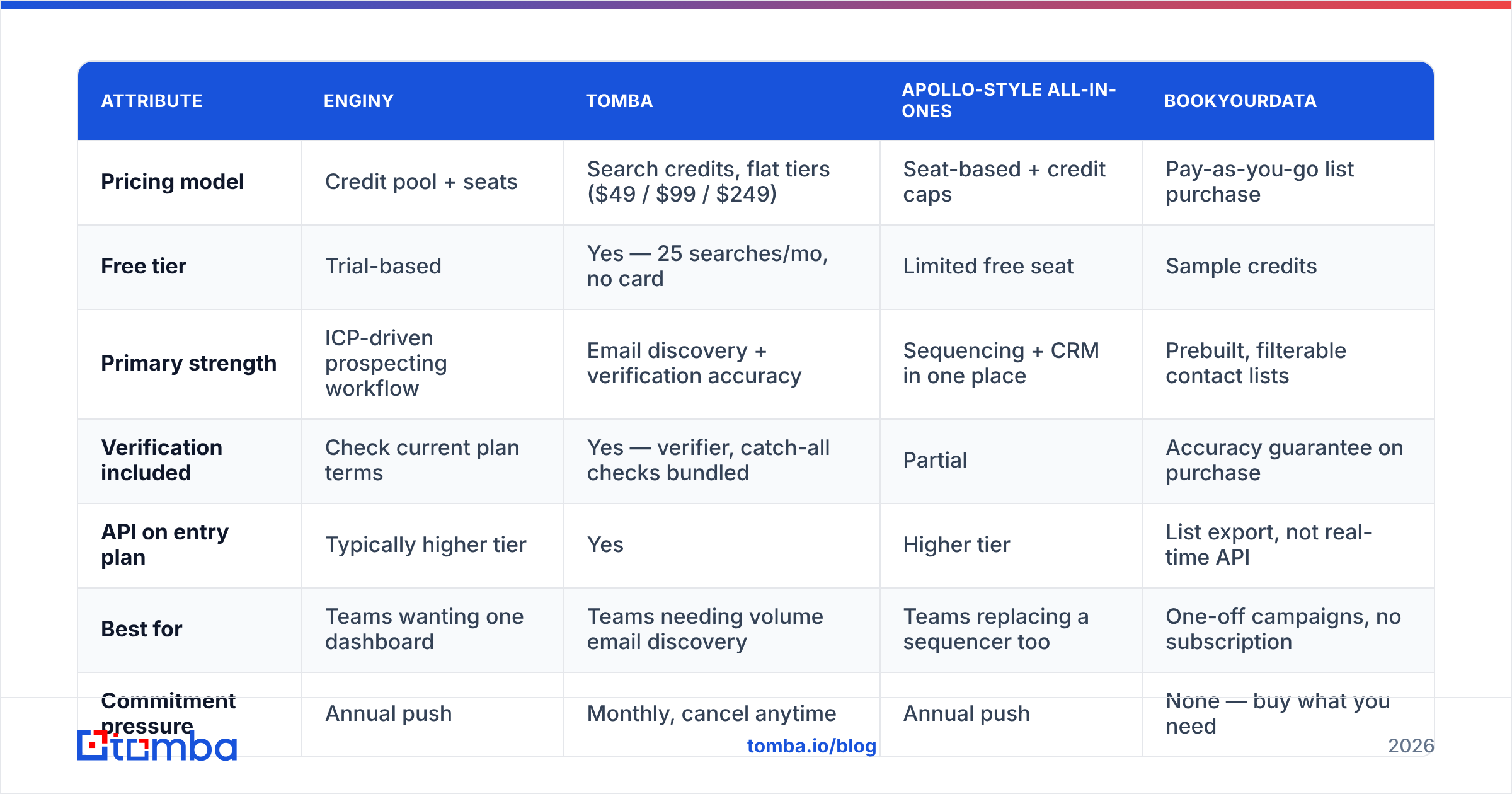
Compare on structure, not stickers. Here's how the main options differ on the mechanics that drive effective cost:
| Attribute | Enginy | Tomba | Apollo-style all-in-ones | BookYourData |
|---|---|---|---|---|
| Pricing model | Credit pool + seats | Search credits, flat tiers ($49 / $99 / $249) | Seat-based + credit caps | Pay-as-you-go list purchase |
| Free tier | Trial-based | Yes — 25 searches/mo, no card | Limited free seat | Sample credits |
| Primary strength | ICP-driven prospecting workflow | Email discovery + verification accuracy | Sequencing + CRM in one place | Prebuilt, filterable contact lists |
| Verification included | Check current plan terms | Yes — verifier, catch-all checks bundled | Partial | Accuracy guarantee on purchase |
| API on entry plan | Typically higher tier | Yes | Higher tier | List export, not real-time API |
| Best for | Teams wanting one dashboard | Teams needing volume email discovery | Teams replacing a sequencer too | One-off campaigns, no subscription |
| Commitment pressure | Annual push | Monthly, cancel anytime | Annual push | None — buy what you need |

Three honest observations from that grid.
All-in-one platforms are worth it when you're consolidating. If Enginy replaces your list tool, your enrichment tool, and part of your sequencer, paying platform prices is rational. Count the licenses you'd cancel before you dismiss it.
BookYourData is the right shape for burst campaigns. If you need 3,000 contacts for one quarter and nothing after, a subscription is the wrong instrument entirely. Buying a filtered list outright avoids paying for eleven months of idle seats — and it's a genuinely strong option when your ICP is well-defined and stable.
Focused finders win on cost per verified email. When your bottleneck is "I have 4,000 companies and need the right person's address," a specialist tool costs less because you're not funding a sequencer you don't use. Tomba plans at $49/mo Starter and $99/mo Growth include the verifier, domain search, and API at every paid level — which removes the tier-jump tax entirely.

Who should pay for Enginy — and who shouldn't?#
Buy it if:
- You're building a prospecting motion from scratch and want ICP definition, discovery, and enrichment in one place.
- Your team is small enough that seat pricing stays reasonable (1-3 users).
- Your usage is steady month over month, so credit resets don't punish you.
- You've validated hit rate on your own ICP, not a demo list.
Skip it if:
- You already run a sequencer and a CRM you like. You'd be paying twice for workflow.
- Your volume is spiky. Credit resets will quietly eat 25%+ of what you buy.
- You need programmatic lookups. Check where API access sits before you get attached.
- Your ICP is SMB or non-US. Coverage thins out fast below 200 employees at most vendors — test it, don't assume it.
How do you cut data spend without ripping everything out?#
You rarely need a full migration. The cheapest fix is usually unbundling one line item:
- Verify with a second tool. Keep discovery where it is, route every export through independent verification. Bounce rate drops, and you stop paying to mail dead addresses. A bulk verify pass on a list costs a rounding error against one damaged sending domain.
- Move high-volume lookups to an API. If 70% of your credits go to bulk email discovery, that workload belongs on a metered API, not a per-seat platform.
- Right-size seats at renewal. Pull login data. Cut the dormant ones. This is free money and almost nobody does it.
- Negotiate rollover, not discount. A 20% discount on credits you don't use is worth less than rollover on credits you do. Vendors give rollover more easily than price cuts because it costs them nothing today.
- Benchmark quarterly. Pull 200 rows of your own ICP through two tools side by side and count verified survivors. Independent review sites like G2 and Capterra are useful for surfacing candidates, but review scores don't measure hit rate on your market — your own test does. For broader context on how this whole category fits together, the lead generation overview is a decent primer.
What's the verdict on Enginy pricing?#
Enginy's pricing is defensible for what it is: a bundled prospecting platform, priced like a platform. The question isn't whether it's expensive in isolation — it's whether you're using enough of the bundle to justify bundle pricing. Most teams that complain about cost in this category aren't overpaying for data; they're paying for workflow they replaced six months ago and never cancelled.
Run the cost-per-verified-contact formula. Ask whether failed lookups burn credits. Get rollover in writing. Test on your own ICP before annual. Those four steps will save you more than any discount code.
And if the honest answer is that you mostly need work emails at volume, buy that specifically. The Tomba Email Finder does exactly one job well: turning names and domains into verified, deliverable addresses — free for your first 25 searches a month, $49/mo when you're ready to scale, with verification and API access included instead of upsold. Test it against your current tool on 100 real prospects and compare survivors. That's the only benchmark that pays for itself.
Related guides#
Ready to find emails that actually work?
Join 150,000+ professionals who stopped guessing and started sending. Free credits on signup — no credit card required.
Get the Tomba newsletter
Practical outbound tactics and product updates — once every two weeks.
About the author