Enreach Pricing Reviews Pros and Cons: 2026 Buyer's Guide
Enreach doesn't publish a price list, so buyers negotiate blind. Here's how quotes are actually built, what reviewers praise and complain about, and where the hidden line items live.
Enreach pricing reviews pros and cons all in one guide. Enreach does not post a price list, so buyers negotiate blind. Below is how quotes get built, what reviewers praise, what they warn about, and where the extra costs hide.
TL;DR
- Enreach publishes no price list. Every deal runs through a rep or a regional partner. Two firms of the same size can pay very different seat rates.
- A quote stacks four or five line items: seats, numbers, minutes, add-ons, and setup. It is not one per-user figure.
- Reviewers praise uptime, EU data hosting, and Teams integration. They flag slow escalation, uneven features by country, and long contracts.
- Small outbound teams pay less on a self-serve tool. Regulated EU voice plus contact-center routing is where Enreach fits.
- No dialler works without clean contact data. That layer is priced on its own, and you own it.
What is Enreach and who actually buys it?#
Enreach is a European cloud communications group. It sells unified communications (UCaaS), contact-center software (CCaaS), and mobile-linked calling to small and mid-market firms. It grew by buying other vendors. Voiceworks, Swyx, Centile, Benemen and Masvoz were folded into one brand. That history shapes both its strengths and its pricing. You can see the current product framing on the official Enreach site.
The typical buyer is a 30–500 seat European company. It wants one vendor for desk phones, softphones, mobile SIMs, and a light contact center. It also wants the data to stay in the EU. That is a real niche. Enreach is not chasing the five-person startup that needs one cheap VoIP line. It is not trying to be Genesys either.
That fit is the key to reading its prices. Enreach sells through partners in the Netherlands, Germany, Finland, Spain, the UK and other markets. Channel-led vendors rarely post rates. The partner needs margin room, and the platform differs by country.
How does Enreach pricing actually work?#
Short answer: you get a quote. It is priced per user, per month, on a term contract. And it is built from stacked parts, not one sticker price.
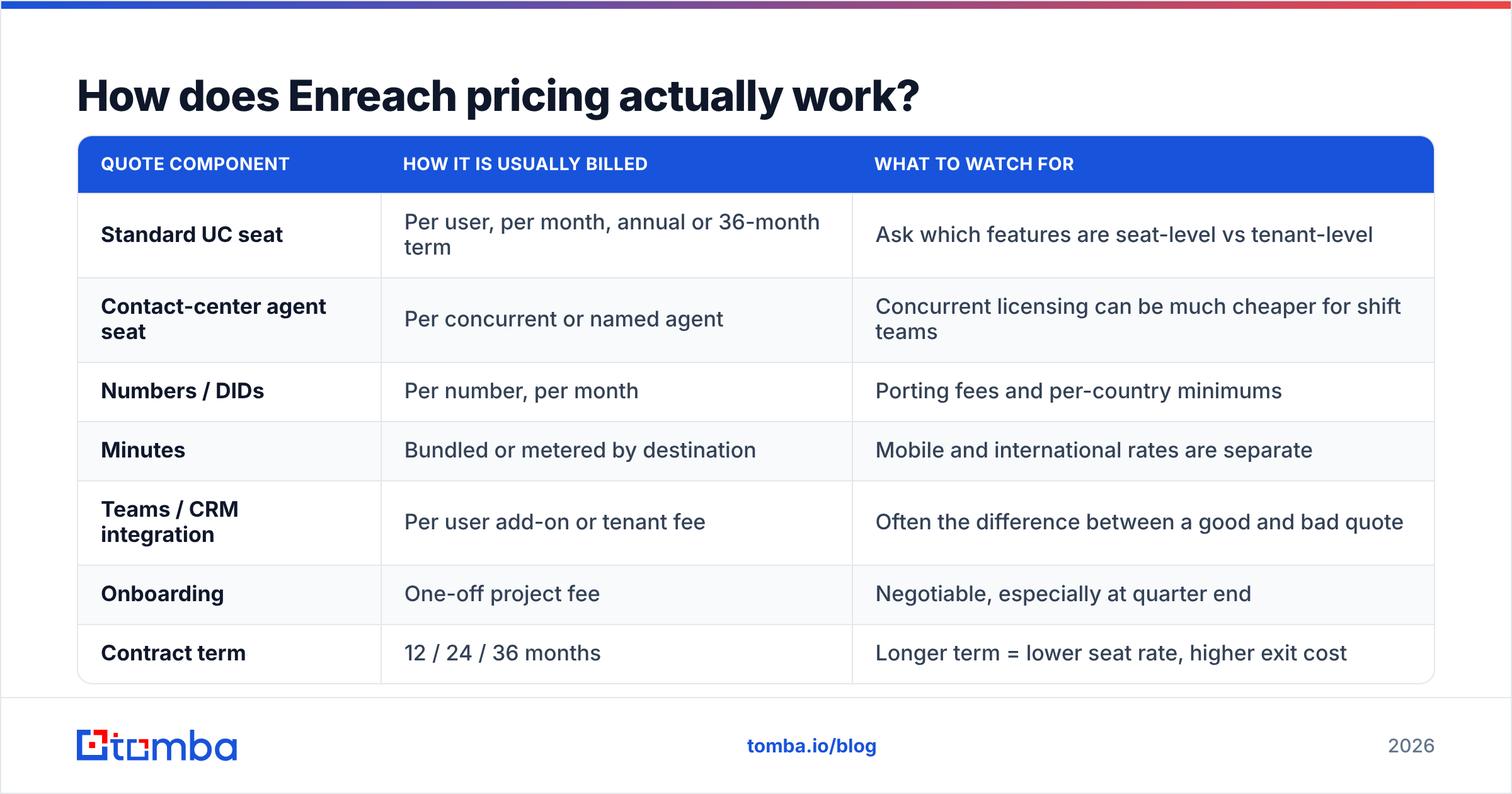
When you ask for a quote, the number that comes back is the sum of these parts:
- Seat licence tier — the biggest line. A basic softphone seat costs far less than a full agent seat with routing, wallboards, and recording. Most quotes mix tiers rather than put everyone on the top plan.
- Numbers and DIDs — each geographic number, toll-free number, or ported range adds a small monthly fee. Multi-country rollouts add up fast.
- Call minutes or bundles — some markets bundle national minutes. Others meter them. Mobile and international calls sit on separate rates.
- Integrations and add-ons — Teams direct routing, CRM connectors, longer recording storage, AI transcription, and API access often sit outside the base seat.
- Hardware — desk phones and headsets are bought, leased, or folded into the seat price with a longer term.
- Onboarding and services — porting, dial-plan design, and training come as a one-off fee. Reps often waive it to close a deal at quarter end.
That shape is normal for channel-sold UCaaS. It is not a trick. But the per-user figure you hear on the first call is rarely the figure on your first invoice.
| Quote component | How it is usually billed | What to watch for |
|---|---|---|
| Standard UC seat | Per user, per month, annual or 36-month term | Ask which features are seat-level vs tenant-level |
| Contact-center agent seat | Per concurrent or named agent | Concurrent licensing can be much cheaper for shift teams |
| Numbers / DIDs | Per number, per month | Porting fees and per-country minimums |
| Minutes | Bundled or metered by destination | Mobile and international rates are separate |
| Teams / CRM integration | Per user add-on or tenant fee | Often the difference between a good and bad quote |
| Onboarding | One-off project fee | Negotiable, especially at quarter end |
| Contract term | 12 / 24 / 36 months | Longer term = lower seat rate, higher exit cost |

What should you expect to pay?#
No one outside the deal can give you an exact Enreach seat price. Distrust any article that prints one as fact. What you can do is anchor on the open market. Mid-market European UCaaS seats run from a low-teens euro figure for a basic extension up to a high double-digit figure for a full agent seat with recording and analytics. Quotes reported by buyers tend to land inside that band. The spread comes from term length, seat mix, and how hard you push.
The practical move: get quotes from Enreach and two vendors that post prices. Use the public numbers as your floor.
What do Enreach reviews say — the pros?#
Most Enreach pricing reviews pros and cons threads repeat the same few themes. Sentiment across G2's UCaaS category and Capterra's VoIP listings is broadly positive.
Uptime is rarely the complaint. Call quality and uptime show up as strengths far more than as gripes. For a phone platform, that is the thing that matters most.
EU data hosting is a real edge. If your legal team cares where call recordings live, an EU provider with in-region kit removes a fight you would otherwise have over a US vendor's DPA.
Mobile works better than average. The mobile roots from deals like Benemen show up here. One number covers desk phone, softphone, and SIM, and calls hand over cleanly. Teams that live on mobile notice.
Teams integration is mature. Direct routing into Microsoft Teams is a common setup. Reviewers call it stable rather than experimental.
Partners give you a local human. When the channel works, you get a named contact in your country. They speak your language and know your dial plan. That beats a ticket queue in another timezone.
What are the cons and hidden costs?#
No public pricing is itself a cost. You burn days on discovery calls before you can compare anything. In a fast evaluation, that friction is real. Vendors with a price page let you rule them out in ninety seconds.
Partner quality varies. Your experience is your reseller's experience. Reviewers who praise support and reviewers who pan it are often describing different partners, not different products. Ask for references from customers of your partner, not the vendor at large.
Features differ by country. The group was built by acquisition, so the platform in one market is not the same as the next. Deploying across three countries? Check feature by feature instead of trusting the datasheet.
Contracts are sticky. The best seat rates come tied to 36-month terms and hardware. Model the exit cost before you sign, not after.
Escalation can be slow. The most common gripe in public reviews is slow fixes for hard problems. They have to travel from partner to vendor engineering. Get the escalation SLA in writing.
The data layer is not included. Buyers miss this one most. A dialler does not tell you who to call. Contact discovery, number checks, and enrichment form a separate budget line. Skip it and you have bought a costly way to dial wrong numbers. Running your list through a phone validator first is the cheapest quality control in the stack.
How does Enreach compare to the alternatives?#
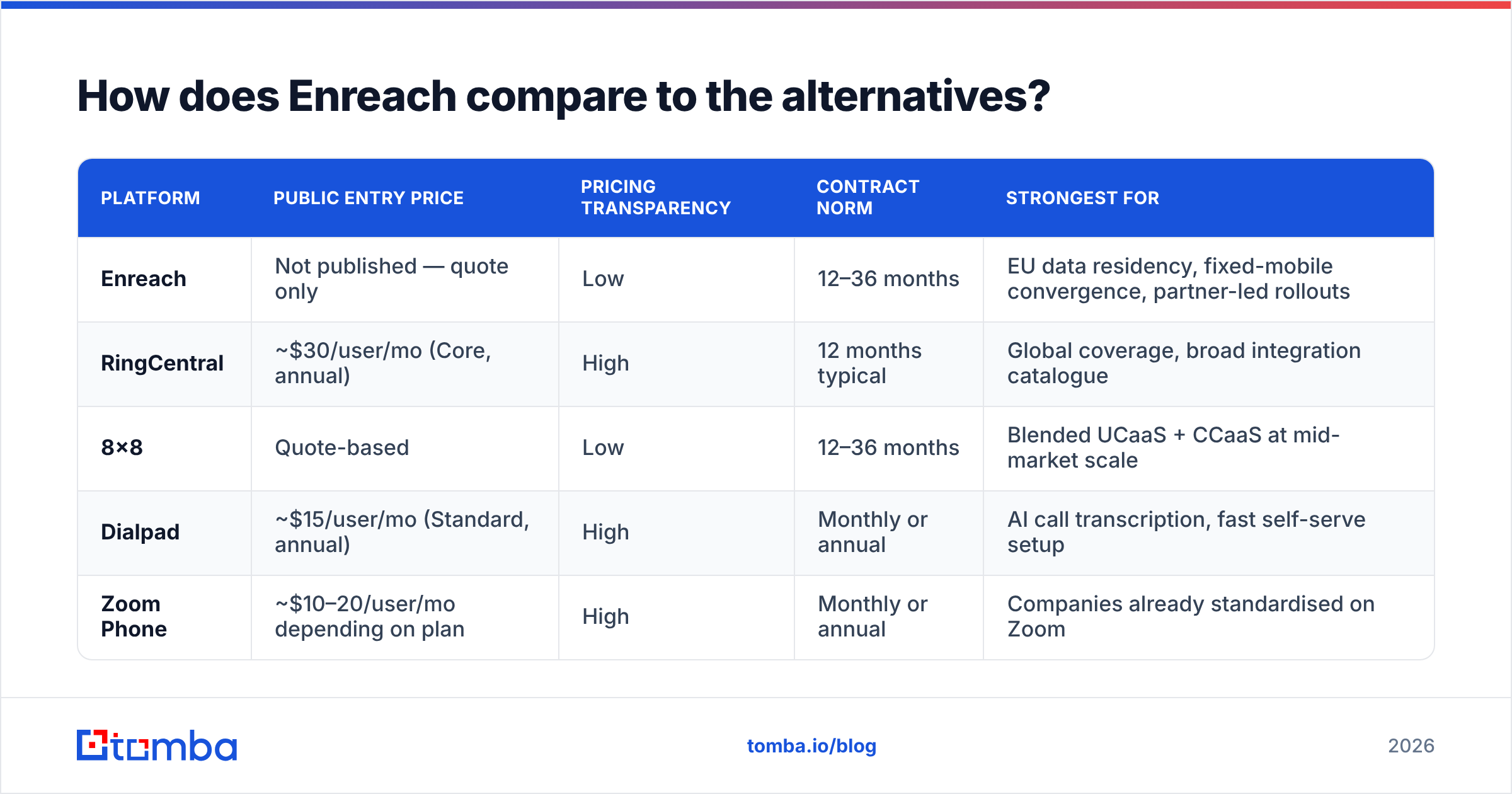
Below are public list prices, where vendors post them. These are list rates, usually on annual billing, and they change often. Check the vendor page before you build a business case.
| Platform | Public entry price | Pricing transparency | Contract norm | Strongest for |
|---|---|---|---|---|
| Enreach | Not published — quote only | Low | 12–36 months | EU data residency, fixed-mobile convergence, partner-led rollouts |
| RingCentral | ~$30/user/mo (Core, annual) | High | 12 months typical | Global coverage, broad integration catalogue |
| 8x8 | Quote-based | Low | 12–36 months | Blended UCaaS + CCaaS at mid-market scale |
| Dialpad | ~$15/user/mo (Standard, annual) | High | Monthly or annual | AI call transcription, fast self-serve setup |
| Zoom Phone | ~$10–20/user/mo depending on plan | High | Monthly or annual | Companies already standardised on Zoom |
The pattern is clear. Enreach and 8x8 stay quote-only. RingCentral, Dialpad and Zoom Phone let you price yourself in a browser tab. That gap should shape your process, not your verdict. Quote-only vendors often beat list-price vendors on the final number at larger seat counts. You just have to do the work to find out.

Is Enreach worth it in 2026?#
Buy it if you are a European mid-market firm that needs in-region voice, real fixed-mobile handover, Teams direct routing, and a local partner who shows up. Then the quote-only process is a nuisance, not a dealbreaker. The platform does what it says.
Skip it if you are a small outbound team that needs a dialler and a CRM link. A self-serve platform with public prices is faster to set up and cheaper to run. You will not need the contact-center gear you would be paying for.
Negotiate hard if you sit in between. Concretely:
- Ask for the price by line item, not a blended per-seat number.
- Price a 12-month term next to the 36-month term. Then you can see what the discount actually buys.
- Push setup fees to zero. They are the first thing reps waive.
- Get the escalation path and response times into the order form, with the partner named.
- Cap the year-two and year-three rises in the contract. If you do not, inflation indexing will set them for you.
What should you pair a calling platform with?#
Whatever you sign, the dialler is only the last ten metres. The costly failure in outbound is not the phone bill. It is agents burning hours on dead numbers, wrong contacts, and stale accounts.
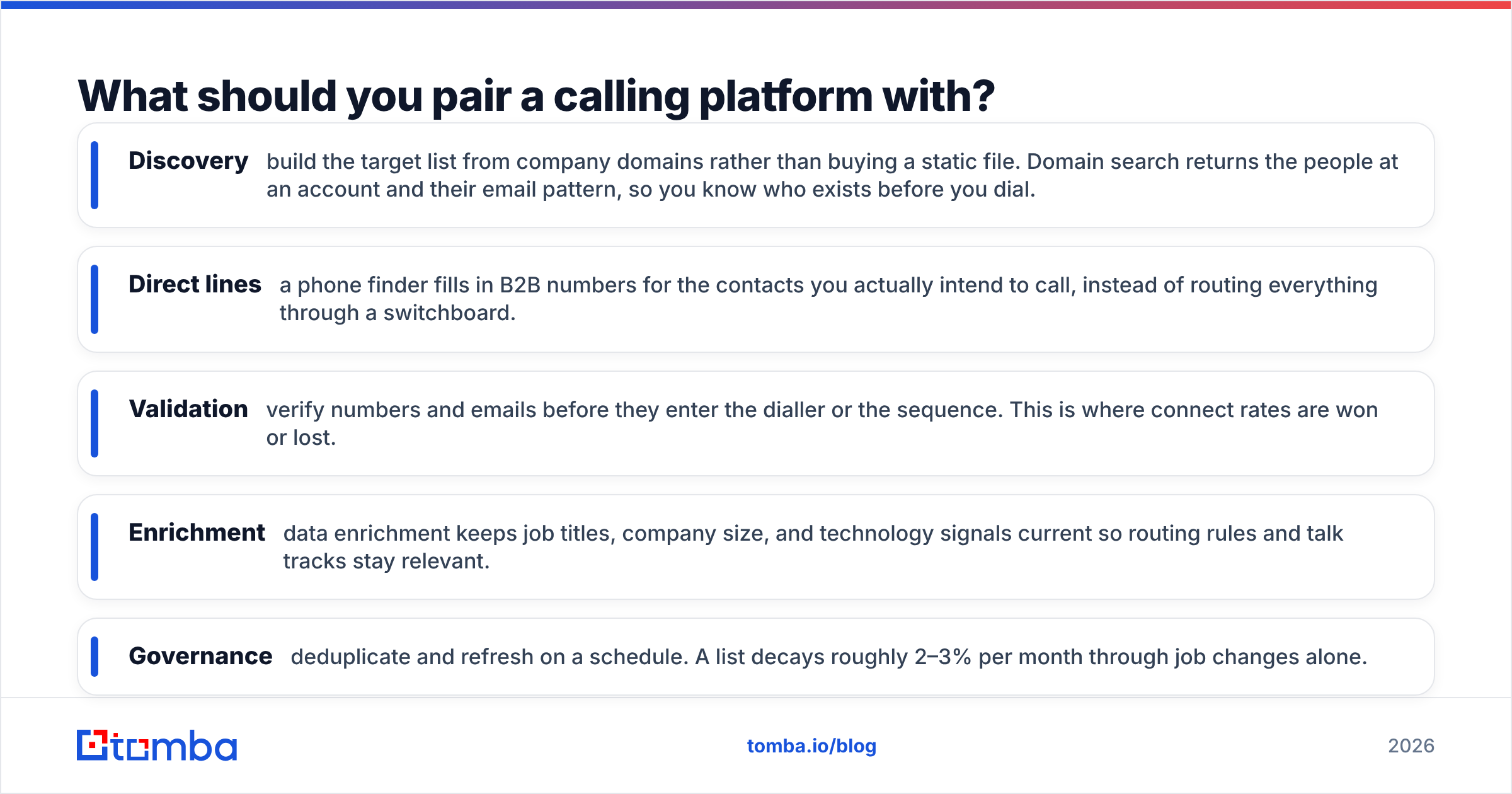
A workable split of the job looks like this:
- Discovery — build the target list from company domains, not a static file you bought. Domain search returns the people at an account and their email pattern, so you know who exists before you dial.
- Direct lines — a phone finder fills in B2B numbers for the people you mean to call, so you skip the switchboard.
- Validation — check numbers and emails before they enter the dialler or the sequence. Connect rates are won or lost here.
- Enrichment — data enrichment keeps job titles, company size, and tech signals current, so routing rules and talk tracks stay on point.
- Governance — dedupe and refresh on a schedule. A list decays 2–3% a month from job changes alone.
The useful part of keeping this layer separate from your phone vendor: it is portable. Switch from Enreach to Dialpad in two years and your contact data comes with you. Let the comms vendor own the data too, and migration gets costly in a way the first quote never showed.
What are the most common Enreach pricing questions?#
Does Enreach publish prices? No. Pricing comes by quote, through direct sales or a regional partner. It varies by country, seat mix, and term.
Is there a free trial? Trials run through the partner, not self-serve signup. Ask for a pilot with a small seat count and a clear exit date.
Can you buy month-to-month? Sometimes, at a much higher rate. The value story is built around multi-year deals.
Are call recordings included? Basic recording is usually available. Longer retention and compliance-grade recording are add-ons. Confirm retention periods in writing if you work in a regulated sector.
How does it compare on total cost? Under 50 seats, self-serve rivals usually win. Above that, and with contact-center seats in the mix, a negotiated Enreach price gets competitive. For category norms, see Gartner's UCaaS reviews.
Enreach pricing reviews pros and cons: the verdict#
Run Enreach through the same test you would run on any quote-only vendor. Ask for three competing quotes, a line-item breakdown, a named partner reference, and a modelled exit cost. If it clears that bar, it is a solid platform for European mid-market voice. If the rep dodges the breakdown, that is your answer.
Then fix the input side. Before your team dials, build the list from verified contacts rather than a bought spreadsheet. The Tomba Email Finder locates verified work emails by domain, name, or company. It pairs with phone lookup and validation, so every record entering your dialler has been checked. Plans start free at 25 searches a month and run to $49/mo on Starter; see Tomba pricing for the full breakdown. Your phone vendor sets the cost per seat. Your data quality sets the return on it.
Related guides#
Ready to find emails that actually work?
Join 150,000+ professionals who stopped guessing and started sending. Free credits on signup — no credit card required.
Get the Tomba newsletter
Practical outbound tactics and product updates — once every two weeks.
About the author