Enrichley vs Apollo.io: Which B2B Data Tool Wins in 2026?
Enrichley is an enrichment-first tool. Apollo.io is an all-in-one GTM platform. We break down accuracy, credit math, pricing traps and workflow fit so you can pick the one that actually matches how your team prospects.
TL;DR
- Enrichley is an enrichment-first tool: you feed it a list, it fills in the blanks. It is narrow, cheap to start, and easy to bolt onto an existing stack.
- Apollo.io is an all-in-one GTM platform: a 200M+ contact database, sequencer, dialer, and CRM-lite in one seat-priced subscription. Powerful, but you pay for the whole suite whether you use it or not.
- The real decision is not "which has better data" — it is whether you want a database you search or a pipe you push lists through.
- Apollo's headline contact count is not the same as usable, deliverable contacts. Budget for a separate verification step regardless of which you pick.
- If you only need accurate work emails at predictable cost, a dedicated finder like Tomba ($49/mo Starter, free tier included) often beats both on cost-per-valid-email.
Most "X vs Y" posts in this category compare feature checkboxes and call it analysis. That is useless when the two products are not the same shape. Enrichley and Apollo.io overlap in exactly one place — turning a name or a domain into a contact record — and diverge everywhere else. This post compares them on the axes that actually change your cost per meeting: data model, accuracy, credit math, and what breaks at scale.
What is Enrichley and who is it for?#
Enrichley sits in the waterfall enrichment category. You give it partial records — a first name and a company domain, a LinkedIn URL, a company name — and it returns filled-in fields: work email, job title, company size, sometimes a phone number.
The defining trait of tools in this class is that they do not sell you a database to browse. There is no "search for VPs of Marketing at 50–200 person SaaS companies in Germany" screen as the primary interface. The primary interface is a CSV upload, an API endpoint, or a spreadsheet integration. You bring the list; the tool fills it.
That makes Enrichley a good fit when:
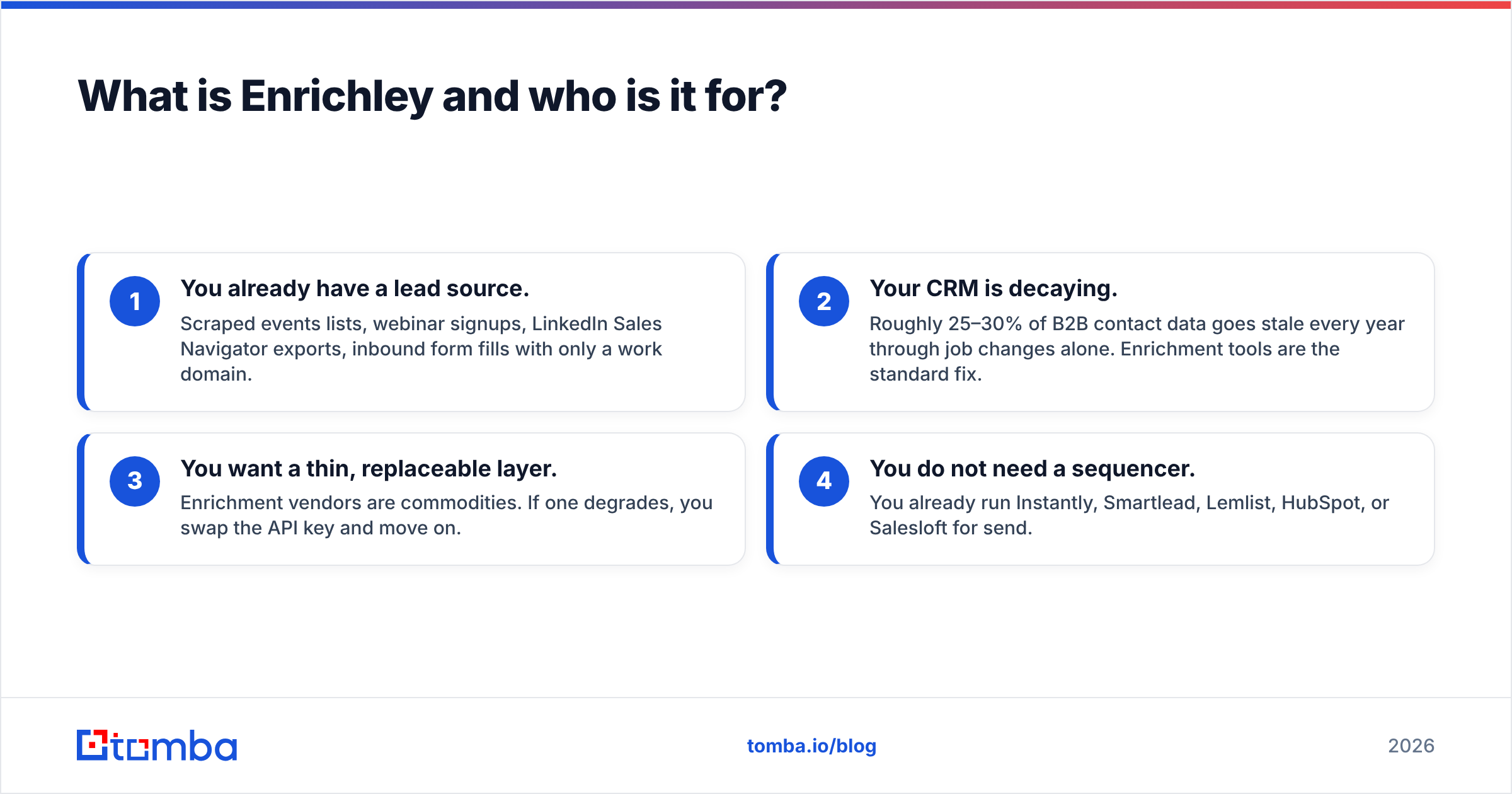
- You already have a lead source. Scraped events lists, webinar signups, LinkedIn Sales Navigator exports, inbound form fills with only a work domain.
- Your CRM is decaying. Roughly 25–30% of B2B contact data goes stale every year through job changes alone. Enrichment tools are the standard fix.
- You want a thin, replaceable layer. Enrichment vendors are commodities. If one degrades, you swap the API key and move on.
- You do not need a sequencer. You already run Instantly, Smartlead, Lemlist, HubSpot, or Salesloft for send.
The flip side: an enrichment-only tool gives you nothing when you have no list. It cannot answer "who should I email this quarter?" It only answers "what is this person's email?"
Enrichley is also a smaller, newer vendor than the incumbents in this space. That has real trade-offs in both directions — faster support response and more flexible pricing on one side, less battle-tested infrastructure and a shorter public track record on the other. Before you commit, verify current pricing and coverage claims directly on the vendor's site; smaller vendors in this category change plans frequently.

What is Apollo.io and where does it actually win?#
Apollo.io is a different animal. It is a full go-to-market platform built around a proprietary contact database — the marketing claims sit north of 275M contacts and 70M companies — with a sequencer, a dialer, meeting scheduling, conversation intelligence, Chrome extension, and CRM sync layered on top.
Apollo's genuine strengths:
- Search-first discovery. 65+ filters over the database. You can build a target list from zero with no external data source. That is the thing Enrichley structurally cannot do.
- Bundled sequencing. One tool, one invoice, one place your reps live. For a 5-rep team without an existing sequencer, that consolidation is worth real money.
- Intent data and scoring. Buying-intent signals and AI-assisted scoring on higher tiers, which pure enrichment vendors do not attempt.
- The free plan is genuinely generous compared to most of the category, which is why Apollo has enormous bottom-up adoption. Check the current sales intelligence category on G2 for how that adoption translates into reviews.
Apollo's genuine weaknesses, which its own users report consistently:
- Data quality is uneven by geography and seniority. US mid-market coverage is strong. EMEA, APAC, and small-business coverage thin out fast. Titles are frequently stale.
- Email accuracy claims and observed bounce rates diverge. Many teams report needing a second verification pass before sending — which means you are paying for the same contact twice.
- Seat-based pricing punishes light users. If three of your five seats only need occasional lookups, you are still buying five seats.
- Credit and export limits are the real ceiling. The plan price is the headline; the export cap is the constraint that actually bites in month two.
Enrichley vs Apollo.io: how do they compare head to head?#
Here is the honest side-by-side. Treat pricing as directional — both vendors adjust plans, and Apollo in particular has revised its packaging repeatedly.
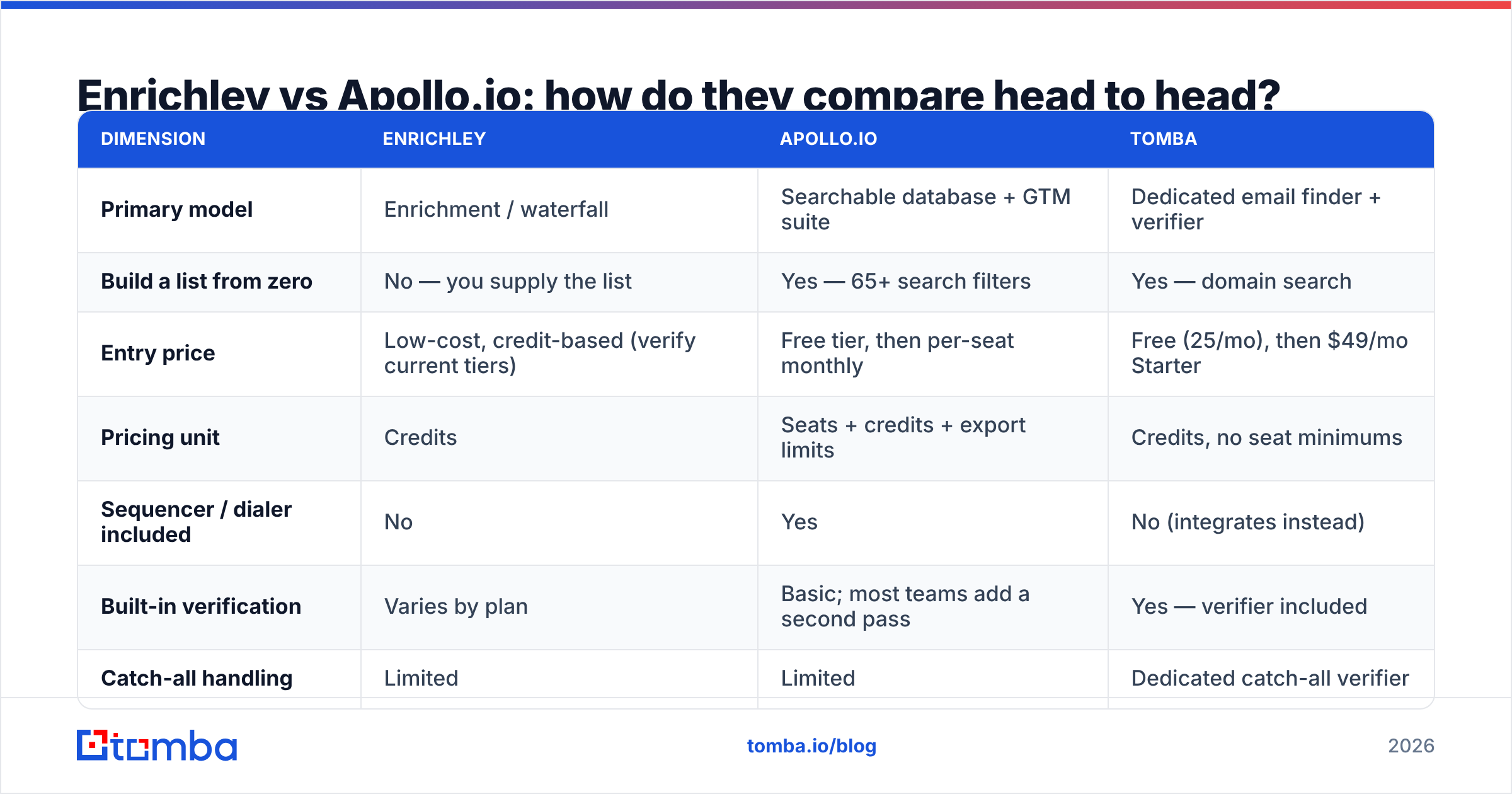
| Dimension | Enrichley | Apollo.io | Tomba |
|---|---|---|---|
| Primary model | Enrichment / waterfall | Searchable database + GTM suite | Dedicated email finder + verifier |
| Build a list from zero | No — you supply the list | Yes — 65+ search filters | Yes — domain search |
| Entry price | Low-cost, credit-based (verify current tiers) | Free tier, then per-seat monthly | Free (25/mo), then $49/mo Starter |
| Pricing unit | Credits | Seats + credits + export limits | Credits, no seat minimums |
| Sequencer / dialer included | No | Yes | No (integrates instead) |
| Built-in verification | Varies by plan | Basic; most teams add a second pass | Yes — verifier included |
| Catch-all handling | Limited | Limited | Dedicated catch-all verifier |
| API-first | Yes | Yes, but rate-limited by plan | Yes, documented and versioned |
| Best fit | Filling an existing list | One-tool teams, US mid-market | Cost-per-valid-email optimisers |
| Worst fit | Teams with no lead source | Non-US targeting, light users | Teams wanting a full sequencer |

The table makes the structural point clear: these two tools are not substitutes for most teams. They are complements or, more often, both replaceable by something narrower.
Which one has better data accuracy?#
This is where most comparisons hand-wave, so let's be precise about what "accuracy" means. There are three separate numbers, and vendors conflate them deliberately:
- Coverage / hit rate — of 1,000 rows you submit, how many come back with any email at all? Vendors love this number because it is the easiest to inflate: return a guessed pattern and count it as a hit.
- Deliverability / valid rate — of the emails returned, how many actually accept mail? This is the number that determines your bounce rate.
- Correctness — of the emails that are deliverable, how many belong to the person you asked about? A catch-all domain will accept mail sent to
nobody@company.com. That is deliverable and wrong.
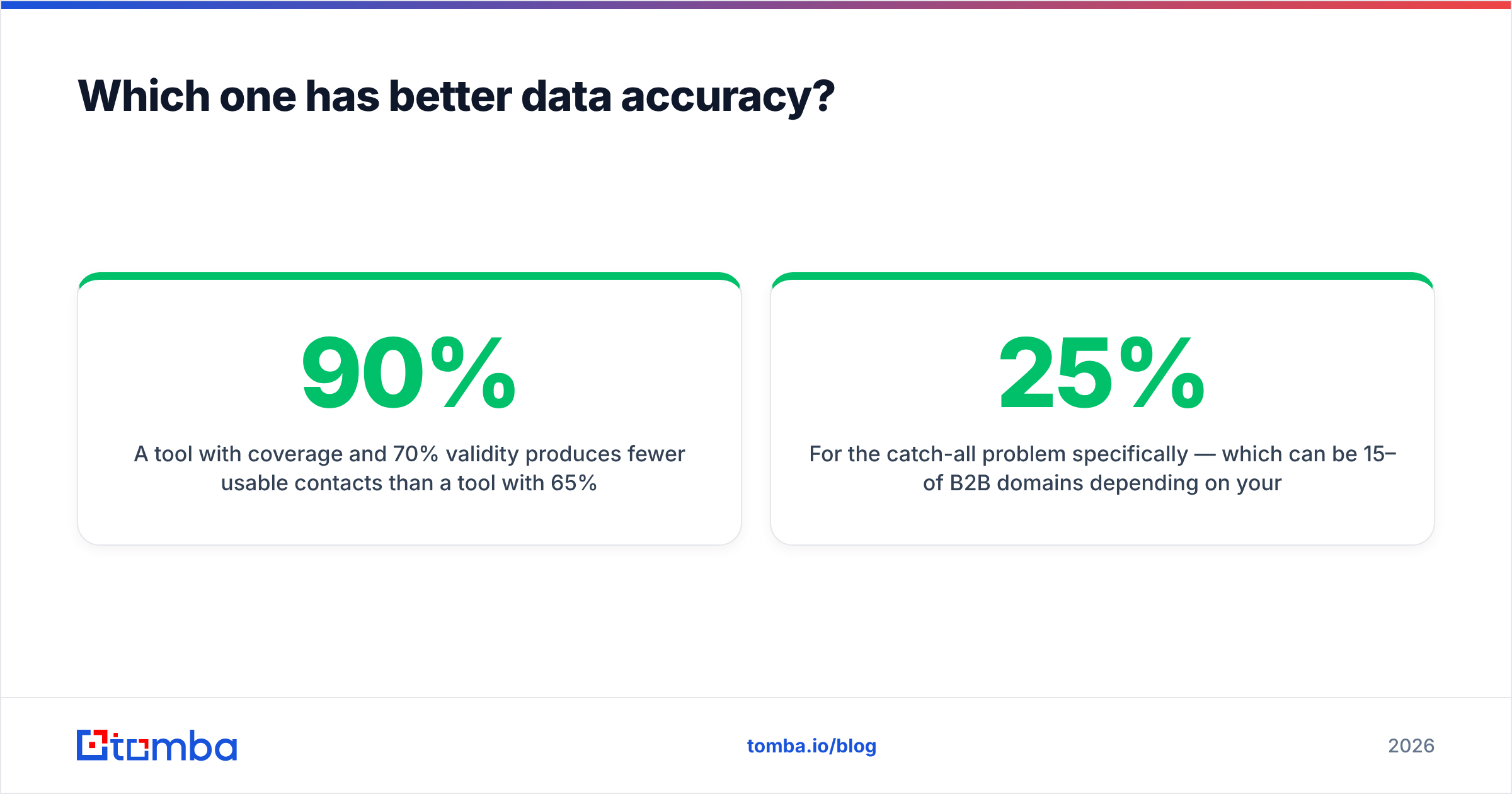
A tool with 90% coverage and 70% validity produces fewer usable contacts than a tool with 65% coverage and 96% validity — and the first one will wreck your sender reputation doing it.

How to test this yourself in 45 minutes, which is worth more than any vendor claim:
- Build a 200-row golden set from a segment you actually sell into — not a random sample. Include names you can independently confirm.
- Run it through each tool's free tier or trial.
- Push all outputs through one neutral verifier so the scoring is consistent. A dedicated email verifier works; so does any tool you are not evaluating.
- Score coverage, valid rate, and catch-all share separately.
- Divide total cost by count of valid, non-catch-all emails. That number — cost per valid email — is the only one worth putting in a slide.
Teams that run this test are routinely surprised. The platform with the biggest database rarely wins on cost-per-valid-email, because you pay platform prices for records you then have to re-verify.
For the catch-all problem specifically — which can be 15–25% of B2B domains depending on your ICP — most general platforms simply return "unknown" and let you decide. A dedicated catch-all verifier resolves a meaningful share of those instead of writing them off, which changes your usable-list math more than a 20M-contact difference in database size ever will.

What does each one actually cost at 5,000 contacts a month?#
Run the arithmetic on a realistic scenario: a 4-person outbound team, 5,000 new contacts enriched per month, sending through an existing sequencer.
Apollo.io path. You are buying seats whether or not all four reps use search daily. Credits and export limits are tier-gated, and 5,000 monthly exports pushes you off the entry paid tier for most configurations. Add the second verification pass most teams end up running, and the effective cost per usable contact climbs well above the sticker math. The bundled sequencer only offsets this if you actually cancel your existing one — and most teams don't, because migrating live sequences is painful.
Enrichley path. Credit-based, no seat tax, so four users cost the same as one. Cheaper per row at this volume. But you still need a list source, which usually means a Sales Navigator subscription or a scraper — a cost that belongs in the comparison and gets left out of most of them.
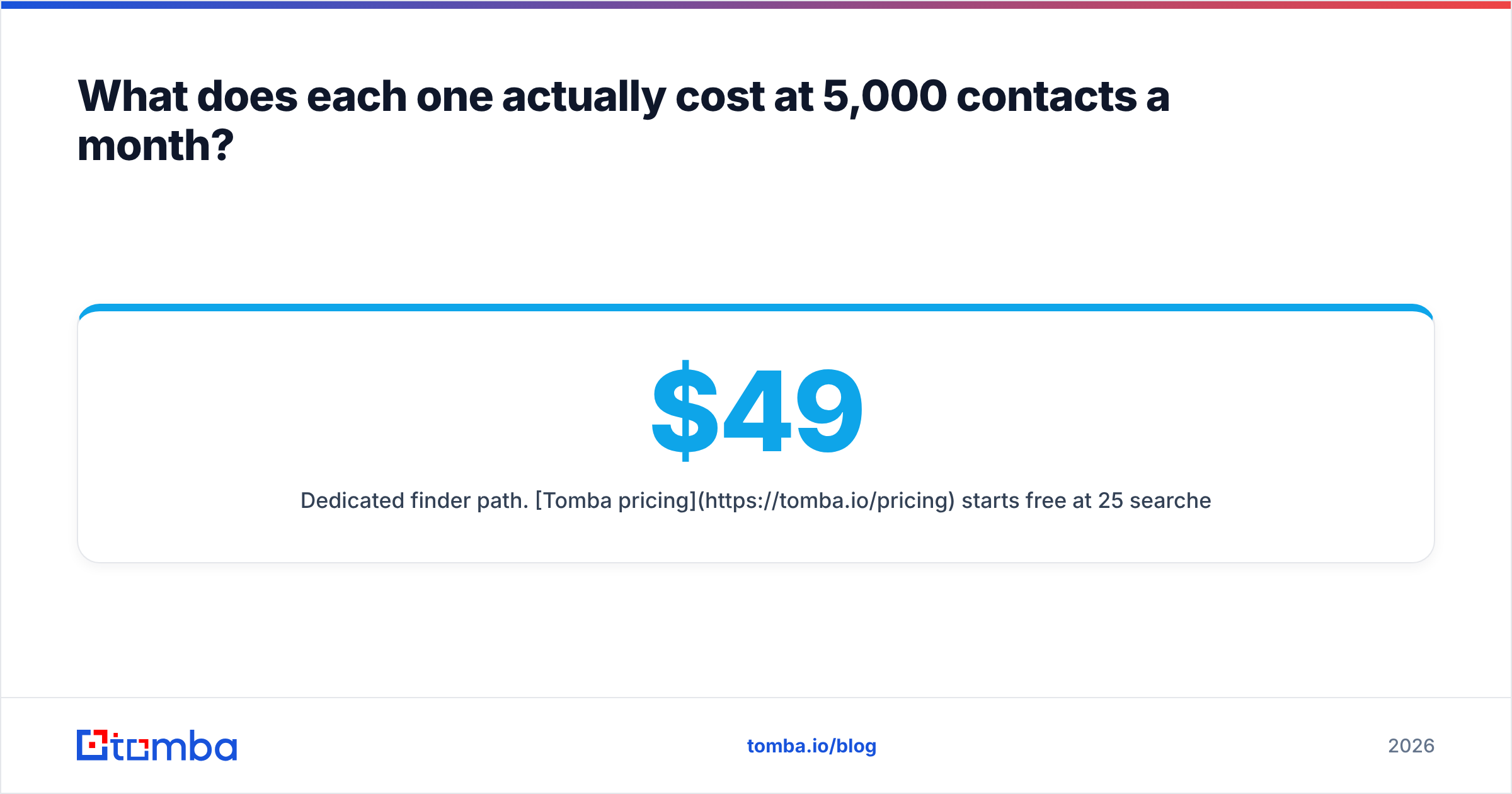
Dedicated finder path. Tomba pricing starts free at 25 searches/mo, then $49/mo Starter, $99/mo Growth, and $249/mo Pro, with no per-seat minimums. Verification is included rather than billed as a separate product, and domain search covers the "I have a company but no names" case that pure enrichment tools can't handle. For teams whose only real requirement is accurate work emails, predictably priced, this is usually the lowest cost per valid contact of the three — because you are not funding a sequencer, a dialer, and an intent-data engine you already have elsewhere.
The general principle, and it applies far beyond these two vendors: bundled platforms are efficient when you use most of the bundle and expensive when you use one slice of it. Be honest about which you are.
When should you pick Apollo.io over Enrichley?#
Pick Apollo when at least three of these are true:
- You have no list source. No Sales Navigator, no scraper, no inbound flow. Apollo's search is the whole value proposition and it's a real one.
- You sell primarily into the US mid-market. That is where the database is densest.
- You have no sequencer yet and would otherwise buy one for $60–100/user/month.
- Your reps live in one tool by preference. Context-switching cost is real; consolidation has non-obvious value.
- You need calling in the same place as emailing. The built-in dialer is a genuine differentiator against every enrichment-only vendor.
Pick Enrichley (or another enrichment-first vendor) when:
- You already generate lists and just need fields filled.
- You have more occasional users than daily users — seat pricing is your enemy.
- You want the enrichment layer to be swappable. Thin API integrations are easy to replace; platform migrations are not.
- You are enriching inbound, where volume is spiky and per-credit beats per-seat.
And pick a dedicated finder + verifier when your bottleneck is bounce rate rather than list-building or sequencing. If your last campaign bounced above 3%, your problem is not which platform you searched — it is that nothing verified the output before send. Google and Microsoft both weight bounce rate heavily in filtering decisions; see HubSpot's deliverability guidance for how that feedback loop compounds.
What do most teams get wrong in this comparison?#
Four recurring mistakes, in rough order of how much money they waste:
- Comparing database size. 275M vs 200M contacts is a marketing number, not a coverage number. What matters is coverage of your ICP. A tool with 40M contacts that covers 90% of German industrial manufacturers beats a 275M-contact tool that covers 30% of them.
- Ignoring the verification line item. If you have to run a second pass, that vendor's real price is their price plus the verifier's. Fold it in before you compare.
- Buying for the demo segment. Vendors demo on the segment they cover best. Always test on your own golden set, never on theirs.
- Underestimating switching cost on platforms. Enrichment layers swap in an afternoon. Getting sequences, call logs, and task history out of an all-in-one takes weeks. Weight that when the platform is only marginally better.
One more that's less obvious: credit rollover and expiry terms. Monthly credits that expire punish spiky workloads. If your prospecting is campaign-driven — three heavy weeks then two quiet ones — expiring monthly credits can silently double your effective rate. Read that clause before you sign anything annual.
What's the verdict?#
There isn't one winner, and any post that declares one is selling something.
- Apollo.io wins if you need discovery and sequencing and dialing in a single seat, and you sell into the US mid-market. The bundle is the product.
- Enrichley wins if you already have list flow, want credit-based pricing without seat tax, and prefer a thin swappable layer over a platform commitment.
- Neither wins if your actual constraint is deliverable, verified email addresses at predictable cost — which, for most teams running under 20,000 contacts a month, it is.
Run the 200-row test. Score cost-per-valid-email, not coverage. Then decide with a number instead of a feature grid.
If the outcome you want is accurate work emails without buying a platform you'll use 20% of, start with the Tomba Email Finder. The free tier gives you 25 searches a month — enough to run the golden-set test above against your own ICP before you spend anything. Verification and catch-all handling are built in, plans start at $49/mo with no per-seat minimums, and the Tomba API drops into whatever sequencer or CRM you already run. Test it against your real list, not a vendor demo, and let the cost-per-valid-email number make the call.
Related guides#
Ready to find emails that actually work?
Join 150,000+ professionals who stopped guessing and started sending. Free credits on signup — no credit card required.
Get the Tomba newsletter
Practical outbound tactics and product updates — once every two weeks.
About the author