7 Best Enrow Alternatives in 2026 for Email Verification
Enrow built its reputation on verification accuracy, but credit pricing, catch-all limits, and a verify-only scope push a lot of teams to look elsewhere. Here are 7 alternatives compared on accuracy, coverage, and real cost.
TL;DR
- Enrow is a solid email verification tool with a strong catch-all story, but it is verification-first — you still need a separate finder, enrichment source, and phone data.
- The biggest reasons teams switch: credit burn on catch-all checks, no meaningful free tier for ongoing use, and the cost of stacking three tools to do one job.
- If you want find + verify + enrich in one place, Tomba at $49/mo is the closest like-for-like swap with an API and a 25-search free tier.
- If you only need bulk hygiene on lists you already own, ZeroBounce, Bouncer, or Clearout are cheaper per email.
- If your bottleneck is data you do not have yet, a database play like BookYourData or a scraper-native tool like Findymail solves a different problem than Enrow does.
What is Enrow and what does it actually do?#
Enrow is a French email verification platform aimed at cold outreach teams. Its pitch is accuracy: it claims to resolve addresses that generic SMTP checkers mark as "unknown," including a large share of catch-all domains, and it sells that as a lower bounce rate on your sending domains.
That pitch is real. Catch-all domains — servers configured to accept mail at any address — are the single hardest part of email validation, and a lot of cheap verifiers just shrug and return "accept-all." Enrow does more work there than most.
But the scope is narrow by design. Enrow verifies, and in newer releases finds. It does not give you a contact database, phone numbers, technographic enrichment, or a website-visitor layer. If your prospecting stack already has a finder and an enrichment provider, that narrowness is a feature. If you are paying three vendors to assemble one contact record, it is a tax.

Why do teams look for Enrow alternatives?#
Four patterns come up repeatedly when people churn off a verification-only tool:
- Credit math gets ugly at scale. Verification credits are consumed per check, and catch-all resolution is the expensive kind. A 50,000-record quarterly cleanup plus daily enrichment of new inbound is a different bill than the pricing page implies.
- You still need a finder. Verifying an address you do not have is not a workflow. Most teams pair Enrow with Hunter, Apollo, or a scraper — which means two subscriptions, two APIs, two sets of credits.
- Thin free tier. There is no practical way to run a small, steady volume for free. For a solo founder doing 200 lookups a month, that matters.
- Integration surface. Ops teams want a CLI, a Sheets add-on, a Zapier connector, and a documented REST API — not just a dashboard and a CSV upload.
None of those are damning. They are just the reasons a stack that made sense at 5 seats stops making sense at 25.
Which Enrow alternatives are worth comparing in 2026?#
Here is the short list, grouped by what problem they actually solve.
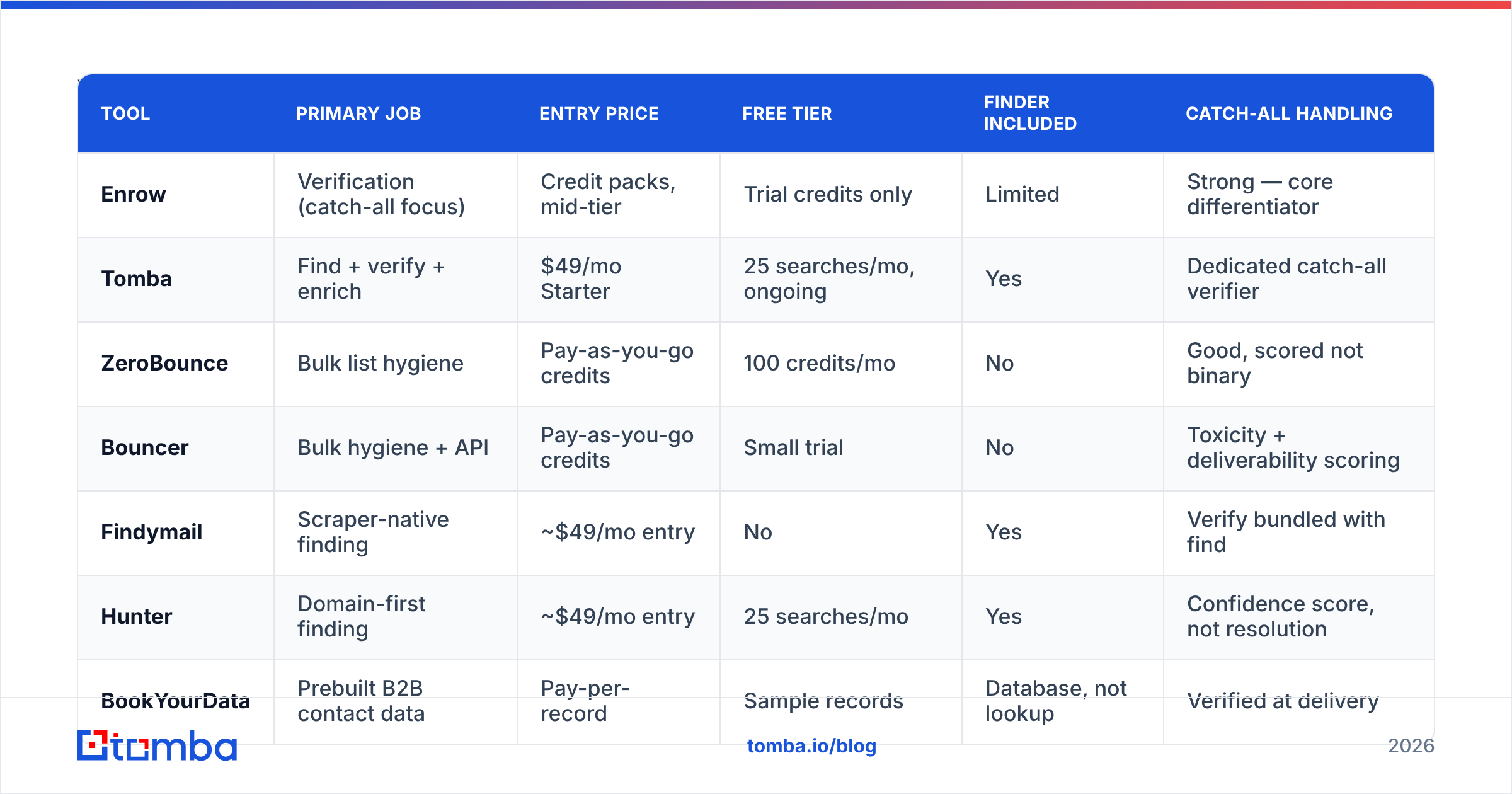
| Tool | Primary job | Entry price | Free tier | Finder included | Catch-all handling |
|---|---|---|---|---|---|
| Enrow | Verification (catch-all focus) | Credit packs, mid-tier | Trial credits only | Limited | Strong — core differentiator |
| Tomba | Find + verify + enrich | $49/mo Starter | 25 searches/mo, ongoing | Yes | Dedicated catch-all verifier |
| ZeroBounce | Bulk list hygiene | Pay-as-you-go credits | 100 credits/mo | No | Good, scored not binary |
| Bouncer | Bulk hygiene + API | Pay-as-you-go credits | Small trial | No | Toxicity + deliverability scoring |
| Findymail | Scraper-native finding | ~$49/mo entry | No | Yes | Verify bundled with find |
| Hunter | Domain-first finding | ~$49/mo entry | 25 searches/mo | Yes | Confidence score, not resolution |
| BookYourData | Prebuilt B2B contact data | Pay-per-record | Sample records | Database, not lookup | Verified at delivery |
| Clearout | Budget bulk verification | Credit packs | 100 credits | Basic | Decent for the price |
Prices move. Treat this as a shape-of-the-market table and confirm on each vendor's own pricing page before you sign anything.
What should you actually evaluate an alternative on?#
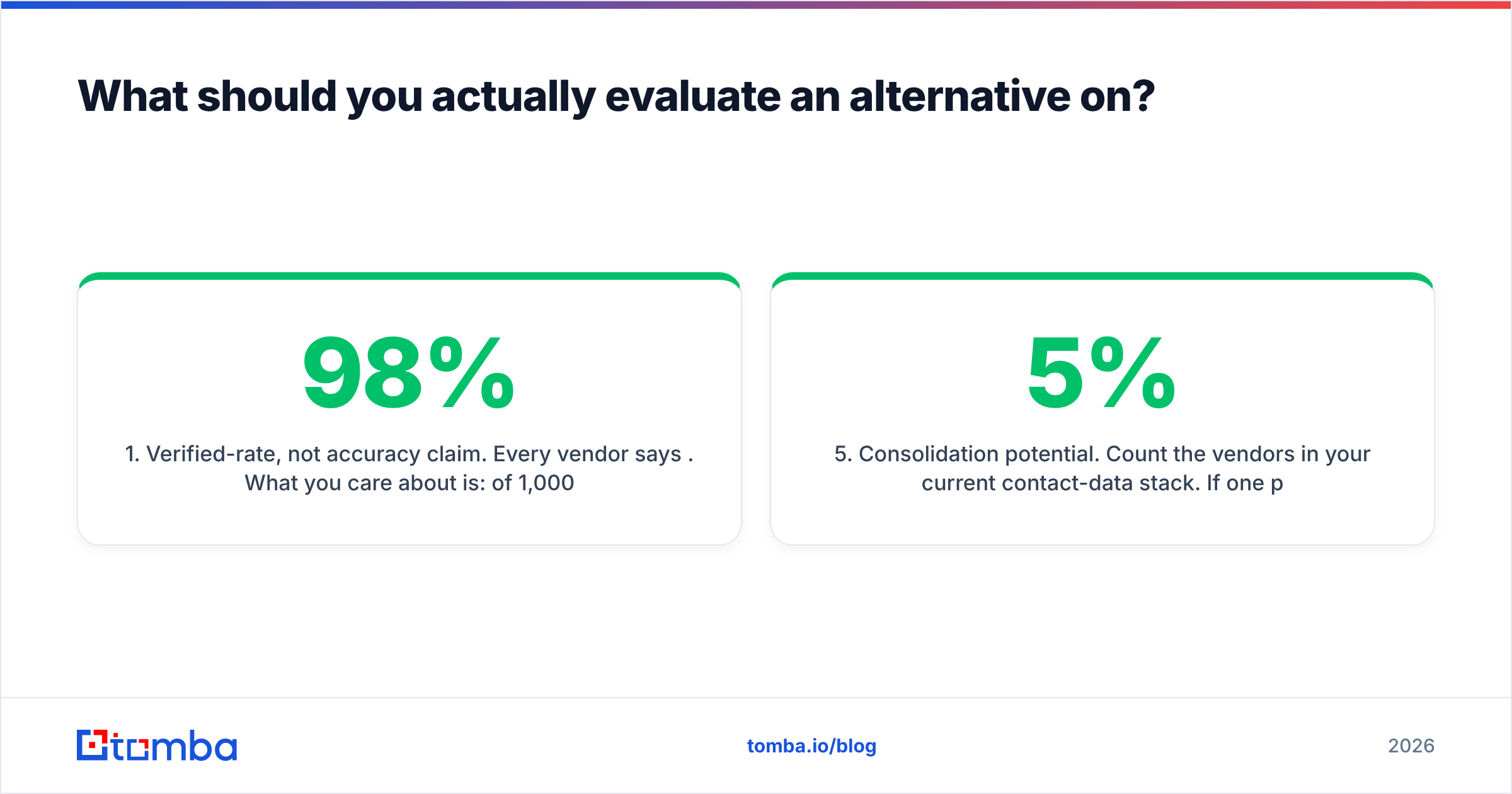
Feature checklists lie. These five criteria predict whether a tool survives contact with your pipeline:
- Verified-rate, not accuracy claim. Every vendor says 98%. What you care about is: of 1,000 real prospects on your ICP domains, how many come back with a deliverable address you can send to today? Run the same list through two tools and compare usable output, not confidence scores.
- Catch-all resolution rate. Roughly a fifth of B2B domains are catch-all, and they skew enterprise. A verifier that returns "unknown" on those is handing the risk back to you. Test with a catch-all verifier on a sample of your own known-good contacts.
- Credit accounting. Ask three questions: do failed lookups burn credits, do re-verifications of the same address burn credits, and do credits roll over? The answers change effective cost by 2-3x.
- API and automation surface. If the tool cannot be called from your enrichment job, someone is doing CSV round-trips at 11pm. A documented email verification API, a Sheets add-on, and a Zapier or Make connector are the difference between a tool and a workflow.
- Consolidation potential. Count the vendors in your current contact-data stack. If one platform can honestly replace two of them at similar quality, that is worth more than a 5% accuracy edge on a single step.

Is Tomba a good Enrow alternative?#
For most teams switching off a verify-only tool, yes — because it collapses the stack rather than replacing one node in it.
Tomba's core product is the email finder: give it a name and a domain, or just a domain, and it returns addresses with confidence scoring and sourcing. Around that sit an email verifier, a catch-all verifier, domain search, phone finder, reverse email lookup, and data enrichment. All of it is exposed through one API and one credit pool.
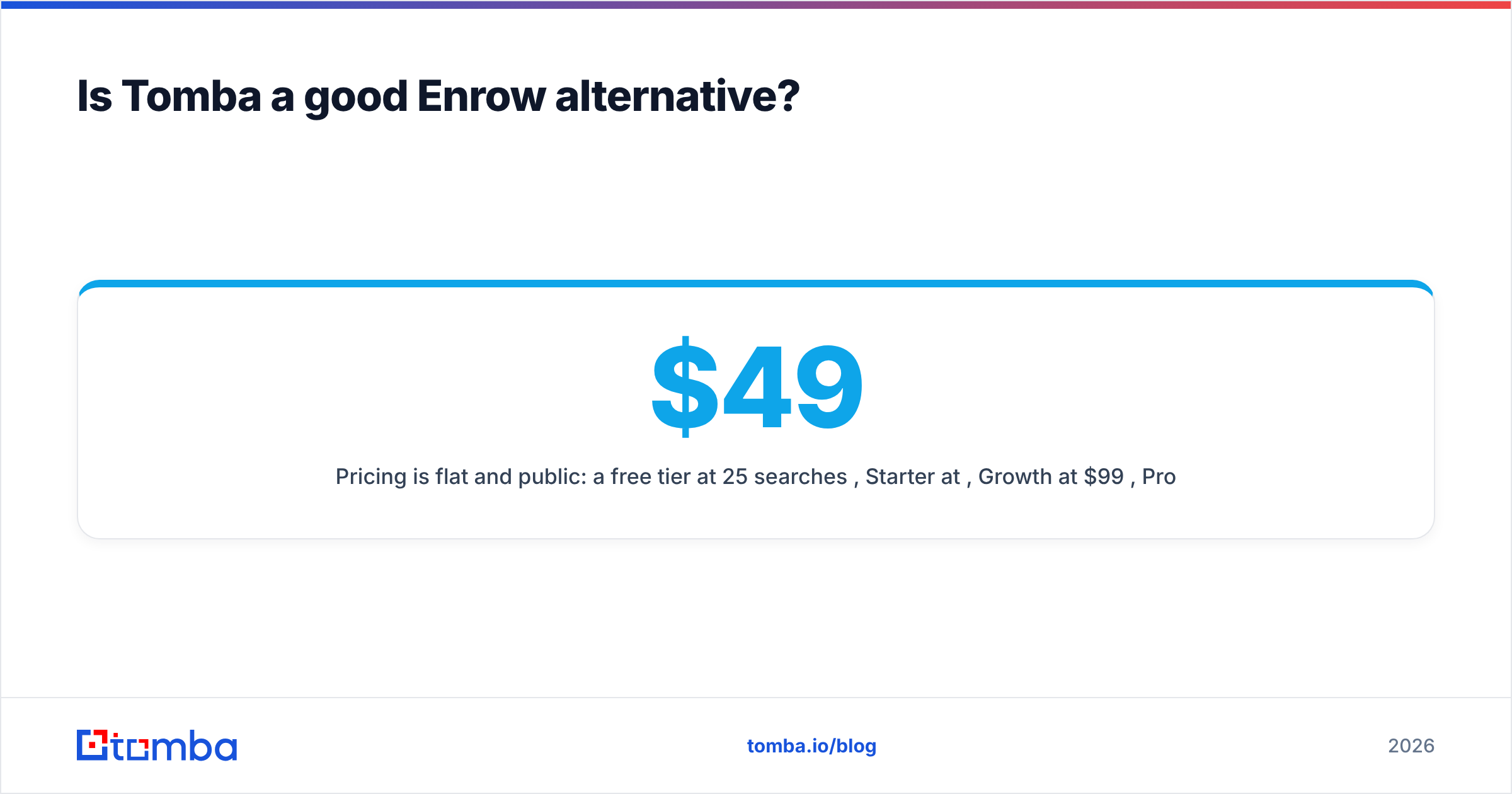
Pricing is flat and public: a free tier at 25 searches per month, Starter at $49/mo, Growth at $99/mo, Pro at $249/mo, and custom Enterprise. Full Tomba pricing is on-site, and the free tier is a real ongoing allowance rather than a 7-day trial — useful when you want to test verification quality on your own contacts before committing.
Where Tomba wins: one vendor for find + verify + enrich, an honest free tier, a documented API plus CLI, Sheets, Excel, Airtable, and Chrome extension surfaces, and bulk processing that does not require a separate SKU.
Where Enrow may still win: if your only job is catch-all resolution on a list you already own, and you have budget for a specialist, Enrow's single-purpose focus is defensible. Specialists usually beat generalists on their one axis — the question is whether that axis is your bottleneck.
How do the bulk verification specialists compare?#
If you genuinely only need list hygiene — you have the addresses, you just need to know which ones bounce — three tools are worth a look.
ZeroBounce is the incumbent. Deep feature set (activity data, abuse detection, deliverability toolkit), strong compliance posture, and pay-as-you-go credits so you are not locked into a monthly commit. It scores well on G2 for support responsiveness. It is more expensive per credit than budget options, and it does not find emails.
Bouncer is the cleaner European option, with GDPR-friendly processing and a well-documented API. Its toxicity and deliverability scoring is genuinely useful when you inherit a list of unknown provenance. Same limitation: verification only.
Clearout is the budget pick. Per-credit cost is low, the free 100 credits let you sanity-check, and the catch-all handling is adequate rather than excellent. If you are cleaning a 200k-record marketing database once a year, the price difference is real money.
All three are strictly narrower than Enrow's newer find-and-verify direction. Choosing one of them is a decision to keep your finder separate — which is fine, as long as you are honest about the total bill.

What if your real problem is finding contacts, not verifying them?#
Then you are shopping in the wrong aisle, and swapping verifiers will not help.
Findymail is built for people who scrape. It plugs into LinkedIn Sales Navigator and Apollo exports, finds addresses for the rows you already pulled, and verifies as part of the same call. If your motion starts with a list of companies and people you identified elsewhere, this fits neatly. It is less useful for domain-first discovery.
Hunter is the domain-first classic. Point it at a company domain and get the email pattern plus known addresses. Its confidence scores are directional, not resolutions — Hunter tells you an address is probably right, where a dedicated verifier tells you whether the mailbox accepts mail. Many teams pair Hunter with a verifier for exactly that reason, which is the two-vendor tax again.
BookYourData takes a different route entirely: prebuilt, pre-verified B2B contact lists sold per record, with a pay-as-you-go model and no subscription. When you need 2,000 verified CFO contacts in manufacturing by Thursday and do not want to build the list yourself, buying delivered data beats running lookups. It is a respected option in this space, and it complements a lookup tool rather than competing with one — use the database for cold volume, use a finder for the specific named accounts your reps actually researched.

Which Enrow alternative should you pick?#
Match the tool to the failure mode you are actually experiencing:
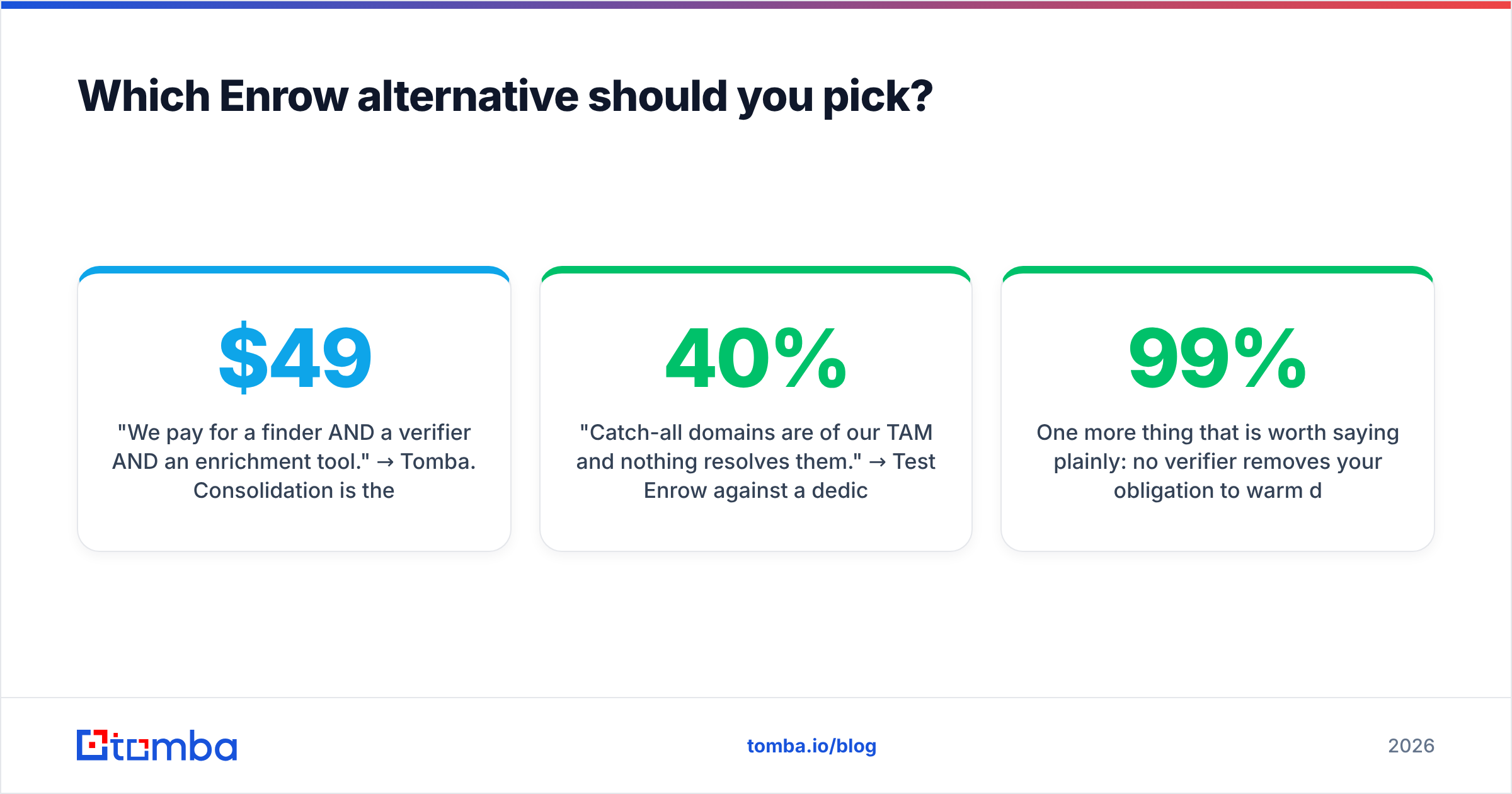
- "We pay for a finder AND a verifier AND an enrichment tool." → Tomba. Consolidation is the whole point, and $49/mo Starter is below what most teams pay for any single one of those.
- "Our bounce rate is fine, we just have a stale 100k-record database." → ZeroBounce, Bouncer, or Clearout. Buy credits, run the cleanup, cancel.
- "We scrape LinkedIn and need emails for the rows." → Findymail, or Tomba's LinkedIn finder if you want it inside the same platform as your verification.
- "We don't have enough contacts at all." → BookYourData for delivered lists, then verify before send regardless of who sold you the data.
- "Catch-all domains are 40% of our TAM and nothing resolves them." → Test Enrow against a dedicated catch-all verifier on the same 500-row sample. Whoever returns more usable addresses wins. Do not decide this from marketing copy.
One more thing that is worth saying plainly: no verifier removes your obligation to warm domains, keep volume sane, and write emails people want to answer. A 99% verified list sent from a cold domain at 300/day still lands in spam. Verification protects your sender reputation; it does not manufacture one.
How do you run a fair head-to-head test?#
Give yourself a week and 500 rows.
- Pull 500 contacts you can independently verify — past customers, webinar registrants, people who have replied to you. You know these addresses are real.
- Strip them to name + domain. Feed the same file to each candidate tool.
- Score three numbers per tool: found rate (returned any address), precision (matched the address you already knew), and catch-all resolution (returned deliverable/undeliverable rather than unknown on catch-all domains).
- Divide the monthly price by usable addresses returned. That is your real cost per contact — the only number that survives a budget review.
- Send a 100-address test campaign through the winner and watch actual bounce rate. Lab accuracy and inbox reality diverge more than vendors admit.
Most teams find the tools cluster within a few points on precision and diverge sharply on found rate and catch-all resolution. That divergence, not the headline accuracy claim, is where your money goes.
Ready to consolidate?#
If you are evaluating Enrow alternatives because you are tired of paying three vendors to produce one verified contact record, start with the Tomba Email Finder. Run your 500-row test on the free tier — 25 searches a month, no card — then scale to Starter at $49/mo when the numbers hold up. Find, verify, catch-all check, and enrich through a single API instead of stitching three of them together.
Related guides#
Ready to find emails that actually work?
Join 150,000+ professionals who stopped guessing and started sending. Free credits on signup — no credit card required.
Get the Tomba newsletter
Practical outbound tactics and product updates — once every two weeks.
About the author