Enrow Pricing Reviews Pros and Cons: An Honest 2026 Look
A plain-English look at Enrow pricing reviews pros and cons. What the plans really cost per usable contact, what reviewers praise and complain about, and when a cheaper stack wins.
Short answer first: Enrow is worth it for small, hard-to-reach lists, and it gets expensive at volume. This guide covers Enrow pricing reviews pros and cons in plain terms. You get the real cost per usable email, what buyers praise, what they complain about, and when a cheaper stack wins.
TL;DR
- Enrow is an accuracy-first email finder and verifier. It charges in credits. Entry plans run about $29–$39/month, and volume tiers climb into the hundreds. Confirm current numbers on enrow.io before you budget — they change.
- The pitch is "only pay for valid results." That is a good deal on small, high-intent lists. It gets expensive once you run six-figure monthly volume.
- Reviews praise catch-all handling and fast support. The recurring complaints: credit math is hard to forecast, and the feature set is narrower than all-in-one platforms.
- Need finding, verification, enrichment, and an API on one bill? A broader platform like Tomba at $49/mo lands cheaper per usable contact for most teams.
- The right question is not "what does a credit cost." It is "what does one contact that replies cost me."
What is Enrow, and who is it built for?#
Enrow is a European email finding and verification service. It markets itself on one number: accuracy. You give it a name plus a domain, a LinkedIn profile, or a bulk CSV. It returns a professional email address with a confidence status. Then it runs verification logic built to resolve the addresses most tools give up on — above all, catch-all domains.
Think of it like a specialist locksmith versus a hardware store. The locksmith opens the hard lock, charges for it, and does not sell you paint. That focus is the whole value proposition. It is also the whole limitation.
Enrow's natural buyer is a small outbound team or agency. They run modest volumes into hard-to-reach accounts. There, one bounced send costs more in domain reputation than the extra cents per lookup. If you blast 50,000 contacts a month from a scraped list, Enrow's pricing model stops being flattering fast.
Here is the decision frame most buyers actually need:
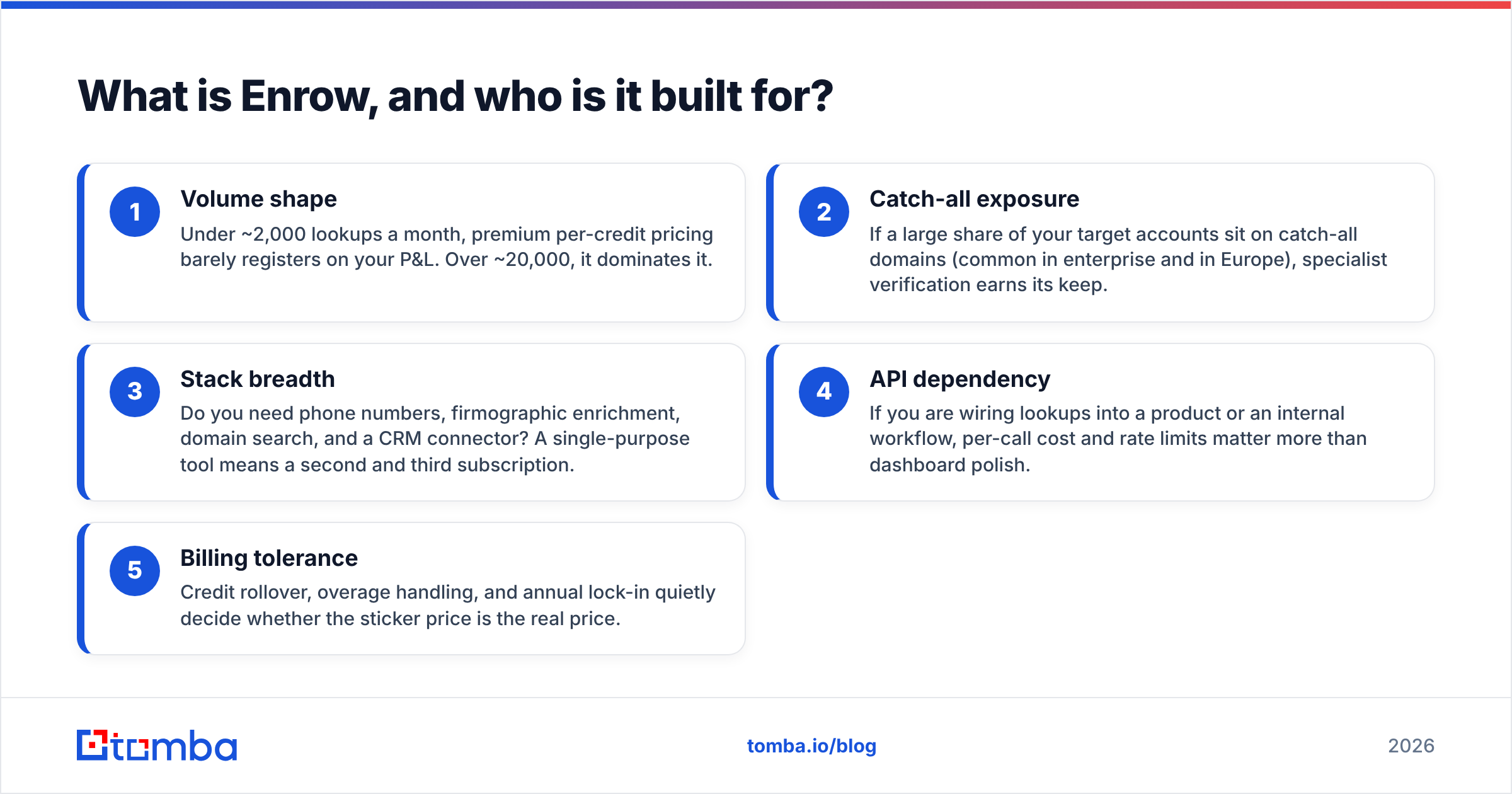
- Volume shape — Under ~2,000 lookups a month, premium per-credit pricing barely shows up on your P&L. Over ~20,000, it dominates it.
- Catch-all exposure — Many enterprise and European targets sit on catch-all domains. If yours do, specialist verification earns its keep.
- Stack breadth — Do you need phone numbers, firmographic enrichment, domain search, and a CRM connector? A single-purpose tool means a second and third subscription.
- API dependency — Wiring lookups into a product or an internal workflow? Then per-call cost and rate limits matter more than dashboard polish.
- Billing tolerance — Credit rollover, overage handling, and annual lock-in quietly decide whether the sticker price is the real price.
How does Enrow pricing actually work?#
Enrow bills on a monthly credit allowance. Credits are consumed per result, not per attempt. That is the "only pay for valid emails" framing you see on the pricing page. That one mechanic is the most important thing to grasp, because it flips how you forecast spend.
On a normal tool, you budget by list size: 10,000 rows, 10,000 credits. On Enrow, you budget by hit rate. A clean list of 10,000 rows with a 70% find rate uses about 7,000 credits. A messy list with a 30% hit rate uses 3,000. Your bill drops when your data is bad and rises when it is good. That feels backwards the first time you see the invoice.
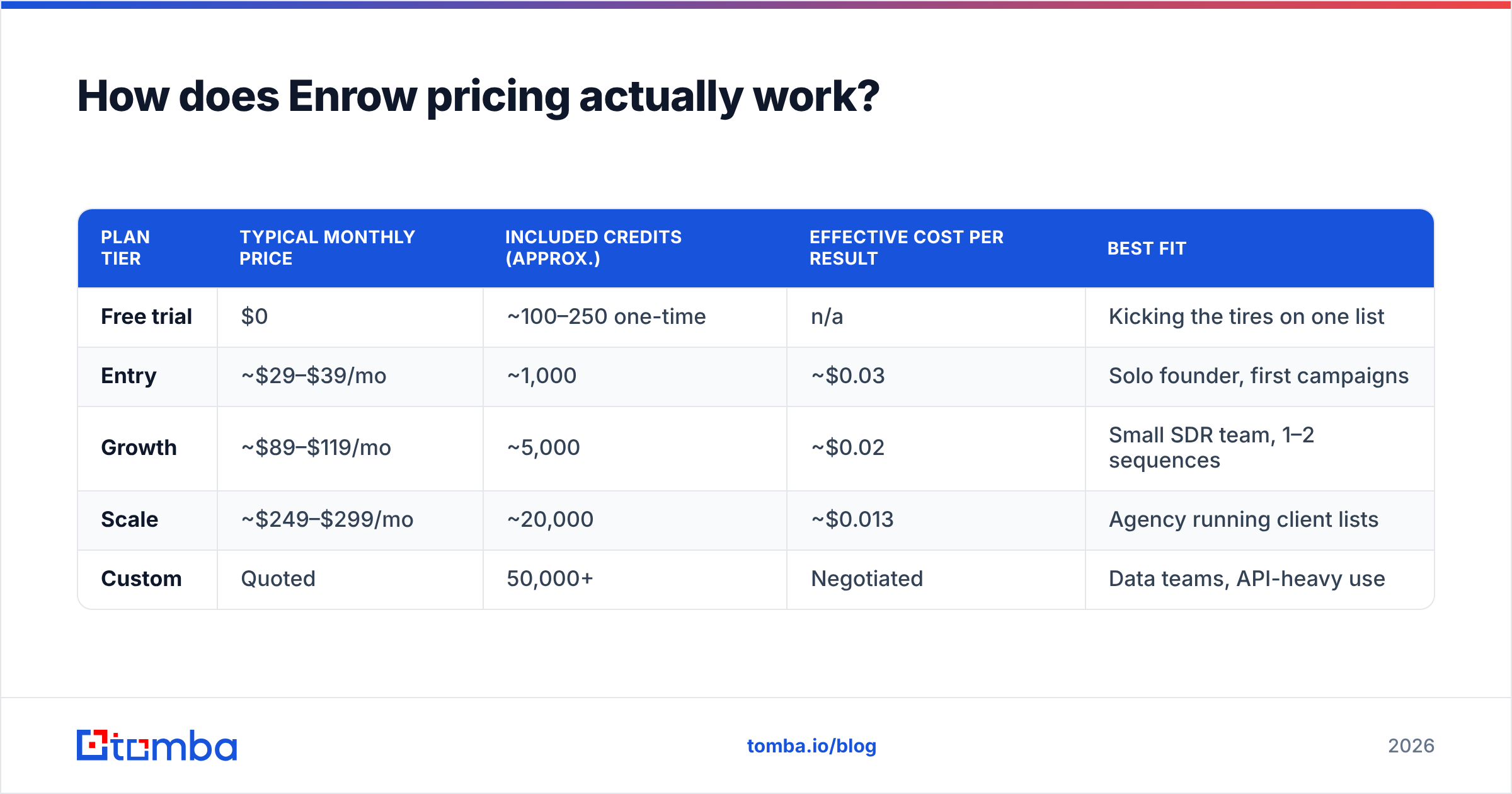
Published tiers at the time of writing look roughly like this. Treat the numbers as directional and verify before purchase:
| Plan tier | Typical monthly price | Included credits (approx.) | Effective cost per result | Best fit |
|---|---|---|---|---|
| Free trial | $0 | ~100–250 one-time | n/a | Kicking the tires on one list |
| Entry | ~$29–$39/mo | ~1,000 | ~$0.03 | Solo founder, first campaigns |
| Growth | ~$89–$119/mo | ~5,000 | ~$0.02 | Small SDR team, 1–2 sequences |
| Scale | ~$249–$299/mo | ~20,000 | ~$0.013 | Agency running client lists |
| Custom | Quoted | 50,000+ | Negotiated | Data teams, API-heavy use |
Two structural details matter more than the headline price:
- Credit rollover. Most credit vendors expire unused credits each month. If yours expire, your real cost is not the list price. It is the list price divided by the credits you actually used. Teams often burn 40% of an allowance and never notice.
- Annual commitment discounts. The per-month figure you see is often the annual-prepay rate. Month-to-month usually runs 15–25% higher in this category. Check which number is on the button before you compare it to anything else.

What do Enrow reviews actually say?#
Public review volume for Enrow is thin. It is a newer, smaller vendor, so you will find fewer entries on G2 and Capterra than for a ten-year-old platform. That is a signal about company age, not product quality. It does mean you are buying with less third-party evidence than usual.
Reading across what is public, the themes are consistent:
What reviewers praise
- Catch-all resolution. This is the most repeated compliment. Domains that return "accept-all" at the SMTP layer are the graveyard of most verification tools. Enrow makes a call there, and that is why people pay the premium.
- Low bounce rates in practice. Users report bounce figures in the low single digits on Enrow-sourced lists. That is the metric that protects your sending domain.
- Support responsiveness. Small-vendor advantage — you tend to get a human, quickly.
- Clean, uncluttered UI. There is not much to learn because there is not much there. Some teams want exactly that.
What reviewers complain about
- Unpredictable spend. The pay-per-result model makes month-to-month budgeting harder, and finance teams dislike variable line items.
- Narrow scope. No phone numbers, no deep firmographic enrichment, no built-in sequencing. It is one tool in a stack, not the stack.
- Coverage gaps outside its sweet spot. Strong on European and mid-market data. Weaker on long-tail SMB or non-Western coverage.
- Documentation depth. API docs work, but they are sparser than what engineering teams get from larger vendors.
Read every review by date and plan tier. A two-year-old coverage complaint from a free trial tells you almost nothing about today's paid product.
How accurate is Enrow compared to other email finders?#
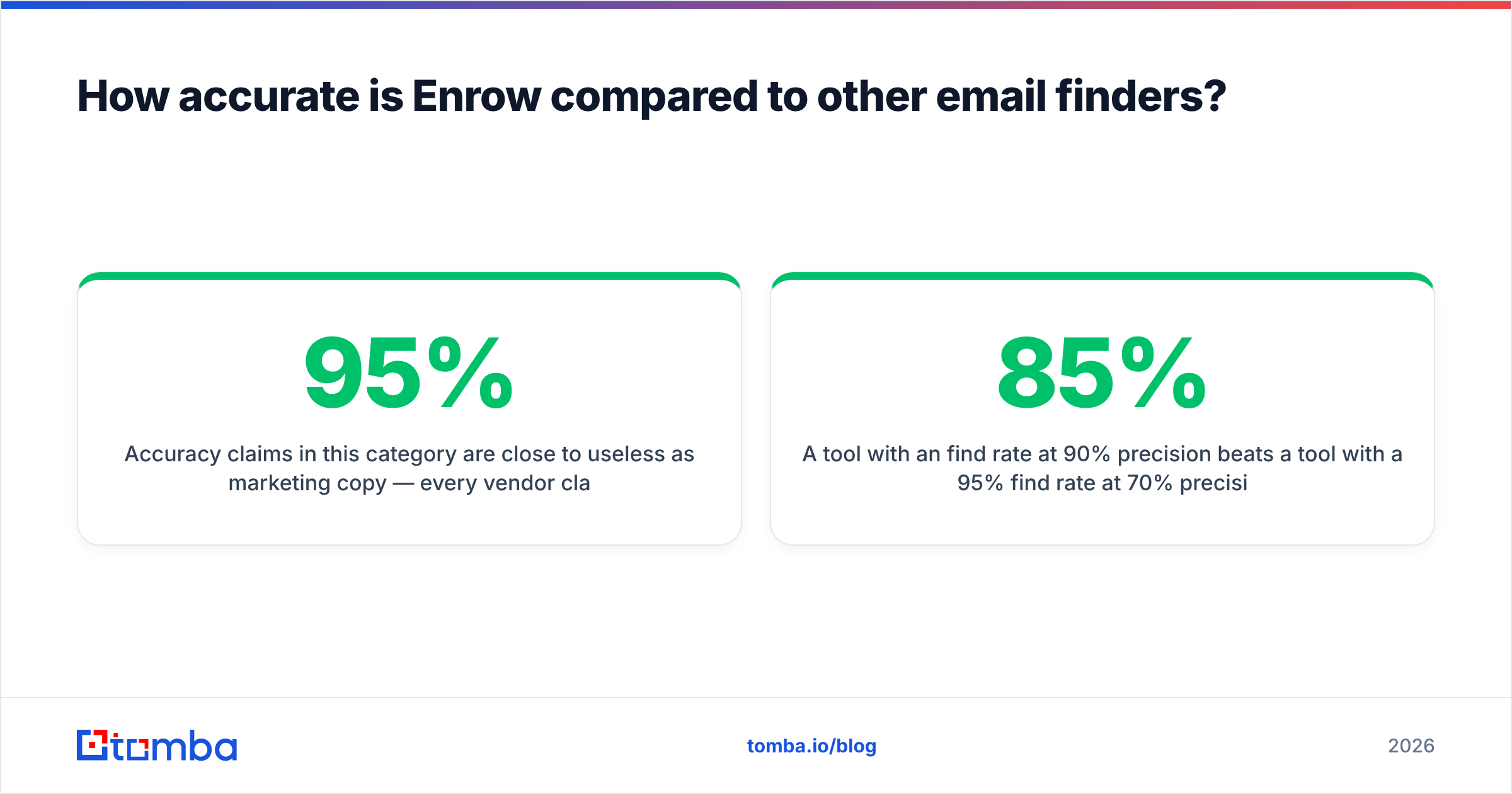
Accuracy claims in this category are near useless as marketing copy. Every vendor claims 95%+, and every vendor measures something slightly different. What matters is your test on your ICP.

Run this benchmark before you sign anything, and run it the same way across vendors:
- Build a 200-row control list from accounts you already have verified emails for — closed-won customers, past webinar registrants, anyone whose address you know is real.
- Strip the emails, leaving only name + company domain.
- Run the list through each tool on its free tier or trial.
- Score three numbers, not one: find rate (how many rows returned an address), precision (how many matched the known-good address), and catch-all share (how many were flagged accept-all or uncertain).
- Compute cost per correct email — plan price ÷ correct results. This is the only number that survives contact with a CFO.
A tool with an 85% find rate at 90% precision beats a tool with a 95% find rate at 70% precision. It is not close. The second one quietly feeds your sequencer addresses that will bounce. Want a second opinion on borderline results? Run the uncertain rows through an independent email verifier before send. A dedicated catch-all verifier targets the exact problem that makes Enrow attractive in the first place.
How does Enrow pricing compare to the alternatives?#
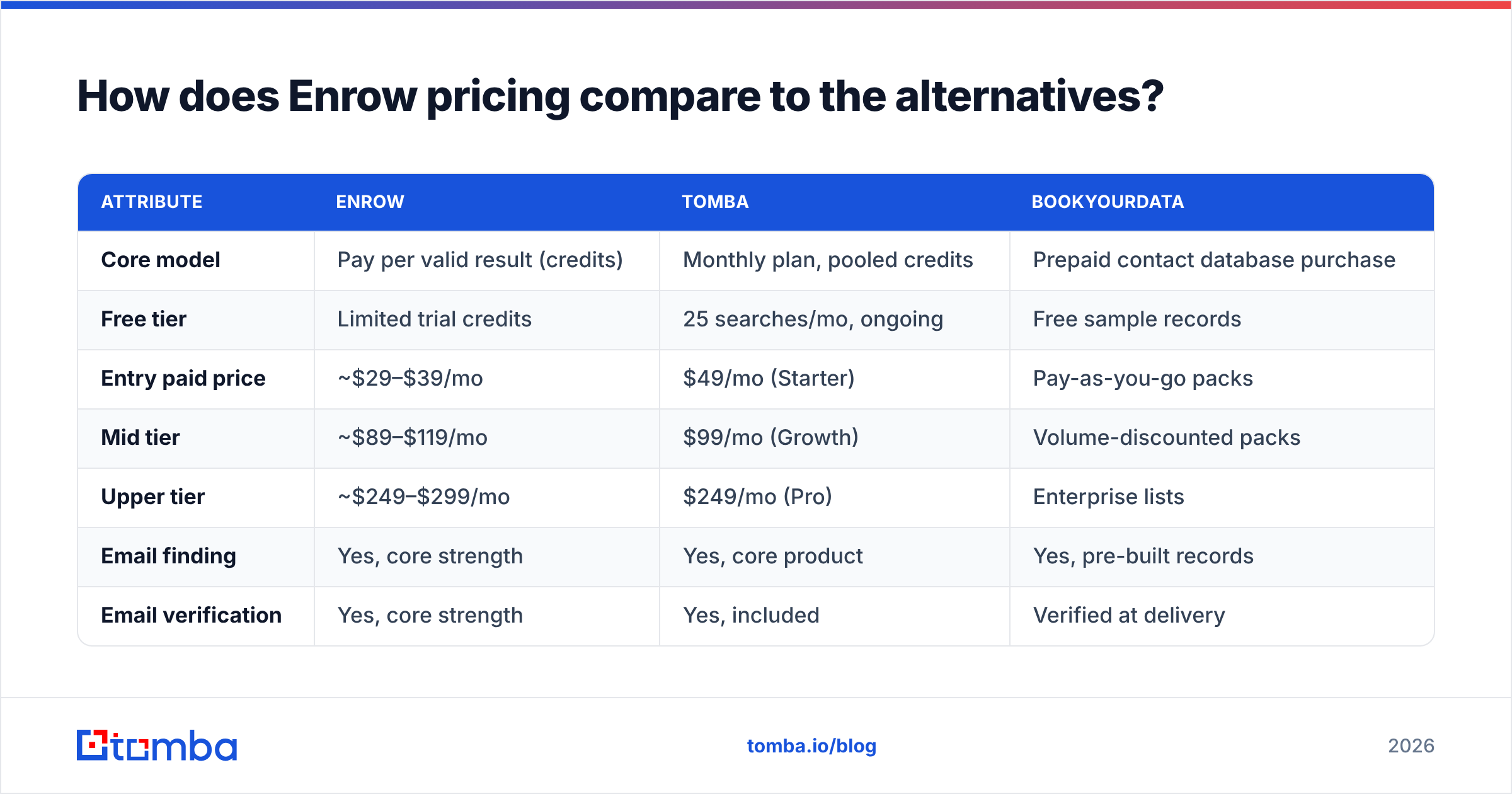
Here is the honest comparison. These vendors are not interchangeable — one is a specialist, one is a broad platform, one is a database play. The right column depends on what you are actually buying.

| Attribute | Enrow | Tomba | BookYourData |
|---|---|---|---|
| Core model | Pay per valid result (credits) | Monthly plan, pooled credits | Prepaid contact database purchase |
| Free tier | Limited trial credits | 25 searches/mo, ongoing | Free sample records |
| Entry paid price | ~$29–$39/mo | $49/mo (Starter) | Pay-as-you-go packs |
| Mid tier | ~$89–$119/mo | $99/mo (Growth) | Volume-discounted packs |
| Upper tier | ~$249–$299/mo | $249/mo (Pro) | Enterprise lists |
| Email finding | Yes, core strength | Yes, core product | Yes, pre-built records |
| Email verification | Yes, core strength | Yes, included | Verified at delivery |
| Catch-all handling | Strong specialist focus | Dedicated catch-all tools | Pre-screened |
| Phone numbers | No | Yes | Yes |
| Domain / company search | Limited | Yes | Yes |
| Data enrichment | Limited | Yes | Yes, firmographic depth |
| Native API | Yes | Yes, plus CLI and MCP | Export-based |
| Spreadsheet add-ons | Limited | Excel, Sheets, Airtable | CSV delivery |
| Best for | Small high-value lists on hard domains | Teams wanting find + verify + enrich on one bill | Buying a defined list outright, no per-lookup guessing |
The pattern is clear. Enrow competes on depth in one lane. BookYourData competes on a different axis. You buy a list of known-good records instead of running lookups. That is a better model when your ICP is well defined and you want a fixed, known cost with no hit-rate roulette. Tomba competes on breadth. Tomba pricing starts at $49/mo for Starter. It bundles finding, verification, domain search, phone lookup, and enrichment into one plan. That removes the "three subscriptions to do one job" problem.
Enrow pricing reviews pros and cons: the honest scorecard#
Here is the short version of Enrow pricing reviews pros and cons, based on the plans above and what buyers report.
Pros
- Catch-all is not a dead end. For teams selling into enterprise, this alone can justify the line item.
- Pay-per-result aligns incentives. You are not billed for the vendor's failures. That is a fairer deal than most credit models.
- Low bounce outcomes in the field. On small volumes, sender reputation is worth more than the price delta.
- Fast, human support. Small vendors compete on this, and Enrow appears to deliver.
- Simple product surface. Nothing to configure, nothing to learn, no seat-based upsell maze.
Cons
- Forecasting is harder. Variable consumption means variable bills. The better your input data, the more you pay.
- You will need other tools. No phone data, thin enrichment, no sequencing. Budget for the full stack, not just this line.
- Thin third-party review base. You get less independent evidence than with a larger vendor.
- Coverage is regional in character. Excellent where its data is strong, average where it is not. Test your specific ICP.
- Per-credit cost stays premium at volume. What feels reasonable at 1,000 lookups feels punishing at 50,000.
Who should buy Enrow, and who should skip it?#
Buy it if: you run fewer than roughly 5,000 lookups a month, your targets cluster on catch-all or enterprise domains, one bounce genuinely hurts you, and you already own the rest of your stack.
Skip it if: you want one vendor for find + verify + enrich + phone, you run high monthly volume where per-credit pricing compounds, you need predictable fixed billing, or you need deep API tooling for a product integration.
There is an honest middle path. Many teams run a broad platform as the workhorse and keep a specialist on a small plan for the hard 10% of rows. That is not a cop-out. It is what mature data operations look like. Run your bulk list through a general email finder, route the uncertain and catch-all rows to the specialist, and pay premium rates only for premium-difficulty lookups.
What should you do before you commit?#
Run the 200-row control test above across two or three vendors in the same week. Compute cost per correct email, not cost per credit. Check whether credits roll over. Confirm whether the advertised price is monthly or annual-prepay. Then send a real 100-contact campaign off each list before you scale. Bounce rate on a live send is the only benchmark you cannot game. That one test settles the Enrow pricing reviews pros and cons debate for your own data better than any review page can.
Is your real bottleneck that you stitch together three subscriptions to build one contact record? Then start with the tool that does the whole job on one bill. Tomba's Email Finder covers finding, verification, catch-all checks, domain search, and enrichment from a single plan. The free tier gives you 25 searches a month to test it against your own control list, and Starter is $49/mo when you are ready to run real volume. Build the control list, run both, and let the cost-per-correct-email number decide.
Related guides#
Ready to find emails that actually work?
Join 150,000+ professionals who stopped guessing and started sending. Free credits on signup — no credit card required.
Get the Tomba newsletter
Practical outbound tactics and product updates — once every two weeks.
About the author