Enrow vs Generect (2026): Which Data Tool Actually Wins?
Enrow verifies emails other tools give up on. Generect pulls fresh leads straight from LinkedIn-style search. They solve different halves of the same problem — here is which one your pipeline actually needs, and what it costs.
TL;DR
- Enrow vs Generect is not a real head-to-head. Enrow is an accuracy layer. It verifies emails and cracks catch-all domains. Generect is a sourcing layer. It returns people and company records from live search.
- Pick Enrow if you already have a list or a scraper. Your problem is bounces, catch-alls, and unknown results.
- Pick Generect if your problem sits upstream. You need net-new contacts by job title, headcount, or tech stack, ideally by API.
- Neither one is a full stack. Run both and you pay two vendors, juggle two credit pools, and file two invoices.
- Budget reality: credit pricing hides the true cost. Compare cost per verified, deliverable contact. Nothing else.
If you searched enrow vs generect, you probably met both tools in the same week. You may still wonder if they overlap. They barely do. This Enrow vs Generect guide covers what each tool does, where the accuracy claims hold up, what you will really pay, and when one platform beats two.
What is Enrow?#
Enrow is a European email finder and verifier. It was built for one pain: the catch-all domain. Most verifiers return unknown or risky on those domains. So you either delete good contacts or risk your sender score.
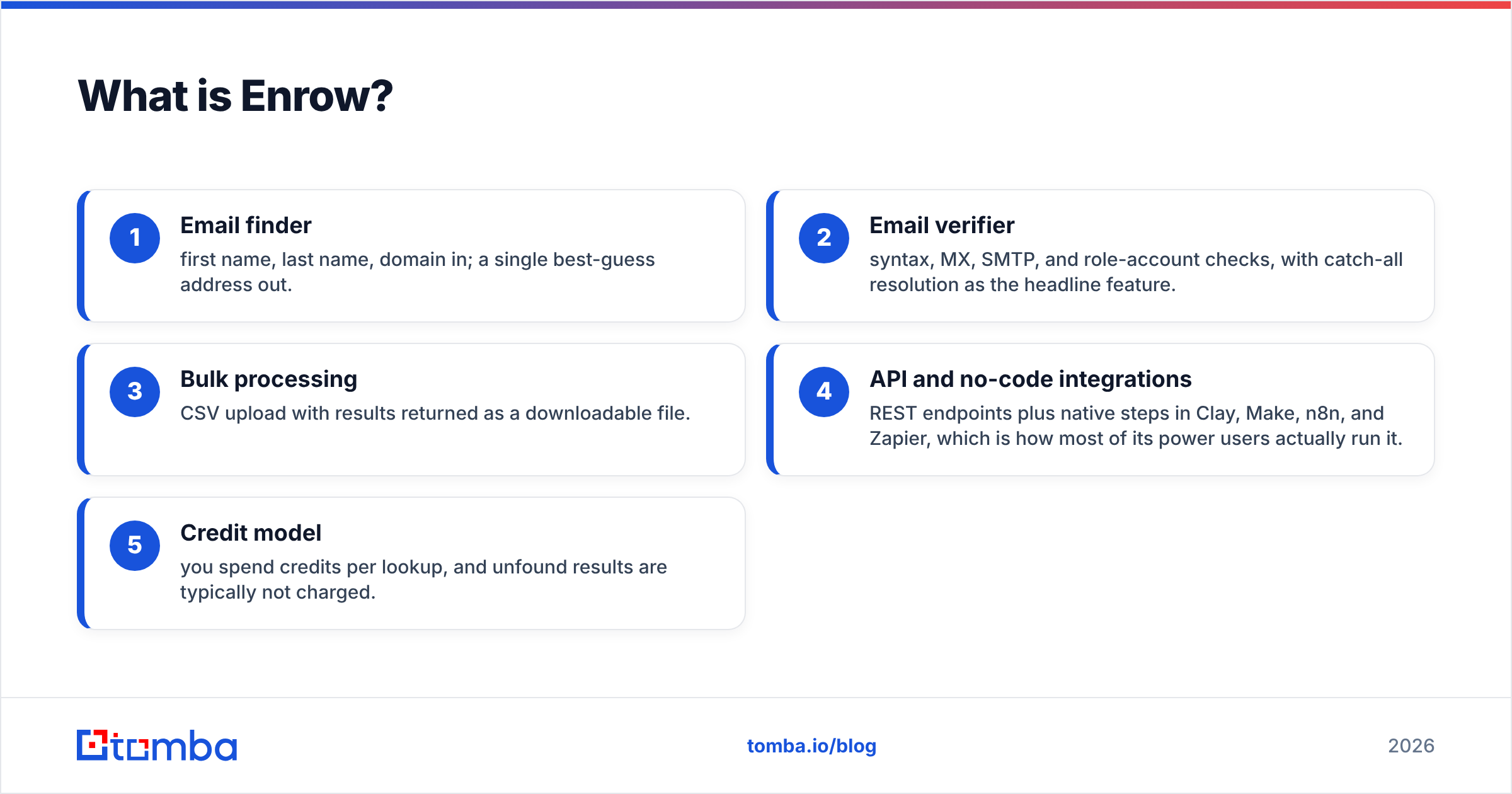
Enrow claims it resolves many of those addresses to a clear verdict. The product stays narrow on purpose:
- Email finder — send a first name, last name, and domain. Get one best-guess address back.
- Email verifier — syntax, MX, SMTP, and role-account checks, plus catch-all resolution as the headline feature.
- Bulk processing — upload a CSV and download the results.
- API and no-code steps — REST endpoints plus native steps in Clay, Make, n8n, and Zapier. That is how most power users run it.
- Credit model — you spend credits per lookup. Misses are usually free.
One thing Enrow does not do: it is not a database. You cannot ask it for 500 VP Marketing contacts at Series B fintechs. You bring the names. It turns them into live addresses.

What is Generect?#
Generect sits at the other end of the pipeline. It is a B2B lead-data provider with an API-first design. It runs live search over professional profiles and company records instead of serving a stale dump.
Core features:
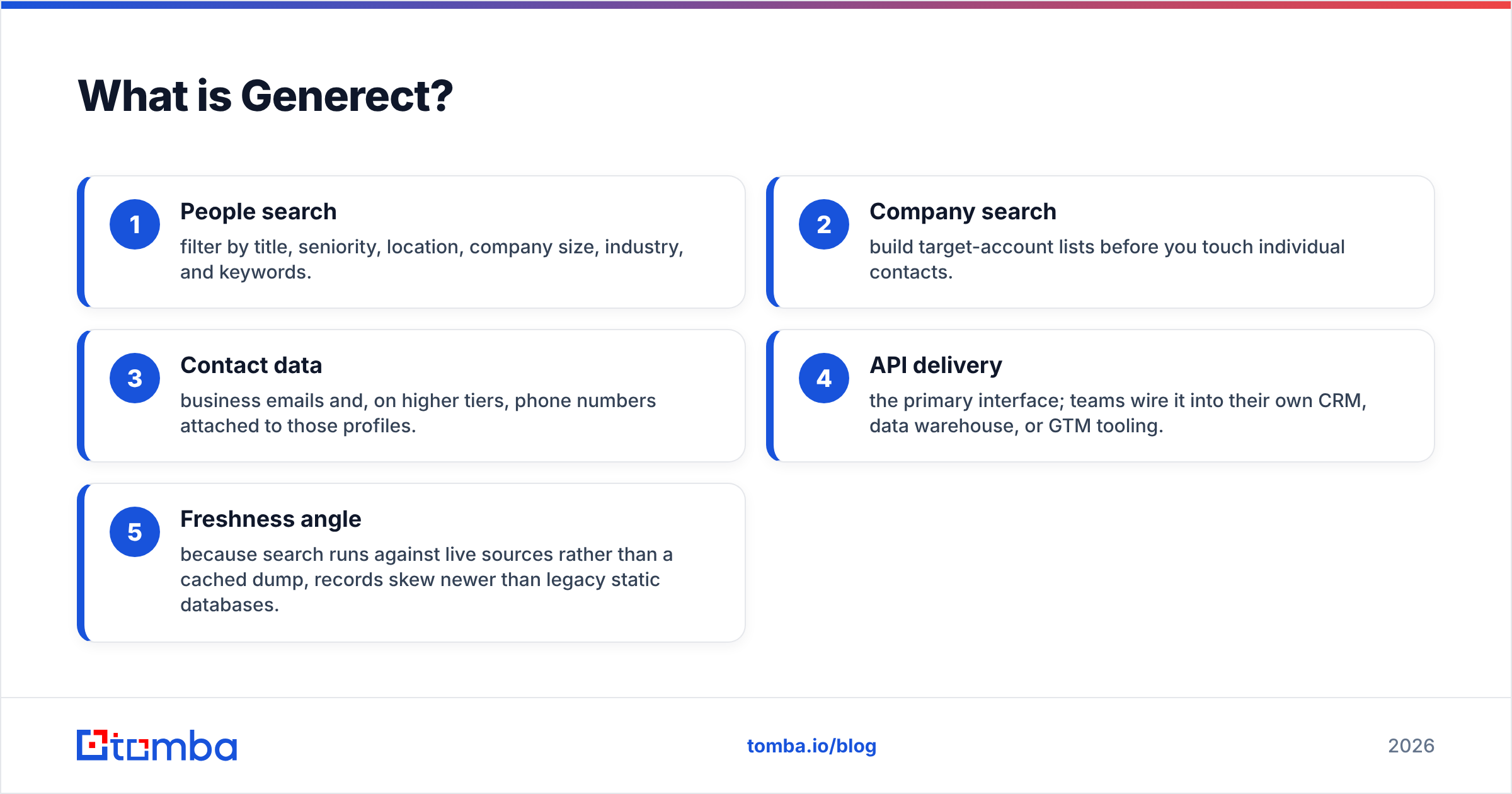
- People search — filter by title, seniority, location, company size, industry, and keywords.
- Company search — build target-account lists before you touch single contacts.
- Contact data — work emails, plus phone numbers on higher tiers.
- API delivery — the main interface. Teams wire it into a CRM, a warehouse, or their own GTM tools.
- Fresh records — live search means records skew newer than static databases.
The trade-off mirrors Enrow's. Generect is strong at finding people. It is weaker as a final gate before you send. Most teams still push its output through a verifier. That seam is the heart of the Enrow vs Generect question.
Enrow vs Generect: how do they compare?#
Here is the honest side-by-side. The figures reflect public positioning at the time of writing. Both vendors change packaging often, so check before you sign.
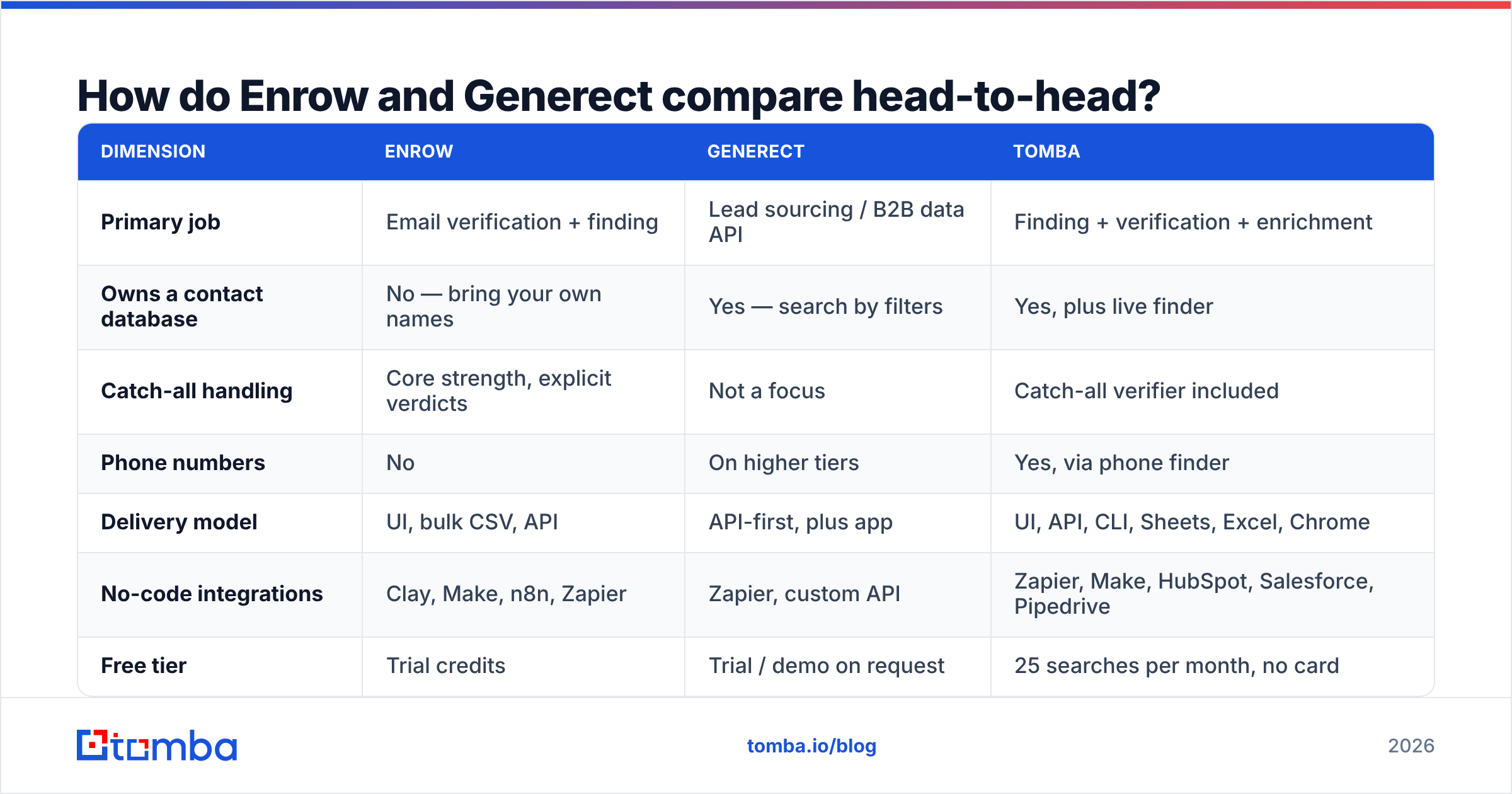
| Dimension | Enrow | Generect | Tomba |
|---|---|---|---|
| Primary job | Email verification + finding | Lead sourcing / B2B data API | Finding + verification + enrichment |
| Owns a contact database | No — bring your own names | Yes — search by filters | Yes, plus live finder |
| Catch-all handling | Core strength, explicit verdicts | Not a focus | Catch-all verifier included |
| Phone numbers | No | On higher tiers | Yes, via phone finder |
| Delivery model | UI, bulk CSV, API | API-first, plus app | UI, API, CLI, Sheets, Excel, Chrome |
| No-code integrations | Clay, Make, n8n, Zapier | Zapier, custom API | Zapier, Make, HubSpot, Salesforce, Pipedrive |
| Free tier | Trial credits | Trial / demo on request | 25 searches per month, no card |
| Entry paid plan | Credit packs, roughly $30–$50/mo equivalent | Custom / quote-led for API volume | $49/mo Starter |
| Best for | Cleaning lists you already own | Building lists from scratch | Doing both without a second vendor |
The table makes the point. On eight of nine rows the two tools answer differently. They answer different questions. "Which is better" only works once you know which half of your pipeline is broken.
Which one produces more valid emails?#
Wrong question. Here is the useful version.
Enrow will hit a higher validity rate on any list you hand it. That is its whole job. Generect will return more net-new contacts. It can surface names Enrow has no way to invent. Comparing their raw accuracy is like comparing a water filter to a well.
The overlap is small but real. Both can return an email for a known person at a known company. On that task, public benchmarks show a 20–40 point spread in match rate. Region, company size, and domain obscurity drive most of it.

Three factors move that number more than the vendor logo does:
- Company size. Small firms leave fewer public traces. Match rates drop hard under 50 staff.
- Geography. Most vendors lean US and Western Europe. APAC and LATAM data is thinner.
- Domain setup. Catch-all domains are about a third of B2B mail servers. If your tool gives up on them, you lose a third of your list before you write a line of copy.
That last point is why Enrow exists. Never accept a headline accuracy figure without asking how the vendor scores catch-alls. A tool that marks every catch-all invalid looks great on bounce rate and starves your pipeline. Test a sample first with a free email checker.
How should you actually test them?#
Do not run the vendor demo list. Run your own. The protocol takes an afternoon:
- Build a 200-row control set from your real ICP. Mix company sizes and at least three countries. Add a few catch-all domains you already know about.
- Add 20 known-good addresses and 20 known-dead ones. Any tool that flags a known-good address as invalid is over-tuned.
- Run the same set through each vendor on the same day. Data ages fast. A week's gap ruins the test.
- Score three columns, not one. Match rate, precision, and cost per verified contact.
- Send a real 50-contact campaign from your own sender. Measure hard bounces. Lab results and live SMTP often disagree.
Step 5 decides the purchase, and most people skip it. In an Enrow vs Generect test, a 3% edge in a spreadsheet means nothing if live bounces match.
What do Enrow and Generect actually cost?#
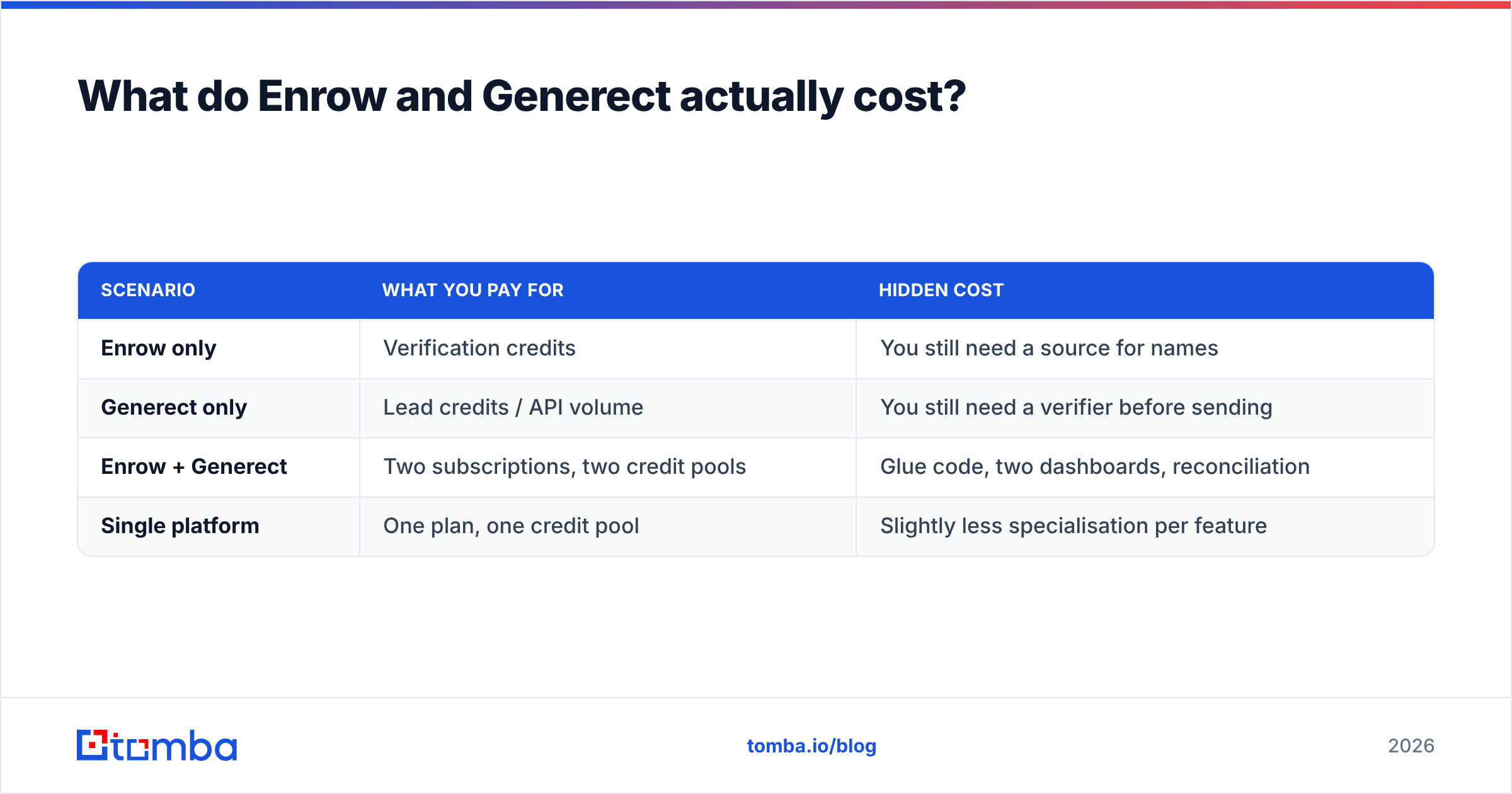
Both charge by use, so list prices tell you little. Enrow sells credit packs on a monthly commitment. Misses usually cost nothing, which helps the real rate. Generect is quote-led for serious API volume, and phone data sits on a higher tier.
One number matters: cost per verified, deliverable contact.
| Scenario | What you pay for | Hidden cost |
|---|---|---|
| Enrow only | Verification credits | You still need a source for names |
| Generect only | Lead credits / API volume | You still need a verifier before sending |
| Enrow + Generect | Two subscriptions, two credit pools | Glue code, two dashboards, reconciliation |
| Single platform | One plan, one credit pool | Slightly less specialisation per feature |
Do the math on the stacked option. Say you spend $40 a month on verification and a few hundred on lead volume. You have passed the price of one platform. You still run two vendors, two rate limits, and two support queues. Compare that with Tomba pricing: Free at 25 searches, Starter at $49/mo, Growth at $99/mo, Pro at $249/mo.

Quick sanity check: divide monthly spend by contacts that got mail without bouncing. Over $0.15–$0.30 per verified B2B contact deserves a second look. Under $0.02 deserves a question about where the data came from.

Who should choose Enrow?#
In the Enrow vs Generect split, pick Enrow when all of this is true:
- You already have a source of names — an internal database, a scraper, a Clay table, or a bought list.
- Bounces are the bottleneck, not volume. If sequences throttle or your domain score slips, pay for depth.
- Catch-all domains matter to your ICP. Enterprise, agencies, and European mid-market skew that way.
- You live in Clay, Make, or n8n. Native steps make Enrow easy to drop in.
It is the wrong pick if you need to build lists. It will happily verify an empty file.
Who should choose Generect?#
Pick Generect when:
- You need net-new contacts filtered by firmographics, and you will not run scrapers yourself.
- You are engineering-led. The value sits in the API. That fits a warehouse or a custom app.
- Freshness beats depth. Live search wins for fast-moving roles and newly funded firms.
- You have budget for a separate verifier. You will want one.
It is the wrong pick if you want a point-and-click prospecting UI, or if your list-building is already solved and you only need a deliverability gate.
Is there a better option than either?#
For most teams, yes. One platform that does both jobs well beats two that each do half. The exception is an extreme need on one side.
That is the case for a single stack. Tomba covers the finder, the email verifier, catch-all handling, domain search, phone lookup, and data enrichment on one credit pool and one API. You stop paying two vendors to hand records to each other. The trade-off is real: a pure verifier keeps a deeper edge-case library, and a pure data API exposes odder filters. Often the Enrow vs Generect debate is a sign you need one tool, not two.
Other options worth knowing, based on your angle:
- BookYourData — good if you want pre-built, pay-as-you-go B2B lists with a verification guarantee instead of a search API. Different buying model. It suits teams who want data delivered, not queried.
- Apollo, Clearbit, RocketReach — wider GTM suites that bundle prospecting with sequencing or firmographics. Heavier, and priced that way.
- ZeroBounce, Bouncer, Clearout — worth a test against Enrow if verification is the only gap.
Check any shortlist on G2 rather than vendor case studies. Weight recent reviews. Data quality in this category shifts every quarter as sources change.
What is the verdict on Enrow vs Generect?#
Enrow wins on verification depth and catch-all resolution. Generect wins on sourcing net-new contacts by API. Neither wins outright. They are not playing the same game. Any post that crowns a single champion is measuring the wrong axis.
The decision tree is short:
- List exists, bounces hurt → Enrow.
- No list, engineers on hand → Generect.
- Both problems, one budget line → use one finder-plus-verifier platform and revisit the specialists when you hit a wall.
Run the cheapest honest test. Pull 25 contacts from your ICP with the Tomba Email Finder on the free tier. Run the same names through Enrow or Generect. Compare live bounce rates on a real send. No card and no sales call. That afternoon will teach you more about Enrow vs Generect than any comparison table, including this one.
Related guides#
Ready to find emails that actually work?
Join 150,000+ professionals who stopped guessing and started sending. Free credits on signup — no credit card required.
Get the Tomba newsletter
Practical outbound tactics and product updates — once every two weeks.
About the author