Enrow vs Leadmine in 2026: Verification vs Lead Finding
Enrow leans hard on verification and catch-all resolution. Leadmine leans on finding contacts fast and cheap. Here is where each one actually wins, what they cost, and when a single combined tool beats both.
TL;DR
- Enrow is a verification-first tool. Its reputation is built on resolving catch-all domains that most verifiers return as "unknown" or "risky." Finding is secondary.
- Leadmine is a finding-first tool. Chrome extension, name + domain lookups, bulk CSV, a lean API, and pricing that undercuts most of the category. Verification is thinner.
- They are not really competitors — they sit on opposite ends of the same pipeline. Buying both is common, and that is exactly the cost problem.
- The real decision is whether you want two specialists or one platform that does discovery and verification on the same credit pool.
- If you run under ~10,000 lookups a month, a combined tool like Tomba at $49/mo usually beats a finder subscription plus a verifier subscription on both price and ops overhead.
What are Enrow and Leadmine?#
Enrow is a French email-verification service that markets itself on one specific pain point: catch-all domains. A catch-all server accepts mail for every address at a domain, valid or not, which makes standard SMTP probing useless. Enrow's pitch is that it resolves a large share of those addresses to a real valid/invalid verdict instead of shrugging and charging you anyway. It also does email finding, but that arrived later and is not what people buy it for.
Leadmine comes at outbound from the other side. It is a contact-discovery tool — search by name and company, pull emails from a browser extension while you are on a LinkedIn or company page, run a bulk list, or hit the API. It has verification built in, but it functions as a confidence filter on results rather than a standalone verification product you would point a purchased list at.
That distinction drives everything below. Comparing them purely on "how many emails did you find" or purely on "how accurate were you" will make one of them look bad for reasons that have nothing to do with quality.
How do Enrow and Leadmine compare head-to-head?#
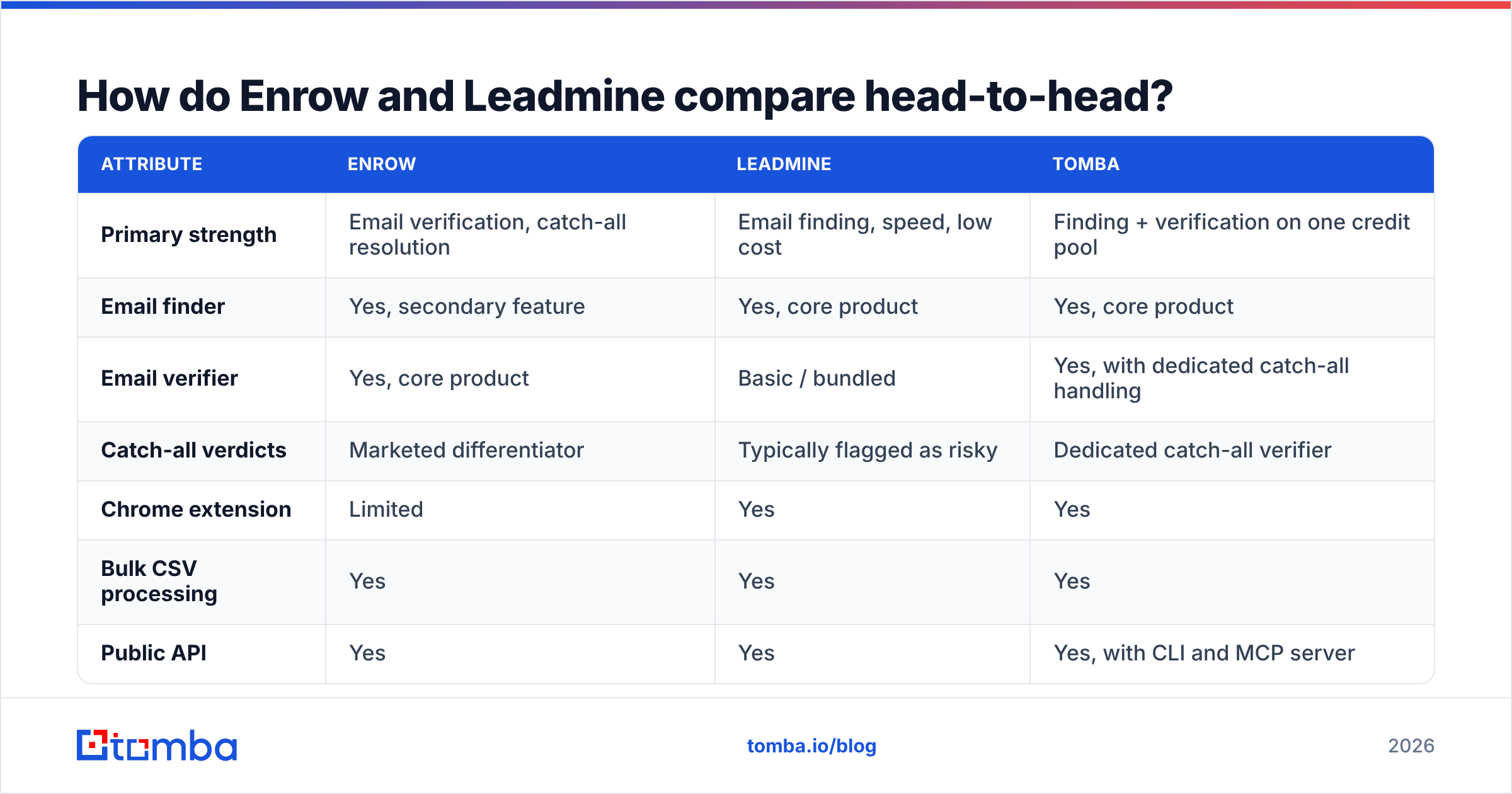
Here is the practical comparison, with Tomba included as the both-in-one reference point since most teams end up evaluating a combined platform once they price out two subscriptions.
| Attribute | Enrow | Leadmine | Tomba |
|---|---|---|---|
| Primary strength | Email verification, catch-all resolution | Email finding, speed, low cost | Finding + verification on one credit pool |
| Email finder | Yes, secondary feature | Yes, core product | Yes, core product |
| Email verifier | Yes, core product | Basic / bundled | Yes, with dedicated catch-all handling |
| Catch-all verdicts | Marketed differentiator | Typically flagged as risky | Dedicated catch-all verifier |
| Chrome extension | Limited | Yes | Yes |
| Bulk CSV processing | Yes | Yes | Yes |
| Public API | Yes | Yes | Yes, with CLI and MCP server |
| Free tier | Trial credits | Small monthly free tier | 25 searches/mo, no card |
| Entry paid plan | Roughly $30–$50/mo published | Roughly $25–$30/mo published | $49/mo Starter |
| Best for | Cleaning lists you already own | Building lists from scratch cheaply | Teams that need both without two bills |
Pricing on all three moves. Treat the numbers above as a shape, not a quote — check Enrow's pricing page, Leadmine's, and Tomba pricing before you commit budget.

Which one finds more valid emails?#
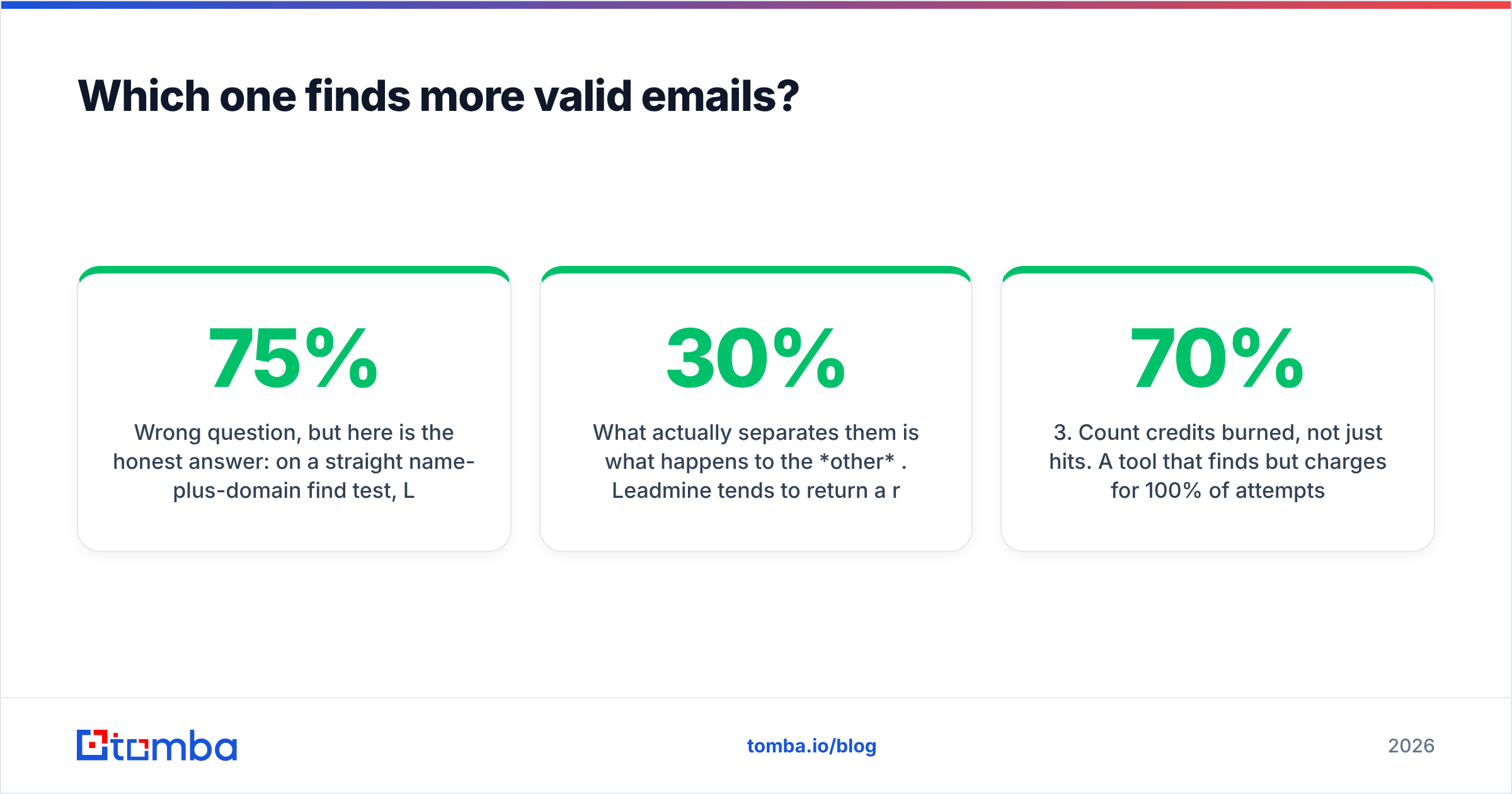
Wrong question, but here is the honest answer: on a straight name-plus-domain find test, Leadmine and Enrow land in a similar band, usually somewhere in the 55–75% coverage range depending entirely on how obscure your target list is. Coverage on Fortune 500 marketing directors is not coverage on 12-person Series A startups in Poland, and no vendor benchmark you read — including the one below — will tell you which of those two your list resembles.

What actually separates them is what happens to the other 30%. Leadmine tends to return a result with a confidence score and let you decide. Enrow tends to return a verdict and charge you only for the ones it could resolve. Neither approach is wrong, but they produce very different bounce rates if you treat the output identically.
Three things to hold constant when you run your own test:
- Use the same list for both. 300–500 contacts minimum, drawn from your actual ICP, not a sample list a vendor supplied.
- Send to a subset, don't trust the label. A verifier calling an address "valid" is a prediction. A soft bounce three days later is data. Run 100 addresses through a warmed inbox and count real bounces.
- Count credits burned, not just hits. A tool that finds 70% but charges for 100% of attempts is more expensive than a 60% tool that charges only for hits. Read the credit policy before the accuracy chart.
- Test catch-all domains separately. They will skew your aggregate number badly in one direction or the other, and they deserve their own line in the results.
How do catch-all domains change the answer?#
This is where Enrow earns its position, and where a lot of comparison posts get lazy.
A catch-all server says "yes" to every recipient probe. So an SMTP-based verifier has no signal — it either returns "accept-all/unknown" or it lies to you. Depending on your market, catch-alls can be 20–35% of your B2B list. Larger enterprises and anyone running a mail gateway like Proofpoint or Mimecast skew heavily catch-all.
Your options:
- Skip them. Safest for email deliverability, but you are throwing away a fifth of your addressable market — often the enterprise fifth.
- Send anyway. Works if your domain reputation is strong and volume is low. Reckless at scale.
- Resolve them with a specialist. This is Enrow's core claim, and it is a legitimate reason to pay for a dedicated verifier.
- Use a tool with a dedicated catch-all path. Tomba splits this out into a catch-all verifier rather than bundling it into a single yes/no endpoint, which keeps the ambiguity visible instead of hiding it behind a false "valid."
Leadmine, being finder-first, generally hands catch-alls back as risky and leaves the call to you. That is fine if you have a separate cleaning step. It is not fine if Leadmine is your only quality gate before a 5,000-contact sequence.

What does each one actually cost at real volume?#
Sticker price is misleading in this category because the unit that gets consumed differs. Some vendors charge per attempt, some per successful find, some per verification, and some count a find plus a verify as two credits on the same contact.
Run the math on your actual monthly volume:
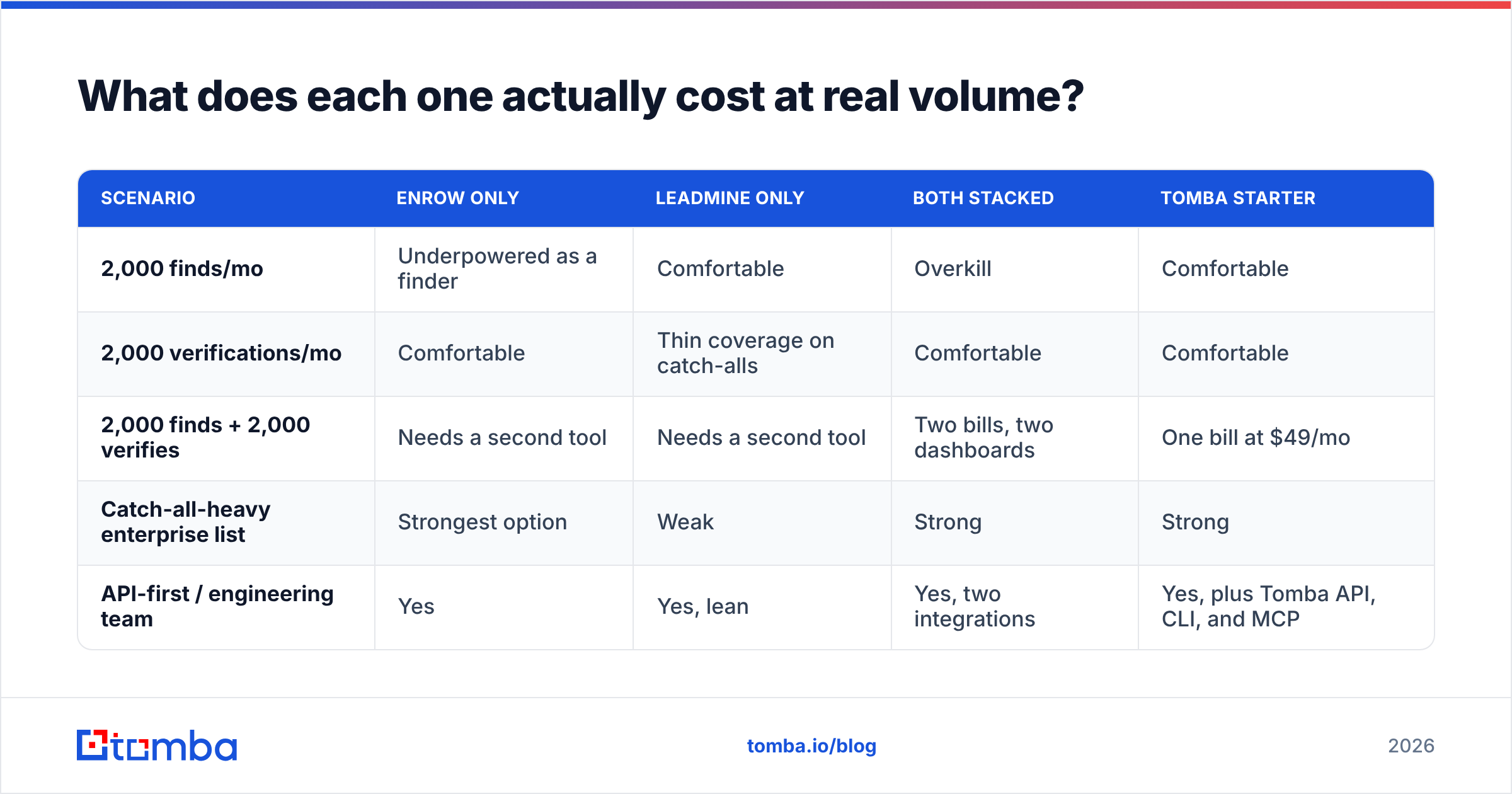
| Scenario | Enrow only | Leadmine only | Both stacked | Tomba Starter |
|---|---|---|---|---|
| 2,000 finds/mo | Underpowered as a finder | Comfortable | Overkill | Comfortable |
| 2,000 verifications/mo | Comfortable | Thin coverage on catch-alls | Comfortable | Comfortable |
| 2,000 finds + 2,000 verifies | Needs a second tool | Needs a second tool | Two bills, two dashboards | One bill at $49/mo |
| Catch-all-heavy enterprise list | Strongest option | Weak | Strong | Strong |
| API-first / engineering team | Yes | Yes, lean | Yes, two integrations | Yes, plus Tomba API, CLI, and MCP |
The stacked column is where most teams quietly land after six months — a finder subscription plus a verifier subscription, two credit pools that expire on different dates, two sets of rate limits, and a CSV shuttling between them. That workflow costs more in engineering time than either license costs in dollars.
If you would rather consolidate, this is what the wider field looks like on features and price:

Which one fits your workflow?#
Pick based on where your bottleneck actually is. Be honest about which of these describes you.
- You buy or inherit lists. Conference exports, partner lists, an old CRM dump. Your problem is quality, not quantity. Enrow wins — it is built for exactly this, and the catch-all resolution pays for itself on enterprise-heavy data.
- You build lists manually from LinkedIn. An SDR working named accounts, 30–60 contacts a day. Leadmine wins on cost and extension ergonomics. Add a cheap verifier later if bounces climb above 3%.
- You run programmatic outbound. Scripts pulling from a target-account list, enriching, and pushing into a sequencer. You need one API, not two. Two vendors means two auth flows, two failure modes, and two rate limits to back off against.
- You verify at high volume, find at low volume. Deliverability-led team, list already exists. Enrow, with a free email checker for spot checks.
- You find at high volume, verify at high volume. Growth team running new sequences weekly. This is the case where two specialists get expensive fast, and where a combined bulk email finder on a single credit pool wins on both price and operations.
Where does Tomba fit in the Enrow vs Leadmine decision?#
Honestly: if your need is purely one-sided, buy the specialist. If Enrow's catch-all engine is the whole reason you are shopping, buy Enrow. If you want the cheapest possible per-contact find and nothing else, Leadmine is hard to beat on raw price.
The case for Tomba is the middle — which is where most outbound teams actually live.
- One credit pool. Finding emails and verifying them draw from the same balance. No guessing how to split budget across two vendors.
- Catch-alls handled explicitly. A separate catch-all path rather than a binary verdict that quietly guesses.
- Distribution everywhere you already work. Chrome extension, Google Sheets, Excel, Airtable, HubSpot, Salesforce, a CLI, and an MCP server — so the same data is available to a rep clicking a button and to a script running at 3am.
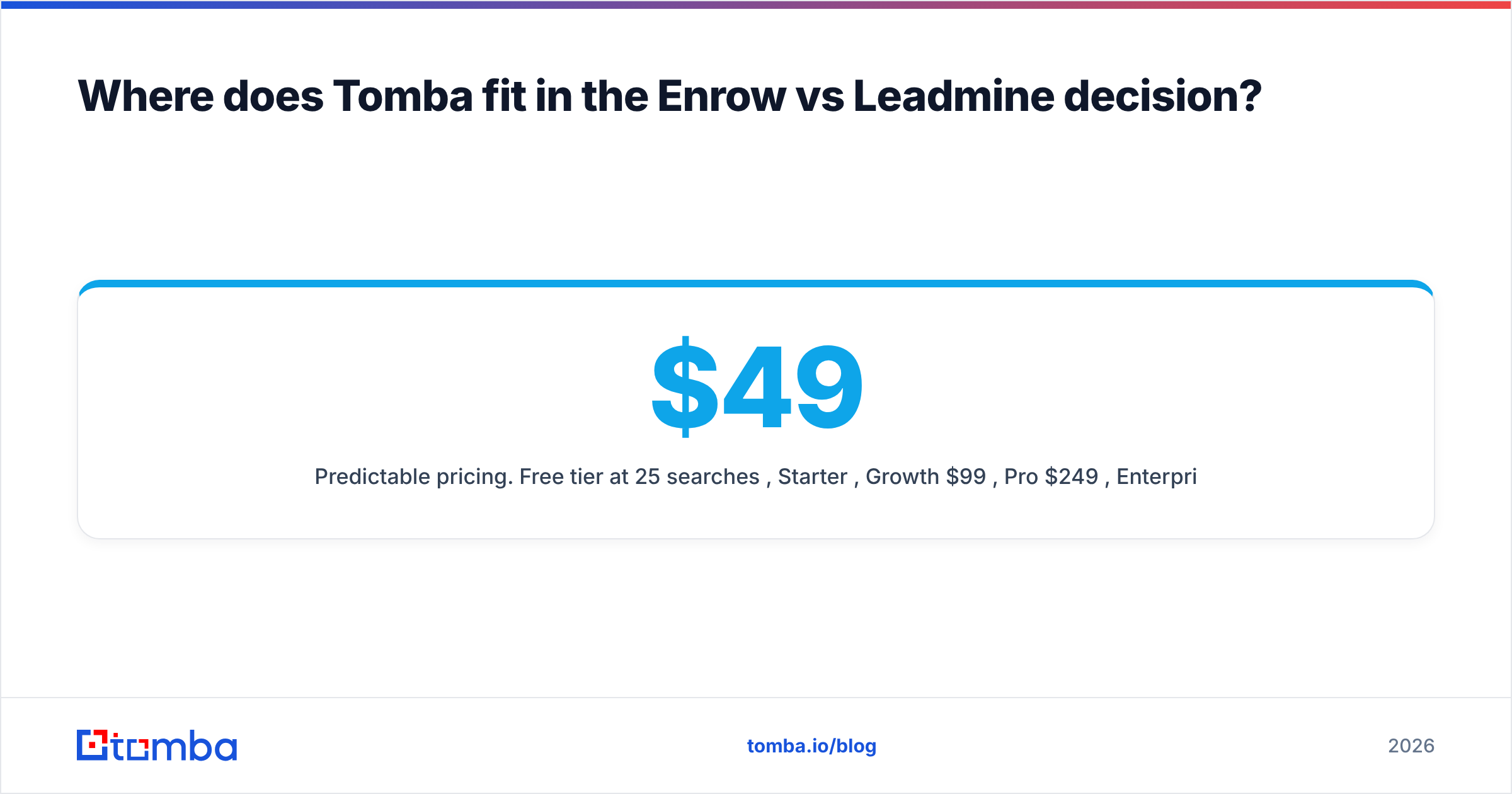
- Predictable pricing. Free tier at 25 searches/mo, Starter $49/mo, Growth $99/mo, Pro $249/mo, Enterprise custom. No per-seat multiplier on top of credits.
- Documented sourcing. How the data is sourced is published rather than described as proprietary magic.
Where Tomba is not the answer: if you need a full sales-engagement platform with sequencing, dialing, and conversation intelligence, this is a data layer, not a sequencer. Pair it with your sender of choice.
What should you check before you sign anything?#
Vendor accuracy claims are marketing artifacts. Every tool in this space publishes a chart where it wins. Cross-reference against user reviews on G2 or Capterra, then run your own test. Specifically, confirm:
- Credit policy on misses. Do you pay for a failed lookup? This single line item can double your effective cost.
- Rollover and expiry. Monthly credits that vanish are a hidden price increase on any team with uneven volume.
- Rate limits on the API tier you can afford. Advertised limits are often gated behind the plan above the one you were quoted.
- GDPR posture. If you sell into the EU, ask where data is sourced and what the legitimate-interest basis is. Get it in writing.
- Export freedom. Can you pull your enriched contacts out as CSV without a plan upgrade?
The verdict#
Enrow if verification is the job. It is the stronger tool for cleaning lists you already have, and its catch-all handling is a real differentiator rather than a marketing line — especially on enterprise-heavy data where a third of your list sits behind an accept-all gateway.
Leadmine if finding is the job and budget is tight. It is a lean, fast, cheap discovery tool. Do not mistake its bundled verification for a dedicated verifier.
Neither, if you need both. Two subscriptions, two credit pools, and a CSV in between is a workflow you will resent by month three. Consolidate.
Start with the Tomba Email Finder free tier — 25 searches a month, no card required. Run the same 100 contacts you would test on Enrow and Leadmine, compare hit rate and bounce rate side by side, and let your own numbers make the call. If it holds up, Starter is $49/mo and covers both halves of the pipeline on one bill.
Related guides#
Ready to find emails that actually work?
Join 150,000+ professionals who stopped guessing and started sending. Free credits on signup — no credit card required.
Get the Tomba newsletter
Practical outbound tactics and product updates — once every two weeks.
About the author