Enrow vs Listkit (2026): Which B2B Email Tool Wins?
Enrow verifies emails. Listkit sells lists and sends them. They get compared constantly, but they solve different halves of the same problem. Here is where each one actually wins in 2026.
TL;DR
- Enrow and Listkit are not really the same product. Enrow is a verification-first email tool built to push bounce rates under 2%. Listkit is a lead database plus a sending layer sold as one subscription.
- If your bottleneck is "my list bounces," Enrow is the closer fit. If your bottleneck is "I don't have a list," Listkit is the closer fit.
- Listkit's all-in-one bundle is convenient but locks your data and your sequencer together. Enrow stays a component you can swap.
- Neither is the cheapest way to find verified B2B emails at volume — that's where a dedicated finder plus verifier stack (Tomba, for example, at $49/mo Starter) usually undercuts both.
- Test both on a 500-row sample of your own ICP before committing. Vendor-published accuracy numbers are measured on vendor-chosen lists.
What are Enrow and Listkit, and why do people compare them?#
They get compared because they show up in the same Google searches and the same cold-email subreddits, not because they overlap much.
Enrow is a French email verification and finding tool. Its entire marketing position is bounce-rate insurance: send us your list, we'll tell you which addresses are real, and we'll take a position on the catch-all domains most verifiers punt on. It sells credits, plugs into your existing stack via API and Clay-style enrichment waterfalls, and does not try to be your CRM.
Listkit is an American B2B data platform that grew out of an agency. It sells access to a contact database — filter by title, industry, headcount, tech stack — and increasingly bundles the downstream pieces: verified lists, email infrastructure, and sending. The pitch is "one login from list to reply."
So the honest framing of enrow vs listkit is: one is a quality-control layer, the other is a supply-and-distribution layer. Plenty of teams end up buying both, which is exactly why comparing them on a single scoreboard misleads people.

How do Enrow and Listkit compare feature by feature?#
Here is the practical breakdown. Prices are the published entry points at time of writing and move often — check each vendor's pricing page before you budget.
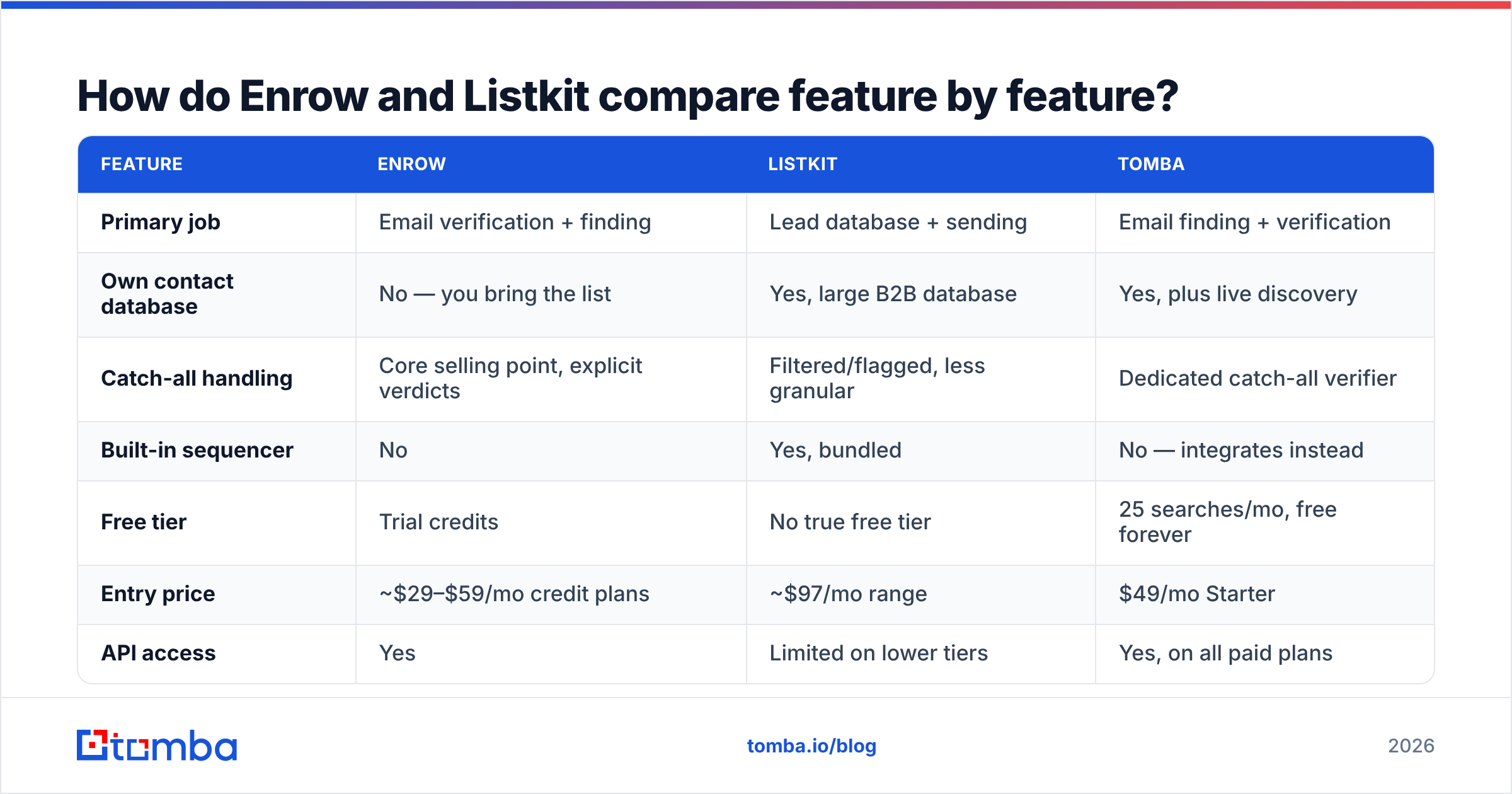
| Feature | Enrow | Listkit | Tomba |
|---|---|---|---|
| Primary job | Email verification + finding | Lead database + sending | Email finding + verification |
| Own contact database | No — you bring the list | Yes, large B2B database | Yes, plus live discovery |
| Catch-all handling | Core selling point, explicit verdicts | Filtered/flagged, less granular | Dedicated catch-all verifier |
| Built-in sequencer | No | Yes, bundled | No — integrates instead |
| Free tier | Trial credits | No true free tier | 25 searches/mo, free forever |
| Entry price | ~$29–$59/mo credit plans | ~$97/mo range | $49/mo Starter |
| API access | Yes | Limited on lower tiers | Yes, on all paid plans |
| Spreadsheet/CRM add-ons | Clay, Make, Zapier | Native CRM push | Sheets, Excel, Airtable, HubSpot, Salesforce |
| Best for | Cleaning lists you already sourced | Teams with no list and no stack | Building verified lists from scratch |
Two things jump out of that table.
First, Listkit's price includes things Enrow never claimed to sell — the database and the sender. Comparing $97 to $49 without accounting for that is comparing a meal to an ingredient.
Second, Enrow's narrow scope is a feature for anyone who already runs Instantly, Smartlead, Apollo, or a Clay build. You slot it in and nothing else changes. Listkit expects to become the stack, and stacks are expensive to rip out.
Which one is more accurate on email data?#
Accuracy splits into two questions that people constantly collapse into one.
Question 1: Is this address deliverable? That's verification. Enrow is genuinely strong here, and its published sub-2% bounce claim is the sharpest promise in the category. In practice, verification vendors cluster tightly on standard mailboxes — everyone gets Gmail and Outlook-hosted domains right. The spread shows up on catch-all and greylisted domains, which is precisely where Enrow spends its engineering budget.
Question 2: Is this the right address for this person? That's finding. Listkit's answer comes from database coverage — if the contact is in the index, you get the record. The weakness of any static database is decay: B2B contact data goes stale at roughly 25–30% per year as people change jobs, per widely cited HubSpot and industry research. A record that was verified when it was ingested is not verified today.

This is why a lot of teams run a hybrid: pull the list from a database, then re-verify at send time with a dedicated email verifier rather than trusting the ingestion-time flag. It costs a fraction of a cent per row and it is the single highest-ROI habit in outbound.
If you want to see how the vendors actually score against each other rather than against their own marketing, G2's review data is the least-bad public source — filter by company size, because enterprise reviewers and solo founders report wildly different experiences of the same product.
How does pricing really compare between Enrow and Listkit?#
Credits versus seats. That's the whole story.
Enrow charges per verification or per enrichment. Volume is predictable if your list sizes are predictable, and the marginal cost of a bad month is zero — you just don't burn credits. The trap is enrichment waterfalls: if you chain three providers to find one email, you pay three times for the misses too.
Listkit charges a subscription that bundles record exports with the sending layer. Predictable monthly cost, but you're paying for the database even in months where you don't prospect, and export caps are the real constraint rather than dollars.
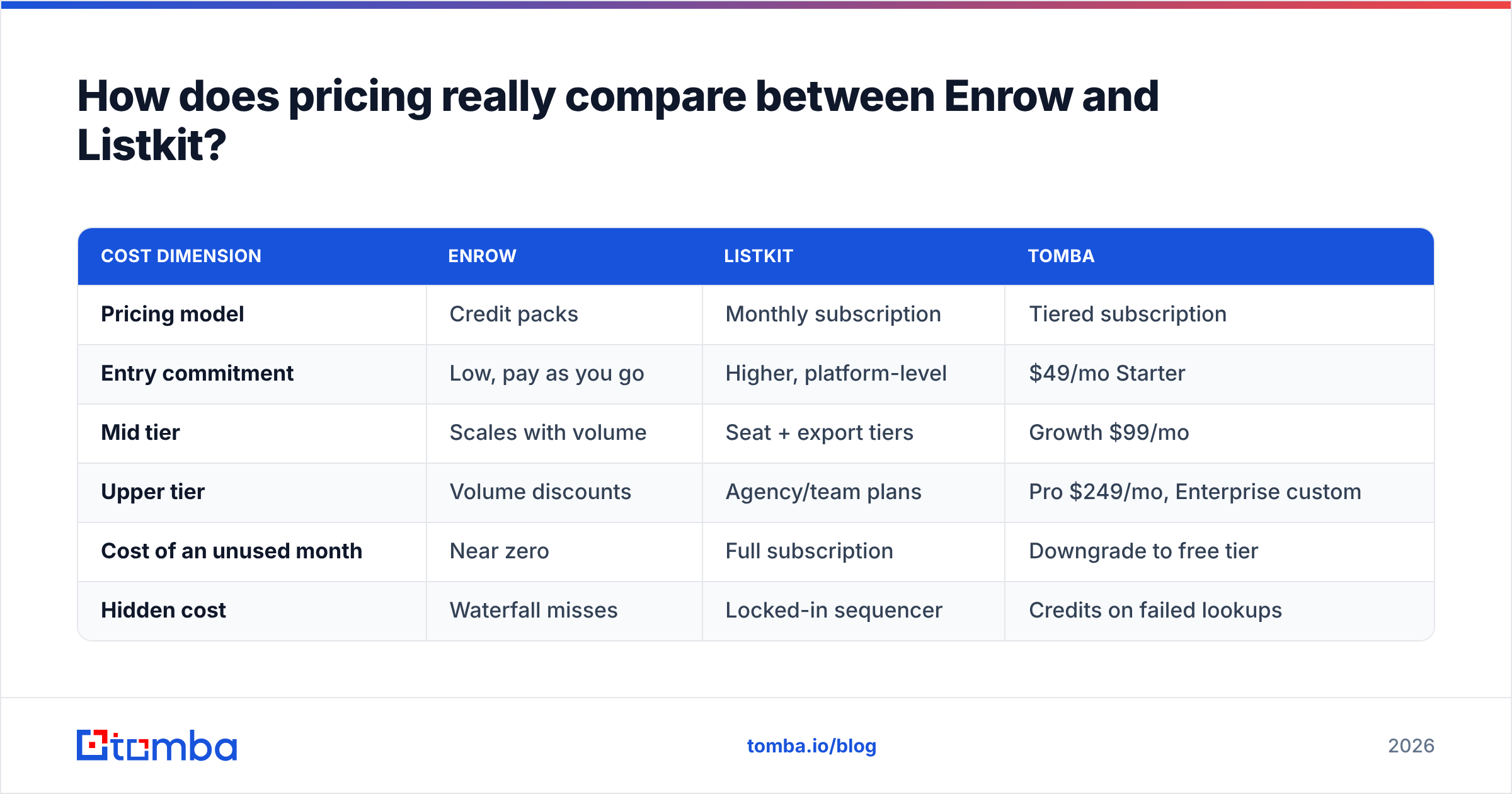
| Cost dimension | Enrow | Listkit | Tomba |
|---|---|---|---|
| Pricing model | Credit packs | Monthly subscription | Tiered subscription |
| Entry commitment | Low, pay as you go | Higher, platform-level | $49/mo Starter |
| Mid tier | Scales with volume | Seat + export tiers | Growth $99/mo |
| Upper tier | Volume discounts | Agency/team plans | Pro $249/mo, Enterprise custom |
| Cost of an unused month | Near zero | Full subscription | Downgrade to free tier |
| Hidden cost | Waterfall misses | Locked-in sequencer | Credits on failed lookups |
Full Tomba pricing is public if you want the exact per-credit math for the comparison.
The honest budgeting rule: if you prospect in bursts — campaign, pause, analyze, campaign — credit models win. If you prospect continuously with a team, seat-based platforms amortize better.
Who should actually choose Enrow?#
Pick Enrow when all of these are true:
- You already have a source of leads. Scraped, exported, bought, or built in Clay. Enrow adds nothing if your list is empty.
- Catch-all domains are killing you. If 30–40% of your ICP sits on catch-all servers and your current verifier returns "unknown" on all of them, Enrow's willingness to make a call is worth real money.
- You want to stay modular. Enrow doesn't try to own your sending. If you switch sequencers next quarter, nothing breaks.
- Your deliverability is already fragile. If you're rebuilding sender reputation after a rough quarter, the tightest possible verification pass is worth overpaying for.
Skip Enrow if you're looking for a list to send to. It is not that product and does not pretend to be.
Who should actually choose Listkit?#
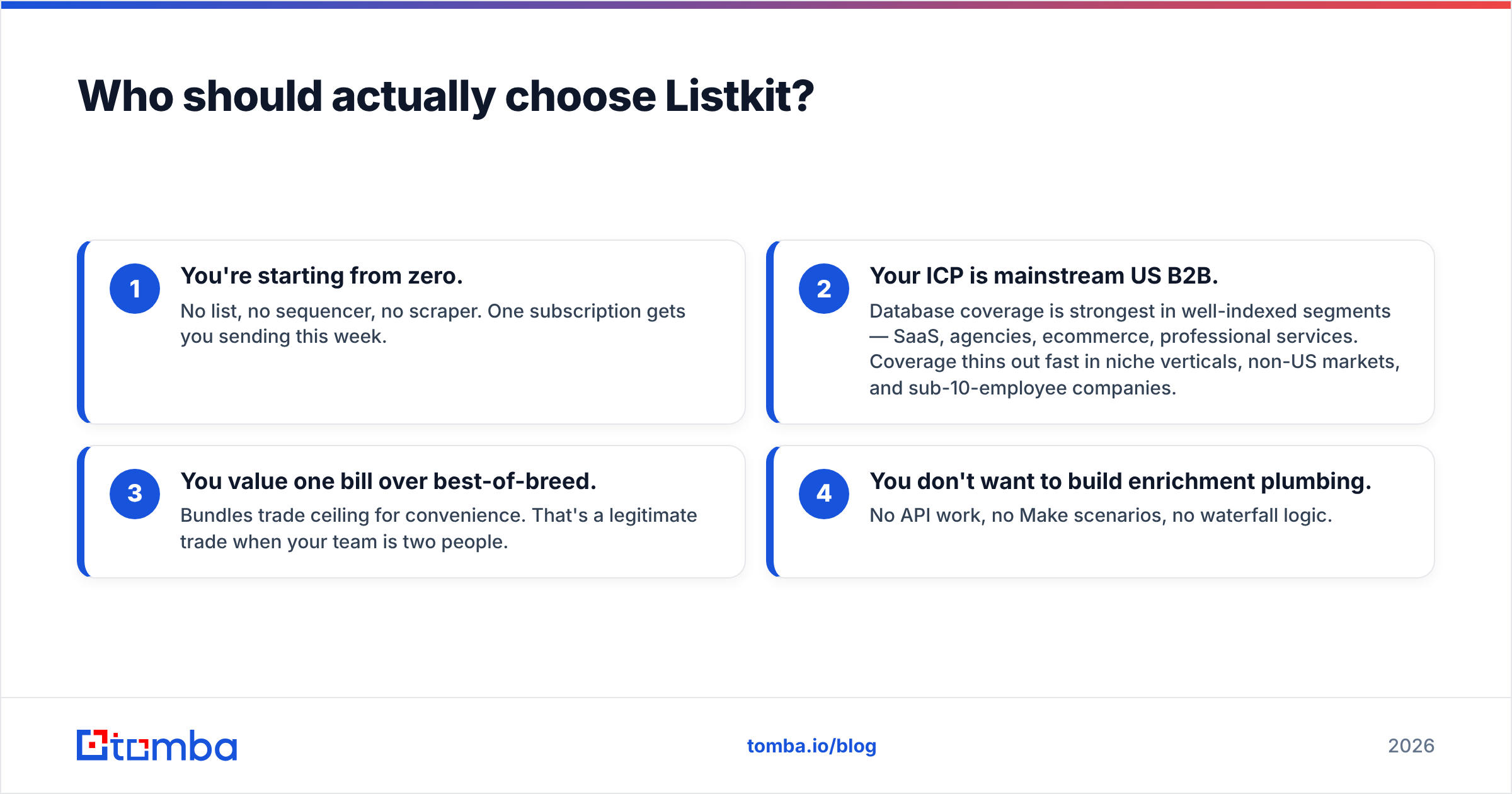
Pick Listkit when:
- You're starting from zero. No list, no sequencer, no scraper. One subscription gets you sending this week.
- Your ICP is mainstream US B2B. Database coverage is strongest in well-indexed segments — SaaS, agencies, ecommerce, professional services. Coverage thins out fast in niche verticals, non-US markets, and sub-10-employee companies.
- You value one bill over best-of-breed. Bundles trade ceiling for convenience. That's a legitimate trade when your team is two people.
- You don't want to build enrichment plumbing. No API work, no Make scenarios, no waterfall logic.
Skip Listkit if you already pay for a sequencer you like, or if your ICP is one the database doesn't cover well — you'd be buying a whole platform for a slice of it.

What about catch-all domains, the thing everyone gets wrong?#
Catch-all servers accept mail to any address at the domain, then silently discard the invalid ones. Standard SMTP verification can't distinguish real from fake there, so most tools return "unknown" and leave the decision to you.
Your three options, in order of how much they'll cost you:
- Delete every catch-all. Safest for email deliverability, and it can remove 30%+ of your enterprise TAM. Large companies disproportionately run catch-all.
- Send to all of them. Your bounce rate becomes a coin flip and your domain reputation absorbs the damage.
- Score them and send to the confident ones. Pattern confidence, source corroboration, and historical engagement all feed the verdict. This is where Enrow competes, and where a dedicated catch-all verifier earns its keep.
If your list is mostly SMBs, this whole section barely matters. If you sell to enterprise, it's the most important paragraph on this page.
Where does Tomba fit in the comparison?#
Neutrally: Tomba sits in the same lane as Enrow on verification but adds the finding layer that Enrow doesn't sell and the database Listkit charges a platform fee for.
The practical shape of a Tomba-based stack:
- Find — domain search to pull every published address at a target company, or the email finder for named prospects.
- Verify — SMTP plus pattern verification before anything reaches your sequencer.
- Enrich — data enrichment to fill titles, LinkedIn, and phone where you need multichannel.
- Automate — the Tomba API or the Sheets and Airtable add-ons, so nobody is exporting CSVs by hand.
Where Tomba does not win: it has no built-in sequencer. If your requirement is genuinely "one tool that also sends," Listkit answers that and Tomba doesn't. And for a team whose only problem is verifying a list they already own at very high volume, Enrow's specialization is defensible.
Worth noting for completeness: if your need is purely a pre-built, pay-per-record list rather than a subscription, providers like BookYourData occupy a different and reasonable niche — one-time purchase instead of a recurring platform commitment. Different buying model, different fit.

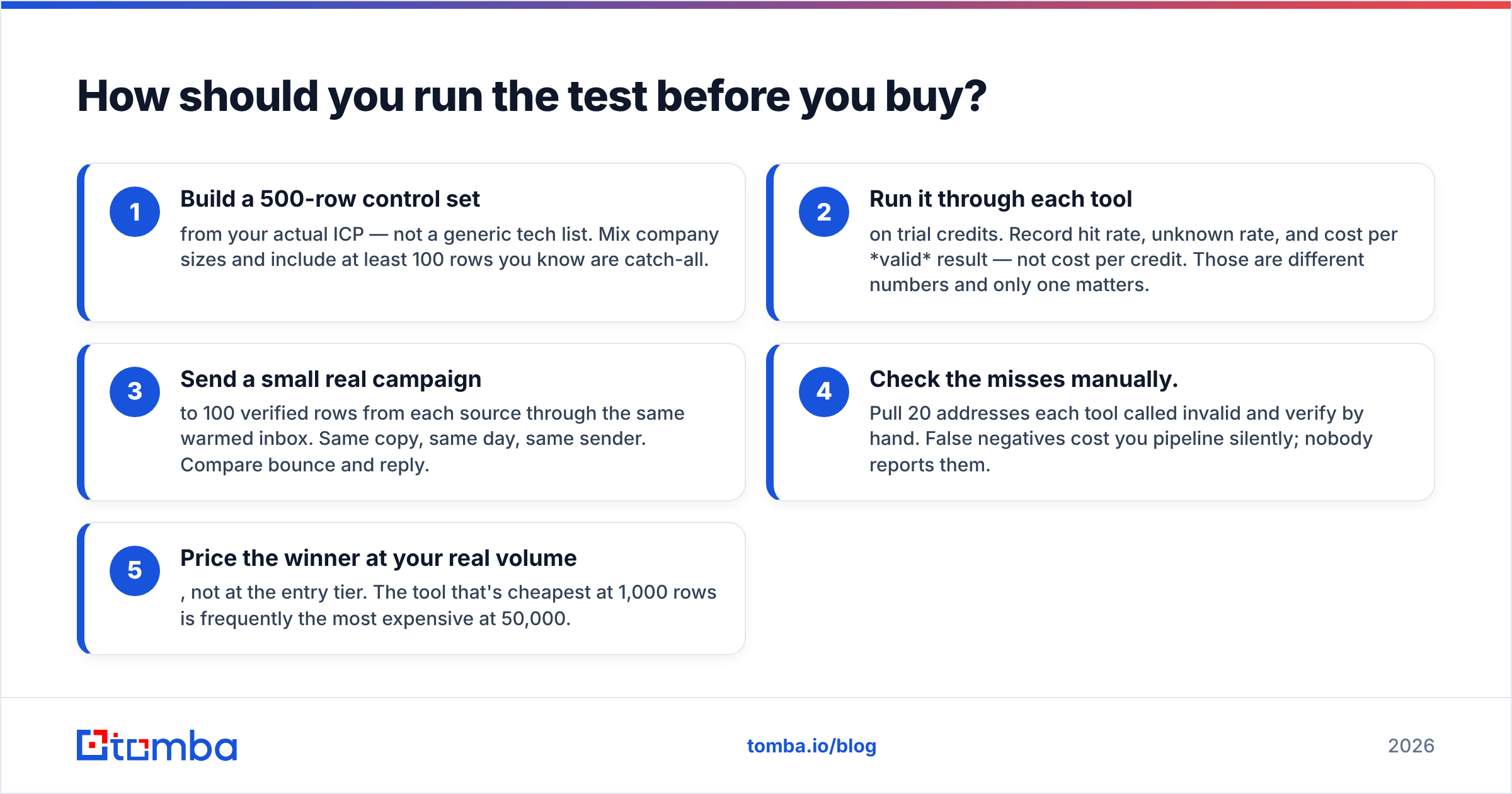
How should you run the test before you buy?#
Don't take anyone's published accuracy number, including the ones on this page. Run this in an afternoon:
- Build a 500-row control set from your actual ICP — not a generic tech list. Mix company sizes and include at least 100 rows you know are catch-all.
- Run it through each tool on trial credits. Record hit rate, unknown rate, and cost per valid result — not cost per credit. Those are different numbers and only one matters.
- Send a small real campaign to 100 verified rows from each source through the same warmed inbox. Same copy, same day, same sender. Compare bounce and reply.
- Check the misses manually. Pull 20 addresses each tool called invalid and verify by hand. False negatives cost you pipeline silently; nobody reports them.
- Price the winner at your real volume, not at the entry tier. The tool that's cheapest at 1,000 rows is frequently the most expensive at 50,000.
That test costs maybe $50 and three hours, and it settles the enrow vs listkit question for your data rather than for a generic benchmark.
So which one wins?#
Neither, cleanly — and any post that gives you a single winner is selling something.
Enrow wins the narrow, important job of deciding whether an address is safe to send to, especially on catch-all domains, and it stays out of the rest of your stack. If you have leads and a bounce problem, buy Enrow.
Listkit wins on time-to-first-campaign for teams starting from nothing. If you have neither a list nor a sequencer and you need to be sending by Friday, the bundle is worth the premium.
Neither wins the most common actual requirement, which is: find verified emails for a specific set of target companies, at a predictable cost, without adopting a whole platform. That's a finder-plus-verifier job.
If that last description is you, start with the Tomba Email Finder. The free tier gives you 25 searches a month with no card, which is enough to run the 500-row control test above on a sample and see the hit rate on your own ICP. If it holds up, Starter is $49/mo and every plan includes API access — so whatever sequencer you're already paying for keeps working exactly as it does today.
Related guides#
Ready to find emails that actually work?
Join 150,000+ professionals who stopped guessing and started sending. Free credits on signup — no credit card required.
Get the Tomba newsletter
Practical outbound tactics and product updates — once every two weeks.
About the author