Enrow vs SignalHire 2026: Accuracy, Pricing, and Verdict
Enrow verifies emails at high accuracy but finds nothing new. SignalHire finds people, emails, and phones but charges per seat. Here is which one actually fits your outbound stack in 2026.
TL;DR
- Enrow is a verification specialist. It cleans and validates lists — including catch-all domains — but it is not built to source contacts from scratch.
- SignalHire is a contact database. It returns emails and mobile numbers from LinkedIn profiles, which makes it popular with recruiters and multichannel SDRs.
- They barely overlap. Choosing "Enrow vs SignalHire" is really choosing between cleaning data you already have and acquiring data you don't.
- Pricing models differ sharply. Enrow sells credits; SignalHire sells per-seat plans with credit caps, which gets expensive across a team.
- If you need both sourcing and verification in one place, a combined platform like Tomba (free tier, then $49/mo) usually beats running two subscriptions.
What is Enrow and who is it for?#
Enrow is a French email-verification tool built around one claim: it can tell you whether an address is deliverable even when standard SMTP checks fail. Its pitch is accuracy on the hard cases — catch-all domains, Microsoft 365 tenants that swallow probes, and role-based addresses that most validators mark "unknown" and hand back to you unresolved.
The product surface is deliberately narrow:
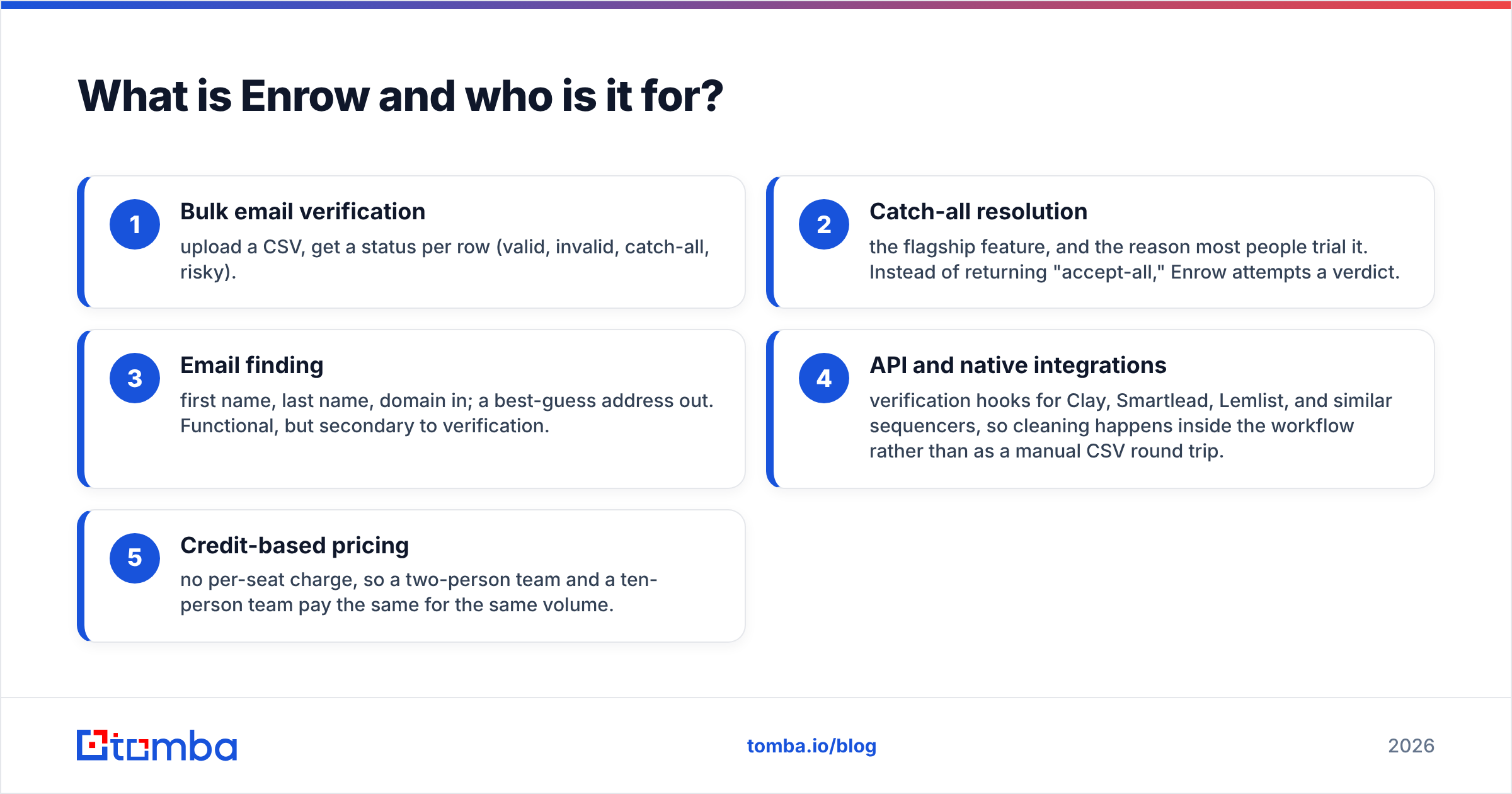
- Bulk email verification — upload a CSV, get a status per row (valid, invalid, catch-all, risky).
- Catch-all resolution — the flagship feature, and the reason most people trial it. Instead of returning "accept-all," Enrow attempts a verdict.
- Email finding — first name, last name, domain in; a best-guess address out. Functional, but secondary to verification.
- API and native integrations — verification hooks for Clay, Smartlead, Lemlist, and similar sequencers, so cleaning happens inside the workflow rather than as a manual CSV round trip.
- Credit-based pricing — no per-seat charge, so a two-person team and a ten-person team pay the same for the same volume.
Enrow's customer is someone who already has volume. Agencies running lead-gen for multiple clients, RevOps teams inheriting a stale CRM export, and outbound shops that scrape aggressively and need the junk filtered before it hits a mailbox. If you have no list yet, Enrow gives you very little to do.
You can see the current feature set on the official Enrow site.

What is SignalHire and who is it for?#
SignalHire is a people-search platform with a Chrome extension as its center of gravity. You open a LinkedIn profile, hit the extension, and it reveals whatever contact data it holds: work email, personal email, and — this is the differentiator — direct dial and mobile numbers.
Around that core it stacks a candidate-tracking layer: pipelines, notes, team folders, basic ATS behavior. That lineage matters. SignalHire grew out of recruiting, and the product still reflects it. The database is organized around people and their career histories, not around companies and their email patterns.
Where SignalHire genuinely wins:
- Phone coverage. If your motion is cold calling or call-plus-email, having the mobile alongside the email in one reveal removes an entire tool from the stack.
- LinkedIn-native workflow. Sourcers who live in LinkedIn Recruiter or Sales Navigator do not want to context-switch to a web app.
- Candidate management. For small recruiting teams, the built-in pipeline can replace a lightweight ATS.
Where it frustrates people: the pricing structure. SignalHire bills per user, and credits are attached to seats rather than pooled generously across the account. Add three sourcers and you triple the base cost even if total credit consumption stays flat. Reviews on G2 consistently flag this, alongside variable email accuracy on smaller or non-US companies.
Enrow vs SignalHire: how do they compare feature by feature?#
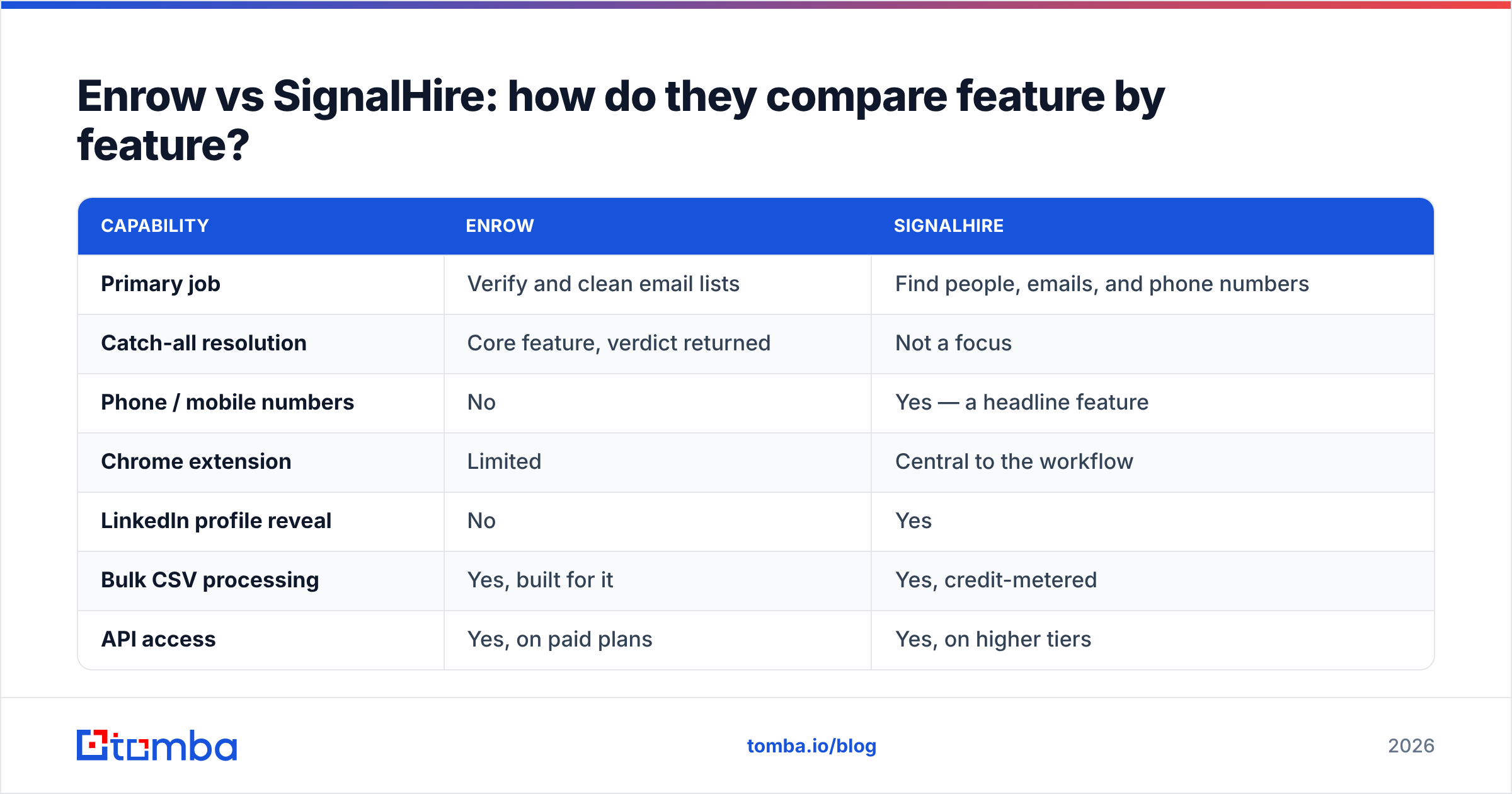
Here is the honest side-by-side. Note how few rows are genuinely contested — these tools mostly do different jobs.
| Capability | Enrow | SignalHire |
|---|---|---|
| Primary job | Verify and clean email lists | Find people, emails, and phone numbers |
| Catch-all resolution | Core feature, verdict returned | Not a focus |
| Phone / mobile numbers | No | Yes — a headline feature |
| Chrome extension | Limited | Central to the workflow |
| LinkedIn profile reveal | No | Yes |
| Bulk CSV processing | Yes, built for it | Yes, credit-metered |
| API access | Yes, on paid plans | Yes, on higher tiers |
| Candidate/ATS pipeline | No | Yes, basic |
| Pricing model | Credit packs, no seat fee | Per-seat plans with credit caps |
| Best for | Deliverability and list hygiene | Recruiting and multichannel outbound |
The takeaway: these are complements, not substitutes. A recruiter who buys Enrow will wonder where the contacts are. A deliverability lead who buys SignalHire will wonder why their bounce rate did not move.
Which tool is more accurate — and does that question even make sense?#
Not directly comparable, because they measure different things.
Enrow's accuracy claim is about verification: given an address, how often is the deliverable/undeliverable verdict correct? That is a binary classification problem, and on catch-all domains it is genuinely hard. Most verifiers punt. Enrow's differentiation is that it attempts a call, and in independent user tests it lands well above the "unknown" pile that generic validators return.
SignalHire's accuracy claim is about coverage and freshness: given a person, does the database hold a current work email and a working mobile? That is a data-acquisition problem. Coverage is strong for US tech and enterprise roles, thinner for EU SMBs, and — as with every people database — decays fast when someone changes jobs.

The practical implication for your bounce rate: a high-coverage finder with mediocre validation will still burn your domain. Coverage without verification is just a faster way to hit spam traps. That is why serious outbound stacks always end up with two layers — sourcing and verification — whether they buy them separately or get both from one vendor. If you are running SignalHire alone, budget for a dedicated email verifier before the list touches a sequencer.
And if catch-all domains are the specific thing eating your list, a purpose-built catch-all verifier will resolve rows that a generic validator hands back as "risky."
How does pricing compare between Enrow and SignalHire?#
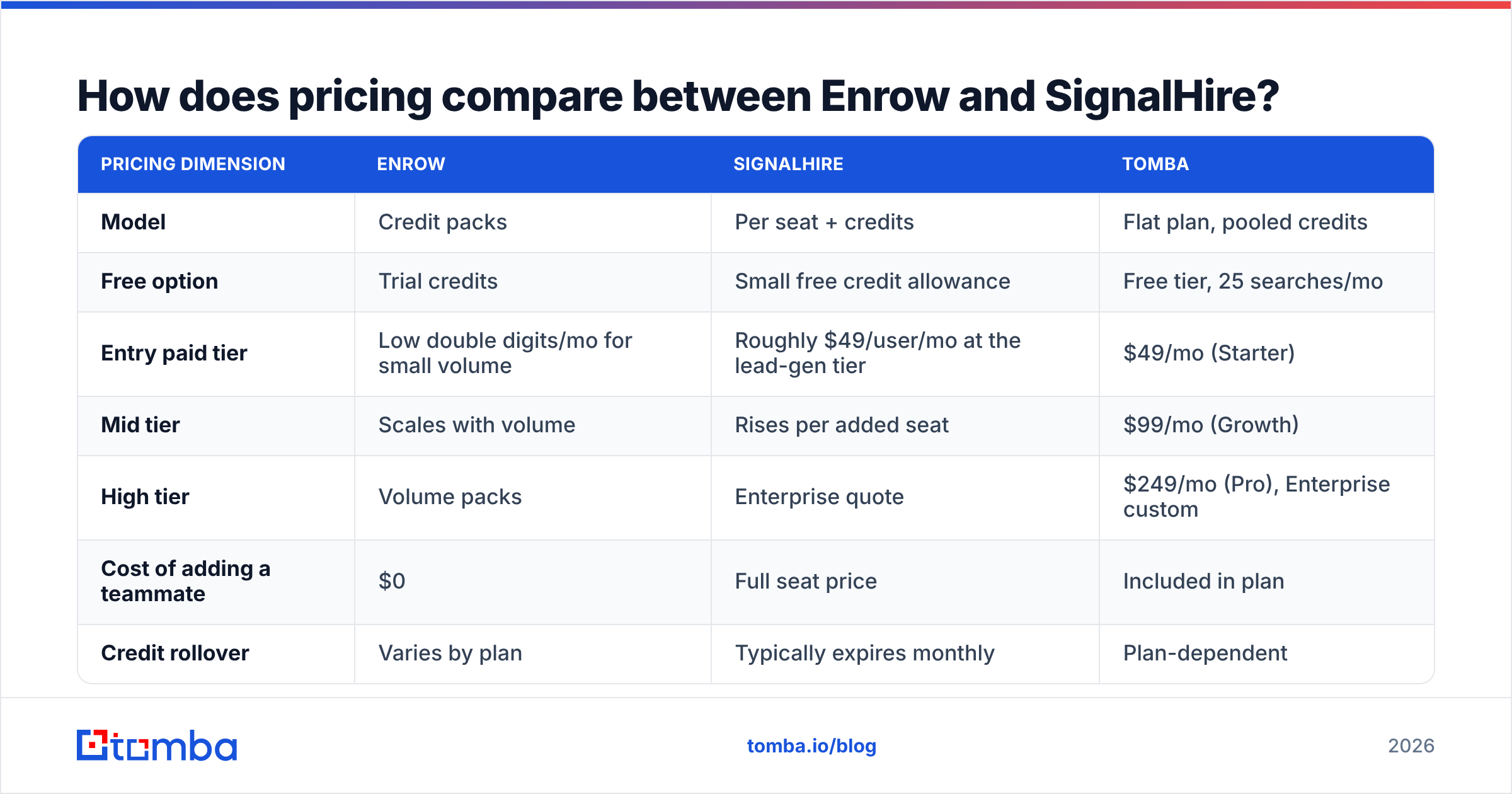
Pricing changes often, so treat these as directional and verify on the vendor sites before you buy. The structure is more important than the numbers anyway.
| Pricing dimension | Enrow | SignalHire | Tomba |
|---|---|---|---|
| Model | Credit packs | Per seat + credits | Flat plan, pooled credits |
| Free option | Trial credits | Small free credit allowance | Free tier, 25 searches/mo |
| Entry paid tier | Low double digits/mo for small volume | Roughly $49/user/mo at the lead-gen tier | $49/mo (Starter) |
| Mid tier | Scales with volume | Rises per added seat | $99/mo (Growth) |
| High tier | Volume packs | Enterprise quote | $249/mo (Pro), Enterprise custom |
| Cost of adding a teammate | $0 | Full seat price | Included in plan |
| Credit rollover | Varies by plan | Typically expires monthly | Plan-dependent |
The seat model is the buried cost. A five-person SDR team on a per-seat tool pays roughly five times the sticker price, even if three of those people run twenty lookups a month. Credit-pooled platforms — Enrow on the verification side, Tomba pricing on the combined side — absorb that headcount without a proportional bill.
Run the arithmetic for your team size before comparing the headline numbers. A $49/user tool at six seats is $294/mo, which lands in a completely different bracket than it first appears.
Do you actually need both tools?#
Many teams end up running SignalHire (or an equivalent) for sourcing plus Enrow (or an equivalent) for cleaning. That works. It also means two contracts, two credit systems, two API keys, and a CSV shuffle between them.
Three questions decide it:
- Do you need phone numbers? If cold calling is a real channel for you, SignalHire earns its place — Enrow has nothing here. If you need dials without the recruiting layer, a standalone phone finder is usually cheaper.
- Is your bounce rate above 3%? If yes, verification is not optional, and a finder alone will not fix it.
- Does your team exceed three seats? If yes, per-seat pricing becomes the dominant line item and consolidation starts paying for itself.

What are the best alternatives to Enrow and SignalHire?#
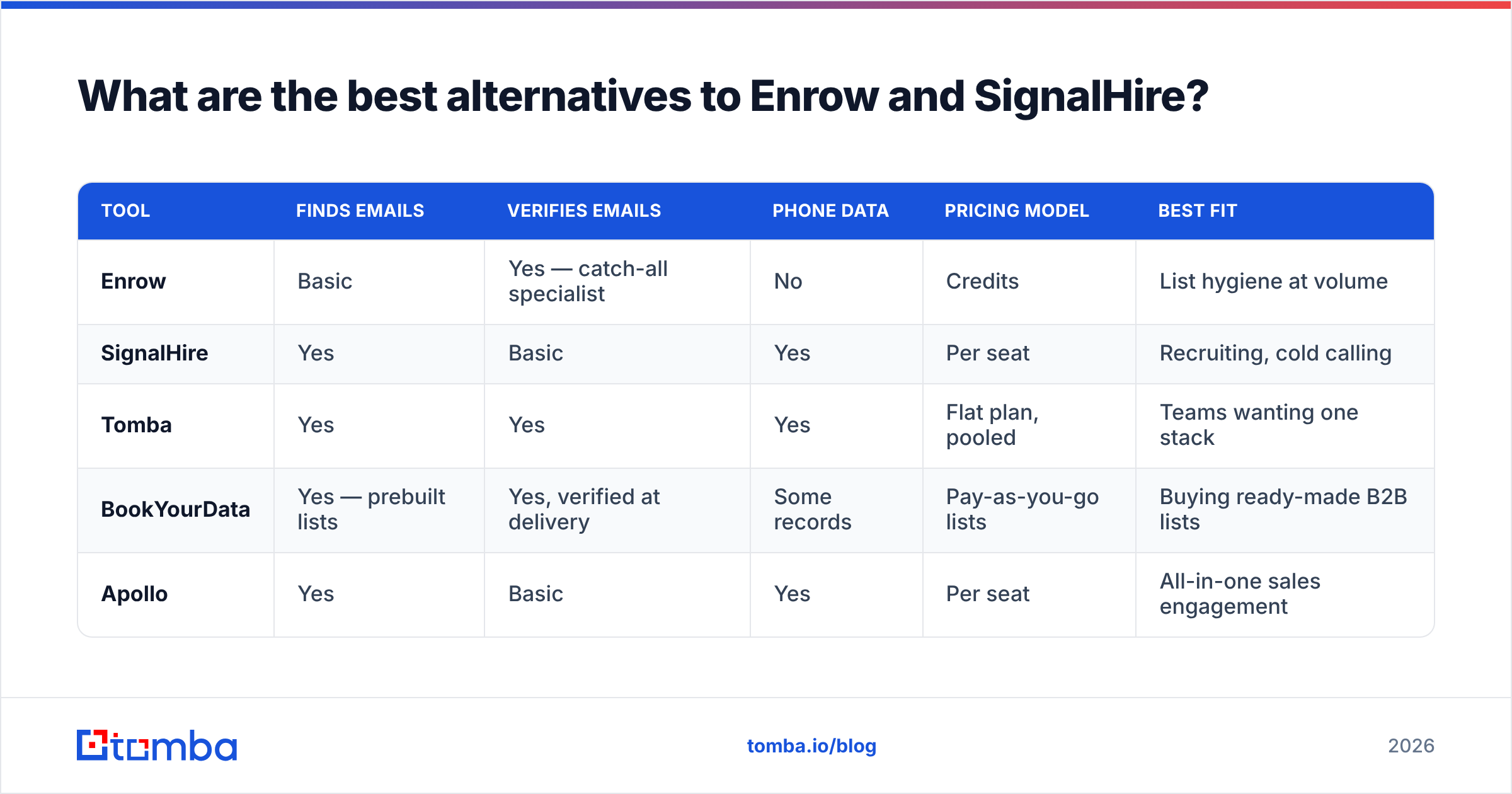
If you would rather not run two subscriptions, the consolidated platforms are worth a look. Here is where the main options land.

| Tool | Finds emails | Verifies emails | Phone data | Pricing model | Best fit |
|---|---|---|---|---|---|
| Enrow | Basic | Yes — catch-all specialist | No | Credits | List hygiene at volume |
| SignalHire | Yes | Basic | Yes | Per seat | Recruiting, cold calling |
| Tomba | Yes | Yes | Yes | Flat plan, pooled | Teams wanting one stack |
| BookYourData | Yes — prebuilt lists | Yes, verified at delivery | Some records | Pay-as-you-go lists | Buying ready-made B2B lists |
| Apollo | Yes | Basic | Yes | Per seat | All-in-one sales engagement |
A few notes on that table. BookYourData is a solid pick if you want a list handed to you rather than a tool to run — different buying motion, and its pay-as-you-go structure suits teams that buy in bursts rather than subscribing. Apollo bundles sequencing, which is either a feature or bloat depending on whether you already own an outreach tool.
Tomba sits deliberately between Enrow and SignalHire: domain search and email finding for sourcing, verification (including catch-all) for hygiene, phone lookup for dials, and enrichment on top — all on pooled credits rather than seats. The Tomba API exposes the same endpoints, which matters if you are building lookups into Clay tables, an internal enrichment service, or an AI agent workflow.
What should you pick?#
Short version, by scenario:
- You have a big dirty list and bounce problems. Enrow. That is exactly its job, and the catch-all handling is the reason to pay for it over a commodity validator.
- You source from LinkedIn and need mobiles. SignalHire. Nothing in Enrow's product touches this use case.
- You are a recruiter with no ATS. SignalHire — the pipeline layer is a real cost saving.
- You are a two-to-ten person outbound team that needs sourcing and verification. Consolidate. Two subscriptions plus CSV handoffs is overhead you do not need at that size, and per-seat pricing will outgrow you.
- You are a developer building enrichment into a product. Pick on API quality and credit economics, not on UI. Per-seat models make no sense for machine-driven usage.
The one thing not to do is buy a finder, skip verification, and hope. Sender reputation is slow to build and fast to lose; a 12% bounce week can cost you a quarter of recovery. Whichever side of the Enrow vs SignalHire question you land on, make sure both layers exist in your stack.
Frequently asked questions#
Is Enrow just an email verifier? Mostly. It includes an email finder, but the verification engine — especially catch-all resolution — is the product. Do not buy it expecting a contact database.
Does SignalHire verify emails before returning them? It applies internal checks, but it is not a dedicated verification engine. Run a separate validation pass before any high-volume send.
Which has better phone number data? SignalHire, unambiguously — Enrow does not offer phone data at all.
Can I use both together? Yes, and plenty of teams do: SignalHire for reveals, Enrow for the cleaning pass. Expect manual CSV movement unless you wire both APIs into something like Clay or Make.
Is there a single tool that does both? Several. Tomba, Apollo, and a handful of others combine sourcing and verification. The trade-off is that a generalist rarely beats a specialist on its home turf — Enrow will out-verify most bundles on catch-all edge cases.
Ready to stop paying two vendors for one workflow? Start with the Tomba Email Finder — find verified professional emails by name, domain, or company, with catch-all verification and phone lookup on the same pooled credits. The free tier gives you 25 searches a month to test accuracy against your own list before you commit, and paid plans start at $49/mo with no per-seat charge as your team grows.
Related guides#
Ready to find emails that actually work?
Join 150,000+ professionals who stopped guessing and started sending. Free credits on signup — no credit card required.
Get the Tomba newsletter
Practical outbound tactics and product updates — once every two weeks.
About the author